

A Systematic Review on the Use of Psychosocial Interventions in Conjunction With Medications for the Treatment of Opioid Addiction
Open accessThe DOI matches its Crossref record; 42 of the 42 references it cites were found in a registry or an index.
Abstract
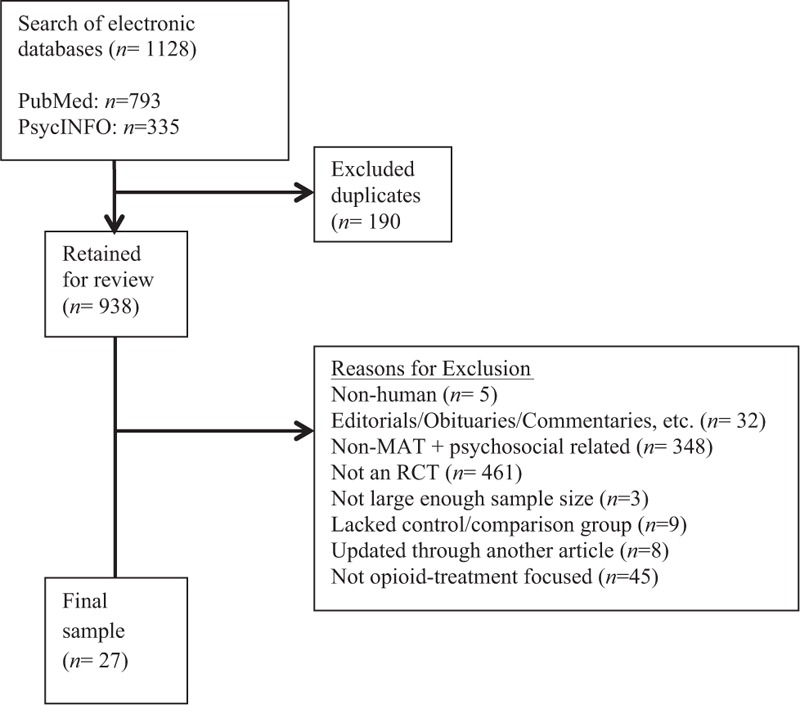
Opioid use and overdose rates have risen to epidemic levels in the United States during the past decade. Fortunately, there are effective medications (ie, methadone, buprenorphine, and oral and injectable naltrexone) available for the treatment of opioid addiction. Each of these medications is approved for use in conjunction with psychosocial treatment; however, there is a dearth of empirical research on the optimal psychosocial interventions to use with these medications. In this systematic review, we outline and discuss the findings of 3 prominent prior reviews and 27 recent publications of empirical studies on this topic. The most widely studied psychosocial interventions examined in conjunction with medications for opioid addiction were contingency management and cognitive behavioral therapy, with the majority focusing on methadone treatment. The results generally support the efficacy of providing psychosocial interventions in combination with medications to treat opioid addictions, although the incremental utility varied across studies, outcomes, medications, and interventions. The review highlights significant gaps in the literature and provides areas for future research. Given the enormity of the current opioid problem in the United States, it is critical to gain a better understanding of the most effective ways to deliver psychosocial treatments in conjunction with these medications to improve the health and well-being of individuals suffering from opioid addiction.
Overview
The claims and statistics of this paper haven’t been checked yet.
Free: it reads the open-access text and checks the first 5 claims that cite a source we can check. Create a free account to check every claim.
Integrity signals
Registry
Cites
Statistics
Figures
Verification
Claims the paper makes
The claims and statistics of this paper haven’t been checked yet.
Free: it reads the open-access text and checks the first 5 claims that cite a source we can check. Create a free account to check every claim.
Claims other papers make about this one
Each is checked against this paper’s own text: does it say what the citing paper says it does?
The source backs part of the claim, not all of it — or backs it for a different population, condition or comparison.
In the citing paper
“Recent reviews have highlighted the lack of research regarding psychological interventions (e.g., Integrated CBT) for patients with comorbid anxiety and opioid use and specifically the potential of psychological interventions to be paired with medication (e.g., suboxone) to address both anxiety and opioid use concurrently.(Dugosh et al., 2016; Langdon et al., 2019)”
From A systematic review and meta-analysis of psychosocial interventions for persons with comorbid anxiety and substance use disorders (2024) · cites this paper as Dugosh et al., 2016
Experimental — accuracy not yet measured
Self-check
Percentages, sums and reported differences re-computed from the paper’s own numbers.
The self-check needs the paper’s full text.
Citations
Cites
Preferred Reporting Items for Systematic Reviews and Meta-Analyses: the PRISMA statement
Moher, D., Liberati, A., Tetzlaff, J., Altman, D. G., & for the PRISMA Group (2009) · BMJ · doi:10.1136/bmj.b2535 · Cited by 83,823
Preferred reporting items for systematic reviews and meta-analyses: the PRISMA Statement.
(2009) · PubMed Central · Cited by 44,859
Preferred reporting items for systematic reviews and meta-analyses: The PRISMA statement
Moher, D., Liberati, A., Tetzlaff, J., Altman, D. G., & the PRISMA Group* (2009) · Annals of Internal Medicine · doi:10.7326/0003-4819-151-4-200908180-00135 · Cited by 37,554
Preferred Reporting Items for Systematic Reviews and Meta-Analyses: The PRISMA Statement
Moher, D., Liberati, A., Tetzlaff, J., & Altman, D. G. (2009) · Journal of Clinical Epidemiology · doi:10.1016/j.jclinepi.2009.06.005 · Cited by 19,575
Vital signs: overdoses of prescription opioid pain relievers---United States, 1999--2008.
Paulozzi, L. J., Jones, C. M., Mack, K. A., & Rudd, R. A. (2011) · PubMed · Cited by 1,540
A Meta-Analytic Review of Psychosocial Interventions for Substance Use Disorders
Dutra, L., Stathopoulou, G., Basden, S. L., Leyro, T. M., Powers, M. B., & Otto, M. W. (2008) · American Journal of Psychiatry · doi:10.1176/appi.ajp.2007.06111851 · Cited by 1,287 · cited 2×
“The goal of psychosocial treatment is to help patients control urges to use drugs and remain abstinent, while also serving to assist patients in coping with the emotional strife that often accompanies addiction (Dutra et al., 2008).”
BackgroundKampman, K., & Jarvis, M. (2015) · Journal of Addiction Medicine · doi:10.1097/adm.0000000000000166 · Cited by 678
Vital signs: overdoses of prescription opioid pain relievers---United States, 1999--2008.
(2011) · PubMed · Cited by 640
Vital Signs: Demographic and Substance Use Trends Among Heroin Users - United States, 2002-2013.
Jones, C. M., Logan, J. E., Gladden, R. M., & Bohm, M. K. (2015) · PubMed Central · Cited by 569
Weiss, R. D. (2011) · Archives of General Psychiatry · doi:10.1001/archgenpsychiatry.2011.121 · Cited by 540 · cited 3×
“One study (Weiss et al., 2011) examined the effectiveness of a manualized opioid dependence counseling intervention used in conjunction with buprenorphine during Phase 1 (brief treatment: buprenorphine-naloxone induction, 2 weeks of stabilization, 2 week taper, and 8 weeks of follow-up) and Phase 2…”
BackgroundMethodInfluentialBehavioral Therapies for Drug Abuse
Carroll, K. M., & Onken, L. S. (2005) · American Journal of Psychiatry · doi:10.1176/appi.ajp.162.8.1452 · Cited by 459 · cited 2×
“…outpatient) and in a variety of formats (eg, social skills training, individual, group and couples counseling, cognitive-behavioral therapy [CBT], contingency management (CM), 12-step facilitation therapy, motivational interviewing (MI), family therapy, and others (Carroll and Onken, 2005)].”
BackgroundAmato, L., Minozzi, S., Davoli, M., & Vecchi, S. (2011) · Cochrane Database of Systematic Reviews · doi:10.1002/14651858.cd004147.pub4 · Cited by 370
Amato, L., Minozzi, S., Davoli, M., & Vecchi, S. (2011) · Cochrane Database of Systematic Reviews · doi:10.1002/14651858.cd005031.pub4 · Cited by 221
A Randomized Trial of Cognitive Behavioral Therapy in Primary Care-based Buprenorphine
Fiellin, D. A., Barry, D. T., Sullivan, L. E., Cutter, C. J., Moore, B. A., O'Connor, P. G., & Schottenfeld, R. S. (2013) · The American Journal of Medicine · doi:10.1016/j.amjmed.2012.07.005 · Cited by 159 · cited 5×
“…Brigham et al. (2014) Community reinforcement and family training Treatment retention; reduction in opioid and other drug use Fiellin et al. (2013) Cognitive behavioral therapy Physician management session attendance Katz et al. (2011) Intensive role induction Counseling…”
BackgroundInfluentialMarsch, L. A., Guarino, H., Acosta, M., Aponte-Melendez, Y., Cleland, C., Grabinski, M., Brady, R., & Edwards, J. (2014) · Journal of Substance Abuse Treatment · doi:10.1016/j.jsat.2013.08.012 · Cited by 139 · cited 3×
“Marsch et al. (2014) examined the efficacy of a webbased behavioral intervention used in conjunction with MMT. Study participants were randomly assigned to receive standard adjunctive drug treatment (TAU, n¼ 80) or reduced standard treatment plus the Therapeutic Education System (TES, n¼ 80).”
BackgroundMethodComparison of behavioral treatment conditions in buprenorphine maintenance
Ling, W., Hillhouse, M., Ang, A., Jenkins, J., & Fahey, J. (2013) · Addiction · doi:10.1111/add.12266 · Cited by 128 · cited 6×
“A third study by Ling et al. (2013) examined the efficacy of both CBT and CM in improving outcomes for individuals receiving buprenorphine treatment.”
BackgroundInfluentialBehavioral Therapy to Augment Oral Naltrexone for Opioid Dependence: A Ceiling on Effectiveness?
Nunes, E. V., Rothenberg, J. L., Sullivan, M. A., Carpenter, K. M., & Kleber, H. D. (2006) · The American Journal of Drug and Alcohol Abuse · doi:10.1080/00952990600918973 · Cited by 93 · cited 6×
“Psychosocial Interventions Delivered in Conjunction With Oral Naltrexone Only 3 studies (one of which was a secondary analysis) examined the efficacy of providing psychosocial treatment concurrently with oral naltrexone treatment (Nunes et al., 2006; Carpenter et al., 2009; Dunn et al., 2013).”
BackgroundMethodInfluentialGruber, V. A., Delucchi, K., Kielstein, A., & Batki, S. L. (2008) · Drug and Alcohol Dependence · doi:10.1016/j.drugalcdep.2007.11.021 · Cited by 87 · cited 5×
“…opiate use Chen et al. (2013) Contingency management UA; treatment attendance Gerra et al. (2011) Contingency management Treatment retention Gruber et al. (2008) General supportive counseling UA; self-reported heroin use; self-reported alcohol use Gu et al. (2013) General supportive…”
BackgroundMethodInfluentialHser, Y., Li, J., Jiang, H., Zhang, R., Du, J., Zhang, C., Zhang, B., Evans, E., Wu, F., Chang, Y., et al. (2011) · Addiction · doi:10.1111/j.1360-0443.2011.03490.x · Cited by 80 · cited 7×
“Hser et al. (2011) randomly assigned MMT clients at 3 sites to receive usual care plus CM (n¼ 160) or MMT (n¼ 159) as usual.”
BackgroundMethodResultInfluentialDeFulio, A., Everly, J. J., Leoutsakos, J., Umbricht, A., Fingerhood, M., Bigelow, G. E., & Silverman, K. (2011) · Drug and Alcohol Dependence · doi:10.1016/j.drugalcdep.2011.06.023 · Cited by 80 · cited 8×
“…completion Nunes et al. (2006) Behavioral naltrexone therapy Treatment retention; weeks treatment completed; treatment attendance Injectable naltrexone DeFulio et al. (2012) Contingency management Number of injections; treatment retention; treatment completion Everly et al. (2011)…”
BackgroundResultInfluentialA Stage I pilot study of acceptance and commitment therapy for methadone detoxification
Stotts, A. L., Green, C., Masuda, A., Grabowski, J., Wilson, K., Northrup, T. F., Moeller, F. G., & Schmitz, J. M. (2012) · Drug and Alcohol Dependence · doi:10.1016/j.drugalcdep.2012.02.015 · Cited by 79 · cited 4×
“Stotts et al. (2012) randomized participants to receive either drug counseling (DC; n¼ 26) or 24-individual therapy sessions of ACT (n¼ 30) as part of a 6-month methadone dose reduction program.”
BackgroundMethodInfluentialEverly, J. J., DeFulio, A., Koffarnus, M. N., Leoutsakos, J., Donlin, W. D., Aklin, W. M., Umbricht, A., Fingerhood, M., Bigelow, G. E., & Silverman, K. (2011) · Addiction · doi:10.1111/j.1360-0443.2011.03400.x · Cited by 70 · cited 6×
“The 2 studies (Everly et al., 2011; DeFulio et al., 2012) examining the use of psychosocial treatments in conjunction with injectable naltrexone demonstrated the efficacy of providing CM in increasing the number of injections received and treatment retention.”
BackgroundResultInfluentialGerra, G., Sáenz, E., Busse, A., Maremmani, I., Ciccocioppo, R., Zaimovic, A., Gerra, M. L., Amore, M., Manfredini, M., Donnini, C., et al. (2010) · Progress in Neuro-Psychopharmacology and Biological Psychiatry · doi:10.1016/j.pnpbp.2010.12.002 · Cited by 65 · cited 5×
“…of psychosocial interventions on secondary outcomes including HIV risk (Chawarski et al., 2011), psychosocial functioning (Hesse and Pedersen, 2008; Gerra et al., 2011), adherence to psychiatric medications (Kidorf et al., 2013), alcohol use (Gruber et al., 2008), and fear of detoxification…”
BackgroundMethodResultInfluentialAmato, L., Minozzi, S., Davoli, M., Vecchi, S., Ferri, M. M., & Mayet, S. (2008) · The Cochrane Database of Systematic Reviews · doi:10.1002/14651858.cd005031.pub2 · Cited by 63
Amato, L., Minozzi, S., Davoli, M., Vecchi, S., Ferri, M., & Mayet, S. (2004) · Cochrane Database of Systematic Reviews · doi:10.1002/14651858.cd005031 · Cited by 62
Brigham, G. S., Slesnick, N., Winhusen, T. M., Lewis, D. F., Guo, X., & Somoza, E. (2014) · Drug and Alcohol Dependence · doi:10.1016/j.drugalcdep.2014.02.013 · Cited by 59
Effectiveness of prize-based contingency management in a methadone maintenance program in China
Chen, W., Hong, Y. A., Zou, X., McLaughlin, M. M., Xia, Y., & Ling, L. (2013) · Drug and Alcohol Dependence · doi:10.1016/j.drugalcdep.2013.05.028 · Cited by 56
Mitchell, S. G., Gryczynski, J., Schwartz, R. P., O’Grady, K. E., Olsen, Y. K., & Jaffe, J. H. (2013) · Drug and Alcohol Dependence · doi:10.1016/j.drugalcdep.2012.08.027 · Cited by 50 · cited 3×
“…retention; counselor rapport Ling et al. (2013) Cognitive behavioral therapy Perceived behavioral treatment effectiveness Contingency management Mitchell et al. (2013) Level of care (IOP vs OP) — Moore et al. (2012) Cognitive behavioral therapy — Ruetsch et al. (2012) Telephonic patient…”
BackgroundInfluentialDunn, K. E., Defulio, A., Everly, J. J., Donlin, W. D., Aklin, W. M., Nuzzo, P. A., Leoutsakos, J.-M. S., Umbricht, A., Fingerhood, M., Bigelow, G. E., et al. (2013) · Experimental and Clinical Psychopharmacology · doi:10.1037/a0030743 · Cited by 48 · cited 17×
“Psychosocial Interventions Delivered in Conjunction With Oral Naltrexone Only 3 studies (one of which was a secondary analysis) examined the efficacy of providing psychosocial treatment concurrently with oral naltrexone treatment (Nunes et al., 2006; Carpenter et al., 2009; Dunn et al., 2013).”
BackgroundMethodInfluentialKidorf, M., Brooner, R. K., Gandotra, N., Antoine, D., King, V. L., Peirce, J., & Ghazarian, S. (2013) · Drug and Alcohol Dependence · doi:10.1016/j.drugalcdep.2013.06.005 · Cited by 44 · cited 6×
“Articles Included in the Literature Review Author (Publication Year) Type of Psychosocial Intervention Outcomes Demonstrating Efficacy of the Psychosocial Intervention Methadone Chawarski et al. (2011) Behavioral drug and HIV risk reduction counseling HIV risk behaviors; opiate use Chen et al. (2013) Contingency manag…”
BackgroundResultInfluentialChawarski, M. C., Zhou, W., & Schottenfeld, R. S. (2011) · Drug and Alcohol Dependence · doi:10.1016/j.drugalcdep.2010.09.024 · Cited by 37 · cited 6×
“Articles Included in the Literature Review Author (Publication Year) Type of Psychosocial Intervention Outcomes Demonstrating Efficacy of the Psychosocial Intervention Methadone Chawarski et al. (2011) Behavioral drug and HIV risk reduction counseling HIV risk behaviors; opiate use Chen et al. (2013) Contingency manag…”
BackgroundMethodInfluentialMoore, B. A., Barry, D. T., Sullivan, L. E., O’Connor, P. G., Cutter, C. J., Schottenfeld, R. S., & Fiellin, D. A. (2012) · Journal of Addiction Medicine · doi:10.1097/adm.0b013e3182596492 · Cited by 32 · cited 4×
“…(2013) Cognitive behavioral therapy Perceived behavioral treatment effectiveness Contingency management Mitchell et al. (2013) Level of care (IOP vs OP) — Moore et al. (2012) Cognitive behavioral therapy — Ruetsch et al. (2012) Telephonic patient support system Medication compliance; reduced…”
BackgroundMethodInfluentialEffectiveness of Intervention on Improvement of Drug Use Among Methadone Maintained Adults
Nyamathi, A. M., Nandy, K., Greengold, B., Marfisee, M., Khalilifard, F., Cohen, A., & Leake, B. (2010) · Journal of Addictive Diseases · doi:10.1080/10550887.2010.531669 · Cited by 31 · cited 5×
“(2011) examined the relative effectiveness of 3 motivational interviewing (MI) approaches in reducing drug use among MMT clients: MI focused on reduction of drug use delivered in individual sessions (MIS, n1⁄4 90), MI delivered in group sessions (MI-G, n1⁄4 79) and a non-MI Nurse-Led Hepatitis Health Promotion (n1⁄4 8…”
BackgroundMethodInfluentialRuetsch, C. R., Tkacz, J. P., McPherson, T. L., & Cacciola, J. (2012) · Addictive Behaviors · doi:10.1016/j.addbeh.2012.01.013 · Cited by 31 · cited 4×
“In addition, 3 studies found significant differences for secondary outcomes including treatment satisfaction (Ling et al., 2013), counselor rating (Katz et al., 2011; Ruetsch et al., 2012), and 12-step/self-help meeting attendance (Ruetsch et al., 2012).”
BackgroundMethodInfluentialMoore, B. A., Fazzino, T., Barry, D. T., Fiellin, D. A., Cutter, C. J., Schottenfeld, R. S., & Ball, S. A. (2013) · Journal of Substance Abuse Treatment · doi:10.1016/j.jsat.2012.12.011 · Cited by 30 · cited 2×
“The second study (Moore et al., 2013) randomly assigned participants to receive MMT as usual (n¼ 18) or MMT as usual plus Recovery Line (RL, n¼ 18) for a 4-week period.”
BackgroundMethodKatz, E. C., Brown, B. S., Schwartz, R. P., O’Grady, K. E., King, S. D., & Gandhi, D. H. (2011) · Drug and Alcohol Dependence · doi:10.1016/j.drugalcdep.2010.12.024 · Cited by 26 · cited 5×
“, 2013), counselor rating (Katz et al., 2011; Ruetsch et al., 2012), and 12-step/self-help meeting attendance (Ruetsch et al.”
BackgroundInfluentialGu, J., Lau, J. T. F., Xu, H., Zhong, Y., Hao, Y., Zhao, Y., Fan, L., & Ling, W. (2013) · AIDS and Behavior · doi:10.1007/s10461-012-0393-9 · Cited by 21 · cited 7×
“…management Treatment retention Gruber et al. (2008) General supportive counseling UA; self-reported heroin use; self-reported alcohol use Gu et al. (2013) General supportive counseling Treatment attendance; treatment retention Hesse and Pedersen (2008) General supportive counseling…”
BackgroundMethodResultInfluentialCarpenter, K. M., Jiang, H., Sullivan, M. A., Bisaga, A. M., Comer, S. D., Raby, W. N., Brooks, A. C., & Nunes, E. V. (2009) · Psychology of Addictive Behaviors · doi:10.1037/a0013049 · Cited by 17 · cited 5×
“Psychosocial Interventions Delivered in Conjunction With Oral Naltrexone Only 3 studies (one of which was a secondary analysis) examined the efficacy of providing psychosocial treatment concurrently with oral naltrexone treatment (Nunes et al., 2006; Carpenter et al., 2009; Dunn et al., 2013).”
BackgroundMethodInfluentialEasy-access Services in Low-threshold Opiate Agonist Maintenance
Hesse, M., & Pedersen, M. U. (2007) · International Journal of Mental Health and Addiction · doi:10.1007/s11469-007-9084-6 · Cited by 17 · cited 5×
“…UA; self-reported heroin use; self-reported alcohol use Gu et al. (2013) General supportive counseling Treatment attendance; treatment retention Hesse and Pedersen (2008) General supportive counseling Treatment contacts; fewer missed appointments; social and psychiatric improvement Hser et al.…”
BackgroundMethodResultInfluentialKouimtsidis, C., Reynolds, M., Coulton, S., & Drummond, C. (2011) · Drugs Education Prevention and Policy · doi:10.3109/09687637.2011.579194 · Cited by 17 · cited 2×
“…al. (2012) General supportive counseling — Kidorf et al. (2013) Contingency management Counseling session attendance; psychiatric medication adherence Kouimtsidis et al. (2012) Cognitive behavioral therapy Positive appraisal; emotional discharge Marsch et al. (2014) Web-based behavioral…”
BackgroundImpact of Methadone With Versus Without Drug Abuse Counseling on HIV Risk
Kelly, S. M., Schwartz, R. P., O’Grady, K. E., Gandhi, D. H., & Jaffe, J. H. (2011) · Journal of Addiction Medicine · doi:10.1097/adm.0b013e31823ae556 · Cited by 8 · cited 2×
“The fourth study (Kelly et al., 2012) examined the efficacy of different interventions designed to reduce HIV risk among MMT participants.”
BackgroundMitchell, S. G., Gryczynski, J., Schwartz, R. P., O’Grady, K. E., Olsen, Y. K., & Jaffe, J. H. (2016) · Drug and Alcohol Dependence · doi:10.1016/j.drugalcdep.2016.09.011 · Cited by 4
Research works printed but not linked: 1
- Drummond DC Perryman K Psychosocial Interventions in Pharmacotherapy of Opioid Dependence: A Literature Review. London: St. George's University of London; 2007.
Cited by
Stigma as a fundamental hindrance to the United States opioid overdose crisis response
Tsai, A. C., Kiang, M. V., Barnett, M. L., Beletsky, L., Keyes, K. M., McGinty, E. E., Smith, L. R., Strathdee, S. A., Wakeman, S. E., & Venkataramani, A. S. (2019) · PLOS Medicine · doi:10.1371/journal.pmed.1002969 · Cited by 437
“Psychosocial interventions can also be effective when offered in conjunction with medication [54].”
BackgroundThe ASAM National Practice Guideline for the Treatment of Opioid Use Disorder: 2020 Focused Update
(2020) · Journal of Addiction Medicine · doi:10.1097/adm.0000000000000633 · Cited by 412
Witkiewitz, K., & Vowles, K. E. (2018) · Alcoholism: Clinical and Experimental Research · doi:10.1111/acer.13594 · Cited by 248
The Role of Behavioral Interventions in Buprenorphine Maintenance Treatment: A Review
Carroll, K. M., & Weiss, R. D. (2017) · American Journal of Psychiatry · doi:10.1176/appi.ajp.2016.16070792 · Cited by 211
Lofexidine versus clonidine for mitigation of opioid withdrawal symptoms: A systematic review
Kuszmaul, A. K., Palmer, E. C., & Frederick, E. K. (2020) · Journal of the American Pharmacists Association · doi:10.1016/j.japh.2019.10.004 · Cited by 192
Metadata
- Authors
- Dugosh, K., Abraham, A., Seymour, B., McLoyd, K., Chalk, M., & Festinger, D.
- Affiliations
- University of Georgia (US)
- Corresponding author
- Dugosh, Karen
- Venue
- Journal of Addiction Medicine
- Published
- 2016-03
- Volume
- 10
- Issue
- 2
- Pages
- 93-103
- ISSN
- 1932-0620 (ISSN-L)
- PMC
- PMC4795974
- OpenAlex
- W2315302680
- Cited by
- 333
- References
- 42
- Citations by year
- 2026: 19 · 2025: 27 · 2024: 31 · 2023: 35 · 2022: 31 · 2021: 61 · 2020: 52 · 2019: 35 · 2018: 21 · 2017: 14 · 2016: 6
- FWCI
- 3.74
- Type
- journal article
- Language
- en
- Open access
- hybrid
- doi.org
- Licence
- cc-by-nc-nd
- Locations
- Journal of Addiction Medicine (publishedVersion, cc-by-nc-nd)
- Europe PMC (PubMed Central) (publishedVersion, cc-by-nc-nd)
- PubMed Central (publishedVersion, cc-by-nc-nd)
- PubMed (publishedVersion)
- Digital Commons - PCOM (Philadelphia College of Osteopathic Medicine) (submittedVersion)
- Funders
- National Institute on Drug Abuse (HHSN271201200001C)
- Topics
- Health Sciences › Medicine › Public Health, Environmental and Occupational Health › Opioid Use Disorder Treatment
- Health Sciences › Medicine › Epidemiology › Substance Abuse Treatment and Outcomes
- Health Sciences › Medicine › Anesthesiology and Pain Medicine › Pain Management and Opioid Use
- Keywords
- opioid use disorder, psychosocial interventions, medication-assisted treatment, methadone, buprenorphine, naltrexone, contingency management, cognitive behavioral therapy, opioid use disorder treatment
- MeSH terms
- Analgesics, Opioid, Buprenorphine, Combined Modality Therapy, Humans, Methadone, Naltrexone, Narcotic Antagonists, Opioid-Related Disorders, Cognitive Behavioral Therapy
About these checks
Registry, retraction, Cites and statistics results are computed, not judged, with one exception: a printed reference that no index lists is read once by a model before it counts as a citation error. Claims are extracted by a model and kept only when their quote appears verbatim in the text; each cited source is then checked, with a model’s help, for whether it says what the claim relies on. Those verdicts can be wrong — read the claim’s quote and the cited source before relying on one.
Statistics and arithmetic are recomputed, not judged.
Confidence bands are shown only for fields calibrated on our annotated test set. None is calibrated yet, so no band is shown.
What counts as a claim ›How we measure confidence ›How we check this ›
Are you an author, or do you see a problem with this page? Request a review
Data sources
Bibliographic data: Semantic Scholar, OpenAlex, Crossref.
Contains information from the Semantic Scholar Academic Graph Datasets, made available under the ODC Attribution License (ODC-BY 1.0).
Semantic Scholar’s data is described in: Kinney, R., et al. (2023). The Semantic Scholar Open Data Platform. arXiv:2301.10140.
