

The DOI matches its Crossref record; 71 of the 76 references it cites were found in a registry or an index.
Mindfulness-based Relapse Prevention for Substance Use Disorders: A Systematic Review and Meta-analysis
Open accessAbstract
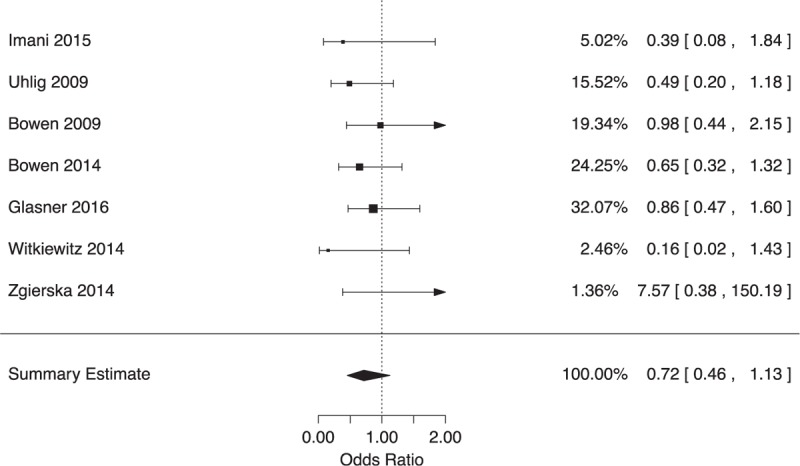
Objectives: Substance use disorder (SUD) is a prevalent health issue with serious personal and societal consequences. This review aims to estimate the effects and safety of Mindfulness-based Relapse Prevention (MBRP) for SUDs. Methods: We searched electronic databases for randomized controlled trials evaluating MBRP for adult patients diagnosed with SUDs. Two reviewers independently assessed citations, extracted trial data, and assessed risks of bias. We conducted random-effects meta-analyses and assessed quality of the body of evidence (QoE) using the Grading of Recommendations Assessment, Development, and Evaluation approach. Results: We identified 9 randomized controlled trials comprising 901 participants. We did not detect statistically significant differences between MBRP and comparators on relapse (odds ratio [OR] 0.72, 95% confidence interval [CI] 0.46–1.13, low QoE), frequency of use (standardized mean difference [SMD] 0.02, 95% CI −0.40 to 0.44, low QoE), treatment dropout (OR 0.81, 95% CI 0.40 to 1.62, very low QoE), depressive symptoms (SMD −0.09, 95% CI −0.39 to 0.21, low QoE), anxiety symptoms (SMD −0.32, 95% CI −1.16 to 0.52, very low QoE), and mindfulness (SMD −0.28, 95% CI −0.72 to 0.16, very low QoE). We identified significant differences in favor of MBRP on withdrawal/craving symptoms (SMD −0.13, 95% CI −0.19 to −0.08, I 2 = 0%, low QoE) and negative consequences of substance use (SMD −0.23, 95% CI −0.39 to −0.07, I 2 = 0%, low QoE). We found negligible evidence of adverse events. Conclusions: We have limited confidence in estimates suggesting MBRP yields small effects on withdrawal/craving and negative consequences versus comparator interventions. We did not detect differences for any other outcome. Future trials should aim to minimize participant attrition to improve confidence in effect estimates.
Overview
The claims and statistics of this paper haven’t been checked yet.
Free: it reads the open-access text and checks the first 5 claims that cite a source we can check. Create a free account to check every claim.
Integrity signals
Registry
Cites
Statistics
Figures

Verification
Claims the paper makes
The claims and statistics of this paper haven’t been checked yet.
Free: it reads the open-access text and checks the first 5 claims that cite a source we can check. Create a free account to check every claim.
Claims other papers make about this one
Each is checked against this paper’s own text: does it say what the citing paper says it does?
The cited source doesn’t support the claim as written.
In the citing paper
“Second, MBSR has been adapted in a variety of other marginalized populations (e.g., African American adults) and clinical conditions (e.g., addiction) with demonstrated efficacy (Grant et al., 2017; Palta et al., 2012; Sibinga et al., 2014; Witkiewitz & Bowen, 2010).”
From Mindfulness for Reducing Minority Stress and Promoting Health Among Sexual Minority Men: Uncovering Intervention Principles and Techniques (2022) · cites this paper as Grant et al., 2017
Checked by a reasoning model — may be wrong.
Experimental — accuracy not yet measuredThe source backs part of the claim, not all of it — or backs it for a different population, condition or comparison.
In the citing paper
“Furthermore, MBRP may have direct benefits on well-being for participants in jails and prisons (Grant et al. 2017, Auty, Cope, & Liebling, 2017).”
From Mindfulness-Based Relapse Prevention in a Jail Drug Treatment Program. (2019) · cites this paper as Grant et al. 2017
Experimental — accuracy not yet measuredThe source backs part of the claim, not all of it — or backs it for a different population, condition or comparison.
In the citing paper
“MT has been shown to reduce the severity of physical symptoms in populations with various medical disorders, including pain severity in people being treated for cancer,16 gastrointestinal symptoms in adults with irritable bowel syndrome,17 and withdrawal symptoms in people recovering from substance use.18”
From Prenatal Mindfulness Training and Interoceptive Awareness in Pregnant People at Risk for Hypertensive Disorders. (2024) · cites this paper as [18]
Experimental — accuracy not yet measuredThe source backs part of the claim, not all of it — or backs it for a different population, condition or comparison.
In the citing paper
“Meta-analyses of mindfulness intervention studies indicate small-to-large effects of mindfulness interventions in reducing frequency and severity of substance use, intensity of drug craving and severity of experienced stress, and improving mental health [22–24].”
From Mindful moms: acceptability and impact of co-designed and digitally delivered video meditations for pregnant and parenting women with opioid use disorder (2025) · cites this paper as [23]
Experimental — accuracy not yet measuredThe cited source says what the claim attributes to it.
In the citing paper
“A recent meta-analysis has suggested that the benefits of MBRP over other treatments in reducing substance use may be limited (Grant et al. 2017).”
From Mindfulness-Based Relapse Prevention in a Jail Drug Treatment Program. (2019) · cites this paper as Grant et al. 2017
3 more claims about this paper
Create a free account to see every claim other papers make about this one.
Self-check
Percentages, sums and reported differences re-computed from the paper’s own numbers.
The self-check needs the paper’s full text.
Citations
Cites
Measuring inconsistency in meta-analyses
Higgins, J. P. T., Thompson, S. G., Deeks, J. J., & Altman, D. G. (2003) · BMJ · doi:10.1136/bmj.327.7414.557 · Cited by 63,139
Bias in meta-analysis detected by a simple, graphical test
Egger, M., Smith, G. D., Schneider, M., & Minder, C. (1997) · BMJ · doi:10.1136/bmj.315.7109.629 · Cited by 56,722
The Cochrane Collaboration's tool for assessing risk of bias in randomised trials
Higgins, J. P. T., Altman, D. G., Gotzsche, P. C., Juni, P., Moher, D., Oxman, A. D., Savovic, J., Schulz, K. F., Weeks, L., Sterne, J. A. C., et al. (2011) · BMJ · doi:10.1136/bmj.d5928 · Cited by 33,817
Dermyshi, E., Wang, Y., Yan, C., Hong, W., Qiu, G., Gong, X., & Zhang, T. (2017) · Neonatology · doi:10.1159/000454668 · Cited by 24,451
Operating characteristics of a rank correlation test for publication bias
Begg, C. B., & Mazumdar, M. (1994) · Biometrics · doi:10.2307/2533446 · Cited by 16,955
Duval, S., & Tweedie, R. (2000) · Biometrics · doi:10.1111/j.0006-341x.2000.00455.x · Cited by 14,099
The benefits of being present: Mindfulness and its role in psychological well-being
Brown, K. W., & Ryan, R. M. (2003) · Journal of Personality and Social Psychology · doi:10.1037/0022-3514.84.4.822 · Cited by 13,448
Moher, D., Hopewell, S., Schulz, K. F., Montori, V., Gotzsche, P. C., Devereaux, P. J., Elbourne, D., Egger, M., & Altman, D. G. (2010) · BMJ · doi:10.1136/bmj.c869 · Cited by 8,883
GRADE guidelines: 3. Rating the quality of evidence
Balshem, H., Helfand, M., Schünemann, H. J., Oxman, A. D., Kunz, R., Brozek, J., Vist, G. E., Falck-Ytter, Y., Meerpohl, J., & Norris, S. (2011) · Journal of Clinical Epidemiology · doi:10.1016/j.jclinepi.2010.07.015 · Cited by 8,285
Dissociable intrinsic connectivity networks for salience processing and executive control
Seeley, W. W., Menon, V., Schatzberg, A. F., Keller, J., Glover, G. H., Kenna, H., Reiss, A. L., & Greicius, M. D. (2007) · The Journal of Neuroscience · doi:10.1523/jneurosci.5587-06.2007 · Cited by 7,426
Research works printed but not linked: 2
- McCown, 2010, Mindfulness and mindfulness-based stress reduction, Integrative Psychiatry, 289
- Uhlig, 2009, Mindfulness based relapse prevention and the matrix model in substance abuse relapse prevention, Dissertation Abstracts Int B Sci Eng, 70, 2596
Cited by
Mindfulness-Based Interventions in Psychiatry
Shapero, B. G., Greenberg, J., Pedrelli, P., de Jong, M., & Desbordes, G. (2018) · Focus · doi:10.1176/appi.focus.20170039 · Cited by 172
“Mindfulness-Based Relapse Prevention may be successful in reducing both substance use and craving (40), however a meta-analysis did not detect statistically significant differences between Mindfulness-Based Relapse Prevention and comparators on relapse, frequency of use, treatment dropout (41).”
BackgroundCraving in Opioid Use Disorder: From Neurobiology to Clinical Practice
Kakko, J., Alho, H., Baldacchino, A., Molina, R., Nava, F. A., & Shaya, G. (2019) · Frontiers in Psychiatry · doi:10.3389/fpsyt.2019.00592 · Cited by 140
Expanding the continuum of substance use disorder treatment: Nonabstinence approaches
Paquette, C. E., Daughters, S. B., & Witkiewitz, K. A. (2021) · Clinical Psychology Review · doi:10.1016/j.cpr.2021.102110 · Cited by 163
The Trauma Resiliency Model: A “Bottom-Up” Intervention for Trauma Psychotherapy
Grabbe, L., & Miller-Karas, E. (2018) · Journal of the American Psychiatric Nurses Association · doi:10.1177/1078390317745133 · Cited by 107
Priddy, S. E., Howard, M. O., Hanley, A. W., Riquino, M. R., Friberg-Felsted, K., & Garland, E. L. (2018) · Substance Abuse and Rehabilitation · doi:10.2147/sar.s145201 · Cited by 101
Metadata
- Authors
- Grant, S., Colaiaco, B., Motala, A., Shanman, R., Booth, M., Sorbero, M., & Hempel, S.
- Affiliations
- RAND Corporation (US)
- Corresponding author
- Grant, Sean
- Venue
- Journal of Addiction Medicine
- Published
- 2017-09
- Volume
- 11
- Issue
- 5
- Pages
- 386-396
- ISSN
- 1932-0620 (ISSN-L)
- 1935-3227
- PMC
- PMC5636047
- OpenAlex
- W2739068436
- Cited by
- 220
- References
- 76
- Citations by year
- 2026: 7 · 2025: 14 · 2024: 23 · 2023: 26 · 2022: 19 · 2021: 36 · 2020: 64 · 2019: 13 · 2018: 15 · 2017: 2
- FWCI
- 3.38
- Type
- journal article
- Language
- en
- Open access
- hybrid
- doi.org
- Licence
- Locations
- Journal of Addiction Medicine (publishedVersion, cc-by-nc-nd)
- PubMed Central (publishedVersion, cc-by-nc-nd)
- PubMed (publishedVersion)
- Funders
- RAND Corporation
- Topics
- Health Sciences › Medicine › Epidemiology › Substance Abuse Treatment and Outcomes
- Social Sciences › Psychology › Clinical Psychology › Mindfulness and Compassion Interventions
- Health Sciences › Medicine › Public Health, Environmental and Occupational Health › Opioid Use Disorder Treatment
- Keywords
- mindfulness-based relapse prevention, substance use disorders, relapse prevention, withdrawal symptoms, craving, treatment discontinuation, depressive symptoms, anxiety symptoms, treatment safety, quality of evidence
- MeSH terms
- Humans, Outcome Assessment, Health Care, Substance-Related Disorders, Secondary Prevention, Mindfulness
About these checks
Registry, retraction, Cites and statistics results are computed, not judged, with one exception: a printed reference that no index lists is read once by a model before it counts as a citation error. Claims are extracted by a model and kept only when their quote appears verbatim in the text; each cited source is then checked, with a model’s help, for whether it says what the claim relies on. Those verdicts can be wrong — read the claim’s quote and the cited source before relying on one.
Statistics and arithmetic are recomputed, not judged.
Confidence bands are shown only for fields calibrated on our annotated test set. None is calibrated yet, so no band is shown.
What counts as a claim ›How we measure confidence ›How we check this ›
Are you an author, or do you see a problem with this page? Request a review
How to cite
Cite CoChat for the checks on this page, and the paper for its own findings.
- This page
- CoChat. (2026). Citation check: Mindfulness-based Relapse Prevention for Substance Use Disorders: A Systematic Review and Meta-analysis. https://app.cochat.ai/papers/10.1097/adm.0000000000000338
- The paper
- Grant, S., Colaiaco, B., Motala, A., Shanman, R., Booth, M., Sorbero, M., & Hempel, S. (2017). Mindfulness-based Relapse Prevention for Substance Use Disorders: A Systematic Review and Meta-analysis. Journal of Addiction Medicine. https://doi.org/10.1097/adm.0000000000000338
Data sources
Bibliographic data: Semantic Scholar, OpenAlex, Crossref.
Contains information from the Semantic Scholar Academic Graph Datasets, made available under the ODC Attribution License (ODC-BY 1.0).
Semantic Scholar’s data is described in: Kinney, R., et al. (2023). The Semantic Scholar Open Data Platform. arXiv:2301.10140.
