

Mindfulness-based Relapse Prevention for Substance Use Disorders: A Systematic Review and Meta-analysis
Open accessThe DOI matches its Crossref record; 72 of the 76 references it cites were found in a registry or an index.
Abstract
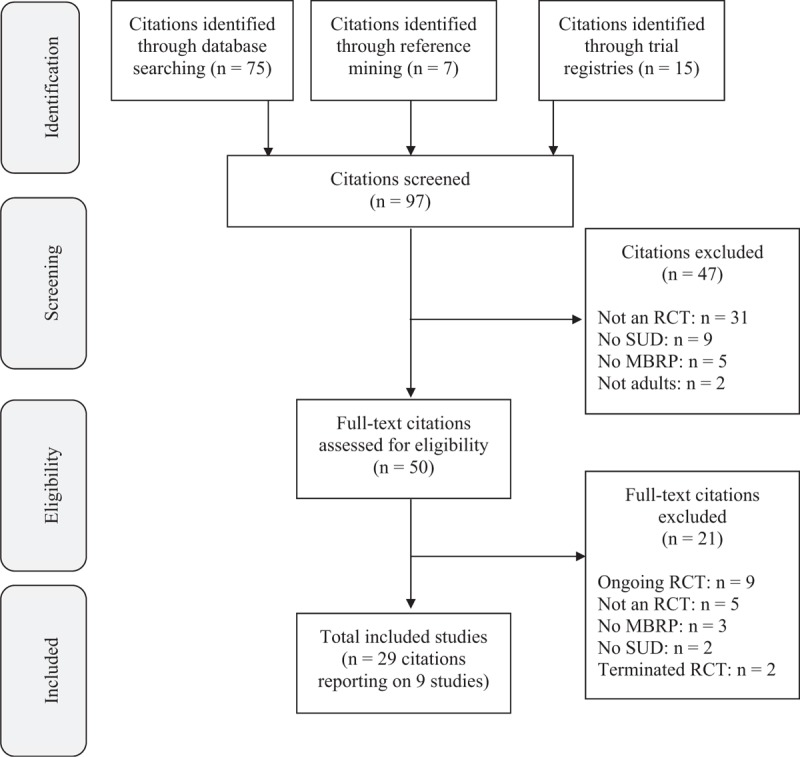
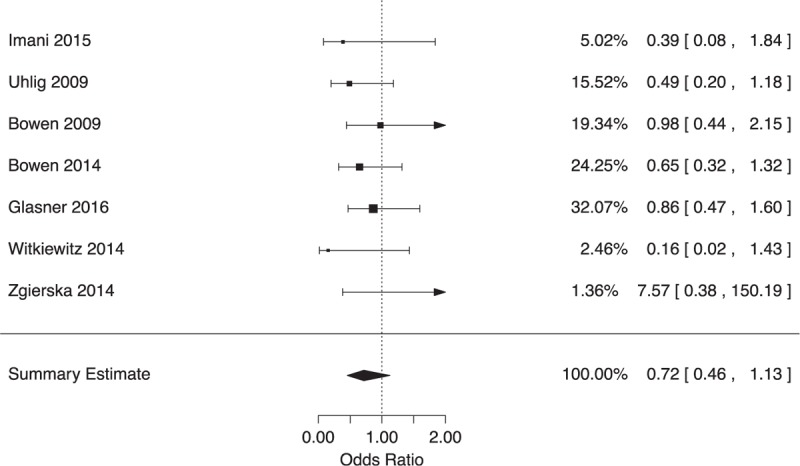
Objectives: Substance use disorder (SUD) is a prevalent health issue with serious personal and societal consequences. This review aims to estimate the effects and safety of Mindfulness-based Relapse Prevention (MBRP) for SUDs. Methods: We searched electronic databases for randomized controlled trials evaluating MBRP for adult patients diagnosed with SUDs. Two reviewers independently assessed citations, extracted trial data, and assessed risks of bias. We conducted random-effects meta-analyses and assessed quality of the body of evidence (QoE) using the Grading of Recommendations Assessment, Development, and Evaluation approach. Results: We identified 9 randomized controlled trials comprising 901 participants. We did not detect statistically significant differences between MBRP and comparators on relapse (odds ratio [OR] 0.72, 95% confidence interval [CI] 0.46–1.13, low QoE), frequency of use (standardized mean difference [SMD] 0.02, 95% CI −0.40 to 0.44, low QoE), treatment dropout (OR 0.81, 95% CI 0.40 to 1.62, very low QoE), depressive symptoms (SMD −0.09, 95% CI −0.39 to 0.21, low QoE), anxiety symptoms (SMD −0.32, 95% CI −1.16 to 0.52, very low QoE), and mindfulness (SMD −0.28, 95% CI −0.72 to 0.16, very low QoE). We identified significant differences in favor of MBRP on withdrawal/craving symptoms (SMD −0.13, 95% CI −0.19 to −0.08, I 2 = 0%, low QoE) and negative consequences of substance use (SMD −0.23, 95% CI −0.39 to −0.07, I 2 = 0%, low QoE). We found negligible evidence of adverse events. Conclusions: We have limited confidence in estimates suggesting MBRP yields small effects on withdrawal/craving and negative consequences versus comparator interventions. We did not detect differences for any other outcome. Future trials should aim to minimize participant attrition to improve confidence in effect estimates.
Overview
The claims and statistics of this paper haven’t been checked yet.
Free: it reads the open-access text and checks the first 5 claims that cite a source we can check. Create a free account to check every claim.
Integrity signals
Registry
Cites
Statistics
Figures
Verification
Claims the paper makes
The claims and statistics of this paper haven’t been checked yet.
Free: it reads the open-access text and checks the first 5 claims that cite a source we can check. Create a free account to check every claim.
Claims other papers make about this one
Each is checked against this paper’s own text: does it say what the citing paper says it does?
The cited source doesn’t support the claim as written.
In the citing paper
“Second, MBSR has been adapted in a variety of other marginalized populations (e.g., African American adults) and clinical conditions (e.g., addiction) with demonstrated efficacy (Grant et al., 2017; Palta et al., 2012; Sibinga et al., 2014; Witkiewitz & Bowen, 2010).”
From Mindfulness for Reducing Minority Stress and Promoting Health Among Sexual Minority Men: Uncovering Intervention Principles and Techniques (2022) · cites this paper as Grant et al., 2017
Checked by a reasoning model — may be wrong.
Experimental — accuracy not yet measuredThe source backs part of the claim, not all of it — or backs it for a different population, condition or comparison.
In the citing paper
“Furthermore, MBRP may have direct benefits on well-being for participants in jails and prisons (Grant et al. 2017, Auty, Cope, & Liebling, 2017).”
From Mindfulness-Based Relapse Prevention in a Jail Drug Treatment Program. (2019) · cites this paper as Grant et al. 2017
Experimental — accuracy not yet measuredThe source backs part of the claim, not all of it — or backs it for a different population, condition or comparison.
In the citing paper
“MT has been shown to reduce the severity of physical symptoms in populations with various medical disorders, including pain severity in people being treated for cancer,16 gastrointestinal symptoms in adults with irritable bowel syndrome,17 and withdrawal symptoms in people recovering from substance use.18”
From Prenatal Mindfulness Training and Interoceptive Awareness in Pregnant People at Risk for Hypertensive Disorders. (2024) · cites this paper as [18]
Experimental — accuracy not yet measuredThe source backs part of the claim, not all of it — or backs it for a different population, condition or comparison.
In the citing paper
“Meta-analyses of mindfulness intervention studies indicate small-to-large effects of mindfulness interventions in reducing frequency and severity of substance use, intensity of drug craving and severity of experienced stress, and improving mental health [22–24].”
From Mindful moms: acceptability and impact of co-designed and digitally delivered video meditations for pregnant and parenting women with opioid use disorder (2025) · cites this paper as [23]
Experimental — accuracy not yet measuredThe cited source says what the claim attributes to it.
In the citing paper
“A recent meta-analysis has suggested that the benefits of MBRP over other treatments in reducing substance use may be limited (Grant et al. 2017).”
From Mindfulness-Based Relapse Prevention in a Jail Drug Treatment Program. (2019) · cites this paper as Grant et al. 2017
3 more claims about this paper
Create a free account to see every claim other papers make about this one.
Self-check
Percentages, sums and reported differences re-computed from the paper’s own numbers.
The self-check needs the paper’s full text.
Citations
Cites
Measuring inconsistency in meta-analyses
Higgins, J. P. T., Thompson, S. G., Deeks, J. J., & Altman, D. G. (2003) · BMJ · doi:10.1136/bmj.327.7414.557 · Cited by 63,139
Bias in meta-analysis detected by a simple, graphical test
Egger, M., Smith, G. D., Schneider, M., & Minder, C. (1997) · BMJ · doi:10.1136/bmj.315.7109.629 · Cited by 56,722 · cited 2×
“Published by Wolters Kluwer He for funnel plot asymmetry (Begg and Mazumdar, 1994), and Egger test for funnel plot asymmetry (Egger et al., 1997).”
MethodThe Cochrane Collaboration's tool for assessing risk of bias in randomised trials
Higgins, J. P. T., Altman, D. G., Gotzsche, P. C., Juni, P., Moher, D., Oxman, A. D., Savovic, J., Schulz, K. F., Weeks, L., Sterne, J. A. C., et al. (2011) · BMJ · doi:10.1136/bmj.d5928 · Cited by 33,817
Dermyshi, E., Wang, Y., Yan, C., Hong, W., Qiu, G., Gong, X., & Zhang, T. (2017) · Neonatology · doi:10.1159/000454668 · Cited by 24,451
Operating characteristics of a rank correlation test for publication bias
Begg, C. B., & Mazumdar, M. (1994) · Biometrics · doi:10.2307/2533446 · Cited by 16,955
Duval, S., & Tweedie, R. (2000) · Biometrics · doi:10.1111/j.0006-341x.2000.00455.x · Cited by 14,099
The benefits of being present: Mindfulness and its role in psychological well-being
Brown, K. W., & Ryan, R. M. (2003) · Journal of Personality and Social Psychology · doi:10.1037/0022-3514.84.4.822 · Cited by 13,448
Moher, D., Hopewell, S., Schulz, K. F., Montori, V., Gotzsche, P. C., Devereaux, P. J., Elbourne, D., Egger, M., & Altman, D. G. (2010) · BMJ · doi:10.1136/bmj.c869 · Cited by 8,883
GRADE guidelines: 3. Rating the quality of evidence
Balshem, H., Helfand, M., Schünemann, H. J., Oxman, A. D., Kunz, R., Brozek, J., Vist, G. E., Falck-Ytter, Y., Meerpohl, J., & Norris, S. (2011) · Journal of Clinical Epidemiology · doi:10.1016/j.jclinepi.2010.07.015 · Cited by 8,285
Dissociable intrinsic connectivity networks for salience processing and executive control
Seeley, W. W., Menon, V., Schatzberg, A. F., Keller, J., Glover, G. H., Kenna, H., Reiss, A. L., & Greicius, M. D. (2007) · The Journal of Neuroscience · doi:10.1523/jneurosci.5587-06.2007 · Cited by 7,426 · cited 1×
“, 2010), and stimulate activity in circuitry related to cognitive self-regulation of behavior (Seeley et al., 2007; Craig, 2009; Xue et al., 2011; Hasenkamp and Barsalou, 2012; Hasenkamp et al., 2012).”
Background
Research works printed but not linked: 9
- Bowen S Chawla N Marlatt GA Mindfulness-based Relapse Prevention for Addictive Behaviors: A Clinician's Guide. New York, NY: Guilford Press; 2010.
- Bowen S Chawla N Marlatt GA Mindfulness-based Relapse Prevention for Addictive Behaviors: A Clinician's Guide. New York, NY: Guilford Press; 2011.
- Grant S Hempel S Colaiaco B Mindfulness-based Relapse Prevention for Substance Use Disorders: A Systematic Review; RR-1031. RAND Corporation, Santa Monica; 2015. PMC5636047 28727663
- Institute of Medicine. Complementary and Alternative Medicine in the United States. Washington, DC: National Academies Press; 2005. 22379647
- Institute of Medicine. Clinical Practice Guidelines We Can Trust. Washington, DC: National Academies Press; 2011.
- Marlatt GA Gordon JR Relapse Prevention: Maintenance Strategies in the Treatment of Addictive Behaviors. New York, NY: Guilford Press; 1985.
- McCown D Reibel D Monti DA Beitman BD Mindfulness and mindfulness-based stress reduction. Integrative Psychiatry. New York, NY: Oxford University Press; 2010 289– 338. 494, xvii.
- Substance Abuse and Mental Health Services Administration. Treatment Episode Data Set (TEDS): 2005: Discharges From Substance Abuse Treatment Services: DASIS Series: S-41. Dept of Health & Human Services publication No. (SMA) 08-4314, in: Services, U.D., o.H.H., (Ed.). Rockville, MD; 2008.
- Uhlig DJ Mindfulness based relapse prevention and the matrix model in substance abuse relapse prevention. Dissertation Abstracts Int B Sci Eng 2009; 70: 2596.
Cited by
Mindfulness-Based Interventions in Psychiatry
Shapero, B. G., Greenberg, J., Pedrelli, P., de Jong, M., & Desbordes, G. (2018) · Focus · doi:10.1176/appi.focus.20170039 · Cited by 172
“Mindfulness-Based Relapse Prevention may be successful in reducing both substance use and craving (40), however a meta-analysis did not detect statistically significant differences between Mindfulness-Based Relapse Prevention and comparators on relapse, frequency of use, treatment dropout (41).”
BackgroundCraving in Opioid Use Disorder: From Neurobiology to Clinical Practice
Kakko, J., Alho, H., Baldacchino, A., Molina, R., Nava, F. A., & Shaya, G. (2019) · Frontiers in Psychiatry · doi:10.3389/fpsyt.2019.00592 · Cited by 140
Expanding the continuum of substance use disorder treatment: Nonabstinence approaches
Paquette, C. E., Daughters, S. B., & Witkiewitz, K. A. (2021) · Clinical Psychology Review · doi:10.1016/j.cpr.2021.102110 · Cited by 165
The Trauma Resiliency Model: A “Bottom-Up” Intervention for Trauma Psychotherapy
Grabbe, L., & Miller-Karas, E. (2018) · Journal of the American Psychiatric Nurses Association · doi:10.1177/1078390317745133 · Cited by 107
Priddy, S. E., Howard, M. O., Hanley, A. W., Riquino, M. R., Friberg-Felsted, K., & Garland, E. L. (2018) · Substance Abuse and Rehabilitation · doi:10.2147/sar.s145201 · Cited by 101
Vancampfort, D., Stubbs, B., Van Damme, T., Smith, L., Hallgren, M., Schuch, F., Deenik, J., Rosenbaum, S., Ashdown-Franks, G., Mugisha, J., et al. (2021) · Journal of Psychiatric Research · doi:10.1016/j.jpsychires.2020.12.048 · Cited by 99
Sanada, K., Montero-Marin, J., Barceló-Soler, A., Ikuse, D., Ota, M., Hirata, A., Yoshizawa, A., Hatanaka, R., Valero, M. S., Demarzo, M., et al. (2020) · International Journal of Molecular Sciences · doi:10.3390/ijms21072484 · Cited by 96
Coco, G. L., Melchiori, F. M., Oieni, V., Infurna, M. R., Strauss, B. M., Schwartze, D., Rosendahl, J., & Gullo, S. (2019) · Journal of Substance Abuse Treatment · doi:10.1016/j.jsat.2019.01.016 · Cited by 108
Mindfulness-based interventions for adolescent health
Lin, J., Chadi, N., & Shrier, L. (2019) · Current Opinion in Pediatrics · doi:10.1097/mop.0000000000000760 · Cited by 76
Davis, J. P., Berry, D., Dumas, T. M., Ritter, E., Smith, D. C., Menard, C., & Roberts, B. W. (2018) · Journal of Substance Abuse Treatment · doi:10.1016/j.jsat.2018.05.002 · Cited by 71
Byrne, S. P., Haber, P., Baillie, A., Costa, D. S. J., Fogliati, V., & Morley, K. (2019) · Alcohol and Alcoholism · doi:10.1093/alcalc/agy089 · Cited by 71
Stein, E., & Witkiewitz, K. (2020) · Mindfulness · doi:10.1007/s12671-020-01444-0 · Cited by 63
“…such adolescents and young adults (Chi et al. 2018), chronic pain (Khoo et al. 2019), craving and negative consequences in substance use disorder (Grant et al. 2017), post-traumatic stress (Hilton et al. 2017b), women (Roos et al. 2019), racial and ethnic minorities (Greenfield et al. 2018),…”
BackgroundThe Cambridge Handbook of Substance and Behavioral Addictions
Sussman, S. Y. (2020) · Cambridge University Press eBooks · doi:10.1017/9781108632591 · Cited by 69
Brewer, J. (2019) · Current Opinion in Psychology · doi:10.1016/j.copsyc.2019.01.014 · Cited by 58
Immune treatments for alcohol use disorder: A translational framework
Meredith, L. R., Burnette, E. M., Grodin, E. N., Irwin, M. R., & Ray, L. A. (2021) · Brain, Behavior, and Immunity · doi:10.1016/j.bbi.2021.07.023 · Cited by 56
Warner, N., & Murphy, M. F. (2021) · Drug and Alcohol Review · doi:10.1111/dar.13362 · Cited by 72
Ramadas, E., de Lima, M. P., Caetano, T., Lopes, J., & Dixe, M. D. A. (2021) · Behavioral Sciences · doi:10.3390/bs11100133 · Cited by 70
Mindfulness in Treatment Approaches for Addiction — Underlying Mechanisms and Future Directions
Rosenthal, A., Levin, M. E., Garland, E. L., & Romanczuk-Seiferth, N. (2021) · Current Addiction Reports · doi:10.1007/s40429-021-00372-w · Cited by 54
“Effects of MBRP on substance use frequency or relapse, however, did not differ from standardized treatment approaches including CBT and TAU [21].”
BackgroundInfluentialZamboni, L., Centoni, F., Fusina, F., Mantovani, E., Rubino, F., Lugoboni, F., & Federico, A. (2021) · The Journal of Nervous and Mental Disease · doi:10.1097/nmd.0000000000001381 · Cited by 76
Mindfulness-based interventions for substance use disorders
Goldberg, S. B., Pace, B., Griskaitis, M., Willutzki, R., Skoetz, N., Thoenes, S., Zgierska, A. E., & Rösner, S. (2021) · Cochrane Database of Systematic Reviews · doi:10.1002/14651858.cd011723.pub2 · Cited by 50
Mindfulness-Based Relapse Prevention in a Jail Drug Treatment Program.
Lyons, T., Womack, V. Y., Cantrell, W. D., & Kenemore, T. (2019) · Substance Use & Misuse · doi:10.1080/10826084.2018.1491054 · Cited by 49
Reed, D. D., Naudé, G. P., Gelino, B. W., & Amlung, M. T. (2020) · Cambridge University Press eBooks · doi:10.1017/9781108632591.011 · Cited by 48
Canadian Guidelines on Opioid Use Disorder Among Older Adults
Rieb, L. M., Samaan, Z., Furlan, A. D., Rabheru, K., Feldman, S., Hung, L., Budd, G., & Coleman, D. (2020) · Canadian Geriatrics Journal · doi:10.5770/cgj.23.420 · Cited by 57
Ii, T., Sato, H., Watanabe, N., Kondo, M., Masuda, A., Hayes, S. C., & Akechi, T. (2019) · Journal of Contextual Behavioral Science · doi:10.1016/j.jcbs.2019.07.003 · Cited by 47
Sun, S., Nardi, W., Loucks, E. B., & Operario, D. (2021) · Mindfulness · doi:10.1007/s12671-021-01710-9 · Cited by 46
The Prevention and Treatment of Gambling Disorders: Some Art, Some Science
Derevensky, J. L. (2020) · Cambridge University Press eBooks · doi:10.1017/9781108632591.024 · Cited by 47
Roos, C. R., Kirouac, M., Stein, E., Wilson, A. D., Bowen, S., & Witkiewitz, K. (2019) · Mindfulness · doi:10.1007/s12671-018-1054-5 · Cited by 45
Considering the Overlap and Nonoverlap of Compulsivity, Impulsivity, and Addiction
Blum, A. W., & Grant, J. E. (2020) · Cambridge University Press eBooks · doi:10.1017/9781108632591.038 · Cited by 44
Neurobiological Foundations of Behavioral Addictions
Vaccaro, A. G., & Potenza, M. N. (2020) · Cambridge University Press eBooks · doi:10.1017/9781108632591.016 · Cited by 45
Neurobiology of Substance Addictions
Christie, N. C., & Bechara, A. (2020) · Cambridge University Press eBooks · doi:10.1017/9781108632591.015 · Cited by 44
Sensitization of Incentive Salience and the Transition to Addiction
Warlow, S. M., Baumgartner, H. M., Freeland, C. M., Naffziger, E. E., Olney, J. J., Berridge, K. C., & Robinson, M. J. F. (2020) · Cambridge University Press eBooks · doi:10.1017/9781108632591.006 · Cited by 47
Economic Evaluations of Mindfulness-Based Interventions: a Systematic Review
Zhang, L., Lopes, S. S., Lavelle, T. A., Jones, K. O., Chen, L., Jindal, M., Zinzow, H. M., & Shi, L. (2022) · Mindfulness · doi:10.1007/s12671-022-01960-1 · Cited by 71
Mindfulness-Based Interventions Applied to Addiction Treatments
Kechter, A., & Black, D. S. (2020) · Cambridge University Press eBooks · doi:10.1017/9781108632591.040 · Cited by 44
Multiple Memory Systems, Addiction, and Health Habits: New Routes for Translational Science
Stacy, A. W., Pike, J. R., & Lee, A. Y. (2020) · Cambridge University Press eBooks · doi:10.1017/9781108632591.017 · Cited by 43
Tanning as an Addiction: The State of the Research and Implications for Intervention
Miller, K. A., & Mays, D. M. (2020) · Cambridge University Press eBooks · doi:10.1017/9781108632591.037 · Cited by 43
Schulte, E. M., Schiestl, E. T., & Gearhardt, A. N. (2020) · Cambridge University Press eBooks · doi:10.1017/9781108632591.035 · Cited by 43
Behavioral Economics and Addictive Disorders
Jarmolowicz, D. P., & Schneider, T. D. (2020) · Cambridge University Press eBooks · doi:10.1017/9781108632591.005 · Cited by 42
Prevention and Treatment of Compulsive Buying Disorder
Galimov, A., & Black, D. W. (2020) · Cambridge University Press eBooks · doi:10.1017/9781108632591.027 · Cited by 42
Blum, K., Roy, A. K., Podesta, A., Modestino, E. J., Steinberg, B., Gondré-Lewis, M. C., Baron, D. A., Thanos, P. K., Lott, L., Badgaiyan, S., et al. (2020) · Cambridge University Press eBooks · doi:10.1017/9781108632591.031 · Cited by 42
Prevention and Treatment of “Food Addiction”
Davis, C., & Mason, A. E. (2020) · Cambridge University Press eBooks · doi:10.1017/9781108632591.023 · Cited by 42
Human Neurobiological Approaches to Hedonically Motivated Behaviors
Burger, K. S., Shearrer, G. E., & Sadler, J. R. (2020) · Cambridge University Press eBooks · doi:10.1017/9781108632591.009 · Cited by 42
Feedback Models for Gambling Control: The Use and Efficacy of Online Responsible Gambling Tools
Griffiths, M. D. (2020) · Cambridge University Press eBooks · doi:10.1017/9781108632591.034 · Cited by 42
Mindfulness-based interventions for addictive behaviors: implementation issues on the road ahead
Wilson, A. D., Roos, C. R., Robinson, C. S., Stein, E. R., Manuel, J. A., Enkema, M. C., Bowen, S., & Witkiewitz, K. (2017) · Psychology of Addictive Behaviors · doi:10.1037/adb0000319 · Cited by 41
Behavioral Treatments for Alcohol Use Disorder and Post-Traumatic Stress Disorder
Flanagan, J. C., Jones, J. L., Jarnecke, A. M., & Back, S. E. (2018) · Alcohol research · doi:10.35946/arcr.v39.2.08 · Cited by 57
Batchelder, A. W., Moskowitz, J. T., Jain, J., Cohn, M., Earle, M. A., & Carrico, A. W. (2020) · Cognitive and Behavioral Practice · doi:10.1016/j.cbpra.2019.03.001 · Cited by 39
Shuai, R., Bakou, A. E., Hardy, L., & Hogarth, L. (2020) · Addictive Behaviors · doi:10.1016/j.addbeh.2019.106141 · Cited by 38
Roos, C., Bowen, S., & Witkiewitz, K. (2020) · Mindfulness · doi:10.1007/s12671-020-01456-w · Cited by 38
Greenberg, J., Datta, T., Shapero, B. G., Sevinc, G., Mischoulon, D., & Lazar, S. W. (2018) · Spirituality in Clinical Practice · doi:10.1037/scp0000168 · Cited by 36
Amaro, H. D. L. A., & Black, D. S. (2021) · Psychosomatic Medicine · doi:10.1097/psy.0000000000000907 · Cited by 36
Zgierska, A. E., Burzinski, C. A., Mundt, M. P., McClintock, A. S., Cox, J., Coe, C. L., Miller, M. M., & Fleming, M. F. (2019) · Journal of Substance Abuse Treatment · doi:10.1016/j.jsat.2019.01.013 · Cited by 40
Grabbe, L., Higgins, M. K., Jordan, D., Noxsel, L., Gibson, B., & Murphy, J. (2020) · International Journal of Mental Health and Addiction · doi:10.1007/s11469-019-00189-9 · Cited by 44
Self-Efficacy as a Potential Mechanism of Behavior Change in Mindfulness-Based Relapse Prevention
Moniz-Lewis, D. I. K., Stein, E., Bowen, S. W., & Witkiewitz, K. A. (2022) · Mindfulness · doi:10.1007/s12671-022-01946-z · Cited by 37
Shapero, B. G., Greenberg, J., Mischoulon, D., Pedrelli, P., Meade, K., & Lazar, S. W. (2018) · Mindfulness · doi:10.1007/s12671-018-0889-0 · Cited by 43
Providing Psychological Services to Firefighters
Vujanovic, A. A., & Tran, J. K. (2021) · Journal of Health Service Psychology · doi:10.1007/s42843-021-00041-6 · Cited by 37
Drinking motives mediate the relationship between facets of mindfulness and problematic alcohol use
Vinci, C., Spears, C. A., Peltier, M. R., & Copeland, A. L. (2016) · Mindfulness · doi:10.1007/s12671-016-0515-y · Cited by 28
Mindfulness and Eating Disorders: A Network Analysis
Sala, M., Vanzhula, I. A., Roos, C. R., & Levinson, C. A. (2021) · Behavior Therapy · doi:10.1016/j.beth.2021.07.002 · Cited by 36
Factors Associated with Relapses in Alcohol and Substance Use Disorder
Yazıcı, A. B., & Bardakçı, M. R. (2023) · Eurasian Journal of Medicine · doi:10.5152/eurasianjmed.2023.23335 · Cited by 44
Chen, X., Wang, D., Zhou, L. D., Winkler, M. H., Paul, P., Sui, N., & Li, Y. H. (2018) · Contemporary Clinical Trials · doi:10.1016/j.cct.2018.04.006 · Cited by 30
Sun, S., Guy, A. A., Zelaya, D. G., & Operario, D. (2022) · Mindfulness · doi:10.1007/s12671-022-01973-w · Cited by 25
“, addiction) with demonstrated efficacy (Grant et al., 2017; Palta et al., 2012; Sibinga et al., 2014; Witkiewitz & Bowen, 2010).”
BackgroundSchuman‐Olivier, Z., Goodman, H., Rosansky, J. A., Fredericksen, A. K., Barria, J., Parry, G. J., Sokol, R. G., Gardiner, P. M., Cook, B. L., & Weiss, R. D. (2025) · JAMA Network Open · doi:10.1001/jamanetworkopen.2024.54950 · Cited by 27
Ma, Y., Kraemer, K. M., Lyu, J., & Yeh, G. Y. (2021) · The Journal of Alternative and Complementary Medicine · doi:10.1089/acm.2020.0548 · Cited by 22
Félix-Junior, I. J., Donate, A. P. G., Noto, A. R., Galduróz, J. C. F., Simionato, N. M., & Opaleye, E. S. (2022) · Addictive Behaviors Reports · doi:10.1016/j.abrep.2022.100467 · Cited by 23
“However, it found small effect sizes for an important predictor of relapse (craving) and also for negative consequences of alcohol or drug use, even in comparison with other interventions (treatment as usual, relapse prevention, or cognitive-behavioral therapy) (Grant et al., 2017).”
ResultReynolds, L., Rogers, O., Benford, A., Ingwaldson, A., Vu, B., Holstege, T., & Alvarado, K. (2020) · Journal of Addiction · doi:10.1155/2020/1892390 · Cited by 29
Lorenzetti, V., Gaillard, A., Beyer, E., Kowalczyk, M. A., Kamboj, S. K., Manning, V., & Gleeson, J. (2023) · BMC Psychiatry · doi:10.1186/s12888-023-04789-7 · Cited by 28
A Pilot Open Trial of a Digital Mindfulness-Based Intervention for Anorexia Nervosa
Sala, M., Levinson, C. A., Kober, H., & Roos, C. R. (2023) · Behavior Therapy · doi:10.1016/j.beth.2023.01.003 · Cited by 19
Demina, A., Petit, B., Meille, V., & Trojak, B. (2023) · BMC Neuroscience · doi:10.1186/s12868-023-00821-4 · Cited by 20
Kargın, M., & Hiçdurmaz, D. (2020) · Journal of Psychosocial Nursing and Mental Health Services · doi:10.3928/02793695-20200624-03 · Cited by 28
Jones, J., Yuan, Y., & Yarosh, S. (2021) · Proceedings of the ACM on Interactive Mobile Wearable and Ubiquitous Technologies · doi:10.1145/3494955 · Cited by 19
Smith, R. S., Lavalley, C. A., Taylor, S., Stewart, J. L., Khalsa, S. S., Berg, H. E., Ironside, M., Paulus, M. P., & Aupperle, R. L. (2023) · Journal of Psychiatry and Neuroscience · doi:10.1503/jpn.220226 · Cited by 24
Weiss de Souza, I. C., Kozasa, E. H., Bowen, S., Richter, K. P., Sartes, L. M. A., Colugnati, F. A. B., & Noto, A. R. (2020) · Nicotine and Tobacco Research · doi:10.1093/ntr/ntaa057 · Cited by 18
Psychedelics and Evidence-based Psychotherapy
Leone, L., McSpadden, B., DeMarco, A., Enten, L., Kline, R., & Fonzo, G. A. (2024) · Psychiatric Clinics of North America · doi:10.1016/j.psc.2024.02.006 · Cited by 19
Corso, S. J. F., O’Malley, K. Y., Subaiya, S., Mayall, D., & Dakwar, E. (2023) · Journal of Affective Disorders · doi:10.1016/j.jad.2023.04.116 · Cited by 22
Integration of Transcendental Meditation® (TM) into alcohol use disorder (AUD) treatment
Gryczynski, J., Schwartz, R. P., Fishman, M. J., Nordeck, C. D., Grant, J., Nidich, S. I., Rothenberg, S., & O’Grady, K. E. (2018) · Journal of Substance Abuse Treatment · doi:10.1016/j.jsat.2018.01.009 · Cited by 18
Novel Insights into Addiction Management: A Meta-Analysis on Intervention for Relapse Prevention
Tabugan, D. C., Bredicean, A. C., Anghel, T., Dumache, R., Mureşan, C. O., Corsaro, L., & Hogea, L. (2025) · Medicina · doi:10.3390/medicina61040619 · Cited by 18
Savoring as an intervention for cannabis use: acceptability, feasibility, and preliminary results
Mian, M. N., & Earleywine, M. (2022) · Addiction Research & Theory · doi:10.1080/16066359.2022.2160871 · Cited by 14
Sun, S., Sheridan, M. A., Tyrka, A. R., Donofry, S. D., Erickson, K. I., & Loucks, E. B. (2022) · Neuroscience & Biobehavioral Reviews · doi:10.1016/j.neubiorev.2022.104526 · Cited by 18
Roos, C. R., Kiluk, B., Carroll, K. M., Bricker, J. B., Mun, C. J., Sala, M., Kirouac, M., Stein, E., John, M., Palmer, R., et al. (2024) · Annals of Medicine · doi:10.1080/07853890.2024.2315228 · Cited by 12
Appetitive Needs and Addiction
Sussman, S. Y., & Pakdaman, S. (2020) · Cambridge University Press eBooks · doi:10.1017/9781108632591.004 · Cited by 12
Mindfulness: reflexão sobre limites e potencialidades para a assistência de enfermagem
Gherardi‐Donato, E. C. D. S., Fernandes, M. N. D. F., Scorsolini‐Comin, F., & Zanetti, A. C. G. (2019) · Revista de Enfermagem da UFSM · doi:10.5902/2179769233058 · Cited by 12
LaBelle, O. P., Hastings, M., Vest, N. A., Meeks, M., & Lucier, K. (2022) · SSRN Electronic Journal · doi:10.1016/j.josat.2022.208939 · Cited by 17
Shirk, S. D., Muquit, L. S., Deckro, J., Sweeney, P. J., & Kraus, S. W. (2021) · Clinical Case Studies · doi:10.1177/15346501211020122 · Cited by 21
Ogilvie, L., & Carson, J. F. (2024) · Journal of Substance Use · doi:10.1080/14659891.2024.2395514 · Cited by 11
Davis, J. P., Pedersen, E. R., Borsari, B. E., Bowen, S. W., Owen, J. E., Sedano, A., Fitzke, R. E., Delacruz, J., Tran, D. D., Buch, K. D., et al. (2023) · Contemporary Clinical Trials · doi:10.1016/j.cct.2023.107181 · Cited by 14
Junyue, J., Chen, S., Wang, X., Qinge, X., Zeng, J., Li-ming, L., & Guohua, L. (2021) · Frontiers in Psychiatry · doi:10.3389/fpsyt.2021.722240 · Cited by 12
Hepner, K. A., Bloom, E. L., Newberry, S. J., Sousa, J., Osilla, K. C., Booth, M. S., Bialas, A., & Rutter, C. M. (2022) · Rand health quarterly · doi:10.7249/rhq-10-01-09 · Cited by 19
Self-citationEvaluating substance use treatment efficacy for younger and older adults
Dingle, T., & Bowen, S. W. (2020) · Addictive Behaviors · doi:10.1016/j.addbeh.2020.106618 · Cited by 10
Confirming Savoring’s Link to Fewer Cannabis Problems
Mian, M. N., Altman, B. R., Ueno, L. F., & Earleywine, M. (2020) · Journal of Psychoactive Drugs · doi:10.1080/02791072.2020.1853284 · Cited by 10
Zullig, K. J., Lander, L. R., Tuscano, M., Garland, M., Hobbs, G. R., & Faulkenberry, L. (2021) · Mindfulness · doi:10.1007/s12671-021-01763-w · Cited by 10
Behavioral therapies targeting reward mechanisms in substance use disorders
Wardle, M. C., Webber, H. E., Yoon, J. H., Heads, A. M. B., Stotts, A. L., Lane, S. D., & Schmitz, J. M. (2024) · Pharmacology Biochemistry and Behavior · doi:10.1016/j.pbb.2024.173787 · Cited by 12
Clinical symptoms and personality traits predict subpopulations of treatment-seeking substance users
Loredo, V. M., Macipe, V., Pérez, J. M. E., & Al‐Halabí, S. (2021) · Journal of Substance Abuse Treatment · doi:10.1016/j.jsat.2021.108314 · Cited by 13
Combined pharmacological and psychosocial interventions for alcohol use disorder
Minozzi, S., Rosa, G. R. M. L., Salis, F., Camposeragna, A., Saulle, R., Leggio, L., & Agabio, R. (2023) · Cochrane Database of Systematic Reviews · doi:10.1002/14651858.cd015673.pub2 · Cited by 27
Minding the Gap: Leveraging Mindfulness to Inform Cue Exposure Treatment for Substance Use Disorders
Vinci, C., Sawyer, L. E., & Yang, M.-J. (2021) · Frontiers in Psychology · doi:10.3389/fpsyg.2021.649409 · Cited by 13
Ferkul, S., Agabani, Z., Minami, O., Bormann, J. E., Foll, B. L., Lobo, L., & Hassan, A. N. (2024) · BMC Complementary Medicine and Therapies · doi:10.1186/s12906-023-04312-1 · Cited by 9
Trait mindfulness and cannabis use–related factors in adolescents and young adults with frequent use
Lin, J., Harris, S. K., & Shrier, L. A. (2021) · Substance Abuse · doi:10.1080/08897077.2021.1901179 · Cited by 11
Qualitative Approaches to the Study of Substance and Behavioral Addictions
Simpson, K. A., & Bluthenthal, R. N. (2020) · Cambridge University Press eBooks · doi:10.1017/9781108632591.013 · Cited by 11
Tutuk, S. P. M., & Budak, F. K. (2023) · Journal of Substance Use · doi:10.1080/14659891.2023.2199847 · Cited by 9
Hosseini, P. S., Saadi, Z. E., & Fard, R. J. (2023) · Journal of Health Reports and Technology · doi:10.5812/jhrt-136888 · Cited by 9
Buenrostro, C. M., & Plante, T. G. (2024) · Journal of Addictions & Offender Counseling · doi:10.1002/jaoc.12127 · Cited by 8
Fattahi, C. B., Hamada, K., Chiang, M., Kosuru, S., Polavarapu, M., Sitthichai, R., & Fan, X. (2021) · Psychiatry Research · doi:10.1016/j.psychres.2021.113707 · Cited by 8
Diehl, J. M., Rodriguez-Seijas, C. A., Thompson, J. S., Dalrymple, K. L., Chelminski, I., & Zimmerman, M. (2021) · Journal of Personality Assessment · doi:10.1080/00223891.2021.1998080 · Cited by 10
Metadata
- Authors
- Grant, S., Colaiaco, B., Motala, A., Shanman, R., Booth, M., Sorbero, M., & Hempel, S.
- Affiliations
- RAND Corporation (US)
- Corresponding author
- Grant, Sean
- Venue
- Journal of Addiction Medicine
- Published
- 2017-09
- Volume
- 11
- Issue
- 5
- Pages
- 386-396
- ISSN
- 1932-0620 (ISSN-L)
- 1935-3227
- PMC
- PMC5636047
- OpenAlex
- W2739068436
- Semantic Scholar
- 90b756bf07db25b46d40ee483e95f030758081aa
- Cited by
- 220
- References
- 76
- Citations by year
- 2026: 7 · 2025: 14 · 2024: 23 · 2023: 26 · 2022: 19 · 2021: 36 · 2020: 64 · 2019: 13 · 2018: 15 · 2017: 2
- FWCI
- 3.38
- Type
- journal article
- Language
- en
- Open access
- hybrid
- doi.org
- Licence
- Locations
- Journal of Addiction Medicine (publishedVersion, cc-by-nc-nd)
- PubMed Central (publishedVersion, cc-by-nc-nd)
- PubMed (publishedVersion)
- Funders
- RAND Corporation
- Topics
- Health Sciences › Medicine › Epidemiology › Substance Abuse Treatment and Outcomes
- Social Sciences › Psychology › Clinical Psychology › Mindfulness and Compassion Interventions
- Health Sciences › Medicine › Public Health, Environmental and Occupational Health › Opioid Use Disorder Treatment
- Keywords
- mindfulness-based relapse prevention, substance use disorders, relapse prevention, withdrawal symptoms, craving, treatment discontinuation, depressive symptoms, anxiety symptoms, treatment safety, quality of evidence
- MeSH terms
- Humans, Outcome Assessment, Health Care, Substance-Related Disorders, Secondary Prevention, Mindfulness
About these checks
Registry, retraction, Cites and statistics results are computed, not judged, with one exception: a printed reference that no index lists is read once by a model before it counts as a citation error. Claims are extracted by a model and kept only when their quote appears verbatim in the text; each cited source is then checked, with a model’s help, for whether it says what the claim relies on. Those verdicts can be wrong — read the claim’s quote and the cited source before relying on one.
Statistics and arithmetic are recomputed, not judged.
Confidence bands are shown only for fields calibrated on our annotated test set. None is calibrated yet, so no band is shown.
What counts as a claim ›How we measure confidence ›How we check this ›
Are you an author, or do you see a problem with this page? Request a review
Data sources
Bibliographic data: Semantic Scholar, OpenAlex, Crossref.
Contains information from the Semantic Scholar Academic Graph Datasets, made available under the ODC Attribution License (ODC-BY 1.0).
Semantic Scholar’s data is described in: Kinney, R., et al. (2023). The Semantic Scholar Open Data Platform. arXiv:2301.10140.
