

Mindfulness-based Relapse Prevention for Substance Use Disorders: A Systematic Review and Meta-analysis
Open accessThe DOI matches its Crossref record; 72 of the 76 references it cites were found in a registry or an index.
Abstract
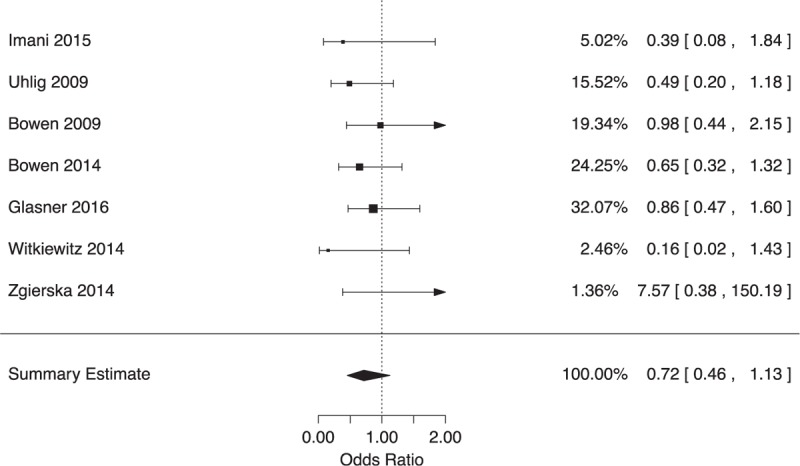
Objectives: Substance use disorder (SUD) is a prevalent health issue with serious personal and societal consequences. This review aims to estimate the effects and safety of Mindfulness-based Relapse Prevention (MBRP) for SUDs. Methods: We searched electronic databases for randomized controlled trials evaluating MBRP for adult patients diagnosed with SUDs. Two reviewers independently assessed citations, extracted trial data, and assessed risks of bias. We conducted random-effects meta-analyses and assessed quality of the body of evidence (QoE) using the Grading of Recommendations Assessment, Development, and Evaluation approach. Results: We identified 9 randomized controlled trials comprising 901 participants. We did not detect statistically significant differences between MBRP and comparators on relapse (odds ratio [OR] 0.72, 95% confidence interval [CI] 0.46–1.13, low QoE), frequency of use (standardized mean difference [SMD] 0.02, 95% CI −0.40 to 0.44, low QoE), treatment dropout (OR 0.81, 95% CI 0.40 to 1.62, very low QoE), depressive symptoms (SMD −0.09, 95% CI −0.39 to 0.21, low QoE), anxiety symptoms (SMD −0.32, 95% CI −1.16 to 0.52, very low QoE), and mindfulness (SMD −0.28, 95% CI −0.72 to 0.16, very low QoE). We identified significant differences in favor of MBRP on withdrawal/craving symptoms (SMD −0.13, 95% CI −0.19 to −0.08, I 2 = 0%, low QoE) and negative consequences of substance use (SMD −0.23, 95% CI −0.39 to −0.07, I 2 = 0%, low QoE). We found negligible evidence of adverse events. Conclusions: We have limited confidence in estimates suggesting MBRP yields small effects on withdrawal/craving and negative consequences versus comparator interventions. We did not detect differences for any other outcome. Future trials should aim to minimize participant attrition to improve confidence in effect estimates.
Overview
The claims and statistics of this paper haven’t been checked yet.
Free: it reads the open-access text and checks the first 5 claims that cite a source we can check. Create a free account to check every claim.
Integrity signals
Registry
Cites
Statistics
Figures
Verification
Claims the paper makes
The claims and statistics of this paper haven’t been checked yet.
Free: it reads the open-access text and checks the first 5 claims that cite a source we can check. Create a free account to check every claim.
Claims other papers make about this one
Each is checked against this paper’s own text: does it say what the citing paper says it does?
The cited source doesn’t support the claim as written.
In the citing paper
“Second, MBSR has been adapted in a variety of other marginalized populations (e.g., African American adults) and clinical conditions (e.g., addiction) with demonstrated efficacy (Grant et al., 2017; Palta et al., 2012; Sibinga et al., 2014; Witkiewitz & Bowen, 2010).”
From Mindfulness for Reducing Minority Stress and Promoting Health Among Sexual Minority Men: Uncovering Intervention Principles and Techniques (2022) · cites this paper as Grant et al., 2017
Checked by a reasoning model — may be wrong.
Experimental — accuracy not yet measuredThe source backs part of the claim, not all of it — or backs it for a different population, condition or comparison.
In the citing paper
“Furthermore, MBRP may have direct benefits on well-being for participants in jails and prisons (Grant et al. 2017, Auty, Cope, & Liebling, 2017).”
From Mindfulness-Based Relapse Prevention in a Jail Drug Treatment Program. (2019) · cites this paper as Grant et al. 2017
Experimental — accuracy not yet measuredThe source backs part of the claim, not all of it — or backs it for a different population, condition or comparison.
In the citing paper
“MT has been shown to reduce the severity of physical symptoms in populations with various medical disorders, including pain severity in people being treated for cancer,16 gastrointestinal symptoms in adults with irritable bowel syndrome,17 and withdrawal symptoms in people recovering from substance use.18”
From Prenatal Mindfulness Training and Interoceptive Awareness in Pregnant People at Risk for Hypertensive Disorders. (2024) · cites this paper as [18]
Experimental — accuracy not yet measuredThe source backs part of the claim, not all of it — or backs it for a different population, condition or comparison.
In the citing paper
“Meta-analyses of mindfulness intervention studies indicate small-to-large effects of mindfulness interventions in reducing frequency and severity of substance use, intensity of drug craving and severity of experienced stress, and improving mental health [22–24].”
From Mindful moms: acceptability and impact of co-designed and digitally delivered video meditations for pregnant and parenting women with opioid use disorder (2025) · cites this paper as [23]
Experimental — accuracy not yet measuredThe cited source says what the claim attributes to it.
In the citing paper
“A recent meta-analysis has suggested that the benefits of MBRP over other treatments in reducing substance use may be limited (Grant et al. 2017).”
From Mindfulness-Based Relapse Prevention in a Jail Drug Treatment Program. (2019) · cites this paper as Grant et al. 2017
3 more claims about this paper
Create a free account to see every claim other papers make about this one.
Self-check
Percentages, sums and reported differences re-computed from the paper’s own numbers.
The self-check needs the paper’s full text.
Citations
Cites
Measuring inconsistency in meta-analyses
Higgins, J. P. T., Thompson, S. G., Deeks, J. J., & Altman, D. G. (2003) · BMJ · doi:10.1136/bmj.327.7414.557 · Cited by 63,139
Bias in meta-analysis detected by a simple, graphical test
Egger, M., Smith, G. D., Schneider, M., & Minder, C. (1997) · BMJ · doi:10.1136/bmj.315.7109.629 · Cited by 56,722 · cited 2×
“Published by Wolters Kluwer He for funnel plot asymmetry (Begg and Mazumdar, 1994), and Egger test for funnel plot asymmetry (Egger et al., 1997).”
MethodThe Cochrane Collaboration's tool for assessing risk of bias in randomised trials
Higgins, J. P. T., Altman, D. G., Gotzsche, P. C., Juni, P., Moher, D., Oxman, A. D., Savovic, J., Schulz, K. F., Weeks, L., Sterne, J. A. C., et al. (2011) · BMJ · doi:10.1136/bmj.d5928 · Cited by 33,817
Dermyshi, E., Wang, Y., Yan, C., Hong, W., Qiu, G., Gong, X., & Zhang, T. (2017) · Neonatology · doi:10.1159/000454668 · Cited by 24,451
Operating characteristics of a rank correlation test for publication bias
Begg, C. B., & Mazumdar, M. (1994) · Biometrics · doi:10.2307/2533446 · Cited by 16,955
Duval, S., & Tweedie, R. (2000) · Biometrics · doi:10.1111/j.0006-341x.2000.00455.x · Cited by 14,099
The benefits of being present: Mindfulness and its role in psychological well-being
Brown, K. W., & Ryan, R. M. (2003) · Journal of Personality and Social Psychology · doi:10.1037/0022-3514.84.4.822 · Cited by 13,448
Moher, D., Hopewell, S., Schulz, K. F., Montori, V., Gotzsche, P. C., Devereaux, P. J., Elbourne, D., Egger, M., & Altman, D. G. (2010) · BMJ · doi:10.1136/bmj.c869 · Cited by 8,883
GRADE guidelines: 3. Rating the quality of evidence
Balshem, H., Helfand, M., Schünemann, H. J., Oxman, A. D., Kunz, R., Brozek, J., Vist, G. E., Falck-Ytter, Y., Meerpohl, J., & Norris, S. (2011) · Journal of Clinical Epidemiology · doi:10.1016/j.jclinepi.2010.07.015 · Cited by 8,285
Dissociable intrinsic connectivity networks for salience processing and executive control
Seeley, W. W., Menon, V., Schatzberg, A. F., Keller, J., Glover, G. H., Kenna, H., Reiss, A. L., & Greicius, M. D. (2007) · The Journal of Neuroscience · doi:10.1523/jneurosci.5587-06.2007 · Cited by 7,426 · cited 1×
“, 2010), and stimulate activity in circuitry related to cognitive self-regulation of behavior (Seeley et al., 2007; Craig, 2009; Xue et al., 2011; Hasenkamp and Barsalou, 2012; Hasenkamp et al., 2012).”
Background
Research works printed but not linked: 9
- Bowen S Chawla N Marlatt GA Mindfulness-based Relapse Prevention for Addictive Behaviors: A Clinician's Guide. New York, NY: Guilford Press; 2010.
- Bowen S Chawla N Marlatt GA Mindfulness-based Relapse Prevention for Addictive Behaviors: A Clinician's Guide. New York, NY: Guilford Press; 2011.
- Grant S Hempel S Colaiaco B Mindfulness-based Relapse Prevention for Substance Use Disorders: A Systematic Review; RR-1031. RAND Corporation, Santa Monica; 2015. PMC5636047 28727663
- Institute of Medicine. Complementary and Alternative Medicine in the United States. Washington, DC: National Academies Press; 2005. 22379647
- Institute of Medicine. Clinical Practice Guidelines We Can Trust. Washington, DC: National Academies Press; 2011.
- Marlatt GA Gordon JR Relapse Prevention: Maintenance Strategies in the Treatment of Addictive Behaviors. New York, NY: Guilford Press; 1985.
- McCown D Reibel D Monti DA Beitman BD Mindfulness and mindfulness-based stress reduction. Integrative Psychiatry. New York, NY: Oxford University Press; 2010 289– 338. 494, xvii.
- Substance Abuse and Mental Health Services Administration. Treatment Episode Data Set (TEDS): 2005: Discharges From Substance Abuse Treatment Services: DASIS Series: S-41. Dept of Health & Human Services publication No. (SMA) 08-4314, in: Services, U.D., o.H.H., (Ed.). Rockville, MD; 2008.
- Uhlig DJ Mindfulness based relapse prevention and the matrix model in substance abuse relapse prevention. Dissertation Abstracts Int B Sci Eng 2009; 70: 2596.
Cited by
Items 101–200 of 219
A Qualitative Study of Virtual Reality and Mindfulness for Substance Use Disorders
Holley, R., Moldow, E., Chaudhary, S., Gaumond, G., Hacker, R. L., Kahn, P., Boeldt, D. L., & Hubley, S. H. (2022) · Journal of Technology in Behavioral Science · doi:10.1007/s41347-022-00284-0 · Cited by 7
Votaw, V. R., & Witkiewitz, K. A. (2023) · Springer eBooks · doi:10.1007/978-3-031-32483-3_20 · Cited by 9
Rosenthal, A., Haslacher, D., Garbusow, M., Pangratz, L., Apfel, B., Soekadar, S. R., Romanczuk‐Seiferth, N., & Beck, A. (2024) · BMC Psychiatry · doi:10.1186/s12888-024-06085-4 · Cited by 9
Relationship between levels of mindfulness and substance use pattern
Baptista, J. D. S., Leite, T. H., Ferreira, V. K. D. L., de Magalhães, L. D. S. P., Cruz, M. S., & Mathias, A. C. R. (2022) · Jornal Brasileiro de Psiquiatria · doi:10.1590/0047-2085000000337 · Cited by 13
Yoga: A Holistic Approach to Addiction Treatment and Recovery
Greene, D. S. (2021) · OBM Integrative and Complementary Medicine · doi:10.21926/obm.icm.2104047 · Cited by 8
Zhai, J., Long, Y., Shi, J., Shi, D., Ren, Q., Zhao, M., & Du, J. (2022) · Frontiers in Psychiatry · doi:10.3389/fpsyt.2022.819075 · Cited by 8
Black, D. S., & Kirkpatrick, M. G. (2022) · Contemporary Clinical Trials · doi:10.1016/j.cct.2022.106855 · Cited by 6
Mindfulness aplicado a la atención primaria
Barceló‐Soler, A., Monreal‐Bartolomé, A., Navarro‐Gil, M., Beltrán-Ruiz, M., & García‐Campayo, J. (2018) · FMC - Formación Médica Continuada en Atención Primaria · doi:10.1016/j.fmc.2018.03.004 · Cited by 12
Sharp, M., Ward, L. G., Pomerantz, M., Bourjeily, G., Guthrie, K. M., Salmoirago-Blotcher, E., Desmarattes, A., & Bublitz, M. H. (2024) · Journal of Integrative and Complementary Medicine · doi:10.1089/jicm.2024.0121 · Cited by 4
Dundas, I., Ravnanger, K., Binder, P.-E., & Stige, S. H. (2020) · Frontiers in Psychiatry · doi:10.3389/fpsyt.2020.493349 · Cited by 5
Combined pharmacological and psychosocial interventions for alcohol use disorder
Agabio, R., Camposeragna, A., Saulle, R., Krupchanka, D., Leggio, L., & Minozzi, S. (2023) · Cochrane Database of Systematic Reviews · doi:10.1002/14651858.cd015673 · Cited by 8
Trinh, C. D., Girard, R., Schick, M. R., & Spillane, N. S. (2023) · Journal of Substance Use and Addiction Treatment · doi:10.1016/j.josat.2023.209241 · Cited by 7
Freedom from Within: A Meta-Analytic Review of Mindfulness Meditation-Based Interventions in Prisons
Pankovics, N., & Martinovic, M. (2024) · European journal of behavioral sciences · doi:10.33422/ejbs.v7i2.1251 · Cited by 9
Substance and Behavioral Addictions Assessment Instruments
Grigsby, T. J. (2020) · Cambridge University Press eBooks · doi:10.1017/9781108632591.012 · Cited by 7
Neurocircuitry of Mindfulness-Based Interventions for Substance Use Prevention and Recovery
Kirlić, N., Cohen, Z. P., & Stewart, J. L. (2021) · Current Addiction Reports · doi:10.1007/s40429-021-00396-2 · Cited by 7
Meditation and Yoga in the Treatment of Addictive Disorders
Mallik, D., Dingle, T., & Bowen, S. W. (2022) · Springer eBooks · doi:10.1007/978-981-16-6913-2_21 · Cited by 5
Therapy Strategies for Substance Use Disorders
Worley, J. (2020) · Journal of Psychosocial Nursing and Mental Health Services · doi:10.3928/02793695-20200115-02 · Cited by 5
Killeen, T. K., Baker, N. L., Davis, L. L., Bowen, S., & Brady, K. T. (2023) · Journal of Substance Use and Addiction Treatment · doi:10.1016/j.josat.2023.209116 · Cited by 4
Stakehold ZXSY: Disorder Deficit Familial Asynchrony and Syndrome Z
(2023) · Journal of Medical Clinical Case Reports · doi:10.47485/2767-5416.1032 · Cited by 7
Mumba, M. N., Mugoya, G. C. T., Allen, R. S., Glenn, A. L., Richman, J., Ghera, A., Butler, A., Rogers, B., Granger, T. A., & Davis, L. L. (2024) · Frontiers in Psychiatry · doi:10.3389/fpsyt.2024.1330672 · Cited by 4
Luquiens, A., Panjo, H., Bonnaire, C., & Pelletier‐Fleury, N. (2024) · Quality of Life Research · doi:10.1007/s11136-024-03835-5 · Cited by 4
Villarreal-Mata, J. L., Oliva, E. I. P. N., Esteve, E. B., Puente, L. A. R., Castillo, M. M. A., & Torres-Obregón, R. (2020) · SMAD Revista Eletrônica Saúde Mental Álcool e Drogas (Edição em Português) · doi:10.11606/issn.1806-6976.smad.2020.167320 · Cited by 4
Black, D. S., & Kirkpatrick, M. G. (2023) · JNCI Cancer Spectrum · doi:10.1093/jncics/pkad095 · Cited by 7
Mindfulness-Based Approaches in Addiction Treatment
McClintock, A. S., & Marcus, M. T. (2020) · Springer eBooks · doi:10.1007/978-3-030-36391-8_27 · Cited by 5
Prevention and Treatment of Sex Addiction
Reid, R. C., Grubbs, J. B., & Kraus, S. W. (2020) · Cambridge University Press eBooks · doi:10.1017/9781108632591.025 · Cited by 4
Stewart, K. L., Farris, S. G., Jackson, K. M., Borsari, B. E., & Metrik, J. (2018) · Cognitive Therapy and Research · doi:10.1007/s10608-018-9950-5 · Cited by 6
Lent, M. R., Callahan, H. R., Womer, P., Mullen, P. M., Shook, C. B., DiTomasso, R. A., Felgoise, S. H., & Festinger, D. S. (2021) · Journal of Clinical Psychology · doi:10.1002/jclp.23170 · Cited by 6
Rosansky, J. A., Howard, L., Goodman, H., Okst, K., Fatkin, T., Fredericksen, A. K., Sokol, R., Gardiner, P., Parry, G., Cook, B. L., et al. (2024) · Contemporary Clinical Trials · doi:10.1016/j.cct.2023.107417 · Cited by 3
Neves, V. V., dos Santos, D. T., Demarzo, M., Antico, L., Meirelles, C. D. A. B., & Barboza, A. R. A. (2025) · BMC Medical Education · doi:10.1186/s12909-025-07726-2 · Cited by 3
Gaming Disorder and Its Treatment
Griffiths, M. D., Kuss, D. J., & Pontes, H. M. (2020) · Cambridge University Press eBooks · doi:10.1017/9781108632591.029 · Cited by 7
Dey, M., Wenger, A., Baumgartner, C., Herrmann, U., Augsburger, M., Haug, S., Malischnig, D., & Schaub, M. P. (2022) · BMC Psychiatry · doi:10.1186/s12888-022-03802-9 · Cited by 6
Obarska, K., Binkowska, A. A., Marcowski, P., Szymczak, K., Lewczuk, K., Sollich, K., Banaszak, M., Woronowicz, B. T., Nowicka, M., Skorko, M., et al. (2022) · Frontiers in Psychiatry · doi:10.3389/fpsyt.2022.1011585 · Cited by 4
Vowles, K. E., Witkiewitz, K. A., Clarke, E. W., Schmidt, Z., Borsari, B. E., Edwards, K. A., Korecki, J. R., Moniz-Lewis, D. I. K., Bondzie, J., Mullins, C., et al. (2023) · Contemporary Clinical Trials · doi:10.1016/j.cct.2023.107096 · Cited by 5
Lai, Y., Lee, K., & Huang, T.-W. (2023) · Current Psychology · doi:10.1007/s12144-023-04529-w · Cited by 3
Félix-Junior, I. J., Opaleye, E. S., Donate, A. P. G., Bedendo, A., Machado, M. P. A., Galduróz, J. C. F., Bowen, S. W., & Noto, A. R. (2023) · International Journal of Mental Health and Addiction · doi:10.1007/s11469-023-01113-y · Cited by 3
Redeł, A., Binkowska, A. A., Obarska, K., Marcowski, P., Szymczak, K., Lewczuk, K., Sollich, K., Banaszak, M., Woronowicz, B. T., Nowicka, M., et al. (2024) · Frontiers in Psychiatry · doi:10.3389/fpsyt.2024.1335105 · Cited by 5
de Souza, I. C. W., Kozasa, E. H., Rabello, L., Mattozo, B., Bowen, S. W., Richter, K. P., Sartes, L. M. A., & Noto, A. R. (2019) · Tobacco Induced Diseases · doi:10.18332/tid/105846 · Cited by 5
Treatment of Alcohol, Tobacco, and Other Drug (ATOD) Misuse
Sussman, S. Y., & Bolshakova, M. (2020) · Cambridge University Press eBooks · doi:10.1017/9781108632591.022 · Cited by 3
The Role of Culture in Addiction
Hoffman, B. R., & Unger, J. B. (2020) · Cambridge University Press eBooks · doi:10.1017/9781108632591.018 · Cited by 4
Review of Evidence-Based Strategies to Treat Alcohol Use Disorder
Worley, J. (2021) · Journal of Psychosocial Nursing and Mental Health Services · doi:10.3928/02793695-20211110-01 · Cited by 4
Mindfulness-based approaches to mental health
Nauphal, M., Cardona, N. D., Morgan, L. P. K., & Eustis, E. H. (2023) · Encyclopedia of Mental Health · doi:10.1016/b978-0-323-91497-0.00053-9 · Cited by 2
Leton, N. (2024) · Cureus · doi:10.7759/cureus.70313 · Cited by 2
Recovery from Addiction: Maintenance and Preventing Relapse
Restrepo-Guzman, R., Li, D., & Lynn, G. (2020) · Springer eBooks · doi:10.1007/978-3-030-33404-8_6 · Cited by 2
Intervenciones basadas en Mindfulness en el tratamiento de adicciones a sustancias psicotrópicas
Flores, D. I. R., & Ortiz, G. G. R. (2021) · Revista Ecuatoriana de Psicología · doi:10.33996/repsi.v4i10.62 · Cited by 3
Contreras-Pérez, M. E., Alessi, S. M., Langwerden, R. J., Morris, S. L., & Wagner, E. F. (2023) · Addictive Behaviors · doi:10.1016/j.addbeh.2023.107759 · Cited by 4
How Meditation Promotes Well‐Being: Applying a Dual‐System Theory
Lehman, B. J., Fogel, C. A., & Wiederaenders, E. (2025) · Social and Personality Psychology Compass · doi:10.1111/spc3.70037 · Cited by 5
Zinzow, H. M., Shi, L., Rennert, L., Chen, L., Lopes, S. S., Zhang, L., Jones, K. O., Jindal, M., Stam, C., & Mclain, M. (2020) · Contemporary Clinical Trials · doi:10.1016/j.cct.2020.106182 · Cited by 3
Psychotherapeutische Interventionen bei Alkoholabhängigkeit
Frischknecht, U., & Kiefer, F. (2019) · PSYCH up2date · doi:10.1055/a-0581-6580 · Cited by 2
Belsher, B. E., Beech, E. H., Kelber, M. S., Hempel, S., Evatt, D. P., Smolenski, D. J., Campbell, M. S., Otto, J. L., Morgan, M. A., Workman, D. E., et al. (2019) · Medical Care · doi:10.1097/mlr.0000000000001172 · Cited by 2
Self-citationMindfulness-Based Interventions in the Treatment of Physical Conditions
Goyal, M., & Rusch, H. L. (2020) · Oxford University Press eBooks · doi:10.1093/oxfordhb/9780198808640.013.34 · Cited by 3
Passionate Love Addiction: An Evolutionary Survival Mechanism That Can Go Terribly Wrong
Bolshakova, M., Fisher, H. E., Aubin, H., & Sussman, S. Y. (2020) · Cambridge University Press eBooks · doi:10.1017/9781108632591.026 · Cited by 2
Philosophical Issues in the Addictions
Glackin, S. N. (2020) · Cambridge University Press eBooks · doi:10.1017/9781108632591.007 · Cited by 2
Vujanovic, A. A., Webber, H. E., Wardle, M. C., Green, C. E., Lane, S. D., & Schmitz, J. M. (2021) · Addictive Behaviors · doi:10.1016/j.addbeh.2021.107211 · Cited by 2
Sussman, S. Y. (2020) · Cambridge University Press eBooks · doi:10.1017/9781108632591.020 · Cited by 2
Lord, S. E., & Rao, D. (2025) · Annals of Medicine · doi:10.1080/07853890.2025.2486585 · Cited by 1
Ting, K. T., Leung, I. C. H., Chan, D. C. C., Yu, K. O. T., Tang, W. K., Chan, F., Tang, A. K. L., Ma, H. S. W., Yip, B. H. K., Zhang, D. D., et al. (2026) · Addiction · doi:10.1111/add.70441 · Cited by 1
“To date, only one meta-analysis evaluated MBRP, reporting a small effect for reducing withdrawal symptoms, craving and negative consequences of substance use, although the confidence in these findings was limited because of methodological limitation [26].”
Bayar, B. D., & Erci, B. (2024) · Journal of Substance Use · doi:10.1080/14659891.2024.2378758 · Cited by 2
Treating Comorbid Posttraumatic Stress Disorder and Substance Use Disorder
Ebrahimi, C. T., Gette, J. A., Saraiya, T. C., & Hien, D. A. (2024) · CBT: science into practice · doi:10.1007/978-3-031-62971-6_5 · Cited by 2
Stone, B. M. (2024) · International Journal of Mental Health and Addiction · doi:10.1007/s11469-024-01382-1 · Cited by 1
Dalmolin, I. S., Heidemann, I. T. S. B., & Durand, M. K. (2024) · Escola Anna Nery · doi:10.1590/2177-9465-ean-2024-0044pt · Cited by 1
Pautassi, R. M., Bravo, A. J., Salguero, A., & Pilatti, A. (2024) · Springer eBooks · doi:10.1007/978-3-031-72219-6_45 · Cited by 3
Brief mindfulness intervention for adults with cannabis use disorder: A randomised clinical trial
Lorenzetti, V., McTavish, E., Thomson, H. M., Clemente, A., Rendell, P. G., Terrett, G., Greenwood, L., Freeman, T. P., Kamboj, S. K., & Manning, V. (2025) · Drug and Alcohol Dependence · doi:10.1016/j.drugalcdep.2025.112909 · Cited by 2
Prevention and Treatment of Work Addiction
Quiñones, C., & Griffiths, M. D. (2020) · Cambridge University Press eBooks · doi:10.1017/9781108632591.028 · Cited by 3
Sussman, S. Y. (2020) · Cambridge University Press eBooks · doi:10.1017/9781108632591.003 · Cited by 1
Meditation-based on mindfulness in Primary Health Care: care strategy in the nurse’s role
Dalmolin, I. S., Heidemann, I. T. S. B., & Durand, M. K. (2024) · Escola Anna Nery · doi:10.1590/2177-9465-ean-2024-0044en · Cited by 1
Recovery Habits: A Habit Perspective on Recovery from Substance Use Disorder
Arnaudova, I., Amaro, H. D. L. A., & Monterosso, J. R. (2018) · Springer eBooks · doi:10.1007/978-3-319-97529-0_17 · Cited by 2
Adolescent Drug Misuse Prevention: Challenges in School-Based Programming
Scheier, L. M. (2020) · Cambridge University Press eBooks · doi:10.1017/9781108632591.021 · Cited by 1
Measurement, Prevention, and Treatment of Exercise Addiction
Hausenblas, H. A., Mann, D. T. Y., & Downs, D. S. (2020) · Cambridge University Press eBooks · doi:10.1017/9781108632591.036 · Cited by 4
Cognitive behavioral therapy for substance use disorders
Rohsenow, D. J., & Snell, L. M. (2023) · Elsevier eBooks · doi:10.1016/b978-0-323-91497-0.00245-9 · Cited by 2
Drug and alcohol psychosocial interventions
Fisher, A. C., Nepal, S., Harvey, L. R., Peach, N., Marel, C., KAY‐LAMBKIN, F. J., Teesson, M., Newton, N. C., & Mills, K. L. (2020) · doi:10.57022/sczj5829 · Cited by 2
Narzisi, A. (2018) · QUADERNI DI GESTALT · doi:10.3280/gest2017-002004 · Cited by 1
Hershberger, A. R. (2019) · Figshare · doi:10.25394/pgs.8867957
Cognitive Behavioural Therapies for Alcohol and Other Drug Use Problems
Lee, N., Ross, P., & Cash, R. (2020) · Springer eBooks · doi:10.1007/978-3-030-36391-8_25
Attention Deficit/Hyperactivity Disorder & Substance Abuse in Adults & Children
Dambreville, N., Hernández, M., & LEVIN, F. R. (2020) · Springer eBooks · doi:10.1007/978-3-030-36391-8_95
Compton, W. M., & Blanco, C. (2020) · Cambridge University Press eBooks · doi:10.1017/9781108632591.001
Novel Psychoactive Substances: A New Challenge for Prevention and Treatment
Kapitány‐Fövény, M., Corazza, O., Marrinan, S., & Demetrovics, Z. (2020) · Cambridge University Press eBooks · doi:10.1017/9781108632591.032
Human Laboratory Paradigms in Addictions Research
Morris, V. L., Arshad, F., Balodis, I. M., Reed, D. D., MacKillop, J. M., & Amlung, M. T. (2020) · Cambridge University Press eBooks · doi:10.1017/9781108632591.010
Anhedonia in Addictive Behaviors
Dyer, W. G., Leventhal, A. M., Goldenson, N. I., & Bello, M. S. (2020) · Cambridge University Press eBooks · doi:10.1017/9781108632591.039 · Cited by 2
American Legal Issues in Addiction Treatment and Research
Willick, D. H. (2020) · Cambridge University Press eBooks · doi:10.1017/9781108632591.041
Strack, R. W., Orsini, M. M., Ewald, D. R., & Scheier, L. M. (2020) · Cambridge University Press eBooks · doi:10.1017/9781108632591.019
Chapter 30. Mindfulness, Exercise, and Other Alternative Therapies
Bowen, S. W., Wilson, A. D., & Laue, C. S. (2021) · American Psychiatric Association Publishing eBooks · doi:10.1176/appi.books.9781615373970.kb30
Mindfulness for the Treatment of Substance Use Disorders
de Barros, V. V., Opaleye, E. S., Machado, M. P. A., & Noto, A. R. (2021) · Springer eBooks · doi:10.1007/978-3-030-62855-0_21
Chronicle of an Indian psychiatrist's mindfulness journey retold
Sivasubramoney, K. (2021) · BJPsych International · doi:10.1192/bji.2021.33
The Efficacy of Somatic Therapies in Trauma Recovery
Waheed, M. (2021) · National University System Repository (National University System)
Rakowska, J. M. (2021) · Wydawnictwa Uniwersytetu Warszawskiego eBooks · doi:10.31338/uw.9788323547655 · Cited by 2
Sivasubramoney, K. (2021) · GLOBAL JOURNAL FOR RESEARCH ANALYSIS · doi:10.36106/gjra/0900439
Clinical and Research Methods in the Addictions
Sussman, S. Y. (2020) · Cambridge University Press eBooks · doi:10.1017/9781108632591.008
Levels of Analysis and Etiology
Sussman, S. Y. (2020) · Cambridge University Press eBooks · doi:10.1017/9781108632591.014
Ongoing and Future Research Directions
Sussman, S. Y. (2020) · Cambridge University Press eBooks · doi:10.1017/9781108632591.030
Sussman, S. Y. (2020) · Cambridge University Press eBooks · doi:10.1017/9781108632591.002
Srivastava, A. B., & Gold, M. S. (2020) · Cambridge University Press eBooks · doi:10.1017/9781108632591.033
Arnaud, N., Banaschewski, T., Nees, F., Buchholz, V. N., Klein, M. C., Reis, O., Legenbauer, T., Zapf, A., Thomasius, R., & Konsortium, I.-M. (2022) · SUCHT - Zeitschrift für Wissenschaft und Praxis / Journal of Addiction Research and Practice · doi:10.1024/0939-5911/a000743
Sussman, S. Y. (2020) · Cambridge University Press eBooks · doi:10.1017/9781108632591.042
Third Wave Therapies and Substance Use Disorders: A Case Example
Stotts, A. L., Villarreal, Y. R., Spellman, M., & Northrup, T. F. (2022) · Springer eBooks · doi:10.1007/978-3-031-11677-3_25
Substances Pathological of Use and Syndrome Z: Medicine D
Furlanetto, M. L. (2023) · Journal of Integrated Health · doi:10.51219/jih/furlanetto-m-l-jr/4 · Cited by 1
Reangsing, C., Pusuwun, S., Boonsin, S., & Oerther, S. E. (2023) · Frontiers of Nursing · doi:10.2478/fon-2023-0016
Grodin, E. N., Meredith, L. R., Burnette, E. M., & Ray, L. A. (2023) · Springer eBooks · doi:10.1007/978-3-031-32483-3_30
Clay Use as Mindfulness for Women in Early Substance Use Recovery
Feldman, C. (2023) · Dominican Scholar (Dominican University of California) · doi:10.33015/dominican.edu/2023.at.phd.04 · Cited by 2
Bernaldo‐de‐Quirós, M., & Amores, A. (2024) · African journal of rhetoric · doi:10.21134/haaj.v24i1.792 · Cited by 1
Metadata
- Authors
- Grant, S., Colaiaco, B., Motala, A., Shanman, R., Booth, M., Sorbero, M., & Hempel, S.
- Affiliations
- RAND Corporation (US)
- Corresponding author
- Grant, Sean
- Venue
- Journal of Addiction Medicine
- Published
- 2017-09
- Volume
- 11
- Issue
- 5
- Pages
- 386-396
- ISSN
- 1932-0620 (ISSN-L)
- 1935-3227
- PMC
- PMC5636047
- OpenAlex
- W2739068436
- Semantic Scholar
- 90b756bf07db25b46d40ee483e95f030758081aa
- Cited by
- 220
- References
- 76
- Citations by year
- 2026: 7 · 2025: 14 · 2024: 23 · 2023: 26 · 2022: 19 · 2021: 36 · 2020: 64 · 2019: 13 · 2018: 15 · 2017: 2
- FWCI
- 3.38
- Type
- journal article
- Language
- en
- Open access
- hybrid
- doi.org
- Licence
- Locations
- Journal of Addiction Medicine (publishedVersion, cc-by-nc-nd)
- PubMed Central (publishedVersion, cc-by-nc-nd)
- PubMed (publishedVersion)
- Funders
- RAND Corporation
- Topics
- Health Sciences › Medicine › Epidemiology › Substance Abuse Treatment and Outcomes
- Social Sciences › Psychology › Clinical Psychology › Mindfulness and Compassion Interventions
- Health Sciences › Medicine › Public Health, Environmental and Occupational Health › Opioid Use Disorder Treatment
- Keywords
- mindfulness-based relapse prevention, substance use disorders, relapse prevention, withdrawal symptoms, craving, treatment discontinuation, depressive symptoms, anxiety symptoms, treatment safety, quality of evidence
- MeSH terms
- Humans, Outcome Assessment, Health Care, Substance-Related Disorders, Secondary Prevention, Mindfulness
About these checks
Registry, retraction, Cites and statistics results are computed, not judged, with one exception: a printed reference that no index lists is read once by a model before it counts as a citation error. Claims are extracted by a model and kept only when their quote appears verbatim in the text; each cited source is then checked, with a model’s help, for whether it says what the claim relies on. Those verdicts can be wrong — read the claim’s quote and the cited source before relying on one.
Statistics and arithmetic are recomputed, not judged.
Confidence bands are shown only for fields calibrated on our annotated test set. None is calibrated yet, so no band is shown.
What counts as a claim ›How we measure confidence ›How we check this ›
Are you an author, or do you see a problem with this page? Request a review
Data sources
Bibliographic data: Semantic Scholar, OpenAlex, Crossref.
Contains information from the Semantic Scholar Academic Graph Datasets, made available under the ODC Attribution License (ODC-BY 1.0).
Semantic Scholar’s data is described in: Kinney, R., et al. (2023). The Semantic Scholar Open Data Platform. arXiv:2301.10140.
