

Gestational diabetes: weight gain during pregnancy and its relationship to pregnancy outcomes
Open accessThe DOI matches its Crossref record; 25 of the 25 references it cites were found in a registry or an index.
Abstract
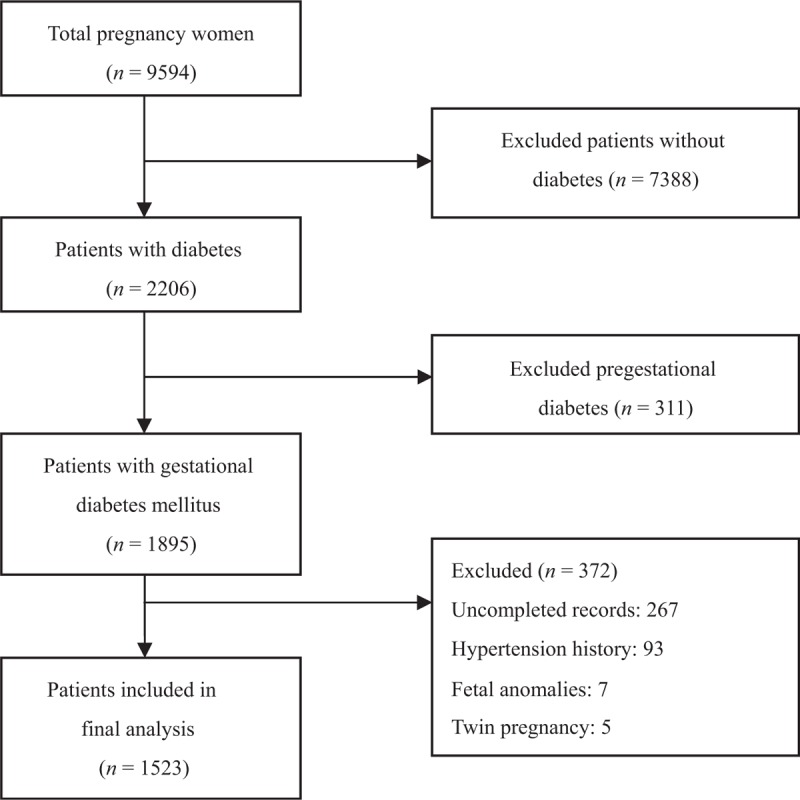
BACKGROUND: Weight gain during pregnancy reflects the mother's nutritional status. However, it may be affected by nutritional therapy and exercise interventions used to control blood sugar in gestational diabetes mellitus (GDM). This study aimed to evaluate weight gain during gestation and pregnancy outcomes among women with GDM. METHODS: A retrospective study involving 1523 women with GDM was conducted between July 2013 and July 2016. Demographic data, gestational weight gain (GWG), blood glucose, glycated-hemoglobin level, and maternal and fetal outcomes were extracted from medical records. Relationships between GWG and pregnancy outcomes were investigated using multivariate logistic regression. RESULTS: In total, 451 (29.6%) women showed insufficient GWG and 484 (31.8%) showed excessive GWG. Excessive GWG was independently associated with macrosomia (adjusted odds ratio [aOR] 2.20, 95% confidence interval [CI] 1.50-3.52, P < 0.001), large for gestational age (aOR 2.06, 95% CI 1.44-2.93, P < 0.001), small for gestational age (aOR 0.49, 95% CI 0.25-0.97, P = 0.040), neonatal hypoglycemia (aOR 3.80, 95% CI 1.20-12.00, P = 0.023), preterm birth (aOR 0.45, 95% CI 0.21-0.96, P = 0.040), and cesarean delivery (aOR 1.45, 95% CI 1.13-1.87, P = 0.004). Insufficient GWG increased the incidence of preterm birth (aOR 3.53, 95% CI 1.96-6.37, P < 0.001). CONCLUSIONS: Both excessive and insufficient weight gain require attention in women with GDM. Nutritional therapy and exercise interventions to control blood glucose should also be used to control reasonable weight gain during pregnancy to decrease adverse pregnancy outcomes.
Overview
The claims and statistics of this paper haven’t been checked yet.
Free: it reads the open-access text and checks the first 5 claims that cite a source we can check. Create a free account to check every claim.
Integrity signals
Registry
Cites
Statistics
Figures
Verification
Claims the paper makes
The claims and statistics of this paper haven’t been checked yet.
Free: it reads the open-access text and checks the first 5 claims that cite a source we can check. Create a free account to check every claim.
Claims other papers make about this one
Each is checked against this paper’s own text: does it say what the citing paper says it does?
The source backs part of the claim, not all of it — or backs it for a different population, condition or comparison.
In the citing paper
“Lower GWG in women with GDM [44,45,46,47,48,49] is associated with reduced risks of pregnancy-induced hypertension, pre-eclampsia [49,50,51], caesarean section [47], and macrosomia [43,49] without increasing small-for-gestational-age (SGA) risks [43,49].”
From Medical Nutrition Therapy for Women with Gestational Diabetes: Current Practice and Future Perspectives (2025) · cites this paper as [44]
Experimental — accuracy not yet measuredThe cited source says what the claim attributes to it.
In the citing paper
“Excessive GWG in women with GDM worsens hyperglycaemia [41] and adverse pregnancy outcomes [42,43,44], although specific GWG targets remain undefined.”
From Medical Nutrition Therapy for Women with Gestational Diabetes: Current Practice and Future Perspectives (2025) · cites this paper as [44]
Self-check
Percentages, sums and reported differences re-computed from the paper’s own numbers.
The self-check needs the paper’s full text.
Citations
Cites
International Association of Diabetes and Pregnancy Study Groups Consensus Panel (2010) · Diabetes Care · doi:10.2337/dc09-1848 · Cited by 5,390
Zhu, W.-W., Yang, H.-X., Wei, Y.-M., Yan, J., Wang, Z.-L., Li, X.-L., Wu, H.-R., Li, N., Zhang, M.-H., Liu, X.-H., et al. (2013) · Diabetes Care · doi:10.2337/dc12-1157 · Cited by 338
Weinert, L. S. (2010) · Diabetes Care · doi:10.2337/dc10-0544 · Cited by 260
Kim, S. Y., Sharma, A. J., Sappenfield, W., Wilson, H. G., & Salihu, H. M. (2014) · Obstetrics & Gynecology · doi:10.1097/aog.0000000000000177 · Cited by 250
Blood glucose in the neonate and its clinical significance
Cornblath, M., & Reisner, S. H. (1965) · New England Journal of Medicine · doi:10.1056/nejm196508122730707 · Cited by 190
Paul, H. A., Bomhof, M. R., Vogel, H. J., & Reimer, R. A. (2016) · Scientific Reports · doi:10.1038/srep20683 · Cited by 173
Gestational weight gain as a risk factor for hypertensive disorders of pregnancy
Macdonald-Wallis, C., Tilling, K., Fraser, A., Nelson, S. M., & Lawlor, D. A. (2013) · American Journal of Obstetrics and Gynecology · doi:10.1016/j.ajog.2013.05.042 · Cited by 167
Spaight, C., Gross, J., Horsch, A., & Puder, J. J. (2016) · Endocrine Development · doi:10.1159/000439413 · Cited by 148 · cited 1×
“Introduction cy,([3]) and is one of themain causes ofmaternal and neonatal complications (eg, preeclampsia, fetal macrosomia, preterm Gestationalweight gain (GWG) is an important index for the health and quality of life of women and their fetuses.”
BackgroundAssociation of Second and Third Trimester Weight Gain in Pregnancy with Maternal and Fetal Outcomes
Drehmer, M., Duncan, B. B., Kac, G., & Schmidt, M. I. (2013) · PLoS ONE · doi:10.1371/journal.pone.0054704 · Cited by 128
Li, C., Liu, Y., & Zhang, W. (2015) · PLOS ONE · doi:10.1371/journal.pone.0136850 · Cited by 125
Fortner, R. T., Pekow, P., Solomon, C. G., Markenson, G., & Chasan-Taber, L. (2009) · American Journal of Obstetrics and Gynecology · doi:10.1016/j.ajog.2008.08.021 · Cited by 120
Hung, T.-H., & Hsieh, T.-T. (2016) · Taiwanese Journal of Obstetrics and Gynecology · doi:10.1016/j.tjog.2016.06.016 · Cited by 120
Liu, L., Hong, Z., & Zhang, L. (2015) · Scientific Reports · doi:10.1038/srep12863 · Cited by 94
Prepregnancy body mass index as an important predictor of perinatal outcomes in Japanese
Murakami, M., Ohmichi, M., Takahashi, T., Shibata, A., Fukao, A., Morisaki, N., & Kurachi, H. (2004) · Archives of Gynecology and Obstetrics · doi:10.1007/s00404-004-0629-7 · Cited by 94
Update on neonatal hypoglycemia
Rozance, P. J. (2014) · Current Opinion in Endocrinology, Diabetes & Obesity · doi:10.1097/med.0000000000000027 · Cited by 75
The effect of maternal obesity on pregnancy outcomes in women with gestational diabetes
Roman, A. S., Rebarber, A., Fox, N. S., Klauser, C. K., Istwan, N., Rhea, D., & Saltzman, D. (2011) · The Journal of Maternal-Fetal & Neonatal Medicine · doi:10.3109/14767058.2010.521871 · Cited by 64 · cited 1×
“Some previous studies reported that excessive GWG was independently associated with adverse pregnancy outcomes inwomenwithGDM([5-7]) but the effects of insufficientGWG have not been analyzed in detail.”
ResultGodoy, A. C., do Nascimento, S. L., & Surita, F. G. (2015) · Clinics · doi:10.6061/clinics/2015(11)08 · Cited by 63
Huang, A., Ji, Z., Zhao, W., Hu, H., Yang, Q., & Chen, D. (2016) · Reproductive Health · doi:10.1186/s12978-016-0204-2 · Cited by 60 · cited 11×
“SGA (aOR 0.49, 95% CI 0.25– 0.97, P=0.040), preterm birth (aOR 0.45, 95% CI 0.21– 0.96, P=0.041), and neonatal hypoglycemia (aOR 3.80, 95% CI 1.20–12.00, P=0.023) were associated with excessive GWG. Women with excessive GWG also had a greater likelihood of having had a cesarean delivery (aOR 1.45, 95% CI 1.13–1.87, P=…”
BackgroundMethodResultInfluentialAdverse Outcomes and Potential Targets for Intervention in Gestational Diabetes and Obesity
Scifres, C., Feghali, M., Althouse, A. D., Caritis, S., & Catov, J. (2015) · Obstetrics & Gynecology · doi:10.1097/aog.0000000000000928 · Cited by 49 · cited 3×
“However, Scifres et al([5]) reported that both excessive GWG and insufficient GWG increased the risk for macrosomia.”
BackgroundResultKgosidialwa, O., Egan, A. M., Carmody, L., Kirwan, B., Gunning, P., & Dunne, F. P. (2015) · The Journal of Clinical Endocrinology & Metabolism · doi:10.1210/jc.2015-3259 · Cited by 46
Hung, T.-H., Chen, S.-F., Hsu, J.-J., & Hsieh, T.-T. (2015) · Taiwanese Journal of Obstetrics and Gynecology · doi:10.1016/j.tjog.2015.06.010 · Cited by 43
Factors in Gestational Diabetes Mellitus Predicting the Needs for Insulin Therapy
Zhang, Y., Shao, J., Li, F., & Xu, X. (2016) · International Journal of Endocrinology · doi:10.1155/2016/4858976 · Cited by 37 · cited 7×
“However, the proportion may be higher among women with GDM because of the effects of nutritional therapy and exercise, which are the main methods used to control blood glucose in GDM.([8]) The prevalence of GDM in China has recently increased to 14.”
MethodInfluentialBlackwell, S. C., Landon, M. B., Mele, L., Reddy, U. M., Casey, B. M., Wapner, R. J., Varner, M. W., Rouse, D. J., Thorp, J. M., Sciscione, A., et al. (2016) · Obstetrics & Gynecology · doi:10.1097/aog.0000000000001773 · Cited by 33
Li, S., Rosenberg, L. A., Palmer, J. R., Phillips, G. S., Heffner, L. J., & Wise, L. A. (2013) · Obesity · doi:10.1002/oby.20238 · Cited by 29
The proceedings of the diabetes in pregnancy study group of North America 2009 conference
Langer, O., Miodovnik, M., Reece, E. A., & Rosenn, B. (2010) · The Journal of Maternal-Fetal & Neonatal Medicine · doi:10.3109/14767050903550634 · Cited by 15
Research works printed but not linked: 2
- 10. Department Of Obstetrics And Gynecology, Chinese Medical Association. Guidelines for diagnosis and treatment of gestational diabetes mellitus (2014). Chin J Obstetr Gynecol 2014;49:561–569.
- 12. Guidelines IOMU. Weight Gain During Pregnancy: Reexamining the Guidelines. National Academies Press, Washington (DC): 2009.
Cited by
Lewandowska, M. (2021) · International Journal of Environmental Research and Public Health · doi:10.3390/ijerph18136936 · Cited by 92
Management of Gestational Diabetes Mellitus
Oskovi-Kaplan, Z. A., & Ozgu-Erdinc, A. S. (2020) · Advances in experimental medicine and biology · doi:10.1007/5584_2020_552 · Cited by 78
Lai, M., Weng, J., Yang, J., Gong, Y., Fang, F., Li, N., Kang, M., Xu, X., & Wang, Y. (2023) · Frontiers in Endocrinology · doi:10.3389/fendo.2023.1174239 · Cited by 62
Zhang, S., Liu, H., Li, N., Dong, W., Li, W., Wang, L., Zhang, Y., Yang, Y., & Leng, J. (2022) · BMC Pregnancy and Childbirth · doi:10.1186/s12884-022-04672-5 · Cited by 63
Preda, A., Iliescu, D. G., Comănescu, A. C., Zorilă, G. L., Vladu, I. M., Forțofoiu, M.-C., Ţenea-Cojan, T. Ş., Preda, S. D., Diaconu, I.-D., Moța, E., et al. (2023) · Journal of Clinical Medicine · doi:10.3390/jcm12144572 · Cited by 65
Metadata
- Authors
- Gou, B.-H., Guan, H.-M., Bi, Y.-X., & Ding, B.-J.
- Venue
- Chinese Medical Journal
- Published
- 2019-01-20
- Volume
- 132
- Issue
- 2
- Pages
- 154-160
- ISSN
- 0366-6999 (ISSN-L)
- PMC
- PMC6365271
- OpenAlex
- W2910587056
- Semantic Scholar
- 2f920b7027974e9e5339fae5d0ccda7c7345dca5
- Cited by
- 91
- References
- 25
- Citations by year
- 2026: 5 · 2025: 13 · 2024: 10 · 2023: 24 · 2022: 19 · 2021: 17 · 2020: 3
- FWCI
- 10.61
- Type
- journal article
- Language
- en
- Open access
- gold
- doi.org
- Licence
- cc-by-nc-nd
- Locations
- Chinese Medical Journal (publishedVersion, cc-by-nc-nd)
- Europe PMC (PubMed Central) (publishedVersion, cc-by-nc-nd)
- PubMed Central (publishedVersion, cc-by-nc-nd)
- PubMed (publishedVersion)
- DOAJ (DOAJ: Directory of Open Access Journals) (submittedVersion, cc-by-sa)
- Topics
- Health Sciences › Medicine › Obstetrics and Gynecology › Gestational Diabetes Research and Management
- Health Sciences › Medicine › Pediatrics, Perinatology and Child Health › Maternal and Neonatal Healthcare
- Health Sciences › Medicine › Pediatrics, Perinatology and Child Health › Birth, Development, and Health
- Keywords
- gestational diabetes mellitus, gestational weight gain, excessive weight gain, insufficient weight gain, macrosomia, large for gestational age, small for gestational age, neonatal hypoglycemia, preterm birth, cesarean section, maternal and fetal outcomes, HbA1c, glycemic control, nutritional therapy, exercise intervention
- MeSH terms
- Adult, Female, Fetal Macrosomia, Gestational Age, Humans, Pregnancy, Pregnancy Complications, Pregnancy Outcome, Retrospective Studies, Weight Gain, Body Mass Index, Logistic Models, Diabetes, Gestational
About these checks
Registry, retraction, Cites and statistics results are computed, not judged, with one exception: a printed reference that no index lists is read once by a model before it counts as a citation error. Claims are extracted by a model and kept only when their quote appears verbatim in the text; each cited source is then checked, with a model’s help, for whether it says what the claim relies on. Those verdicts can be wrong — read the claim’s quote and the cited source before relying on one.
Statistics and arithmetic are recomputed, not judged.
Confidence bands are shown only for fields calibrated on our annotated test set. None is calibrated yet, so no band is shown.
What counts as a claim ›How we measure confidence ›How we check this ›
Are you an author, or do you see a problem with this page? Request a review
Data sources
Bibliographic data: Semantic Scholar, OpenAlex, Crossref.
Contains information from the Semantic Scholar Academic Graph Datasets, made available under the ODC Attribution License (ODC-BY 1.0).
Semantic Scholar’s data is described in: Kinney, R., et al. (2023). The Semantic Scholar Open Data Platform. arXiv:2301.10140.
