

Mindfulness and Behavior Change
Open accessThe DOI matches its Crossref record; 465 of the 466 references it cites were found in a registry or an index.
Abstract
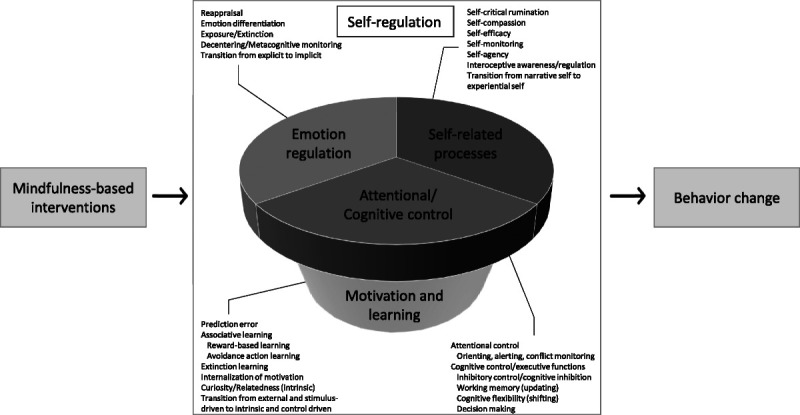
Initiating and maintaining behavior change is key to the prevention and treatment of most preventable chronic medical and psychiatric illnesses. The cultivation of mindfulness, involving acceptance and nonjudgment of present-moment experience, often results in transformative health behavior change. Neural systems involved in motivation and learning have an important role to play. A theoretical model of mindfulness that integrates these mechanisms with the cognitive, emotional, and self-related processes commonly described, while applying an integrated model to health behavior change, is needed. This integrative review (1) defines mindfulness and describes the mindfulness-based intervention movement, (2) synthesizes the neuroscience of mindfulness and integrates motivation and learning mechanisms within a mindful self-regulation model for understanding the complex effects of mindfulness on behavior change, and (3) synthesizes current clinical research evaluating the effects of mindfulness-based interventions targeting health behaviors relevant to psychiatric care. The review provides insight into the limitations of current research and proposes potential mechanisms to be tested in future research and targeted in clinical practice to enhance the impact of mindfulness on behavior change.
Overview
The claims and statistics of this paper haven’t been checked yet.
Free: it reads the open-access text and checks the first 5 claims that cite a source we can check. Create a free account to check every claim.
Integrity signals
Registry
Cites
Statistics
Figures
Verification
Claims the paper makes
The claims and statistics of this paper haven’t been checked yet.
Free: it reads the open-access text and checks the first 5 claims that cite a source we can check. Create a free account to check every claim.
Claims other papers make about this one
Each is checked against this paper’s own text: does it say what the citing paper says it does?
The source backs part of the claim, not all of it — or backs it for a different population, condition or comparison.
In the citing paper
“This study’s findings support and extend the existing literature regarding the impact and mechanisms of mindfulness on health, emotional wellness, relationships, and healthy behaviors.25–30”
From Mechanisms of mindfulness in patients with migraine: Results of a qualitative study. (2023) · cites this paper as [27]
Experimental — accuracy not yet measuredThe source backs part of the claim, not all of it — or backs it for a different population, condition or comparison.
In the citing paper
“Both the MTPC curriculum and Carina’s GLs were trauma-informed and conducive to integrating choice points, supporting individual autonomy, and developing skillful responses to trauma-related symptoms”
From Integrating choice points into mindfulness training for the dissociative subtype of PTSD: A case report (2024) · cites this paper as Schuman-Olivier et al., 2020
Experimental — accuracy not yet measuredThe source backs part of the claim, not all of it — or backs it for a different population, condition or comparison.
In the citing paper
“Contemplative practices including meditation and other mind-body techniques have been shown to yield a wide range of benefits on cardiopulmonary health, immune and physical functions, and mental health.38”
From Brief structured respiration practices enhance mood and reduce physiological arousal (2023) · cites this paper as [38]
Experimental — accuracy not yet measuredThe source backs part of the claim, not all of it — or backs it for a different population, condition or comparison.
In the citing paper
“All interventions included were group-based and utilised core mindfulness theory and practice including mindful meditation, focused thought attention, open monitoring of thoughts, and relaxation techniques (Schuman-Olivier et al., 2020).”
From Group-based mindfulness interventions in prisons: a selective critical review (2024) · cites this paper as Schuman-Olivier et al., 2020
Experimental — accuracy not yet measuredThe source backs part of the claim, not all of it — or backs it for a different population, condition or comparison.
In the citing paper
“For those with greater dysregulation, such as in chronic pain, it may be essential to achieve some measure of body-mind regulation as a beginning step for mindfulness practices and for finding cues of safety taught in PNE. 47”
From Remotely Delivered Psychologically Informed Mindful Movement Physical Therapy for Pain Care: A Framework for Operationalization (2023) · cites this paper as [47]
Experimental — accuracy not yet measured
5 more claims about this paper
Create a free account to see every claim other papers make about this one.
Self-check
Percentages, sums and reported differences re-computed from the paper’s own numbers.
The self-check needs the paper’s full text.
Citations
Cites
Items 401–465 of 465
Cormack, D., Jones, F. W., & Maltby, M. (2018) · Qualitative Health Research · doi:10.1177/1049732317733448 · Cited by 50
Group-based treatment of opioid use disorder with buprenorphine: A systematic review
Sokol, R., LaVertu, A. E., Morrill, D., Albanese, C., & Schuman-Olivier, Z. (2018) · Journal of Substance Abuse Treatment · doi:10.1016/j.jsat.2017.11.003 · Cited by 50
Self-citationGarland, E. L., Schwarz, N. R., Kelly, A., Whitt, A., & Howard, M. O. (2012) · Journal of Social Work Practice in the Addictions · doi:10.1080/1533256x.2012.702638 · Cited by 49
Being aware and functioning fully: Mindfulness and interest taking within self-determination theory.
Deci, E. L., Ryan, R. M., Schultz, P. P., & Niemiec, C. P. (2015) · Cited by 48
Davidson, R. J., SCHWARTZ, G. E. R., & Rothman, L. P. (1976) · Journal of Abnormal Psychology · doi:10.1037/0021-843x.85.6.611 · Cited by 47
Dixon, M. L., de la Vega, A. I., Mills, C., et al. (2017) · bioRxiv (Cold Spring Harbor Laboratory) · doi:10.1101/178863 · Cited by 47
Andreu, C. I., Cosmelli, D., Slagter, H. A., & Franken, I. H. A. (2018) · PLOS ONE · doi:10.1371/journal.pone.0191661 · Cited by 47
Trait and State Hostile Rumination Facilitate Alcohol-Related Aggression
Borders, A., & Giancola, P. R. (2011) · Journal of Studies on Alcohol and Drugs · doi:10.15288/jsad.2011.72.545 · Cited by 46
Psychobiology of health: A new synthesis.
SCHWARTZ, G. E. R. (2004) · American Psychological Association eBooks · doi:10.1037/10082-004 · Cited by 46
Roos, C. R., Kirouac, M., Stein, E., Wilson, A. D., Bowen, S., & Witkiewitz, K. (2019) · Mindfulness · doi:10.1007/s12671-018-1054-5 · Cited by 45
Yaghubi, M., Zargar, F., & Akbari, H. (2017) · PubMed Central · Cited by 44
Mindfulness-Based Stress Reduction and Change in Health-Related Behaviors
Salmoirago-Blotcher, E., Hunsinger, M., Morgan, L., Fischer, D., & Carmody, J. (2013) · Journal of Evidence-Based Complementary & Alternative Medicine · doi:10.1177/2156587213488600 · Cited by 43
Shapero, B. G., Greenberg, J., Mischoulon, D., Pedrelli, P., Meade, K., & Lazar, S. W. (2018) · Mindfulness · doi:10.1007/s12671-018-0889-0 · Cited by 43
Self-citationLu, R., Zhou, Y., Wu, Q., Peng, X., Dong, J., Zhu, Z., & Xu, W. (2019) · Child: Care, Health and Development · doi:10.1111/cch.12650 · Cited by 43
Neiss, M. B., Stevenson, J., Sedikides, C., Kumashiro, M., Finkel, E. J., & Rusbult, C. E. (2005) · Journal of Personality and Social Psychology · doi:10.1037/0022-3514.89.4.593 · Cited by 42
Crane, R. S., & Kuyken, W. (2019) · Current Opinion in Psychology · doi:10.1016/j.copsyc.2018.10.004 · Cited by 42
Roche, A. I., Kroska, E. B., & Denburg, N. L. (2019) · Journal of Contextual Behavioral Science · doi:10.1016/j.jcbs.2019.06.002 · Cited by 41
Methods of Health Behavior Change
Tombor, I., & Michie, S. (2017) · Oxford University Press eBooks · doi:10.1093/acrefore/9780190236557.013.125 · Cited by 40 · cited 1×
“Health behavior refers to any behavior that affects physical or mental health or quality of life.(1) Unhealthy behaviors such as”
BackgroundGreenfield, B. L., Roos, C., Hagler, K. J., Stein, E., Bowen, S., & Witkiewitz, K. A. (2018) · Addictive Behaviors · doi:10.1016/j.addbeh.2018.02.010 · Cited by 40
Ellis, D. A., Carcone, A., Slatcher, R., Naar‐King, S., Hains, A., Graham, A., & Sibinga, E. (2018) · Pediatric Diabetes · doi:10.1111/pedi.12807 · Cited by 40
Emerging Psychological Treatments in Eating Disorders
Pisetsky, E. M., Schaefer, L. M., Wonderlich, S. A., & Peterson, C. B. (2019) · Psychiatric Clinics of North America · doi:10.1016/j.psc.2019.01.005 · Cited by 40
Associative learning, habit, and health behavior
Hunt, W. A., Matarazzo, J. D., Weiss, S. M., & Gentry, W. D. (1979) · Journal of Behavioral Medicine · doi:10.1007/bf00846661 · Cited by 38
Reviewing Mindfulness-Based Interventions for Suicidal Behavior
Chesin, M., Interian, A., Kline, A., Benjamin-Phillips, C., Latorre, M., & Stanley, B. (2016) · Archives of Suicide Research · doi:10.1080/13811118.2016.1162244 · Cited by 37
Mindfulness-based interventions for addictions among diverse and underserved populations
Spears, C. A. (2018) · Current Opinion in Psychology · doi:10.1016/j.copsyc.2018.12.012 · Cited by 37
Mindfulness as therapy for disordered eating: a systematic review
Masuda, A., & Hill, M. L. (2013) · Neuropsychiatry · doi:10.2217/npy.13.36 · Cited by 36
Garland, E. L., Bryan, M. A., Priddy, S. E., Riquino, M. R., Froeliger, B., & Howard, M. O. (2019) · Annals of Behavioral Medicine · doi:10.1093/abm/kay096 · Cited by 36
Carroll, H., & Lustyk, M. K. B. (2018) · Mindfulness · doi:10.1007/s12671-017-0791-1 · Cited by 35
Trindade, I. A., Ferreira, C., & Pinto‐Gouveia, J. (2018) · British Journal of Health Psychology · doi:10.1111/bjhp.12280 · Cited by 35
Prior fear conditioning and reward learning interact in fear and reward networks
Bulganin, L., Bach, D. R., & Wittmann, B. C. (2014) · Frontiers in Behavioral Neuroscience · doi:10.3389/fnbeh.2014.00067 · Cited by 34
Price, C. J., Merrill, J. O., McCarty, R. L., Pike, K. C., & Tsui, J. I. (2020) · Journal of Substance Abuse Treatment · doi:10.1016/j.jsat.2019.05.013 · Cited by 33
Moss, A. C., Erskine, J. A. K., Albery, I. P., Allen, J. R., & Georgiou, G. J. (2015) · Addictive Behaviors · doi:10.1016/j.addbeh.2015.01.029 · Cited by 32
Neural correlates of appetitive–aversive interactions in Pavlovian fear conditioning
Nasser, H. M., & McNally, G. P. (2013) · Learning & Memory · doi:10.1101/lm.029744.112 · Cited by 32
Associations of Mindfulness with Glucose Regulation and Diabetes
Loucks, E. B., Gilman, S. E., Britton, W. B., Gutman, R., Eaton, C. B., & Buka, S. L. (2016) · American Journal of Health Behavior · doi:10.5993/ajhb.40.2.11 · Cited by 32
Self-citationLutz, J., Berry, M. P., Napadow, V., Germer, C., Pollak, S., Gardiner, P., Edwards, R. R., Desbordes, G., & Schuman-Olivier, Z. (2020) · Psychiatry Research: Neuroimaging · doi:10.1016/j.pscychresns.2020.111155 · Cited by 31
Self-citationZlotnick, C., Wolfsdorf, B. A., Johnson, B., & Spirito, A. (2003) · Archives of Suicide Research · doi:10.1080/13811110301576 · Cited by 30
Shorey, R. C., Elmquist, J., Gawrysiak, M. J., Anderson, S., & Stuart, G. L. (2016) · Mindfulness · doi:10.1007/s12671-016-0525-9 · Cited by 30
Chen, X., Wang, D., Zhou, L. D., Winkler, M. H., Paul, P., Sui, N., & Li, Y. H. (2018) · Contemporary Clinical Trials · doi:10.1016/j.cct.2018.04.006 · Cited by 30
Rees, C. S., Hasking, P., Breen, L. J., Lipp, O. V., & Mamotte, C. (2015) · BMC Psychiatry · doi:10.1186/s12888-015-0527-5 · Cited by 29
Cultural influences on neural basis of inhibitory control
Pornpattananangkul, N., Hariri, A. R., Harada, T., Mano, Y., Komeda, H., Parrish, T. B., Sadato, N., Iidaka, T., & Chiao, J. Y. (2016) · NeuroImage · doi:10.1016/j.neuroimage.2016.05.061 · Cited by 29
Levy, I., Emdin, C., & Adjapong, E. (2017) · Social Work With Groups · doi:10.1080/01609513.2016.1275265 · Cited by 29
Mindfulness in Anorexia Nervosa: An Integrated Review of the Literature
Dunne, J. (2018) · Journal of the American Psychiatric Nurses Association · doi:10.1177/1078390317711250 · Cited by 29
Self-citationSocial Power Increases Interoceptive Accuracy
Moeini‐Jazani, M., Knoeferle, K. M., de Molière, L., Gatti, E., & Warlop, L. (2017) · Frontiers in Psychology · doi:10.3389/fpsyg.2017.01322 · Cited by 29
Selves in a World of Stories During Emerging Adulthood
McLean, K. C., & Breen, A. V. (2014) · Oxford University Press eBooks · doi:10.1093/oxfordhb/9780199795574.013.29 · Cited by 28
Skelly, M. J., Ariwodola, O. J., & Weiner, J. L. (2016) · Neuropharmacology · doi:10.1016/j.neuropharm.2016.10.003 · Cited by 28
Cheng, S. K., Banks, K., Bartlett, B. A., Miguel, G. S., & Vujanovic, A. A. (2017) · Mindfulness · doi:10.1007/s12671-017-0814-y · Cited by 27
Clore, J. L., & Gaynor, S. T. (2006) · International Journal of Behavioral Consultation and Therapy · doi:10.1037/h0100786 · Cited by 26
McCubbin, T., Dimidjian, S., Kempe, K., Glassey, M. S., Ross, C., & Beck, A. (2014) · The Permanente Journal · doi:10.7812/tpp/14-014 · Cited by 26
The effect of mindfulness training on extinction retention
Björkstrand, J., Schiller, D., Li, J., Davidson, P., Rosén, J., Mårtensson, J., & Kirk, U. (2019) · Scientific Reports · doi:10.1038/s41598-019-56167-7 · Cited by 26
Eating Self-Regulation in Overweight and Obese Adults: A Concept Analysis
Reed, J. R., Yates, B. C., Houfek, J. F., Pullen, C. H., Briner, W., & Schmid, K. K. (2015) · Nursing Forum · doi:10.1111/nuf.12125 · Cited by 25
Mindfulness-Based Interventions for Weight Loss and CVD Risk Management
Fulwiler, C., Brewer, J. A., Sinnott, S., & Loucks, E. B. (2015) · Current Cardiovascular Risk Reports · doi:10.1007/s12170-015-0474-1 · Cited by 24
Self-citationSelf‐Compassion and Risk Behavior Among People Living With HIV/AIDS
Rose, C. D., Webel, A. R., Sullivan, K. M., Cuca, Y. P., Wantland, D. J., Johnson, M. O., Brion, J. M., Portillo, C. J., Corless, I. B., Voss, J. G., et al. (2014) · Research in Nursing & Health · doi:10.1002/nur.21587 · Cited by 24
Stanek, D. (2014) · Body Movement and Dance in Psychotherapy · doi:10.1080/17432979.2014.971872 · Cited by 24
Childhood self-regulatory skills predict adolescent smoking behavior
deBlois, M. E., & Kubzansky, L. D. (2015) · Psychology Health & Medicine · doi:10.1080/13548506.2015.1077261 · Cited by 23
Schuman-Olivier, Z., Hoeppner, B. B., Evins, A. E., & Brewer, J. A. (2014) · Substance Use & Misuse · doi:10.3109/10826084.2014.850254 · Cited by 22
Self-citationMindfulness-Based Approaches to Impulsive Behaviors
Stratton, K. J. (2006) · PsycEXTRA Dataset · doi:10.1037/e741562011-004 · Cited by 22
Gawande, R., Pine, E., Griswold, T., Creedon, T., Vallejo, Z., Rosenbaum, E., Lozada, A., & Schuman-Olivier, Z. (2019) · Mindfulness · doi:10.1007/s12671-019-01116-8 · Cited by 21
Self-citationLudwig, K., Haindl, A., Laufs, R. M., & Rauch, W. A. (2016) · University Library Heidelberg · doi:10.11588/josar.2016.2.34357 · Cited by 20
Kummar, A. S. (2017) · Psychological Reports · doi:10.1177/0033294117740137 · Cited by 19
Bloom-Foster, J., & Mehl-Madrona, L. (2020) · The Journal of Alternative and Complementary Medicine · doi:10.1089/acm.2019.0242 · Cited by 17
Spiritual Self-Schema Therapy, Drug Abuse, and HIV
Marcotte, D., Avants, S. K., & Margolin, A. (2003) · Journal of Psychoactive Drugs · doi:10.1080/02791072.2003.10400023 · Cited by 12
Sule, A., & Inkster, B. (2014) · The Lancet Psychiatry · doi:10.1016/s2215-0366(14)00063-7 · Cited by 10
David A. Treleaven, Trauma-Sensitive Mindfulness: Practices for Safe and Transformative Healing
Goodman, A., & Sommers‐Flanagan, J. (2018) · Journal of Contemporary Psychotherapy · doi:10.1007/s10879-018-9407-x · Cited by 8
Hamidi, F., & Kheiran, S. (2019) · international journal high risk behaviors & addiction · doi:10.5812/ijhrba.92609 · Cited by 7
Mindfulness and suicidal ideation in Chinese older adults: Perceived stress as mediator
Zeng, W., Ma, Z., & He-zhan, L. (2017) · Social Behavior and Personality An International Journal · doi:10.2224/sbp.5807 · Cited by 5
Mindfulness: Another Tool in the Case Managers' Toolbox
Powell, S. K. (2014) · Professional Case Management · doi:10.1097/ncm.0000000000000041 · Cited by 3
Research works printed but not linked: 8
- Brewer JA Elwafi HM Davis JH Craving to quit: psychological models and neurobiological mechanisms of mindfulness training as treatment for addictions. Psychol Addict Behav 2013; 27: 366– 79. 22642859 PMC3434285 · DOI · Paper page
- Cannon WB The wisdom of the body. 2nd ed. Oxford: Norton, 1939.
- Farb N Daubenmier J Price CJ, Interoception, contemplative practice, and health. Front Psychol 2015; 6: 763. 26106345 PMC4460802
- Schultz P Ryan R The “why,” “what,” and “how” of healthy self-regulation: mindfulness and well-being from a self-determination theory perspective. In: Ostafin BD Robinson MD Meier BP, eds. Handbook of mindfulness and self-regulation. New York: Springer, 2015.
- Bowen S Witkiewitz K Clifasefi SL, Relative efficacy of mindfulness-based relapse prevention, standard relapse prevention, and treatment as usual for substance use disorders: a randomized clinical trial. JAMA Psychiatry 2014; 71: 547– 56. 24647726 PMC4489711
- Bowen S Witkiewitz K Dillworth TM Marlatt GA The role of thought suppression in the relationship between mindfulness meditation and alcohol use. Addict Behav 2007; 32: 2324– 8. 17300875 PMC1989113 · DOI · Paper page
- Geller S Cultivation of therapeutic presence: therapeutic drumming and mindfulness practices. Tijdschr Clientgerichte Psychother 2009; 47: 273– 87.
- Afifi T Asmundson G Sareen J Epidemiology of traumatic events and posttraumatic stress disorder. In: Nutt DJ Stein MB Zohar J, eds. Post traumatic stress disorder: diagnosis, management and treatment. Boca Raton, FL: Taylor & Francis, 2009.
Cited by
Brief structured respiration practices enhance mood and reduce physiological arousal
Balban, M. Y., Neri, E., Kogon, M. M., Weed, L., Nouriani, B., Jo, B., Holl, G., Zeitzer, J. M., Spiegel, D., & Huberman, A. D. (2023) · Cell Reports Medicine · doi:10.1016/j.xcrm.2022.100895 · Cited by 284
“Contemplative practices including meditation and other mindbody techniques have been shown to yield a wide range of benefits on cardiopulmonary health, immune and physical functions, and mental health.(38) While both meditative practice and controlled breathwork practices show similar benefits, our data reveal they se…”
BackgroundBueno, H., Deaton, C., Farrero, M., Forsyth, F., Braunschweig, F., Buccheri, S., Dragan, S., Gevaert, S., Held, C., Kurpas, D., et al. (2025) · European Heart Journal · doi:10.1093/eurheartj/ehaf191 · Cited by 178
Sustainable Consumption Research and the Role of Marketing: A Review of the Literature (1976–2021)
Haider, M., Shannon, R. M., & Moschis, G. P. (2022) · Sustainability · doi:10.3390/su14073999 · Cited by 229
“Mindfulness implies an awareness of [217] or an enhanced focus on experiences, feelings, and thoughts [218–220], to be a conscious part of everyday mundane activities [221] like eating food or interacting with family or friends [222].”
BackgroundEmotional Intelligence: The Development of Emotional Intelligence in Leadership
Almadani, N. A. (2024) · Advances in logistics, operations, and management science book series · doi:10.4018/979-8-3693-7372-9.ch004 · Cited by 113
The Importance of Emotional Regulation in Mental Health
Menefee, D. S., Ledoux, T. A., & Johnston, C. A. (2022) · American Journal of Lifestyle Medicine · doi:10.1177/15598276211049771 · Cited by 143
“Mindfulness is a cross-cutting technique of DBT and ACT, among other interventions, and is best described as the practice of intense focus and concentration on one’s immediate situation with curiosity and acceptance rather than judgment and avoidance.(17,18) It involves present-centered awareness of sensory sensations…”
Metadata
- Authors
- Schuman-Olivier, Z., Trombka, M., Lovas, D. A., Brewer, J. A., Vago, D. R., Gawande, R., Dunne, J. P., Lazar, S. W., Loucks, E. B., & Fulwiler, C.
- Affiliations
- Boston College (US)
- ORCID
- Venue
- Harvard Review of Psychiatry
- Published
- 2020-11
- Volume
- 28
- Issue
- 6
- Pages
- 371-394
- ISSN
- 1067-3229 (ISSN-L)
- 1465-7309
- PMC
- PMC7647439
- OpenAlex
- W3097790734
- Semantic Scholar
- 4d71817d634db36629fd23cbb5a31e9c6cde95e9
- Cited by
- 435
- References
- 466
- Citations by year
- 2026: 81 · 2025: 123 · 2024: 97 · 2023: 63 · 2022: 52 · 2021: 17 · 2020: 1
- FWCI
- 2.60
- Type
- journal article
- Language
- en
- Open access
- hybrid
- doi.org
- Licence
- Locations
- Harvard Review of Psychiatry (publishedVersion, cc-by-nc-nd)
- PubMed Central (publishedVersion, cc-by-nc-nd)
- PubMed (publishedVersion)
- eScholarship@UMassChan (submittedVersion, cc-by-nc-nd)
- Funders
- National Institute on Aging (R01AG048351)
- National Center for Complementary and Integrative Health (UH2AT009145, R33AT010125, UH3AT009145, R21AT010125, R01AT006344)
- Topics
- Social Sciences › Psychology › Clinical Psychology › Mindfulness and Compassion Interventions
- Social Sciences › Psychology › Applied Psychology › Behavioral Health and Interventions
- Social Sciences › Psychology › Developmental and Educational Psychology › Behavioral and Psychological Studies
- Keywords
- mindfulness, behavior change, mindfulness-based interventions, motivation, learning, self-regulation, health behavior change, psychiatric nursing, chronic disease prevention, mechanisms of change
- MeSH terms
- Self-Control, Self-Management, Mental Disorders, Humans, Motivation, Health Behavior, Mindfulness
About these checks
Registry, retraction, Cites and statistics results are computed, not judged, with one exception: a printed reference that no index lists is read once by a model before it counts as a citation error. Claims are extracted by a model and kept only when their quote appears verbatim in the text; each cited source is then checked, with a model’s help, for whether it says what the claim relies on. Those verdicts can be wrong — read the claim’s quote and the cited source before relying on one.
Statistics and arithmetic are recomputed, not judged.
Confidence bands are shown only for fields calibrated on our annotated test set. None is calibrated yet, so no band is shown.
What counts as a claim ›How we measure confidence ›How we check this ›
Are you an author, or do you see a problem with this page? Request a review
Data sources
Bibliographic data: Semantic Scholar, OpenAlex, Crossref.
Contains information from the Semantic Scholar Academic Graph Datasets, made available under the ODC Attribution License (ODC-BY 1.0).
Semantic Scholar’s data is described in: Kinney, R., et al. (2023). The Semantic Scholar Open Data Platform. arXiv:2301.10140.
