

The DOI matches its Crossref record; 33 of the 34 references it cites were found in a registry or an index.
Neuropathic pain: an updated grading system for research and clinical practice
Open accessAbstract
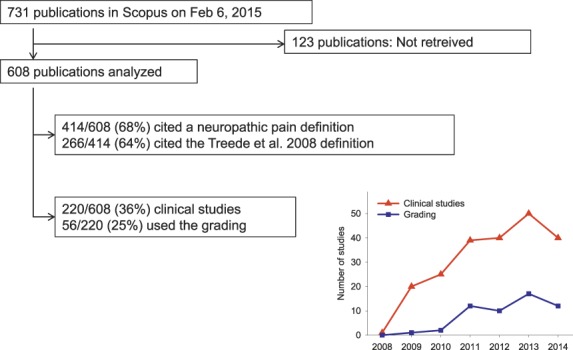
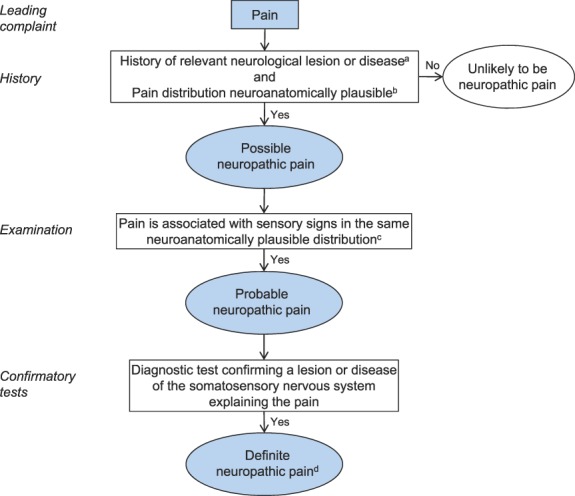
The redefinition of neuropathic pain as “pain arising as a direct consequence of a lesion or disease affecting the somatosensory system,” which was suggested by the International Association for the Study of Pain (IASP) Special Interest Group on Neuropathic Pain (NeuPSIG) in 2008, has been widely accepted. In contrast, the proposed grading system of possible, probable, and definite neuropathic pain from 2008 has been used to a lesser extent. Here, we report a citation analysis of the original NeuPSIG grading paper of 2008, followed by an analysis of its use by an expert panel and recommendations for an improved grading system. As of February, 2015, 608 eligible articles in Scopus cited the paper, 414 of which cited the neuropathic pain definition. Of 220 clinical studies citing the paper, 56 had used the grading system. The percentage using the grading system increased from 5% in 2009 to 30% in 2014. Obstacles to a wider use of the grading system were identified, including (1) questions about the relative significance of confirmatory tests, (2) the role of screening tools, and (3) uncertainties about what is considered a neuroanatomically plausible pain distribution. Here, we present a revised grading system with an adjusted order, better reflecting clinical practice, improvements in the specifications, and a word of caution that even the “definite” level of neuropathic pain does not always indicate causality. In addition, we add a table illustrating the area of pain and sensory abnormalities in common neuropathic pain conditions and propose areas for further research.
Overview
The claims and statistics of this paper haven’t been checked yet.
Run the check — free, no account needed. It reads the open-access text and checks the sources it cites.
Integrity signals
Registry
Cites
Statistics
Figures
Verification
Claims the paper makes
The claims and statistics of this paper haven’t been checked yet.
Run the check — free, no account needed. It reads the open-access text and checks the sources it cites.
Claims other papers make about this one
Each is checked against this paper’s own text: does it say what the citing paper says it does?
The source backs part of the claim, not all of it — or backs it for a different population, condition or comparison.
In the citing paper
“To indicate probable neuropathic pain, pain must also be associated with sensory abnormalities (i.e., clinical signs such as allodynia and/or hyperalgesia) in the same neuroanatomical plausible distribution (Finnerup et al. 2016; Schmid et al. 2023).”
From The Prevalence of Neuropathic Pain in Multiple Sclerosis—A Systematic Review and Meta‐Analysis Using the NeuPSIG Algorithm (2026) · cites this paper as Finnerup et al. 2016
Experimental — accuracy not yet measuredThe cited source says what the claim attributes to it.
In the citing paper
“Lastly, to establish definite neuropathic pain, additional objective confirmation of a lesion or disease in the somatosensory nervous system that may explain the pain is required (Finnerup et al. 2016; Schmid et al. 2023).”
From The Prevalence of Neuropathic Pain in Multiple Sclerosis—A Systematic Review and Meta‐Analysis Using the NeuPSIG Algorithm (2026) · cites this paper as Finnerup et al. 2016
The cited source says what the claim attributes to it.
In the citing paper
“To indicate possible neuropathic pain, patients must meet two criteria. First, the medical history should prompt a possible explanation for neuropathic pain, and patients should present with clinical symptoms. Second, the experienced pain distribution must be neuroanatomically plausible (i.e., the experienced pain is likely to correspond to the patient's neurological damage) (Finnerup et al. 2016;”
From The Prevalence of Neuropathic Pain in Multiple Sclerosis—A Systematic Review and Meta‐Analysis Using the NeuPSIG Algorithm (2026) · cites this paper as Finnerup et al. 2016
The cited source says what the claim attributes to it.
In the citing paper
“the Neuropathic Pain Special Interest Group (NeuPSIG) has developed a grading system for the identification of neuropathic pain (Finnerup et al. 2016; Schmid et al. 2023)”
From The Prevalence of Neuropathic Pain in Multiple Sclerosis—A Systematic Review and Meta‐Analysis Using the NeuPSIG Algorithm (2026) · cites this paper as Finnerup et al. 2016
The cited source says what the claim attributes to it.
In the citing paper
“Importantly, a possible diagnosis cannot replace the probable and definite certainty provided by NeuPSIG in clinical practice (Finnerup et al. 2016).”
From The Prevalence of Neuropathic Pain in Multiple Sclerosis—A Systematic Review and Meta‐Analysis Using the NeuPSIG Algorithm (2026) · cites this paper as Finnerup et al. 2016
The cited source says what the claim attributes to it.
In the citing paper
“Importantly, the algorithms used across diagnostic certainty levels do not yield a definitive diagnosis of neuropathic pain (i.e., not to be confused with definite neuropathic pain). Instead, the grading system evaluate the probability that the experienced pain is caused by neurological damage, with increasing certainty as more criteria are met (Finnerup et al. 2016).”
From The Prevalence of Neuropathic Pain in Multiple Sclerosis—A Systematic Review and Meta‐Analysis Using the NeuPSIG Algorithm (2026) · cites this paper as Finnerup et al. 2016
The cited source says what the claim attributes to it.
In the citing paper
“Given these considerations and in line with existing guidelines, the establishment of a probable diagnosis of neuropathic pain may be adequate for prompting analgesic treatments in pwMS, provided that the patient has a valid diagnosis of MS (Finnerup et al. 2016; Treede et al. 2019).”
From The Prevalence of Neuropathic Pain in Multiple Sclerosis—A Systematic Review and Meta‐Analysis Using the NeuPSIG Algorithm (2026) · cites this paper as Finnerup et al. 2016
The cited source says what the claim attributes to it.
In the citing paper
“Hence, achieving definite diagnostic certainty does not constitute absolute proof of central neuropathic pain but should rather be interpreted as a strong indication within the context of best clinical practice (Finnerup et al. 2016).”
From The Prevalence of Neuropathic Pain in Multiple Sclerosis—A Systematic Review and Meta‐Analysis Using the NeuPSIG Algorithm (2026) · cites this paper as Finnerup et al. 2016
Self-check
Percentages, sums and reported differences re-computed from the paper’s own numbers.
The self-check needs the paper’s full text.
Citations
Cites
Central sensitization: implications for the diagnosis and treatment of pain
Woolf, C. J. (2011) · Pain · doi:10.1016/j.pain.2010.09.030 · Cited by 4,771 · cited 1×
“Because of central sensitization phenomena, the areas of allodynia and hyperalgesia may extend beyond the innervation territory.(35) Table 1”
BackgroundPharmacotherapy for neuropathic pain in adults: a systematic review and meta-analysis
Finnerup, N. B., Attal, N., Haroutounian, S., McNicol, E., Baron, R., Dworkin, R. H., Gilron, I., Haanpää, M., Hansson, P., Jensen, T. S., et al. (2015) · The Lancet Neurology · doi:10.1016/s1474-4422(14)70251-0 · Cited by 3,980
Self-citationBouhassira, D., Attal, N., Alchaar, H., Boureau, F., Brochet, B., Bruxelle, J., Cunin, G., Fermanian, J., Giniès, P., Grun-Overdyking, A., et al. (2005) · Pain · doi:10.1016/j.pain.2004.12.010 · Cited by 2,834
Self-citationA classification of chronic pain for ICD-11
Treede, R.-D., Rief, W., Barke, A., Aziz, Q., Bennett, M. I., Benoliel, R., Cohen, M., Evers, S., Finnerup, N. B., First, M. B., et al. (2015) · Pain · doi:10.1097/j.pain.0000000000000160 · Cited by 2,822
Self-citationTreede (2008) · doi:10.1212/01.wnl.0000282763.29778.59 · Cited by 2,746
Self-citationFreynhagen, R., Baron, R., Gockel, U., & Tölle, T. R. (2006) · Current Medical Research and Opinion · doi:10.1185/030079906x132488 · Cited by 2,280
Self-citationA new definition of neuropathic pain
Jensen, T., Baron, R., Haanpää, M., Kalso, E., Loeser, J., Rice, A., & Treede, R. (2011) · Pain · doi:10.1016/j.pain.2011.06.017 · Cited by 1,343
Self-citationThe LANSS Pain Scale: the Leeds assessment of neuropathic symptoms and signs
Bennett, M. (2001) · Pain · doi:10.1016/s0304-3959(00)00482-6 · Cited by 1,165
NeuPSIG guidelines on neuropathic pain assessment
Haanpää, M., Attal, N., Backonja, M., Baron, R., Bennett, M., Bouhassira, D., Cruccu, G., Hansson, P., Haythornthwaite, J. A., Iannetti, G. D., et al. (2011) · Pain · doi:10.1016/j.pain.2010.07.031 · Cited by 1,060
Self-citationMaier, C., Baron, R., Tölle, T. R., Binder, A., Birbaumer, N., Birklein, F., Gierthmühlen, J., Flor, H., Geber, C., Huge, V., et al. (2010) · Pain · doi:10.1016/j.pain.2010.05.002 · Cited by 1,021
Self-citation
Cited by
Sorted by citations
Treede, R.-D., Rief, W., Barke, A., Aziz, Q., Bennett, M. I., Benoliel, R., Cohen, M., Evers, S., Finnerup, N. B., First, M. B., et al. (2019) · Pain · doi:10.1097/j.pain.0000000000001384 · Cited by 3,478
Self-citationChronic pain: an update on burden, best practices, and new advances
Cohen, S. P., Vase, L., & Hooten, W. M. (2021) · The Lancet · doi:10.1016/s0140-6736(21)00393-7 · Cited by 2,614
Colloca, L., Ludman, T., Bouhassira, D., Baron, R., Dickenson, A. H., Yarnitsky, D., Freeman, R. L., Truini, A., Attal, N., Finnerup, N. B., et al. (2017) · Nature Reviews Disease Primers · doi:10.1038/nrdp.2017.2 · Cited by 2,271
Self-citationNeuropathic Pain: From Mechanisms to Treatment
Finnerup, N. B., Kuner, R., & Jensen, T. S. (2020) · Physiological Reviews · doi:10.1152/physrev.00045.2019 · Cited by 1,727
Self-citationThe IASP classification of chronic pain for ICD-11: chronic neuropathic pain
Scholz, J., Finnerup, N. B., Attal, N., Aziz, Q., Baron, R., Bennett, M. I., Benoliel, R., Cohen, M., Cruccu, G., Davis, K. D., et al. (2019) · Pain · doi:10.1097/j.pain.0000000000001365 · Cited by 1,171
“The definite diagnosis of neuropathic pain requires demonstration of the cause, eg, neurophysiological tests confirming a peripheral neuropathy or imaging results showing the involvement of somatosensory fiber tracts after spinal cord injury.(6,10,25) Neuropathic pain also requires specific treatment, involving both p…”
Self-citation
Metadata
- Authors
- Finnerup, N. B., Haroutounian, S., Kamerman, P., Baron, R., Bennett, D. L. H., Bouhassira, D., Cruccu, G., Freeman, R., Hansson, P., Nurmikko, T., Raja, S. N., Rice, A. S. C., Serra, J., Smith, B. H., Treede, R.-D., & Jensen, T. S.
- Affiliations
- Aarhus University (DK)
- Washington University in St. Louis (US)
- University of the Witwatersrand (ZA)
- University Hospital Schleswig-Holstein (DE)
- University of Oxford (GB)
- Inserm (FR)
- Sapienza University of Rome (IT)
- Beth Israel Deaconess Medical Center (US)
- Oslo University Hospital (NO)
- Walton Centre (GB)
- Johns Hopkins University (US)
- Chelsea and Westminster Hospital NHS Foundation Trust (GB)
- Neuroscience Technologies, Ltd, Barcelona, Spain
- University of Dundee (GB)
- Heidelberg University (DE)
- Corresponding author
- Finnerup, Nanna B.
- ORCID
- Venue
- Pain
- Published
- 2016-01-13
- Volume
- 157
- Issue
- 8
- Pages
- 1599-1606
- ISSN
- 0304-3959 (ISSN-L)
- 1872-6623
- PMC
- PMC4949003
- OpenAlex
- W2316569153
- Semantic Scholar
- 4d1325782b7eb15e39a0a2fafbff56c6b01dbb4c
- Cited by
- 1,332
- References
- 34
- Citations by year
- 2026: 116 · 2025: 155 · 2024: 134 · 2023: 198 · 2022: 138 · 2021: 164 · 2020: 131 · 2019: 120 · 2018: 97 · 2017: 57 · 2016: 17
- FWCI
- 11.40
- Type
- journal article
- Language
- en
- Open access
- hybrid
- doi.org
- Locations
- Pain (publishedVersion, cc-by)
- Europe PMC (PubMed Central) (publishedVersion, cc-by)
- PubMed Central (publishedVersion, cc-by)
- PubMed (publishedVersion)
- Discovery Research Portal (University of Dundee) (publishedVersion, cc-by)
- Digital Commons@Becker (Washington University School of Medicine) (submittedVersion)
- IRIS Research product catalog (Sapienza University of Rome) (submittedVersion, cc-by)
- Digital Access to Scholarship at Harvard (DASH) (Harvard University) (submittedVersion, cc-by)
- Spiral (Imperial College London) (submittedVersion, other-oa)
- Funders
- Eli Lilly and Company
- Pfizer
- AstraZeneca
- Sanofi
- International Association for the Study of Pain
- Teva Pharmaceutical Industries
- Glenmark Pharmaceuticals
- European Commission (633491, HORIZON2020)
- Deutsche Forschungsgemeinschaft
- Bundesministerium für Bildung und Forschung
- Eisai
- Novo Nordisk (NNF14SA0006)
- Astellas Pharma
- Novo Nordisk Fonden (NNF14SA000 6, NNF14OC0011633)
- Allergan
- Sanofi Pasteur
- National Institute of General Medical Sciences
- Daiichi Sankyo Europe
- Topics
- Health Sciences › Medicine › Physiology (medical) › Pain Mechanisms and Treatments
- Health Sciences › Medicine › Anesthesiology and Pain Medicine › Pain Management and Treatment
- Health Sciences › Health Professions › Physical Therapy, Sports Therapy and Rehabilitation › Musculoskeletal pain and rehabilitation
- Keywords
- neuropathic pain, neuropathic pain diagnosis, pain distribution, sensory disturbances, confirmatory testing, screening tool
- MeSH terms
- Humans, Neuralgia, Pain Measurement, Surveys and Questionnaires, Research, Pain Management
About these checks
Registry, retraction, Cites and statistics results are computed, not judged, with one exception: a printed reference that no index lists is read once by a model before it counts as a citation error. Claims are extracted by a model and kept only when their quote appears verbatim in the text; each cited source is then checked, with a model’s help, for whether it says what the claim relies on. Those verdicts can be wrong — read the claim’s quote and the cited source before relying on one.
Statistics and arithmetic are recomputed, not judged.
Confidence bands are shown only for fields calibrated on our annotated test set. None is calibrated yet, so no band is shown.
What counts as a claim ›How we measure confidence ›How we check this ›
Are you an author, or do you see a problem with this page? Request a review
How to cite
Cite CoChat for the checks on this page, and the paper for its own findings.
- This page
- CoChat. (2026). Citation check: Neuropathic pain: an updated grading system for research and clinical practice. https://app.cochat.ai/papers/10.1097/j.pain.0000000000000492
- The paper
- Finnerup, N. B., Haroutounian, S., Kamerman, P., Baron, R., Bennett, D. L. H., Bouhassira, D., Cruccu, G., Freeman, R., Hansson, P., Nurmikko, T., Raja, S. N., Rice, A. S. C., Serra, J., Smith, B. H., Treede, R.-D., & Jensen, T. S. (2016). Neuropathic pain: an updated grading system for research and clinical practice. Pain. https://doi.org/10.1097/j.pain.0000000000000492
