

Metabolic syndrome independently predicts future diabetes in women with a history of gestational diabetes mellitus
Open accessThe DOI matches its Crossref record; 34 of the 34 references it cites were found in a registry or an index.
Abstract
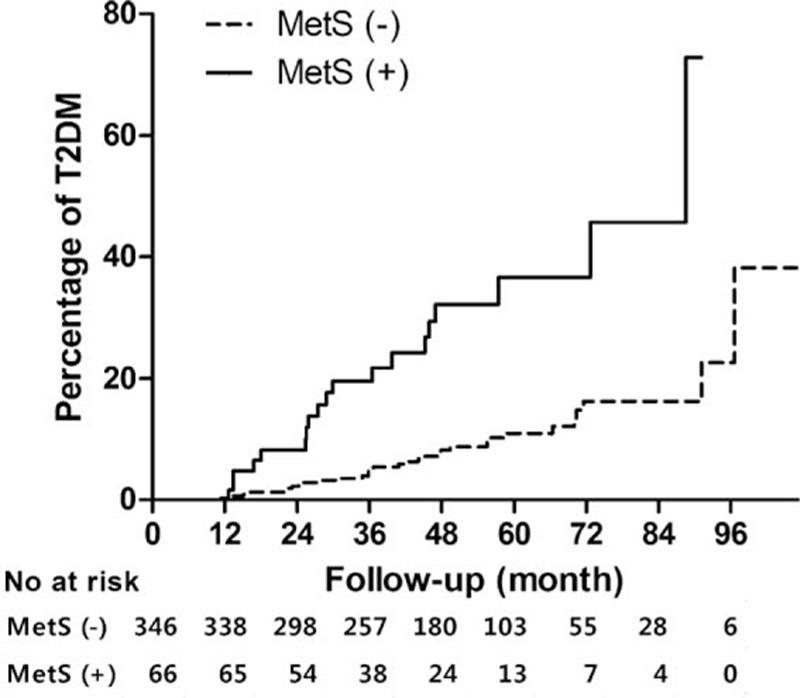
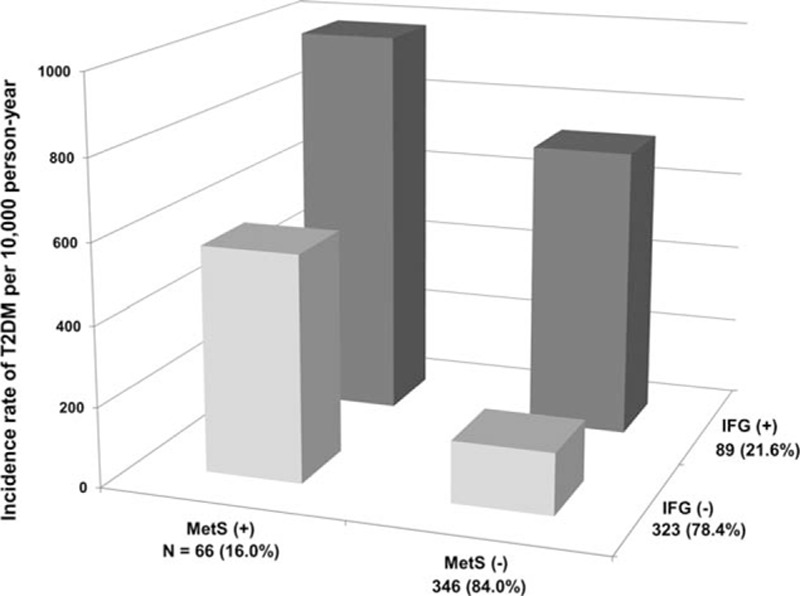
Metabolic syndrome (MetS) is an established predisposing condition for type 2 diabetes mellitus (T2DM). However, it is not thoroughly evaluated whether MetS increases the risk of T2DM in women with a previous history of gestational diabetes mellitus (GDM) who already at high risk of T2DM compared with the general population. We investigated the impact of MetS on the development of postpartum diabetes in women with a history of GDM.This was a multicenter, prospective cohort study of women diagnosed with GDM. The follow-up evaluations, including the oral glucose tolerance test, were completed at 6 weeks postpartum and annually thereafter. MetS was diagnosed at the initial postpartum evaluation according to the revised criteria of the National Cholesterol Education Program-Adult Treatment Panel III. The risk of developing type 2 diabetes (T2DM) in the follow-up period was analyzed based on the presence of MetS, and the adjusted risk was calculated using a Cox proportional hazards model.A total of 412 women without diabetes at the initial postpartum evaluation participated in the annual follow-up for median 3.8 years. MetS was prevalent in 66 (19.2%) women at the initial postpartum evaluation. The incidences of diabetes in women with and without MetS were 825 and 227 per 10,000 person-years, respectively (P < 0.001). The presence of MetS was an independent risk factor for T2DM, with a hazard ratio (HR) of 2.23 (95% confidence interval 1.04-5.08) in multivariate analysis after adjustment for clinical and metabolic parameters. When we considered MetS and impaired fasting glucose (IFG) separately, women with MetS, IFG, or both had an increased risk of T2DM, with HRs of 4.17, 4.36, and 6.98, respectively.The presence of MetS during the early postpartum period is an independent risk factor for the development of T2DM in women with a previous history of GDM.
Overview
The claims and statistics of this paper haven’t been checked yet.
Free: it reads the open-access text and checks the first 5 claims that cite a source we can check. Create a free account to check every claim.
Integrity signals
Registry
Cites
Statistics
Figures
Verification
Claims the paper makes
The claims and statistics of this paper haven’t been checked yet.
Free: it reads the open-access text and checks the first 5 claims that cite a source we can check. Create a free account to check every claim.
Claims other papers make about this one
Each is checked against this paper’s own text: does it say what the citing paper says it does?
The source backs part of the claim, not all of it — or backs it for a different population, condition or comparison.
In the citing paper
“Immediately after delivery, women with a previous history of GDM are more obese and have a higher prevalence of metabolic syndrome [64,65].”
From Gestational Diabetes Mellitus: Diagnostic Approaches and Maternal-Offspring Complications (2022) · cites this paper as [65]
Experimental — accuracy not yet measured
Self-check
Percentages, sums and reported differences re-computed from the paper’s own numbers.
The self-check needs the paper’s full text.
Citations
Cites
Friedewald, W. T., Levy, R. I., & Fredrickson, D. S. (1972) · Clinical Chemistry · doi:10.1093/clinchem/18.6.499 · Cited by 32,423 · cited 1×
“LDL cholesterol levels were calculated using the Friedewald equation([19]) in subjects with serum triglyceride levels 4.”
MethodReduction in the incidence of type 2 diabetes with lifestyle intervention or metformin
(2002) · New England Journal of Medicine · doi:10.1056/nejmoa012512 · Cited by 19,011
Role of Insulin Resistance in Human Disease
Reaven, G. M. (1988) · Diabetes · doi:10.2337/diab.37.12.1595 · Cited by 12,154
Grundy, S. M., Cleeman, J. I., Daniels, S. R., Donato, K. A., Eckel, R. H., Franklin, B. A., Gordon, D. J., Krauss, R. M., Savage, P. J., Smith, S. C., et al. (2005) · Circulation · doi:10.1161/circulationaha.105.169404 · Cited by 11,961 · cited 1×
“In addition, we compared the effect ofMetS and IFG on the development of T2DM in these women.”
BackgroundTuomilehto, J., Lindström, J., Eriksson, J. G., Valle, T. T., Hämäläinen, H., Ilanne-Parikka, P., Keinänen-Kiukaanniemi, S., Laakso, M., Louheranta, A., Rastas, M., et al. (2001) · New England Journal of Medicine · doi:10.1056/nejm200105033441801 · Cited by 10,873
The metabolic syndrome—a new worldwide definition
Alberti, K. G. M., Zimmet, P., & Shaw, J. (2005) · The Lancet · doi:10.1016/s0140-6736(05)67402-8 · Cited by 9,352
Matsuda, M., & DeFronzo, R. A. (1999) · Diabetes Care · doi:10.2337/diacare.22.9.1462 · Cited by 5,621 · cited 1×
“To assess insulin sensitivity, the Matsuda index was calculated as 10,000/ p (fasting glucose ∗ fasting insulin ∗ mean glucose ∗ mean insulin).([20]) The insulinogenic index (IGI) ((insulin at 30 min insulin at 0min)/(glucose at 30min glucose at 0min)) was calculated to estimate insulin secretion, and the disposition…”
MethodDiagnosis and classification of diabetes mellitus
American Diabetes Association (2010) · Diabetes Care · doi:10.2337/dc10-s062 · Cited by 5,491
Standards of medical care in diabetes 2010
American Diabetes Association (2010) · Diabetes Care · doi:10.2337/dc10-s011 · Cited by 3,470
Type 2 diabetes mellitus after gestational diabetes: a systematic review and meta-analysis
Bellamy, L., Casas, J.-P., Hingorani, A. D., & Williams, D. (2009) · The Lancet · doi:10.1016/s0140-6736(09)60731-5 · Cited by 3,253 · cited 12×
“Women with a history of GDM have more than a 7-fold increased risk of developing T2DMcompared with those without a history of GDM.[6] InKoreanwomen, theriskofdevelopingT2DMis3.”
BackgroundInfluentialDiagnosis and Classification of diabetes mellitus
(2014) · Diapedia · doi:10.14496/dia..20 · Cited by 3,214
Metabolic Syndrome as a Precursor of Cardiovascular Disease and Type 2 Diabetes Mellitus
Wilson, P. W. F., D’Agostino, R. B., Parise, H., Sullivan, L., & Meigs, J. B. (2005) · Circulation · doi:10.1161/circulationaha.105.539528 · Cited by 2,064 · cited 3×
“Inaddition, theriskofT2DMwas increased by5-fold evenwithout impaired fasting glucose (IFG).([4])Gestational diabetes mellitus (GDM), which is defined as carbohydrate intolerance with onset or first recognition during pregnancy,([5]) also increases the lifetime risk of type 2 diabetes mellitus (T2DM).”
BackgroundInfluentialPHYSICAL ACTIVITY ASSESSMENT METHODOLOGY IN THE FIVE-CITY PROJECT1
SALLIS, J. F., HASKELL, W. L., WOOD, P. D., FORTMANN, S. P., ROGERS, T., BLAIR, S. N., & PAFFENBARGER, R. S. (1985) · American Journal of Epidemiology · doi:10.1093/oxfordjournals.aje.a113987 · Cited by 1,716 · cited 1×
“Physical activity was assessed at each postpartum evaluation and was classified as mild, moderate, or vigorous.([17]) The subjects with moderate or vigorous physical activity were considered to be physically active.”
BackgroundLaaksonen, D. E. (2002) · American Journal of Epidemiology · doi:10.1093/aje/kwf145 · Cited by 916 · cited 1×
“MetSwas diagnosed at the initial postpartum evaluation according to the revised criteria of the National Cholesterol Education Program-Adult Treatment Panel III.”
MethodThe Metabolic Syndrome as Predictor of Type 2 Diabetes
Lorenzo, C., Okoloise, M., Williams, K., Stern, M. P., & Haffner, S. M. (2003) · Diabetes Care · doi:10.2337/diacare.26.11.3153 · Cited by 803 · cited 1×
“30 after multivariate adjustment.([3]) In our study, the risk of T2DM was increased by 2.”
BackgroundPhysical Activity of Moderate Intensity and Risk of Type 2 Diabetes
Jeon, C. Y., Lokken, R. P., Hu, F. B., & van Dam, R. M. (2007) · Diabetes Care · doi:10.2337/dc06-1842 · Cited by 758 · cited 1×
“The subjects with moderate or vigorous physical activity were considered to be physically active.([18]) Laboratory assessment included the 75g OGTT, serum insulin and C-peptide levels, and a fasting serum lipid profile (total cholesterol, high-density lipoprotein (HDL) cholesterol, and triglycerides).”
MethodDuration of Lactation and Incidence of Type 2 Diabetes
Stuebe, A. M. (2005) · JAMA · doi:10.1001/jama.294.20.2601 · Cited by 505
Metzger, B. E. (1991) · Diabetes · doi:10.2337/diab.40.2.s197 · Cited by 481 · cited 3×
“GDM and GIGT were diagnosed based on the criteria of the Third International Workshop-Conference on Gestational Diabetes Mellitus.([5]) The criteria for glucose measurements were a fasting plasma glucose ≥5.”
BackgroundMethodInfluentialSelf-citationBuchanan, T. A. (2001) · The Journal of Clinical Endocrinology & Metabolism · doi:10.1210/jc.86.3.989 · Cited by 335
Evaluation of proposed oral disposition index measures in relation to the actual disposition index
Retnakaran, R., Qi, Y., Goran, M. I., & Hamilton, J. K. (2009) · Diabetic Medicine · doi:10.1111/j.1464-5491.2009.02841.x · Cited by 320 · cited 1×
“The insulinogenic index (IGI) ((insulin at 30 min insulin at 0min)/(glucose at 30min glucose at 0min)) was calculated to estimate insulin secretion, and the disposition index (Matsuda index ∗ IGI) was calculated to assess insulin secretion considering the degree of insulin sensitivity.([21])”
MethodLauenborg, J., Mathiesen, E., Hansen, T., Glümer, C., Jørgensen, T., Borch-Johnsen, K., Hornnes, P., Pedersen, O., & Damm, P. (2005) · The Journal of Clinical Endocrinology & Metabolism · doi:10.1210/jc.2004-1713 · Cited by 279 · cited 12×
“Women with a history of GDM have more than a 7-fold increased risk of developing T2DMcompared with those without a history of GDM.[6] InKoreanwomen, theriskofdevelopingT2DMis3.”
BackgroundInfluentialProgression From Newly Acquired Impaired Fasting Glusose to Type 2 Diabetes
Nichols, G. A., Hillier, T. A., & Brown, J. B. (2007) · Diabetes Care · doi:10.2337/dc06-1392 · Cited by 272
Early postpartum metabolic assessment in women with prior gestational diabetes
Pallardo, F., Herranz, L., Garcia-Ingelmo, T., Grande, C., Martin-Vaquero, P., Jañez, M., & Gonzalez, A. (1999) · Diabetes Care · doi:10.2337/diacare.22.7.1053 · Cited by 160 · cited 1×
“When we consideredMetS and impaired fasting glucose (IFG) separately, womenwith MetS, IFG, or both had an increased risk of T2DM, with HRs of 4.17, 4.36, and 6.98, respectively.”
BackgroundInfluentialIncreased Risk of Hypertension After Gestational Diabetes Mellitus
Tobias, D. K., Hu, F. B., Forman, J. P., Chavarro, J., & Zhang, C. (2011) · Diabetes Care · doi:10.2337/dc11-0268 · Cited by 118
Breast-feeding and maternal risk of type 2 diabetes: a prospective study and meta-analysis
Jäger, S., Jacobs, S., Kröger, J., Fritsche, A., Schienkiewitz, A., Rubin, D., Boeing, H., & Schulze, M. B. (2014) · Diabetologia · doi:10.1007/s00125-014-3247-3 · Cited by 116
2011 Clinical Practice Guidelines for Type 2 Diabetes in Korea
Ko, S.-H., Kim, S.-R., Kim, D.-J., Oh, S.-J., Lee, H.-J., Shim, K.-H., Woo, M.-H., Kim, J.-Y., Kim, N.-H., Kim, J.-T., et al. (2011) · Diabetes & Metabolism Journal · doi:10.4093/dmj.2011.35.5.431 · Cited by 114
Kwak, S. H., Choi, S. H., Jung, H. S., Cho, Y. M., Lim, S., Cho, N. H., Kim, S. Y., Park, K. S., & Jang, H. C. (2013) · The Journal of Clinical Endocrinology & Metabolism · doi:10.1210/jc.2012-3324 · Cited by 112
Self-citationLipid Levels in Former Gestational Diabetic Mothers
Meyers-Seifer, C. H., & Vohr, B. R. (1996) · Diabetes Care · doi:10.2337/diacare.19.12.1351 · Cited by 106
Metabolic syndrome as a risk factor for diabetes
Aschner, P. J. (2010) · Expert Review of Cardiovascular Therapy · doi:10.1586/erc.10.13 · Cited by 99
Jang, H. C. (2011) · Diabetes & Metabolism Journal · doi:10.4093/dmj.2011.35.1.1 · Cited by 78 · cited 1×
“5times greater in women with a history of GDM than in the general population.([7,8]) Because of this high incidence of T2DM, the identification and prediction of high-risk groups for T2DM are crucial for women with a history of GDM.”
BackgroundSelf-citationPrevalence of type 2 diabetes among women with a previous history of gestational diabetes mellitus
Lee, H., Jang, H. C., Park, H. K., Metzger, B. E., & Cho, N. H. (2008) · Diabetes Research and Clinical Practice · doi:10.1016/j.diabres.2008.02.017 · Cited by 61 · cited 2×
“We have previously investigated the risk of T2DM in women with a history of GDM compared with the general population.([8]) In present study, we mainly focused on women with a previous history of GDM who are at high risk of future T2DM, and investigated whether MetS additionally increases the risk of T2DM.”
BackgroundSelf-citationThe metabolic syndrome in early pregnancy and risk of gestational diabetes mellitus
Chatzi, L., Plana, E., Pappas, A. C., Alegkakis, D., Karakosta, P., Daraki, V. N., Vassilaki, M. E., Tsatsanis, C., Kafatos, A., Koutis, A., et al. (2009) · Diabetes & Metabolism · doi:10.1016/j.diabet.2009.07.003 · Cited by 55 · cited 12×
“Women with a history of GDM have more than a 7-fold increased risk of developing T2DMcompared with those without a history of GDM.[6] InKoreanwomen, theriskofdevelopingT2DMis3.”
BackgroundInfluentialCho, N. H., Jang, H. C., Park, H. K., & Cho, Y. W. (2006) · Diabetes Research and Clinical Practice · doi:10.1016/j.diabres.2005.06.003 · Cited by 53 · cited 1×
“The diagnosis and follow-up protocol was described in previous reports.([14]) Briefly, all pregnant women who were between 24 and 28 weeks of gestation were administered a 50g oral glucose challenge test for the initial screening of GDM.”
MethodSelf-citation
Cited by
Gestational Diabetes Mellitus: Diagnostic Approaches and Maternal-Offspring Complications
Moon, J. H., & Jang, H. C. (2022) · Diabetes & Metabolism Journal · doi:10.4093/dmj.2021.0335 · Cited by 377
Self-citationLi, Z., Cheng, Y., Wang, D., Chen, H., Chen, H., Ming, W.-K., & Wang, Z. (2020) · Journal of Diabetes Research · doi:10.1155/2020/3076463 · Cited by 231
Gestational Diabetes Mellitus: Mechanisms Underlying Maternal and Fetal Complications
Lee, J., Lee, N. K., & Moon, J. H. (2025) · Endocrinology and Metabolism · doi:10.3803/enm.2024.2264 · Cited by 101
“Over time, women with a history of GDM consistently demonstrate poorer cardiometabolic risk profiles, resulting in a higher incidence of obesity and metabolic syndrome compared to women without GDM [30,31].”
Self-citationHuvinen, E., Eriksson, J. G., Koivusalo, S. B., Grotenfelt, N., Tiitinen, A., Stach-Lempinen, B., & Rönö, K. (2018) · Acta Diabetologica · doi:10.1007/s00592-018-1118-y · Cited by 55
Kansu-Celik, H., Karakaya, B. K., Taşçı, Y., Hançerlioğulları, N., Yaman, S., Özel, Ş., & Erkaya, S. (2018) · Interventional Medicine and Applied Science · doi:10.1556/1646.10.2018.01 · Cited by 23
Metadata
- Authors
- Cho, N. H., Ahn, C. H., Moon, J. H., Kwak, S. H., Choi, S. H., Lim, S., Park, K. S., Metzger, B. E., & Jang, H. C.
- Affiliations
- Northwestern University (US)
- Seoul National University (KR)
- Corresponding author
- Jang, Hak C.
- ORCID
- Venue
- Medicine
- Published
- 2016-08
- Volume
- 95
- Issue
- 35
- Pages
- e4582
- ISSN
- 0025-7974 (ISSN-L)
- PMC
- PMC5008552
- OpenAlex
- W2514782289
- Semantic Scholar
- 1c66163f56564032e2e1e85308f422c0572d74d0
- Cited by
- 15
- References
- 33
- Citations by year
- 2026: 1 · 2025: 1 · 2024: 1 · 2023: 2 · 2022: 2 · 2021: 1 · 2020: 1 · 2019: 1 · 2018: 5
- FWCI
- 2.58
- Type
- journal article
- Language
- en
- Open access
- gold
- doi.org
- Licence
- cc-by-nc
- Locations
- Medicine (publishedVersion, cc-by-nc)
- PubMed Central (publishedVersion, cc-by-nc)
- PubMed (publishedVersion)
- AJOU Open Repository (Ajou University) (submittedVersion)
- Funders
- Seoul National University Bundang Hospital
- Seoul National University
- Topics
- Health Sciences › Medicine › Obstetrics and Gynecology › Gestational Diabetes Research and Management
- Health Sciences › Medicine › Endocrinology, Diabetes and Metabolism › Diabetes, Cardiovascular Risks, and Lipoproteins
- Health Sciences › Medicine › Endocrinology, Diabetes and Metabolism › Diabetes Management and Research
- Keywords
- metabolic syndrome, gestational diabetes mellitus, type 2 diabetes, postpartum diabetes, impaired fasting glucose, diabetes risk prediction, women, postpartum period
- MeSH terms
- Adult, Blood Glucose, Diabetes Mellitus, Type 2, Female, Follow-Up Studies, Humans, Pregnancy, Prospective Studies, Incidence, Diabetes, Gestational, Metabolic Syndrome, Postpartum Period, Republic of Korea
About these checks
Registry, retraction, Cites and statistics results are computed, not judged, with one exception: a printed reference that no index lists is read once by a model before it counts as a citation error. Claims are extracted by a model and kept only when their quote appears verbatim in the text; each cited source is then checked, with a model’s help, for whether it says what the claim relies on. Those verdicts can be wrong — read the claim’s quote and the cited source before relying on one.
Statistics and arithmetic are recomputed, not judged.
Confidence bands are shown only for fields calibrated on our annotated test set. None is calibrated yet, so no band is shown.
What counts as a claim ›How we measure confidence ›How we check this ›
Are you an author, or do you see a problem with this page? Request a review
Data sources
Bibliographic data: Semantic Scholar, OpenAlex, Crossref.
Contains information from the Semantic Scholar Academic Graph Datasets, made available under the ODC Attribution License (ODC-BY 1.0).
Semantic Scholar’s data is described in: Kinney, R., et al. (2023). The Semantic Scholar Open Data Platform. arXiv:2301.10140.
