

Meta-analysis of studies using metformin as a reducer for liver cancer risk in diabetic patients
Open accessThe DOI matches its Crossref record; 58 of the 59 references it cites were found in a registry or an index.
Abstract
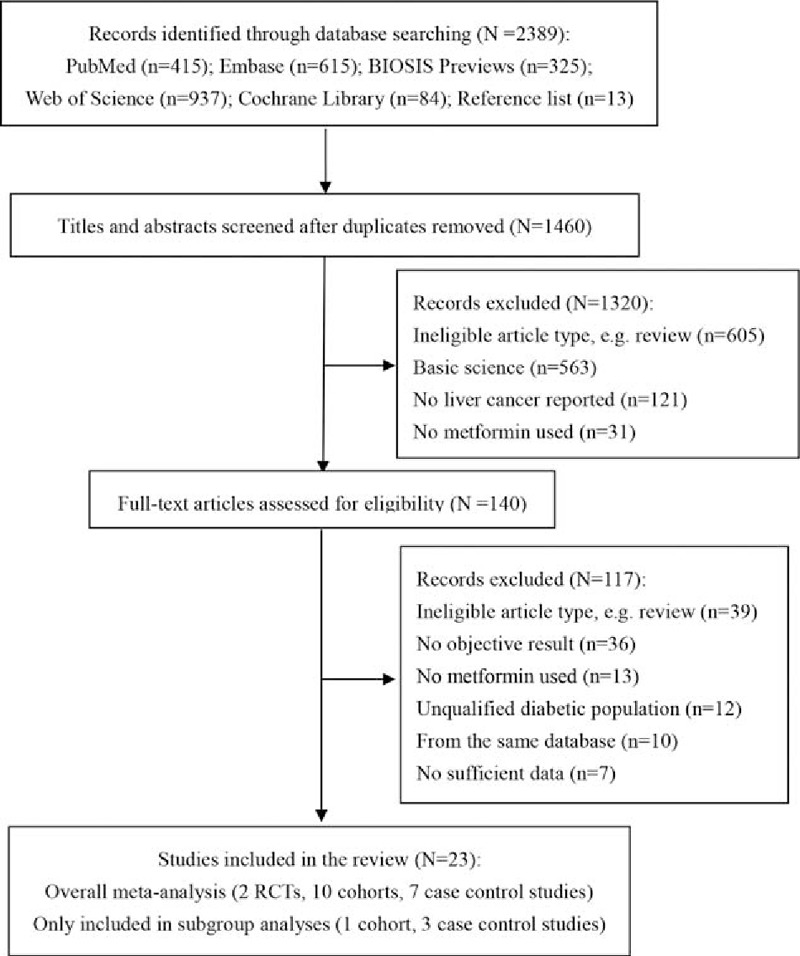
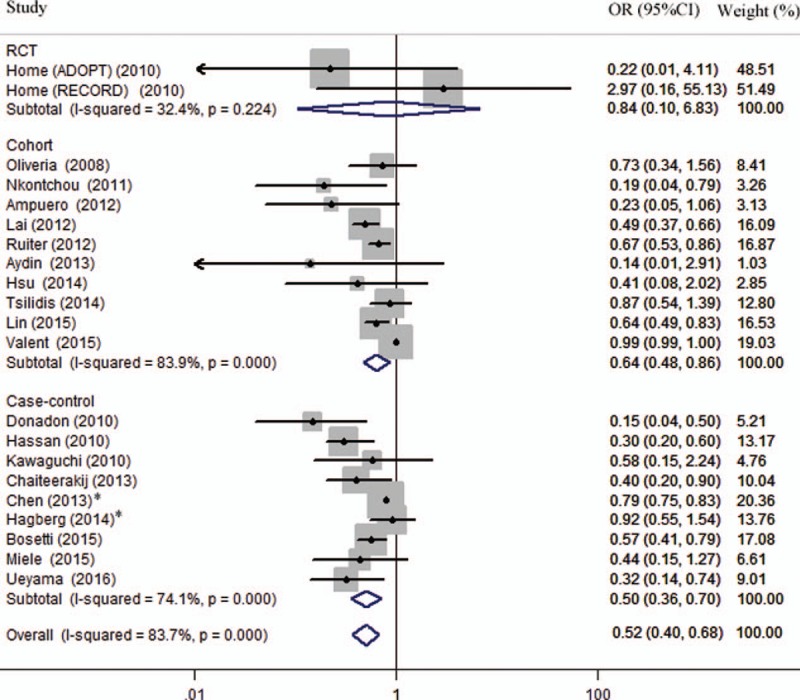
Metformin has garnered more interest as a chemo-preventive agent given the increased liver cancer risk in diabetic patients. This work was undertaken to better understand the effect of metformin use on liver cancer risk in diabetic patients.A comprehensive literature search was performed in PubMed, Embase, BIOSIS Previews, Web of Science, and Cochrane Library through July 30, 2016. Meta-analyses were performed using Stata version 12.0, with odds ratio (ORs) and 95% confidence intervals (CIs) as effect measures.Twenty-three studies were included. Meta-analysis of 19 studies involving 550,882 diabetic subjects suggested that metformin use reduced the ratio of liver cancer by 48% (OR = 0.52; 95% CI, 0.40-0.68) compared with nonusers. The protective effect was validated in all the exploratory subgroup analyses, except that pooled result of post hoc analyses of 2 randomized controlled trials found no significant difference between subjects with metformin and those without, with OR being 0.84 (95% CI, 0.10-6.83). After adjusting for hepatitis B/C virus infection, cirrhosis, obesity, behavioral factors, and time-related bias, the association was stable, pooled OR ranged from 0.42 to 0.75.A protective effect for liver cancer was found in diabetic metformin users. However, more randomized clinical evidence is still needed to verify the results.
Overview
The claims and statistics of this paper haven’t been checked yet.
Free: it reads the open-access text and checks the first 5 claims that cite a source we can check. Create a free account to check every claim.
Integrity signals
Registry
Cites
Statistics
Figures
Verification
Claims the paper makes
The claims and statistics of this paper haven’t been checked yet.
Free: it reads the open-access text and checks the first 5 claims that cite a source we can check. Create a free account to check every claim.
Claims other papers make about this one
Each is checked against this paper’s own text: does it say what the citing paper says it does?
The source backs part of the claim, not all of it — or backs it for a different population, condition or comparison.
In the citing paper
“however, most of the available evidence was gathered from observational studies with varied designs and risk for bias.1781–1783”
From American Association of Clinical Endocrinology Clinical Practice Guideline: Developing a Diabetes Mellitus Comprehensive Care Plan-2022 Update. (2022) · cites this paper as [1781]
Experimental — accuracy not yet measuredThe source backs part of the claim, not all of it — or backs it for a different population, condition or comparison.
In the citing paper
“Metformin mayeither be neutral or modestly protective regarding cancer incidence and mortality;”
From American Association of Clinical Endocrinology Clinical Practice Guideline: Developing a Diabetes Mellitus Comprehensive Care Plan-2022 Update. (2022) · cites this paper as [1781]
Experimental — accuracy not yet measuredThe check wasn’t confident either way, so it gives no verdict — never disputed.
In the citing paper
“TZD therapy in general is not associated with other cancers and a modest reduction in overall cancer risk has been reported for pioglitazone.1781”
From American Association of Clinical Endocrinology Clinical Practice Guideline: Developing a Diabetes Mellitus Comprehensive Care Plan-2022 Update. (2022) · cites this paper as [1781]
Experimental — accuracy not yet measured
Self-check
Percentages, sums and reported differences re-computed from the paper’s own numbers.
The self-check needs the paper’s full text.
Citations
Cites
Measuring inconsistency in meta-analyses
Higgins, J. P. T., Thompson, S. G., Deeks, J. J., & Altman, D. G. (2003) · BMJ · doi:10.1136/bmj.327.7414.557 · Cited by 63,139 · cited 1×
“1, and quantified by estimated I(2) (I(2)< 50% representing low heterogeneity, 50% I(2) 75% representing moderate heterogeneity, I(2) > 75% representing substantial heterogeneity).([16]) An inverse variance fixed-effects model was used to calculate when the test for heterogeneity was not statistically significant, oth…”
MethodBias in meta-analysis detected by a simple, graphical test
Egger, M., Smith, G. D., Schneider, M., & Minder, C. (1997) · BMJ · doi:10.1136/bmj.315.7109.629 · Cited by 56,722 · cited 1×
“1).([21,22]) All the statistical analyses were 2-sided and performed using Stata version 12.”
MethodStang, A. (2010) · European Journal of Epidemiology · doi:10.1007/s10654-010-9491-z · Cited by 17,396 · cited 2×
“Quality assessment Newcastle–Ottawa Scale [14] was used to assess the quality of observational studies and post hoc analyses of RCTs, which were treated as cohort studies to achieve quality assessment.”
MethodOperating characteristics of a rank correlation test for publication bias
Begg, C. B., & Mazumdar, M. (1994) · Biometrics · doi:10.2307/2533446 · Cited by 16,955
Statistical Aspects of the Analysis of Data From Retrospective Studies of Disease
(1959) · JNCI: Journal of the National Cancer Institute · doi:10.1093/jnci/22.4.719 · Cited by 14,689 · cited 1×
“An inverse variance fixed-effects model was used to calculate when the test for heterogeneity was not statistically significant, otherwise the DerSimonian–Laird random-effects model was employed.([17]) Sensitivity analyses were performed to assess the robustness of results.”
MethodGuyot, P., Ades, A., Ouwens, M. J., & Welton, N. J. (2012) · BMC Medical Research Methodology · doi:10.1186/1471-2288-12-9 · Cited by 2,526
Foretz, M., Hébrard, S., Leclerc, J., Zarrinpashneh, E., Soty, M., Mithieux, G., Sakamoto, K., Andreelli, F., & Viollet, B. (2010) · Journal of Clinical Investigation · doi:10.1172/jci40671 · Cited by 1,181
El–Serag, H. B., Hampel, H., & Javadi, F. (2006) · Clinical Gastroenterology and Hepatology · doi:10.1016/j.cgh.2005.12.007 · Cited by 826 · cited 2×
“Accumulating epidemiologic studies comparing the risk of liver cancer between those using metformin with those using other ADMs have shown somewhat variable results, and it was also endorsed that confounders were not well addressed in most studies.([2]) Several meta-analyses have been published to determine if a consi…”
BackgroundResultAdjusting for publication bias in the presence of heterogeneity
Terrin, N., Schmid, C. H., Lau, J., & Olkin, I. (2003) · Statistics in Medicine · doi:10.1002/sim.1461 · Cited by 809
Nathan, D. M., Buse, J. B., Davidson, M. B., Ferrannini, E., Holman, R. R., Sherwin, R., & Zinman, B. (2009) · Diabetologia · doi:10.1007/s00125-008-1157-y · Cited by 712
Metformin and the Risk of Cancer
Suissa, S., & Azoulay, L. (2012) · Diabetes Care · doi:10.2337/dc12-0788 · Cited by 531
Metformin in Cancer Treatment and Prevention
Morales, D. R., & Morris, A. D. (2015) · Annual Review of Medicine · doi:10.1146/annurev-med-062613-093128 · Cited by 484
Gandini, S., Puntoni, M., Heckman-Stoddard, B. M., Dunn, B. K., Ford, L., DeCensi, A., & Szabo, E. (2014) · Cancer Prevention Research · doi:10.1158/1940-6207.capr-13-0424 · Cited by 457
Singh, S., Singh, P. P., Singh, A. G., Murad, M. H., & Sanchez, W. (2013) · Gastroenterology · doi:10.1053/j.gastro.2012.10.005 · Cited by 452
Wang, C., Wang, X., Gong, G., Ben, Q., Qiu, W., Chen, Y., Li, G., & Wang, L. (2012) · International Journal of Cancer · doi:10.1002/ijc.26165 · Cited by 449 · cited 1×
“Diabetes mellitus (DM) is becoming an established independent risk factor for liver cancer as reported in multiple observational studies and subsequent meta-analyses.([2,3]) In these existing studies, DM has been reported to confer a 2- to 4-fold risk of liver cancer, and the risk increases with DM severity and durati…”
BackgroundChen, H.-P., Shieh, J.-J., Chang, C.-C., Chen, T.-T., Lin, J.-T., Wu, M.-S., Lin, J.-H., & Wu, C.-Y. (2013) · Gut · doi:10.1136/gutjnl-2011-301708 · Cited by 392
Lee, M.-S., Hsu, C.-C., Wahlqvist, M. L., Tsai, H.-N., Chang, Y.-H., & Huang, Y.-C. (2011) · BMC Cancer · doi:10.1186/1471-2407-11-20 · Cited by 380
Singh, S., Singh, P. P., Singh, A. G., Murad, M. H., & Sanchez, W. (2013) · American Journal of Gastroenterology · doi:10.1038/ajg.2013.5 · Cited by 320 · cited 1×
“Moreover, metformin may be specifically sensitive to certain etiological types of liver cancer.([10]) After adjusting for HBV/HCV infection, cirrhosis, obesity, and behavioral factors, the beneficial effects on the ratio of liver cancer for metformin use were significant and larger (pooled OR ranged from 0.”
BackgroundLai, S.-W., Chen, P.-C., Liao, K.-F., Muo, C.-H., Lin, C.-C., & Sung, F.-C. (2012) · American Journal of Gastroenterology · doi:10.1038/ajg.2011.384 · Cited by 313
Association of diabetes duration and diabetes treatment with the risk of hepatocellular carcinoma
Hassan, M. M., Curley, S. A., Li, D., Kaseb, A., Davila, M., Abdalla, E. K., Javle, M., Moghazy, D. M., Lozano, R. D., Abbruzzese, J. L., et al. (2010) · Cancer · doi:10.1002/cncr.24982 · Cited by 309
Donadon, V., Balbi, M., Mas, M. D., Casarin, P., & Zanette, G. (2010) · Liver International · doi:10.1111/j.1478-3231.2010.02223.x · Cited by 292
Zheng, Z., Chen, H., Li, J., Li, T., Zheng, B., Zheng, Y., Jin, H., He, Y., Gu, Q., & Xu, X. (2012) · Diabetes · doi:10.2337/db11-0416 · Cited by 282
Self-citationAssociation of metformin use with cancer incidence and mortality: A meta-analysis
Zhang, P., Li, H., Tan, X., Chen, L., & Wang, S. (2013) · Cancer Epidemiology · doi:10.1016/j.canep.2012.12.009 · Cited by 270
Lower Risk of Cancer in Patients on Metformin in Comparison With Those on Sulfonylurea Derivatives
Ruiter, R., Visser, L. E., van Herk-Sukel, M. P. P., Coebergh, J.-W. W., Haak, H. R., Geelhoed-Duijvestijn, P. H., Straus, S. M. J. M., Herings, R. M. C., & Stricker, B. H. C. (2012) · Diabetes Care · doi:10.2337/dc11-0857 · Cited by 232
Diabetes mellitus in patients with cirrhosis: clinical implications and management
Elkrief, L., Rautou, P., Sarin, S., Valla, D., Paradis, V., & Moreau, R. (2016) · Liver International · doi:10.1111/liv.13115 · Cited by 220
Chang, C.-H., Lin, J.-W., Wu, L.-C., Lai, M.-S., Chuang, L.-M., & Chan, K. A. (2012) · Hepatology · doi:10.1002/hep.25509 · Cited by 193
Tsilidis, K. K., Capothanassi, D., Allen, N. E., Rizos, E. C., Lopez, D. S., van Veldhoven, K., Sacerdote, C., Ashby, D., Vineis, P., Tzoulaki, I., et al. (2014) · Diabetes Care · doi:10.2337/dc14-0584 · Cited by 190
for the ADOPT Study Group and the RECORD Steering Committee, Home, P. D., Kahn, S. E., Jones, N. P., Noronha, D., Beck-Nielsen, H., & Viberti, G. (2010) · Diabetologia · doi:10.1007/s00125-010-1804-y · Cited by 177 · cited 9×
“Pooled result of post hoc analyses of 2 RCTs([23]) found no significant difference between subjects with metformin and those without, with OR being 0.”
InfluentialImpact of Metformin on the Prognosis of Cirrhosis Induced by Viral Hepatitis C in Diabetic Patients
Nkontchou, G., Cosson, E., Aout, M., Mahmoudi, A., Bourcier, V., Charif, I., Ganne-Carrie, N., Grando-Lemaire, V., Vicaut, E., Trinchet, J.-C., et al. (2011) · The Journal of Clinical Endocrinology & Metabolism · doi:10.1210/jc.2010-2415 · Cited by 166 · cited 6×
“Treatment comparators were sulfonylureas,([28,31,32,37]) insulin([25,26,29,32,37,40]) or nonuse of any ADMs.”
BackgroundInfluentialThe Influence of Type 2 Diabetes and Glucose-Lowering Therapies on Cancer Risk in the Taiwanese
Hsieh, M.-C., Lee, T.-C., Cheng, S.-M., Tu, S.-T., Yen, M.-H., & Tseng, C.-H. (2012) · Experimental Diabetes Research · doi:10.1155/2012/413782 · Cited by 163
Zhang, Z. ‐., & Li, S. (2014) · Diabetes, Obesity and Metabolism · doi:10.1111/dom.12267 · Cited by 149
Chaiteerakij, R., Yang, J. D., Harmsen, W. S., Slettedahl, S. W., Mettler, T. A., Fredericksen, Z. S., Kim, R. W., Gores, G. J., Roberts, R. O., Olson, J. E., et al. (2013) · Hepatology · doi:10.1002/hep.26092 · Cited by 149
Antidiabetic therapy and increased risk of hepatocellular carcinoma in chronic liver disease
Donadon, V., Balbi, M., Ghersetti, M., Grazioli, S., Perciaccante, A., Valentina, G. D., Gardenal, R., Mas, M. D., Casarin, P., Zanette, G., et al. (2009) · World Journal of Gastroenterology · doi:10.3748/wjg.15.2506 · Cited by 145
Hepatocellular carcinoma and lifestyles
Saran, U., Humar, B., Kolly, P., & Dufour, J. (2015) · Journal of Hepatology · doi:10.1016/j.jhep.2015.08.028 · Cited by 134
Oral Insulin Secretagogues, Insulin, and Cancer Risk in Type 2 Diabetes Mellitus
Chang, C.-H., Lin, J.-W., Wu, L.-C., Lai, M.-S., & Chuang, L.-M. (2012) · The Journal of Clinical Endocrinology & Metabolism · doi:10.1210/jc.2012-1162 · Cited by 129
Fidan, E., Ersöz, H. Ö., Yılmaz, M., Yilmaz, H., Koçak, M., Karahan, C., & Erem, C. (2011) · Acta Diabetologica · doi:10.1007/s00592-011-0276-y · Cited by 107
Metformin inhibits renal cell carcinoma in vitro and in vivo xenograft
Liu, J., Li, M., Song, B., Jia, C., Zhang, L., Bai, X., & Wei-lie, H. (2011) · Urologic Oncology Seminars and Original Investigations · doi:10.1016/j.urolonc.2011.01.003 · Cited by 98
Epidemiology, risk factors and surveillance of hepatocellular carcinoma.
Cabibbo, G., & Craxì, A. (2010) · PubMed · Cited by 96
Cancer incidence among patients treated with antidiabetic pharmacotherapy
Oliveria, S. A., Koro, C. E., Yood, M. U., & Sowell, M. O. (2008) · Diabetes & Metabolic Syndrome Clinical Research & Reviews · doi:10.1016/j.dsx.2007.11.002 · Cited by 89
Kawaguchi, T., Taniguchi, E., Morita, Y., Shirachi, M., Tateishi, I., Nagata, E., & Sata, M. (2010) · Liver International · doi:10.1111/j.1478-3231.2009.02191.x · Cited by 80
Cai, X., Hu, X., Cai, B., Wang, Q., LI, Y., Tan, X., HU, H., CHEN, X., Huang, J., Cheng, J., et al. (2013) · Oncology Reports · doi:10.3892/or.2013.2718 · Cited by 77
Glycated hemoglobin and antidiabetic strategies as risk factors for hepatocellular carcinoma
Donadon, V. (2010) · World Journal of Gastroenterology · doi:10.3748/wjg.v16.i24.3025 · Cited by 66
Diabetes mellitus and cancer of the digestive organs: An Italian population-based cohort study
Valent, F. (2015) · Journal of Diabetes and its Complications · doi:10.1016/j.jdiacomp.2015.07.017 · Cited by 64 · cited 6×
“Some other confounders were failed to control, such as information like details of DM (severity and duration) and metformin use (dose and duration) were absent in most studies, which would have been important to adjust for residual confounding.([9]) Fourth, significant publication bias was found for overall analysis.”
BackgroundMethodInfluentialMolecular targets of metformin antitumor action
Sośnicki, S., Kapral, M., & Węglarz, L. (2016) · Pharmacological Reports · doi:10.1016/j.pharep.2016.04.021 · Cited by 59
Lin, C.-M., Huang, H.-L., Chu, F.-Y., Fan, H.-C., Chen, H.-A., Chu, D.-M., Wu, L.-W., Wang, C.-C., Chen, W.-L., Lin, S.-H., et al. (2015) · PLOS ONE · doi:10.1371/journal.pone.0125421 · Cited by 55 · cited 4×
“In addition to age and sex, most studies adjusted for HBV/HCV infection,([7,24,25,27,30,32,33,40]) obesity,([7,25,31,32]) behavioral factors, use of statins,([6,31,38]) and time-related bias.([6,7,9,25,28,31,32]) 3.”
BackgroundMethodInfluentialHsu, Y., Wu, C., Lane, H.-Y., Chang, C., Tai, C.-M., Tseng, C., Lo, G., Perng, D., Lin, J.-T., & Mo, L. (2014) · Journal of Antimicrobial Chemotherapy · doi:10.1093/jac/dku041 · Cited by 53
Ueyama, M., Nishida, N., Korenaga, M., Korenaga, K., Kumagai, E., Yanai, H., Adachi, H., Katsuyama, H., Moriyama, S., Hamasaki, H., et al. (2015) · Journal of Gastroenterology · doi:10.1007/s00535-015-1116-6 · Cited by 50
Chiu, C.-C., Huang, C., Chen, Y., Chen, T., Liang, Y. J., Lin, S., Chen, J., Leu, H., & Chan, W. (2013) · Internal Medicine · doi:10.2169/internalmedicine.52.8276 · Cited by 50
Diabetes and Insulin Therapy, but Not Metformin, Are Related to Hepatocellular Cancer Risk
Miele, L., Bosetti, C., Turati, F., Rapaccini, G., Gasbarrini, A., La Vecchia, C., Boccia, S., & Grieco, A. (2015) · Gastroenterology Research and Practice · doi:10.1155/2015/570356 · Cited by 47
Chen, H.-H., Lin, M., Muo, C., Yeh, S.-Y., Sung, F., & Kao, C. (2015) · Medicine · doi:10.1097/md.0000000000001013 · Cited by 46
Li, J., Hernanda, P. Y., Bramer, W. M., Peppelenbosch, M. P., van Luijk, J., & Pan, Q. (2015) · PLOS ONE · doi:10.1371/journal.pone.0127967 · Cited by 42 · cited 1×
“A metaanalysis demonstrated that metformin appeared to have a direct antihepatocellular carcinoma (HCC) effect in animal models.([5]) Accumulating epidemiologic studies comparing the risk of liver cancer between those using metformin with those using other ADMs have shown somewhat variable results, and it was also end…”
ResultBosetti, C., Franchi, M., Nicotra, F., Asciutto, R., Merlino, L., La Vecchia, C., & Corrao, G. (2015) · Pharmacoepidemiology and Drug Safety · doi:10.1002/pds.3801 · Cited by 40 · cited 3×
“In addition to age and sex, most studies adjusted for HBV/HCV infection,([7,24,25,27,30,32,33,40]) obesity,([7,25,31,32]) behavioral factors, use of statins,([6,31,38]) and time-related bias.([6,7,9,25,28,31,32]) 3.”
BackgroundAmpuero, J. (2015) · World Journal of Hepatology · doi:10.4254/wjh.v7.i8.1105 · Cited by 38
Metformin and the Incidence of Cancer in Patients With Diabetes: A Nested Case-Control Study
Wang, S., Chuang, C., Muo, C., Tu, S., Lin, M., Sung, F., & Kao, C. (2013) · Diabetes Care · doi:10.2337/dc13-0708 · Cited by 32
Park, D.-B. (2015) · Diabetes & Metabolism Journal · doi:10.4093/dmj.2015.39.6.518 · Cited by 31
Anti-diabetic medications and risk of primary liver cancer in persons with type II diabetes
Hagberg, K. W., McGlynn, K. A., Sahasrabuddhe, V. V., & Jick, S. S. (2014) · British Journal of Cancer · doi:10.1038/bjc.2014.447 · Cited by 27
Diabetes is not an independent risk factor for hepatocellular carcinoma
Tseng, C. (2013) · Diabetes/Metabolism Research and Reviews · doi:10.1002/dmrr.2422 · Cited by 11
Ampuero, J., Fernández-Gil, M., Núñez, D., Alonso, S., Maraver, M., Gutiérrez, M., Cano, C., Rojas, Á., Lledó, J. L., Millán, M., et al. (2012) · Journal of Hepatology · doi:10.1016/s0168-8278(12)60618-7 · Cited by 2
Research works printed but not linked: 2
- Aydin Y Erden M Ermis F Oral antidiabetics and insulins do not increase cancer risk. Acta Medica Mediterr 2013; 29: 859– 67.
- Zheng LY Zou DJ Metformin inhibits proliferation and colony formation ability through AMP-activated protein kinase in hepatocellular carcinoma cells. Diabetes 2012; 61: A457.
Cited by
Global epidemiology of NAFLD-related HCC: trends, predictions, risk factors and prevention
Huang, D. Q., El-Serag, H. B., & Loomba, R. (2021) · Nature Reviews Gastroenterology & Hepatology · doi:10.1038/s41575-020-00381-6 · Cited by 1,855
Risk factors and prevention of hepatocellular carcinoma in the era of precision medicine
Fujiwara, N., Friedman, S. L., Goossens, N., & Hoshida, Y. (2018) · Journal of Hepatology · doi:10.1016/j.jhep.2017.09.016 · Cited by 659
Blonde, L., Umpierrez, G. E., Reddy, S. S., McGill, J. B., Berga, S. L., Bush, M., Chandrasekaran, S., DeFronzo, R. A., Einhorn, D., Galindo, R. J., et al. (2022) · Endocrine Practice · doi:10.1016/j.eprac.2022.08.002 · Cited by 507
Campbell, J. M., Bellman, S. M., Stephenson, M. D., & Lisy., K. (2017) · Ageing Research Reviews · doi:10.1016/j.arr.2017.08.003 · Cited by 455
Loomba, R., Lim, J. K., Patton, H., & El-Serag, H. B. (2020) · Gastroenterology · doi:10.1053/j.gastro.2019.12.053 · Cited by 357
Metadata
- Authors
- Ma, S., Zheng, Y., Xiao, Y., Zhou, P., & Tan, H.
- Affiliations
- Central South University (CN)
- Corresponding author
- Tan, Hongzhuan
- Venue
- Medicine
- Published
- 2017-05
- Volume
- 96
- Issue
- 19
- Pages
- e6888
- ISSN
- 0025-7974 (ISSN-L)
- PMC
- PMC5428628
- OpenAlex
- W2613565875
- Semantic Scholar
- d6b7de551d926aec4c84582572d83288707cc83a
- Cited by
- 89
- References
- 59
- Citations by year
- 2026: 2 · 2025: 5 · 2024: 8 · 2023: 10 · 2022: 16 · 2021: 15 · 2020: 9 · 2019: 11 · 2018: 10 · 2017: 3
- FWCI
- 0.84
- Type
- journal article
- Language
- en
- Open access
- gold
- doi.org
- Licence
- cc-by
- Locations
- Medicine (publishedVersion, cc-by)
- Europe PMC (PubMed Central) (publishedVersion, cc-by)
- PubMed Central (publishedVersion, cc-by)
- PubMed (publishedVersion)
- Topics
- Life Sciences › Biochemistry, Genetics and Molecular Biology › Molecular Biology › Metabolism, Diabetes, and Cancer
- Health Sciences › Medicine › Hepatology › Hepatocellular Carcinoma Treatment and Prognosis
- Health Sciences › Medicine › Oncology › Pancreatic and Hepatic Oncology Research
- Keywords
- metformin, liver cancer, hepatocellular carcinoma, diabetes mellitus, chemoprevention, cancer risk reduction, hepatocellular carcinoma incidence
- MeSH terms
- Animals, Diabetes Mellitus, Humans, Hypoglycemic Agents, Liver Neoplasms, Metformin, Risk, Diabetes Complications
About these checks
Registry, retraction, Cites and statistics results are computed, not judged, with one exception: a printed reference that no index lists is read once by a model before it counts as a citation error. Claims are extracted by a model and kept only when their quote appears verbatim in the text; each cited source is then checked, with a model’s help, for whether it says what the claim relies on. Those verdicts can be wrong — read the claim’s quote and the cited source before relying on one.
Statistics and arithmetic are recomputed, not judged.
Confidence bands are shown only for fields calibrated on our annotated test set. None is calibrated yet, so no band is shown.
What counts as a claim ›How we measure confidence ›How we check this ›
Are you an author, or do you see a problem with this page? Request a review
Data sources
Bibliographic data: Semantic Scholar, OpenAlex, Crossref.
Contains information from the Semantic Scholar Academic Graph Datasets, made available under the ODC Attribution License (ODC-BY 1.0).
Semantic Scholar’s data is described in: Kinney, R., et al. (2023). The Semantic Scholar Open Data Platform. arXiv:2301.10140.
