

The effect of whole-body vibration training on lean mass: A PRISMA-compliant meta-analysis
Open accessThe DOI matches its Crossref record; 41 of the 41 references it cites were found in a registry or an index.
Abstract
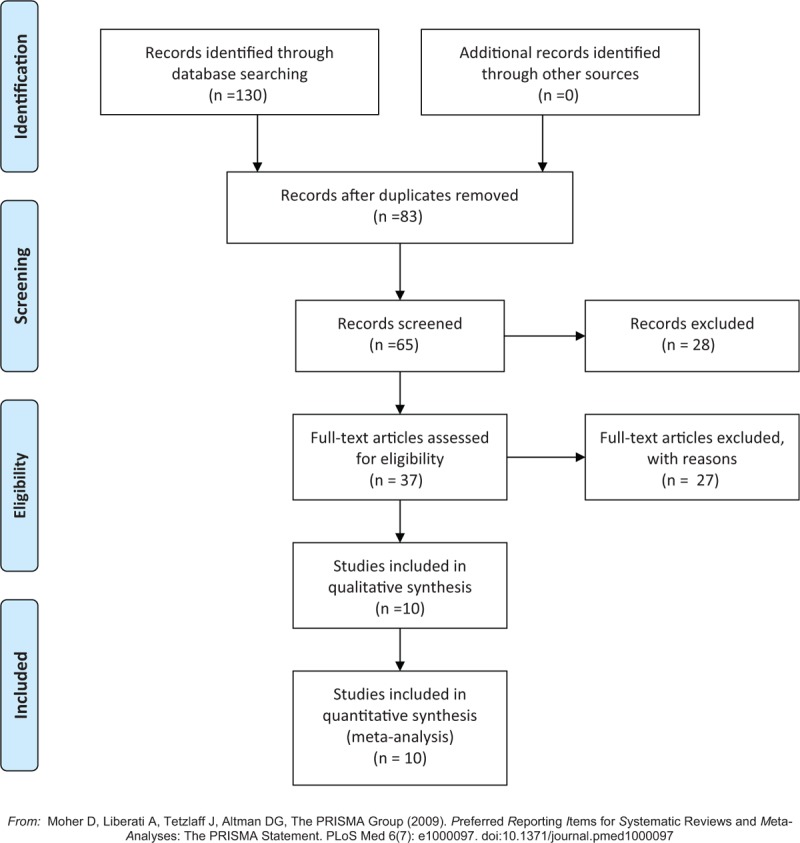
BACKGROUND: Whole-body vibration training (WBVT) confers a continuous vibration stimuli to the body. Although some reports have discussed the effects of whole-body vibration (WBV) on bone mineral density and muscle strength, study of WBV effects on lean mass have not been determined. The purpose of the present meta-analysis was to evaluate published, randomized controlled trials (RCTs) that investigated the effects of WBVT on lean mass. METHODS: We identified only RCTs by searching databases, including Web of Science, PubMed, Scopus, Embase, and the Cochrane Library from inception to March 2017. Data extraction, quality assessment, and meta-analysis were performed. RESULTS: Ten RCTs with 5 RCTs concentrating on older people, 3 on young adults, and 2 on children and adolescents were included. We additionally explored the effect of WBVT on postmenopausal women (6 trials from the 10 trials). Significant improvements in lean mass with WBVT were merely found in young adults (P = .02) but not in other populations compared to control group. CONCLUSION: The effect of WBVT found in the present meta-analysis may be used in counteracting the loss of muscle mass in younger adults. Moreover, optimal WBVT protocols for greater muscle hypertrophy are expected to be investigated.
Overview
The claims and statistics of this paper haven’t been checked yet.
Free: it reads the open-access text and checks the first 5 claims that cite a source we can check. Create a free account to check every claim.
Integrity signals
Registry
Cites
Statistics
Figures
Verification
Claims the paper makes
The claims and statistics of this paper haven’t been checked yet.
Free: it reads the open-access text and checks the first 5 claims that cite a source we can check. Create a free account to check every claim.
Claims other papers make about this one
Each is checked against this paper’s own text: does it say what the citing paper says it does?
The source backs part of the claim, not all of it — or backs it for a different population, condition or comparison.
In the citing paper
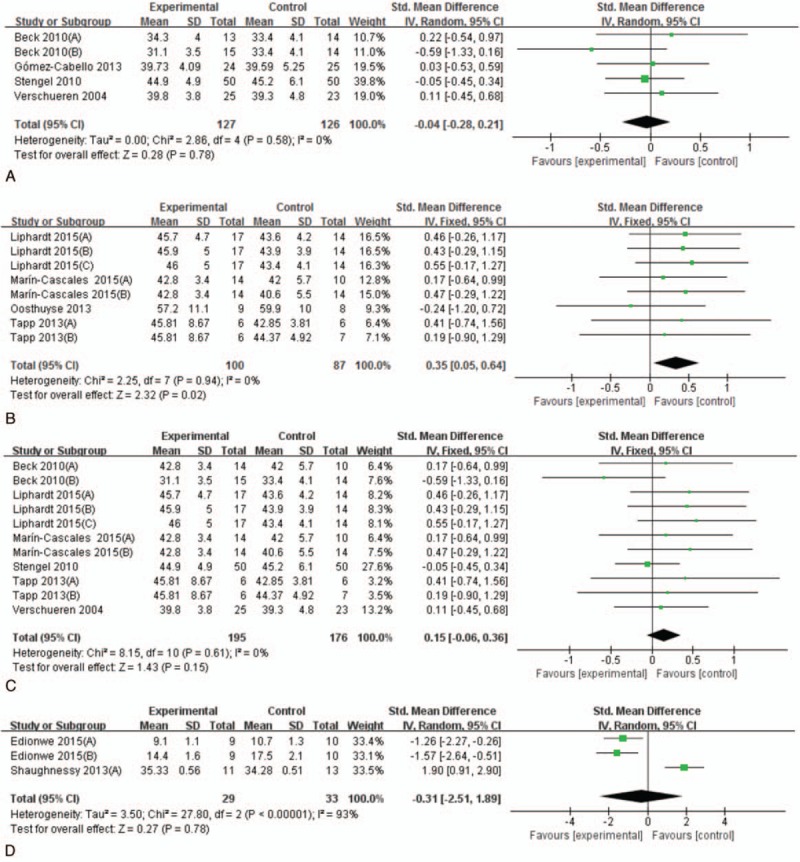
“Hengting Chen and colleagues370 identified 10 randomized trials of whole-body vibration therapy showing its usefulness in younger adults (difference (d) = 0.35 (95% CI 0.05–0.64; P = 0.02)), but this usefulness was not seen in older adults (d = −0.04 (95% CI −0.28 to 0.21; P = 0.78)).”
From Sarcopenic obesity in older adults: aetiology, epidemiology and treatment strategies (2018) · cites this paper as [370]
Experimental — accuracy not yet measuredThe cited source says what the claim attributes to it.
In the citing paper
“The review included heterogeneous studies using different methodologies, training and vibration characteristics.”
From Sarcopenic obesity in older adults: aetiology, epidemiology and treatment strategies (2018) · cites this paper as [370]
Self-check
Percentages, sums and reported differences re-computed from the paper’s own numbers.
The self-check needs the paper’s full text.
Citations
Cites
Measuring inconsistency in meta-analyses
Higgins, J. P. T., Thompson, S. G., Deeks, J. J., & Altman, D. G. (2003) · BMJ · doi:10.1136/bmj.327.7414.557 · Cited by 63,139
Assessing the quality of reports of randomized clinical trials: Is blinding necessary?
Jadad, A. R., Moore, R. A., Carroll, D., Jenkinson, C., Reynolds, D. J. M., Gavaghan, D. J., & McQuay, H. J. (1996) · Controlled Clinical Trials · doi:10.1016/0197-2456(95)00134-4 · Cited by 17,582
Zhang, Q., Wang, C., Zheng, M., Li, Y., Li, J., Zhang, L., Shang, X., & Yan, C. (2015) · Cerebrovascular Diseases · doi:10.1159/000369778 · Cited by 11,533
Dong, Y., Hao, L., Shi, Z., Wang, G., Zhang, Z., & Han, C. (2013) · Urologia Internationalis · doi:10.1159/000351405 · Cited by 4,540
Fielding, R. A., Vellas, B., Evans, W. J., Bhasin, S., Morley, J. E., Newman, A. B., Abellan van Kan, G., Andrieu, S., Bauer, J., Breuille, D., et al. (2011) · Journal of the American Medical Directors Association · doi:10.1016/j.jamda.2011.01.003 · Cited by 3,256
Exercise training and nutritional supplementation for physical frailty in very elderly people
Fiatarone, M. A., O'Neill, E. F., Ryan, N. D., Clements, K. M., Solares, G. R., Nelson, M. E., Roberts, S. B., Kehayias, J. J., Lipsitz, L. A., & Evans, W. J. (1994) · New England Journal of Medicine · doi:10.1056/nejm199406233302501 · Cited by 2,857
Sarcopenia: origins and clinical relevance
Rosenberg, I. H. (1997) · The Journal of Nutrition · doi:10.1093/jn/127.5.990s · Cited by 2,399 · cited 1×
“Sarcopenia is a term derived from Greek words sarx (flesh) and penia (loss), which was firstly used by Rosenberg in 1989 to describe the decline in muscle mass among older people.([2]) The total decline in themuscle mass between age 40 and 80 years ranges from 30% to 50% and the annual decline in functional capacity i…”
MethodProgressive resistance strength training for improving physical function in older adults
Liu, C.-J., & Latham, N. K. (2009) · Cochrane Database of Systematic Reviews · doi:10.1002/14651858.cd002759.pub2 · Cited by 1,258
Age-related and disease-related muscle loss: The effect of diabetes, obesity, and other diseases
Kalyani, R. R., Corriere, M., & Ferrucci, L. (2014) · The Lancet Diabetes & Endocrinology · doi:10.1016/s2213-8587(14)70034-8 · Cited by 1,102
Verschueren, S. M., Roelants, M., Delecluse, C., Swinnen, S., Vanderschueren, D., & Boonen, S. (2004) · Journal of Bone and Mineral Research · doi:10.1359/jbmr.0301245 · Cited by 833
Exercise for improving balance in older people
Howe, T. E., Rochester, L., Neil, F., Skelton, D. A., & Ballinger, C. (2011) · Cochrane Database of Systematic Reviews · doi:10.1002/14651858.cd004963.pub3 · Cited by 809
Sarcopenia: origins and clinical relevance
Rosenberg, I. H. (2011) · Clinics in Geriatric Medicine · doi:10.1016/j.cger.2011.03.003 · Cited by 786
AGE‐RELATED CHANGES IN THE STRUCTURE AND FUNCTION OF SKELETAL MUSCLES
Faulkner, J. A., Larkin, L. M., Claflin, D. R., & Brooks, S. V. (2007) · Clinical and Experimental Pharmacology and Physiology · doi:10.1111/j.1440-1681.2007.04752.x · Cited by 759
Hormonal responses to whole-body vibration in men
Bosco, C., Iacovelli, M., Tsarpela, O., Cardinale, M., Bonifazi, M., Tihanyi, J., Viru, M., De Lorenzo, A., & Viru, A. (2000) · European Journal of Applied Physiology · doi:10.1007/s004210050067 · Cited by 497
Pang, M. Y. C., Eng, J. J., Dawson, A. S., McKay, H. A., & Harris, J. E. (2005) · Journal of the American Geriatrics Society · doi:10.1111/j.1532-5415.2005.53521.x · Cited by 389
(2004) · International Journal of Sports Medicine · doi:10.1055/s-2003-45238 · Cited by 302
Marigold, D. S., Eng, J. J., Dawson, A. S., Inglis, J. T., Harris, J. E., & Gylfadóttir, S. (2005) · Journal of the American Geriatrics Society · doi:10.1111/j.1532-5415.2005.53158.x · Cited by 278
Maximum Strength-Power-Performance Relationships in Collegiate Throwers
STONE, M. H., SANBORN, K., OʼBRYANT, H. S., HARTMAN, M., STONE, M. E., PROULX, C., WARD, B., & HRUBY, J. (2003) · Journal of Strength and Conditioning Research · doi:10.1519/00124278-200311000-00019 · Cited by 254
Exercise for improving balance in older people
Howe, T. E., Rochester, L., Jackson, A., Banks, P. M., & Blair, V. A. (2007) · Cochrane Database of Systematic Reviews · doi:10.1002/14651858.cd004963.pub2 · Cited by 196
Prevalence of sarcopenia in healthy community-dwelling elderly in an urban area of Barcelona (Spain)
Masanes Toran, F., Culla, A., Navarro-Gonzalez, M., Navarro-Lopez, M., Sacanella, E., Torres, B., & Lopez-Soto, A. (2012) · The Journal of nutrition, health and aging · doi:10.1007/s12603-011-0108-3 · Cited by 136
Sarcopenia and Fragility Fractures: Molecular and Clinical Evidence of the Bone-Muscle Interaction
Tarantino, U., Piccirilli, E., Fantini, M., Baldi, J., Gasbarra, E., & Bei, R. (2015) · Journal of Bone and Joint Surgery · doi:10.2106/jbjs.n.00648 · Cited by 129
Zaidell, L. N., Mileva, K. N., Sumners, D., & Bowtell, J. L. (2013) · PLoS ONE · doi:10.1371/journal.pone.0085247 · Cited by 112
von Stengel, S., Kemmler, W., Engelke, K., & Kalender, W. A. (2012) · Scandinavian Journal of Medicine & Science in Sports · doi:10.1111/j.1600-0838.2010.01126.x · Cited by 106
Mikhael, M., Orr, R., Amsen, F., Greene, D., & Singh, M. A. F. (2010) · BMC Geriatrics · doi:10.1186/1471-2318-10-74 · Cited by 98
Beck, B. R., & Norling, T. L. (2010) · American Journal of Physical Medicine & Rehabilitation · doi:10.1097/phm.0b013e3181f71063 · Cited by 98
Pamukoff, D. N., Ryan, E. D., & Blackburn, J. T. (2014) · Journal of Electromyography and Kinesiology · doi:10.1016/j.jelekin.2014.07.014 · Cited by 84
Cawthon, P. M., Fox, K. M., Gandra, S. R., Delmonico, M. J., Chiou, C., Anthony, M. S., Caserotti, P., Kritchevsky, S. B., Newman, A. B., Goodpaster, B. H., et al. (2011) · Journal of the American Geriatrics Society · doi:10.1111/j.1532-5415.2011.03389.x · Cited by 83
Effects of whole body vibration training on body composition in adolescents with Down syndrome
González‐Agüero, A., Matute-Llorente, Á., Gómez‐Cabello, A., Casajús, J. A., & Vicente‐Rodríguez, G. (2013) · Research in Developmental Disabilities · doi:10.1016/j.ridd.2013.01.023 · Cited by 59
Liphardt, A., Schipilow, J. D., Hanley, D. A., & Boyd, S. K. (2015) · Osteoporosis International · doi:10.1007/s00198-014-2995-8 · Cited by 52
Effects of a short-term whole body vibration intervention on physical fitness in elderly people
Gómez‐Cabello, A., González‐Agüero, A., Ara, I., Casajús, J. A., & Vicente‐Rodríguez, G. (2013) · Maturitas · doi:10.1016/j.maturitas.2012.12.008 · Cited by 49
Signorile, J. F., & Tapp (2013) · Clinical Interventions in Aging · doi:10.2147/cia.s30048 · Cited by 46
Lin, C.-I., Huang, W.-C., Chen, W.-C., Kan, N., Li, W., Chiu, Y., & Huang, C. (2015) · Metabolism · doi:10.1016/j.metabol.2015.05.007 · Cited by 41
Acute Effects of Resistance Training with Local Vibration
Couto, B. P., Silva, H., Filho, A. B. D. S., Neves, S. D. S., Ramos, M., Szmuchrowski, L. A., & Barbosa, M. (2013) · International Journal of Sports Medicine · doi:10.1055/s-0032-1331198 · Cited by 37
Cardim, A. B., Marinho, P. E., Nascimento, J. F., Fuzari, H. K., & Dornelas de Andrade, A. (2016) · Respiratory Care · doi:10.4187/respcare.04763 · Cited by 32
Lienhard, K., Vienneau, J., Nigg, S., Friesenbichler, B., & Nigg, B. M. (2016) · Journal of Biomechanics · doi:10.1016/j.jbiomech.2016.12.009 · Cited by 30
Mettlach, G., Polo‐Parada, L., Peca, L., Rubin, C. T., Plattner, F., & Bibb, J. A. (2013) · Journal of Biomechanics · doi:10.1016/j.jbiomech.2013.09.024 · Cited by 25
Effect of 12 Weeks of Whole-Body Vibration Versus Multi-Component Training in Post-Menopausal Women
Marín-Cascales, E., Rubio-Arias, J. A., Romero-Arenas, S., & Alcaraz, P. E. (2015) · Rejuvenation Research · doi:10.1089/rej.2015.1681 · Cited by 23
Edionwe, J. I., Hess, C., Fernández‐Río, J., Herndon, D. N., Andersen, C. R., Klein, G. L., Suman-Vejas, O. E., & Amonette, W. E. (2016) · Burns · doi:10.1016/j.burns.2015.10.017 · Cited by 21
Anaerobic Power in Road Cyclists Is Improved After 10 Weeks of Whole-Body Vibration Training
Oosthuyse, T., Viedge, A., McVeigh, J. A., & Avidon, I. (2012) · The Journal of Strength and Conditioning Research · doi:10.1519/jsc.0b013e31825770be · Cited by 19
Bongaarts, J. (2014) · Population and Development Review · doi:10.1111/j.1728-4457.2014.00686.x · Cited by 18
Fong, S. S. M., Chan, J. S. M., Bae, Y.-H., Yam, T. T. T., Chung, L. M. Y., W., A. W., & Kuisma, R. (2017) · Medicine · doi:10.1097/md.0000000000005961 · Cited by 14
Cited by
Sarcopenic obesity in older adults: aetiology, epidemiology and treatment strategies
Batsis, J. A., & Villareal, D. T. (2018) · Nature Reviews Endocrinology · doi:10.1038/s41574-018-0062-9 · Cited by 1,382
Wu, S., Ning, H.-T., Xiao, S.-M., Hu, M.-Y., Wu, X.-Y., Deng, H.-W., & Feng, H. (2020) · European Review of Aging and Physical Activity · doi:10.1186/s11556-020-00247-5 · Cited by 79
Kim, H., Kwon, B. S., Park, J., Lee, H. J., Nam, K., Park, T., Cho, Y.-J., & Kim, T. (2018) · Annals of Rehabilitation Medicine · doi:10.5535/arm.2018.42.6.804 · Cited by 26
Focal Vibration Therapy: Vibration Parameters of Effective Wearable Devices
Ghazi, M., Rippetoe, J., Chandrashekhar, R., & Wang, H. (2021) · Applied Sciences · doi:10.3390/app11072969 · Cited by 24
Zaidell, L. N., Pollock, R. D., James, D. C., Bowtell, J. L., Newham, D. J., Sumners, D., & Mileva, K. N. (2019) · Dose-Response · doi:10.1177/1559325818819946 · Cited by 24
Metadata
- Authors
- Chen, H., Ma, J., Lu, B., & Ma, X.-L.
- Affiliations
- Tianjin Hospital (CN)
- Venue
- Medicine
- Published
- 2017-11
- Volume
- 96
- Issue
- 45
- Pages
- e8390
- ISSN
- 0025-7974 (ISSN-L)
- PMC
- PMC5690715
- OpenAlex
- W2767392212
- Semantic Scholar
- be0a1e3bbe5e98a2e231d4452e6e1cfb2e3769b4
- Cited by
- 21
- References
- 41
- Citations by year
- 2026: 1 · 2024: 3 · 2023: 2 · 2022: 2 · 2021: 4 · 2020: 3 · 2019: 3 · 2018: 3
- FWCI
- 0.44
- Type
- journal article
- Language
- en
- Open access
- gold
- doi.org
- Licence
- cc-by
- Locations
- Medicine (publishedVersion, cc-by)
- PubMed Central (publishedVersion, cc-by)
- PubMed (publishedVersion)
- Topics
- Health Sciences › Medicine › Orthopedics and Sports Medicine › Effects of Vibration on Health
- Health Sciences › Nursing › Nutrition and Dietetics › Muscle metabolism and nutrition
- Health Sciences › Medicine › Physiology (medical) › Nutrition and Health in Aging
- Keywords
- whole-body vibration training, lean body mass, muscle mass, muscle hypertrophy, postmenopausal women, older adults, young adults, children and adolescents, muscle strength, bone mineral density
- MeSH terms
- Adolescent, Aged, Child, Female, Humans, Male, Middle Aged, Vibration, Randomized Controlled Trials as Topic, Postmenopause, Muscle, Skeletal, Physical Therapy Modalities, Muscle Strength, Young Adult
About these checks
Registry, retraction, Cites and statistics results are computed, not judged, with one exception: a printed reference that no index lists is read once by a model before it counts as a citation error. Claims are extracted by a model and kept only when their quote appears verbatim in the text; each cited source is then checked, with a model’s help, for whether it says what the claim relies on. Those verdicts can be wrong — read the claim’s quote and the cited source before relying on one.
Statistics and arithmetic are recomputed, not judged.
Confidence bands are shown only for fields calibrated on our annotated test set. None is calibrated yet, so no band is shown.
What counts as a claim ›How we measure confidence ›How we check this ›
Are you an author, or do you see a problem with this page? Request a review
Data sources
Bibliographic data: Semantic Scholar, OpenAlex, Crossref.
Contains information from the Semantic Scholar Academic Graph Datasets, made available under the ODC Attribution License (ODC-BY 1.0).
Semantic Scholar’s data is described in: Kinney, R., et al. (2023). The Semantic Scholar Open Data Platform. arXiv:2301.10140.
