

Post-traumatic stress symptom clusters in acute whiplash associated disorder and their prediction of chronic pain-related disability
Open accessThe DOI matches its Crossref record; 40 of the 40 references it cites were found in a registry or an index.
Abstract
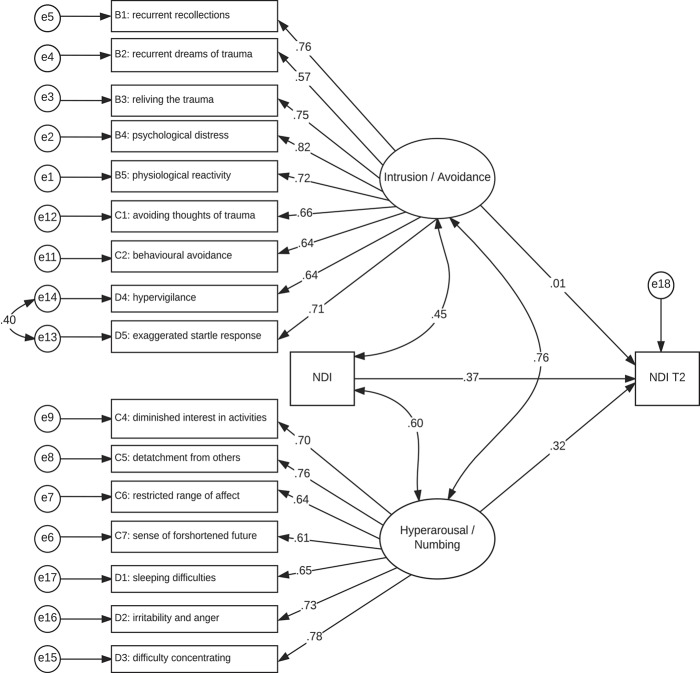
Introduction: The presence of post-traumatic stress disorder (PTSD) symptoms has been found to be associated with an increased risk of persisting neck pain and disability in motor vehicle crash (MVC) survivors with whiplash injuries. The findings are mixed as to which PTSD symptom(s) best predicts recovery in this population. Objectives: The aims were (1) to explore the factor structure of the Post-traumatic Stress Diagnostic Scale (PDS) in a sample of acute whiplash-injured individuals following a MVC and (2) to identify the PTSD-symptom clusters that best predict long-term neck pain-related disability in this population as measured by the Neck Pain Disability Index (NDI). Methods: A sample (N = 146) of whiplash-injured individuals completed the NDI and the PDS at baseline (<1 month) and at 6 months follow-up. Results: Principal component analyses generated 2 symptom clusters: re-experiencing/avoidance and hyperarousal/numbing. Nine trauma-related PTSD symptoms loaded exclusively on the re-experiencing/avoidance cluster and 7 nonspecific PTSD symptoms loaded exclusively on the hyperarousal/numbing cluster. One PTSD symptom (ie, inability to recall an important aspect of the trauma) had no salient loading on either clusters. Structural equation modelling analysis indicated that there was a significant positive relationship between the hyperarousal/numbing symptom cluster and long-term neck pain-related disability, while no significant relationship was found between the re-experiencing/avoidance symptom cluster and long-term neck pain-related disability. Conclusion: Given that only the hyperarousal/numbing symptom cluster predicted long-term neck pain-related disability, this finding may have implications in terms of diagnosis, assessment, and management of the psychological impact of whiplash-injured individuals following a MVC.
Overview
The claims and statistics of this paper haven’t been checked yet.
Free: it reads the open-access text and checks the first 5 claims that cite a source we can check. Create a free account to check every claim.
Integrity signals
Registry
Cites
Statistics
Figures
Verification
Claims the paper makes
The claims and statistics of this paper haven’t been checked yet.
Free: it reads the open-access text and checks the first 5 claims that cite a source we can check. Create a free account to check every claim.
Self-check
Percentages, sums and reported differences re-computed from the paper’s own numbers.
The self-check needs the paper’s full text.
Citations
Cites
Hu, L., & Bentler, P. M. (1999) · Structural Equation Modeling A Multidisciplinary Journal · doi:10.1080/10705519909540118 · Cited by 108,788
Marsh, H. W., Hau, K.-T., & Wen, Z. (2004) · Structural Equation Modeling: A Multidisciplinary Journal · doi:10.1207/s15328007sem1103_2 · Cited by 6,691 · cited 1×
“However, such values should be regarded as guidelines rather than strict cutoffs when assessing a model fit.(29)”
BackgroundMissing data analysis: making it work in the real world
Graham, J. W. (2009) · Annual Review of Psychology · doi:10.1146/annurev.psych.58.110405.085530 · Cited by 6,163
The Neck Disability Index: a study of reliability and validity.
Vernon, H. T., & Mior, S. A. (1991) · PubMed · Cited by 3,048
Foa, E. B., Cashman, L., Jaycox, L., & Perry, K. (1997) · Psychological Assessment · doi:10.1037/1040-3590.9.4.445 · Cited by 2,709 · cited 2×
“87).(22) The PDS also has high convergent validity with the interview version of that scale.”
BackgroundReliability and validity of a brief instrument for assessing post-traumatic stress disorder
Foa, E. B., Riggs, D. S., Dancu, C. V., & Rothbaum, B. O. (1993) · Journal of Traumatic Stress · doi:10.1002/jts.2490060405 · Cited by 2,537 · cited 1×
“The PDS also has high convergent validity with the interview version of that scale.(22,23) Internal consistency in the current study was high (a 5 0.”
BackgroundSpitzer, W. O., Skovron, M. L., Salmi, L., Cassidy, J. D., DURANCEAU, J., Suissa, S., & Zeiss, E. E. (1995) · PubMed · Cited by 1,853
On tests and indices for evaluating structural models
Bentler, P. M. (2007) · Personality and Individual Differences · doi:10.1016/j.paid.2006.09.024 · Cited by 852 · cited 1×
“The comparative fit index (CFI) and root mean square error of approximation (RMSEA) were also used.(10) As a general guide, Hu and Bentler(26) suggested the following cutoffs for “acceptable” fit: CFI$0.”
MethodChronic pain and posttraumatic stress disorder: Mutual maintenance?
Sharp, T. J., & Harvey, A. G. (2001) · Clinical Psychology Review · doi:10.1016/s0272-7358(00)00071-4 · Cited by 779 · cited 2×
“Several theoretical models have attempted to explain the reciprocal relationship between PTSD and pain associated with WAD including the mutual maintenance model.(32) This model proposes that various symptoms from the 3 DSM-IV PTSD clusters (re-”
BackgroundUnderstanding the co-occurrence of anxiety disorders and chronic pain: state-of-the-art
Asmundson, G. J. G., & Katz, J. (2009) · Depression and Anxiety · doi:10.1002/da.20600 · Cited by 756
Asmundson, G. J., Coons, M. J., Taylor, S., & Katz, J. (2002) · The Canadian Journal of Psychiatry · doi:10.1177/070674370204701004 · Cited by 695
Beck, J. G., Grant, D. M., Read, J. P., Clapp, J. D., Coffey, S. F., Miller, L. M., & Palyo, S. A. (2008) · Journal of Anxiety Disorders · doi:10.1016/j.janxdis.2007.02.007 · Cited by 500 · cited 2×
“Finally, a study conducted by Beck et al.(9) using a sample of 182MVC survivors provided support for theDSM-IV 3 PTSD-symptom clusters.”
MethodDifferentiating the mood and anxiety disorders: A quadripartite model
Watson, D. (2009) · Annual Review of Clinical Psychology · doi:10.1146/annurev.clinpsy.032408.153510 · Cited by 498 · cited 4×
“Numbing symptoms are known to be subjective general distress symptoms and nonspecific to PTSD.33,43,46 Consequently, an individual could meet the criteria for the avoidance cluster in the absence of perceived trauma.”
BackgroundInfluentialPhysical and psychological factors predict outcome following whiplash injury
Sterling, M., Jull, G., Vicenzino, B., Kenardy, J., & Darnell, R. (2005) · Pain · doi:10.1016/j.pain.2004.12.005 · Cited by 389 · cited 1×
“Several studies have shown that PTSD symptoms are predictive of later chronic neck pain and disability following a whiplash injury.(13,37,38) Whiplash-injured individuals who experience moderate to severe pain and disability at 6 to 12months post injury are also more likely to report more severe PTSD symptoms.”
BackgroundInfluentialSelf-citationSaving PTSD from itself in DSM-V
Spitzer, R. L., First, M. B., & Wakefield, J. C. (2007) · Journal of Anxiety Disorders · doi:10.1016/j.janxdis.2006.09.006 · Cited by 353 · cited 4×
“Numbing symptoms are known to be subjective general distress symptoms and nonspecific to PTSD.33,43,46 Consequently, an individual could meet the criteria for the avoidance cluster in the absence of perceived trauma.”
BackgroundInfluentialMol, S. S. L., Arntz, A., Metsemakers, J. F. M., Dinant, G.-J., Vilters-van Montfort, P. A. P., & Knottnerus, J. A. (2005) · British Journal of Psychiatry · doi:10.1192/bjp.186.6.494 · Cited by 330 · cited 3×
“Several studies have demonstrated that even in the absence of trauma, individuals can still present with a range of PTSD symptoms.(11,24,28,30) One of those studies was conducted by Bodkin et al.”
BackgroundIs life stress more traumatic than traumatic stress?
Gold, S. D., Marx, B. P., Soler-Baillo, J. M., & Sloan, D. M. (2005) · Journal of Anxiety Disorders · doi:10.1016/j.janxdis.2004.06.002 · Cited by 269 · cited 1×
“Several studies have demonstrated that even in the absence of trauma, individuals can still present with a range of PTSD symptoms.(11,24,28,30) One of those studies was conducted by Bodkin et al.”
BackgroundAcute and Chronic Posttraumatic Stress Disorder in Motor Vehicle Accident Victims
Ursano, R. J., Fullerton, C. S., Epstein, R. S., Crowley, B., Kao, T.-C., Vance, K., Craig, K. J., Dougall, A. L., & Baum, A. (1999) · American Journal of Psychiatry · doi:10.1176/ajp.156.4.589 · Cited by 241 · cited 1×
“The presence of PTSD symptoms has been found to play an important role in the persistence of whiplash symptoms.(13,27,37,41) Several studies have shown that PTSD symptoms are predictive of later chronic neck pain and disability following a whiplash injury.”
BackgroundThe structure of posttraumatic stress symptoms.
Taylor, S., Kuch, K., Koch, W. J., Crockett, D. J., & Passey, G. (1998) · Journal of Abnormal Psychology · doi:10.1037/0021-843x.107.1.154 · Cited by 217 · cited 4×
“For example, Taylor et al.(40) conducted an exploratory factor analysis”
BackgroundMethodResultInfluentialThe development of psychological changes following whiplash injury
Sterling, M., Kenardy, J., Jull, G., & Vicenzino, B. (2003) · Pain · doi:10.1016/j.pain.2003.09.013 · Cited by 216 · cited 1×
“Earlier research using the DSM-III PTSD diagnostic systemcomprising only 2 symptom clusters, ie, re-experiencing and avoidance found that both clusters were associated with persistent whiplash complaints at 4 weeks(17) and 6months following aMVC.(39)”
MethodSelf-citationSterling, M., Hendrikz, J., & Kenardy, J. (2010) · Pain · doi:10.1016/j.pain.2010.02.013 · Cited by 202
Self-citationA confirmatory factor analysis of posttraumatic stress symptoms
Buckley, T. C., Blanchard, E. B., & Hickling, E. J. (1998) · Behaviour Research and Therapy · doi:10.1016/s0005-7967(98)00076-x · Cited by 170 · cited 5×
“and Buckley et al.(12) who also found that a 2-factor structure was a better fit for this population than the 3-factor model proposed by the DSM-IV.”
MethodInfluentialUNDERSTANDING HETEROGENEITY IN PTSD: FEAR, DYSPHORIA, AND DISTRESS: Review: Heterogeniety in PTSD
Zoellner, L. A., Pruitt, L. D., Farach, F. J., & Jun, J. J. (2014) · Depression and Anxiety · doi:10.1002/da.22133 · Cited by 152
Is PTSD caused by traumatic stress?
Bodkin, J. A., Pope, H. G., Detke, M. J., & Hudson, J. I. (2006) · Journal of Anxiety Disorders · doi:10.1016/j.janxdis.2006.09.004 · Cited by 140 · cited 3×
“Several studies have demonstrated that even in the absence of trauma, individuals can still present with a range of PTSD symptoms.(11,24,28,30) One of those studies was conducted by Bodkin et al.”
BackgroundMethodSterling, M., Hendrikz, J., & Kenardy, J. (2011) · Pain · doi:10.1016/j.pain.2011.01.056 · Cited by 130 · cited 3×
“Whiplash-injured individuals who experience moderate to severe pain and disability at 6 to 12months post injury are also more likely to report more severe PTSD symptoms.(37) Consequently, several studies have attempted to identify the PTSD-symptom clusters likely to predict poor recovery in this population.”
BackgroundInfluentialSelf-citationRitchie, C., Hendrikz, J., Kenardy, J., & Sterling, M. (2013) · Pain · doi:10.1016/j.pain.2013.07.001 · Cited by 120
Self-citationLong, M. E., Elhai, J. D., Schweinle, A., Gray, M. J., Grubaugh, A. L., & Frueh, B. C. (2008) · Journal of Anxiety Disorders · doi:10.1016/j.janxdis.2008.01.006 · Cited by 119 · cited 1×
“Several studies have demonstrated that even in the absence of trauma, individuals can still present with a range of PTSD symptoms.(11,24,28,30) One of those studies was conducted by Bodkin et al.”
BackgroundRelationship between posttraumatic stress disorder symptoms and the course of whiplash complaints
Buitenhuis, J., de Jong, P. J., Jaspers, J., & Groothoff, J. W. (2006) · Journal of Psychosomatic Research · doi:10.1016/j.jpsychores.2006.07.008 · Cited by 115 · cited 4×
“In terms of the presence of PTSD symptoms in individuals with WAD following aMVC, it is important to note that PTSD andWAD do share a range of overlapping symptoms such as sleeping difficulties, irritability, and decrease interest in activities.(13) Several theoretical models have attempted to explain the reciprocal r…”
BackgroundInfluentialThe structure of PTSD symptoms: A test of alternative models using confirmatory factor analysis
Elklit, A., & Shevlin, M. (2007) · British Journal of Clinical Psychology · doi:10.1348/014466506x171540 · Cited by 112
Dunne, R. L., Kenardy, J., & Sterling, M. (2012) · The Clinical Journal of Pain · doi:10.1097/ajp.0b013e318243e16b · Cited by 103
Self-citationDrottning, M., Staff, P. H., Levin, L., & Malt, U. F. (1995) · Nordic Journal of Psychiatry · doi:10.3109/08039489509011919 · Cited by 87
Crombez, G., Beirens, K., Van Damme, S., Eccleston, C., & Fontaine, J. (2009) · Pain · doi:10.1016/j.pain.2009.04.006 · Cited by 86
Testing alternative factor models of PTSD and the robustness of the dysphoria factor
Elklit, A., Armour, C., & Shevlin, M. E. (2009) · Journal of Anxiety Disorders · doi:10.1016/j.janxdis.2009.10.002 · Cited by 78 · cited 1×
“minished interest in activities, a sense of foreshortened future) as they overlap with symptoms from other mood and anxiety disorders.(6,20) The inclusion of these nonspecific symptoms in the PTSD clusters has been debated(16,33,44) because of their comorbidities with other mental health conditions.”
BackgroundOne Quintillion Ways to Have PTSD Comorbidity: Recommendations for the Disordered DSM-5
Young, G. C., Lareau, C., & Pierre, B. (2014) · Psychological Injury and Law · doi:10.1007/s12207-014-9186-y · Cited by 68
Whiplash and post-traumatic stress disorder
Jaspers, J. P. C. (1998) · Disability and Rehabilitation · doi:10.3109/09638289809166101 · Cited by 65 · cited 1×
“The presence of PTSD symptoms has been found to play an important role in the persistence of whiplash symptoms.(13,27,37,41) Several studies have shown that PTSD symptoms are predictive of later chronic neck pain and disability following a whiplash injury.”
BackgroundScreening for Posttraumatic Stress Disorder: What Combination of Symptoms Predicts Best?
Ehring, T., Kleim, B., Clark, D. M., Foa, E. B., & Ehlers, A. (2007) · Journal of Nervous & Mental Disease · doi:10.1097/nmd.0b013e31815c1999 · Cited by 64 · cited 3×
“The average PDS symptoms score for this sample is similar to those previously reported in individuals with WAD18,36 and in a sample of MVA survivors.19 In addition, 70% of the participants in the current study scored below the recommended cutoff score of 18 on the PDS.19 2 A. Maujean et al.·2 (2017) e631 PAIN Reports®…”
BackgroundResultInfluentialZoellner, L. A., Bedard-Gilligan, M. A., Jun, J. J., Marks, L. H., & Garcia, N. M. (2013) · Psychological Injury and Law · doi:10.1007/s12207-013-9175-6 · Cited by 61 · cited 4×
“Numbing symptoms are known to be subjective general distress symptoms and nonspecific to PTSD.33,43,46 Consequently, an individual could meet the criteria for the avoidance cluster in the absence of perceived trauma.”
BackgroundInfluentialA historical review of trauma-related diagnoses to reconsider the heterogeneity of PTSD
DiMauro, J., Carter, S., Folk, J. B., & Kashdan, T. B. (2014) · Journal of Anxiety Disorders · doi:10.1016/j.janxdis.2014.09.002 · Cited by 57
Andersen, T. E., Elklit, A., & Vase, L. (2011) · European Journal of Psychotraumatology · doi:10.3402/ejpt.v2i0.5633 · Cited by 35 · cited 4×
“There is evidence that symptoms of the post-traumatic stress disorder (PTSD) are prevalent in whiplash-injured individuals following a motor vehicle crash (MVC), with approximately 25% meeting the diagnostic criteria for PTSD.(4,36) Post-traumatic”
BackgroundInfluentialSelf-citationArmour, C., McBride, O., Shevlin, M. E., & Adamson, G. (2011) · Psychological Trauma Theory Research Practice and Policy · doi:10.1037/a0020848 · Cited by 23 · cited 1×
“minished interest in activities, a sense of foreshortened future) as they overlap with symptoms from other mood and anxiety disorders.(6,20) The inclusion of these nonspecific symptoms in the PTSD clusters has been debated(16,33,44) because of their comorbidities with other mental health conditions.”
Background
Research works printed but not linked: 3
- American Psychiatric Association. Diagnostic and statistical manual of mental disorders DSM-IV-TR fourth edition (text revision). Washington: American Psychiatric Association, 2000.
- Carmines EG McIver JP Analysing models with unobserved variables: analysis of covariance structures. In: Bohrnstedt GW Borgatta EF, editors. Social measurement: current issues. London: Sage, 1981 pp. 65– 115.
- Spitzer W Whiplash-associated disorders (WAD): redefining whiplash and its management: Quebec Task Force on whiplash-related disorders. Spine 1995; 20: 1S– 73S. 7604354
Cited by
Acute stress and subsequent health outcomes: A systematic review
Garfin, D. R., Thompson, R. R., & Holman, E. A. (2018) · Journal of Psychosomatic Research · doi:10.1016/j.jpsychores.2018.05.017 · Cited by 166
A new science of emotion: implications for functional neurological disorder
Jungilligens, J., Paredes-Echeverri, S., Popkirov, S., Barrett, L. F., & Perez, D. L. (2022) · Brain · doi:10.1093/brain/awac204 · Cited by 164
Best Evidence Rehabilitation for Chronic Pain Part 4: Neck Pain
Sterling, M. M., de Zoete, R. M. J., Coppieters, I., & Farrell, S. F. (2019) · Journal of Clinical Medicine · doi:10.3390/jcm8081219 · Cited by 148
“It is known that many lifestyle factors are associated with chronic musculoskeletal pain including physical activity [60], sleep [92], smoking [93], stress [94,95], and possibly diet [96].”
BackgroundSelf-citationRavn, S. L., Hartvigsen, J., Hansen, M., Sterling, M. M., & Andersen, T. E. (2018) · Pain · doi:10.1097/j.pain.0000000000001331 · Cited by 82
Self-citationJadhakhan, F., Evans, D. W., & Falla, D. (2022) · European Journal of Pain · doi:10.1002/ejp.2048 · Cited by 27
“Five studies (Andersen et al., 2016; Åsenlöf et al., 2013; Maujean et al., 2017; Pedler et al., 2016; Ramchand et al., 2008) employed a purposive sampling strategy to recruit patients and three studies (Kongsted et al., 2008; Ravn et al., 2019; Ravn, Sterling, et al., 2018) recruited…”
BackgroundInfluential
Metadata
- Authors
- Maujean, A., Gullo, M. J., Andersen, T. E., Ravn, S. L., & Sterling, M.
- Affiliations
- Griffith University (AU)
- The University of Queensland (AU)
- University of Southern Denmark (DK)
- Corresponding author
- Maujean, Annick
- Venue
- PAIN Reports
- Published
- 2017-11
- Volume
- 2
- Issue
- 6
- Pages
- e631
- ISSN
- 2471-2531 (ISSN-L)
- PMC
- PMC5741330
- OpenAlex
- W2769837601
- Semantic Scholar
- 8f08f759a133fc23ae0d5b01aeabcf5692b7cee4
- Cited by
- 22
- References
- 40
- Citations by year
- 2026: 3 · 2025: 1 · 2024: 4 · 2023: 3 · 2022: 5 · 2021: 2 · 2019: 1 · 2018: 3
- FWCI
- 1.36
- Type
- journal article
- Language
- en
- Open access
- gold
- doi.org
- Locations
- PAIN Reports (publishedVersion, cc-by)
- PubMed Central (publishedVersion, cc-by)
- PubMed (publishedVersion)
- DOAJ (DOAJ: Directory of Open Access Journals) (submittedVersion, cc-by-sa)
- Griffith Research Online (submittedVersion, cc-by)
- University of Southern Denmark Research Portal (University of Southern Denmark) (submittedVersion, cc-by)
- Topics
- Social Sciences › Psychology › Clinical Psychology › Posttraumatic Stress Disorder Research
- Health Sciences › Health Professions › Physical Therapy, Sports Therapy and Rehabilitation › Musculoskeletal pain and rehabilitation
- Physical Sciences › Engineering › Biomedical Engineering › Automotive and Human Injury Biomechanics
- Keywords
- whiplash-associated disorders, post-traumatic stress disorder, PTSD symptom clusters, hyperarousal, numbing, re-experiencing, avoidance, neck pain, traffic accidents
About these checks
Registry, retraction, Cites and statistics results are computed, not judged, with one exception: a printed reference that no index lists is read once by a model before it counts as a citation error. Claims are extracted by a model and kept only when their quote appears verbatim in the text; each cited source is then checked, with a model’s help, for whether it says what the claim relies on. Those verdicts can be wrong — read the claim’s quote and the cited source before relying on one.
Statistics and arithmetic are recomputed, not judged.
Confidence bands are shown only for fields calibrated on our annotated test set. None is calibrated yet, so no band is shown.
What counts as a claim ›How we measure confidence ›How we check this ›
Are you an author, or do you see a problem with this page? Request a review
Data sources
Bibliographic data: Semantic Scholar, OpenAlex, Crossref.
Contains information from the Semantic Scholar Academic Graph Datasets, made available under the ODC Attribution License (ODC-BY 1.0).
Semantic Scholar’s data is described in: Kinney, R., et al. (2023). The Semantic Scholar Open Data Platform. arXiv:2301.10140.
