

Neurobiology of functional (psychogenic) movement disorders
Open accessThe DOI matches its Crossref record; 33 of the 33 references it cites were found in a registry or an index.
Abstract
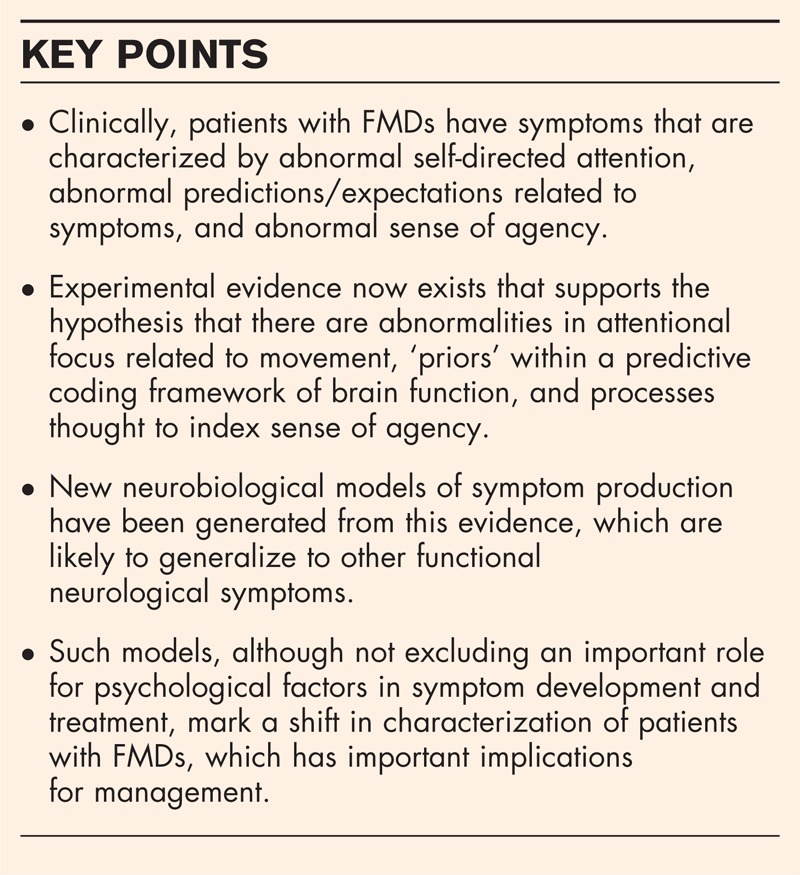
PURPOSE OF REVIEW: This review explores recent developments in understanding the neurobiological mechanism of functional (psychogenic) movement disorders (FMDs). This is particularly relevant given the resurgence of academic and clinical interest in patients with functional neurological symptoms and the clear shift in diagnostic and treatment approaches away from a pure psychological model of functional symptoms. RECENT FINDINGS: Recent research findings implicate three key processes in the neurobiology of FMD (and by extension other functional neurological symptoms): abnormal attentional focus, abnormal beliefs and expectations, and abnormalities in sense of agency. These three processes have been combined in recent neurobiological models of FMD in which abnormal predictions related to movement are triggered by self-focused attention, and the resulting movement is generated without the normal sense of agency that accompanies voluntary movement. SUMMARY: New understanding of the neurobiology of FMD forms an important part of reappraising the way that patients with FMD (and other functional disorders) are characterized and treated. It also provides a testable framework for further exploring the pathophysiology of these common causes of ill health.
Overview
The claims and statistics of this paper haven’t been checked yet.
Free: it reads the open-access text and checks the first 5 claims that cite a source we can check. Create a free account to check every claim.
Integrity signals
Registry
Cites
Statistics
Figures
Verification
Claims the paper makes
The claims and statistics of this paper haven’t been checked yet.
Free: it reads the open-access text and checks the first 5 claims that cite a source we can check. Create a free account to check every claim.
Claims other papers make about this one
Each is checked against this paper’s own text: does it say what the citing paper says it does?
The source backs part of the claim, not all of it — or backs it for a different population, condition or comparison.
In the citing paper
“FND symptoms increase when the child or family place their attention on the symptoms, and they decrease or disappear when the child’s attention (or that of the family) is directed elsewhere [19,51].”
From Illness-Promoting Psychological Processes in Children and Adolescents with Functional Neurological Disorder (2023) · cites this paper as [51]
Experimental — accuracy not yet measuredThe source backs part of the claim, not all of it — or backs it for a different population, condition or comparison.
In the citing paper
“symptoms amplify with attention, and they diminish when attention is drawn away from them (and toward something else) [19,51,53].”
From Illness-Promoting Psychological Processes in Children and Adolescents with Functional Neurological Disorder (2023) · cites this paper as [51]
Experimental — accuracy not yet measuredThe cited source says what the claim attributes to it.
In the citing paper
“symptoms amplify with attention, and they diminish when attention is drawn away from them (and toward something else) [19,51,53].”
From Illness-Promoting Psychological Processes in Children and Adolescents with Functional Neurological Disorder (2023) · cites this paper as [51]
Self-check
Percentages, sums and reported differences re-computed from the paper’s own numbers.
The self-check needs the paper’s full text.
Citations
Cites
The free-energy principle: a rough guide to the brain?
Friston, K. (2009) · Trends in Cognitive Sciences · doi:10.1016/j.tics.2009.04.005 · Cited by 1,831 · cited 1×
“Active inference refers to a well grounded neurobiological theory of brain function that the brain actively predicts and seeks to explain sensory input on the basis of past experience: there is an internal model of the world that is used to interact with and explain the world [11].”
BackgroundVoluntary action and conscious awareness
Haggard, P., Clark, S., & Kalogeras, J. (2002) · Nature Neuroscience · doi:10.1038/nn827 · Cited by 1,546 · cited 2×
“In the latter context, the perceived timings of the two events move closer to each other (the movement is perceived to happen later and the tone earlier) [22].”
BackgroundA Bayesian account of ‘hysteria’
Edwards, M. J., Adams, R. A., Brown, H., Parees, I., & Friston, K. J. (2012) · Brain · doi:10.1093/brain/aws129 · Cited by 825
Self-citationAnatomy of motor learning. I. Frontal cortex and attention to action
Jueptner, M., Stephan, K. M., Frith, C. D., Brooks, D. J., Frackowiak, R. S. J., & Passingham, R. E. (1997) · Journal of Neurophysiology · doi:10.1152/jn.1997.77.3.1313 · Cited by 624 · cited 1×
“This does not normally occur in healthy people [15] but does in patients with FMD, and as a result, just as when healthy people are explicitly instructed to pay attention to movement [15], movement production is impaired.”
BackgroundGARETY, P. A., HEMSLEY, D. R., & WESSELY, S. (1991) · The Journal of Nervous and Mental Disease · doi:10.1097/00005053-199104000-00003 · Cited by 597 · cited 1×
“decision-making on this task has previously been reported in patients with delusional beliefs [19], for example, in the context of schizophrenia.”
BackgroundPsychological Mechanisms of Medically Unexplained Symptoms: An Integrative Conceptual Model.
Brown, R. J. (2004) · Psychological Bulletin · doi:10.1037/0033-2909.130.5.793 · Cited by 498
Psychogenic movement disorders
Gupta, A., & Lang, A. E. (2009) · Current Opinion in Neurology · doi:10.1097/wco.0b013e32832dc169 · Cited by 431
Haggard, P., & Chambon, V. (2012) · Current Biology · doi:10.1016/j.cub.2012.02.040 · Cited by 417
Toward a neurobiology of delusions
Corlett, P. R., Taylor, J. R., Wang, X.-J., Fletcher, P. C., & Krystal, J. H. (2010) · Progress in Neurobiology · doi:10.1016/j.pneurobio.2010.06.007 · Cited by 394 · cited 1×
“This work makes a tentative but interesting parallel therefore between the neurobiology of delusions [20] and of FMD.”
ResultEmotional stimuli and motor conversion disorder
Voon, V., Brezing, C., Gallea, C., Ameli, R., Roelofs, K., LaFrance, W. C., & Hallett, M. (2010) · Brain · doi:10.1093/brain/awq054 · Cited by 353
Cited by
Items 101–145 of 145
Generalization and enhancement of the effects of an active placebo nasal spray on sadness
Wilhelm, M., Fischer, S. M., Rief, W., Fiorio, M., & Barbiani, D. (2024) · Journal of Affective Disorders · doi:10.1016/j.jad.2024.10.045 · Cited by 3
Ryou, J. H., Han, D. H., Lee, R., & Kim, S. M. (2022) · Clinical Psychopharmacology and Neuroscience · doi:10.9758/cpn.2022.20.3.581 · Cited by 3
“by the manifestation of abnormal involuntary movements, which are not typically observed in other neurological illnesses [1].”
BackgroundEntwicklung und inhaltliche Validierung eines Fragebogens für funktionelle Bewegungsstörungen
Michaelis, R., Brüggemann, N., Ebersbach, G., Ganos, C., Münchau, A. M., Schmidt, T., Weißbach, A., Schlegel, U. S., & Popkirov, S. (2021) · Der Nervenarzt · doi:10.1007/s00115-021-01247-1 · Cited by 2
Predictive processes linking sense of agency and fatigue: a novel allostatic framework
Pizzolla, E., Marotta, A., Longo, M. R., & Fiorio, M. (2026) · Frontiers in Psychology · doi:10.3389/fpsyg.2026.1792850 · Cited by 2
“…comes from functional movement disorders (FMD), a condition characterized by motor symptoms that out-wardly resemble voluntary movements (e.g., functional tremor may momentarily disappear with distraction) but are experienced by patients as involuntary (Edwards et al., 2013; Fiorio et al., 2022).”
Schwingenschuh, P. (2022) · Current clinical neurology · doi:10.1007/978-3-030-86495-8_6 · Cited by 3
Mouchabac, S., Micoulaud‐Franchi, J., & Salvador, A. (2017) · Annales Médico-psychologiques revue psychiatrique · doi:10.1016/j.amp.2017.03.007 · Cited by 2
Functional motor disorders: mechanism, prognosis and treatment
Gelauff, J. (2020) · University of Groningen research database (University of Groningen / Centre for Information Technology) · doi:10.33612/diss.136733110 · Cited by 2
Blurred boundaries between organic and functional etiology: A man with a jerky leg
Berlot, R., Kramberger, M. G., Dreo, J., Pirtošek, Z., & Kojović, M. (2015) · Journal of the Neurological Sciences · doi:10.1016/j.jns.2015.04.046 · Cited by 1
“New sensory data arising from the initial seizure could alter expectations about movement, as well as direct abnormal attention towards the limb, resulting in further functional paroxysms [5].”
Jankovic, J. J., Hallett, M., Okun, M. S., Comella, C., Fahn, S., & Goldman, J. G. (2021) · Elsevier eBooks · doi:10.1016/b978-0-323-31071-0.00002-0 · Cited by 2
Revisiting motor inhibition in individuals with functional paralysis and spinal cord injury
Vallesi, V., Galléa, C., Sritharan, J., Hurni, E. R., Hoogland, I. E., Gegusch, M., Slotboom, J., Worbe, Y., Roze, E. F., Scheel‐Sailer, A., et al. (2025) · Brain Communications · doi:10.1093/braincomms/fcaf377 · Cited by 1
“4 5-7 While psychiatric comorbidities, such as depression and anxiety, are frequently observed in FND, they do not appear to directly influence the disorder’s outcome.”
Eleopra, R., Paio, F., Rinaldo, S., Carozzi, C., Oriana, A., Devigili, G., Romito, L. M., Cilia, R., Andreasi, N. G., Gaudiano, G., et al. (2025) · Movement Disorders · doi:10.1002/mds.70094 · Cited by 1
“The absence of muscle activity in these states may re fl ect a disruption of the voluntary motor drive, which is a hallmark of FMDs. 6 Furthermore, the emergence of distinct muscle recruitment patterns post-propofol administration, when compared with baseline pre-infusion EMG activity, may…”
InfluentialFunctional (Psychogenic) Movement Disorders
Singer, H. S., Mink, J. W., Gilbert, D. L., & Jankovic, J. J. (2015) · Elsevier eBooks · doi:10.1016/b978-0-12-411573-6.00023-1 · Cited by 1
Arabi, H., Benhima, M. A., Elhaouri, H., & Saïdi, H. (2016) · Journal de Réadaptation Médicale Pratique et Formation en Médecine Physique et de Réadaptation · doi:10.1016/j.jrm.2016.08.002 · Cited by 1
Psychiatric Comorbidities and the Role of Psychiatry in Functional Movement Disorder
Bullock, K. D., & Lockman, J. (2022) · Current clinical neurology · doi:10.1007/978-3-030-86495-8_22 · Cited by 1
Clarici, A. (2025) · Neuropsychoanalysis · doi:10.1080/15294145.2025.2485413 · Cited by 1
“To define conversion disorders, I follow the suggestions of Edwards et al. (2013), who propose to define functional neurological disorders (which include conversion disorder) solely on a clinical basis, particularly as: a disorder [ perceptual exteroceptive as well as motor activity ] that is…”
Functional (Psychogenic) Dystonia
Macerollo, A., & Edwards, M. J. (2015) · Springer eBooks · doi:10.1007/978-3-7091-1516-9_8 · Cited by 1
Self-citationGelauff, J., & van Tricht, M. J. (2014) · Neuropraxis · doi:10.1007/s12474-014-0049-9 · Cited by 1
“De neurologische symptomen worden gekenmerkt door het significante effect van afleiding op de klachten en de incongruentie met hun organische tegenhanger.(1) Functionele bewegingsstoornissen vormen een belangrijke groep als het gaat om prevalentie, zorgconsumptie en de ernst van de symptomen.”
BackgroundNeuropsychologische correlaten, prognostische factoren en behandelopties
Gelauff, J., & van Tricht, M. J. (2014)
Physiotherapy for functional movement disorders
Fialová, D., & Serranová, T. (2016) · Neurologie pro praxi · doi:10.36290/neu.2016.017
A Case of a Familial “Dopamine-Responsive” Movement Disorder
Gelauff, J., & Tijssen, M. A. J. (2016) · Springer eBooks · doi:10.1007/978-3-319-42190-2_17
Funkční poruchy hybnosti - slovo úvodem
Roth, J., & Serranová, T. (2016) · Neurologie pro praxi · doi:10.36290/neu.2016.015
Functional Movement Disorders: Updated Overview
Subki, A. H., Alkahtani, A., Alfayez, A. A., Atoudi, R. A., Rio, M. A., Alsheikh, I. M., & Jan, M. M. (2017) · Journal of Pediatric Care · doi:10.21767/2471-805x.100023
Treatment of Psychogenic (Functional) Movement Disorders
Edwards, M. J. (2019) · Current clinical neurology · doi:10.1007/978-3-319-97897-0_73
Self-citationFunktionelle Störungen (Psychosomatik)
Limburg, K., Furmaniak, A., & Henningsen, P. (2019) · Elsevier eBooks · doi:10.1016/b978-3-437-21882-8.00024-4
Beckh, J. (2019) · KOPS (University of Konstanz) · Cited by 1
The Impact of Comorbidities and Expectations on Functional Neurological Disorder Symptoms (FND)
Artigas, H., & del Pilar, D. (2020) · Minerva Access (University of Melbourne)
THE CLINICAL FEATURES AND PROGNOSIS OF SCAN NEGATIVE URO-NEUROLOGICAL DISORDERS
Hoeritzauer, I., Panicker, J. N., Elneil, S., Granitsiotis, V., Small, D., Statham, P. F. X., Summers, D., Eugenicos, M. P., Carson, A. J., & Stone, J. (2016) · Journal of Neurology Neurosurgery & Psychiatry · doi:10.1136/jnnp-2016-315106.169
Palatal myoclonus with tinnitus treated as a psychogenic disorder for 35-years
de Filippis, R., Viola, P., Pisani, D., Chiarella, G., Fazio, P. D., & Segura‐Garcìa, C. (2022) · L Encéphale · doi:10.1016/j.encep.2022.03.005
Functional tic disorder: a mass social media-induced contagion?
Růžička, E., Мала, Э., & Serranová, T. (2023) · Neurologie pro praxi · doi:10.36290/neu.2023.032
Interpretation eines Konzepts für funktionelle Bewegungsstörungen aus der Sicht des alten Patienten
Maetzler, W., Geritz, J., Stagneth, L., & Emmert, K. (2024) · Der Nervenarzt · doi:10.1007/s00115-024-01614-8
(2022) · Elsevier eBooks · doi:10.1016/b978-3-437-21884-2.00033-7
Funktionelle Störungen (Psychosomatik)
Furmaniak, A., Limburg, K., & Henningsen, P. (2022) · Elsevier eBooks · doi:10.1016/b978-3-437-21884-2.00024-6
Huys, A. M. L., Bhatia, K. P., & Edwards, M. J. (2025) · BMJ Neurology Open · doi:10.1136/bmjno-2025-001171
“20 Numerous cases report symptom resolution through placebo responses.”
Self-citationMingolla, G. P., Antelmi, E., Sandri, A., Andani, M. E., Vico, I. A. D., Fiorio, M., & Tinazzi, M. (2025) · Movement Disorders Clinical Practice · doi:10.1002/mdc3.70443
“14,59 In this context, our fi ndings showed that FW patients recognized different degrees of muscular force and effort when explicitly asked, as re fl ected in their subjective ratings; however, their motor system failed to produce the expected facilitatory patterns observed in HC.”
Xie, X.-Y., Lin, G.-Z., Huang, Q., Li, C.-B., Hallett, M., Voon, V., Ren, R.-J., Chen, S.-D., & Wang, G. (2021) · Figshare · doi:10.6084/m9.figshare.16969241
Xie, X.-Y., Guo⁃zhen, L., Huang, Q., Li, C.-B., Hallett, M., Voon, V., Ren, R.-J., Chen, S.-D., & Wang, G. (2021) · Figshare · doi:10.6084/m9.figshare.16969238
Xie, X.-Y., Lin, G.-Z., Huang, Q., Li, C.-B., Hallett, M., Voon, V., Ren, R.-J., Chen, S.-D., & Wang, G. (2021) · Figshare · doi:10.6084/m9.figshare.16969244
Xie, X.-Y., Guo⁃zhen, L., Huang, Q., Li, C.-B., Hallett, M., Voon, V., Ren, R.-J., Chen, S.-D., & Wang, G. (2021) · Figshare · doi:10.6084/m9.figshare.16969235
Modèle prédictif et énactiviste des troubles fonctionnels en médecine
Bérubé, A.-A. (2023) · Archipel (Université du Québec à Montréal)
Smith, S. C. L., Harland, L., Bissett, B., Gaughwin, P., & Matangira, T. (2025) · Case Reports in Neurological Medicine · doi:10.1155/crnm/5007133
“A useful diagnostic feature of FNDs is distractibility, meaning the decrease in severity of symptoms in response to redirection of attention away from a task or movement [4, 5, 20, 21].”
Rujirussawarawong, S., Ounmuang, C., Aungsumart, S., Kasemsuk, C., & Limotai, N. (2026) · Movement Disorders Clinical Practice · doi:10.1002/mdc3.70707
Raima, C., Ito, M., Saiki, S., Yamazaki, Y., & Kurita, Y. (2026) · IEEE Access · doi:10.1109/access.2026.3704575
“For example, SoA decline was observed in a case in which magnetic stimulation of the motor cortex caused the experiment participant’s finger to move [22] and in another case in which a semi-automatic system was used to correct the trajectory of a teleoperated excavator [23].”
Valentina, B., Notaristefano, I., Maggiore, P., Sara, R., Serena, G., Michele, T., Christian, G., & Esposito, D. (2026) · Frontiers in Neurology · doi:10.3389/fneur.2026.1968237
Metadata
- Authors
- Edwards, M. J., Fotopoulou, A., & Pareés, I.
- Affiliations
- National Hospital for Neurology and Neurosurgery (GB)
- University College London (GB)
- Corresponding author
- Edwards, Mark J.
- Venue
- Current Opinion in Neurology
- Published
- 2013-08
- Volume
- 26
- Issue
- 4
- Pages
- 442-447
- ISSN
- 1350-7540 (ISSN-L)
- PMC
- PMC4196785
- OpenAlex
- W2089479596
- Cited by
- 137
- References
- 33
- Citations by year
- 2026: 2 · 2025: 8 · 2024: 7 · 2023: 9 · 2022: 20 · 2021: 22 · 2020: 15 · 2019: 11 · 2018: 8 · 2017: 10 · 2016: 11 · 2015: 8 · 2014: 4 · 2013: 1
- FWCI
- 1.09
- Type
- journal article
- Language
- en
- Open access
- green
- www.ncbi.nlm.nih.gov
- Licence
- cc-by
- Locations
- Current Opinion in Neurology (publishedVersion)
- PubMed Central (publishedVersion, cc-by)
- PubMed (publishedVersion)
- St George's Online Research Archive (St George's University of London) (acceptedVersion)
- UCL Discovery (University College London) (submittedVersion)
- Topics
- Health Sciences › Medicine › Psychiatry and Mental health › Psychosomatic Disorders and Their Treatments
- Health Sciences › Medicine › Clinical Neurology › Deep Brain Stimulation and Movement Disorders
- Social Sciences › Arts and Humanities › Philosophy › Free Will and Agency
- Keywords
- functional movement disorders, psychogenic movement disorders, functional neurological symptoms, neurobiology, self-focus, sense of agency, pathophysiology
- MeSH terms
- Attention, Culture, Humans, Models, Biological, Movement Disorders, Neurobiology
About these checks
Registry, retraction, Cites and statistics results are computed, not judged, with one exception: a printed reference that no index lists is read once by a model before it counts as a citation error. Claims are extracted by a model and kept only when their quote appears verbatim in the text; each cited source is then checked, with a model’s help, for whether it says what the claim relies on. Those verdicts can be wrong — read the claim’s quote and the cited source before relying on one.
Statistics and arithmetic are recomputed, not judged.
Confidence bands are shown only for fields calibrated on our annotated test set. None is calibrated yet, so no band is shown.
What counts as a claim ›How we measure confidence ›How we check this ›
Are you an author, or do you see a problem with this page? Request a review
Data sources
Bibliographic data: Semantic Scholar, OpenAlex, Crossref.
Contains information from the Semantic Scholar Academic Graph Datasets, made available under the ODC Attribution License (ODC-BY 1.0).
Semantic Scholar’s data is described in: Kinney, R., et al. (2023). The Semantic Scholar Open Data Platform. arXiv:2301.10140.
