

Neurobiology of functional (psychogenic) movement disorders
Open accessThe DOI matches its Crossref record; 33 of the 33 references it cites were found in a registry or an index.
Abstract
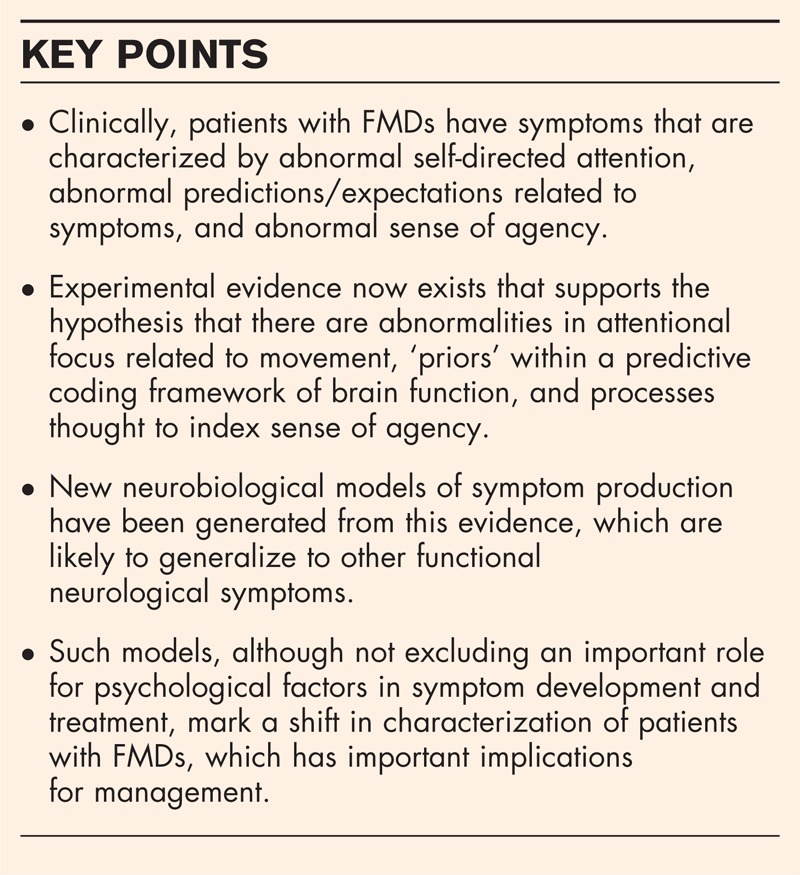
PURPOSE OF REVIEW: This review explores recent developments in understanding the neurobiological mechanism of functional (psychogenic) movement disorders (FMDs). This is particularly relevant given the resurgence of academic and clinical interest in patients with functional neurological symptoms and the clear shift in diagnostic and treatment approaches away from a pure psychological model of functional symptoms. RECENT FINDINGS: Recent research findings implicate three key processes in the neurobiology of FMD (and by extension other functional neurological symptoms): abnormal attentional focus, abnormal beliefs and expectations, and abnormalities in sense of agency. These three processes have been combined in recent neurobiological models of FMD in which abnormal predictions related to movement are triggered by self-focused attention, and the resulting movement is generated without the normal sense of agency that accompanies voluntary movement. SUMMARY: New understanding of the neurobiology of FMD forms an important part of reappraising the way that patients with FMD (and other functional disorders) are characterized and treated. It also provides a testable framework for further exploring the pathophysiology of these common causes of ill health.
Overview
The claims and statistics of this paper haven’t been checked yet.
Free: it reads the open-access text and checks the first 5 claims that cite a source we can check. Create a free account to check every claim.
Integrity signals
Registry
Cites
Statistics
Figures
Verification
Claims the paper makes
The claims and statistics of this paper haven’t been checked yet.
Free: it reads the open-access text and checks the first 5 claims that cite a source we can check. Create a free account to check every claim.
Claims other papers make about this one
Each is checked against this paper’s own text: does it say what the citing paper says it does?
The source backs part of the claim, not all of it — or backs it for a different population, condition or comparison.
In the citing paper
“FND symptoms increase when the child or family place their attention on the symptoms, and they decrease or disappear when the child’s attention (or that of the family) is directed elsewhere [19,51].”
From Illness-Promoting Psychological Processes in Children and Adolescents with Functional Neurological Disorder (2023) · cites this paper as [51]
Experimental — accuracy not yet measuredThe source backs part of the claim, not all of it — or backs it for a different population, condition or comparison.
In the citing paper
“symptoms amplify with attention, and they diminish when attention is drawn away from them (and toward something else) [19,51,53].”
From Illness-Promoting Psychological Processes in Children and Adolescents with Functional Neurological Disorder (2023) · cites this paper as [51]
Experimental — accuracy not yet measuredThe cited source says what the claim attributes to it.
In the citing paper
“symptoms amplify with attention, and they diminish when attention is drawn away from them (and toward something else) [19,51,53].”
From Illness-Promoting Psychological Processes in Children and Adolescents with Functional Neurological Disorder (2023) · cites this paper as [51]
Self-check
Percentages, sums and reported differences re-computed from the paper’s own numbers.
The self-check needs the paper’s full text.
Citations
Cites
The free-energy principle: a rough guide to the brain?
Friston, K. (2009) · Trends in Cognitive Sciences · doi:10.1016/j.tics.2009.04.005 · Cited by 1,831 · cited 1×
“Active inference refers to a well grounded neurobiological theory of brain function that the brain actively predicts and seeks to explain sensory input on the basis of past experience: there is an internal model of the world that is used to interact with and explain the world [11].”
BackgroundVoluntary action and conscious awareness
Haggard, P., Clark, S., & Kalogeras, J. (2002) · Nature Neuroscience · doi:10.1038/nn827 · Cited by 1,546 · cited 2×
“In the latter context, the perceived timings of the two events move closer to each other (the movement is perceived to happen later and the tone earlier) [22].”
BackgroundA Bayesian account of ‘hysteria’
Edwards, M. J., Adams, R. A., Brown, H., Parees, I., & Friston, K. J. (2012) · Brain · doi:10.1093/brain/aws129 · Cited by 825
Self-citationAnatomy of motor learning. I. Frontal cortex and attention to action
Jueptner, M., Stephan, K. M., Frith, C. D., Brooks, D. J., Frackowiak, R. S. J., & Passingham, R. E. (1997) · Journal of Neurophysiology · doi:10.1152/jn.1997.77.3.1313 · Cited by 624 · cited 1×
“This does not normally occur in healthy people [15] but does in patients with FMD, and as a result, just as when healthy people are explicitly instructed to pay attention to movement [15], movement production is impaired.”
BackgroundGARETY, P. A., HEMSLEY, D. R., & WESSELY, S. (1991) · The Journal of Nervous and Mental Disease · doi:10.1097/00005053-199104000-00003 · Cited by 597 · cited 1×
“decision-making on this task has previously been reported in patients with delusional beliefs [19], for example, in the context of schizophrenia.”
BackgroundPsychological Mechanisms of Medically Unexplained Symptoms: An Integrative Conceptual Model.
Brown, R. J. (2004) · Psychological Bulletin · doi:10.1037/0033-2909.130.5.793 · Cited by 498
Psychogenic movement disorders
Gupta, A., & Lang, A. E. (2009) · Current Opinion in Neurology · doi:10.1097/wco.0b013e32832dc169 · Cited by 431
Haggard, P., & Chambon, V. (2012) · Current Biology · doi:10.1016/j.cub.2012.02.040 · Cited by 417
Toward a neurobiology of delusions
Corlett, P. R., Taylor, J. R., Wang, X.-J., Fletcher, P. C., & Krystal, J. H. (2010) · Progress in Neurobiology · doi:10.1016/j.pneurobio.2010.06.007 · Cited by 394 · cited 1×
“This work makes a tentative but interesting parallel therefore between the neurobiology of delusions [20] and of FMD.”
ResultEmotional stimuli and motor conversion disorder
Voon, V., Brezing, C., Gallea, C., Ameli, R., Roelofs, K., LaFrance, W. C., & Hallett, M. (2010) · Brain · doi:10.1093/brain/awq054 · Cited by 353
Cited by
Stress and functional neurological disorders: mechanistic insights
Keynejad, R. C., Frodl, T., Kanaan, R., Pariante, C., Reuber, M., & Nicholson, T. R. (2019) · Journal of Neurology, Neurosurgery & Psychiatry · doi:10.1136/jnnp-2018-318297 · Cited by 151
The role of alexithymia in the development of functional motor symptoms (conversion disorder)
Demartini, B., Petrochilos, P., Ricciardi, L., Price, G., Edwards, M. J., & Joyce, E. (2014) · Journal of Neurology, Neurosurgery & Psychiatry · doi:10.1136/jnnp-2013-307203 · Cited by 147
Self-citationOutcomes of a 5-day physiotherapy programme for functional (psychogenic) motor disorders
Nielsen, G., Ricciardi, L., Demartini, B., Hunter, R. M., Joyce, E. M., & Edwards, M. J. (2015) · Journal of Neurology · doi:10.1007/s00415-014-7631-1 · Cited by 153
“This explanation was based on a specific pathophysiological model of FMD [10, 11].”
MethodSelf-citationFobian, A. D., & Elliott, L. (2019) · Journal of Psychiatry and Neuroscience · doi:10.1503/jpn.170190 · Cited by 134
Interoceptive awareness in patients with functional neurological symptoms
Ricciardi, L., Demartini, B., Crucianelli, L., Krahé, C., Edwards, M. J., & Fotopoulou, A. (2015) · Biological Psychology · doi:10.1016/j.biopsycho.2015.10.009 · Cited by 138
Self-citationTics and functional tic-like movements: Can we tell them apart?
Ganos, C., Martino, D., Espay, A. J., Lang, A. E., Bhatia, K. P., & Edwards, M. J. (2019) · Neurology · doi:10.1212/wnl.0000000000008372 · Cited by 124
“Indeed, attention is a significant factor in the expression of not only functional tic-like movements but also tics: the frequency and severity of tics increases if they become the center of attentional focus and characteristically decreases during distraction or engagement in other cognitive or physical activities.(2…”
BackgroundSelf-citationTreatment of Functional (Psychogenic) Movement Disorders
Ricciardi, L., & Edwards, M. J. (2013) · Neurotherapeutics · doi:10.1007/s13311-013-0246-x · Cited by 86
“Recent proposals regarding underlying mechanisms for functional neurologic symptoms have concentrated on the role of abnormal self-directed attention, and abnormal beliefs and expectations about symptoms, which together are proposed to bring about a lack of sense of agency for motor and sensory phenomena [10, 11].”
BackgroundSelf-citationGelauff, J. M., Kingma, E. M., Kalkman, J. S., Bezemer, R., van Engelen, B. G. M., Stone, J., Tijssen, M. A. J., & Rosmalen, J. G. M. (2018) · Journal of Neurology · doi:10.1007/s00415-018-8915-7 · Cited by 67
Quality of life in functional movement disorders is as altered as in organic movement disorders
Gendre, T., Carle, G., Mesrati, F., Hubsch, C. A., Mauras, T., Roze, E. F., Houot, M., Degos, B., & Garcin, B. (2018) · Journal of Psychosomatic Research · doi:10.1016/j.jpsychores.2018.11.006 · Cited by 65
The Neurobiology of Pathological Fatigue: New Models, New Questions
Kuppuswamy, A. (2021) · The Neuroscientist · doi:10.1177/1073858420985447 · Cited by 66
on behalf of the Physio4FMD Collaborative Group, Nielsen, G., Stone, J., Buszewicz, M., Carson, A., Goldstein, L. H., Holt, K., Hunter, R., Marsden, J., Marston, L., et al. (2019) · BMC Neurology · doi:10.1186/s12883-019-1461-9 · Cited by 57
Self-citationParkinsonism and Related Disorders
Slow, E. J., & Lang, A. E. (2019) · DeckerMed Transitional Year Weekly Curriculum™ · doi:10.2310/tywc.1178 · Cited by 62
Functional neurological disorder and placebo and nocebo effects: shared mechanisms
Fiorio, M., Braga, M., Marotta, A., Villa‐Sánchez, B., Edwards, M. J., Tinazzi, M., & Barbiani, D. (2022) · Nature Reviews Neurology · doi:10.1038/s41582-022-00711-z · Cited by 70
Self-citationPsychogenic Movement Disorders
Thenganatt, M. A., & Jankovic, J. J. (2014) · Neurologic Clinics · doi:10.1016/j.ncl.2014.09.013 · Cited by 63
“Based on recent research studies, 3 key processes have been in implicated in the neurobiology of PMDs: abnormal beliefs, abnormal self-focus, and an abnormal sense of agency.(76) The proposed models suggest that excessive self-focus triggers movements that are not associated with the normal sense of agency associated…”
Backgroundvan der Hoeven, R. M., Broersma, M., Pijnenborg, G. H. M., Koops, E. A., van Laar, T., Stone, J., & van Beilen, M. (2015) · Journal of Psychosomatic Research · doi:10.1016/j.jpsychores.2015.06.002 · Cited by 58
“Contemporary models offer aninterestingsynthesis of psychological factors such as attention, the feeling of self-agency, and disturbed perception of bodily events that lead to a unique form of involuntariness [19,36 – 38].”
Marotta, A., Bombieri, F., Zampini, M., Schena, F. F., Dallocchio, C., Fiorio, M., & Tinazzi, M. (2017) · Frontiers in Human Neuroscience · doi:10.3389/fnhum.2017.00291 · Cited by 56
“In other words, although the motor symptoms look like intentionally produced movements, the patients’ self-report is that the abnormal movements are not under their control (Edwards et al., 2013).”
BackgroundResultInfluentialLotfinia, S., Soorgi, Z., Mertens, Y., & Daniels, J. (2020) · Journal of Psychiatric Research · doi:10.1016/j.jpsychires.2020.05.006 · Cited by 53
Metacognition in functional cognitive disorder- a potential mechanism and treatment target
Bhome, R., McWilliams, A., Huntley, J. D., Fleming, S. M., & Howard, R. J. (2019) · Cognitive Neuropsychiatry · doi:10.1080/13546805.2019.1651708 · Cited by 48
Processing of emotion in functional neurological disorder
Sojka, P., Bareš, M., Kašpárek, T., & Světlák, M. (2018) · Frontiers in Psychiatry · doi:10.3389/fpsyt.2018.00479 · Cited by 46
“Some authors question the importance of emotions in the etiology of the disorder, because psychological stressors and emotional dysregulation are not always apparent in FND (8).”
BackgroundMethodPhysical treatment of functional neurologic disorders
Nielsen, G. (2016) · Handbook of clinical neurology · doi:10.1016/b978-0-12-801772-2.00045-x · Cited by 45
The neuroimaging evidence of brain abnormalities in functional movement disorders
Sasikumar, S., & Strafella, A. P. (2021) · Brain · doi:10.1093/brain/awab131 · Cited by 38
“Functional movement disorders (FMDs) describe involuntary movements and posturing that are not in keeping with a known neurological cause.(1) They comprise 2–3% of all movement disorders, but there is a lack of population-based data so the true prevalence remains uncertain.”
BackgroundFunctional (psychogenic) movement disorders
LaFaver, K., & Hallett, M. (2012) · Current Opinion in Neurology · doi:10.1097/wco.0b013e3283551bc1 · Cited by 40
Pain processing in functional and idiopathic dystonia: An exploratory study
Morgante, F., Matinella, A., Andrenelli, E., Ricciardi, L., Allegra, C., Terranova, C., Girlanda, P., & Tinazzi, M. (2018) · Movement Disorders · doi:10.1002/mds.27402 · Cited by 37
Gray, N., Savage, B., Scher, S., & Kozlowska, K. (2020) · The Journal of Neuropsychiatry and Clinical Neurosciences · doi:10.1176/appi.neuropsych.19120355 · Cited by 33
Schwingenschuh, P., & Espay, A. J. (2022) · Journal of the Neurological Sciences · doi:10.1016/j.jns.2022.120208 · Cited by 36
“Although the pathophysiology remains insufficiently understood, there is an important role of excessive attentional focus, abnormal beliefs and expectations, and impaired sense of agency [47,48].”
Variability of Movement Disorders: The Influence of Sensation, Action, Cognition, and Emotions
Berlot, R., Rothwell, J. C., Bhatia, K. P., & Kojović, M. (2020) · Movement Disorders · doi:10.1002/mds.28415 · Cited by 35
“With the use of specific maneuvers or cognitive tasks, one can test if attention plays a part in symptom generation.(115) An important clue to the diagnosis of functional tremor is its variability in response to voluntary movements, manifested as transitory tremor cessation during voluntary ballistic movements of the…”
MethodBarbey, A., & Aybek, S. (2017) · Current Opinion in Neurology · doi:10.1097/wco.0000000000000464 · Cited by 35
“com disorder’ is recommended, as it is descriptive (disorder of function of nervous system, no underlying structural abnormality) and nonjudgmental [2,80].”
BackgroundPosttraumatic functional movement disorders
Ganos, C., Edwards, M. J., & Bhatia, K. P. (2016) · Handbook of clinical neurology · doi:10.1016/b978-0-12-801772-2.00041-2 · Cited by 31
“…physical trauma (Trimble, 2004), more recent work attempted to create a neurobiologic framework of understanding of functional neurologic symptoms (Edwards et al., 2012, 2013), including those associated with physical precipitators (Pare es et al., 2014) in the absence of identifiable psychologic…”
BackgroundSelf-citationThe illness-disease dichotomy and the biological-clinical splitting of medicine
Tesio, L., & Buzzoni, M. (2020) · Medical Humanities · doi:10.1136/medhum-2020-011873 · Cited by 30
Breakdown of the affective‐cognitive network in functional dystonia
Canu, E., Agosta, F., Tomić, A., Sarasso, E., Petrović, I. N., Piramide, N., Svetel, M. V., Inuggi, A., Mišković, N., Kostić, V., et al. (2020) · Human Brain Mapping · doi:10.1002/hbm.24997 · Cited by 30
“, 2015); (d) altered action authorship perception due to a main dysfunction of the right temporoparietal junction (rTPJ), which is a key brain structure for the sense of “involuntariness” and agency (Edwards et al., 2013; Schrag et al., 2013); and (e) altered self-referential processing, memory retrieval, emotional re…”
BackgroundInfluentialRecent advances in understanding the neurobiology of pediatric functional neurological disorder
Kozlowska, K., & Scher, S. (2024) · Expert Review of Neurotherapeutics · doi:10.1080/14737175.2024.2333390 · Cited by 30
“FND symptoms increase when the child (or families) pay attention to the symptoms, and they decrease or disappear when attention is directed elsewhere [56,133].”
BackgroundAutism Spectrum Disorder May Be Highly Prevalent in People with Functional Neurological Disorders
González‐Herrero, B., Morgante, F., Pagonabarraga, J., Stanton, B. R., & Edwards, M. J. (2022) · Journal of Clinical Medicine · doi:10.3390/jcm12010299 · Cited by 30
Self-citationMoccia, L., Luzio, M. D., Conte, E., Modica, M., Ambrosecchia, M., Ardizzi, M., Lanzotti, P., Kotzalidis, G. D., Janiri, D., Nicola, M. D., et al. (2023) · Psychiatry and Clinical Neurosciences · doi:10.1111/pcn.13601 · Cited by 35
“86 Individuals with functional motor symptoms usually report abnormal action awareness 87 ; studies involving action recognition and sensory attenuation tasks con fi rmed reduced SoA in FMDs. 88,89”
BackgroundGandolfi, M., Riello, M., Bellamoli, V., Bombieri, F., Geroin, C., Vico, I. A. D., & Tinazzi, M. (2021) · Neurorehabilitation · doi:10.3233/nre-201617 · Cited by 29
“As mentioned by the program developers, the purpose of education is to reinforce information about diagnosis and explain symptoms according to the pathophysiological model of FMDs (Nielsen et al., 2015b; Edwards et al., 2012; Edwards et al., 2013).”
Sense of agency disturbances in movement disorders: A comprehensive review
Seghezzi, S., Convertino, L., & Zapparoli, L. (2021) · Consciousness and Cognition · doi:10.1016/j.concog.2021.103228 · Cited by 29
Psychologic treatment of functional neurologic disorders
Goldstein, L. H., & Mellers, J. D. C. (2016) · Handbook of clinical neurology · doi:10.1016/b978-0-12-801772-2.00046-1 · Cited by 34
Functional dystonia and the borderland between neurology and psychiatry: New concepts
Newby, R., Alty, J., & Kempster, P. A. (2016) · Movement Disorders · doi:10.1002/mds.26805 · Cited by 28
“Three concepts that link the internalized processes of thought with the execution of movement are important here: belief, agency, and attention.(52,53)”
BackgroundDemartini, B., Volpe, R., Mattavelli, G. C., Goeta, D., D’Agostino, A., & Gambini, O. (2019) · Neurological Sciences · doi:10.1007/s10072-019-03912-5 · Cited by 30
Virameteekul, S., & Bhidayasiri, R. (2022) · Frontiers in Neurology · doi:10.3389/fneur.2022.834217 · Cited by 29
“have proposed three key concepts in the neurobiology of FNDs which are attention, beliefs, and agency (76).”
BackgroundSimilar association between objective and subjective symptoms in functional and organic tremor
Kramer, G., Dominguez‐Vega, Z. T., Laarhoven, H. S., Brandsma, R., Smit, M., van der Stouwe, A. M. M., Elting, J. W. J., Maurits, N. M., Rosmalen, J. G. M., & Tijssen, M. A. J. (2019) · Parkinsonism & Related Disorders · doi:10.1016/j.parkreldis.2019.05.026 · Cited by 25
“These results have implications for the suggested pathophysiology in FT, especially regarding the hypothesis of abnormal prior beliefs and attention [2,3].”
BackgroundResultNeuropsychiatric Treatment Approaches for Functional Neurological Disorder: A How to Guide
Finkelstein, S. A., Adams, C. N., Saxena, A. R., Perez, D. L., & Tuttle, M. C. (2022) · Seminars in Neurology · doi:10.1055/s-0042-1742773 · Cited by 24
Sense of body ownership in patients affected by functional motor symptoms (conversion disorder)
Demartini, B., Ricciardi, L., Crucianelli, L., Fotopoulou, A., & Edwards, M. J. (2015) · Consciousness and Cognition · doi:10.1016/j.concog.2015.11.005 · Cited by 27
Self-citationA dimensional approach to functional movement disorders: Heresy or opportunity
Spagnolo, P. A., Garvey, M., & Hallett, M. (2021) · Neuroscience & Biobehavioral Reviews · doi:10.1016/j.neubiorev.2021.04.005 · Cited by 23
Metacognitive Performance on Memory and Visuospatial Tasks in Functional Cognitive Disorder
Pennington, C. M., Ball, H. A., Swirski, M., Newson, M., & Coulthard, E. J. (2021) · Brain Sciences · doi:10.3390/brainsci11101368 · Cited by 24
“Abnormal attention is implicated in functional movement disorders, coupled with abnormal beliefs and expectations, and an abnormal sense of agency [24].”
BackgroundIs there a specific psychiatric background or personality profile in functional dystonia?
Tomić, A., Petrović, I. N., Pešić, D., Mitković-Vončina, M., Svetel, M. V., Mišković, N., Potrebić, A., Toševski, D. L., & Kostić, V. (2017) · Journal of Psychosomatic Research · doi:10.1016/j.jpsychores.2017.04.004 · Cited by 24
“Increasing research interest in FND that revealed complex pathophysiological interplay among different features like specific biological vulnerability [4], personality characteristics [5], early childhood trauma [6], social and family modeling [7], and physical trauma [8] moved the focus away from psychological stress.”
BackgroundStager, L., Morriss, S., Szaflarski, J. P., & Fobian, A. D. (2022) · Seizure · doi:10.1016/j.seizure.2022.04.006 · Cited by 22
Gandolfi, M., Sandri, A., Geroin, C., Bombieri, F., Riello, M., Menaspà, Z., Bonetto, C., Smania, N., & Tinazzi, M. (2022) · Journal of Neurology · doi:10.1007/s00415-022-11230-8 · Cited by 22
“FMDs pathophysiology and management have not yet been elucidated [3, 4, 21].”
BackgroundFobian, A. D., & Szaflarski, J. P. (2021) · Epilepsy & Behavior Reports · doi:10.1016/j.ebr.2021.100479 · Cited by 21
“Some of these include abnormal attentional focus on the affected area, beliefs and expectations about illness, impairments in habituation, and decreased sense of control over actions [7,32].”
BackgroundGonzález‐Herrero, B., Happe, F. G. E., Nicholson, T. R., Morgante, F., Pagonabarraga, J., Deeley, Q., & Edwards, M. J. (2024) · Brain and Behavior · doi:10.1002/brb3.70168 · Cited by 22
Self-citationFunctional Overlay Model of Persistent Post-Concussion Syndrome
Mavroudis, I. A., Chatzikonstantinou, S., Petridis, F., Palade, D. O., Ciobica, A. S., & Balmuș, I.-M. (2023) · Brain Sciences · doi:10.3390/brainsci13071028 · Cited by 22
“These observations suggested that beliefs and expectations play a critical role in developing and maintaining functional symptoms, and they highlight the need for further research to elucidate the underlying mechanisms of this phenomenon [86,87].”
BackgroundThe Flip Side of Distractibility—Executive Dysfunction in Functional Movement Disorders
Huys, A. M. L., Bhatia, K. P., Edwards, M. J., & Haggard, P. (2020) · Frontiers in Neurology · doi:10.3389/fneur.2020.00969 · Cited by 21
Self-citationHuepe-Artigas, D., Carter, O. L., Morsy, S. K., & Kanaan, R. (2020) · Epilepsy & Behavior · doi:10.1016/j.yebeh.2020.107577 · Cited by 20
5-HT2A Agonists: A Novel Therapy for Functional Neurological Disorders?
Bryson, A., Carter, O. L., Norman, T. R., & Kanaan, R. (2017) · The International Journal of Neuropsychopharmacology · doi:10.1093/ijnp/pyx011 · Cited by 23
“This theory accounts for the worsening of symptoms when patients attend to their affected body part: the abnormal prior is strengthened through attentional focus (Edwards et al., 2013).”
BackgroundAlexithymia 3.0: reimagining alexithymia from a medical perspective
Lane, R. D. (2020) · BioPsychoSocial Medicine · doi:10.1186/s13030-020-00191-x · Cited by 21
Management of Functional Neurological Disorders (FND): Experience from a Swiss FND Clinic
Barbey, A., Pjanic, I., Studer, H., Bischoff, N., Bassetti, C. L., & Aybek, S. (2022) · Clinical and Translational Neuroscience · doi:10.3390/ctn6010002 · Cited by 21
Macerollo, A., Edwards, M. J., Huang, H., Lu, M., Chen, H.-J., Tsai, C., & Chen, J. (2019) · PLoS ONE · doi:10.1371/journal.pone.0216772 · Cited by 19
Self-citationDeep Learning for the Assisted Diagnosis of Movement Disorders, Including Isolated Dystonia
Bashir, S. M. A., & Wang, Y. (2021) · Frontiers in Neurology · doi:10.3389/fneur.2021.638266 · Cited by 18
“Functional movement disorder (FMD) is a disorder that is altered by distraction or non-physiological maneuvers (this includes excessive placebo response); this disorder is clinically different from movement disorders known to be caused by neurological disease (1).”
BackgroundAgency judgments in post-stroke patients with sensorimotor deficits
Miyawaki, Y., Otani, T., & Morioka, S. (2020) · PLoS ONE · doi:10.1371/journal.pone.0230603 · Cited by 21
“Previous studies have suggested that sense of agency is altered in patients with motor disorders, such as Parkinson’s disease [5], Gilles de la Tourette syndrome [6], or functional movement disorders [7,8], and that sense of agency is not always stable, but rather might fluctuate as a function of motor control.”
BackgroundDifferentiating tics from functional (psychogenic) movements with electrophysiological tools
Felipe Vial, U., Attaripour, S., & Hallett, M. (2019) · Clinical Neurophysiology Practice · doi:10.1016/j.cnp.2019.04.005 · Cited by 17
“BP has not been demonstrated to precede other movements, including externally triggered voluntary movements (Papa et al., 1991), but functional myoclonus generally has a BP (Hallett, 2010).”
BackgroundCortical Inhibitory Imbalance in Functional Paralysis
Benussi, A., Premi, E., Cantoni, V., Compostella, S., Magni, E., Gilberti, N., Vergani, V., Delrio, I., Gamba, M., Spezi, R., et al. (2020) · Frontiers in Human Neuroscience · doi:10.3389/fnhum.2020.00153 · Cited by 16
Kaas, B. M., Humbyrd, C. J., & Pantelyat, A. Y. (2018) · Movement Disorders Clinical Practice · doi:10.1002/mdc3.12641 · Cited by 19
“In patients with FMDs, movements that are similar or identical in appearance to volitional movements are perceived as involuntary by the individual.(12) The experience of voluntary motion depends on both the perception of one’s body as one’s own (body ownership) and the sense of authorship of movements (agency).”
BackgroundAttention impairment in motor functional neurological disorders: a neuropsychological study
Věchetová, G., Nikolai, T., Slovák, M., Forejtová, Z., Vranka, M. A., Straková, E., Teodoro, T., Růžička, E., Edwards, M. J., & Serranová, T. (2022) · Journal of Neurology · doi:10.1007/s00415-022-11211-x · Cited by 15
“mFND are clinically characterised by inconsistency (variability) of symptoms over time and incongruency with movement disorders known to be caused by a neurological disease [12].”
BackgroundSelf-citationLower urinary tract dysfunction in patients with functional movement disorders
Batla, A., Pareés, I., Edwards, M. J., Stamelou, M., Bhatia, K. P., & Panicker, J. N. (2015) · Journal of the Neurological Sciences · doi:10.1016/j.jns.2015.12.048 · Cited by 15
“Recently, a role of abnormal self-directed attention in the production of FMD has been proposed [2] and similar to increase in body-focused attention in patients with FMD [2], abnormal attention focus toward”
BackgroundInfluentialSelf-citationTesting Head Rotation and Flexion Is Useful in Functional Limb Weakness
Horn, D., Galli, S., Berney, A., Vingerhoets, F. J. G., & Aybek, S. (2017) · Movement Disorders Clinical Practice · doi:10.1002/mdc3.12492 · Cited by 15
“05* Duration of symptoms: Mean [range], days 833 [2-5844] 117 [1-2413] < 0.”
Kozlowska, K., Schollar-Root, O., Savage, B., Hawkes, C., Chudleigh, C., Raghunandan, J., Scher, S., & Helgeland, H. (2023) · Children · doi:10.3390/children10111724 · Cited by 14
“In FND, however, once the medical assessment has been undertaken and a positive diagnosis provided, further attention to the symptoms is unhelpful—symptoms amplify with attention, and they diminish when attention is drawn away from them (and toward something else) [19,51,53].”
BackgroundMatthews, J., Nagao, K. J., Ding, C., Newby, R., Kempster, P. A., & Hohwy, J. (2020) · Cortex · doi:10.1016/j.cortex.2019.12.009 · Cited by 14
Yu, J. R. T., Shuaib, U., Mate, K., Kaur, H., Sonneborn, C., Hogue, O., Morrison, J., & Yu, X. X. (2023) · Journal of Clinical Neuroscience · doi:10.1016/j.jocn.2023.06.008 · Cited by 14
Functional Neurological Disorder: Historical Trends and Urgent Directions
Velazquez-Rodriguez, Y., & Fehily, B. (2023) · Journal of Neurology Research · doi:10.14740/jnr754 · Cited by 14
Movement perception of the tonic vibration reflex is abnormal in functional limb weakness
Tinazzi, M., Marotta, A., Zenorini, M., Riello, M., Antonini, A., & Fiorio, M. (2021) · Parkinsonism & Related Disorders · doi:10.1016/j.parkreldis.2021.04.011 · Cited by 13
The chronnectome as a model for Charcot’s ‘dynamic lesion’ in functional movement disorders
Marapin, R. S., van der Stouwe, A. M. M., de Jong, B. M., Gelauff, J., Vergara, V. M., Calhoun, V. D., Dalenberg, J. R., Dreissen, Y. E. M., Koelman, J. H. T. M., Tijssen, M. A. J., et al. (2020) · NeuroImage Clinical · doi:10.1016/j.nicl.2020.102381 · Cited by 13
“This process is impaired in FMD, as patients report a lack of voluntary control over their movements (Edwards et al., 2013).”
BackgroundXie, X., Lin, G., Huang, Q., Li, C., Hallett, M., Voon, V., Ren, R., Chen, S., & Wang, G. (2021) · BMC Neurology · doi:10.1186/s12883-021-02474-4 · Cited by 13
Thomas, S. T., Thomas, E. T., Schembri, E., Lehn, A., & Palmer, D. D. (2025) · BMJ Neurology Open · doi:10.1136/bmjno-2025-001150 · Cited by 12
No increased suggestibility to placebo in functional neurological disorder
Huys, A. M. L., Beck, B., Haggard, P., Bhatia, K. P., & Edwards, M. J. (2021) · European Journal of Neurology · doi:10.1111/ene.14816 · Cited by 12
Self-citationDiagnosis and Initial Treatment of Functional Movement Disorders in Children
Larsh, T. R., Wilson, J. L., Mackenzie, K. M., & O’Malley, J. A. (2022) · Seminars in Pediatric Neurology · doi:10.1016/j.spen.2022.100953 · Cited by 11
Priming overconfidence in belief systems reveals negative return on postural control mechanisms
Castro, P., Papoutselou, E., Mahmoud, S. H., Hussain, S., Bassaletti, C. F., Kaski, D. N., Bronstein, A. M., & Arshad, Q. (2022) · Gait & Posture · doi:10.1016/j.gaitpost.2022.02.015 · Cited by 11
Teodoro, T., & Edwards, M. J. (2016) · Current Opinion in Neurology · doi:10.1097/wco.0000000000000350 · Cited by 12
Self-citationFunctional disorders: pathogenesis and systematic of clinical presentation
Diukova, G. M., Голубев, В. Л., Павлович, П. А., & Mnatsakanyan, M. G. (2016) · S S Korsakov Journal of Neurology and Psychiatry · doi:10.17116/jnevro2016116121137-144 · Cited by 12
Gninenko, N., Müller, E., & Aybek, S. (2025) · NeuroImage Clinical · doi:10.1016/j.nicl.2025.103791 · Cited by 11
“7), and persistent postural-perceptual dizziness (PPPD, ICD-11 code AB32), as well as from 75 age-and sex-matched HCs, were further preprocessed.”
InfluentialLanda, J., Gerner, M., Eisenstein, E., & Barak, S. (2023) · International Journal of Environmental Research and Public Health · doi:10.3390/ijerph20021631 · Cited by 9
“For example, adolescents with FNSD present a wide range of psychological features related to attachment formation, post-trauma-related behavior, and abnormal expectations regarding the meaning of symptoms [6].”
BackgroundDean, S. L., & Torbey, S. (2024) · Psychiatric Clinics of North America · doi:10.1016/j.psc.2024.09.001 · Cited by 8
Self-modulation of the sense of agency via neurofeedback enhances sensory-guided behavioral control
Zito, G. A., Ribeiro, R. D. S., Kamal, E., Ledergerber, D., Imbach, L., & Polanía, R. (2023) · Cerebral Cortex · doi:10.1093/cercor/bhad360 · Cited by 10
‘Cryptogenic Drop Attacks’ revisited: evidence of overlap with functional neurological disorder
Hoeritzauer, I., Carson, A. J., & Stone, J. (2018) · Journal of Neurology Neurosurgery & Psychiatry · doi:10.1136/jnnp-2017-317396 · Cited by 8
Developing a sense of agency scale for heavy machinery operation
Raima, C., Ito, M., Saiki, S., Yamazaki, Y., & Kurita, Y. (2020) · Conference on Human System Interactions · doi:10.1109/hsi49210.2020.9142639 · Cited by 7
“The SoA is defined as the sense, or conscious experience, that one is causing or controlling their own voluntary actions [4, 5], and there are 4 main factors that can affect SoA [6, 7, 8]: sensory modality, difference between expected and actual feedback, response delay, and changes to motion caused by external forces.”
BackgroundFunctional dystonia in the foot and ankle
Gray, J., Welck, M. J., Cullen, N. P., & Singh, D. S. (2021) · The Bone & Joint Journal · doi:10.1302/0301-620x.103b6.bjj-2020-2187.r2 · Cited by 7
Gandolfi, M., Sandri, A., Menaspà, Z., Avanzino, L., Pelosin, E., Geroin, C., Vidale, D., Fiorio, M., & Tinazzi, M. (2024) · Movement Disorders Clinical Practice · doi:10.1002/mdc3.13961 · Cited by 6
“11,12 Since the early 2000s, breakthroughs in PwFMD pathophysiology and management 1,13 – 15 have helped set the disorder into a biopsy-chosocial framework, where predisposing, precipitating, and per-petuating factors lead to symptoms ’ manifestation.”
BackgroundInternal and external modulation of parieto-premotor circuitry in movement disorders
Meppelink, A. M., de Jong, B. M., & Beudel, M. (2024) · Brain Communications · doi:10.1093/braincomms/fcae339 · Cited by 5
“5 When providing these examples, the question raises whether there is a unifying neural mechanism that synthesizes the sensory information for successful motor control.”
BackgroundChronic idiopathic urinary retention: Comorbidity and outcome in 102 individuals
Milligan, F., Whittingham, C., Granitsitotis, V., Simpson, H., Woodfield, J., Carson, A. J., Stone, J., & Hoeritzauer, I. (2024) · Journal of Psychosomatic Research · doi:10.1016/j.jpsychores.2024.111663 · Cited by 5
Zito, G. A., Worbe, Y., Lamy, J., Kälin, J., Bühler, J., Weber, S., Müri, R. M., & Aybek, S. (2021) · Frontiers in Neuroscience · doi:10.3389/fnins.2021.658688 · Cited by 5
l-dopa-induced off: Functional overlay in Parkinson disease
Erro, R., Bozzetti, S., Goffi, F., Mariotto, S., & Tinazzi, M. (2016) · Journal of the Neurological Sciences · doi:10.1016/j.jns.2016.03.022 · Cited by 5
From conversion disorders to functional neurological disorders. Overcoming the rule-out diagnosis?
Uribe-Restrepo, J. M., & Restrepo, D. (2019) · Revista Colombiana de Psiquiatría (English ed ) · doi:10.1016/j.rcpeng.2017.10.005 · Cited by 7
Vico, I. A. D., Riello, M., Marotta, A., Colombari, M., Sandri, A., Tinazzi, M., & Zanolin, M. E. (2021) · Parkinsonism & Related Disorders · doi:10.1016/j.parkreldis.2021.11.007 · Cited by 4
“Traditionally viewed as “psychogenic”, FMDs raise important concerns in terms of increased susceptibility to stressful conditions and environmental dramatic events [2].”
BackgroundMotor Control, Motor Learning, and Neural Plasticity in Orthotic and Prosthetic Rehabilitation
Bowers, D. M., Oberlander, A., Chui, K. K., Malin, K. L., & Lusardi, M. M. (2020) · Elsevier eBooks · doi:10.1016/b978-0-323-60913-5.00003-9 · Cited by 6
Functional dystonia: A pitfall for the foot and ankle surgeon
Singh, D. S. (2021) · Foot and Ankle Surgery · doi:10.1016/j.fas.2021.10.002 · Cited by 4
Uribe-Restrepo, J. M., & Restrepo, D. (2017) · Revista Colombiana de Psiquiatría · doi:10.1016/j.rcp.2017.10.005 · Cited by 5
Singer, H. S., Mink, J. W., Gilbert, D. L., & Jankovic, J. J. (2022) · Elsevier eBooks · doi:10.1016/b978-0-12-820552-5.00023-1 · Cited by 3
Gandolfi, M., Sandri, A., Russo, M., Sarasso, E., Gardoni, A., Basaia, S., Erro, R., Cuoco, S., Carotenuto, I., Ricciardi, C., et al. (2026) · Journal of Neurology · doi:10.1007/s00415-026-13838-6 · Cited by 3
“These results support the role of motor and cognitive dual-tasking in improving postural control by redirecting attention toward exter-nal focus [42].”
Crying spells triggered by thumb-index rubbing after thalamic stroke: a case report
Bassani, R., Rosazza, C., Ghirardin, L., Caldiera, V., Banco, E., Casati, C., & Tesio, L. (2017) · BMC Research Notes · doi:10.1186/s13104-017-2425-z · Cited by 3
“The so-called action-effect binding [21] is the basis for the “sense of agency”, the perception that sensation was caused by one’s own action.”
BackgroundDono, F., Evangelista, G., Consoli, S., Pasini, F., Russo, M., Nucera, B., Rinaldi, F., Battaglia, G., Vollono, C., Brigo, F., et al. (2022) · Journal of Psychosomatic Research · doi:10.1016/j.jpsychores.2022.111046 · Cited by 3
Functional Disorders Presenting to the Stroke Service
Nielsen, G., Edwards, M. J., & Stone, J. (2017) · Primer on Cerebrovascular Diseases · doi:10.1016/b978-0-12-803058-5.00121-1 · Cited by 3
Self-citationPrezelj, N., Vogelnik, K., Georgiev, D., Schwingenschuh, P., & Kojović, M. (2022) · Parkinsonism & Related Disorders · doi:10.1016/j.parkreldis.2022.02.015 · Cited by 3
Metadata
- Authors
- Edwards, M. J., Fotopoulou, A., & Pareés, I.
- Affiliations
- National Hospital for Neurology and Neurosurgery (GB)
- University College London (GB)
- Corresponding author
- Edwards, Mark J.
- Venue
- Current Opinion in Neurology
- Published
- 2013-08
- Volume
- 26
- Issue
- 4
- Pages
- 442-447
- ISSN
- 1350-7540 (ISSN-L)
- PMC
- PMC4196785
- OpenAlex
- W2089479596
- Cited by
- 137
- References
- 33
- Citations by year
- 2026: 2 · 2025: 8 · 2024: 7 · 2023: 9 · 2022: 20 · 2021: 22 · 2020: 15 · 2019: 11 · 2018: 8 · 2017: 10 · 2016: 11 · 2015: 8 · 2014: 4 · 2013: 1
- FWCI
- 1.09
- Type
- journal article
- Language
- en
- Open access
- green
- www.ncbi.nlm.nih.gov
- Licence
- cc-by
- Locations
- Current Opinion in Neurology (publishedVersion)
- PubMed Central (publishedVersion, cc-by)
- PubMed (publishedVersion)
- St George's Online Research Archive (St George's University of London) (acceptedVersion)
- UCL Discovery (University College London) (submittedVersion)
- Topics
- Health Sciences › Medicine › Psychiatry and Mental health › Psychosomatic Disorders and Their Treatments
- Health Sciences › Medicine › Clinical Neurology › Deep Brain Stimulation and Movement Disorders
- Social Sciences › Arts and Humanities › Philosophy › Free Will and Agency
- Keywords
- functional movement disorders, psychogenic movement disorders, functional neurological symptoms, neurobiology, self-focus, sense of agency, pathophysiology
- MeSH terms
- Attention, Culture, Humans, Models, Biological, Movement Disorders, Neurobiology
About these checks
Registry, retraction, Cites and statistics results are computed, not judged, with one exception: a printed reference that no index lists is read once by a model before it counts as a citation error. Claims are extracted by a model and kept only when their quote appears verbatim in the text; each cited source is then checked, with a model’s help, for whether it says what the claim relies on. Those verdicts can be wrong — read the claim’s quote and the cited source before relying on one.
Statistics and arithmetic are recomputed, not judged.
Confidence bands are shown only for fields calibrated on our annotated test set. None is calibrated yet, so no band is shown.
What counts as a claim ›How we measure confidence ›How we check this ›
Are you an author, or do you see a problem with this page? Request a review
Data sources
Bibliographic data: Semantic Scholar, OpenAlex, Crossref.
Contains information from the Semantic Scholar Academic Graph Datasets, made available under the ODC Attribution License (ODC-BY 1.0).
Semantic Scholar’s data is described in: Kinney, R., et al. (2023). The Semantic Scholar Open Data Platform. arXiv:2301.10140.
