

The DOI matches its Crossref record; 133 of the 140 references it cites were found in a registry or an index, and 7 are not checked yet.
The macroevolutionary consequences of phenotypic integration: from development to deep time
Open accessAbstract
Phenotypic integration is a pervasive characteristic of organisms. Numerous analyses have demonstrated that patterns of phenotypic integration are conserved across large clades, but that significant variation also exists. For example, heterochronic shifts related to different mammalian reproductive strategies are reflected in postcranial skeletal integration and in coordination of bone ossification. Phenotypic integration and modularity have been hypothesized to shape morphological evolution, and we extended simulations to confirm that trait integration can influence both the trajectory and magnitude of response to selection. We further demonstrate that phenotypic integration can produce both more and less disparate organisms than would be expected under random walk models by repartitioning variance in preferred directions. This effect can also be expected to favour homoplasy and convergent evolution. New empirical analyses of the carnivoran cranium show that rates of evolution, in contrast, are not strongly influenced by phenotypic integration and show little relationship to morphological disparity, suggesting that phenotypic integration may shape the direction of evolutionary change, but not necessarily the speed of it. Nonetheless, phenotypic integration is problematic for morphological clocks and should be incorporated more widely into models that seek to accurately reconstruct both trait and organismal evolution.
Overview
The claims and statistics of this paper haven’t been checked yet.
Run the check — free, no account needed. It reads the open-access text and checks the sources it cites.
Integrity signals
Registry
Cites
Statistics
Figures
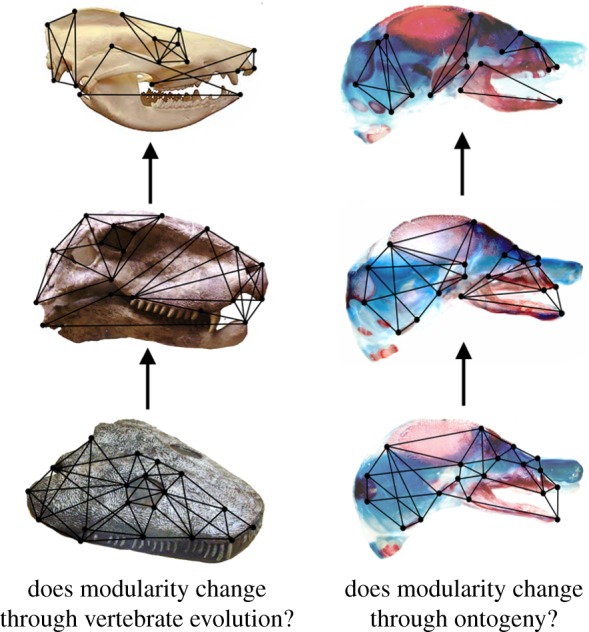
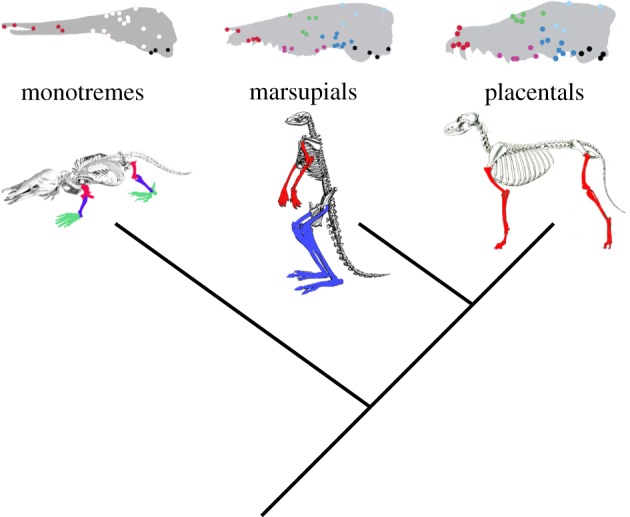
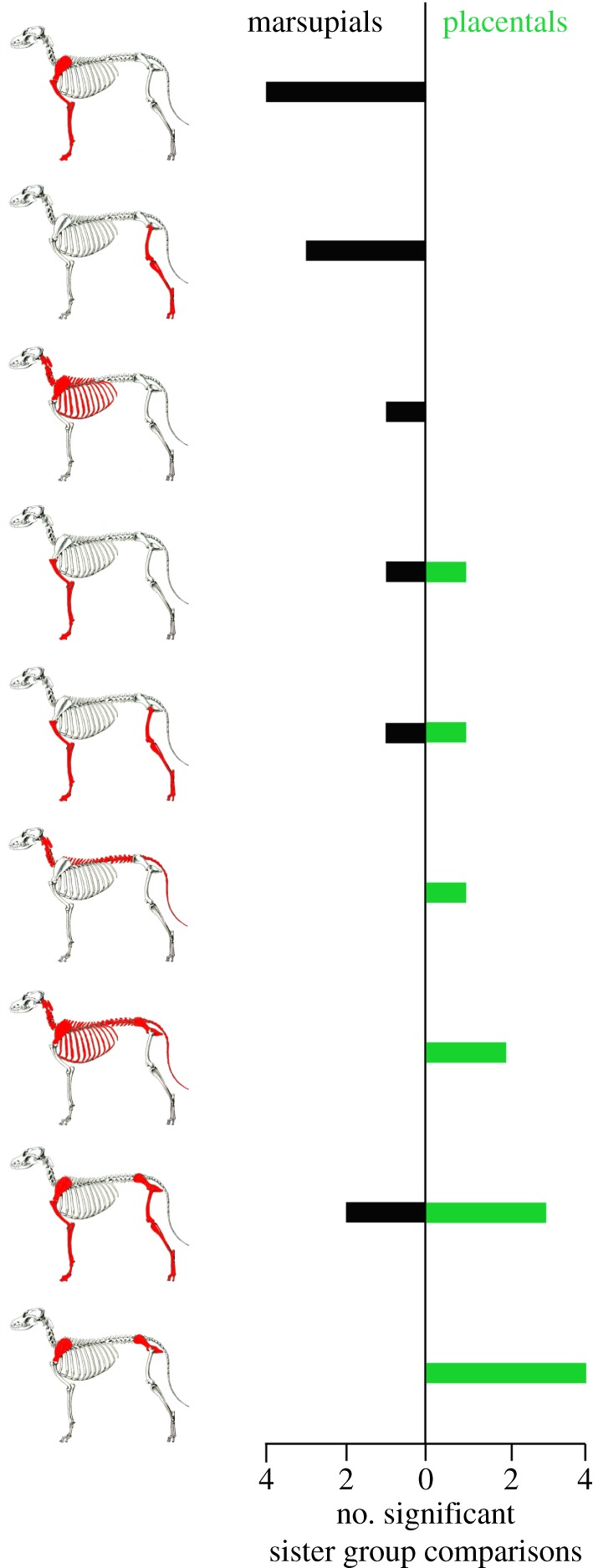
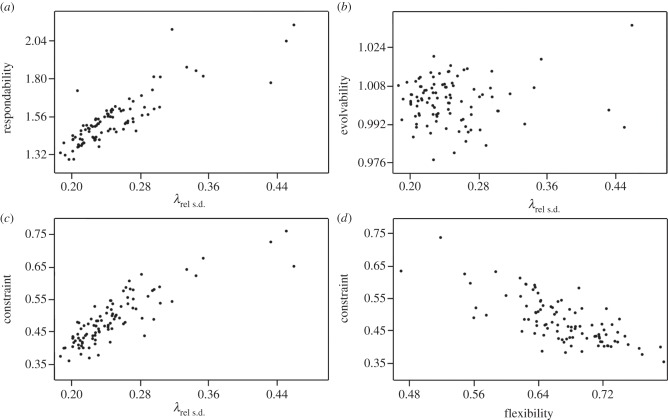
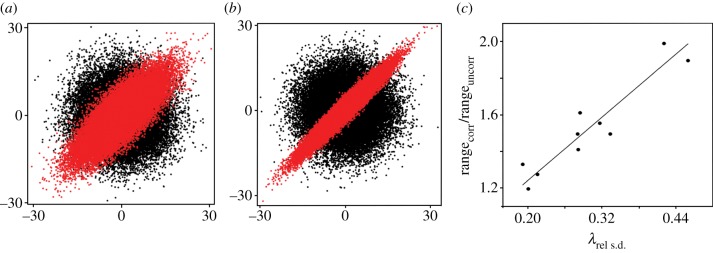
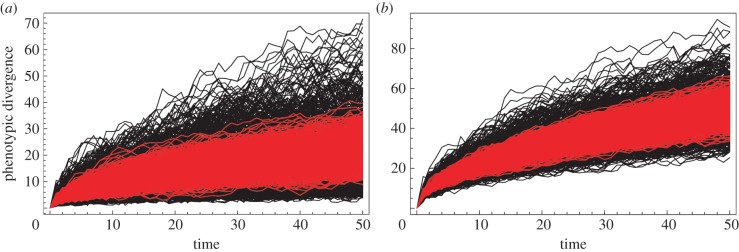
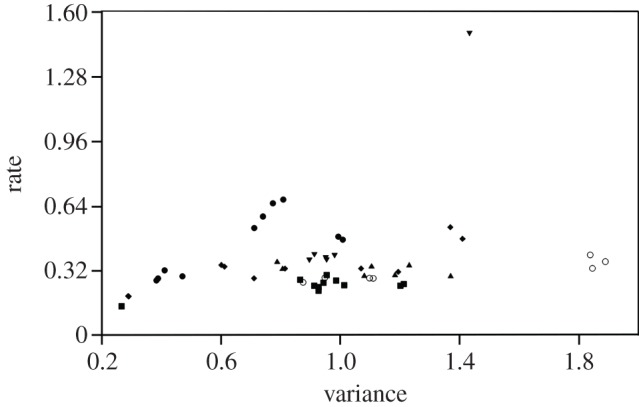
Verification
Claims the paper makes
The claims and statistics of this paper haven’t been checked yet.
Run the check — free, no account needed. It reads the open-access text and checks the sources it cites.
Claims other papers make about this one
Each is checked against this paper’s own text: does it say what the citing paper says it does?
The source backs part of the claim, not all of it — or backs it for a different population, condition or comparison.
In the citing paper
“Rather, the macroevolutionary consequences of integration are likely to be highly dependent on the direction and magnitude of selection on each module (13).”
From Developmental origins of mosaic evolution in the avian cranium (2018) · cites this paper as [13]
Experimental — accuracy not yet measuredThe source backs part of the claim, not all of it — or backs it for a different population, condition or comparison.
In the citing paper
“Taken together, these results support the fundamental prediction that macroevolutionary patterns are shaped by phenotypic modularity and integration, which are in turn determined by developmental processes (7, 11, 13, 16, 23).”
From Developmental origins of mosaic evolution in the avian cranium (2018) · cites this paper as [13]
Experimental — accuracy not yet measured
Self-check
Percentages, sums and reported differences re-computed from the paper’s own numbers.
The self-check needs the paper’s full text.
Citations
Cites
(1977) · Cited by 4,052
Løvtrup, S., & Gould, S. J. (1978) · Systematic Zoology · doi:10.2307/2412825 · Cited by 2,359
PERSPECTIVE: COMPLEX ADAPTATIONS AND THE EVOLUTION OF EVOLVABILITY
Wagner, G. P., & Altenberg, L. (1996) · Evolution · doi:10.1111/j.1558-5646.1996.tb02339.x · Cited by 2,118
The delayed rise of present-day mammals
Bininda-Emonds, O. R. P., Cardillo, M., Jones, K. E., MacPhee, R. D. E., Beck, R. M. D., Grenyer, R., Price, S. A., Vos, R. A., Gittleman, J. L., & Purvis, A. (2007) · Nature · doi:10.1038/nature05634 · Cited by 2,082
Martins, E. P., & Hansen, T. F. (1997) · The American Naturalist · doi:10.1086/286013 · Cited by 1,718
The Development of the Vertebrate Skull
(1938) · Nature · doi:10.1038/142004a0 · Cited by 1,425
Raff, R. A. (1996) · University of Chicago Press eBooks · doi:10.7208/chicago/9780226256573.001.0001 · Cited by 1,262
The shape of life: genes, development, and the evolution of animal form
(1996) · Choice Reviews Online · doi:10.5860/choice.34-1536 · Cited by 1,003
Perspective: Complex Adaptations and the Evolution of Evolvability
Wagner, G. P., & Altenberg, L. (1996) · Evolution · doi:10.2307/2410639 · Cited by 884
PHENOTYPIC, GENETIC, AND ENVIRONMENTAL MORPHOLOGICAL INTEGRATION IN THE CRANIUM
Cheverud, J. M. (1982) · Evolution · doi:10.1111/j.1558-5646.1982.tb05070.x · Cited by 859
Research works printed but not linked: 11
- Schlosser G, 2004, Modularity in development and evolution
- Atchley WR, 1993, The skull. 1 Development, 207
- Cheverud JM, 2004, Modularity in development and evolution, 132
- Goswami A, 2010, Quantitative methods in paleobiology, 213
- 10.1002/1096-8644(2000)43:31 <117::AID-AJPA5>3.3.CO;2-9 · DOI
- Klingenberg CP, 2008, MorphoJ
- Schlosser G, 2005, Modularity in development and evolution, 519
- Shubin N, 2004, Modularity in development and evolution, 429
- Zelditch ML, 2001, Beyond heterochrony: the evolution of development, 145
- Polly PD, 2012, Phylogenetics for mathematica, 2.1 edn
- Polly PD, 2004, On the simulation of the evolution of morphological shape: multivariate shape under selection and drift, Palaeontol. Electron., 7, 1
Cited by
Sorted by citations
Items 101–200 of 360
Weisbecker, V., Guillerme, T., Speck, C., Sherratt, E., Abraha, H. M., Sharp, A. C., Terhune, C. E., Collins, S., Johnston, S. D., & Panagiotopoulou, O. (2019) · Frontiers in Zoology · doi:10.1186/s12983-019-0338-5 · Cited by 26
Mammalian forelimb evolution is driven by uneven proximal-to-distal morphological diversity
Rothier, P. S., Fabre, A., Clavel, J., Benson, R., & Herrel, A. (2023) · eLife · doi:10.7554/elife.81492 · Cited by 27
Are more diverse parts of the mammalian skull more labile?
Linde‐Medina, M., Boughner, J. C., Santana, S. E., & Diogo, R. (2016) · Ecology and Evolution · doi:10.1002/ece3.2046 · Cited by 25
Sansalone, G., Colangelo, P., Loy, A., Raia, P., Wroe, S., & Piras, P. (2019) · BMC Evolutionary Biology · doi:10.1186/s12862-019-1506-0 · Cited by 25
Evolutionary selection and morphological integration in the vertebral column of modern humans
Arlegi, M., Couture, C., & Gómez‐Olivencia, A. (2019) · American Journal of Physical Anthropology · doi:10.1002/ajpa.23950 · Cited by 25
Morphological evolution in a time of phenomics
Goswami, A., & Clavel, J. (2025) · Paleobiology · doi:10.1017/pab.2024.35 · Cited by 27
Self-citationDynamic evolutionary interplay between ontogenetic skull patterning and whole-head integration
Ollonen, J., Khannoon, E. R., Macrì, S., Vergilov, V., Kuurne, J., Saarikivi, J., Soukainen, A., Aalto, I.-M., Werneburg, I., Díaz, R. E., et al. (2024) · Nature Ecology & Evolution · doi:10.1038/s41559-023-02295-3 · Cited by 24
Sansalone, G., Wroe, S., Coates, G. W., Attard, M. R. G., & Fruciano, C. (2024) · Nature Communications · doi:10.1038/s41467-024-47620-x · Cited by 24
Mallet, C., Billet, G., Houssaye, A., & Cornette, R. (2020) · Journal of Anatomy · doi:10.1111/joa.13232 · Cited by 28
Collar, D. C., Quintero, M., Buttler, B., Ward, A. B., & Mehta, R. S. (2016) · Evolution · doi:10.1111/evo.12887 · Cited by 23
A comparison of metrics for quantifying cranial suture complexity
White, H., Clavel, J., Tucker, A. S., & Goswami, A. (2020) · Journal of The Royal Society Interface · doi:10.1098/rsif.2020.0476 · Cited by 23
Self-citationLópez‐Aguirre, C., Pérez‐Torres, J., & Wilson, L. A. B. (2015) · PeerJ · doi:10.7717/peerj.1197 · Cited by 23
Developmental origin underlies evolutionary rate variation across the placental skull
Goswami, A., Noirault, E., Coombs, E. J., Clavel, J., Fabre, A., Halliday, T. J. D., Churchill, M., Curtis, A. A., Watanabe, A., Simmons, N. B., et al. (2023) · Philosophical Transactions of the Royal Society B Biological Sciences · doi:10.1098/rstb.2022.0083 · Cited by 22
Self-citationRose, J. P., & Sytsma, K. J. (2021) · Evolution · doi:10.1111/evo.14220 · Cited by 23
Barrett, P. Z., Hopkins, S. S. B., & Price, S. A. (2021) · Journal of Vertebrate Paleontology · doi:10.1080/02724634.2021.1923523 · Cited by 22
Burns, M. D., Collyer, M. L., & Sidlauskas, B. L. (2022) · Evolution · doi:10.1093/evolut/qpac070 · Cited by 24
Diversification of the ruminant skull along an evolutionary line of least resistance
Rhoda, D., Haber, A., & Angielczyk, K. D. (2023) · Science Advances · doi:10.1126/sciadv.ade8929 · Cited by 22
The cichlid pharyngeal jaw novelty enhances evolutionary integration in the feeding apparatus
Roberts, A. S., Burress, E. D., Lam, B., & Wainwright, P. C. (2023) · Evolution · doi:10.1093/evolut/qpad109 · Cited by 22
Benitez‐Vieyra, S., Pérez‐Alquicira, J., Sazatornil, F. D., Domínguez, C. A., Boege, K., Pérez‐Ishiwara, R., & Fornoni, J. (2019) · Journal of Evolutionary Biology · doi:10.1111/jeb.13480 · Cited by 22
The largest hoplophonine and a complex new hypothesis of nimravid evolution
Barrett, P. Z. (2021) · Scientific Reports · doi:10.1038/s41598-021-00521-1 · Cited by 21
The causes and ecological context of rapid morphological evolution in birds
Crouch, N. M. A., & Tobias, J. A. (2022) · Ecology Letters · doi:10.1111/ele.13962 · Cited by 21
Variable evidence for convergence in morphology and function across avian nectarivores
Hewes, A. E., Cuban, D., Groom, D. J. E., Sargent, A. J., Beltrán, D. F., & Rico‐Guevara, A. (2022) · Journal of Morphology · doi:10.1002/jmor.21513 · Cited by 21
Homo sapiens and Neanderthals share high cerebral cortex integration into adulthood
Sansalone, G., Profico, A., Wroe, S., Allen, K. L., Ledogar, J. A., Ledogar, S. H., Mitchell, D. R., Mondanaro, A., Melchionna, M., Castiglione, S., et al. (2023) · Nature Ecology & Evolution · doi:10.1038/s41559-022-01933-6 · Cited by 21
Biomechanics illuminates form–function relationships in bird bills
Krishnan, A. (2023) · Journal of Experimental Biology · doi:10.1242/jeb.245171 · Cited by 25
Hubbe, A., Melo, D., & Marroig, G. (2016) · Paleobiology · doi:10.1017/pab.2015.49 · Cited by 21
Franchini, P., Colangelo, P., Meyer, A., & Fruciano, C. (2016) · Ecology and Evolution · doi:10.1002/ece3.1912 · Cited by 20
Disparate Postnatal Ontogenies Do Not Add to the Shape Disparity of Infants
Zelditch, M. L., Calamari, Z. T., & Swiderski, D. L. (2016) · Evolutionary Biology · doi:10.1007/s11692-016-9370-y · Cited by 20
Evolution of the bovid cranium: morphological diversification under allometric constraint
Bibi, F., & Tyler, J. M. B. (2022) · Communications Biology · doi:10.1038/s42003-021-02877-6 · Cited by 20
Conaway, M. A., Schroeder, L., & von Cramon‐Taubadel, N. (2018) · American Journal of Physical Anthropology · doi:10.1002/ajpa.23456 · Cited by 20
Arístide, L., Bastide, P., dos Reis, S. F., dos Santos, T. M. P., Lopes, R. T., & Pérez, S. I. (2018) · Evolution · doi:10.1111/evo.13609 · Cited by 21
Du, T. Y., Tissandier, S., & Larsson, H. C. E. (2018) · Evolution · doi:10.1111/evo.13669 · Cited by 19
Kovaleva, V. Y., Pozdnyakov, А. А., Litvinov, Y. N., & Efimov, V. M. (2019) · Ecological genetics · doi:10.17816/ecogen17221-34 · Cited by 57
Hanot, P., Bayarsaikhan, J., Guintard, C., Haruda, A. F., Mijiddorj, E., Schafberg, R., & Taylor, W. T. T. (2021) · BMC Ecology and Evolution · doi:10.1186/s12862-021-01907-5 · Cited by 19
Heritability: the link between development and the microevolution of molar tooth form
Polly, P. D., & Mock, O. B. (2017) · Historical Biology · doi:10.1080/08912963.2017.1337760 · Cited by 19
Self-citationConith, A. J., Meagher, M. A., & Dumont, E. R. (2018) · The American Naturalist · doi:10.1086/697376 · Cited by 22
Phylogeny and foraging behaviour shape modular morphological variation in bat humeri
López‐Aguirre, C., Hand, S. J., Koyabu, D. B., Tú, V. T., & Wilson, L. A. B. (2020) · Journal of Anatomy · doi:10.1111/joa.13380 · Cited by 18
Evolvability and craniofacial diversification in genus Homo
Baab, K. L. (2018) · Evolution · doi:10.1111/evo.13637 · Cited by 20
Covariation between the cranium and the cervical vertebrae in hominids
Arlegi, M., Pantoja‐Pérez, A., Couture, C., & Gómez‐Olivencia, A. (2021) · Journal of Human Evolution · doi:10.1016/j.jhevol.2021.103112 · Cited by 18
The developing bird pelvis passes through ancestral dinosaurian conditions
Griffin, C. T., Botelho, J. F., Hanson, M., Fabbri, M., Smith‐Paredes, D., Carney, R. M., Norell, M. A., Egawa, S., Gatesy, S. M., Rowe, T. B., et al. (2022) · Nature · doi:10.1038/s41586-022-04982-w · Cited by 21
Dantzer, B. (2023) · Hormones and Behavior · doi:10.1016/j.yhbeh.2023.105311 · Cited by 19
Orkney, A., & Hedrick, B. P. (2024) · Nature Communications · doi:10.1038/s41467-024-48324-y · Cited by 19
Martín‐Serra, A., Nanova, O. G., Varón‐González, C., Ortega, G., & Figueirido, B. (2019) · Biology Letters · doi:10.1098/rsbl.2019.0406 · Cited by 18
Ferraz, T., Rossoni, D. M., Althoff, S. L., Pissinatti, A., Paixão‐Côrtes, V. R., Bortolini, M. C., González‐José, R., Marroig, G., Salzano, F. M., GONÇALVES, G. L., et al. (2018) · Scientific Reports · doi:10.1038/s41598-018-26225-7 · Cited by 17
Neaux, D., Wroe, S., Ledogar, J. A., Ledogar, S. H., & Sansalone, G. (2019) · American Journal of Physical Anthropology · doi:10.1002/ajpa.23899 · Cited by 17
Conith, A. J., Hope, S. A., Chhouk, B. H., & Albertson, R. C. (2020) · Molecular Ecology · doi:10.1111/mec.15748 · Cited by 17
Newton, A. H., Weisbecker, V., Pask, A. J., & Hipsley, C. A. (2021) · Communications Biology · doi:10.1038/s42003-020-01569-x · Cited by 17
Adams, D. C., Korneisel, D. E., Young, M., & Nistri, A. (2017) · The American Naturalist · doi:10.1086/692471 · Cited by 17
Cranial integration in the fire salamander, Salamandra salamandra (Caudata: Salamandridae)
Bon, M., Bardua, C., Goswami, A., & Fabre, A. (2020) · Biological Journal of the Linnean Society · doi:10.1093/biolinnean/blaa020 · Cited by 17
Self-citationMultilevel analysis of integration and disparity in the mammalian skull
Sherratt, E., & Kraatz, B. (2023) · Evolution · doi:10.1093/evolut/qpad020 · Cited by 16
How to tuna fish: constraint, convergence, and integration in the neurocranium of pelagiarian fishes
Knapp, A., Lázaro, G. R., Friedman, M., Johanson, Z., Evans, K. M., Giles, S., Beckett, H. T., & Goswami, A. (2023) · Evolution · doi:10.1093/evolut/qpad056 · Cited by 16
Self-citationWeisbecker, V., Beck, R. M. D., Guillerme, T., Harrington, A. R., Lange-Hodgson, L., Lee, M. S. Y., Mardon, K., & Phillips, M. J. (2023) · Philosophical Transactions of the Royal Society B Biological Sciences · doi:10.1098/rstb.2022.0085 · Cited by 16
Tejero‐Cicuéndez, H., Menéndez, I., Talavera, A., Mochales‐Riaño, G., Burriel‐Carranza, B., Simó‐Riudalbas, M., Carranza, S., & Adams, D. C. (2023) · Evolution · doi:10.1093/evolut/qpad166 · Cited by 16
Verger, K. L., Hautier, L., Gerber, S., Bardin, J., Delsuc, F., Ruiz, L. R. G., Amson, E., & Billet, G. (2023) · Evolution · doi:10.1093/evolut/qpad214 · Cited by 17
Uncovering the mosaic evolution of the carnivoran skeletal system
Law, C. J., Hlusko, L. J., & Tseng, Z. J. (2024) · Biology Letters · doi:10.1098/rsbl.2023.0526 · Cited by 16
Edie, S. M., Khouja, S. C., Collins, K. S., Crouch, N. M. A., & Jablonski, D. (2022) · Proceedings of the Royal Society B Biological Sciences · doi:10.1098/rspb.2021.1199 · Cited by 15
Integration and macroevolutionary patterns in the pollination biology of conifers
Leslie, A. B., Beaulieu, J. M., Crane, P. R., Knopf, P., & Donoghue, M. J. (2015) · Evolution · doi:10.1111/evo.12670 · Cited by 15
Friedman, N. R., Remeš, V., & Economo, E. P. (2019) · Integrative and Comparative Biology · doi:10.1093/icb/icz053 · Cited by 15
Celik, M. A., & Phillips, M. J. (2020) · Frontiers in Genetics · doi:10.3389/fgene.2020.00651 · Cited by 15
Feiner, N., Jackson, I. S. C., Stanley, E. L., & Uller, T. (2021) · Nature Communications · doi:10.1038/s41467-021-21757-5 · Cited by 19
Constraints associated with captivity alter craniomandibular integration in wild boar
Neaux, D., Blanc, B., Ortiz, K., Locatelli, Y., Schafberg, R., Herrel, A., Debat, V., & Cucchi, T. (2021) · Journal of Anatomy · doi:10.1111/joa.13425 · Cited by 15
A surrogate forelimb: Evolution, function and development of the avian cervical spine
Marek, R. D. (2023) · Journal of Morphology · doi:10.1002/jmor.21638 · Cited by 16
Taylor, G. W., Santos, J. C., Perrault, B. J., Morando, M. M., Almazán, C. R. V., & Sites, J. W. (2017) · Ecology and Evolution · doi:10.1002/ece3.3356 · Cited by 14
Farina, S. C., Knope, M. L., Corn, K. A., Summers, A. P., & Bemis, W. E. (2019) · Integrative and Comparative Biology · doi:10.1093/icb/icz022 · Cited by 14
Development and function explain the modular evolution of phalanges in gecko lizards
Rothier, P. S., Simon, M. N., Marroig, G., Herrel, A., & Kohlsdorf, T. (2022) · Proceedings of the Royal Society B Biological Sciences · doi:10.1098/rspb.2021.2300 · Cited by 14
Fighting does not influence the morphological integration of crustacean claws (Decapoda: Aeglidae)
Nogueira, C. S., da Silva, A. R., & Palaoro, A. V. (2022) · Biological Journal of the Linnean Society · doi:10.1093/biolinnean/blac026 · Cited by 14
Palate Variation and Evolution in New World Leaf-Nosed and Old World Fruit Bats (Order Chiroptera)
Sorensen, D. W., Butkus, C. E., Cooper, L. N., Cretekos, C. J., Rasweiler, J. J., & Sears, K. E. (2014) · Evolutionary Biology · doi:10.1007/s11692-014-9291-6 · Cited by 14
López‐Aguirre, C., Hand, S. J., Koyabu, D. B., Sơn, N. T., & Wilson, L. A. B. (2019) · BMC Evolutionary Biology · doi:10.1186/s12862-019-1396-1 · Cited by 15
Mosaic evolution, preadaptation, and the evolution of evolvability in apes
Parins‐Fukuchi, C. (2020) · Evolution · doi:10.1111/evo.13923 · Cited by 14
On Information Rank Deficiency in Phenotypic Covariance Matrices
O'Keefe, F. R., Meachen, J., & Polly, P. D. (2021) · Systematic Biology · doi:10.1093/sysbio/syab088 · Cited by 13
Self-citationTroyer, E. M., Evans, K. M., Goatley, C. H. R., Friedman, M., Carnevale, G., Nicholas, B., Kolmann, M. A., Bemis, K. E., & Arcila, D. (2024) · Evolution · doi:10.1093/evolut/qpae127 · Cited by 13
Radiation and extinction: investigating clade dynamics in deep time
Goswami, A., Mannion, P. D., & Benton, M. J. (2016) · Biological Journal of the Linnean Society · doi:10.1111/bij.12763 · Cited by 13
Self-citationMartínez‐Vargas, J., Muñoz‐Muñoz, F., Martı́nez-Maza, C., Molinero, A., & Ventura, J. (2017) · Journal of Morphology · doi:10.1002/jmor.20694 · Cited by 11
Avian predation intensity as a driver of clinal variation in colour morph frequency
Matthews, G., Goulet, C. T., Delhey, K. J. V., Atkins, Z. S., While, G. M., Gardner, M., & Chapple, D. G. (2018) · Journal of Animal Ecology · doi:10.1111/1365-2656.12894 · Cited by 13
Natural Selection on Adults Has Trait-Dependent Consequences for Juvenile Evolution in Dragonflies
Moore, M. P., & Martin, R. A. (2021) · The American Naturalist · doi:10.1086/714048 · Cited by 13
The neck as a keystone structure in avian macroevolution and mosaicism
Marek, R. D., & Felice, R. N. (2023) · BMC Biology · doi:10.1186/s12915-023-01715-x · Cited by 12
The hierarchical radiation of phyllostomid bats as revealed by adaptive molar morphology
Grossnickle, D. M., Sadier, A., Patterson, E., Cortés-Viruet, N. N., Jiménez-Rivera, S. M., Sears, K. E., & Santana, S. E. (2024) · Current Biology · doi:10.1016/j.cub.2024.02.027 · Cited by 12
A classic key innovation constrains oral jaw functional diversification in fishes
Roberts, A. S., Martinez, C. M., Corn, K. A., & Wainwright, P. C. (2024) · Evolution Letters · doi:10.1093/evlett/qrae046 · Cited by 13
Patterns and magnitudes of craniofacial covariation in extant cercopithecids
Monson, T. A. (2020) · The Anatomical Record · doi:10.1002/ar.24398 · Cited by 12
Modularity in the trilobite head consistent with the hypothesized segmental origin of the eyes
Vargas-Parra, E. E., & Hopkins, M. J. (2022) · Evolution & Development · doi:10.1111/ede.12418 · Cited by 11
Figueirido, B., Pérez‐Ramos, A., & Martín‐Serra, A. (2022) · Journal of Anatomy · doi:10.1111/joa.13811 · Cited by 12
Disentangling Mechanical and Sensory Modules in the Radiation of Noctilionoid Bats
Mutumi, G. L., Hall, R. P., Hedrick, B. P., Yohe, L. R., Sadier, A., Davies, K. T. J., Rossiter, S. J., Sears, K. E., Dávalos, L. M., & Dumont, E. R. (2023) · The American Naturalist · doi:10.1086/725368 · Cited by 12
Constraints on geographic variation in fiddler crabs (Ocypodidae: Uca) from the western Atlantic
Hopkins, M. J., Haber, A., & Thurman, C. L. (2016) · Journal of Evolutionary Biology · doi:10.1111/jeb.12891 · Cited by 12
Stange, M., Aguirre‐Fernández, G., Salzburger, W., & Sánchez-Villagra, M. R. (2018) · BMC Evolutionary Biology · doi:10.1186/s12862-018-1152-y · Cited by 12
Allometry, evolution and development of neocortex size in mammals
Smaers, J. B., Mongle, C. S., Safi, K., & Dechmann, D. K. N. (2019) · Progress in brain research · doi:10.1016/bs.pbr.2019.05.002 · Cited by 11
Self-citationNations, J. A., Mount, G. G., Morere, S. M., Achmadi, A. S., Rowe, K. C., & Esselstyn, J. A. (2020) · Evolution · doi:10.1111/evo.14156 · Cited by 12
Changing Modular Patterns in the Carnivoran Pelvic Girdle
Martín‐Serra, A., Figueirido, B., & Palmqvist, P. (2018) · Journal of Mammalian Evolution · doi:10.1007/s10914-018-9454-9 · Cited by 11
Nogueira, C. S., Pantaleão, J. A. F., & da Costa, R. C. (2022) · Animal Biology · doi:10.1163/15707563-bja10082 · Cited by 11
Alfieri, F., Botton‐Divet, L., Wölfer, J., Nyakatura, J. A., & Amson, E. (2023) · Communications Biology · doi:10.1038/s42003-023-05371-3 · Cited by 11
Chan, H., Colaco, E., Martin, C. H., & Evans, K. M. (2024) · Evolutionary Journal of the Linnean Society · doi:10.1093/evolinnean/kzae013 · Cited by 11
Orkney, A., Boerma, D. B., & Hedrick, B. P. (2024) · Nature Ecology & Evolution · doi:10.1038/s41559-024-02572-9 · Cited by 12
Burbrink, F. T., & Futterman, I. (2019) · Ecology and Evolution · doi:10.1002/ece3.5492 · Cited by 11
Olivares, A. I., Álvarez, A., Verzi, D. H., Pérez, S. I., & Santi, N. A. D. (2019) · Palaeontology · doi:10.1111/pala.12464 · Cited by 11
Benítez, H. A., Püschel, T. A., & Suazo, M. J. (2022) · Biology · doi:10.3390/biology11040567 · Cited by 11
Pérez, F., Lavandero, N., Ossa, C. G., Hinojosa, L. F., Jara‐Arancio, P., & Arroyo, M. T. K. (2020) · Frontiers in Plant Science · doi:10.3389/fpls.2020.00714 · Cited by 11
Boivin, M., Álvarez, A., & Ercoli, M. D. (2022) · Zoological Journal of the Linnean Society · doi:10.1093/zoolinnean/zlac005 · Cited by 11
Roberts, A. S., Farina, S. C., Goforth, R. R., & Gidmark, N. J. (2018) · Zoology · doi:10.1016/j.zool.2018.06.006 · Cited by 11
The Development of Integration in Marsupial and Placental Limbs
Kelly, E. M., Marcot, J. D., Selwood, L., & Sears, K. E. (2019) · Integrative Organismal Biology · doi:10.1093/iob/oby013 · Cited by 11
Liu, Y., Deakin, W. J., Rayfield, E. J., & Donoghue, P. C. J. (2024) · Evolutionary Journal of the Linnean Society · doi:10.1093/evolinnean/kzae019 · Cited by 10
The Implications of Stratigraphic Compatibility for Character Integration among Fossil Taxa
Wagner, P. J., & Estabrook, G. F. (2015) · Systematic Biology · doi:10.1093/sysbio/syv040 · Cited by 10
Analyzing endocrine system conservation and evolution
Bonett, R. M. (2016) · General and Comparative Endocrinology · doi:10.1016/j.ygcen.2016.03.011 · Cited by 12
Metadata
- Authors
- Goswami, A., Smaers, J. B., Soligo, C., & Polly, P. D.
- Affiliations
- University College London (GB)
- Indiana University Bloomington (US)
- Corresponding author
- Goswami, A.
- Venue
- Philosophical Transactions of the Royal Society B: Biological Sciences
- Publisher
- The Royal Society
- Published
- 2014-08-19
- Volume
- 369
- Issue
- 1649
- Pages
- 20130254
- ISSN
- 0962-8436 (ISSN-L)
- 1471-2970
- PMC
- PMC4084539
- OpenAlex
- W2158213278
- Cited by
- 359
- References
- 133
- Citations by year
- 2026: 20 · 2025: 30 · 2024: 27 · 2023: 39 · 2022: 30 · 2021: 40 · 2020: 30 · 2019: 42 · 2018: 34 · 2017: 19 · 2016: 26 · 2015: 17 · 2014: 5
- FWCI
- 31.00
- Type
- journal article
- Language
- en
- Open access
- hybrid
- doi.org
- Locations
- Philosophical Transactions of the Royal Society B Biological Sciences (publishedVersion, cc-by)
- Europe PMC (PubMed Central) (publishedVersion, cc-by)
- PubMed Central (publishedVersion, cc-by)
- PubMed (publishedVersion)
- UCL Discovery (University College London) (submittedVersion)
- Funders
- National Science Foundation (0308765, 0502186)
- American Museum of Natural History
- University of Chicago
- Field Museum
- Royal Society
- University of New South Wales
- National Museum of Natural History
- Natural Environment Research Council (NE/J012432/1, NE/H022937/1)
- Office of International Science and Engineering
- University of California Museum of Paleontology
- Topics
- Life Sciences › Agricultural and Biological Sciences › Ecology, Evolution, Behavior and Systematics › Morphological variations and asymmetry
- Physical Sciences › Earth and Planetary Sciences › Paleontology › Evolution and Paleontology Studies
- Life Sciences › Biochemistry, Genetics and Molecular Biology › Genetics › Evolution and Genetic Dynamics
- Keywords
- phenotypic integration, modularity, morphological evolution, heterochrony, postcranial skeleton, ossification, selection response, morphological disparity, homoplasy, convergent evolution, evolutionary rates, random walks
- MeSH terms
- Animals, Biological Evolution, Models, Biological, Phenotype, Phylogeny, Selection, Genetic, Time Factors, Vertebrates, Developmental Biology, Body Patterning, Biodiversity, Systems Biology
About these checks
Registry, retraction, Cites and statistics results are computed, not judged, with one exception: a printed reference that no index lists is read once by a model before it counts as a citation error. Claims are extracted by a model and kept only when their quote appears verbatim in the text; each cited source is then checked, with a model’s help, for whether it says what the claim relies on. Those verdicts can be wrong — read the claim’s quote and the cited source before relying on one.
Statistics and arithmetic are recomputed, not judged.
Confidence bands are shown only for fields calibrated on our annotated test set. None is calibrated yet, so no band is shown.
What counts as a claim ›How we measure confidence ›How we check this ›
Are you an author, or do you see a problem with this page? Request a review
