

The DOI matches its Crossref record; 6 of the 6 references it cites were found in a registry or an index.
Biogeochemical significance of pelagic ecosystem function: an end-Cretaceous case study
Abstract
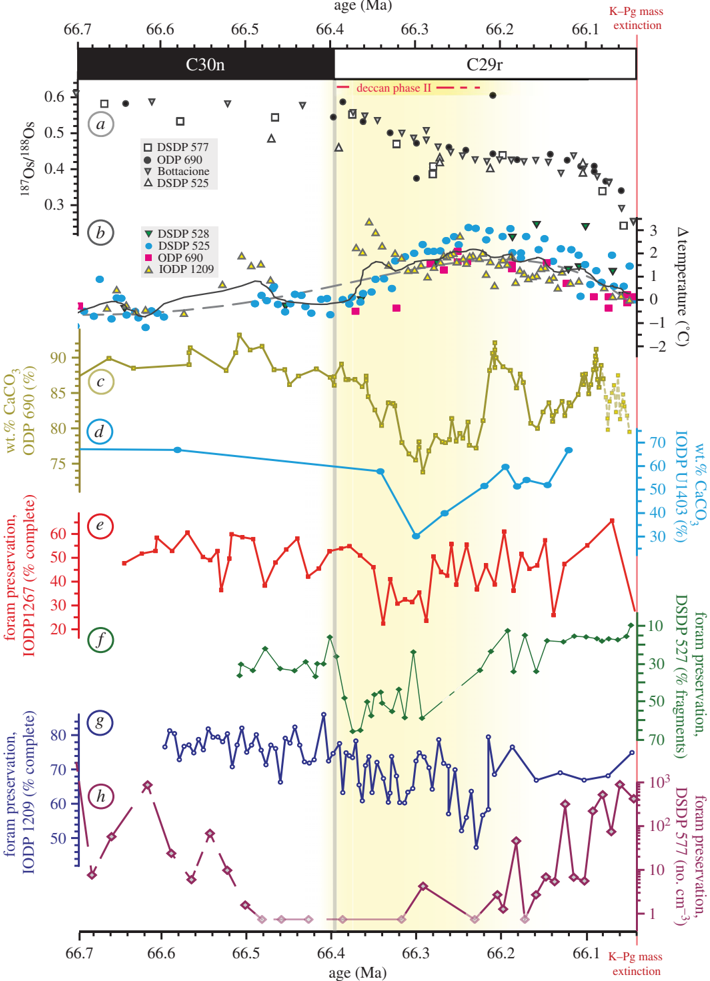
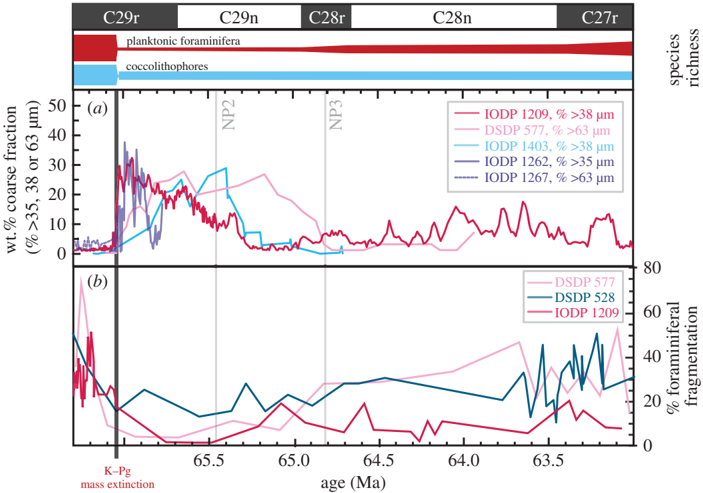
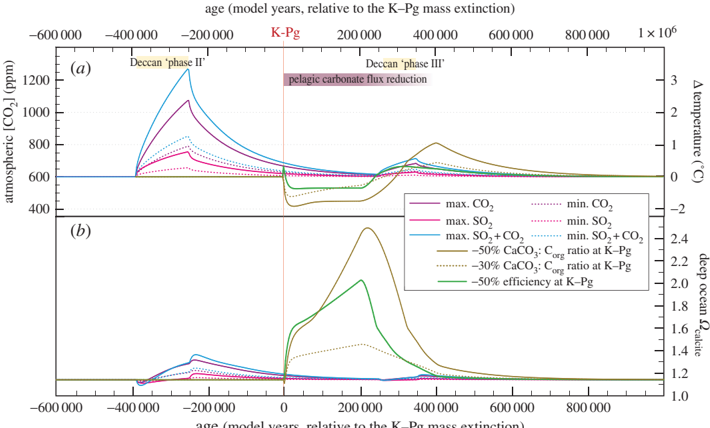
Pelagic ecosystem function is integral to global biogeochemical cycling, and plays a major role in modulating atmospheric CO 2 concentrations ( p CO 2 ). Uncertainty as to the effects of human activities on marine ecosystem function hinders projection of future atmospheric p CO 2 . To this end, events in the geological past can provide informative case studies in the response of ecosystem function to environmental and ecological changes. Around the Cretaceous–Palaeogene (K–Pg) boundary, two such events occurred: Deccan large igneous province (LIP) eruptions and massive bolide impact at the Yucatan Peninsula. Both perturbed the environment, but only the impact coincided with marine mass extinction. As such, we use these events to directly contrast the response of marine biogeochemical cycling to environmental perturbation with and without changes in global species richness. We measure this biogeochemical response using records of deep-sea carbonate preservation. We find that Late Cretaceous Deccan volcanism prompted transient deep-sea carbonate dissolution of a larger magnitude and timescale than predicted by geochemical models. Even so, the effect of volcanism on carbonate preservation was slight compared with bolide impact. Empirical records and geochemical models support a pronounced increase in carbonate saturation state for more than 500 000 years following the mass extinction of pelagic carbonate producers at the K–Pg boundary. These examples highlight the importance of pelagic ecosystems in moderating climate and ocean chemistry.
Overview
The claims and statistics of this paper haven’t been checked yet.
Run the check — free, no account needed. It reads the open-access text and checks the sources it cites.
Integrity signals
Registry
Cites
Statistics
Figures
Verification
Claims the paper makes
The claims and statistics of this paper haven’t been checked yet.
Run the check — free, no account needed. It reads the open-access text and checks the sources it cites.
Claims other papers make about this one
Each is checked against this paper’s own text: does it say what the citing paper says it does?
In the citing paper
“The transient timing of marine carbonate dissolution suggests the main phase of degassing occurred beginning shortly after the onset of Chron 29R and ending within 200 kyr (ref. 37).”
From End-Cretaceous extinction in Antarctica linked to both Deccan volcanism and meteorite impact via climate change (2016) · cites this paper as [37]
Self-check
Percentages, sums and reported differences re-computed from the paper’s own numbers.
The self-check needs the paper’s full text.
Citations
Cites
Impacts of Biodiversity Loss on Ocean Ecosystem Services
Worm, B., Barbier, E. B., Beaumont, N., Duffy, J. E., Folke, C., Halpern, B. S., Jackson, J. B. C., Lotze, H. K., Micheli, F., Palumbi, S. R., et al. (2006) · Science · doi:10.1126/science.1132294 · Cited by 4,544
Berner, R. A., Lasaga, A. C., & Garrels, R. M. (1983) · American Journal of Science · doi:10.2475/ajs.283.7.641 · Cited by 2,428 · cited 1×
“Consequently, the marine carbonate cycle, coupled with global silicate weathering feedbacks [1], could assimilate Deccan-derived CO2 over these timescales without drastic, long-lasting effects on surface ocean VCaCO3 (only very modest lysocline shallowing and some reduction in surface ocean pH—see electronic supplemen…”
BackgroundStanley, S. M., & Hardie, L. A. (1998) · Palaeogeography, Palaeoclimatology, Palaeoecology · doi:10.1016/s0031-0182(98)00109-6 · Cited by 830
The role of the global carbonate cycle in the regulation and evolution of the Earth system
RIDGWELL, A., & ZEEBE, R. (2005) · Earth and Planetary Science Letters · doi:10.1016/j.epsl.2005.03.006 · Cited by 705
Anthropogenic modification of the oceans
Tyrrell, T. (2011) · Philosophical Transactions of the Royal Society A Mathematical Physical and Engineering Sciences · doi:10.1098/rsta.2010.0334 · Cited by 91
Carbon dioxide emissions from Deccan Volcanism and a K/T boundary Greenhouse Effect
Caldeira, K., & Rampino, M. R. (1990) · Geophysical Research Letters · doi:10.1029/gl017i009p01299 · Cited by 90
Research works printed but not linked: 77
- Gruber N, 2004, The global carbon cycle: integrating humans, climate and the natural world, 45
- Ciais P, 2013, Climate change 2013: the physical science basis. Contribution of working group I to the fifth assessment report of the intergovernmental panel on climate Change, 465
- 10.1029/2003GC000538 · DOI
- 10.1029/2001GB001459 · DOI
- 10.1029/93GB02524 · DOI
- Pörtner H-O, 2014, Climate change 2014: impacts, adaptation, and vulnerability. Part A: global and sectoral aspects. contribution of working group II to the fifth assessment report of the intergovernmental panel on climate change, 411
- 10.1371/journal.pbio.1001682 · DOI
- 10.5194/bg-7-621-2010 · DOI
- 10.1098/rstb.2015.0282 · DOI
- Yasuhara M, 2015, Combining marine macroecology and palaeoecology in understanding biodiversity: microfossils as a model, Biol. Rev
- 10.1098/rstb.2015.0267 · DOI
- 10.1029/2008JB005644 · DOI · Paper page
- 10.1126/science.aaa0118 · DOI · Paper page
- 10.1126/science.208.4448.1095 · DOI · Paper page
- 10.1126/science.1177265 · DOI · Paper page
- 10.1038/ngeo2095 · DOI
- 10.1073/pnas.1418604112 · DOI
- 10.1073/pnas.1110601109 · DOI
- 10.1016/j.marmicro.2009.05.001 · DOI
- D'Hondt S, 1996, Special paper 307: the Cretaceous–tertiary event and other catastrophes in earth history, 303
- 10.2113/31.3.275 · DOI
- 10.1130/G30326.1 · DOI
- 10.1126/science.1109004 · DOI
- Hancock HJL, 2005, Carbonate dissolution episodes in Paleocene and Eocene sediment, Shatsky Rise, West-Central Pacific, Proc. Ocean Drill. Program Sci, 198, 1
- Colosimo AB, 2006, Proc. of the Ocean Drilling Project, Scientific Results, 1
- Berger WH, 1982, Foraminifera on the deep-sea floor: lysocline and dissolution rate, Oceanol. Acta, 5, 249
- 10.5194/gmd-5-149-2012 · DOI
- 10.1002/2014GB004986 · DOI
- 10.1130/1052-5173(2003)013<4:TEFTGE>2.0.CO;2 · DOI
- 10.1130/0091-7613(2002)030<0703:PBIEFI>2.0.CO;2 · DOI
- 10.1038/nature11574 · DOI
- 10.1016/j.epsl.2007.07.011 · DOI · Paper page
- 10.1016/j.epsl.2006.05.041 · DOI · Paper page
- 10.1016/j.epsl.2009.02.019 · DOI · Paper page
- 10.1144/0016-76492006-062 · DOI · Paper page
- 10.1016/0195-6671(85)90048-5 · DOI
- Stott LD, 1990, Proc. Ocean Drilling Project, 829
- 10.1016/0031-0182(94)90081-7 · DOI
- 10.1029/2010PA002092 · DOI · Paper page
- 10.1130/0091-7613(1998)026<0995:ADSWAT>2.3.CO;2 · DOI
- Ehrendorfer TW. 1993 Late Cretaceous (Maestrichtian) calcareous nannoplankton biogeography with emphasis on events immediately preceding the Cretaceous/Paleocene Boundary. PhD thesis The University is the Massachusetts Institute of Technology and Woods Hole Oceanographic Institution USA. · DOI
- O'Connell SB, 1990, Variations in Upper Cretaceous and Cenozoic calcium carbonate percentages, Maud Rise, Weddell Sea, Antarctica, Proc. Ocean Drill. Program Sci. Results, 113, 971
- Norris RD, 2014, Paleogene Newfoundland sediment drifts
- 10.1016/S0031-0182(96)00133-2 · DOI
- 10.1029/PA001i002p00097 · DOI
- 10.1016/j.palaeo.2010.02.036 · DOI
- 10.1016/j.marmicro.2007.07.004 · DOI
- 10.1029/1998PA900017 · DOI
- 10.1126/science.346.6215.1281 · DOI
- 10.1126/science.1208277 · DOI
- Zachos JC, 1985, Stable isotope and trace element geochemistry of carbonate sediments across the Cretaceous/Tertiary boundary at deep sea drilling project hole 577, leg 86, Initial Rep. Deep Sea Drill. Proj, 86, 513
- 10.1038/ngeo1302 · DOI
- 10.1146/annurev.ecolsys.35.021103.105715 · DOI
- 10.1666/11027.1 · DOI
- 10.1017/pab.2015.28 · DOI
- 10.1016/0025-3227(85)90108-2 · DOI
- 10.1029/2000GB001279 · DOI
- D'Hondt S Inagaki F Alvarez-Zarikian CA Expedition 329 scientists 2011 south pacific gyre subseafloor life. Proc. Integr. Ocean Drill. Program 329. (doi:10.2204/iodp.proc.329.2011) · DOI
- 10.1130/0016-7606(1992)104<0954:TROOJP>2.3.CO;2 · DOI
- Caldeira K, 1990, Extinction events in earth history, 333, 10.1007/BFb0011156 · DOI
- 10.1029/93PA01163 · DOI
- 10.1130/G21566.1 · DOI
- Smit J, 1982, Extinction and evolution of planktonic foraminifera after a major impact at the Cretaceous/Tertiary boundary, Geol. Soc. Am. Spec. Pap, 190, 329
- 10.1073/pnas.0811302106 · DOI
- 10.1016/j.epsl.2016.01.012 · DOI
- 10.1016/j.palaeo.2004.10.006 · DOI
- 10.1016/j.palaeo.2009.08.029 · DOI
- 10.1016/S0012-821X(03)00390-X · DOI
- 10.1130/0091-7613(1994)022<0099:CNATKT>2.3.CO;2 · DOI
- 10.1016/j.tree.2015.08.009 · DOI
- Paris G, 2015, Geochemical consequences of intense pulse-like degassing during the onset of the Central Atlantic Magmatic Province, Palaeogeogr. Palaeoclimatol. Palaeoecol
- 10.1126/science.258.5089.1760 · DOI
- Birch H Coxall HK Pearson PN Kroon D Schmidt DN. 2016 Partial collapse of the marine biological pump at the Cretaceous–Paleogene boundary. Geology G37581–1. · DOI
- 10.1126/science.1176233 · DOI
- 10.1130/G21702.1 · DOI
- 10.1016/j.cub.2015.08.053 · DOI
- 10.1038/nclimate2722 · DOI
Cited by
The Sixth Mass Extinction: fact, fiction or speculation?
Cowie, R. H., Bouchet, P., & Fontaine, B. (2022) · Biological Reviews · doi:10.1111/brv.12816 · Cited by 874
U-Pb constraints on pulsed eruption of the Deccan Traps across the end-Cretaceous mass extinction
Schoene, B., Eddy, M. P., Samperton, K. M., Keller, C. B., Keller, G., Adatte, T., & Khadri, S. F. R. (2019) · Science · doi:10.1126/science.aau2422 · Cited by 542
Petersen, S. V., Dutton, A., & Lohmann, K. C. (2016) · Nature Communications · doi:10.1038/ncomms12079 · Cited by 210
Mercury linked to Deccan Traps volcanism, climate change and the end-Cretaceous mass extinction
Keller, G., Mateo, P., Monkenbusch, J., Thibault, N., Punekar, J., Spangenberg, J. E., Abramovich, S., Ashckenazi-Polivoda, S., Schoene, B., Eddy, M. P., et al. (2020) · Global and Planetary Change · doi:10.1016/j.gloplacha.2020.103312 · Cited by 130
Earth orbital rhythms links timing of Deccan trap volcanism phases and global climate change
Westerhold, T., Dallanave, E., Penman, D., Schoene, B., Röhl, U., Gussone, N., & Kuroda, J. (2025) · Science Advances · doi:10.1126/sciadv.adr8584 · Cited by 17
Self-citation
Metadata
- Authors
- Henehan, M. J., Hull, P. M., Penman, D. E., Rae, J. W. B., & Schmidt, D. N.
- Venue
- Philosophical Transactions of the Royal Society B: Biological Sciences
- Publisher
- The Royal Society
- Published
- 2016-05-19
- Volume
- 371
- Issue
- 1694
- Pages
- 20150510
- ISSN
- 0962-8436
- 1471-2970
- Cited by
- 63
- References
- 6
- Language
- en
- Funders
- Nuffield Foundation (Summer Student Bursary)
- Yale University (Flint Post-Doctoral Fellowship)
- Royal Society (University Research Fellowship, Wolfson Merit Award)
- Natural Environment Research Council (PhD Studentship)
- NSF-IODP U.S. Science Support Program (Post-Expedition Activity award for IODP Exp. 342)
About these checks
Registry, retraction, Cites and statistics results are computed, not judged, with one exception: a printed reference that no index lists is read once by a model before it counts as a citation error. Claims are extracted by a model and kept only when their quote appears verbatim in the text; each cited source is then checked, with a model’s help, for whether it says what the claim relies on. Those verdicts can be wrong — read the claim’s quote and the cited source before relying on one.
Statistics and arithmetic are recomputed, not judged.
Confidence bands are shown only for fields calibrated on our annotated test set. None is calibrated yet, so no band is shown.
What counts as a claim ›How we measure confidence ›How we check this ›
Are you an author, or do you see a problem with this page? Request a review
