

The DOI matches its Crossref record; 69 of the 69 references it cites were found in a registry or an index.
Regulation of NFATc1 in Osteoclast Differentiation
Open accessAbstract
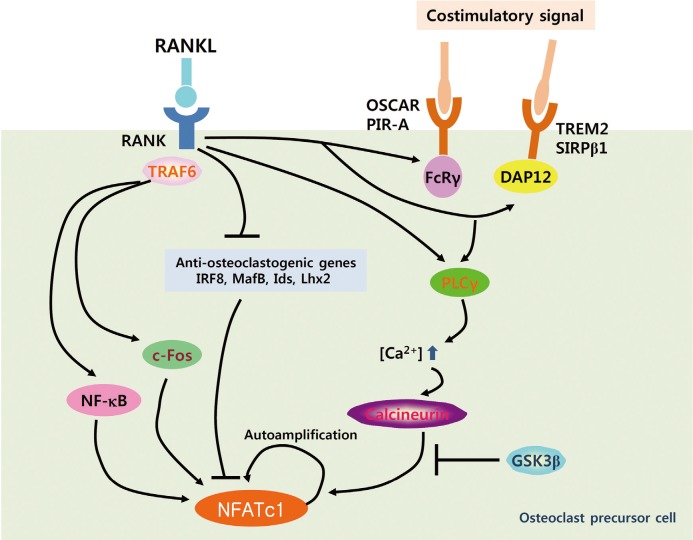
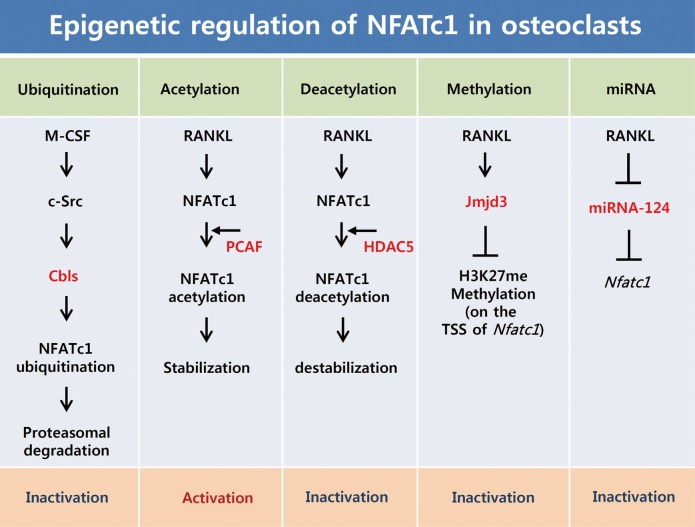
Osteoclasts are unique cells that degrade the bone matrix. These large multinucleated cells differentiate from the monocyte/macrophage lineage upon stimulation by two essential cytokines, macrophage colony-stimulating factor (M-CSF) and receptor activator of nuclear factor-kappa B (NF-κB) ligand (RANKL). Activation of transcription factors such as microphthalmia transcription factor (MITF), c-Fos, NF-κB, and nuclear factor-activated T cells c1 (NFATc1) is required for sufficient osteoclast differentiation. In particular, NFATc1 plays the role of a master transcription regulator of osteoclast differentiation. To date, several mechanisms, including transcription, methylation, ubiquitination, acetylation, and non-coding RNAs, have been shown to regulate expression and activation of NFATc1. In this review, we have summarized the various mechanisms that control NFATc1 regulation during osteoclast differentiation.
Overview
The claims and statistics of this paper haven’t been checked yet.
Run the check — free, no account needed. It reads the open-access text and checks the sources it cites.
Integrity signals
Registry
Cites
Statistics
Figures
Verification
Claims the paper makes
The claims and statistics of this paper haven’t been checked yet.
Run the check — free, no account needed. It reads the open-access text and checks the sources it cites.
Claims other papers make about this one
Each is checked against this paper’s own text: does it say what the citing paper says it does?
The source backs part of the claim, not all of it — or backs it for a different population, condition or comparison.
In the citing paper
“NFATc1 binds to its own promoter, switching on an epigenetically controlled autoregulatory cycle that permits efficient induction of the osteoclast-specific genes, tartrate-resistant acid phosphatase (TRAP), cathepsin K, as well as the fusion-specific genes, dendritic cell-specific transmembrane protein (DC-STAMP) and ATPase H+ transporting V0 subunit D2 (ATP6v0d2) [20,25,26] (Figure 3).”
From Osteoclasts and Microgravity (2020) · cites this paper as [20]
Experimental — accuracy not yet measuredThe source backs part of the claim, not all of it — or backs it for a different population, condition or comparison.
In the citing paper
“In RANKL-activated HSCs, polyubiquitination of NIK is inhibited [18], and TRAF6 activates a cascade of kinases, including extracellular regulated kinase (ERK), p38 mitogen-activated protein kinase (p38), c-jun N-terminal kinase (JNK), phosphatidylinositol-3 kinase (PI3K), and Akt and IkB kinases [20,21].”
From Osteoclasts and Microgravity (2020) · cites this paper as [20]
Experimental — accuracy not yet measuredThe source backs part of the claim, not all of it — or backs it for a different population, condition or comparison.
In the citing paper
“This cascade requires Lys63-linked TRAF-6 auto-ubiquitination [22] and initiates the transcription of activator protein-1 (AP-1), c-Fos, NF-κB, and nuclear factor of activated T cells cytoplasmic calcineurin-dependent 1 (NFATc1), the master regulator of osteoclast differentiation [20,23,24].”
From Osteoclasts and Microgravity (2020) · cites this paper as [20]
Experimental — accuracy not yet measuredIn the citing paper
“Among genes harboring an excess of HF SNCs associated with specific facial features, we find RUNX2, EDAR, and GLI3133, NFATC1134, SPOP135, DDR2136 and NELL1137, possibly carrying changes in regulatory regions”
From A catalog of single nucleotide changes distinguishing modern humans from archaic hominins (2019) · cites this paper as [134]
Self-check
Percentages, sums and reported differences re-computed from the paper’s own numbers.
The self-check needs the paper’s full text.
Citations
Cites
Bartel (2004) · doi:10.1016/s0092-8674(04)00045-5 · Cited by 34,714
Calcium's Role in Mechanotransduction during Muscle Development
Damm, T. B., & Egli, M. (2014) · Cellular Physiology and Biochemistry · doi:10.1159/000356667 · Cited by 14,552
The functions of animal microRNAs
Ambros, V. (2004) · Nature · doi:10.1038/nature02871 · Cited by 10,728
Osteoclast differentiation and activation
Boyle, W. J., Simonet, W. S., & Lacey, D. L. (2003) · Nature · doi:10.1038/nature01658 · Cited by 6,670 · cited 1×
“The multinucleated osteoclasts reorganize the actin cytoskeleton to attach to the bone surface and to resorb the bone.[4] Osteoclast differentiation is regulated by two essential cytokines, macrophage colony-stimulating factor (M-CSF) and receptor activator of nuclear factor-kappa B (NF-κB) ligand (RANKL).”
BackgroundJaenisch, R., & Bird, A. (2003) · Nature Genetics · doi:10.1038/ng1089 · Cited by 6,325 · cited 1×
“[47,48] Yasui et al.”
Bone Resorption by Osteoclasts
Teitelbaum, S. L. (2000) · Science · doi:10.1126/science.289.5484.1504 · Cited by 3,962 · cited 3×
“Bone is a highly dynamic tissue that undergoes continuous remodeling, which is regulated by various factors, including cytokines/chemokines, hormones, and mechanical stimuli.[1,2] Under normal conditions, bone homeostasis is controlled by the balance between bone formation and bone resorption, processes regulated by o…”
BackgroundHayden, M. S., & Ghosh, S. (2004) · Genes & Development · doi:10.1101/gad.1228704 · Cited by 3,842 · cited 2×
“[32,33] In the alternative pathway, NF-κB-inducing kinase (NIK) and IKKα phosphorylate and process p100 to generate p52 by proteasomes, resulting in the activation of the p52/RelB complex.”
BackgroundMissing Pieces in the NF-κB Puzzle
Ghosh, S., & Karin, M. (2002) · Cell · doi:10.1016/s0092-8674(02)00703-1 · Cited by 3,638 · cited 2×
“[32,33] In the alternative pathway, NF-κB-inducing kinase (NIK) and IKKα phosphorylate and process p100 to generate p52 by proteasomes, resulting in the activation of the p52/RelB complex.”
Non-coding RNAs and cancer: microRNAs and beyond
Raia, R. M., & Călin, G. A. (2011) · Journal of Nucleic Acids Investigation · doi:10.4081/jnai.2011.e5 · Cited by 3,394
OPGL is a key regulator of osteoclastogenesis, lymphocyte development and lymph node organogenesis.
Kong, Y.-Y., Yoshida, H., Sarosi, I., Tan, H.-L., Timms, E., Capparelli, C., Morony, S., Oliveira-dos-Santos, A. J., Van, G., Itie, A., et al. (1999) · Nature · doi:10.1038/16852 · Cited by 3,351 · cited 1×
“[5-8] RANKL mediates biological effects in bone through its sole receptor, RANK.”
Background
Cited by
Sorted by citations
Immunology of Osteoporosis: A Mini-Review
Pietschmann, P., Mechtcheriakova, D., Meshcheryakova, A., Föger‐Samwald, U., & Ellinger, I. (2015) · Gerontology · doi:10.1159/000431091 · Cited by 291
Yu, W. H., Zhong, L., Yao, L., Wei, Y., Gui, T., Li, Z., Kim, H., Holdreith, N., Jiang, X., Tong, W., et al. (2020) · Journal of Clinical Investigation · doi:10.1172/jci140214 · Cited by 216
“Nfatc1, a master regulator of osteoclast differentiation (20), was present within the osteoclast lineage differentiation, supporting the reliability of our computational analysis.”
ResultCommon signalling pathways in macrophage and osteoclast multinucleation
Pereira, M., Petretto, E. G., Gordon, S., Bassett, J. H. D., Williams, G. R., & Behmoaras, J. V. (2018) · Journal of Cell Science · doi:10.1242/jcs.216267 · Cited by 197
“Indeed, in osteoclasts, most studies show that RANK-mediated signalling pathways and/or transcription factors converge towards NFATc1 as the ultimate master regulator of osteoclast multinucleation (Kim and Kim, 2014).”
BackgroundInfluence of Iron on Bone Homeostasis
Balogh, E., Paragh, G., & Jeney, V. (2018) · Pharmaceuticals · doi:10.3390/ph11040107 · Cited by 196
“Among them, NFATc1 is considered to be the master transcription factor that drives terminal differentiation of osteclasts via regulating numerous osteoclast-specific genes such as tartrate-resistant acid phosphatase (TRAP), cathepsin K and calcitonin receptor [12,13].”
BackgroundYou, J., Zhang, Y., & Zhou, Y. (2022) · Frontiers in Bioengineering and Biotechnology · doi:10.3389/fbioe.2022.928799 · Cited by 137
Metadata
- Authors
- Kim, J. H., & Kim, N.
- Affiliations
- Chonnam National University (KR)
- Corresponding author
- Kim, Nacksung
- Venue
- Journal of Bone Metabolism
- Published
- 2014
- Volume
- 21
- Issue
- 4
- Pages
- 233
- ISSN
- 2287-6375 (ISSN-L)
- 2287-7029
- PMC
- PMC4255043
- OpenAlex
- W2132541910
- Cited by
- 570
- References
- 69
- Citations by year
- 2026: 54 · 2025: 43 · 2024: 54 · 2023: 64 · 2022: 58 · 2021: 57 · 2020: 68 · 2019: 51 · 2018: 46 · 2017: 31 · 2016: 26 · 2015: 17
- FWCI
- 2.28
- Type
- journal article
- Language
- en
- Open access
- green
- www.ncbi.nlm.nih.gov
- Licence
- Locations
- Journal of Bone Metabolism (publishedVersion)
- PubMed Central (publishedVersion, cc-by-nc)
- PubMed (publishedVersion)
- Topics
- Life Sciences › Biochemistry, Genetics and Molecular Biology › Molecular Biology › Bone Metabolism and Diseases
- Life Sciences › Biochemistry, Genetics and Molecular Biology › Molecular Biology › Signaling Pathways in Disease
- Life Sciences › Biochemistry, Genetics and Molecular Biology › Molecular Biology › Nuclear Receptors and Signaling
- Keywords
- NFATc1, osteoclastogenesis, transcriptional regulation, epigenetic regulation, DNA methylation, ubiquitination, acetylation, non-coding RNA, macrophage colony-stimulating factor, RANKL, MITF, c-fos, NF-κB, bone resorption
About these checks
Registry, retraction, Cites and statistics results are computed, not judged, with one exception: a printed reference that no index lists is read once by a model before it counts as a citation error. Claims are extracted by a model and kept only when their quote appears verbatim in the text; each cited source is then checked, with a model’s help, for whether it says what the claim relies on. Those verdicts can be wrong — read the claim’s quote and the cited source before relying on one.
Statistics and arithmetic are recomputed, not judged.
Confidence bands are shown only for fields calibrated on our annotated test set. None is calibrated yet, so no band is shown.
What counts as a claim ›How we measure confidence ›How we check this ›
Are you an author, or do you see a problem with this page? Request a review
