

The DOI matches its Crossref record; 80 of the 80 references it cites were found in a registry or an index; 1 of the 31 sources its claims cite were checked for support.
Exome sequencing identifies rare coding variants in 10 genes which confer substantial risk for schizophrenia
Open accessPreprint — published as 10.1038/s41586-022-04556-w · Paper page
Abstract
By meta-analyzing the whole-exomes of 24,248 cases and 97,322 controls, we implicate ultra-rare coding variants (URVs) in ten genes as conferring substantial risk for schizophrenia (odds ratios 3 - 50, P < 2.14 × 10 -6 ), and 32 genes at a FDR < 5%. These genes have the greatest expression in central nervous system neurons and have diverse molecular functions that include the formation, structure, and function of the synapse. The associations of NMDA receptor subunit GRIN2A and AMPA receptor subunit GRIA3 provide support for the dysfunction of the glutamatergic system as a mechanistic hypothesis in the pathogenesis of schizophrenia. We find significant evidence for an overlap of rare variant risk between schizophrenia, autism spectrum disorders (ASD), and severe neurodevelopmental disorders (DD/ID), supporting a neurodevelopmental etiology for schizophrenia. We show that protein-truncating variants in GRIN2A, TRIO , and CACNA1G confer risk for schizophrenia whereas specific missense mutations in these genes confer risk for DD/ID. Nevertheless, few of the strongly associated schizophrenia genes appear to confer risk for DD/ID. We demonstrate that genes prioritized from common variant analyses of schizophrenia are enriched in rare variant risk, suggesting that common and rare genetic risk factors at least partially converge on the same underlying pathogenic biological processes. Even after excluding significantly associated genes, schizophrenia cases still carry a substantial excess of URVs, implying that more schizophrenia risk genes await discovery using this approach.
Overview
AI snapshot
Written from the paper’s full text.
TL;DR
Meta-analyzing exomes from 24,248 schizophrenia cases, 97,322 controls, and 3,402 trios identified 10 genes with ultra-rare coding variants at exome-wide significance and 32 genes at FDR < 5%. The results implicate synaptic and glutamatergic biology, show shared rare-variant risk with ASD/DD/ID, and suggest partial convergence with common-variant GWAS signals.
Key findings
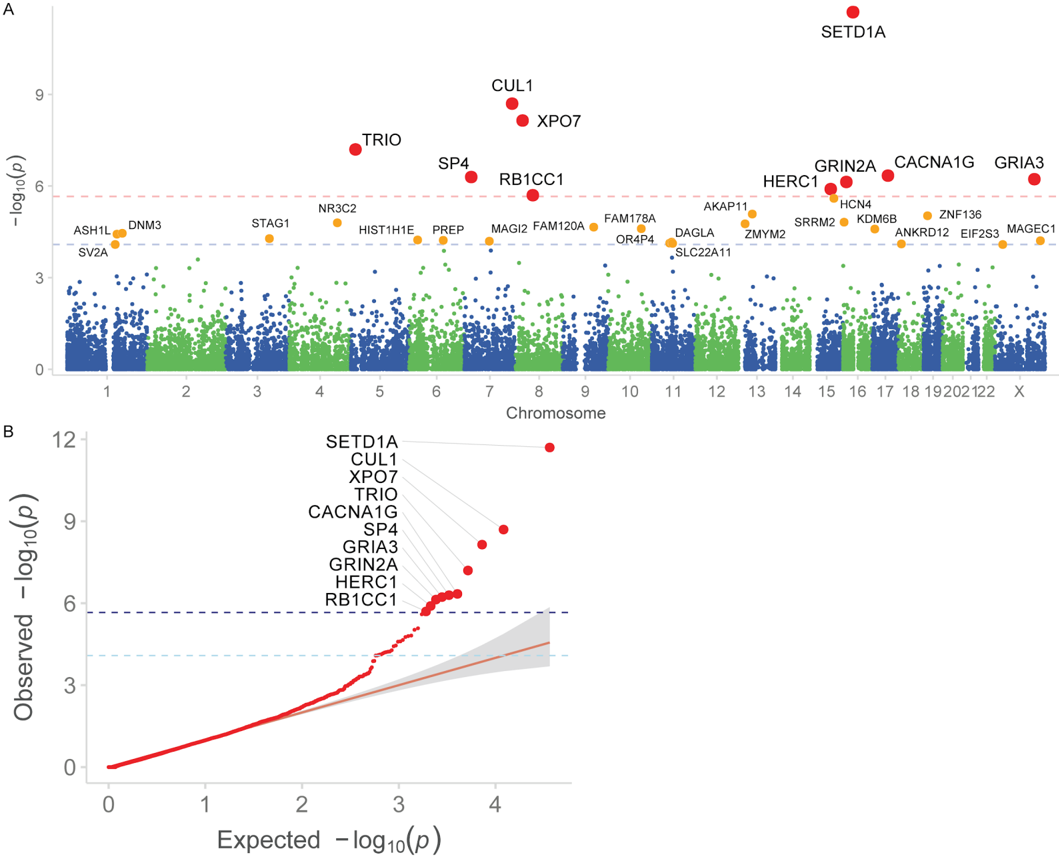
- Ten genes reached exome-wide significance (P < 2.14 × 10⁻⁶), with odds ratios for PTVs and Class I variants ranging from 3 to 50; 22 additional genes were significant at FDR < 5%. The 10 genes were SETD1A, CUL1, XPO7, TRIO, CACNA1G, SP4, GRIA3, GRIN2A, HERC1, and RB1CC1.
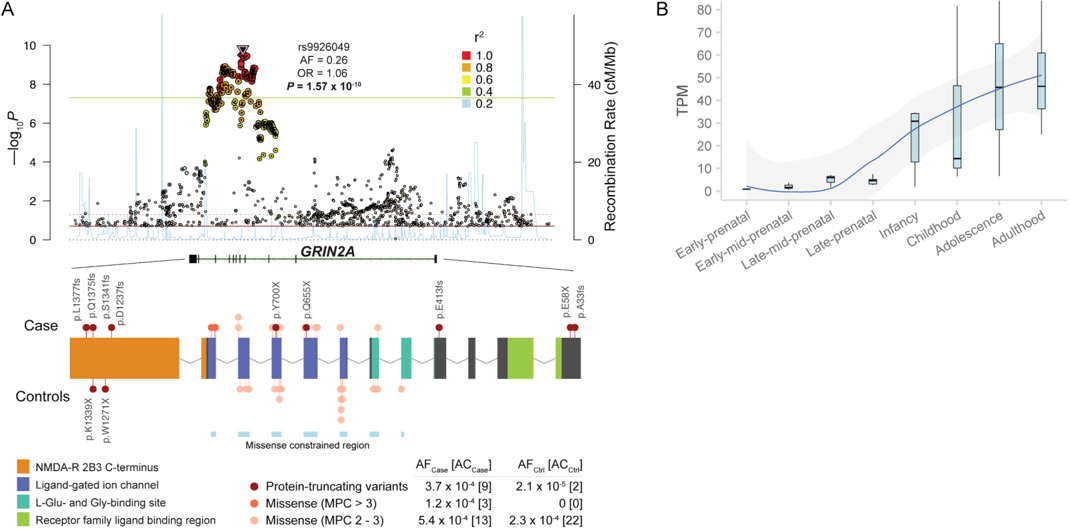
- GRIN2A and GRIA3 support glutamatergic dysfunction: GRIN2A Class I OR = 24.1 (95% CI 5.36–221), Class II OR = 2.37 (95% CI 1.1–4.92); GRIA3 Class I OR = 20.1 (95% CI 4.28–188).
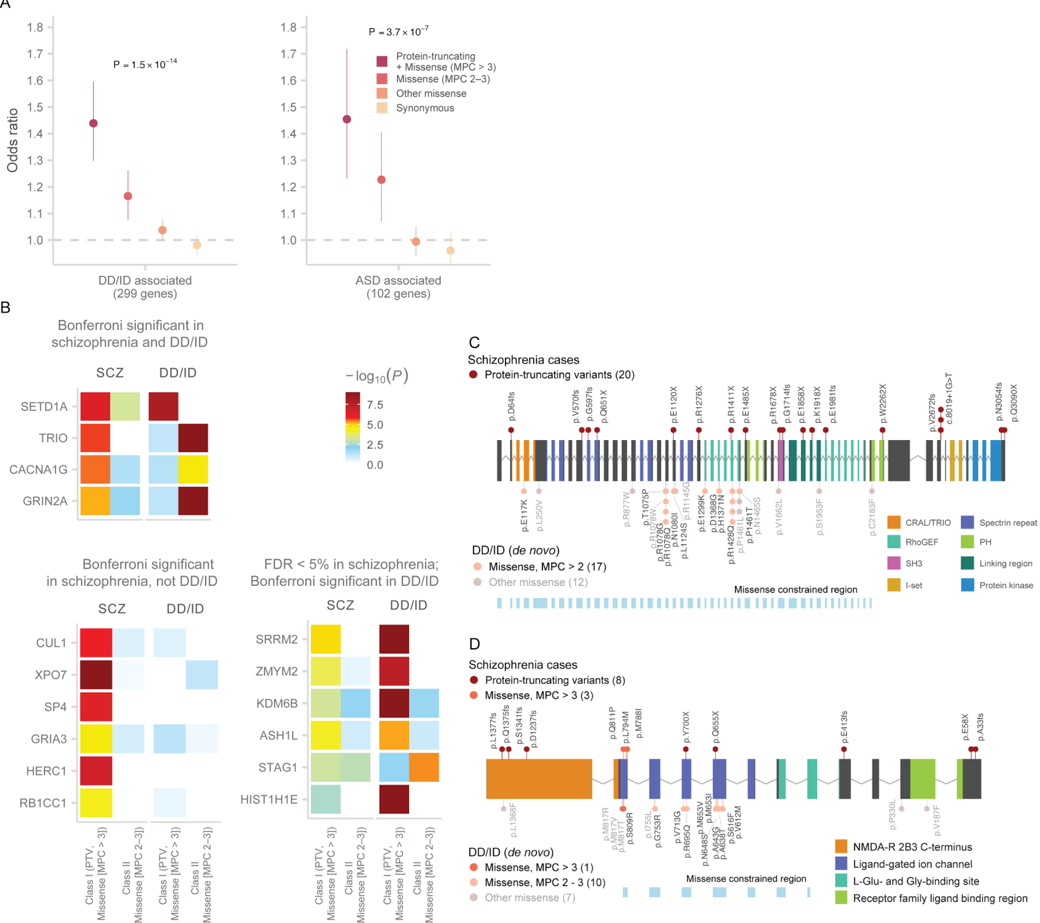
- Schizophrenia rare-variant risk overlaps with neurodevelopmental disorders: enrichment in DD/ID genes (P = 1.5 × 10⁻¹⁴; ORClass I = 1.44, 95% CI 1.3–1.6) and ASD genes (P = 3.7 × 10⁻⁷; ORClass I = 1.45, 95% CI 1.23–1.72). PTVs in GRIN2A, TRIO, and CACNA1G confer schizophrenia risk, whereas specific missense mutations in these genes confer DD/ID risk.
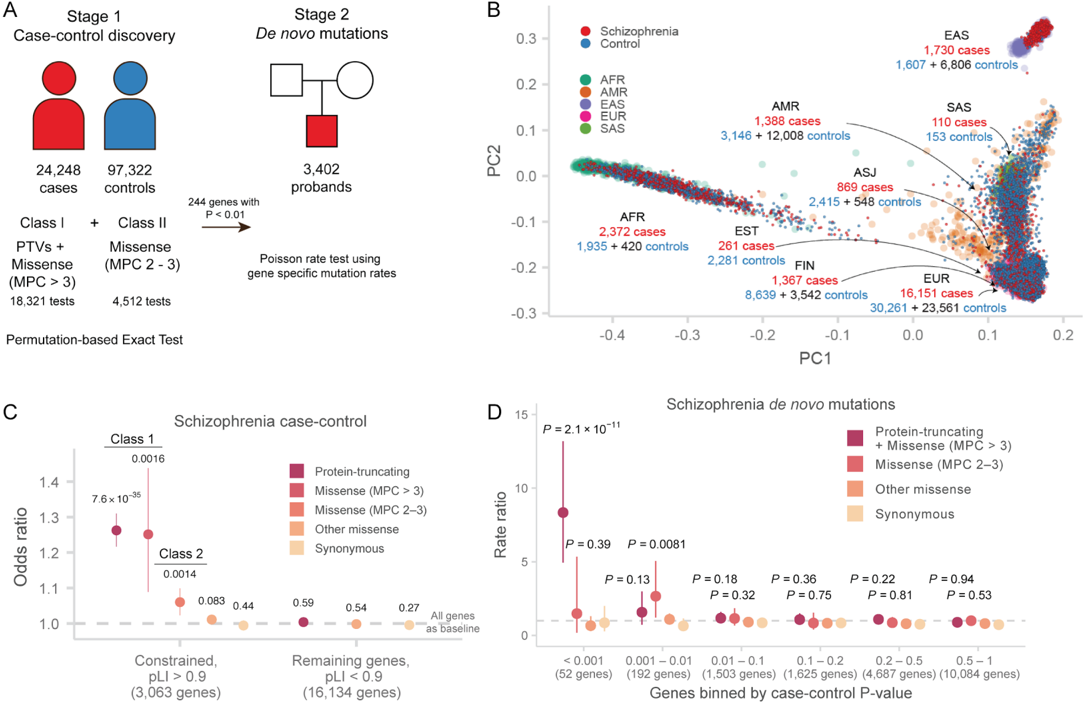
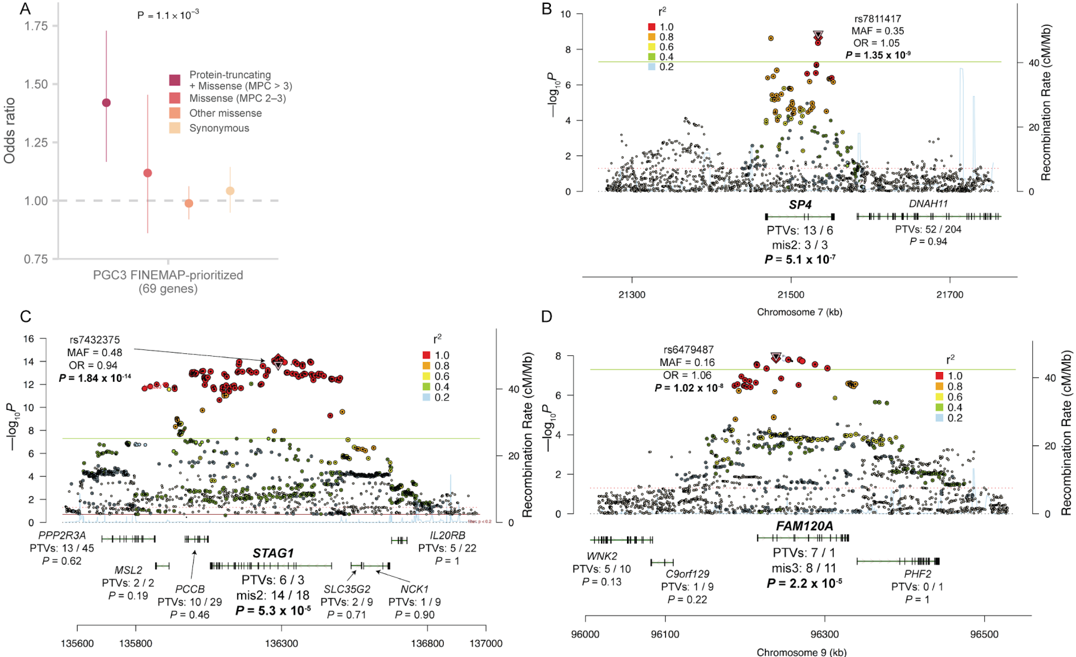
- Common and rare variant signals partially converge: genes prioritized by GWAS fine-mapping were enriched for ultra-rare variants (Pmeta = 1.1 × 10⁻³; ORClass I = 1.42, 95% CI 1.17–1.73), and the constrained-gene burden remained after excluding the 32 FDR < 5% genes (OR = 1.23, P = 4.3 × 10⁻²⁷).
Methods
- Aggregated exome sequence data from 24,248 schizophrenia cases and 50,437 individuals without a known psychiatric diagnosis across 11 global collections, then added 46,885 gnomAD controls for a combined discovery set of 24,248 cases and 97,322 controls; also analyzed de novo mutations from 3,402 parent-proband trios.
- Samples were jointly reprocessed and variant-called with a standardized BWA-Picard-GATK pipeline; analyses were restricted to coding exons and ultra-rare variants (MAC ≤ 5), including PTVs and damaging missense variants defined by MPC > 3 (Class I) and MPC 2–3 (Class II).
- Gene-based burden tests used Fisher’s exact test with case-control permutations within strata, meta-analysis by weighted Z-score, and Poisson rate tests for de novo mutations; pathway, tissue, and cell-type enrichments were also tested, and results were jointly analyzed with the largest schizophrenia GWAS.
Limitations
- The paper states that earlier sequencing studies had limited power for individual gene discovery and that even after excluding the 32 FDR < 5% genes, cases still carry a substantial excess of ultra-rare variants (OR = 1.23, P = 4.3 × 10⁻²⁷), implying that many schizophrenia risk genes remain undiscovered.
- The paper notes that only summary-level variant counts were available for 46,885 external gnomAD controls, and it used permutation testing and strata to control for possible technical or methodological batch effects.
- The paper states that confidence intervals for the top gene associations are wide (e.g., GRIN2A Class I 5.36–221; GRIA3 Class I 4.28–188), reflecting imprecise effect estimates from few variant carriers; no formal limitations section is included.
Model-written summary. Check it against the paper before relying on it.
Integrity signals
Registry
Cites
Statistics
Figures
Verification
Claims the paper makes
47 Own result · 23 Not checked yet · 21 Own interpretation · 7 No basis given · 3 Own method · 1 Partly supported · accuracy not yet measured
The paper states this without a source or data behind it here, so there is nothing to check it against. The quote shows it is in the paper.
In the paper
“Combining these findings with other large-scale sequencing studies, we find shared and distinct genetic signals between schizophrenia and other neurodevelopmental disorders.”
§ Exome sequencing identifies rare coding variants in 10 genes which confer substantial risk for schizophrenia > Introduction
plaincorrelationaln = 24,248- Asserted: passes — The authors put it forward as true.
- Checkable: passes — It can be checked against evidence.
- Load-bearing: unclear — It is unclear whether the paper’s conclusions depend on it.
- Based: passes — The paper gives a reason why it holds.
A result the paper reports from its own data — it cites no other source for it, so there is none to check. The quote shows it is in the paper.
In the paper
“Nevertheless, few of the strongly associated schizophrenia genes appear to confer risk for DD/ID.”
- Also stated in: § Shared and distinct genetic risk with other neurodevelopmental disorders · plain
“Nine of the ten schizophrenia genes showed limited de novo PTV signal in DD/ID, with a combined 8 de novo PTVs observed in these genes (Xexp = 4.98; PPois = 0.13; Figure 5B; Table S13).”
§ Exome sequencing identifies rare coding variants in 10 genes which confer substantial risk for schizophrenia > Abstract
plain- Asserted: passes — The authors put it forward as true.
- Checkable: passes — It can be checked against evidence.
- Load-bearing: passes — The paper’s conclusions depend on it.
- Based: passes — The paper gives a reason why it holds.
- Also stated in: § Shared and distinct genetic risk with other neurodevelopmental disorders · plain
A result the paper reports from its own data — it cites no other source for it, so there is none to check. The quote shows it is in the paper.
In the paper
“Here, we find that PTV and damaging missense variants in NMDA receptor subunit GRIN2A confer substantial risk for schizophrenia (P = 7.37 x 10 -7 ; Class I [PTV and MPC > 3] OR 24.1, 95% CI 5.36 -221; Class II [MPC > 2] OR 2.37, 95% CI 1.1 -4.92).”
§ Exome sequencing identifies rare coding variants in 10 genes which confer substantial risk for schizophrenia > Risk genes implicated by rare protein-coding variants
plaindirect- Asserted: passes — The authors put it forward as true.
- Checkable: passes — It can be checked against evidence.
- Load-bearing: passes — The paper’s conclusions depend on it.
- Based: passes — The paper gives a reason why it holds.
A result the paper reports from its own data — it cites no other source for it, so there is none to check. The quote shows it is in the paper.
In the paper
“We find significant evidence for an overlap of rare variant risk between schizophrenia, autism spectrum disorders (ASD), and severe neurodevelopmental disorders (DD/ID), supporting a neurodevelopmental etiology for schizophrenia.”
- Also stated in: § Shared and distinct genetic risk with other neurodevelopmental disorders · plain
“We found a significant excess of URVs in schizophrenia cases compared to controls in the 299 DD/ID-associated genes (Pmeta = 1.5 x 10 -14 ; ORClass I = 1.44, 1.3 -1.6 95% CI), and in the 102 ASD-associated genes (Pmeta = 3.7 x 10 -7 ; ORClass I = 1.45, 1.23 -1.72 95% CI; Figure 5A; Table S12).”
§ Exome sequencing identifies rare coding variants in 10 genes which confer substantial risk for schizophrenia > Abstract
plaincorrelationaln = 24,248- Asserted: passes — The authors put it forward as true.
- Checkable: passes — It can be checked against evidence.
- Load-bearing: passes — The paper’s conclusions depend on it.
- Based: passes — The paper gives a reason why it holds.
- Also stated in: § Shared and distinct genetic risk with other neurodevelopmental disorders · plain
A result the paper reports from its own data — it cites no other source for it, so there is none to check. The quote shows it is in the paper.
In the paper
“We observed significant enrichment of URVs in 33 gene sets (P < 2.9 x 10 -5 ) that recapitulated consistent and overlapping cellular compartments and biological processes, including definitions of the postsynaptic density (human cortex biopsy post-synaptic density; P = 1.2 x 10 -12 ), chromatin modification (GO:0016568; P = 1.8 x 10 -12 ), regulation of ion transmembrane transport (GO:0034765; P =”
§ Exome sequencing identifies rare coding variants in 10 genes which confer substantial risk for schizophrenia > Shared genes and processes identified by common variants and ultra-rare protein-coding variants
plaincorrelational- Asserted: passes — The authors put it forward as true.
- Checkable: passes — It can be checked against evidence.
- Load-bearing: passes — The paper’s conclusions depend on it.
- Based: passes — The paper gives a reason why it holds.
A result the paper reports from its own data — it cites no other source for it, so there is none to check. The quote shows it is in the paper.
In the paper
“These genes have the greatest expression in central nervous system neurons”
- Also stated in: § Shared genes and processes identified by common variants and ultra-rare protein-coding variants · plain
“Here, we found widespread enrichments across central nervous system neurons with limited to no signal in glial cells and peripheral nervous system neurons (Table S10, Figure S20).”
§ Exome sequencing identifies rare coding variants in 10 genes which confer substantial risk for schizophrenia > Abstract
plaincorrelational- Asserted: passes — The authors put it forward as true.
- Checkable: passes — It can be checked against evidence.
- Load-bearing: unclear — It is unclear whether the paper’s conclusions depend on it.
- Based: passes — The paper gives a reason why it holds.
- Also stated in: § Shared genes and processes identified by common variants and ultra-rare protein-coding variants · plain
A result the paper reports from its own data — it cites no other source for it, so there is none to check. The quote shows it is in the paper.
In the paper
“and 32 genes at a FDR < 5%.”
- Also stated in: § Risk genes implicated by rare protein-coding variants · plain
“Beyond these ten genes, we identify 22 additional genes at a False Discovery Rate (FDR) < 5% (Figure 2A, Table S5).”
§ Exome sequencing identifies rare coding variants in 10 genes which confer substantial risk for schizophrenia > Abstract
plaincorrelationaln = 24,248- Asserted: passes — The authors put it forward as true.
- Checkable: passes — It can be checked against evidence.
- Load-bearing: unclear — It is unclear whether the paper’s conclusions depend on it.
- Based: passes — The paper gives a reason why it holds.
- Also stated in: § Risk genes implicated by rare protein-coding variants · plain
In the paper
“In tandem with a companion paper from the Psychiatric Genomics Consortium 10 , we provide evidence that common and ultra-rare coding variants identify an overlapping set of genes.”
§ Exome sequencing identifies rare coding variants in 10 genes which confer substantial risk for schizophrenia > Introduction
What the sources say
- Not checked yetcites [10] Schizophrenia Working Group of the Psychiatric Genomics Consortium. Mapping genomic loci prioritises genes and implicates synaptic biology in schizophrenia. Submitted (2020).
plaincorrelational- Asserted: passes — The authors put it forward as true.
- Checkable: passes — It can be checked against evidence.
- Load-bearing: passes — The paper’s conclusions depend on it.
- Based: passes — The paper gives a reason why it holds.
A result the paper reports from its own data — it cites no other source for it, so there is none to check. The quote shows it is in the paper.
In the paper
“The most striking enrichment was observed for the 52 genes with case-control P < 0.001 (Class I mutations: P = 2.1 x 10 -11 ; Rate ratio = 8.3, 95% CI = 4.9 -13), which provides additional reassurance of the robustness of our case-control gene results.”
§ Exome sequencing identifies rare coding variants in 10 genes which confer substantial risk for schizophrenia > Analysis approach
plaincorrelational- Asserted: passes — The authors put it forward as true.
- Checkable: passes — It can be checked against evidence.
- Load-bearing: unclear — It is unclear whether the paper’s conclusions depend on it.
- Based: passes — The paper gives a reason why it holds.
A result the paper reports from its own data — it cites no other source for it, so there is none to check. The quote shows it is in the paper.
In the paper
“We additionally find that risk URVs in AMPA receptor subunit GRIA3 confer substantial risk (P = 5.98 x 10 -7 ; Class I [PTV and MPC > 3] OR 20.1 95% CI 4.28 -188; Table 1).”
§ Exome sequencing identifies rare coding variants in 10 genes which confer substantial risk for schizophrenia > Risk genes implicated by rare protein-coding variants
plaindirect- Asserted: passes — The authors put it forward as true.
- Checkable: passes — It can be checked against evidence.
- Load-bearing: passes — The paper’s conclusions depend on it.
- Based: passes — The paper gives a reason why it holds.
- Probably not a substantial claim. 14
- It may state two separate claims as one. 28
The cited sources support only part of this claim — read each source’s verdict below.
In the paper
“Several rare (MAF < 0.1%) recurrent copy number variants (CNVs) have also been robustly associated with schizophrenia, as exemplified by the dramatically higher rates of schizophrenia in 22q11.2deletion carriers 7,12 .”
§ Exome sequencing identifies rare coding variants in 10 genes which confer substantial risk for schizophrenia > Introduction
What the sources say
- Partly supportedcites [7] sourceExperimental — accuracy not yet measured
The Gene CNV association section reports genome-wide significant associations for several CNV loci, including 22q11.2 deletions; the Introduction says implicated CNVs are rare and confer substantial schizophrenia risk. The copy does not establish that all the variants described have MAF < 0.1%, or report a schizophrenia rate specifically among 22q11.2 deletion carriers. (LLM, conf=0.83)
- Not checked yetcites [12] source
boostedcorrelational- Asserted: passes — The authors put it forward as true.
- Checkable: passes — It can be checked against evidence.
- Load-bearing: fails — The paper’s conclusions may not depend on it.
- Based: passes — The paper gives a reason why it holds.
Probably not a substantial claim. The paper’s conclusions may not depend on it. It may state two separate claims as one.
- Partly supported
In the paper
“Using Poisson rate tests based on expected mutation rate 25 , we found these de novo mutations are enriched for the 244 genes with P < 0.01 in our case-control analysis (Figure S16, Table S5), with limited or no signal in the remaining genes in the genome (Figure 1D).”
§ Exome sequencing identifies rare coding variants in 10 genes which confer substantial risk for schizophrenia > Analysis approach
What the sources say
- Not checked yetcites [25] source
plaincorrelational- Asserted: passes — The authors put it forward as true.
- Checkable: passes — It can be checked against evidence.
- Load-bearing: passes — The paper’s conclusions depend on it.
- Based: passes — The paper gives a reason why it holds.
It may state two separate claims as one.
A result the paper reports from its own data — it cites no other source for it, so there is none to check. The quote shows it is in the paper.
In the paper
“We show that proteintruncating variants in GRIN2A, TRIO, and CACNA1G confer risk for schizophrenia whereas specific missense mutations in these genes confer risk for DD/ID.”
- Also stated in: § Shared and distinct genetic risk with other neurodevelopmental disorders · plain
“Notably, three of the ten risk genes for schizophrenia (TRIO, GRIN2A, and CACNA1G) were associated with risk of severe DD/IDs exclusively through de novo missense mutations that cluster within each gene (Figure 5B; Table S13), while the schizophrenia signal was largely driven by PTVs.”
§ Exome sequencing identifies rare coding variants in 10 genes which confer substantial risk for schizophrenia > Abstract
plaindirectn = 24,248- Asserted: passes — The authors put it forward as true.
- Checkable: passes — It can be checked against evidence.
- Load-bearing: passes — The paper’s conclusions depend on it.
- Based: passes — The paper gives a reason why it holds.
It may state two separate claims as one.
- Also stated in: § Shared and distinct genetic risk with other neurodevelopmental disorders · plain
None of the sources cited for this claim have been checked yet.
In the paper
“Following earlier reports studying heritability enrichment in GTEx tissues 5,30 , we found that genes with the highest specific expression in brain regions showed the strongest enrichment of risk URVs, most significantly in the human frontal cortex (P = 1.63 x 10 -8 ) and with limited signal in the other tissue types (Figure S19, Table S8, S9).”
§ Exome sequencing identifies rare coding variants in 10 genes which confer substantial risk for schizophrenia > Shared genes and processes identified by common variants and ultra-rare protein-coding variants
plaincorrelational- Asserted: passes — The authors put it forward as true.
- Checkable: passes — It can be checked against evidence.
- Load-bearing: passes — The paper’s conclusions depend on it.
- Based: passes — The paper gives a reason why it holds.
It may state two separate claims as one.
A result the paper reports from its own data — it cites no other source for it, so there is none to check. The quote shows it is in the paper.
In the paper
“Indeed, individual genes like SETD1A, TRIO, and SP4 exhibited prenatal expression while GRIN2A and GRIA3 showed postnatal expression (Figure S24).”
§ Exome sequencing identifies rare coding variants in 10 genes which confer substantial risk for schizophrenia > Figure 5. Shared genetic signal between schizophrenia and other neurodevelopmental disorders.
plain- Asserted: passes — The authors put it forward as true.
- Checkable: passes — It can be checked against evidence.
- Load-bearing: unclear — It is unclear whether the paper’s conclusions depend on it.
- Based: passes — The paper gives a reason why it holds.
It may state two separate claims as one.
A result the paper reports from its own data — it cites no other source for it, so there is none to check. The quote shows it is in the paper.
In the paper
“De novo missense mutations in these genes clustered in specific domains and are associated with more severe neurodevelopmental, syndromic disorders with cognitive impairment”
§ Exome sequencing identifies rare coding variants in 10 genes which confer substantial risk for schizophrenia > Discussion
hedgedcorrelational- Asserted: passes — The authors put it forward as true.
- Checkable: passes — It can be checked against evidence.
- Load-bearing: unclear — It is unclear whether the paper’s conclusions depend on it.
- Based: passes — The paper gives a reason why it holds.
It may state two separate claims as one.
A result the paper reports from its own data — it cites no other source for it, so there is none to check. The quote shows it is in the paper.
In the paper
“Statistical fine-mapping prioritized the likely underlying protein-coding gene at 69 of these associations (Table S11), and we found a case-control enrichment of URVs in these genes (Pmeta = 1.1 x 10 -3 ; ORClass I = 1.42, 1.17 -1.73 95% CI; Figure 4A, Table S12).”
§ Exome sequencing identifies rare coding variants in 10 genes which confer substantial risk for schizophrenia > Shared genes and processes identified by common variants and ultra-rare protein-coding variants
plaincorrelational- Asserted: passes — The authors put it forward as true.
- Checkable: passes — It can be checked against evidence.
- Load-bearing: passes — The paper’s conclusions depend on it.
- Based: passes — The paper gives a reason why it holds.
It may state two separate claims as one.
A result the paper reports from its own data — it cites no other source for it, so there is none to check. The quote shows it is in the paper.
In the paper
“Broadly speaking, while PTV mutations in certain genes are joint risk factors for schizophrenia and DD/ID, the majority of schizophrenia associations reported here appear to have little or no role in DD/ID despite the enormous power of published DD/ID studies to date.”
§ Exome sequencing identifies rare coding variants in 10 genes which confer substantial risk for schizophrenia > Shared and distinct genetic risk with other neurodevelopmental disorders
hedgedcorrelational- Asserted: passes — The authors put it forward as true.
- Checkable: passes — It can be checked against evidence.
- Load-bearing: passes — The paper’s conclusions depend on it.
- Based: passes — The paper gives a reason why it holds.
It may state two separate claims as one.
A result the paper reports from its own data — it cites no other source for it, so there is none to check. The quote shows it is in the paper.
In the paper
“Of further interest, we observe allelic series in GRIN2A, TRIO, and CACNA1G in which PTVs increase schizophrenia risk and de novo missense mutations confer strong DD/ID risk.”
§ Exome sequencing identifies rare coding variants in 10 genes which confer substantial risk for schizophrenia > Discussion
plaindirect- Asserted: passes — The authors put it forward as true.
- Checkable: passes — It can be checked against evidence.
- Load-bearing: unclear — It is unclear whether the paper’s conclusions depend on it.
- Based: passes — The paper gives a reason why it holds.
It may state two separate claims as one.
A result the paper reports from its own data — it cites no other source for it, so there is none to check. The quote shows it is in the paper.
In the paper
“Furthermore, FAM120A and STAG1 resided in more complex GWAS-associated regions containing multiple genes but were prioritized among their neighbors as FDR < 5% in our sequencing study (Figure 4C, 4D).”
§ Exome sequencing identifies rare coding variants in 10 genes which confer substantial risk for schizophrenia > Shared genes and processes identified by common variants and ultra-rare protein-coding variants
plaincorrelational- Asserted: passes — The authors put it forward as true.
- Checkable: passes — It can be checked against evidence.
- Load-bearing: passes — The paper’s conclusions depend on it.
- Based: passes — The paper gives a reason why it holds.
It may state two separate claims as one.
A result the paper reports from its own data — it cites no other source for it, so there is none to check. The quote shows it is in the paper.
In the paper
“Notably, three of the ten risk genes for schizophrenia (TRIO, GRIN2A, and CACNA1G) were associated with risk of severe DD/IDs exclusively through de novo missense mutations that cluster within each gene (Figure 5B; Table S13), while the schizophrenia signal was largely driven by PTVs.”
§ Exome sequencing identifies rare coding variants in 10 genes which confer substantial risk for schizophrenia > Shared and distinct genetic risk with other neurodevelopmental disorders
plaincorrelational- Asserted: passes — The authors put it forward as true.
- Checkable: passes — It can be checked against evidence.
- Load-bearing: passes — The paper’s conclusions depend on it.
- Based: passes — The paper gives a reason why it holds.
It may state two separate claims as one.
The paper states this without a source or data behind it here, so there is nothing to check it against. The quote shows it is in the paper.
In the paper
“A natural doseresponse curve occurs at this gene in which common regulatory variants modestly influence disease risk and PTV and predicted damaging missense variants increase risk more substantially.”
§ Exome sequencing identifies rare coding variants in 10 genes which confer substantial risk for schizophrenia > Discussion
plaindirect- Asserted: passes — The authors put it forward as true.
- Checkable: passes — It can be checked against evidence.
- Load-bearing: unclear — It is unclear whether the paper’s conclusions depend on it.
- Based: passes — The paper gives a reason why it holds.
It may state two separate claims as one.
A result the paper reports from its own data — it cites no other source for it, so there is none to check. The quote shows it is in the paper.
In the paper
“We found a significant excess of URVs in schizophrenia cases compared to controls in the 299 DD/ID-associated genes (Pmeta = 1.5 x 10 -14 ; ORClass I = 1.44, 1.3 -1.6 95% CI), and in the 102 ASD-associated genes (Pmeta = 3.7 x 10 -7 ; ORClass I = 1.45, 1.23 -1.72 95% CI; Figure 5A; Table S12).”
§ Exome sequencing identifies rare coding variants in 10 genes which confer substantial risk for schizophrenia > Shared and distinct genetic risk with other neurodevelopmental disorders
plaincorrelational- Asserted: passes — The authors put it forward as true.
- Checkable: passes — It can be checked against evidence.
- Load-bearing: passes — The paper’s conclusions depend on it.
- Based: passes — The paper gives a reason why it holds.
It may state two separate claims as one.
In the paper
“SETD1A had a significant de novo PTV signal in DD/ID (Xobs = 8, Xexp = 0.41; P = 1.3 x 10 -8 ), supporting an earlier report that described SETD1A as a gene associated with both schizophrenia and broader neurodevelopmental disorders 18 .”
§ Exome sequencing identifies rare coding variants in 10 genes which confer substantial risk for schizophrenia > Shared and distinct genetic risk with other neurodevelopmental disorders
What the sources say
- Not checked yetcites [18] source
plaincorrelational- Asserted: passes — The authors put it forward as true.
- Checkable: passes — It can be checked against evidence.
- Load-bearing: passes — The paper’s conclusions depend on it.
- Based: passes — The paper gives a reason why it holds.
It may state two separate claims as one.
A result the paper reports from its own data — it cites no other source for it, so there is none to check. The quote shows it is in the paper.
In the paper
“Genome-wide analyses recapitulated known biological processes and reaffirm that schizophrenia risk genes are involved in the postsynaptic density and broader synaptic function”
§ Exome sequencing identifies rare coding variants in 10 genes which confer substantial risk for schizophrenia > Discussion
plaincorrelational- Asserted: passes — The authors put it forward as true.
- Checkable: passes — It can be checked against evidence.
- Load-bearing: unclear — It is unclear whether the paper’s conclusions depend on it.
- Based: passes — The paper gives a reason why it holds.
It may state two separate claims as one.
A result the paper reports from its own data — it cites no other source for it, so there is none to check. The quote shows it is in the paper.
In the paper
“while ASD individuals have 0.0478 (0.0387 -0.0568 95% CI) extra de novo PTV mutations”
§ Exome sequencing identifies rare coding variants in 10 genes which confer substantial risk for schizophrenia > Contribution of ultra-rare PTVs to schizophrenia risk
plaincorrelational- Asserted: passes — The authors put it forward as true.
- Checkable: passes — It can be checked against evidence.
- Load-bearing: fails — The paper’s conclusions may not depend on it.
- Based: passes — The paper gives a reason why it holds.
Probably not a substantial claim. The paper’s conclusions may not depend on it.
- Rests on an assumption: Schizophrenia risk URVs are concentrated in the 3,063 PTV-intolerant (pLI > 0.9) genes.
A conclusion the paper draws from its own results — it cites no other source for it, so there is none to check. The quote shows it is in the paper.
In the paper
“Finally, we demonstrate that increased scale following this approach will uncover additional risk genes and help complete the genetic architecture of schizophrenia.”
§ Exome sequencing identifies rare coding variants in 10 genes which confer substantial risk for schizophrenia > Introduction
boosteddirectn = 24,248- Asserted: passes — The authors put it forward as true.
- Checkable: passes — It can be checked against evidence.
- Load-bearing: passes — The paper’s conclusions depend on it.
- Based: passes — The paper gives a reason why it holds.
It may state two separate claims as one.
None of the sources cited for this claim have been checked yet.
In the paper
“However, the analysis of URVs has had limited success in delivering individual gene discovery in schizophrenia because of power limitations, with only a single gene, SETD1A, identified as robustly associated 13,18 .”
§ Exome sequencing identifies rare coding variants in 10 genes which confer substantial risk for schizophrenia > Introduction
plaincorrelational- Asserted: passes — The authors put it forward as true.
- Checkable: passes — It can be checked against evidence.
- Load-bearing: passes — The paper’s conclusions depend on it.
- Based: passes — The paper gives a reason why it holds.
It may state two separate claims as one.
None of the sources cited for this claim have been checked yet.
In the paper
“Furthermore, these risk alleles are concentrated in genes with a near-complete depletion of protein-truncating variants in population studies, a result shared with other neurodevelopmental disorders 6,8 and suggesting strong direct selection against such mutations.”
§ Exome sequencing identifies rare coding variants in 10 genes which confer substantial risk for schizophrenia > Introduction
What the sources say
- Not checked yetcites [6] source
- Not checked yetcites [8] Singh, T. et al. The contribution of rare variants to risk of schizophrenia in individuals with and without intellectual disability. Nat. Genet. 1–10 (2017).
hedgedcorrelational- Asserted: passes — The authors put it forward as true.
- Checkable: passes — It can be checked against evidence.
- Load-bearing: unclear — It is unclear whether the paper’s conclusions depend on it.
- Based: passes — The paper gives a reason why it holds.
It may state two separate claims as one.
In the paper
“As a class of variation, common variants explain ~24% of the variance in disease liability 11 .”
§ Exome sequencing identifies rare coding variants in 10 genes which confer substantial risk for schizophrenia > Introduction
What the sources say
- Not checked yetcites [11] source
plaincorrelational- Asserted: passes — The authors put it forward as true.
- Checkable: passes — It can be checked against evidence.
- Load-bearing: fails — The paper’s conclusions may not depend on it.
- Based: passes — The paper gives a reason why it holds.
Probably not a substantial claim. The paper’s conclusions may not depend on it.
None of the sources cited for this claim have been checked yet.
In the paper
“The most natural grouping for rare variants is within a gene, based on predicted functional consequence or evidence for deleteriousness 13,14 .”
§ Exome sequencing identifies rare coding variants in 10 genes which confer substantial risk for schizophrenia > Introduction
plain- Asserted: passes — The authors put it forward as true.
- Checkable: fails — It may be too vague to check against evidence.
- Load-bearing: passes — The paper’s conclusions depend on it.
- Based: passes — The paper gives a reason why it holds.
Probably not a substantial claim. It may be too vague to check against evidence.
- Rests on an assumption: Most rare variants will have little or no functional consequence or impact on risk.
The paper states this without a source or data behind it here, so there is nothing to check it against. The quote shows it is in the paper.
In the paper
“Analyzing rare coding variants offers a powerful complementary approach to identify genes in complex traits.”
§ Exome sequencing identifies rare coding variants in 10 genes which confer substantial risk for schizophrenia > Introduction
boosted- Asserted: passes — The authors put it forward as true.
- Checkable: fails — It may be too vague to check against evidence.
- Load-bearing: passes — The paper’s conclusions depend on it.
- Based: passes — The paper gives a reason why it holds.
Probably not a substantial claim. It may be too vague to check against evidence.
- Rests on an assumption: Most rare variants will have little or no functional consequence or impact on risk.
- Rests on an assumption: Causal variants in schizophrenia GWAS are predominantly noncoding.
In the paper
“It is well-established that schizophrenia has a substantial genetic component with contributions from across the allele frequency spectrum [5][6][7][8] .”
§ Exome sequencing identifies rare coding variants in 10 genes which confer substantial risk for schizophrenia > Introduction
What the sources say
- Not checked yetcites [5][6][7][8]
boostedcorrelational- Asserted: passes — The authors put it forward as true.
- Checkable: passes — It can be checked against evidence.
- Load-bearing: passes — The paper’s conclusions depend on it.
- Based: passes — The paper gives a reason why it holds.
Probably not a substantial claim. It may state two separate claims as one.
In the paper
“The NMDA receptor changes in composition during prenatal to postnatal neurodevelopment with GRIN2A predominantly expressed during late childhood and adolescence, recapitulating expected epidemiological observations on schizophrenia age-ofonset (Supplementary Information, Figure 3B) 27 .”
§ Exome sequencing identifies rare coding variants in 10 genes which confer substantial risk for schizophrenia > Risk genes implicated by rare protein-coding variants
What the sources say
- Not checked yetcites [27] source
plaincorrelational- Asserted: passes — The authors put it forward as true.
- Checkable: passes — It can be checked against evidence.
- Load-bearing: unclear — It is unclear whether the paper’s conclusions depend on it.
- Based: passes — The paper gives a reason why it holds.
It may state two separate claims as one.
In the paper
“This has been borne out by genome-wide association studies (GWAS) which have now, in a companion paper, identified 270 common (minor allele frequency [MAF] > 1%) risk loci of individually small effect (median odds ratio [OR] < 1.05) 10 .”
§ Exome sequencing identifies rare coding variants in 10 genes which confer substantial risk for schizophrenia > Introduction
What the sources say
- Not checked yetcites [10] Schizophrenia Working Group of the Psychiatric Genomics Consortium. Mapping genomic loci prioritises genes and implicates synaptic biology in schizophrenia. Submitted (2020).
plaincorrelational- Asserted: passes — The authors put it forward as true.
- Checkable: passes — It can be checked against evidence.
- Load-bearing: passes — The paper’s conclusions depend on it.
- Based: passes — The paper gives a reason why it holds.
Probably not a substantial claim.
In the paper
“Earlier schizophrenia sequencing studies have established that ultra-rare and de novo mutations contribute to risk as a category, and have prioritized disease-relevant tissues and processes, specifically observing an enrichment in neuronal genes and synaptic processes 6,8,[16][17][18][19][20] .”
§ Exome sequencing identifies rare coding variants in 10 genes which confer substantial risk for schizophrenia > Introduction
What the sources say
- Not checked yetcites 6,8,[16][17][18][19][20]
boosteddirect- Asserted: passes — The authors put it forward as true.
- Checkable: passes — It can be checked against evidence.
- Load-bearing: fails — The paper’s conclusions may not depend on it.
- Based: passes — The paper gives a reason why it holds.
Probably not a substantial claim. The paper’s conclusions may not depend on it. It may state two separate claims as one.
In the paper
“Schizophrenia GWAS also identified a common variant at GRIN2A (OR = 1.057,P = 1.57x 10 - 10 ), providing an allelic series in which different perturbation of gene function results in severity of disease risk (Figure 3A) 5 .”
§ Exome sequencing identifies rare coding variants in 10 genes which confer substantial risk for schizophrenia > Risk genes implicated by rare protein-coding variants
What the sources say
- Not checked yetcites [5] source
plaincorrelational- Asserted: passes — The authors put it forward as true.
- Checkable: passes — It can be checked against evidence.
- Load-bearing: passes — The paper’s conclusions depend on it.
- Based: passes — The paper gives a reason why it holds.
It may state two separate claims as one.
What the paper did — it cites no source for this, so there is none to check. The quote shows it is in the paper.
In the paper
“The most striking enrichment was observed for the 52 genes with case-control P < 0.001 (Class I mutations: P = 2.1 x 10 -11 ; Rate ratio = 8.3, 95% CI = 4.9 -13), which provides additional reassurance of the robustness of our case-control gene results.”
§ Exome sequencing identifies rare coding variants in 10 genes which confer substantial risk for schizophrenia > Analysis approach
plain- Asserted: passes — The authors put it forward as true.
- Checkable: passes — It can be checked against evidence.
- Load-bearing: fails — The paper’s conclusions may not depend on it.
- Based: passes — The paper gives a reason why it holds.
Probably not a substantial claim. The paper’s conclusions may not depend on it.
In the paper
“De novo mutations in GRIN2B conversely are associated with more severe disorders of neurodevelopment that manifest in childhood, including intellectual disability and autism 41 .”
§ Exome sequencing identifies rare coding variants in 10 genes which confer substantial risk for schizophrenia > Discussion
What the sources say
- Not checked yetcites [41] source
plaincorrelational- Asserted: passes — The authors put it forward as true.
- Checkable: passes — It can be checked against evidence.
- Load-bearing: fails — The paper’s conclusions may not depend on it.
- Based: passes — The paper gives a reason why it holds.
Probably not a substantial claim. The paper’s conclusions may not depend on it.
A conclusion the paper draws from its own results — it cites no other source for it, so there is none to check. The quote shows it is in the paper.
In the paper
“Combined, these results suggest there is at least partial convergence in the genes and biological processes implicated by common and ultra-rare genetic variation, and that ultra-rare coding variants can be leveraged to prioritize genes within GWAS loci.”
§ Exome sequencing identifies rare coding variants in 10 genes which confer substantial risk for schizophrenia > Shared genes and processes identified by common variants and ultra-rare protein-coding variants
hedgedcorrelationaln = 69,369- Asserted: passes — The authors put it forward as true.
- Checkable: passes — It can be checked against evidence.
- Load-bearing: passes — The paper’s conclusions depend on it.
- Based: passes — The paper gives a reason why it holds.
It may state two separate claims as one.
A conclusion the paper draws from its own results — it cites no other source for it, so there is none to check. The quote shows it is in the paper.
In the paper
“These observations suggest schizophrenia and childhood onset neurodevelopmental disorders share some genes and biological processes, but that at least in some cases, the severity or the nature of the functional impairment differs between disorders.”
§ Exome sequencing identifies rare coding variants in 10 genes which confer substantial risk for schizophrenia > Shared and distinct genetic risk with other neurodevelopmental disorders
hedgedcorrelational- Asserted: passes — The authors put it forward as true.
- Checkable: passes — It can be checked against evidence.
- Load-bearing: passes — The paper’s conclusions depend on it.
- Based: passes — The paper gives a reason why it holds.
It may state two separate claims as one.
None of the sources cited for this claim have been checked yet.
In the paper
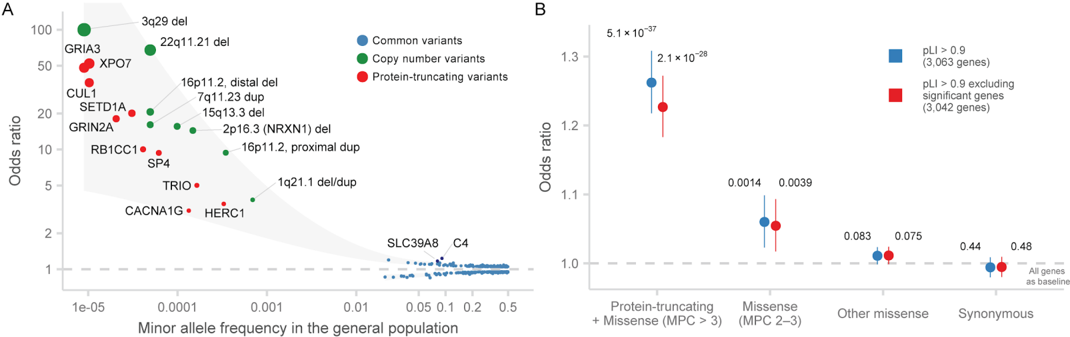
“Efforts in the past decade are beginning to generate a more comprehensive view of the genetic architecture for schizophrenia, composed of common variants of small effects, large CNVs with elevated frequencies driven by genomic instability, and now, URVs of large effect implicating individual genes (Figure 6A) 5,7 .”
§ Exome sequencing identifies rare coding variants in 10 genes which confer substantial risk for schizophrenia > Contribution of ultra-rare PTVs to schizophrenia risk
plaindirect- Asserted: passes — The authors put it forward as true.
- Checkable: passes — It can be checked against evidence.
- Load-bearing: passes — The paper’s conclusions depend on it.
- Based: passes — The paper gives a reason why it holds.
It may state two separate claims as one.
A conclusion the paper draws from its own results — it cites no other source for it, so there is none to check. The quote shows it is in the paper.
In the paper
“suggesting that 0.86% of patients are carriers and ~35% of variants are de novo.”
§ Exome sequencing identifies rare coding variants in 10 genes which confer substantial risk for schizophrenia > Contribution of ultra-rare PTVs to schizophrenia risk
hedged- Asserted: passes — The authors put it forward as true.
- Checkable: passes — It can be checked against evidence.
- Load-bearing: passes — The paper’s conclusions depend on it.
- Based: passes — The paper gives a reason why it holds.
It may state two separate claims as one.
In the paper
“Because schizophrenia as a trait is under strong selection [38][39][40]”
§ Exome sequencing identifies rare coding variants in 10 genes which confer substantial risk for schizophrenia > Contribution of ultra-rare PTVs to schizophrenia risk
What the sources say
- Not checked yetcites [38][39][40]
boosted- Asserted: passes — The authors put it forward as true.
- Checkable: passes — It can be checked against evidence.
- Load-bearing: passes — The paper’s conclusions depend on it.
- Based: passes — The paper gives a reason why it holds.
Probably not a substantial claim.
In the paper
“Despite this progress, it is clear that we are still in the early stages of gene discovery 10 .”
§ Exome sequencing identifies rare coding variants in 10 genes which confer substantial risk for schizophrenia > Discussion
What the sources say
- Not checked yetcites [10] Schizophrenia Working Group of the Psychiatric Genomics Consortium. Mapping genomic loci prioritises genes and implicates synaptic biology in schizophrenia. Submitted (2020).
boosted- Asserted: passes — The authors put it forward as true.
- Checkable: fails — It may be too vague to check against evidence.
- Load-bearing: fails — The paper’s conclusions may not depend on it.
- Based: passes — The paper gives a reason why it holds.
Probably not a substantial claim. It may be too vague to check against evidence. The paper’s conclusions may not depend on it.
A conclusion the paper draws from its own results — it cites no other source for it, so there is none to check. The quote shows it is in the paper.
In the paper
“The vast majority of risk alleles, their direction and magnitude of effect, mode of action, and responsible genes are yet to be discovered.”
§ Exome sequencing identifies rare coding variants in 10 genes which confer substantial risk for schizophrenia > Discussion
plain- Asserted: passes — The authors put it forward as true.
- Checkable: passes — It can be checked against evidence.
- Load-bearing: fails — The paper’s conclusions may not depend on it.
- Based: fails — The paper may give no reason why it holds.
Probably not a substantial claim. The paper’s conclusions may not depend on it. The paper may give no reason why it holds. It may state two separate claims as one.
A conclusion the paper draws from its own results — it cites no other source for it, so there is none to check. The quote shows it is in the paper.
In the paper
“we expect that URVs of large effect to be frequently de novo or of very recent origin and contribute to risk in only a fraction of diagnosed patients.”
§ Exome sequencing identifies rare coding variants in 10 genes which confer substantial risk for schizophrenia > Contribution of ultra-rare PTVs to schizophrenia risk
hedgeddirect- Asserted: passes — The authors put it forward as true.
- Checkable: passes — It can be checked against evidence.
- Load-bearing: passes — The paper’s conclusions depend on it.
- Based: passes — The paper gives a reason why it holds.
Probably not a substantial claim. It may state two separate claims as one.
The paper relies on this without support.
Most rare variants will have little or no functional consequence or impact on risk.
“However, most rare variants will have little or no functional consequence or impact on risk, posing a significant challenge in identifying those that are truly causal and complicating required analyses in which rare variants are tested as a group rather than individually.”
The paper relies on this without support.
Linkage disequilibrium can be readily avoided as a driver of spurious signals because these variants are each seen in very few individuals.
“As these variants are each seen in very few individuals -and often de novo or very recent -linkage disequilibrium can be readily avoided as a driver of spurious signals meaning that genes frequently can be identified directly.”
The paper relies on this without support.
Causal variants in schizophrenia GWAS are predominantly noncoding.
“Because causal variants in schizophrenia GWAS are predominantly noncoding, challenges related to fine-mapping and interpretation of intergenic and intronic elements limit our ability to confidently identify underlying genes, infer the mechanism by which they influence disease risk, and determine the direction of effect.”
The paper relies on this without support.
Schizophrenia risk URVs are concentrated in the 3,063 PTV-intolerant (pLI > 0.9) genes.
“We restrict these analyses to the 3,063 PTV-intolerant (pLI > 0.9) genes in which schizophrenia risk URVs are concentrated.”
The paper relies on this without support.
The NMDA receptor is composed of two GRIN2 units (GRIN2A and/or GRIN2B) along with two constitutive GRIN1 units.
“the NMDA receptor is composed of two GRIN2 units (GRIN2A and/or GRIN2B) along with two constitutive GRIN1 units”
The paper relies on this without support.
GRIN2A increases dramatically in expression later in childhood and adolescence, mimicking the age of onset of disease for schizophrenia.
“GRIN2A increases dramatically in expression later in childhood and adolescence, mimicking the age of onset of disease for schizophrenia.”
Claims other papers make about this one
Each is checked against this paper’s own text: does it say what the citing paper says it does?
The source backs part of the claim, not all of it — or backs it for a different population, condition or comparison.
In the citing paper
“Of the 10 exome-wide significant genes identified by SCHEMA36, two were prioritised candidates from fine-mapping; GRIN2A encoding a glutamatergic NMDA receptor subunit, and SP4, a transcription factor highly expressed in brain and which is regulated by NMDA transmission, and also regulates NMDA receptor abundance37.”
From Mapping genomic loci implicates genes and synaptic biology in schizophrenia (2022) · cites this paper as [37]
Experimental — accuracy not yet measuredIn the citing paper
“SP4, a transcription factor highly expressed in brain and which is regulated by NMDA transmission, and also regulates NMDA receptor abundance37.”
From Mapping genomic loci implicates genes and synaptic biology in schizophrenia (2022) · cites this paper as [37]
In the citing paper
“Significant SMR associations imply colocalization of the schizophrenia associations with eQTL.”
From Mapping genomic loci implicates genes and synaptic biology in schizophrenia (2022) · cites this paper as [37]
In the citing paper
“We applied the HEIDI test37 to filter out SMR associations (PHEIDI < 0.01) due to linkage disequilibrium between SCZ-associated variants and eQTLs.”
From Mapping genomic loci implicates genes and synaptic biology in schizophrenia (2022) · cites this paper as [37]
Self-check
Percentages, sums and reported differences re-computed from the paper’s own numbers.
Each contradiction between two passages listed here was confirmed by an independent check.
Rated minor: it would not touch a result — a value no result rests on, a p-value that stays on the same side of the significance level, or a conflict that is clerical, resolved elsewhere in the paper, or outside its own findings.
In the paper
§ Exome sequencing identifies rare coding variants in 10 genes which confer substantial risk for schizophrenia > Risk genes implicated by rare protein-coding variants
“Class II [MPC > 2] OR 2.37, 95% CI 1.1 -4.92”
§ Exome sequencing identifies rare coding variants in 10 genes which confer substantial risk for schizophrenia > Risk genes implicated by rare protein-coding variants
“Class I: PTV and missense variants (MPC > 3); Class II: missense variants (MPC 2 -3).”
Citations
Cites
Analysis of protein-coding genetic variation in 60,706 humans
Exome Aggregation Consortium, Lek, M., Karczewski, K. J., Minikel, E. V., Samocha, K. E., Banks, E., Fennell, T., O’Donnell-Luria, A. H., Ware, J. S., Hill, A. J., et al. (2016) · Nature · doi:10.1038/nature19057 · Cited by 9,587 · cited 1×
“Previous studies have shown that PTVs are concentrated in 3,063 genes under strong constraint in schizophrenia cases compared to controls 8,22 , and we replicated this result with consistent signals across our major cohorts ( P meta = 7.6 x 10 -35 ; OR = 1.26, 95% CI = 1.22 - 1.31, Figure 1C,…”
ResultInfluentialSelf-citationThe mutational constraint spectrum quantified from variation in 141,456 humans
Karczewski, K. J., Francioli, L. C., Tiao, G., Cummings, B. B., Alföldi, J., Wang, Q., Collins, R. L., Laricchia, K. M., Ganna, A., Birnbaum, D. P., et al. (2020) · Nature · doi:10.1038/s41586-020-2308-7 · Cited by 9,434 · cited 14×
“After extracting SCHEMA samples from this callset, we performed quality control steps to ensure high quality of sequence data, exclude contaminated samples, identify parent-proband trios and other related individuals, and infer global ancestries (Supplementary Methods, Figure 1B, Figures S1-7, Table S2).”
BackgroundMethodInfluentialSelf-citationBiological insights from 108 schizophrenia-associated genetic loci
Schizophrenia Working Group of the Psychiatric Genomics Consortium (2014) · Nature · doi:10.1038/nature13595 · Cited by 7,577
Self-citationPfam: the protein families database
Finn, R. D., Bateman, A., Clements, J., Coggill, P., Eberhardt, R. Y., Eddy, S. R., Heger, A., Hetherington, K., Holm, L., Mistry, J., et al. (2014) · Nucleic Acids Research · doi:10.1093/nar/gkt1223 · Cited by 6,148
Krystal, J. H. (1994) · Archives of General Psychiatry · doi:10.1001/archpsyc.1994.03950030035004 · Cited by 3,330 · cited 1×
“NMDAR channel blockers (ketamine and phencyclidine) induce schizophrenia-like symptoms and cognitive deficits in healthy individuals 64,65 , and anti-NMDAR encephalitis, an autoimmune disorder originating from a antibody-mediated attack on NMDARs, result in psychosis-like symptoms and memory…”
BackgroundRecent advances in the phencyclidine model of schizophrenia
(1991) · American Journal of Psychiatry · doi:10.1176/ajp.148.10.1301 · Cited by 2,904 · cited 1×
“NMDAR channel blockers (ketamine and phencyclidine) induce schizophrenia-like symptoms and cognitive deficits in healthy individuals 64,65 , and anti-NMDAR encephalitis, an autoimmune disorder originating from a antibody-mediated attack on NMDARs, result in psychosis-like symptoms and memory…”
BackgroundSystematic review and meta-analysis
Gillies, A. (2019) · CRC Press eBooks · doi:10.1201/9781315377315-19 · Cited by 2,876
Synaptic, transcriptional and chromatin genes disrupted in autism
Study, T. D., De Rubeis, S., Autism, H. M. C. F., UK10K Consortium, The Autism Sequencing Consortium, He, X., Goldberg, A. P., Poultney, C. S., Samocha, K., Ercument Cicek, A., et al. (2014) · Nature · doi:10.1038/nature13772 · Cited by 2,746 · cited 1×
“These studies have established that the genetic signals were concentrated in constrained genes and shared between the two disorders 34,35 .”
Self-citationAMPA Receptor Trafficking and Synaptic Plasticity
Malinow, R., & Malenka, R. C. (2002) · Annual Review of Neuroscience · doi:10.1146/annurev.neuro.25.112701.142758 · Cited by 2,588
Molecular Architecture of the Mouse Nervous System
Zeisel, A., Hochgerner, H., Lönnerberg, P., Johnsson, A., Memic, F., van der Zwan, J., Häring, M., Braun, E., Borm, L. E., La Manno, G., et al. (2018) · Cell · doi:10.1016/j.cell.2018.06.021 · Cited by 2,552
Molecular Architecture of the Mouse Nervous SystemPreprint
Zeisel, A., Hochgerner, H., Lönnerberg, P., Johnsson, A., Memic, F., van der Zwan, J., Häring, M., Braun, E., Borm, L. E., Manno, G. L., et al. (2018) · bioRxiv · doi:10.1101/294918 · Cited by 2,414 · cited 5×
“The NMDA receptor changes in composition during prenatal to postnatal neurodevelopment with GRIN2A predominantly expressed during late childhood and adolescence, recapitulating expected epidemiological observations on schizophrenia age-of-onset (Supplementary Information, Figure 3B) 27 .”
InfluentialSatterstrom, F. K., Kosmicki, J. A., Wang, J., Breen, M. S., De Rubeis, S., An, J.-Y., Peng, M., Collins, R., Grove, J., Klei, L., et al. (2020) · Cell · doi:10.1016/j.cell.2019.12.036 · Cited by 2,321
Self-citationSchizophrenia: A Concise Overview of Incidence, Prevalence, and Mortality
McGrath, J., Saha, S., Chant, D., & Welham, J. (2008) · Epidemiologic Reviews · doi:10.1093/epirev/mxn001 · Cited by 2,280
Spatio-temporal transcriptome of the human brain
Kang, H. J., Kawasawa, Y. I., Cheng, F., Zhu, Y., Xu, X., Li, M., Sousa, A. M. M., Pletikos, M., Meyer, K. A., Sedmak, G., et al. (2011) · Nature · doi:10.1038/nature10523 · Cited by 2,084 · cited 1×
“The NMDA receptor changes in composition during prenatal to postnatal neurodevelopment with GRIN2A predominantly expressed during late childhood and adolescence, recapitulating expected epidemiological observations on schizophrenia age-of-onset (Supplementary Information, Figure 3B) 27 .”
BackgroundDECIPHER: Database of Chromosomal Imbalance and Phenotype in Humans Using Ensembl Resources
Firth, H. V., Richards, S. M., Bevan, A. P., Clayton, S., Corpas, M., Rajan, D., Vooren, S. V., Moreau, Y., Pettett, R. M., & Carter, N. P. (2009) · The American Journal of Human Genetics · doi:10.1016/j.ajhg.2009.03.010 · Cited by 1,990
De novo mutations in schizophrenia implicate synaptic networks
Fromer, M., Pocklington, A. J., Kavanagh, D. H., Williams, H. J., Dwyer, S., Gormley, P., Georgieva, L., Rees, E., Palta, P., Ruderfer, D. M., et al. (2014) · Nature · doi:10.1038/nature12929 · Cited by 1,617 · cited 2×
“The sequence data for 7,979 cases had been previously presented in earlier publications 6,8,16–19 , while the remaining 16,269 cases are presented here for the first time.”
BackgroundDiscovering the Neural Basis of Human Social Anxiety: A Diagnostic and Therapeutic Imperative
Charney, D. S. (2004) · American Journal of Psychiatry · doi:10.1176/appi.ajp.161.1.1 · Cited by 1,428
A polygenic burden of rare disruptive mutations in schizophrenia
Purcell, S. M., Moran, J. L., Fromer, M., Ruderfer, D., Solovieff, N., Roussos, P., O’Dushlaine, C., Chambert, K., Bergen, S. E., Kähler, A., et al. (2014) · Nature · doi:10.1038/nature12975 · Cited by 1,385
Antibody-Mediated Encephalitis
Dalmau, J. O., & Graus, F. (2018) · New England Journal of Medicine · doi:10.1056/nejmra1708712 · Cited by 1,339 · cited 1×
“…blockers (ketamine and phencyclidine) induce schizophrenia-like symptoms and cognitive deficits in healthy individuals 64,65 , and anti-NMDAR encephalitis, an autoimmune disorder originating from a antibody-mediated attack on NMDARs, result in psychosis-like symptoms and memory deficits 66 .”
BackgroundHjorthøj, C., Stürup, A. E., McGrath, J. J., & Nordentoft, M. (2017) · The Lancet Psychiatry · doi:10.1016/s2215-0366(17)30078-0 · Cited by 1,304
AMPA receptor trafficking at excitatory synapses
Bredt, D. S., & Nicoll, R. A. (2003) · Neuron · doi:10.1016/s0896-6273(03)00640-8 · Cited by 1,150 · cited 2×
“This suggests a role for rare gene-disrupting mutations with much larger effects on individual risk (OR 2 - 60).”
BackgroundLarge-scale discovery of novel genetic causes of developmental disorders
Study, T. D. D. D. (2015) · Nature · doi:10.1038/nature14135 · Cited by 1,124
Finucane, H. K., Reshef, Y. A., Anttila, V., Slowikowski, K., Gusev, A., Byrnes, A., Gazal, S., Loh, P.-R., Lareau, C., Shoresh, N., et al. (2018) · Nature Genetics · doi:10.1038/s41588-018-0081-4 · Cited by 1,097
Self-citationContribution of copy number variants to schizophrenia from a genome-wide study of 41,321 subjects
Marshall, C. R., Howrigan, D. P., Merico, D., Thiruvahindrapuram, B., Wu, W., Greer, D. S., Antaki, D., Shetty, A., Holmans, P. A., Pinto, D., et al. (2017) · Nature Genetics · doi:10.1038/ng.3725 · Cited by 1,058 · cited 3×
“…decade are beginning to generate a more comprehensive view of the genetic architecture for schizophrenia, composed of common variants of small effects, large CNVs with elevated frequencies driven by genomic instability, and now, URVs of large effect implicating individual genes (Figure 6A) 5,7 .”
Self-citation(2016) · doi:10.1101/040493 · Cited by 1,058
Self-citationRare-Variant Association Analysis: Study Designs and Statistical Tests
Lee, S., Abecasis, G. R., Boehnke, M., & Lin, X. (2014) · The American Journal of Human Genetics · doi:10.1016/j.ajhg.2014.06.009 · Cited by 1,042 · cited 1×
“The most natural grouping for rare variants is within a gene, based on predicted functional consequence or evidence for deleteriousness 13,14 .”
BackgroundA framework for the interpretation of de novo mutation in human disease
Samocha, K. E., Robinson, E. B., Sanders, S. J., Stevens, C., Sabo, A., McGrath, L. M., Kosmicki, J. A., Rehnström, K., Mallick, S., Kirby, A., et al. (2014) · Nature Genetics · doi:10.1038/ng.3050 · Cited by 979
Self-citationSynGO: An Evidence-Based, Expert-Curated Knowledge Base for the Synapse
Koopmans, F., van Nierop, P., Andres-Alonso, M., Byrnes, A., Cijsouw, T., Coba, M. P., Cornelisse, L. N., Farrell, R. J., Goldschmidt, H. L., Howrigan, D. P., et al. (2019) · Neuron · doi:10.1016/j.neuron.2019.05.002 · Cited by 938
Self-citationEvidence for multiple AMPA receptor complexes in hippocampal CA1/CA2 neurons
Wenthold, R., Petralia, R., Blahos J, II, & Niedzielski, A. (1996) · The Journal of Neuroscience · doi:10.1523/jneurosci.16-06-01982.1996 · Cited by 850 · cited 1×
“AMPA receptors are well-characterized in their involvement mammalian central nervous system function, and moderates fast excitatory synaptic transmission and are involved in long-term potential and synaptic plasticity 58–60 .”
BackgroundPsychiatric genome-wide association study analyses implicate neuronal, immune and histone pathways
The Network and Pathway Analysis Subgroup of the Psychiatric Genomics Consortium (2015) · Nature Neuroscience · doi:10.1038/nn.3922 · Cited by 755
Self-citationGenetic identification of brain cell types underlying schizophrenia
Major Depressive Disorder Working Group of the Psychiatric Genomics Consortium, Skene, N. G., Bryois, J., Bakken, T. E., Breen, G., Crowley, J. J., Gaspar, H. A., Giusti-Rodriguez, P., Hodge, R. D., Miller, J. A., et al. (2018) · Nature Genetics · doi:10.1038/s41588-018-0129-5 · Cited by 651 · cited 1×
“%) schizophrenia risk genes (Supplementary Information) 32,33 .”
A polygenic theory of schizophrenia.
Gottesman, I. I., & Shields, J. (1967) · Proceedings of the National Academy of Sciences · doi:10.1073/pnas.58.1.199 · Cited by 636 · cited 1×
“As initially theorized, the high heritability, consistency of prevalence across populations and increasing risk observed for individuals in more densely affected families suggested that polygenic predisposition should play a dominant role in defining schizophrenia risk in the population 1,9 .”
BackgroundSearching for missing heritability: Designing rare variant association studies
Zuk, O., Schaffner, S. F., Samocha, K., Do, R., Hechter, E., Kathiresan, S., Daly, M. J., Neale, B. M., Sunyaev, S. R., & Lander, E. S. (2014) · Proceedings of the National Academy of Sciences · doi:10.1073/pnas.1322563111 · Cited by 635 · cited 3×
“Theory predicts that the forces of natural selection will tend to keep large effect risk variants at much lower frequencies in the population, especially in disorders such as schizophrenia that are associated with reduced fecundity 13 .”
BackgroundSelf-citationSchizophrenia susceptibility associated with interstitial deletions of chromosome 22q11.
Karayiorgou, M., Morris, M. A., Morrow, B., Shprintzen, R. J., Goldberg, R., Borrow, J., Gos, A., Nestadt, G., Wolyniec, P. S., & Lasseter, V. K. (1995) · Proceedings of the National Academy of Sciences · doi:10.1073/pnas.92.17.7612 · Cited by 628 · cited 1×
“2 deletion carriers 7,12 .”
Endele, S., Rosenberger, G., Geider, K., Popp, B., Tamer, C., Stefanova, I., Milh, M., Kortüm, F., Fritsch, A., Pientka, F. K., et al. (2010) · Nature Genetics · doi:10.1038/ng.677 · Cited by 499 · cited 2×
“Protein-truncating and specific missense mutations in GRIN2A and GRIN2B cause neurodevelopmental disorders with prominent speech features and epilepsies 41,67 .”
BackgroundStudy, S. S., Singh, T., Study, I., Study, D., UK10 K Consortium, Kurki, M. I., Curtis, D., Purcell, S. M., Crooks, L., McRae, J., et al. (2016) · Nature Neuroscience · doi:10.1038/nn.4267 · Cited by 452 · cited 4×
“Paralogs of this gene, including KMT2A (Wiedemann-Steiner syndrome), KMT2B , KMT2C , and KMT2D (Kabuki syndrome), have been associated with severe neurodevelopmental disorders 18,43 .”
BackgroundResultInfluentialSelf-citationSchizophrenia Working Group of the Psychiatric Genomics Consortium, Loh, P.-R., Bhatia, G., Gusev, A., Finucane, H. K., Bulik-Sullivan, B. K., Pollack, S. J., de Candia, T. R., Lee, S. H., Wray, N. R., et al. (2015) · Nature Genetics · doi:10.1038/ng.3431 · Cited by 449 · cited 1×
“As a class of variation, common variants explain ~24% of the variance in disease liability 11 .”
BackgroundSelf-citationIncreased burden of ultra-rare protein-altering variants among 4,877 individuals with schizophrenia
Genovese, G., Fromer, M., Stahl, E. A., Ruderfer, D. M., Chambert, K., Landén, M., Moran, J. L., Purcell, S. M., Sklar, P., Sullivan, P. F., et al. (2016) · Nature Neuroscience · doi:10.1038/nn.4402 · Cited by 444 · cited 3×
“The sequence data for 7,979 cases had been previously presented in earlier publications 6,8,16–19 , while the remaining 16,269 cases are presented here for the first time.”
BackgroundGRIN2A mutations cause epilepsy-aphasia spectrum disorders
Carvill, G. L., Regan, B. M., Yendle, S. C., O’Roak, B. J., Lozovaya, N., Bruneau, N., Burnashev, N., Khan, A., Cook, J., Geraghty, E., et al. (2013) · Nature Genetics · doi:10.1038/ng.2727 · Cited by 385 · cited 1×
“Protein-truncating and specific missense mutations in GRIN2A and GRIN2B cause neurodevelopmental disorders with prominent speech features and epilepsies 41,67 .”
BackgroundMapping genomic loci prioritises genes and implicates synaptic biology in schizophreniaPreprint
Ripke, S., Walters, J., & O'Donovan, M. (2020) · medRxiv · doi:10.1101/2020.09.12.20192922 · Cited by 365 · cited 4×
“%) risk loci of individually small effect (median odds ratio [OR] < 1.05) 10 .”
BackgroundMethodInfluentialRegional missense constraint improves variant deleteriousness prediction
Samocha, K. E., Kosmicki, J. A., Karczewski, K. J., O’Donnell-Luria, A. H., Pierce-Hoffman, E., MacArthur, D. G., Neale, B. M., & Daly, M. J. (2017) · doi:10.1101/148353 · Cited by 351 · cited 1×
“…our analysis to ultra-rare variants (defined as minor allele count [MAC] ≤ 5 ) that are also either PTVs (defined as stop-gained, frameshift, and essential splice donor or acceptor variants) or damaging missense variants as defined by the MPC pathogenicity score 23,24 (Supplementary Methods).”
BackgroundSelf-citationPower, R. A., Kyaga, S., Uher, R., MacCabe, J. H., Långström, N., Landen, M., McGuffin, P., Lewis, C. M., Lichtenstein, P., & Svensson, A. C. (2013) · JAMA Psychiatry · doi:10.1001/jamapsychiatry.2013.268 · Cited by 336 · cited 1×
“Because schizophrenia as a trait is under strong selection 38–40 , we expect that URVs of large effect to be frequently de novo or of very recent origin and contribute to risk in only a fraction of diagnosed patients.”
BackgroundEffect of predicted protein-truncating genetic variants on the human transcriptome
Rivas, M. A., Pirinen, M., Conrad, D. F., Lek, M., Tsang, E. K., Karczewski, K. J., Maller, J. B., Kukurba, K. R., DeLuca, D. S., Fromer, M., et al. (2015) · Science · doi:10.1126/science.1261877 · Cited by 313 · cited 1×
“Furthermore, protein. truncating variants (PTVs) are among the most interpretable associations as they suggest that the effect on disease most commonly tracks with decreasing expression of the gene 15 .”
BackgroundSelf-citationMangoni, M. E., Traboulsie, A., Léoni, A., Couette, B., Marger, L., Quang, K. L., Kupfer, E., Cohen-Solal, A., Vilar, J., Shin, H., et al. (2006) · Circulation Research · doi:10.1161/01.res.0000225862.14314.49 · Cited by 310
The NMDA Receptor and Schizophrenia
Balu, D. T. (2016) · Advances in pharmacology · doi:10.1016/bs.apha.2016.01.006 · Cited by 303
The glutamate hypothesis of schizophrenia: evidence from human brain tissue studies
Hu, W., MacDonald, M. L., Elswick, D. E., & Sweet, R. A. (2015) · Annals of the New York Academy of Sciences · doi:10.1111/nyas.12547 · Cited by 286
Hyman, S. E. (2012) · Science Translational Medicine · doi:10.1126/scitranslmed.3003142 · Cited by 260 · cited 2×
“SETD1A encodes a catalytic subunit of the COMPASS histone methyltransferase complex that performs mono-, di-, and tri-methylation at Histone H3 Lysine 4.”
BackgroundAMPA receptor GluA2 subunit defects are a cause of neurodevelopmental disorders
Salpietro, V., Dixon, C. L., Guo, H., Bello, O. D., Vandrovcová, J., Efthymiou, S., Maroofian, R., Heimer, G., Bürglen, L., Valence, S., et al. (2019) · Nature Communications · doi:10.1038/s41467-019-10910-w · Cited by 252 · cited 1×
“Individual mutations in two AMPARs, GRIA2 and GRIA3 , have been linked with intellectual disability in small patient cohorts 61,62 .”
BackgroundTSC1 Stabilizes TSC2 by Inhibiting the Interaction between TSC2 and the HERC1 Ubiquitin Ligase
Chong-Kopera, H., Inoki, K., Li, Y., Zhu, T., Garcia-Gonzalo, F. R., Rosa, J. L., & Guan, K.-L. (2006) · Journal of Biological Chemistry · doi:10.1074/jbc.c500451200 · Cited by 234
Singh, T., Walters, J. T. R., Johnstone, M., Curtis, D., Suvisaari, J., Torniainen, M., Rees, E., Iyegbe, C., Blackwood, D., McIntosh, A. M., et al. (2017) · Nature Genetics · doi:10.1038/ng.3903 · Cited by 231 · cited 11×
“The NMDA receptor changes in composition during prenatal to postnatal neurodevelopment with GRIN2A predominantly expressed during late childhood and adolescence, recapitulating expected epidemiological observations on schizophrenia age-of-onset (Supplementary Information, Figure 3B) 27 .”
BackgroundMethodResultInfluentialSelf-citationGRIN2A -related disorders: genotype and functional consequence predict phenotype
Strehlow, V., Heyne, H., Vlaskamp, D. R. M., Marwick, K. F. M., Rudolf, G., de Bellescize, J., Biskup, S., Brilstra, E. H., Brouwer, O. F., Callenbach, P. M. C., et al. (2018) · Brain · doi:10.1093/brain/awy304 · Cited by 228
Thalamic Ca v 3.1 T-type Ca 2 + channel plays a crucial role in stabilizing sleep
Anderson, M. P., Mochizuki, T., Xie, J., Fischler, W., Manger, J. P., Talley, E. M., Scammell, T. E., & Tonegawa, S. (2005) · Proceedings of the National Academy of Sciences · doi:10.1073/pnas.0409644102 · Cited by 201 · cited 1×
“T-type channels produce transient and small currents that modulate the firing patterns of neurons and cardiac nodal cells, which has been shown to influence muscle contraction, neurotransmitter release, cell division and growth, cell motility, and sleep stabilization 51,52 .”
BackgroundMyc-enhanced expression of Cul1 promotes ubiquitin-dependent proteolysis and cell cycle progressionPreprint
O’Hagan, R. C., Ohh, M., David, G., de Alborán, I. M., Alt, F. W., Kaelin, W. G., & DePinho, R. A. (2000) · Genes & Development · doi:10.1101/gad.827200 · Cited by 194 · cited 1×
“CUL1 is a core component of a E3 ubiquitin-protein ligase involved in the ubiquitination of proteins broadly involved in signal transduction, gene regulation, and cell cycle progression 44,45 .”
BackgroundCryo-EM structures of apo and antagonist-bound human Cav3.1
Zhao, Y., Huang, G., Wu, Q., Wu, K. K., Li, R., Lei, J., Pan, X., & Yan, N. (2019) · Nature · doi:10.1038/s41586-019-1801-3 · Cited by 183 · cited 1×
“1 , encodes for the alpha 1 G subunit of a T-type voltage-sensitive calcium channel that mediates calcium influx into excitable cells 50 .”
BackgroundSupp, D. M., Witte, D. P., Branford, W. W., Smith, E. P., & Potter, S. S. (1996) · Developmental Biology · doi:10.1006/dbio.1996.0134 · Cited by 170 · cited 1×
“SP4 knockout mice develop until birth without abnormalities but two-thirds die within four weeks of birth and the remaining third suffer severe developmental delay 54,55 .”
BackgroundLoss of Cul1 results in early embryonic lethality and dysregulation of cyclin E
Dealy, M. J., Nguyen, K. V. T., Lo, J., Gstaiger, M., Krek, W., Elson, D. A., Arbeit, J. M., Kipreos, E. T., & Johnson, R. S. (1999) · Nature Genetics · doi:10.1038/13886 · Cited by 168 · cited 2×
“Mouse studies have demonstrated that CUL1 is required for early development, and mutant mice fail to regulate G1 cyclin (cyclin E) during embryogenesis 46 .”
BackgroundHowrigan, D. P., Rose, S. A., Samocha, K. E., Fromer, M., Cerrato, F., Chen, W. J., Churchhouse, C., Chambert, K., Chandler, S. D., Daly, M. J., et al. (2020) · Nature Neuroscience · doi:10.1038/s41593-019-0564-3 · Cited by 168 · cited 1×
“The sequence data for 7,979 cases had been previously presented in earlier publications 6,8,16–19 , while the remaining 16,269 cases are presented here for the first time.”
BackgroundSelf-citationRecapitulation and Reversal of Schizophrenia-Related Phenotypes in Setd1a-Deficient Mice
Mukai, J., Cannavò, E., Crabtree, G. W., Sun, Z., Diamantopoulou, A., Thakur, P., Chang, C., Cai, Y., Lomvardas, S., Takata, A., et al. (2019) · Neuron · doi:10.1016/j.neuron.2019.09.014 · Cited by 146
Deletion of the Cul1 gene in mice causes arrest in early embryogenesis and accumulation of cyclin E
Wang, Y., Penfold, S. S., Tang, X., Hattori, N., Riley, P. R., Harper, J. W., Cross, J. C., & Tyers, M. (1999) · Current Biology · doi:10.1016/s0960-9822(00)80024-x · Cited by 137 · cited 1×
“CUL1 is a core component of a E3 ubiquitin-protein ligase involved in the ubiquitination of proteins broadly involved in signal transduction, gene regulation, and cell cycle progression 44,45 .”
BackgroundWu, Y., Arai, A., Rumbaugh, G., Srivastava, A. K., TURNER, G. M., Hayashi, T., Suzuki, É., Jiang, Y., Zhang, L., Rodriguez, J. D., et al. (2007) · Proceedings of the National Academy of Sciences · doi:10.1073/pnas.0708699104 · Cited by 129 · cited 1×
“Individual mutations in two AMPARs, GRIA2 and GRIA3 , have been linked with intellectual disability in small patient cohorts 61,62 .”
BackgroundHaukka, J., Suvisaari, J., & Lönnqvist, J. (2003) · American Journal of Psychiatry · doi:10.1176/appi.ajp.160.3.460 · Cited by 126
Recapitulation and reversal of schizophrenia-related phenotypes in Setd1a-deficient mice
Mukai, J., Cannavó, E., Crabtree, G., Sun, Z., Diamantopoulou, A., Thakur, P., Chang, C.-Y., Cai, Y., Lomvardas, S., Takata, A., et al. (2019) · bioRxiv · doi:10.1101/529701 · Cited by 125 · cited 1×
“Through epigenetic modification, SETD1A influences transcriptional regulation that downstream affects axonal branching and cortical synaptic dynamics 42 .”
BackgroundCoutelier, M., Blesneac, I., Monteil, A., Monin, M., Ando, K., Mundwiller, E., Brusco, A., Ber, I. L., Anheim, M., Castrioto, A., et al. (2015) · The American Journal of Human Genetics · doi:10.1016/j.ajhg.2015.09.007 · Cited by 124
Systematic review and meta-analysis
Delgado‐Rodríguez, M., & Sillero‐Arenas, M. (2017) · Medicina Intensiva · doi:10.1016/j.medin.2017.10.003 · Cited by 121
Genetics of schizophrenia in the South African Xhosa
Gulsuner, S., Stein, D. J., Susser, E. S., Sibeko, G., Pretorius, A., Walsh, T., Majara, L., Mndini, M. M., Mqulwana, S. G., Ntola, O. A., et al. (2020) · Science · doi:10.1126/science.aay8833 · Cited by 118 · cited 1×
“Earlier schizophrenia sequencing studies have established that ultra-rare and de novo mutations contribute to risk as a category, and have prioritized disease-relevant tissues and processes, specifically observing an enrichment in neuronal genes and synaptic processes 6,8,16–20 .”
BackgroundAn autism spectrum disorder-related de novo mutation hotspot discovered in the GEF1 domain of Trio
Sadybekov, A., Tian, C., Arnesano, C., Katritch, V., & Herring, B. E. (2017) · Nature Communications · doi:10.1038/s41467-017-00472-0 · Cited by 112 · cited 1×
“TRIO is been shown to directly affect glutamatergic neurotransmission in rodent neurons in vitro : specific hypomorphs in the GEF1/Rac1 activating domain reduce synaptic AMPA receptor expression, while hyperfunctional mutations enhance glutamatergic signaling and synaptogenesis 49 .”
BackgroundReproductive patterns in psychotic patients
Laursen, T. M., & Munk-Olsen, T. (2010) · Schizophrenia Research · doi:10.1016/j.schres.2010.05.018 · Cited by 111
Barbosa, S., Greville-Heygate, S., Bonnet, M., Godwin, A., Fagotto-Kaufmann, C., Kajava, A. V., Laouteouet, D., Mawby, R., Wai, H. A., Dingemans, A. J. M., et al. (2020) · The American Journal of Human Genetics · doi:10.1016/j.ajhg.2020.01.018 · Cited by 104
Zhou, X., Long, J. M., Geyer, M. A., Masliah, E., Kelsoe, J. R., Wynshaw-Boris, A. J., & Chien, K. R. (2004) · Molecular Psychiatry · doi:10.1038/sj.mp.4001621 · Cited by 84 · cited 1×
“These mice also experience robust deficits in sensorimotor gating and contextual memory associated with hippocampal vacuolization 56 .”
BackgroundMashimo, T., Hadjebi, O., Amair‐Pinedo, F., Tsurumi, T., Vives, F. L., Serikawa, T., Sotelo, C., Guénet, J., & Rosa, J. L. (2009) · PLoS Genetics · doi:10.1371/journal.pgen.1000784 · Cited by 69
Xpo7 is a broad-spectrum exportin and a nuclear import receptor
Aksu, M., Pleiner, T., Karaca, S., Kappert, C., Dehne, H.-J., Seibel, K., Urlaub, H., Bohnsack, M. T., & Görlich, D. (2018) · The Journal of Cell Biology · doi:10.1083/jcb.201712013 · Cited by 69
Katrancha, S. M., Wu, Y., Zhu, M., Eipper, B. A., Koleske, A. J., & Mains, R. E. (2017) · Human Molecular Genetics · doi:10.1093/hmg/ddx355 · Cited by 68
Complex phenotype of mice homozygous for a null mutation in the Sp4 transcription factor gene
Göllner, H., Bouwman, P., Mangold, M., Karis, A., Braun, H., Rohner, I., del Rey, A., Besedovsky, H., Meinhardt, A., Broek, M. V. D., et al. (2001) · Genes to Cells · doi:10.1046/j.1365-2443.2001.00455.x · Cited by 59 · cited 2×
“SP1 and SP3 transcription factors recognize similar DNA elements, but SP4 has stronger specific abundance in the central nervous system 54 .”
BackgroundInteraction between HERC1 and M2‐type pyruvate kinase
García-Gonzalo, F. R., Cruz, C., Muñoz, P., Mazurek, S., EIGENBRODT, E., Ventura, F., Bartrons, R., & Rosa, J. L. (2003) · FEBS Letters · doi:10.1016/s0014-5793(03)00205-9 · Cited by 42
Zhou, X., Nie, Z., Roberts, A. J., Zhang, D., Sebat, J. L., Malhotra, D., Kelsoe, J. R., & Geyer, M. A. (2010) · Human Molecular Genetics · doi:10.1093/hmg/ddq298 · Cited by 38
Kaplanis, J., Samocha, K. E., Wiel, L., Zhang, Z., Arvai, K. J., Eberhardt, R. Y., Gallone, G., Lelieveld, S. H., Martin, H. C., McRae, J. F., et al. (2019) · doi:10.1101/797787 · Cited by 36
RB1CC1 activates the promoter and expression of RB1 in human cancer
Ikebuchi, K., Chano, T., Ochi, Y., Tameno, H., Shimada, T., Hisa, Y., & Okabe, H. (2009) · International Journal of Cancer · doi:10.1002/ijc.24466 · Cited by 34 · cited 4×
“Deletions of RB1CC1 have increased frequencies in human breast cancers, with its involvement in cancer development primarily attributed through its regulation of RB1 72 .”
BackgroundInfluentialRB1CC1 Activates RB1 Pathway and Inhibits Proliferation and Cologenic Survival in Human Cancer
Chano, T., Ikebuchi, K., Ochi, Y., Tameno, H., Tomita, Y., Jin, Y., Inaji, H., Ishitobi, M., Teramoto, K., Nishimura, I., et al. (2010) · PLoS ONE · doi:10.1371/journal.pone.0011404 · Cited by 33 · cited 1×
“RB1CC1 encodes for a DNA-binding transcriptional factor that coordinates cell proliferation, autophagy, and cell migration 72,73 .”
BackgroundKaplanis, J., Samocha, K. E., Wiel, L., Zhang, Z., Arvai, K. J., Eberhardt, R. Y., Gallone, G., Lelieveld, S. H., Martin, H. C., McRae, J. F., et al. (2018) · bioRxiv (Cold Spring Harbor Laboratory) · doi:10.1101/258723 · Cited by 19 · cited 3×
“We test for the burden of schizophrenia URVs in genes identified in the most recent exome sequencing studies of ASD and DD/ID 24,36 .”
BackgroundInfluentialSmith, B. (2019) · Faculty Opinions – Post-Publication Peer Review of the Biomedical Literature · doi:10.3410/f.735893194.793562731
Cited by
Sorted by citations
Mapping genomic loci implicates genes and synaptic biology in schizophrenia
Trubetskoy, V., Pardiñas, A. F., Qi, T., Panagiotaropoulou, G., Awasthi, S., Bigdeli, T. B., Bryois, J., Chen, C.-Y., Dennison, C. A., Hall, L. S., et al. (2022) · Nature · doi:10.1038/s41586-022-04434-5 · Cited by 2,964
Self-citationDemontis, D., Walters, G. B., Athanasiadis, G., Walters, R., Therrien, K., Nielsen, T. T., Farajzadeh, L., Voloudakis, G., Bendl, J., Zeng, B., et al. (2022) · Nature Genetics · doi:10.1016/j.euroneuro.2022.07.018 · Cited by 863
“For insomnia and smoking, 83% and 79% of shared variants had concordant directions, respectively, whereas only 21% and 20% of ADHD risk variants were concordant with variants associated with educational attainment and age at first birth, respectively (Supplementary Table 19).”
BackgroundSelf-citationKarczewski, K. J., Solomonson, M., Chao, K. R., Goodrich, J. K., Tiao, G., Lu, W., Riley-Gillis, B. M., Tsai, E. A., Kim, H. I., Zheng, X., et al. (2022) · Cell Genomics · doi:10.1016/j.xgen.2022.100168 · Cited by 284
Self-citationGene-Environment Interactions in Schizophrenia: A Literature Review
Wahbeh, M. H., & Avramopoulos, D. (2021) · Genes · doi:10.3390/genes12121850 · Cited by 162
“have shown that individuals with schizophrenia have more rare structural variants such as deletions and/or duplications of one or more genes compared to controls [10].”
BackgroundAutism Spectrum Disorder Genetics and the Search for Pathological Mechanisms
Manoli, D. S., & State, M. W. (2021) · American Journal of Psychiatry · doi:10.1176/appi.ajp.2020.20111608 · Cited by 159
Metadata
- Authors
- Singh, T., Neale, B. M., & Daly, M. J.
- Affiliations
- Broad Institute (US)
- Corresponding author
- Singh, Tarjinder
- Neale, Benjamin M.
- Daly, Mark J.
- Venue
- Nature
- Publisher
- openRxiv
- Published
- 2020-09-18
- Volume
- 604
- Issue
- 7906
- Pages
- 509-516
- ISSN
- 0028-0836 (ISSN-L)
- PMC
- PMC9805802
- OpenAlex
- W4223433728
- Semantic Scholar
- 0700d2bf8e5a7f57f262a574f1d6005795936054
- Cited by
- 980
- References
- 78
- Citations by year
- 2026: 156 · 2025: 214 · 2024: 220 · 2023: 197 · 2022: 138 · 2021: 53 · 2020: 1
- FWCI
- 125.63
- Type
- journal article
- Language
- en
- Open access
- green
- doi.org
- Licence
- cc-by
- Locations
- Nature (publishedVersion)
- medRxiv (acceptedVersion, cc-by)
- PubMed (publishedVersion)
- Research Portal (King's College London) (publishedVersion, other-oa)
- Research at the University of Copenhagen (University of Copenhagen) (publishedVersion, other-oa)
- ORCA Online Research @Cardiff (Cardiff University) (acceptedVersion)
- PubMed Central (acceptedVersion)
- EUR Research Repository (Erasmus University Rotterdam) (submittedVersion, other-oa)
- UCL Discovery (University College London) (submittedVersion)
- eScholarship (California Digital Library) (submittedVersion)
- Työväentutkimus Vuosikirja (submittedVersion)
- Queen Mary Research Online (Queen Mary University of London) (submittedVersion)
- STM:n Hallinnonalan avoin julkaisuarkisto (Julkari) (submittedVersion)
- Funders
- GlaxoSmithKline
- Massachusetts General Hospital
- Biogen
- Dalio Foundation
- Broad Institute (U54HG003067)
- Stanley Family Foundation
- National Institute for Health and Care Research
- King's College London
- Cardiff University (MR/L010305/1, G0800509)
- Lundbeckfonden (R155-2014-1724, R204-2015-4129, R341-2020-222, R248‐2017‐2003, R24-2008-3243, R364-2021-85)
- National Institutes of Health (5u01da024417-02, -0001, 5p30ns069329-02, AA 09367, DA 05147, DA024417, HG007022)
- Institute of Psychiatry, Psychology and Neuroscience, King’s College London
- Canadian Institutes of Health Research
- Medical Research Council (MR/L010305/1, G0800509)
- National Institute on Alcohol Abuse and Alcoholism (R01AA009367, R37AA009367)
- National Institute on Aging (R01AG064955, R01AG035083, P50AG005681, P01AG003991)
- National Heart, Lung, and Blood Institute (U01HL117626, R01HL117626)
- National Institute of Mental Health (U01MH109539, R01MH085521, U01MH105641, U01MH105666, U01MH105653, R01MH116037, R01MH085548, R01MH104964, R01MH094145, MH105653, U01MH105578, R01MH124851, R01MH123451, DA05147)
- National Institute on Drug Abuse (U01-DA024417, R01DA037904, R01DA024417, R01DA005147, R01DA036216, R37DA005147)
- National Human Genome Research Institute (U54HG003067, R01HG007022)
- National Institute of Neurological Disorders and Stroke (P30-NS069329)
- Eunice Kennedy Shriver National Institute of Child Health and Human Development (P50HD105351)
- Topics
- Health Sciences › Medicine › Psychiatry and Mental health › Schizophrenia research and treatment
- Life Sciences › Biochemistry, Genetics and Molecular Biology › Genetics › Genetic Associations and Epidemiology
- Life Sciences › Biochemistry, Genetics and Molecular Biology › Genetics › Genomics and Rare Diseases
- Keywords
- schizophrenia, risk genes, GRIN2A, GRIA3, NMDA receptor, AMPA receptors, glutamatergic system, synapses, neurodevelopmental disorders, autism spectrum disorder, epilepsy, schizophrenia pathogenesis
- MeSH terms
- Humans, Mutation, Schizophrenia, Case-Control Studies, Receptors, N-Methyl-D-Aspartate, Genetic Predisposition to Disease, Exome, Neurodevelopmental Disorders
About these checks
Registry, retraction, Cites and statistics results are computed, not judged, with one exception: a printed reference that no index lists is read once by a model before it counts as a citation error. Claims are extracted by a model and kept only when their quote appears verbatim in the text; each cited source is then checked, with a model’s help, for whether it says what the claim relies on. Those verdicts can be wrong — read the claim’s quote and the cited source before relying on one.
A language model drew the claims from the paper on 2026-10-06, under version 3 of the claim definition (model deepseek-v4.1-flash, prompt extract-v3).
A second model labelled each claim on 2026-10-06 (model jev-1.13-20260917, definition revision gold-guideline-v0.2).
Cited sources are checked with a language model’s help (gpt-6-sol).
Statistics and arithmetic are recomputed, not judged.
Confidence bands are shown only for fields calibrated on our annotated test set. None is calibrated yet, so no band is shown.
What counts as a claim ›How we measure confidence ›How we check this ›
Are you an author, or do you see a problem with this page? Request a review
