

The DOI matches its Crossref record; 1 of the 1 references it cites were found in a registry or an index.
Identifying cell type specific driver genes in autism-associated copy number loci from cerebral organoids
Preprint — published as 10.1038/s41467-022-30968-3
Abstract
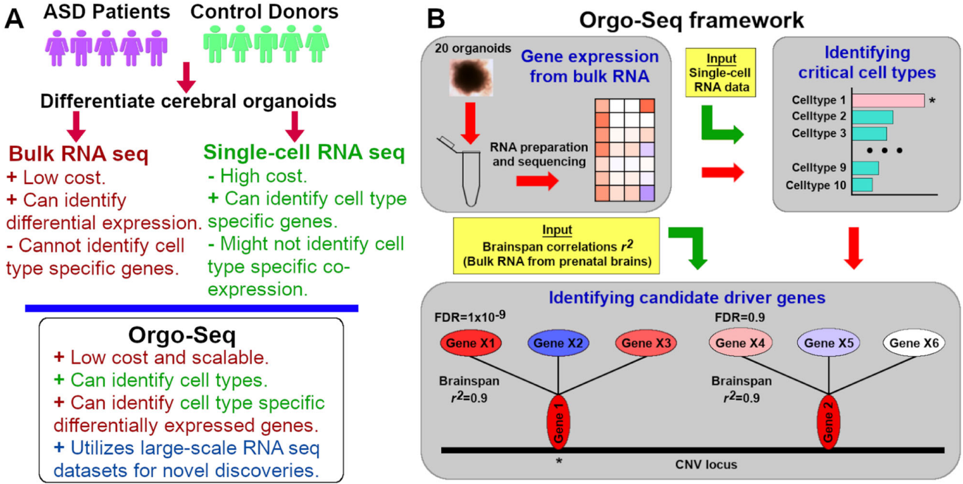
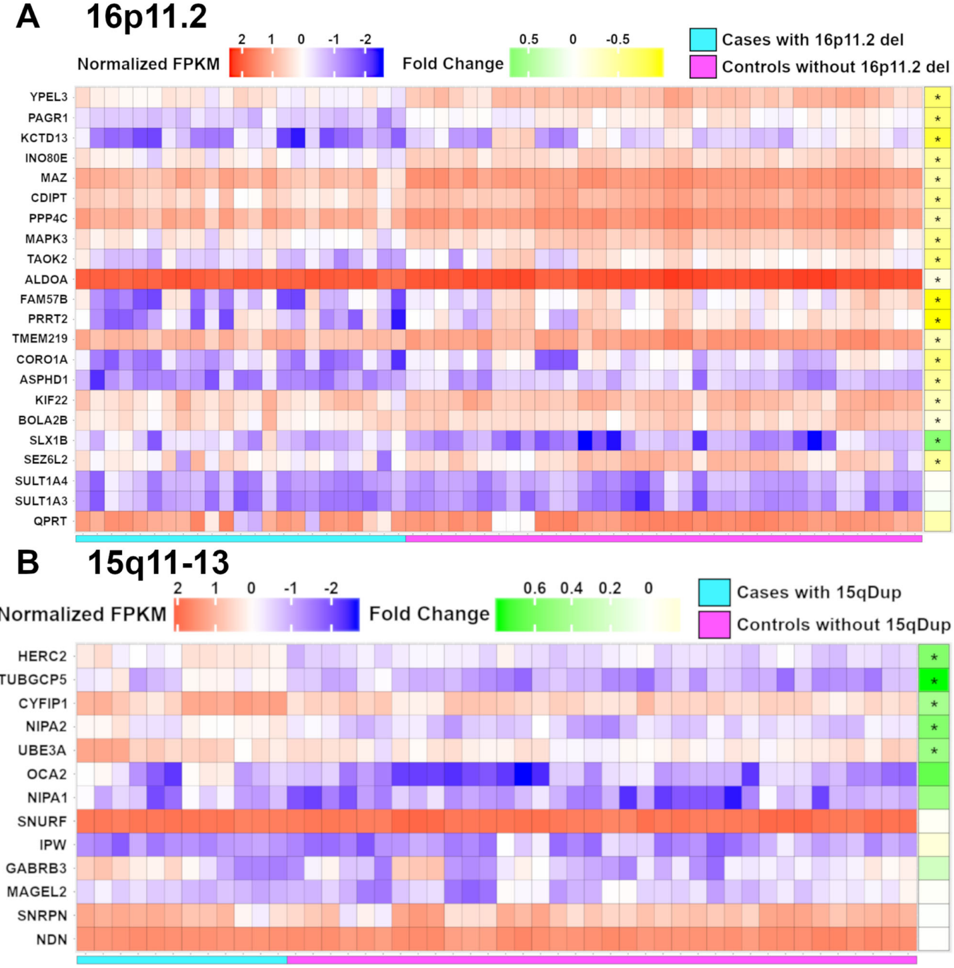
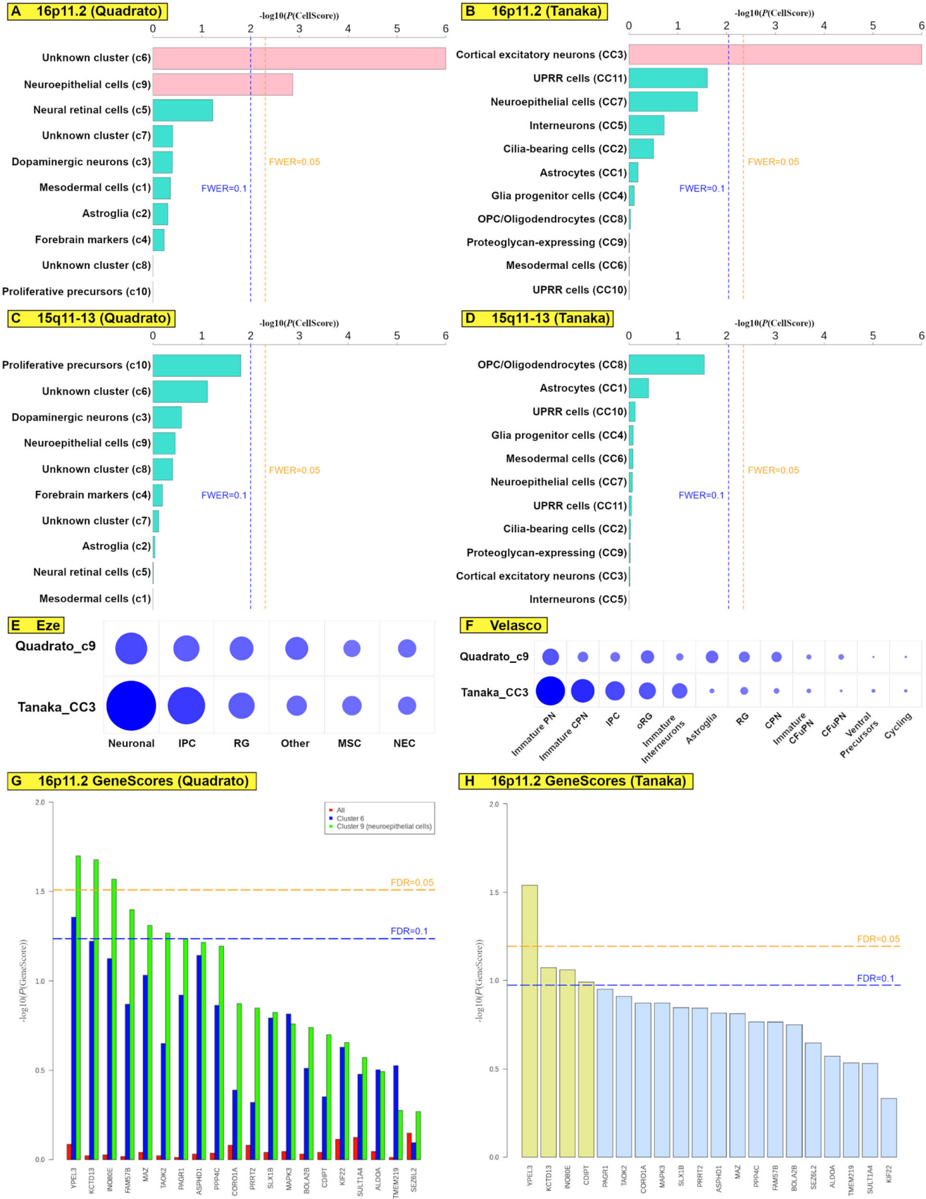
Neuropsychiatric and neurodevelopmental disorders have been particularly challenging to study using animal models, and recently, human-derived cerebral organoids demonstrate great promise for discovering molecular processes that are important in these disorders. However, several challenges remain in achieving robust phenotyping to discover cell type specific genes. We perform RNA sequencing on 71 samples comprising of 1,420 cerebral organoids from 25 donors, and describe a framework (Orgo-Seq) to identify cell type specific driver genes, for 16p11.2 deletions and 15q11-13 duplications. We identify neuroepithelial cells as critical cell types for 16p11.2 deletions, and discover novel and previously reported cell type specific driver genes. Finally, we validated our results that mutations in KCTD13 in the 16p11.2 locus lead to imbalances in the proportion of neuroepithelial cells, using CRISPR/Cas9-edited mosaic organoids. Our work presents a quantitative discovery and validation framework for identifying cell type specific driver genes associated with complex diseases using cerebral organoids.
Overview
The claims and statistics of this paper haven’t been checked yet.
Run the check — free, no account needed. It reads the open-access text and checks the sources it cites.
Integrity signals
Registry
Cites
Statistics
Figures
Verification
Claims the paper makes
The claims and statistics of this paper haven’t been checked yet.
Run the check — free, no account needed. It reads the open-access text and checks the sources it cites.
Claims other papers make about this one
Each is checked against this paper’s own text: does it say what the citing paper says it does?
The cited source says what the claim attributes to it.
In the citing paper
“Recent hiPSC genetic modeling efforts have utilized either a pooled patient iPSC strategy to uncover disease phenotypes in the context of patient genetic heterogeneity or a comprehensive isogenic platform to assess the effect of disease mutations by limiting genetic background variation (Lim et al., 2020; Mitchell et al., 2020; Ramos et al., 2021).”
From Cholesterol and matrisome pathways dysregulated in astrocytes and microglia (2022) · cites this paper as Lim et al., 2020
Self-check
Percentages, sums and reported differences re-computed from the paper’s own numbers.
The self-check needs the paper’s full text.
Citations
Cites
Genome-wide changes in lncRNA, splicing, and regional gene expression patterns in autism
Parikshak, N. N., Swarup, V., Belgard, T. G., Irimia, M., Ramaswami, G., Gandal, M. J., Hartl, C., Leppa, V., Ubieta, L. D. L. T., Huang, J., et al. (2016) · Nature · doi:10.1038/nature20612 · Cited by 685
Research works printed but not linked: 47
- 10.1038/nature22047 · DOI · Paper page
- 10.1038/nature12517 · DOI · Paper page
- 10.1016/j.cell.2015.06.034 · DOI · Paper page
- 10.1016/j.neuron.2011.05.002 · DOI · Paper page
- 10.1002/ajmg.a.37820 · DOI · Paper page
- 10.1523/JNEUROSCI.1366-14.2014 · DOI · Paper page
- 10.1038/nature11091 · DOI · Paper page
- 10.1038/nature24470 · DOI · Paper page
- 10.1093/hmg/ddy436 · DOI · Paper page
- 10.1038/nmeth.2772 · DOI · Paper page
- 10.1038/nature10523 · DOI · Paper page
- 10.1038/nprot.2014.158 · DOI · Paper page
- 10.1007/s00439-013-1331-2 · DOI
- 10.1038/ng.534 · DOI · Paper page
- 10.1073/pnas.1607014113 · DOI · Paper page
- 10.1016/j.ajhg.2017.08.016 · DOI
- 10.1038/s41380-018-0025-5 · DOI · Paper page
- 10.1016/j.cell.2015.06.045 · DOI · Paper page
- 10.1002/humu.22800 · DOI
- 10.1038/mp.2014.124 · DOI · Paper page
- 10.1002/humu.22237 · DOI
- 10.1111/j.0006-341X.1999.00997.x · DOI · Paper page
- 10.1038/nature19356 · DOI · Paper page
- 10.1016/j.cell.2011.06.013 · DOI · Paper page
- 10.1016/S0169-328X(02)00440-0 · DOI
- 10.1038/ejhg.2016.139 · DOI
- 10.1074/jbc.M110.205211 · DOI
- 10.1371/journal.pgen.1002521 · DOI · Paper page
- 10.1038/s41592-018-0048-5 · DOI
- 10.1126/science.1232033 · DOI · Paper page
- 10.1126/science.1231143 · DOI · Paper page
- 10.1126/science.1225829 · DOI · Paper page
- 10.1016/j.cell.2016.04.032 · DOI · Paper page
- 10.1038/nature22330 · DOI · Paper page
- 10.1038/s41587-019-0085-3 · DOI
- 10.1038/s41586-019-1289-x · DOI · Paper page
- 10.1126/science.aat6720 · DOI
- 10.1016/j.cell.2019.05.006 · DOI · Paper page
- 10.1136/jmg.2009.073015 · DOI · Paper page
- 10.1016/j.cell.2019.06.029 · DOI
- 10.1016/j.cell.2018.07.028 · DOI · Paper page
- 10.1016/j.cell.2019.05.031 · DOI · Paper page
- 10.1126/science.1250212 · DOI · Paper page
- 10.1126/science.aaw1219 · DOI · Paper page
- 10.1101/gr.138115.112 · DOI
- 10.1002/(SICI)1097-0258(19980730)17:14<1623::AID-SIM871>3.0.CO;2-S · DOI
- 10.1038/nature13185 · DOI · Paper page
Cited by
Sorted by citations
Cholesterol and matrisome pathways dysregulated in astrocytes and microglia
TCW, J., Qian, L., Pipalia, N. H., Chao, M. J., Liang, S. A., Shi, Y., Jain, B. R., Bertelsen, S. E., Kapoor, M., Marcora, E., et al. (2022) · Cell · doi:10.1016/j.cell.2022.05.017 · Cited by 411
Metadata
- Authors
- Lim, E. T., Chan, Y., Burns, M. J., Guo, X., Erdin, S., Tai, D. J. C., Reichert, J. M., Chan, Y. K., Chiang, J. J., Meyers, K., Zhang, X., Walsh, C. A., Yankner, B. A., Raychaudhuri, S., Hirschhorn, J. N., Gusella, J. F., Talkowski, M. E., & Church, G. M.
- Publisher
- openRxiv
- Published
- 2020-11-17
- Cited by
- 2
- References
- 1
- Type
- Preprint
About these checks
Registry, retraction, Cites and statistics results are computed, not judged, with one exception: a printed reference that no index lists is read once by a model before it counts as a citation error. Claims are extracted by a model and kept only when their quote appears verbatim in the text; each cited source is then checked, with a model’s help, for whether it says what the claim relies on. Those verdicts can be wrong — read the claim’s quote and the cited source before relying on one.
Statistics and arithmetic are recomputed, not judged.
Confidence bands are shown only for fields calibrated on our annotated test set. None is calibrated yet, so no band is shown.
What counts as a claim ›How we measure confidence ›How we check this ›
Are you an author, or do you see a problem with this page? Request a review
