

Emergence and Expansion of the SARS-CoV-2 Variant B.1.526 Identified in New York
Preprint — published as 10.1038/s41586-021-03908-2 · Paper page
The DOI matches its Crossref record; 48 of the 48 references it cites were found in a registry or an index.
Abstract
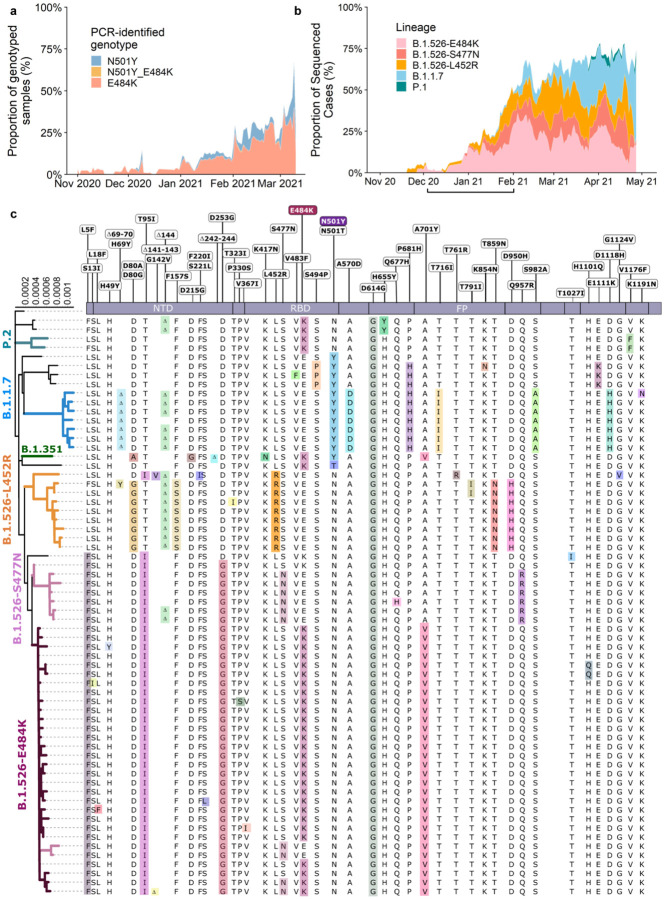
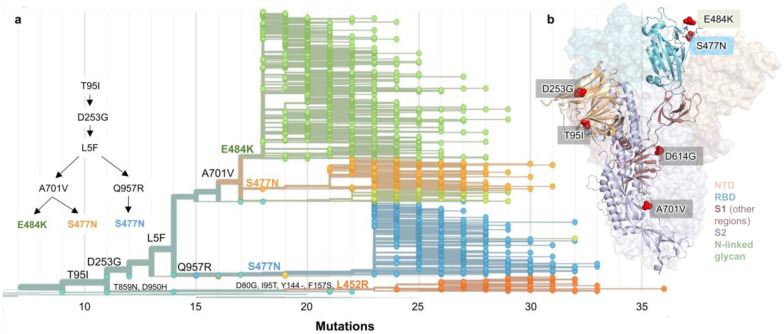
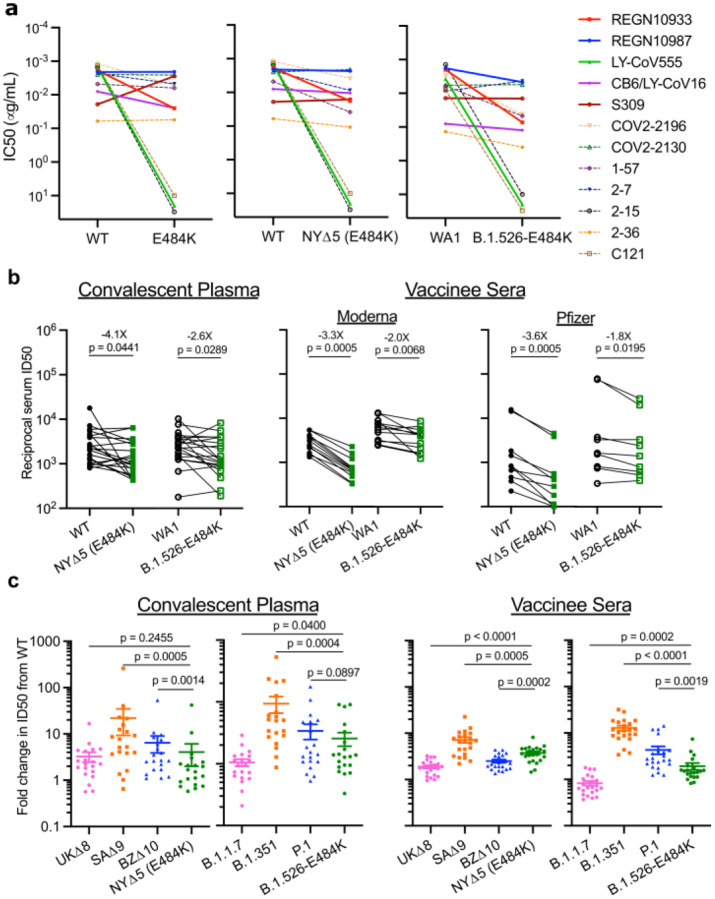
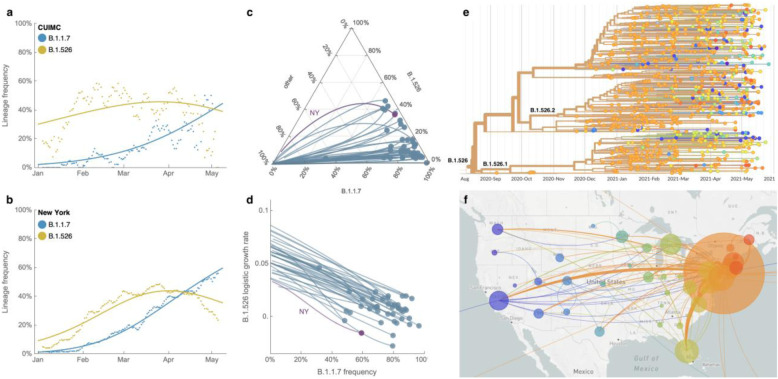
Recent months have seen surges of SARS-CoV-2 infection across the globe with considerable viral evolution 1-3 . Extensive mutations in the spike protein may threaten efficacy of vaccines and therapeutic monoclonal antibodies 4 . Two signature mutations of concern are E484K, which plays a crucial role in the loss of neutralizing activity of antibodies, and N501Y, a driver of rapid worldwide transmission of the B.1.1.7 lineage. Here, we report the emergence of variant lineage B.1.526 that contains E484K and its alarming rise to dominance in New York City in early 2021. This variant is partially or completely resistant to two therapeutic monoclonal antibodies in clinical use and less susceptible to neutralization by convalescent plasma or vaccinee sera, posing a modest antigenic challenge. The B.1.526 lineage has now been reported from all 50 states in the US and numerous other countries. B.1.526 rapidly replaced earlier lineages in New York upon its emergence, with an estimated transmission advantage of 35%. Such transmission dynamics, together with the relative antibody resistance of its E484K sub-lineage, likely contributed to the sharp rise and rapid spread of B.1.526. Although SARS-CoV-2 B.1.526 initially outpaced B.1.1.7 in the region, its growth subsequently slowed concurrent with the rise of B.1.1.7 and ensuing variants.
Overview
The claims and statistics of this paper haven’t been checked yet.
Free: it reads the open-access text and checks the first 5 claims that cite a source we can check. Create a free account to check every claim.
Integrity signals
Registry
Cites
Statistics
Figures
Verification
Claims the paper makes
The claims and statistics of this paper haven’t been checked yet.
Free: it reads the open-access text and checks the first 5 claims that cite a source we can check. Create a free account to check every claim.
Claims other papers make about this one
Each is checked against this paper’s own text: does it say what the citing paper says it does?
The source backs part of the claim, not all of it — or backs it for a different population, condition or comparison.
In the citing paper
“L5F, T95I, D253G, (L452R*), E484K, D614G, and A701V are important spike protein substitutions that may impart reduced susceptibility to MAb’s treatments along with reduced neutralization capacity by post-vaccination sera [45].”
From Waves and variants of SARS-CoV-2: understanding the causes and effect of the COVID-19 catastrophe (2022) · cites this paper as [45]
Experimental — accuracy not yet measuredIn the citing paper
“The Iota variant was first identified in New York state.In June 2021, it had a prevalence of 5-10% in the USA but remained rare outside the USA 154 .”
From The biological and clinical significance of emerging SARS-CoV-2 variants (2021) · cites this paper as [154]
Self-check
Percentages, sums and reported differences re-computed from the paper’s own numbers.
The self-check needs the paper’s full text.
Citations
Cites
IQ-TREE 2: New Models and Efficient Methods for Phylogenetic Inference in the Genomic Era
Minh, B. Q., Schmidt, H. A., Chernomor, O., Schrempf, D., Woodhams, M. D., von Haeseler, A., & Lanfear, R. (2020) · Molecular Biology and Evolution · doi:10.1093/molbev/msaa015 · Cited by 16,873
Fetal Cardiac Rhabdomyoma: A Case Report
Suwardewa, T. G. A., Negara, I. S., Kusuma, A. J., Wiradnyana, A., Surya, R., & Tunas, I. (2016) · doi:10.15562/bmj.v5i3.346 · Cited by 12,286 · cited 1×
“2 that also harbors E484K, have been documented (8, 9).”
BackgroundNextstrain: real-time tracking of pathogen evolution
Hadfield, J., Megill, C., Bell, S. M., Huddleston, J., Potter, B., Callender, C., Sagulenko, P., Bedford, T., & Neher, R. A. (2018) · Bioinformatics · doi:10.1093/bioinformatics/bty407 · Cited by 3,154
Self-citationGISAID: Global initiative on sharing all influenza data – from vision to reality
Shu, Y., & McCauley, J. (2017) · Eurosurveillance · doi:10.2807/1560-7917.es.2017.22.13.30494 · Cited by 3,039
Estimated transmissibility and impact of SARS-CoV-2 lineage B.1.1.7 in England
Davies, N. G., Abbott, S., Barnard, R. C., Jarvis, C. I., Kucharski, A. J., Munday, J. D., Pearson, C. A. B., Russell, T. W., Tully, D. C., Washburne, A. D., et al. (2021) · Science · doi:10.1126/science.abg3055 · Cited by 2,581
A dynamic nomenclature proposal for SARS-CoV-2 lineages to assist genomic epidemiology
Rambaut, A., Holmes, E. C., O’Toole, Á., Hill, V., McCrone, J. T., Ruis, C., du Plessis, L., & Pybus, O. G. (2020) · Nature Microbiology · doi:10.1038/s41564-020-0770-5 · Cited by 2,543
Tegally, H., Wilkinson, E., Giovanetti, M., Iranzadeh, A., Fonseca, V., Giandhari, J., Doolabh, D., Pillay, S., San, E. J., Msomi, N., et al. (2020) · doi:10.1101/2020.12.21.20248640 · Cited by 2,535 · cited 12×
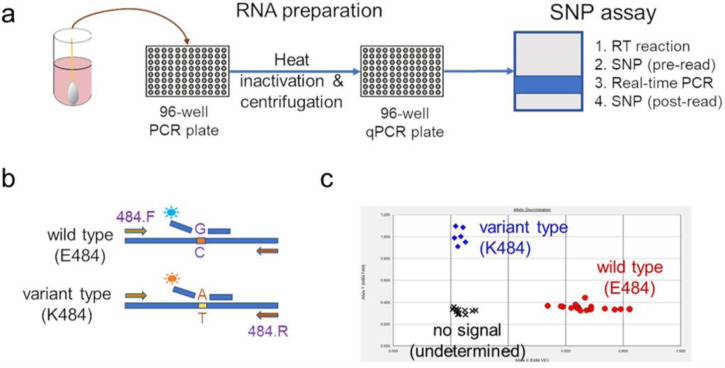
“Each reaction plate included 8 control wells, 5x10⁶ and 5x10³ copies of 413 WA-1 (wild type), UK variant and South African variant, which were generated by PCR to match 414 the variant sequences, and 2 wells with water as no template controls (NTC).”
BackgroundInfluentialAntibody resistance of SARS-CoV-2 variants B.1.351 and B.1.1.7
Wang, P., Nair, M. S., Liu, L., Iketani, S., Luo, Y., Guo, Y., Wang, M., Yu, J., Zhang, B., Kwong, P. D., et al. (2021) · Nature · doi:10.1038/s41586-021-03398-2 · Cited by 2,312
Self-citationCross-neutralization of SARS-CoV-2 by a human monoclonal SARS-CoV antibody
Pinto, D., Park, Y.-J., Beltramello, M., Walls, A. C., Tortorici, M. A., Bianchi, S., Jaconi, S., Culap, K., Zatta, F., De Marco, A., et al. (2020) · Nature · doi:10.1038/s41586-020-2349-y · Cited by 1,885
Convergent Antibody Responses to SARS-CoV-2 in Convalescent Individuals
Robbiani, D. F., Gaebler, C., Muecksch, F., Lorenzi, J. C. C., Wang, Z., Cho, A., Agudelo, M., Barnes, C. O., Gazumyan, A., Finkin, S., et al. (2020) · Nature · doi:10.1038/s41586-020-2456-9 · Cited by 1,853
Cited by
Items 101–137 of 137
Volkan, E. (2021) · Molecular Biotechnology · doi:10.1007/s12033-021-00353-4 · Cited by 14
“526, spread fast in New York City [48].”
BackgroundInfluentialThe Up state of the SARS-COV-2 Spike homotrimer favors an increased virulence for new variants
Giron, C., Laaksonen, A., & da Silva, F. L. B. (2021) · bioRxiv · doi:10.1101/2021.04.05.438465 · Cited by 10
“The theoretical predictions confirm that the N501Y mutation increases this affinity.”
BackgroundInfluentialSmyth, D. S., Trujillo, M., Cheung, K., Gao, A., Hoxie, I., Kannoly, S., Kubota, N., Markman, M., San, K. M., Sompanya, G., et al. (2021) · medRxiv · doi:10.1101/2021.03.21.21253978 · Cited by 10
“526 in 102 clinical samples (23, 24), as well as the presence of Variants of Concern from the 103 United Kingdom, California, South Africa and Brazil (25).”
BackgroundResultInfluentialRelative Consolidation of the Kappa Variant Pre-Dates the Massive Second Wave of COVID-19 in India
Singh, J., Malhotra, A. G., Biswas, D., Shankar, P., Lokhande, L., Yadav, A. K., Raghuvanshi, A., Kale, D., Nema, S., Saigal, S., et al. (2021) · Genes · doi:10.3390/genes12111803 · Cited by 11
“While the other variants harbor E484K as the substitution, E484Q is observed in the kappa variant [13,14] and the E484K mutation is associated with reduced susceptibility to the monoclonal antibody bamlanivimab and the combination of bamlanivimab and etesevimab [15].”
BackgroundSARS-CoV-2 Portrayed against HIV: Contrary Viral Strategies in Similar Disguise
Duerr, R., Crosse, K. M., Valero-Jimenez, A. M., & Dittmann, M. (2021) · Microorganisms · doi:10.3390/microorganisms9071389 · Cited by 13
“Most recently, New York variants were detected carrying mostly either the S477N or E484K mutation (Table 2, Figure 6) [348,349].”
BackgroundAbduljaleel, Z. (2025) · Biophysical Chemistry · doi:10.1016/j.bpc.2025.107413 · Cited by 9
Li, M., Zu, J., Zhang, Y., Ma, L., Shen, M., Li, Z., & Ji, F. (2022) · Virology Journal · doi:10.1186/s12985-022-01771-9 · Cited by 8
Ranjan, P., Neha, N., Devi, C., Devar, K. A., & Das, P. K. (2022) · Microbial Pathogenesis · doi:10.1016/j.micpath.2022.105619 · Cited by 6
Emergence of a SARS-CoV-2 E484K variant of interest in Arizona
Skidmore, P., Kaelin, E. A., Holland, L., et al. (2021) · medRxiv · doi:10.1101/2021.03.26.21254367 · Cited by 7
Yin, R., Guest, J. D., Taherzadeh, G., et al. (2021) · bioRxiv · doi:10.1101/2021.03.21.436311 · Cited by 7
Cowman, K., Guo, Y., Pirofski, L., Wong, D., Bao, H., Chen, V., Hopkins, U. T., Andrews, E., Hamel, J., Keller, M. J., et al. (2021) · Open Forum Infectious Diseases · doi:10.1093/ofid/ofab313 · Cited by 9
Coordinating SARS-CoV-2 genomic surveillance in the United States
Nelson, M. I., & Thielen, P. (2021) · Virus Evolution · doi:10.1093/ve/veab053 · Cited by 5
“Tens of thousands of viral genomes are now sequenced in American labs each week to track the spread of variants originating in the US (Annavajhala et al. 2021; Deng et al. 2021) or imported from other countries (Washington et al.”
BackgroundÇetin, Ş., Ülgen, A., BALCI, P., Şıvgın, H., Çetin, M., ŞIVGIN, S., & Li, W. (2021) · SciMedicine Journal · doi:10.28991/scimedj-2021-03-si-1 · Cited by 5
Zhang, L., Cui, Z., Li, Q., Yu, Y., Wu, J., Nie, J., Ding, R., Wang, H., Zhang, Y., Liu, S., et al. (2021) · doi:10.21203/rs.3.rs-492659/v1 · Cited by 5
SARS-CoV-2 infection: a global outbreak and its implication on public health
Mohan, S., Anjum, M. R., Kodidasu, A., Prathyusha, T., Mrunalini, N. V., & Kishori, B. (2021) · Bulletin of the National Research Centre/Bulletin of the National Research Center · doi:10.1186/s42269-021-00599-7 · Cited by 7
An Appraisal of the Current Scenario in Vaccine Research for COVID-19
Chong, W. C., Chellappan, D. K., Shukla, S. D., Peterson, G. M., Patel, R. P., Jha, N. K., Eri, R. D., Dua, K., Tambuwala, M. M., & Shastri, M. D. (2021) · Viruses · doi:10.3390/v13071397 · Cited by 9
“On 19 December 2020, FDA authorized mRNA-1273 for emergency use in the United States of America [103].”
BackgroundInfluentialBuchan, B. W., & Yao, J. D. C. (2021) · Clinical Microbiology Newsletter · doi:10.1016/j.clinmicnews.2021.05.004 · Cited by 7
COVID-19 variants that escape vaccine immunity: Global and Indian context—are more vaccines needed?
Deb, B., Vilvadrinath, R., & Goel, S. (2021) · Journal of Biosciences · doi:10.1007/s12038-021-00226-7 · Cited by 5
“5.8 Lota, B.1.526 (USA) This variant that originated in November 2020 showed increased prevalence in the North-East USA and was associated with patients being more frequently hospitalized (Annavajhala et al. 2021).”
BackgroundInfluentialCombining genomic and epidemiological data to compare the transmissibility of SARS-CoV-2 lineages
Petrone, M. E., Rothman, J. E., Breban, M., et al. (2021) · medRxiv · doi:10.1101/2021.07.01.21259859 · Cited by 4
Emergence of the E484K Mutation in SARS-CoV-2 Lineage B.1.1.220 in Upstate New York
Lesho, E., Corey, B., Lebreton, F., et al. (2021) · medRxiv · doi:10.1101/2021.03.11.21253231 · Cited by 4
Tauzin, A., Gong, S., Beaudoin-Bussières, G., et al. (2021) · medRxiv · doi:10.1101/2021.09.17.21263532 · Cited by 3
Analysis of amino acid change dynamics reveals SARS-CoV-2 variant emergence
Bernasconi, A., Mari, L., Casagrandi, R., et al. (2021) · bioRxiv · doi:10.1101/2021.07.12.452076 · Cited by 3
Lesho, E. P., Corey, B. W., Lebreton, F., Ong, A., Swierczewski, B. E., Bennett, J. W., Walsh, E. E., & McGann, P. (2021) · Clinical Infectious Diseases · doi:10.1093/cid/ciab507 · Cited by 4
“536 variant in New York City carries E484K [12].”
InfluentialBarona-Gómez, F., Delaye, L., Diaz-Valenzuela, E., et al. (2021) · medRxiv · doi:10.1101/2021.05.18.21256128 · Cited by 3
“…worldwide as they are imported from their regions of origin into naive populations; but also as independent evolution converges to the same point mutations, for instance, in the recently reported VOIs 20A/S.484K and 20C/S. 484K (B.1.525/526, Lasek-Nesselquist et al. 2021; Annavajhala et al. 2021).”
BackgroundInfluentialLaurini, E., Marson, D., Aulic, S., et al. (2021) · bioRxiv · doi:10.1101/2021.05.18.444605 · Cited by 3
Esmaelizad, M., Hamidizadeh, M., Esmaelizad, N., Doroudian, M., Ranjbar, M., & Lotfi, M. (2023) · International Journal of Peptide Research and Therapeutics · doi:10.1007/s10989-023-10550-1 · Cited by 2
Variations from SARS-CoV-2 to Omicron: A new threat knocking at world's door
Balkrishna, A., Rohela, A., Kumar, A., Arya, A., & Khan, N. (2022) · Journal of Applied Pharmaceutical Science · doi:10.7324/japs.2022.120404 · Cited by 3
Cerutti, G., Guo, Y.-C., Wang, P., Nair, M., Huang, Y.-X., Yu, J., Liu, L.-H., Katsamba, P., Bahna, F., Reddem, E., et al. (2021) · bioRxiv · doi:10.1101/2021.06.29.450397 · Cited by 2
Self-citationEvolving SARS-CoV-2 variants and mutational cascades
Halley, J., Vokou, D., Pappas, G., et al. (2021) · medRxiv · doi:10.1101/2021.04.03.21254871 · Cited by 2
da Silva, E. S., Kohnen, M., Gilson, G., Staub, T., Arendt, V., Servais, J., Charpentier, E., Domingues, O., Snoeck, C., Ollert, M., et al. (2022) · medRxiv · doi:10.1101/2022.06.21.22276659 · Cited by 1
“in neutralizing activity is modest (2-3-fold) [48, 72-77], while it reaches ~10-fold to full escape for Beta and Gamma [48, 72-79].”
BackgroundResultPost-vaccination SARS-COV-2 among healthcare workers in New Jersey: a genomic epidemiological study
Mathema, B., Chen, L., Chow, K., et al. (2021) · medRxiv · doi:10.1101/2021.06.30.21259761 · Cited by 1
“Sequences can be accessed by searching records from both the originating lab at Hackensack Medical Center and the submitting lab at the New York Genome Center.”
BackgroundInfluentialMalo-Castillo, J., Jiménez-Álvarez, H., Ludeña-Meléndez, V., Castro, S. S. M., Rodríguez-Esquivel, S. E., Ishikawa-Arias, P., Terrones, C., Chavarría, L. L., Linares-Reyes, E., & Failoc‐Rojas, V. E. (2024) · Vaccines · doi:10.3390/vaccines12040400
“At the end of 2020, Baden et al. in a randomized trial evaluating the mRNA-1273 (Moderna) vaccine, supported that both injection-site and systemic AEs were more common among participants 18 to 65 years of age than those older than 65 years [18].”
Balasubramanian, P., Berto, C. G., Hassan, E., Valentine, N., de Vos, G., Coyle, C., & Sydney, E. (2022) · Infectious Diseases in Clinical Practice · doi:10.1097/ipc.0000000000001128 · Cited by 2
“526 in NewYork which, an E484K substitution strain, which was resistant to Bamlinivimab as monotherapy since late December 2020.(13,14) Comparing the demographics with the abovementioned RCTs, our cohort had a higher proportion of African Americans and Asians (34.”
BackgroundResultSARS-CoV-2 Therapeutic Landscape, Opportunity and Future Threats
Sharma, O. P., Seiz, W., & Scheele, J. (2021) · The Open COVID Journal · doi:10.2174/2666958702101010205
Wang, R., Chen, J., & Wei, G. (2021) · arXiv (Cornell University) · doi:10.48550/arxiv.2110.04626 · Cited by 1
Desingu, P. A., & Nagarajan, K. (2021) · Research Square · doi:10.21203/rs.3.rs-721043/v1
Estimating the strength of selection for new SARS-CoV-2 variants
van Dorp, C. V., Goldberg, E., Hengartner, N., et al. (2021) · medRxiv · doi:10.1101/2021.03.29.21254233
Metadata
- Authors
- Annavajhala, M. K., Mohri, H., Wang, P., Nair, M., Zucker, J. E., Sheng, Z., Gomez-Simmonds, A., Kelley, A. L., Tagliavia, M., Huang, Y., Bedford, T., Ho, D. D., & Uhlemann, A.-C.
- ORCID
- Publisher
- openRxiv
- Published
- 2021-02-25
- PMC
- PMC7924303
- References
- 20
- Type
- Preprint
About these checks
Registry, retraction, Cites and statistics results are computed, not judged, with one exception: a printed reference that no index lists is read once by a model before it counts as a citation error. Claims are extracted by a model and kept only when their quote appears verbatim in the text; each cited source is then checked, with a model’s help, for whether it says what the claim relies on. Those verdicts can be wrong — read the claim’s quote and the cited source before relying on one.
Statistics and arithmetic are recomputed, not judged.
Confidence bands are shown only for fields calibrated on our annotated test set. None is calibrated yet, so no band is shown.
What counts as a claim ›How we measure confidence ›How we check this ›
Are you an author, or do you see a problem with this page? Request a review
Data sources
Bibliographic data: Semantic Scholar, OpenAlex, Crossref.
Contains information from the Semantic Scholar Academic Graph Datasets, made available under the ODC Attribution License (ODC-BY 1.0).
Semantic Scholar’s data is described in: Kinney, R., et al. (2023). The Semantic Scholar Open Data Platform. arXiv:2301.10140.
