

The DOI matches its Crossref record; 25 of the 25 references it cites were found in a registry or an index.
Preliminary Efficacy of the NVX-CoV2373 Covid-19 Vaccine Against the B.1.351 Variant
Open accessPreprint — published as 10.1056/nejmoa2103055 · Paper page
Abstract
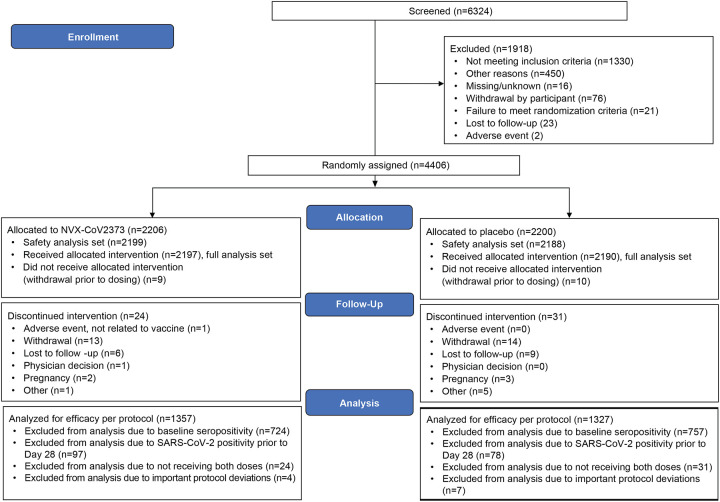
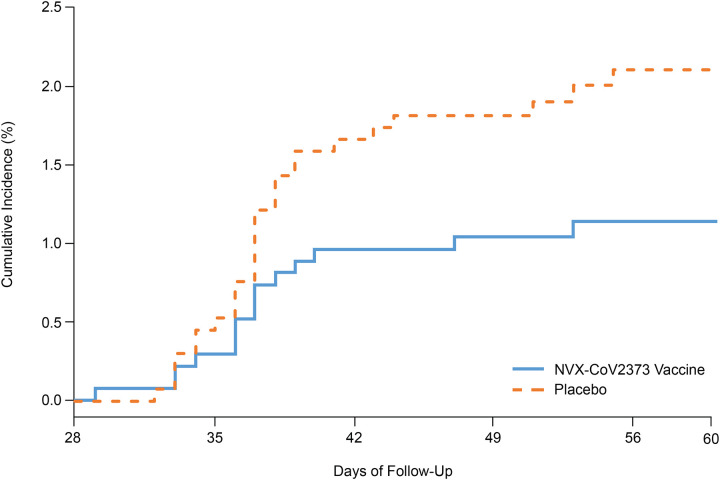
Background: The emergence of severe acute respiratory syndrome coronavirus 2 (SARS-CoV-2) variants threatens progress toward control of the Covid-19 pandemic. Evaluation of Covid-19 vaccine efficacy against SARS-CoV-2 variants is urgently needed to inform vaccine development and use. Methods: In this phase 2a/b, multicenter, randomized, observer-blinded, placebo-controlled trial in South Africa, healthy human immunodeficiency virus (HIV)-negative adults (18 to 84 years) or medically stable people living with HIV (PLWH) (18 to 84 years) were randomized in a 1:1 ratio to receive two doses, administered 21 days apart, of either NVX-CoV2373 nanoparticle vaccine (5 µg recombinant spike protein with 50 µg Matrix-M1 adjuvant) or placebo. The primary endpoints were safety and vaccine efficacy ≥7 days following the second dose against laboratory-confirmed symptomatic Covid-19 in previously SARS-CoV-2 uninfected participants. Results: A total of 4387 participants were randomized and dosed at least once, 2199 with NVX-CoV2373 and 2188 with placebo. Approximately 30% of participants were seropositive at baseline. Among 2684 baseline seronegative participants (94% HIV-negative; 6% PLWH), there were 15 and 29 predominantly mild to moderate Covid-19 cases in NVX-CoV2373 and placebo recipients, respectively; vaccine efficacy was 49.4% (95% confidence interval [CI]: 6.1 to 72.8). Efficacy in HIV-negative participants was 60.1% (95% CI: 19.9 to 80.1), and did not differ by baseline serostatus. Of the primary endpoint cases with available whole genome sequencing, 38 (92.7%) of 41 were the B.1.351 variant. Post-hoc vaccine efficacy against B.1.351 was 51.0% (95% CI: - 0.6 to 76.2) in HIV-negative participants. Among placebo recipients, the incidence of symptomatic Covid-19 was similar in baseline seronegative vs baseline seropositive participants during the first 2 months of follow-up (5.3% vs 5.2%). Preliminary local and systemic reactogenicity were primarily mild to moderate and transient, and higher with NVX-CoV2373; serious adverse events were rare in both groups. Conclusions: The NVX-CoV2373 vaccine was efficacious in preventing Covid-19, which was predominantly mild to moderate and due to the B.1.351 variant, while evidence of prior infection with the presumptive original SARS-CoV-2 did not confer protection against probable B.1.351 disease. (Funded by Novavax, The Bill and Melinda Gates Foundation, and the Coalition for Epidemic Preparedness Innovations; ClinicalTrials.gov number, NCT04533399 )
Overview
The claims and statistics of this paper haven’t been checked yet.
Run the check — free, no account needed. It reads the open-access text and checks the sources it cites.
Integrity signals
Registry
Cites
Statistics
Figures
Verification
Claims the paper makes
The claims and statistics of this paper haven’t been checked yet.
Run the check — free, no account needed. It reads the open-access text and checks the sources it cites.
Claims other papers make about this one
Each is checked against this paper’s own text: does it say what the citing paper says it does?
In the citing paper
“This study found no difference in infection rate between individuals who were seropositive and those who were seronegative (5.2% compared with 5.3%), suggesting that there was no protective effect of previous infection (preprint data, not yet peer reviewed)56.”
From Prospects for durable immune control of SARS-CoV-2 and prevention of reinfection (2021) · cites this paper as [56]
In the citing paper
“However, high levels of transmission of the B.1.351 variant of SARS-CoV-2, which has reduced susceptibility to immune sera from patients infected with ancestral SARS-CoV-2 strains, were occurring at the time of this trial, which may in part explain these findings.”
From Prospects for durable immune control of SARS-CoV-2 and prevention of reinfection (2021) · cites this paper as [56]
Self-check
Percentages, sums and reported differences re-computed from the paper’s own numbers.
The self-check needs the paper’s full text.
Citations
Cites
Safety and Efficacy of the BNT162b2 mRNA Covid-19 Vaccine
Polack, F. P., Thomas, S. J., Kitchin, N., Absalon, J., Gurtman, A., Lockhart, S., Perez, J. L., Pérez Marc, G., Moreira, E. D., Zerbini, C., et al. (2020) · New England Journal of Medicine · doi:10.1056/nejmoa2034577 · Cited by 14,592
Efficacy and Safety of the mRNA-1273 SARS-CoV-2 Vaccine
Baden, L. R., El Sahly, H. M., Essink, B., Kotloff, K., Frey, S., Novak, R., Diemert, D., Spector, S. A., Rouphael, N., Creech, C. B., et al. (2021) · New England Journal of Medicine · doi:10.1056/nejmoa2035389 · Cited by 10,119
Voysey, M., Clemens, S. A. C., Madhi, S. A., Weckx, L. Y., Folegatti, P. M., Aley, P. K., Angus, B., Baillie, V. L., Barnabas, S. L., Bhorat, Q. E., et al. (2021) · The Lancet · doi:10.1016/s0140-6736(20)32661-1 · Cited by 4,616
Self-citationTegally, H., Wilkinson, E., Giovanetti, M., Iranzadeh, A., Fonseca, V., Giandhari, J., Doolabh, D., Pillay, S., San, E. J., Msomi, N., et al. (2020) · doi:10.1101/2020.12.21.20248640 · Cited by 2,535 · cited 3×
“351 variant is characterized by three deleterious mutations at key antigenic sites in the RBD, including N501Y, K417N, and E484K, with the latter two having particular functional impact.(12,14,16,17) The N501Y mutation is known to increase binding affinity of the spike protein to the human angiotensin-converting enzym…”
BackgroundInfluentialDetection of a SARS-CoV-2 variant of concern in South Africa
Tegally, H., Wilkinson, E., Giovanetti, M., Iranzadeh, A., Fonseca, V., Giandhari, J., Doolabh, D., Pillay, S., San, E. J., Msomi, N., et al. (2021) · Nature · doi:10.1038/s41586-021-03402-9 · Cited by 2,510
Antibody Resistance of SARS-CoV-2 Variants B.1.351 and B.1.1.7
Wang, P., Nair, M. S., Liu, L., Iketani, S., Luo, Y., Guo, Y., Wang, M., Yu, J., Zhang, B., Kwong, P. D., et al. (2021) · doi:10.1101/2021.01.25.428137 · Cited by 2,328
Antibody resistance of SARS-CoV-2 variants B.1.351 and B.1.1.7
Wang, P., Nair, M. S., Liu, L., Iketani, S., Luo, Y., Guo, Y., Wang, M., Yu, J., Zhang, B., Kwong, P. D., et al. (2021) · Nature · doi:10.1038/s41586-021-03398-2 · Cited by 2,312
Starr, T. N., Greaney, A. J., Hilton, S. K., Ellis, D., Crawford, K. H. D., Dingens, A. S., Navarro, M. J., Bowen, J. E., Tortorici, M. A., Walls, A. C., et al. (2020) · Cell · doi:10.1016/j.cell.2020.08.012 · Cited by 1,956
Logunov, D. Y., Dolzhikova, I. V., Shcheblyakov, D. V., Tukhvatulin, A. I., Zubkova, O. V., Dzharullaeva, A. S., Kovyrshina, A. V., Lubenets, N. L., Grousova, D. M., Erokhova, A. S., et al. (2021) · The Lancet · doi:10.1016/s0140-6736(21)00234-8 · Cited by 1,747
Volz, E., Mishra, S., Chand, M., Barrett, J. C., Johnson, R., Geidelberg, L., Hinsley, W. R., Laydon, D. J., Dabrera, G., O’Toole, Á., et al. (2021) · doi:10.1101/2020.12.30.20249034 · Cited by 1,611 · cited 2×
“17 variant circulating in the UK.(15) The E484K mutation has been”
BackgroundInfluentialAssessing transmissibility of SARS-CoV-2 lineage B.1.1.7 in England
The COVID-19 Genomics UK (COG-UK) consortium, Volz, E., Mishra, S., Chand, M., Barrett, J. C., Johnson, R., Geidelberg, L., Hinsley, W. R., Laydon, D. J., Dabrera, G., et al. (2021) · Nature · doi:10.1038/s41586-021-03470-x · Cited by 1,611
mRNA vaccine-elicited antibodies to SARS-CoV-2 and circulating variants
Wang, Z., Schmidt, F., Weisblum, Y., Muecksch, F., Barnes, C. O., Finkin, S., Schaefer-Babajew, D., Cipolla, M., Gaebler, C., Lieberman, J. A., et al. (2021) · Nature · doi:10.1038/s41586-021-03324-6 · Cited by 1,343
Efficacy of the ChAdOx1 nCoV-19 Covid-19 Vaccine against the B.1.351 Variant
Madhi, S. A., Baillie, V., Cutland, C. L., Voysey, M., Koen, A. L., Fairlie, L., Padayachee, S. D., Dheda, K., Barnabas, S. L., Bhorat, Q. E., et al. (2021) · New England Journal of Medicine · doi:10.1056/nejmoa2102214 · Cited by 1,257
Self-citationGreaney, A. J., Loes, A. N., Crawford, K. H. D., Starr, T. N., Malone, K. D., Chu, H. Y., & Bloom, J. D. (2021) · doi:10.1101/2020.12.31.425021 · Cited by 1,178 · cited 4×
“351 variant is characterized by three deleterious mutations at key antigenic sites in the RBD, including N501Y, K417N, and E484K, with the latter two having particular functional impact.(12,14,16,17) The N501Y mutation is known to increase binding affinity of the spike protein to the human angiotensin-converting enzym…”
BackgroundInfluentialGreaney, A. J., Loes, A. N., Crawford, K. H. D., Starr, T. N., Malone, K. D., Chu, H. Y., & Bloom, J. D. (2021) · Cell Host & Microbe · doi:10.1016/j.chom.2021.02.003 · Cited by 1,178
Phase 1–2 Trial of a SARS-CoV-2 Recombinant Spike Protein Nanoparticle Vaccine
Keech, C., Albert, G., Cho, I., Robertson, A., Reed, P., Neal, S., Plested, J. S., Zhu, M., Cloney-Clark, S., Zhou, H., et al. (2020) · New England Journal of Medicine · doi:10.1056/nejmoa2026920 · Cited by 1,156
Self-citationSARS-CoV-2 501Y.V2 escapes neutralization by South African COVID-19 donor plasma
Wibmer, C. K., Ayres, F., Hermanus, T., Madzivhandila, M., Kgagudi, P., Oosthuysen, B., Lambson, B. E., de Oliveira, T., Vermeulen, M., van der Berg, K., et al. (2021) · Nature Medicine · doi:10.1038/s41591-021-01285-x · Cited by 1,147
Resurgence of COVID-19 in Manaus, Brazil, despite high seroprevalence
Sabino, E. C., Buss, L. F., Carvalho, M. P. S., Prete, C. A., Crispim, M. A. E., Fraiji, N. A., Pereira, R. H. M., Parag, K. V., da Silva Peixoto, P., Kraemer, M. U. G., et al. (2021) · The Lancet · doi:10.1016/s0140-6736(21)00183-5 · Cited by 758
Escape of SARS-CoV-2 501Y.V2 from neutralization by convalescent plasma
Cele, S., Gazy, I., Jackson, L., Hwa, S.-H., Tegally, H., Lustig, G., Giandhari, J., Pillay, S., Wilkinson, E., Naidoo, Y., et al. (2021) · doi:10.1101/2021.01.26.21250224 · Cited by 651 · cited 3×
“reported to abolish or substantially reduce neutralization by multiple potent monoclonal antibodies and polyclonal convalescent sera in both wild-type and pseudo-virus neutralization assays.(11,12,16,17,21) Additionally, post-vaccination sera derived from volunteers receiving either of”
BackgroundInfluentialSelf-citationEscape of SARS-CoV-2 501Y.V2 from neutralization by convalescent plasma
Network for Genomic Surveillance in South Africa, Cele, S., COMMIT-KZN Team, Gazy, I., Jackson, L., Hwa, S.-H., Tegally, H., Lustig, G., Giandhari, J., Pillay, S., et al. (2021) · Nature · doi:10.1038/s41586-021-03471-w · Cited by 651
Evolution of the COVID-19 vaccine development landscape
Le, T. T., Cramer, J. P., Chen, R. H., & Mayhew, S. (2020) · Nature Reviews Drug Discovery · doi:10.1038/d41573-020-00151-8 · Cited by 556
Tian, J.-H., Patel, N., Haupt, R., Zhou, H., Weston, S., Hammond, H., Logue, J., Portnoff, A. D., Norton, J., Guebre-Xabier, M., et al. (2021) · Nature Communications · doi:10.1038/s41467-020-20653-8 · Cited by 508
Self-citationStructural analysis of full-length SARS-CoV-2 spike protein from an advanced vaccine candidate
Bangaru, S., Ozorowski, G., Turner, H. L., Antanasijevic, A., Huang, D., Wang, X., Torres, J. L., Diedrich, J. K., Tian, J.-H., Portnoff, A. D., et al. (2020) · Science · doi:10.1126/science.abe1502 · Cited by 338
Self-citationSARS-CoV-2 evolution and vaccines: cause for concern?
Williams, T., & Burgers, W. A. (2021) · The Lancet Respiratory Medicine · doi:10.1016/s2213-2600(21)00075-8 · Cited by 163
SARS-CoV-2 501Y.V2 escapes neutralization by South African COVID-19 donor plasma
Wibmer, C. K., Ayres, F., Hermanus, T., Madzivhandila, M., Kgagudi, P., Oosthuysen, B., Lambson, B. E., de Oliveira, T., Vermeulen, M., van der Berg, K., et al. (2021) · doi:10.1101/2021.01.18.427166
Self-citation
Research works printed but not linked: 1
- 2004, A modified poisson regression approach to prospective studies with binary data Am J Epidemiol, 159, 702
Cited by
Sorted by citations
Features, Evaluation and Treatment Coronavirus (COVID-19)
Cascella, M., Rajnik, M., Cuomo, A., Dulebohn, S. C., & Napoli, R. D. (2020) · StatPearls · Cited by 3,351
Effectiveness of Covid-19 Vaccines against the B.1.617.2 (Delta) Variant
Lopez Bernal, J., Andrews, N., Gower, C., Gallagher, E., Simmons, R., Thelwall, S., Stowe, J., Tessier, E., Groves, N., Dabrera, G., et al. (2021) · New England Journal of Medicine · doi:10.1056/nejmoa2108891 · Cited by 2,889
SARS-CoV-2 B.1.617.2 Delta variant replication and immune evasion
Mlcochova, P., Kemp, S. A., Dhar, M. S., Papa, G., Meng, B., Ferreira, I. A. T. M., Datir, R., Collier, D. A., Albecka, A., Singh, S., et al. (2021) · Nature · doi:10.1038/s41586-021-03944-y · Cited by 1,337
Safety and Efficacy of NVX-CoV2373 Covid-19 Vaccine
Heath, P. T., Galiza, E. P., Baxter, D. N., Boffito, M., Browne, D., Burns, F., Chadwick, D. R., Clark, R., Cosgrove, C., Galloway, J., et al. (2021) · New England Journal of Medicine · doi:10.1056/nejmoa2107659 · Cited by 1,085
Self-citationThe biological and clinical significance of emerging SARS-CoV-2 variants
Tao, K., Tzou, P. L., Nouhin, J., Gupta, R. K., de Oliveira, T., Kosakovsky Pond, S. L., Fera, D., & Shafer, R. W. (2021) · Nature Reviews Genetics · doi:10.1038/s41576-021-00408-x · Cited by 1,009
Metadata
- Authors
- Shinde, V., Bhikha, S., Hoosain, Z., Archary, M., Bhorat, Q., Fairlie, L., Lalloo, U., Masilela, M. S. L., Moodley, D., Hanley, S., Fouche, L., Louw, C., Tameris, M., Singh, N., Goga, A., Dheda, K., Grobbelaar, C., Kruger, G., Carrim-Ganey, N., Baillie, V., de Oliveira, T., Koen, A. L., Lombaard, J. J., Mngqibisa, R., Bhorat, A. E., Benadé, G., Lalloo, N., Pitsi, A., Vollgraaff, P.-L., Luabeya, A., Esmail, A., Petrick, F. G., Jose, A. O., Foulkes, S., Ahmed, K., Thombrayil, A., Fries, L., Cloney-Clark, S., Zhu, M., Bennett, C., Albert, G., Faust, E., Plested, J. S., Robertson, A., Neal, S., Cho, I., Glenn, G. M., Dubovsky, F., Madhi, S. A., & for the 2019nCoV-501 Study Group
- Affiliations
- Novavax (United States) (US)
- South African Medical Research Council (ZA)
- University of the Free State (ZA)
- University of KwaZulu-Natal (ZA)
- University of the Witwatersrand (ZA)
- Setshaba Research Centre (ZA)
- Centre for the AIDS Programme of Research in South Africa (ZA)
- University of Pretoria (ZA)
- University of Cape Town (ZA)
- Clinical Trial Center Maastricht (NL)
- Corresponding author
- Shinde, Vivek
- ORCID
- Archary, Moherndran
- Bhorat, Qasim
- Fairlie, Lee
- Lalloo, Umesh
- Moodley, Dhayendre
- Hanley, Sherika
- Fouche, Leon
- Tameris, Michele
- Goga, Ameena
- Dheda, Keertan
- Baillie, Vicky
- de Oliveira, Tulio
- Koen, Anthonet Lombard
- Lombaard, Johan J.
- Mngqibisa, Rosie
- Bhorat, As’ad Ebrahim
- Benadé, Gabriella
- Luabeya, Angelique
- Esmail, Aliasgar
- Ahmed, Khatija
- Zhu, Mingzhu
- Albert, Gary
- Plested, Joyce S.
- Robertson, Andreana
- Cho, Iksung
- Glenn, Greg M.
- Madhi, Shabir A.
- Venue
- New England Journal of Medicine
- Publisher
- openRxiv
- Published
- 2021-03-03
- Volume
- 384
- Issue
- 20
- Pages
- 1899-1909
- ISSN
- 0028-4793 (ISSN-L)
- PMC
- PMC8091623
- OpenAlex
- W3157709232
- Cited by
- 625
- References
- 19
- Citations by year
- 2026: 10 · 2025: 19 · 2024: 46 · 2023: 97 · 2022: 229 · 2021: 221
- FWCI
- 47.03
- Type
- journal article
- Language
- en
- Open access
- hybrid
- doi.org
- Licence
- cc-by
- Locations
- New England Journal of Medicine (publishedVersion, cc-by)
- medRxiv (acceptedVersion)
- PubMed (publishedVersion)
- PubMed Central (acceptedVersion, cc-by)
- LSHTM Research Online (London School of Hygiene and Tropical Medicine) (acceptedVersion)
- UpSpace Institutional Repository (University of Pretoria) (submittedVersion)
- Funders
- Pfizer
- Sanofi
- Regeneron Pharmaceuticals
- Novavax
- Novo Nordisk
- National Institute of Allergy and Infectious Diseases (UM1AI069469)
- Topics
- Health Sciences › Medicine › Infectious Diseases › SARS-CoV-2 and COVID-19 Research
- Health Sciences › Medicine › Infectious Diseases › COVID-19 Clinical Research Studies
- Life Sciences › Agricultural and Biological Sciences › Animal Science and Zoology › Animal Virus Infections Studies
- Keywords
- NVX-CoV2373, COVID-19 vaccines, vaccine efficacy, nanoparticle vaccine, HIV-infected adults, HIV-negative individuals, neutralizing antibodies, CD4+ T cell responses, reactogenicity, South Africa, Omicron variant
- MeSH terms
- Immunogenicity, Vaccine, COVID-19, SARS-CoV-2, COVID-19 Vaccines, COVID-19 Serological Testing, Adolescent, Adult, Aged, Aged, 80 and over, Double-Blind Method, HIV Seropositivity, Humans, Middle Aged, South Africa, HIV Seronegativity, Young Adult, Antibodies, Neutralizing
About these checks
Registry, retraction, Cites and statistics results are computed, not judged, with one exception: a printed reference that no index lists is read once by a model before it counts as a citation error. Claims are extracted by a model and kept only when their quote appears verbatim in the text; each cited source is then checked, with a model’s help, for whether it says what the claim relies on. Those verdicts can be wrong — read the claim’s quote and the cited source before relying on one.
Statistics and arithmetic are recomputed, not judged.
Confidence bands are shown only for fields calibrated on our annotated test set. None is calibrated yet, so no band is shown.
What counts as a claim ›How we measure confidence ›How we check this ›
Are you an author, or do you see a problem with this page? Request a review
