

The DOI matches its Crossref record; 53 of the 53 references it cites were found in a registry or an index.
Neutralising antibodies predict protection from severe COVID-19
Open accessAbstract
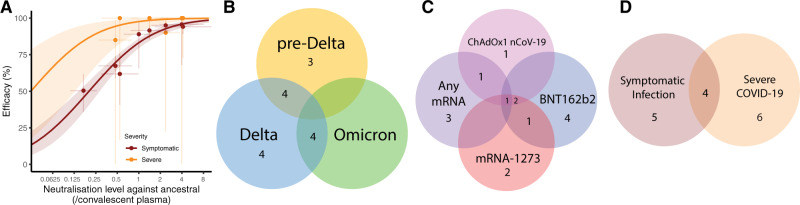
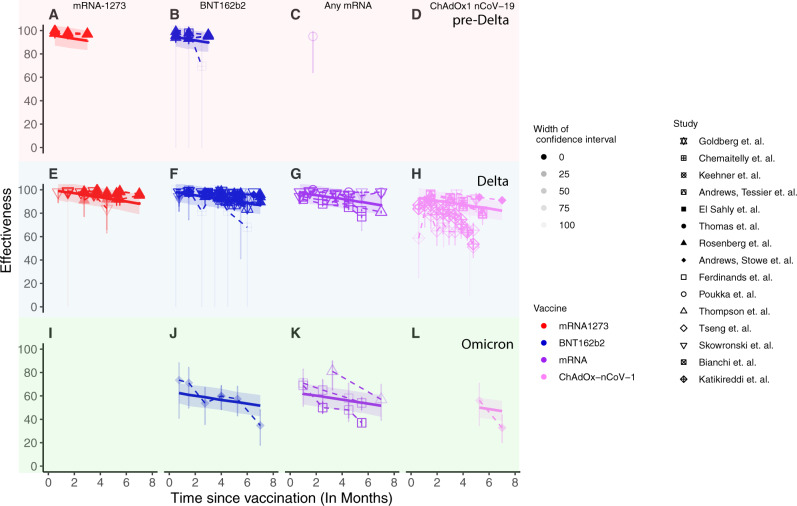
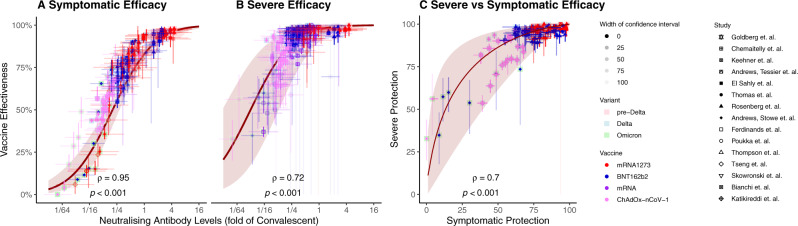
Background: Vaccine protection from COVID-19 has been shown to decline with time-since-vaccination and against SARS-CoV-2 variants. Protection against severe COVID-19 is higher than against symptomatic infection, and also appears relatively preserved over time and against variants. Although Protection protection from symptomatic SARS-CoV-2 infection has been shown to be strongly correlated with neutralising antibody titres, however, this relationship has been is less well described for severe COVID-19. Protection against severe COVID-19 is higher than against symptomatic infection, and also appears relatively preserved over time and against variants. Here we analyse whether neutralising antibody titre remains predictive of protection against severe COVID-19 in the face of waning neutralising antibody levels and emerging variants. Methods: We extracted data from 15 studies reporting on protection against a range of SARS-CoV-2 clinical endpoints ("any infection", "symptomatic infection" and "severe COVID-19"). We then estimated the concurrent neutralising antibody titres using existing parameters on vaccine potency, neutralising antibody decay, and loss of recognition of variants and investigated the relationship between neutralising antibody titre and vaccine effectiveness against severe COVID-19. Findings: Predicted neutralising antibody titres are strongly correlated with vaccine effectiveness against symptomatic and severe COVID-19 (Spearman rho = .94 and 0.63 respectively, p<.001 for both), consistent with previous estimates of the relationship between neutralisation and protection. Indeed 82% (137 of 167) of reported values of protection against severe COVID-19 across a range of vaccines and variants lie within the 95% confidence intervals of the published model. Interpretation: Neutralising antibody titres are predictive of vaccine effectiveness against severe COVID-19 including in realistic scenarios of waning immunity and viral variants. Funding: National Health and Medical Research Council (Australia), Medical Research Future Fund (Australia).
Overview
The claims and statistics of this paper haven’t been checked yet.
Run the check — free, no account needed. It reads the open-access text and checks the sources it cites.
Integrity signals
Registry
Cites
Statistics
Figures
Verification
Claims the paper makes
The claims and statistics of this paper haven’t been checked yet.
Run the check — free, no account needed. It reads the open-access text and checks the sources it cites.
Claims other papers make about this one
Each is checked against this paper’s own text: does it say what the citing paper says it does?
The cited source says what the claim attributes to it.
In the citing paper
“It has been postulated that neutralizing antibodies can also protect against severe disease, albeit at lower concentrations than needed to protect against symptomatic disease [36]”
From Assessing COVID-19 vaccine effectiveness against Omicron subvariants: Report from a meeting of the World Health Organization (2023) · cites this paper as [36]
Self-check
Percentages, sums and reported differences re-computed from the paper’s own numbers.
The self-check needs the paper’s full text.
Citations
Cites
Safety and Efficacy of the BNT162b2 mRNA Covid-19 Vaccine
Polack, F. P., Thomas, S. J., Kitchin, N., Absalon, J., Gurtman, A., Lockhart, S., Perez, J. L., Pérez Marc, G., Moreira, E. D., Zerbini, C., et al. (2020) · New England Journal of Medicine · doi:10.1056/nejmoa2034577 · Cited by 14,592
Efficacy and Safety of the mRNA-1273 SARS-CoV-2 Vaccine
Baden, L. R., El Sahly, H. M., Essink, B., Kotloff, K., Frey, S., Novak, R., Diemert, D., Spector, S. A., Rouphael, N., Creech, C. B., et al. (2021) · New England Journal of Medicine · doi:10.1056/nejmoa2035389 · Cited by 10,119
Voysey, M., Clemens, S. A. C., Madhi, S. A., Weckx, L. Y., Folegatti, P. M., Aley, P. K., Angus, B., Baillie, V. L., Barnabas, S. L., Bhorat, Q. E., et al. (2021) · The Lancet · doi:10.1016/s0140-6736(20)32661-1 · Cited by 4,616
Khoury, D. S., Cromer, D., Reynaldi, A., Schlub, T. E., Wheatley, A. K., Juno, J. A., Subbarao, K., Kent, S. J., Triccas, J. A., & Davenport, M. P. (2021) · Nature Medicine · doi:10.1038/s41591-021-01377-8 · Cited by 3,742 · cited 1×
“MMWR Morb Mortal Wkly Rep 2022; 71(4): 139-45.”
Self-citationAn mRNA Vaccine against SARS-CoV-2 — Preliminary Report
Jackson, L. A., Anderson, E. J., Rouphael, N. G., Roberts, P. C., Makhene, M., Coler, R. N., McCullough, M. P., Chappell, J. D., Denison, M. R., Stevens, L. J., et al. (2020) · New England Journal of Medicine · doi:10.1056/nejmoa2022483 · Cited by 3,237
Immunological memory to SARS-CoV-2 assessed for up to 8 months after infection.
Dan, J. M., Mateus, J., Kato, Y., Hastie, K. M., Yu, E. D., Faliti, C. E., Grifoni, A., Ramirez, S. I., Haupt, S., Frazier, A., et al. (2021) · Science · doi:10.1126/science.abf4063 · Cited by 2,656
RNA-Based COVID-19 Vaccine BNT162b2 Selected for a Pivotal Efficacy Study
Walsh, E. E., Frenck, R., Falsey, A. R., Kitchin, N., Absalon, J., Gurtman, A., Lockhart, S., Neuzil, K., Mulligan, M. J., Bailey, R., et al. (2020) · doi:10.1101/2020.08.17.20176651 · Cited by 2,615
Effectiveness of COVID-19 vaccines against the Omicron (B.1.1.529) variant of concern
Andrews, N., Stowe, J., Kirsebom, F., Toffa, S., Rickeard, T., Gallagher, E., Gower, C., Kall, M., Groves, N., O’Connell, A.-M., et al. (2021) · doi:10.1101/2021.12.14.21267615 · Cited by 2,420
Safety and Efficacy of the BNT162b2 mRNA Covid-19 Vaccine through 6 Months
Thomas, S. J., Moreira, E. D., Kitchin, N., Absalon, J., Gurtman, A., Lockhart, S., Perez, J. L., Pérez Marc, G., Polack, F. P., Zerbini, C., et al. (2021) · New England Journal of Medicine · doi:10.1056/nejmoa2110345 · Cited by 1,640
Covid-19 Breakthrough Infections in Vaccinated Health Care Workers
Bergwerk, M., Gonen, T., Lustig, Y., Amit, S., Lipsitch, M., Cohen, C., Mandelboim, M., Levin, E. G., Rubin, C., Indenbaum, V., et al. (2021) · New England Journal of Medicine · doi:10.1056/nejmoa2109072 · Cited by 1,345 · cited 1×
“MMWR Morb Mortal Wkly Rep 2022; 71(7): 255-63.”
Research works printed but not linked: 3
- [36]Walsh EE Safety and immunogenicity of two RNA-based Covid-19 vaccine candidates N. Engl. J. Med. 2020 383 2439 2450 10.1056/NEJMoa2027906 33053279 PMC7583697 · DOI · Paper page
- [39]Stadler, E. et al. Determinants of passive antibody effectiveness in SARS-CoV-2 infection. Preprint at medRxiv10.1101/2022.1103.1121.22272672 (2022).
- [47]Andrews, N. et al. Effectiveness of COVID-19 vaccines against the Omicron (B.1.1.529) variant of concern. Preprint at medRxiv10.1101/2021.1112.1114.21267615 (2021).
Cited by
Sorted by citations
Omicron BA.4/BA.5 escape neutralizing immunity elicited by BA.1 infection
Khan, K., Karim, F., Ganga, Y., Bernstein, M. P., Jule, Z., Reedoy, K., Cele, S., Lustig, G., Amoako, D. G., Wolter, N., et al. (2022) · Nature Communications · doi:10.1038/s41467-022-32396-9 · Cited by 225
SARS-CoV-2 breakthrough infection induces rapid memory and de novo T cell responses
Koutsakos, M., Reynaldi, A., Lee, W. S., Nguyen, J. T., Amarasena, T. H., Taiaroa, G., Kinsella, P. M., Liew, K. C., Tran, T., Kent, H. E., et al. (2023) · Immunity · doi:10.1016/j.immuni.2023.02.017 · Cited by 112
Self-citationPredicting the efficacy of variant-modified COVID-19 vaccine boosters
Khoury, D. S., Docken, S. S., Subbarao, K., Kent, S. J., Davenport, M. P., & Cromer, D. (2023) · Nature Medicine · doi:10.1038/s41591-023-02228-4 · Cited by 104
Self-citationPainter, M. M., Johnston, T. S., Lundgreen, K. A., Santos, J. J. S., Qin, J. S., Goel, R. R., Apostolidis, S. A., Mathew, D., Fulmer, B., Williams, J. C., et al. (2023) · Nature Immunology · doi:10.1038/s41590-023-01613-y · Cited by 106
Evolution and neutralization escape of the SARS-CoV-2 BA.2.86 subvariant
Khan, K., Lustig, G., Roemer, C., Reedoy, K., Jule, Z., Karim, F., Ganga, Y., Bernstein, M. P., Baig, Z., Jackson, L., et al. (2023) · Nature Communications · doi:10.1038/s41467-023-43703-3 · Cited by 93
Monoclonal antibody levels and protection from COVID-19
Stadler, E., Burgess, M. T., Schlub, T. E., Khan, S. R., Chai, K. L., McQuilten, Z., Wood, E. M., Polizzotto, M. N., Kent, S. J., Cromer, D., et al. (2023) · Nature Communications · doi:10.1038/s41467-023-40204-1 · Cited by 63
Self-citationFumagalli, V., Ravà, M., Marotta, D., Lucia, P. D., Bono, E. B., Giustini, L., Leo, F. D., Casalgrandi, M., Monteleone, E., Mouro, V., et al. (2024) · Nature Immunology · doi:10.1038/s41590-024-01787-z · Cited by 61
Xia, H., Liu, H., Gong, P., Li, P., Xu, Q., Zhang, Q., Sun, M., Meng, Q., Ye, F., & Yin, W. (2024) · The Science of The Total Environment · doi:10.1016/j.scitotenv.2024.178000 · Cited by 47
Immune correlates analysis of a phase 3 trial of the AZD1222 (ChAdOx1 nCoV-19) vaccine
Benkeser, D. C., Fong, Y., Janes, H., Kelly, E. J., Hirsch, I., Sproule, S., Stanley, A. M., Maaske, J., Villafana, T. L., Houchens, C. R., et al. (2023) · npj Vaccines · doi:10.1038/s41541-023-00630-0 · Cited by 41
“Progress in this direction stems from Cromer et al.45 and preceding papers from the Davenport group that developed a model to predict vaccine effectiveness for a given COVID-19 vaccine regimen, time period, and variant, based on the convalescent-sera standardized geometric mean titer of neutralizing antibodies to the…”
ResultInfluentialGardner, B. J., & Kilpatrick, A. M. (2024) · Viruses · doi:10.3390/v16030479 · Cited by 43
Feikin, D. R., Higdon, M. M., Andrews, N., Collie, S., Deloria Knoll, M., Kwong, J. C., Link-Gelles, R., Pilishvili, T., & Patel, M. K. (2023) · Vaccine · doi:10.1016/j.vaccine.2023.02.020 · Cited by 36
Xia, Q., Yang, Y., Wang, F., Huang, Z., Qiu, W., & Mao, A. (2024) · International Journal of Infectious Diseases · doi:10.1016/j.ijid.2024.01.017 · Cited by 38
Mikolajczyk, R., Diexer, S., Klee, B., Pfrommer, L. R., Purschke, O., Fricke, J., Ahnert, P., Gabrysch, S., Gottschick, C., Bohn, B., et al. (2024) · Journal of Infection · doi:10.1016/j.jinf.2024.106206 · Cited by 24
Carpp, L. N., Hyrien, O., Fong, Y., Benkeser, D. C., Roels, S., Stieh, D. J., Dromme, I. V., Roey, G. A. V., Kenny, A., Huang, Y., et al. (2024) · Nature Communications · doi:10.1038/s41467-024-53727-y · Cited by 22
Vattiato, G., Lustig, A. G., Maclaren, O. J., & Plank, M. J. (2022) · Epidemics · doi:10.1016/j.epidem.2022.100657 · Cited by 24
Xie, J., Mothe, B., Alcalde‐Herraiz, M., Li, C., Xu, Y., Jödicke, A. M., Gao, Y., Wang, Y., Feng, S., Wei, J., et al. (2024) · Nature Communications · doi:10.1038/s41467-024-48339-5 · Cited by 23
COVID-19 vaccine effectiveness and evolving variants: understanding the immunological footprint
Zaeck, L. M., GeurtsvanKessel, C. H., & de Vries, R. D. (2023) · The Lancet Respiratory Medicine · doi:10.1016/s2213-2600(23)00140-6 · Cited by 22
Zhang, F.-M., Huang, T., Wang, F., Zhang, G.-S., Liu, D., Dai, J., Zhang, J., Li, Q., Lin, G., Gao, D., et al. (2023) · European Journal of Medicinal Chemistry · doi:10.1016/j.ejmech.2023.115721 · Cited by 21
Bansal, A., Trieu, M.-C., Eriksson, E. M., Zhou, F., McVernon, J., Brokstad, K. A., & Cox, R. J. (2025) · Scientific Reports · doi:10.1038/s41598-025-89472-5 · Cited by 20
Liu, C., Tsang, T. K., Sullivan, S. G., Cowling, B. J., & Yang, B. (2025) · Nature Communications · doi:10.1038/s41467-025-60024-9 · Cited by 19
Inference of epidemic dynamics in the COVID-19 era and beyond
Cori, A., & Kucharski, A. J. (2024) · Epidemics · doi:10.1016/j.epidem.2024.100784 · Cited by 18
Original COVID-19 priming regimen impacts the immunogenicity of bivalent BA.1 and BA.5 boosters
Zaeck, L. M., Tan, N. H., Rietdijk, W. J. R., Geers, D., Sablerolles, R. S. G., Bogers, S., van Dijk, L. L. A., Gommers, L., van Leeuwen, L. P. M., Rugebregt, S., et al. (2024) · Nature Communications · doi:10.1038/s41467-024-48414-x · Cited by 18
Gardner, B. J., & Kilpatrick, A. M. (2021) · medRxiv · doi:10.1101/2021.10.25.21265500 · Cited by 20
Xia, H., Liu, H., Gong, P., Li, P., Xu, Q., Zhang, Q., Yang, C., & Meng, Q. (2025) · Scientific Reports · doi:10.1038/s41598-025-97776-9 · Cited by 23
Plumb, I. D., Hagen, M. B., Wiegand, R. E., Dumyati, G. K., Myers, C., Harland, K. K., Krishnadasan, A., James-Gist, J., Abedi, G. R., Fleming-Dutra, K. E., et al. (2023) · Vaccine · doi:10.1016/j.vaccine.2023.10.072 · Cited by 16
Marrone, G., Covino, M., Merra, G., Piccioni, A., Amodeo, A., Novelli, A., Murri, R., Pompili, M., Gasbarrini, A., & Franceschi, F. (2023) · Liver International · doi:10.1111/liv.15736 · Cited by 15
Cromer, D., Reynaldi, A., Mitchell, A., Schlub, T. E., Juno, J. A., Wheatley, A. K., Kent, S. J., Khoury, D. S., & Davenport, M. P. (2024) · Nature Communications · doi:10.1038/s41467-024-52194-9 · Cited by 15
Self-citationWang, F., Huang, B., Deng, Y., Zhang, S., Liu, X., Wang, L., Liu, Q., Zhao, L., Tang, L., Wang, W., et al. (2023) · BMC Medicine · doi:10.1186/s12916-023-02942-3 · Cited by 14
Kumar, A., Tripathi, P., Kumar, P., Shekhar, R., & Pathak, R. (2024) · Vaccines · doi:10.3390/vaccines12050459 · Cited by 17
Omicron COVID-19 immune correlates analysis of a third dose of mRNA-1273 in the COVE trial
Zhang, B., Fong, Y., Fintzi, J., Chu, E., Janes, H., Kenny, A., Carone, M., Benkeser, D. C., van der Laan, L. W. P., Deng, W., et al. (2024) · Nature Communications · doi:10.1038/s41467-024-52348-9 · Cited by 14
Modelling the impact of the Omicron BA.5 subvariant in New Zealand
Lustig, A. G., Vattiato, G., Maclaren, O. J., Watson, L. M., Datta, S., & Plank, M. J. (2023) · Journal of The Royal Society Interface · doi:10.1098/rsif.2022.0698 · Cited by 13
A unique cytotoxic CD4 + T cell‐signature defines critical COVID‐19
Baird, S., Ashley, C. L., Marsh‐Wakefield, F., Alca, S., Ashhurst, T. M., Ferguson, A. L., Lukeman, H., Counoupas, C., Post, J. J., Koneçny, P., et al. (2023) · Clinical & Translational Immunology · doi:10.1002/cti2.1463 · Cited by 12
Self-citationThe impact of Covid-19 vaccination in Aotearoa New Zealand: A modelling study
Datta, S., Vattiato, G., Maclaren, O. J., Hua, N., Sporle, A. A., & Plank, M. J. (2024) · Vaccine · doi:10.1016/j.vaccine.2024.01.101 · Cited by 14
Quantifying how single dose Ad26.COV2.S vaccine efficacy depends on Spike sequence features
Magaret, C. A., Li, L., deCamp, A. C., Rolland, M., Juraska, M., Williamson, B. D., Ludwig, J., Molitor, C., Benkeser, D. C., Luedtke, A. R., et al. (2024) · Nature Communications · doi:10.1038/s41467-024-46536-w · Cited by 14
Gunale, B., Kapse, D., Kar, S., Bavdekar, A., Kohli, S., Lalwani, S. K., Meshram, S., Raut, A. V., Kulkarni, P., Samuel, C., et al. (2023) · Archives of Pediatrics and Adolescent Medicine · doi:10.1001/jamapediatrics.2023.2552 · Cited by 12
Obesity does not influence SARS-CoV-2 humoral vaccine immunogenicity
D’Souza, M., Keeshan, A., Gravel, C. A., Langlois, M., & Cooper, C. (2024) · npj Vaccines · doi:10.1038/s41541-024-01022-8 · Cited by 14
Hertoghs, N., Roels, S., Brückner, M., SADOFF, J. C., Banbury, B. L., Akers, N. K., Howie, B., Robins, H. S., Roey, G. A. V., Tolboom, J. T. B. M., et al. (2025) · EBioMedicine · doi:10.1016/j.ebiom.2025.105809 · Cited by 15
Hejazi, N. S., Shen, X., Carpp, L. N., Benkeser, D. C., Follmann, D. A., Janes, H., Baden, L. R., Sahly, H. M. E., Deng, W., Zhou, H., et al. (2023) · International Journal of Infectious Diseases · doi:10.1016/j.ijid.2023.09.012 · Cited by 11
Shi, N. D. J., Marcato, A. J., Spirkoska, V., Meagher, N., Villanueva‐Cabezas, J. P., & Price, D. J. (2024) · Influenza and Other Respiratory Viruses · doi:10.1111/irv.13348 · Cited by 10
Krammer, F., Katz, J. M., Engelhardt, O. G., Post, D. J., Roberts, P. C., Sullivan, S. G., Tompkins, S. M., Chiu, C., Schultz‐Cherry, S., & Cox, R. J. (2024) · Influenza and Other Respiratory Viruses · doi:10.1111/irv.13314 · Cited by 10
Azarfar, G., Sun, Y., Pasini, E., Sidhu, A., Brudno, M., Humar, A., Kumar, D., Bhat, M., Ferreira, V. H., Delisle, J., et al. (2024) · American Journal of Transplantation · doi:10.1016/j.ajt.2024.11.033 · Cited by 12
RetractedIndividual variation in vaccine immune response can produce bimodal distributions of protection
Zachreson, C., Tobin, R. J., Szanyi, J., Walker, C., Cromer, D., Shearer, F. M., Conway, E. J., RYAN, G. E., Cheng, A., McCaw, J. M., et al. (2023) · Vaccine · doi:10.1016/j.vaccine.2023.09.025 · Cited by 9
Self-citationMuangnoicharoen, S., Wiangcharoen, R., Nanthapisal, S., Kamolratanakul, S., Lawpoolsri, S., Jongkaewwattana, A., Thitithanyanont, A., Luvira, V., Chinwangso, P., Thanthamnu, N., et al. (2023) · Vaccine · doi:10.1016/j.vaccine.2023.06.043 · Cited by 9
Modelling the impact of hybrid immunity on future COVID-19 epidemic waves
Le, T. P., Abell, I. R., Conway, E. J., Campbell, P. T., Hogan, A. B., Lydeamore, M., McVernon, J., Müeller, I., Walker, C. R., & Baker, C. M. (2024) · BMC Infectious Diseases · doi:10.1186/s12879-024-09282-4 · Cited by 10
“Neutralising antibody titres, which are boosted by exposure to infection and/or vaccination, are correlated with efficacy against clinical endpoints of infection, symptoms and severe disease outcomes [15, 16, 17].”
BackgroundCounoupas, C., Chan, E., Pino, P., Armitano, J., Johansen, M. D., Smith, L. J., Ashley, C. L., Estapé, E., Troyon, J., Alca, S., et al. (2025) · npj Vaccines · doi:10.1038/s41541-025-01144-7 · Cited by 8
Self-citationKawasuji, H., Morinaga, Y., Nagaoka, K., Tani, H., Yoshida, Y., Yamada, H., Takegoshi, Y., Kaneda, M., Murai, Y., Kimoto, K., et al. (2024) · Frontiers in Immunology · doi:10.3389/fimmu.2024.1377014 · Cited by 8
van Leeuwen, L. P. M., Grobben, M., GeurtsvanKessel, C. H., Ellerbroek, P. M., de Bree, G. J., Potjewijd, J., Rutgers, A., Jolink, H., van de Veerdonk, F. L., van Gils, M. J., et al. (2024) · Frontiers in Immunology · doi:10.3389/fimmu.2024.1390022 · Cited by 8
Long-term COVID-19 vaccine- and Omicron infection-induced humoral and cell-mediated immunity
Belik, M., Reinholm, A., Kolehmainen, P., Heroum, J., Maljanen, S., Altan, E., Österlund, P., Laine, L., Ritvos, O., Pasternack, A. H., et al. (2024) · Frontiers in Immunology · doi:10.3389/fimmu.2024.1494432 · Cited by 9
Painter, M. M., Johnston, T. S., Lundgreen, K. A., Santos, J. J. D. S., Qin, J. S., Goel, R. R., Apostolidis, S. A., Mathew, D., Fulmer, B., Williams, J. C., et al. (2023) · bioRxiv (Cold Spring Harbor Laboratory) · doi:10.1101/2023.02.05.527215 · Cited by 7
Wagstaffe, H. R., Thwaites, R. S., Sidhu, J. K., Lindeboom, R. G. H., Kretschmer, L., Worlock, K. B., Dratva, L. M., Huang, A., Ascough, S., Papargyris, L., et al. (2025) · Nature Communications · doi:10.1038/s41467-025-67017-8 · Cited by 6
Khan, M. S., Shakya, M., Verma, C. K., & Mukherjee, R. (2024) · Human Immunology · doi:10.1016/j.humimm.2024.111117 · Cited by 6
Functional and structural investigation of a broadly neutralizing SARS-CoV-2 antibody
Chang, Y.-H., Hsu, M., Chen, W.-N., Wu, M., Kong, W., Lu, M. J., Huang, C.-H., Chang, F.-J., Chang, L., Tsai, H.-Y., et al. (2024) · JCI Insight · doi:10.1172/jci.insight.179726 · Cited by 5
Effects of individual variation and seasonal vaccination on disease risks
Hart, W. S., Amin, J., Park, H., Kitagawa, K., Jeong, Y. D., Kaye, A. R., Iwami, S., & Thompson, R. N. (2025) · Nature Communications · doi:10.1038/s41467-025-63375-5 · Cited by 5
Liao, B., Platen, L., Grommes, M., Cheng, C., Holzmann‐Littig, C., Christa, C., Haller, B., Kappler, V., Bester, R., Werz, M. L., et al. (2024) · Vaccines · doi:10.3390/vaccines12030308 · Cited by 5
Joo, Y., Kim, D. K., Jeon, Y. G., Kim, A., Do, H. N., Yoon, S., Kim, J. S., Jung, S. W., Hwang, H. S., Moon, J.-Y., et al. (2023) · Vaccines · doi:10.3390/vaccines11101584 · Cited by 5
Regional geographies and public health lessons of the COVID-19 pandemic in the Arctic
Tiwari, S., Petrov, A. N., Golosov, N., Devlin, M. K., Mark, W., DeGroote, J. P., Degai, T. S., & Ksenofontov, S. (2024) · Frontiers in Public Health · doi:10.3389/fpubh.2023.1324105 · Cited by 6
Kohli, M. A., Maschio, M., Lee, A., & Igarashi, A. (2024) · Vaccine · doi:10.1016/j.vaccine.2024.01.093 · Cited by 5
Park, H., Nakamura, N., Miyamoto, S., Sato, Y., Kim, K. S., Kitagawa, K., Kobashi, Y., Tani, Y., Shimazu, Y., Zhao, T., et al. (2025) · Science Translational Medicine · doi:10.1126/scitranslmed.adv4214 · Cited by 6
Enabling the evaluation of COVID-19 vaccines with correlates of protection
Marchant, A., Damme, P. V., Plotkin, S. A., Neels, P., Cassetti, M. C., Cramer, J. P., Gruber, M. F., Goldblatt, D., King, D., Hartig-Merkel, W., et al. (2023) · Biologicals · doi:10.1016/j.biologicals.2023.101723 · Cited by 6
Australia’s COVID-19 vaccine journey: progress and future perspectives
Triccas, J. A., & Steain, M. C. (2024) · Microbiology Australia · doi:10.1071/ma24009 · Cited by 4
Self-citationAshley, C. L., Bloul, M., Alca, S., Smith, L., Jin, W., Khoury, D. S., Counoupas, C., Davenport, M. P., Triccas, J. A., & Steain, M. C. (2024) · Journal of Virological Methods · doi:10.1016/j.jviromet.2024.115073 · Cited by 4
Self-citationLee, J. E., Jin, K. N., Hong, H., Jeong, Y. J., & Yoon, S. H. (2024) · Radiology · doi:10.1148/radiol.231928 · Cited by 4
The Effectiveness of the Third Dose of COVID-19 Vaccine: When Should It Be Performed?
Biganzoli, G., Mendola, M., Perrone, P. M., Antonangeli, L. M., Longo, A. B. E., Carrer, P., Colosio, C., Consonni, D., Marano, G., Boracchi, P., et al. (2024) · Vaccines · doi:10.3390/vaccines12030315 · Cited by 4
Augello, M., Wagenhäuser, I., Krone, M., Dauby, N., Ferrara, P., Sabbatucci, M., Ruță, S. M., Rezahosseini, O., Velikov, P., Gkrania‐Klotsas, E., et al. (2024) · Vaccine · doi:10.1016/j.vaccine.2024.126184 · Cited by 4
Moon, S. Y., Son, M., Kang, Y. W., Koh, M., Lee, J. Y., & Baek, Y. H. (2024) · Virology Journal · doi:10.1186/s12985-024-02464-1 · Cited by 3
Pan, B.-Y., Tseng, I., Feng, Y. A., & Fang, C. (2025) · Journal of the Formosan Medical Association · doi:10.1016/j.jfma.2025.04.002 · Cited by 3
López-Macías, C. I. R., López-Medina, E., Alves, M. B., Matos, A. D. R., Hernández-Villena, J. V., Torres, Z. A., Sarabia, L. E., Manrique-Ramirez, P., Tejado-Gallegos, L. F., Ramirez, L., et al. (2025) · Clinics · doi:10.1016/j.clinsp.2025.100648 · Cited by 3
Vencálek, O., Fürst, T., Princova, E., & Fürstová, J. (2025) · BMC Public Health · doi:10.1186/s12889-025-23619-x · Cited by 3
Mkhize, N. N., Zhang, B., Brackett, C., Elyanu, P., Tapley, A., Dadabhai, S. S., Hu, J., Do, B. T. N., Schuster, D. J., Heptinstall, J., et al. (2025) · Nature Communications · doi:10.1038/s41467-025-63948-4 · Cited by 3
Antibody Titers and the Risk of Infection During the SARS-CoV-2 Omicron Phase in Bizen City, Japan
Kadowaki, T., Sasaki, A., Matsumoto, N., Mitsuhashi, T., Hagiya, H., Takao, S., & Yorifuji, T. (2024) · The Journal of Infectious Diseases · doi:10.1093/infdis/jiae207 · Cited by 6
Ramirez, S. I., Lopez, P. G., Faraji, F., Parikh, U. M., Heaps, A., Ritz, J., Moser, C., Eron, J. J., Wohl, D. A., Currier, J. S., et al. (2023) · bioRxiv (Cold Spring Harbor Laboratory) · doi:10.1101/2023.10.25.564014 · Cited by 3
Lee, A. S., Jayasundara, K., Kohli, M. A., Maschio, M., Fust, K., Joshi, K., de Velde, N. V., & Beck, E. C. (2023) · medRxiv · doi:10.1101/2023.11.10.23298369 · Cited by 3
T cell-mediated protection in absence of virus neutralizing antibodies
Alpizar, Y. A., & Dallmeier, K. (2025) · Nature Microbiology · doi:10.1038/s41564-024-01921-5 · Cited by 2
Fibriani, A., Yamahoki, N., Shani, A. M., Rofiqoh, A., Siregar, A. L. F., Gunawan, C., Mayorga, C. G. D., Tjia, T. O. S., Nugrahapraja, H., Giri-Rachman, E. A., et al. (2025) · Vaccine X · doi:10.1016/j.jvacx.2025.100632 · Cited by 2
Shinde, P. S., Willemsen, L., Anderson, M., Aoki, M., Basu, S., Burel, J. G., Cheng, P., Dastidar, S. G., Dunleavy, A., Einav, T., et al. (2025) · PLoS Computational Biology · doi:10.1371/journal.pcbi.1012927 · Cited by 2
Vergori, A., Matusali, G., Cimini, E., Cozzi‐Lepri, A., Mazzotta, V., Mariotti, D., Colavita, F., Gili, S., Cristofanelli, F., Fusto, M., et al. (2025) · International Journal of Molecular Sciences · doi:10.3390/ijms26083521 · Cited by 2
Yan, X., Zhao, X., Wang, H. B., Du, Y., Liu, L., Liu, J., Wang, Q., & Wei, S. (2025) · BMC Infectious Diseases · doi:10.1186/s12879-025-11677-w · Cited by 2
Lomas, V. X., Chambers, T. J., & Plank, M. J. (2025) · Mathematics in Medical and Life Sciences · doi:10.1080/29937574.2025.2591407 · Cited by 2
COVID-19 convalescent plasma safety and efficacy analysis for biologics license application approval
Sullivan, D. J., Reik, R., Prichard, A. B., Pagan, M., Tobian, A. A. R., Caturegli, P., Pekosz, A. S., Klein, S. L., Bloch, E. M., Shoham, S., et al. (2026) · Expert Review of Anti-infective Therapy · doi:10.1080/14787210.2026.2623136 · Cited by 2
Immune responses associated with protection from SARS-CoV-2 infection
Reynaldi, A., Lee, W. S., Selva, K. J., Audsley, J., Trieu, M.-C., Chung, A. W., Cromer, D., Tan, H., Wheatley, A. K., Juno, J. A., et al. (2026) · Vaccine · doi:10.1016/j.vaccine.2026.128579 · Cited by 2
Self-citationAn optimal control model with contact restrictions applied to COVID-19 pandemic
Lv, W., & Xu, M. (2024) · Journal of Industrial and Management Optimization · doi:10.3934/jimo.2024068 · Cited by 2
Kinetics of SARS-CoV-2 antibody titers after booster vaccinations during an Omicron surge in Japan
Matsumoto, N., Sasaki, A., Kadowaki, T., Mitsuhashi, T., Takao, S., & Yorifuji, T. (2024) · Vaccine · doi:10.1016/j.vaccine.2024.126156 · Cited by 3
Göbel, C. H., Heinze, A., Heinze‐Kuhn, K., Karstedt, S. C., Morscheck, M., Tashiro, L., Cirkel, A., Hamid, Q. A., Halwani, R., Temsah, M.-H. A., et al. (2025) · Vaccines · doi:10.3390/vaccines13020113 · Cited by 2
Ana‐Sosa‐Batiz, F., Verma, S. K., Shafee, N., Miller, R., Conner, C., Hastie, K. M., Timis, J., Maule, E., Nguyen, M. N., Tran, L., et al. (2025) · EBioMedicine · doi:10.1016/j.ebiom.2025.105619 · Cited by 2
Jones, J. M., Grebe, E., Lartey, I., Stone, M., Spencer, B. R., Akinseye, A., Manrique, I. M., Fink, R. V., Green, V., Saá, P., et al. (2025) · The Journal of Infectious Diseases · doi:10.1093/infdis/jiaf329 · Cited by 2
Modelling the impact of hybrid immunity on future COVID-19 epidemic wavesPreprint
Le, T. P., Abell, I. R., Conway, E. J., Campbell, P. T., Hogan, A. B., Lydeamore, M., McVernon, J., Müeller, I., Walker, C. R., & Baker, C. M. (2023) · medRxiv · doi:10.1101/2023.03.12.23287174 · Cited by 2
Karim, F., Bernstein, M. P., Jule, Z., Lustig, G., Upton, J., Ganga, Y., Khan, K., Reedoy, K., Mazibuko, M., Govender, K., et al. (2023) · medRxiv · doi:10.1101/2023.08.18.23293746 · Cited by 2
Schest, S., Langer, C., Stiegler, Y., Karnuth, B., Arends, J. P., Stiegler, H., Masetto, T., Peter, C., & Grimmler, M. (2023) · Frontiers in Immunology · doi:10.3389/fimmu.2023.1257265 · Cited by 1
Sun, X., Fusco, M. D., Lupton, L. L., Yehoshua, A., Alvarez, M. B., Allen, K. E., Puzniak, L., Lopez, S. M. C., & Cappelleri, J. C. (2024) · Healthcare · doi:10.3390/healthcare12232321 · Cited by 3
Jacobs, M. B., Clark, A. E., Goldhaber, N. H., Valentine, H. D., Rivera, A., Ngo, T., Barber, T., Holmes, J., Manfredi, B., Garretson, A. F., et al. (2024) · The Journal of Infectious Diseases · doi:10.1093/infdis/jiae622 · Cited by 2
Papadopoulos, I., Diep, A. N., Schyns, J., Gourzonès, C., Minner, F., Bonhomme, G., Paridans, M., Gillain, N., Husson, E., Garigliany, M., et al. (2025) · Frontiers in Immunology · doi:10.3389/fimmu.2025.1619631 · Cited by 1
Purcell, R. A., Koutsakos, M., Kedzierski, Ł., Allen, L. F., Williams, O., Wang, J.-W. D., Cavic, G., Wheatley, A. K., Lee, W. S., Wines, B. D., et al. (2025) · npj Vaccines · doi:10.1038/s41541-025-01268-w · Cited by 5
Self-citationSaito, T., Couzinet, A., Suzuki, T., Shimomura, M., Ryo, A., Miyakawa, K., Katayama, Y., & Nakatsura, T. (2025) · Vaccine · doi:10.1016/j.vaccine.2025.127942 · Cited by 2
Mahanty, S., Eriksson, E. M., Edler, P., Mordant, F. L., Kiernan‐Walker, N., Price, D. J., Braat, S., Conway, E. J., Bryant, V. L., Ding, H., et al. (2025) · mBio · doi:10.1128/mbio.03221-25 · Cited by 1
Breznik, J. A., Ang, J. C., Bhakta, H., Liu, L.-M., Bilaver, L., Kennedy, A. E., Cowbrough, B., Rahim, A., Clare, R., Bramson, J. L., et al. (2025) · Vaccine · doi:10.1016/j.vaccine.2025.128160 · Cited by 1
Spehner, L., Orillard, É., Falcoz, A., Lepiller, Q., Bouard, A., Almotlak, H., Kim, S. C. H., Curtit, E., Meynard, G., Jary, M., et al. (2023) · BMJ Oncology · doi:10.1136/bmjonc-2023-000054 · Cited by 1
Gao, M., Zhang, Z., Yao, G., Zhang, L., Duan, A., Zhang, Y., Wang, Y., Zhao, J., & Zhang, J. (2024) · Antiviral Research · doi:10.1016/j.antiviral.2024.106060 · Cited by 1
Ma, J., Kaniper, S., Vabishchevich, Y., Nyantakyi, N., Lynch, D., Chun, F., Dai, H., & Gerhard, G. S. (2025) · Scientific Reports · doi:10.1038/s41598-025-90730-9 · Cited by 1
Lupton, D. A., Whitten, T., Tay, A. K., Beek, K., Green, M. J., Hassoun, F., Moussa, B., Silove, D. M., & Rees, S. J. (2025) · Vaccine · doi:10.1016/j.vaccine.2025.127251 · Cited by 1
Klaassen, F., Swartwood, N. A., Chitwood, M. H., Lopes, R., Haraguchi, M., Salomon, J. A., Cohen, T., & Menzies, N. A. (2025) · The Journal of Infectious Diseases · doi:10.1093/infdis/jiaf532 · Cited by 2
Metadata
- Authors
- Cromer, D., Steain, M., Reynaldi, A., Schlub, T. E., Sasson, S. C., Kent, S. J., Khoury, D. S., & Davenport, M. P.
- Affiliations
- UNSW Sydney (AU)
- The University of Sydney (AU)
- The University of Melbourne (AU)
- Corresponding author
- Cromer, Deborah
- ORCID
- Venue
- Nature Communications
- Publisher
- openRxiv
- Published
- 2022-06-14
- Volume
- 14
- Issue
- 1
- Pages
- 1633-1633
- ISSN
- 2041-1723 (ISSN-L)
- PMC
- PMC10036966
- OpenAlex
- W4360871696
- Cited by
- 139
- References
- 53
- Citations by year
- 2026: 15 · 2025: 40 · 2024: 50 · 2023: 30 · 2022: 3
- FWCI
- 6.39
- Type
- journal article
- Language
- en
- Open access
- gold
- doi.org
- Licence
- cc-by
- Locations
- Nature Communications (publishedVersion, cc-by)
- medRxiv (acceptedVersion, cc-by-nd)
- PubMed Central (publishedVersion, cc-by)
- PubMed (publishedVersion)
- UNSWorks (University of New South Wales, Sydney, Australia) (submittedVersion, cc-by-nc-nd)
- RePEc: Research Papers in Economics (submittedVersion)
- DOAJ (DOAJ: Directory of Open Access Journals) (submittedVersion, cc-by-sa)
- Minerva Access (University of Melbourne) (submittedVersion, cc-by)
- Funders
- University of New South Wales
- Medical Research Council
- National Health and Medical Research Council (1149990, 1136452, 1173528)
- Medical Research Future Fund
- Topics
- Health Sciences › Medicine › Infectious Diseases › SARS-CoV-2 and COVID-19 Research
- Physical Sciences › Mathematics › Modeling and Simulation › COVID-19 epidemiological studies
- Health Sciences › Medicine › Infectious Diseases › COVID-19 Clinical Research Studies
- Keywords
- COVID-19 vaccine effectiveness, severe COVID-19, SARS-CoV-2, neutralizing antibodies, antibody waning, SARS-CoV-2 variants of concern, time since vaccination, vaccine regimens, symptomatic infection
- MeSH terms
- COVID-19, SARS-CoV-2, Vaccine Efficacy, Antibodies, Viral, Humans, Vaccination, Antibodies, Neutralizing
About these checks
Registry, retraction, Cites and statistics results are computed, not judged, with one exception: a printed reference that no index lists is read once by a model before it counts as a citation error. Claims are extracted by a model and kept only when their quote appears verbatim in the text; each cited source is then checked, with a model’s help, for whether it says what the claim relies on. Those verdicts can be wrong — read the claim’s quote and the cited source before relying on one.
Statistics and arithmetic are recomputed, not judged.
Confidence bands are shown only for fields calibrated on our annotated test set. None is calibrated yet, so no band is shown.
What counts as a claim ›How we measure confidence ›How we check this ›
Are you an author, or do you see a problem with this page? Request a review
