

An Engineered T7 RNA Polymerase for efficient co-transcriptional capping with reduced dsRNA byproducts in mRNA synthesis
Preprint — published as 10.1039/d4fd00023d
The DOI matches its Crossref record.
Abstract
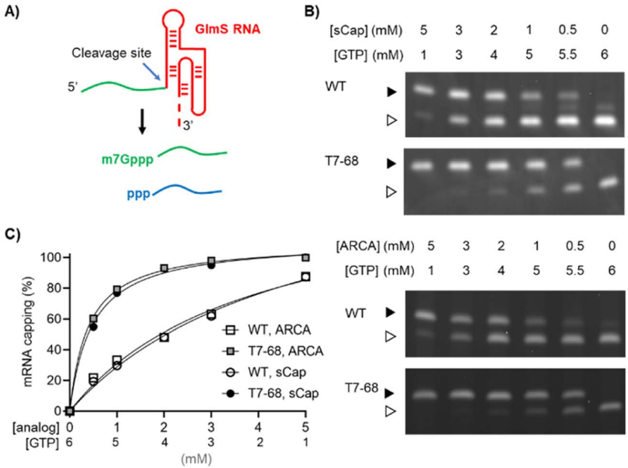
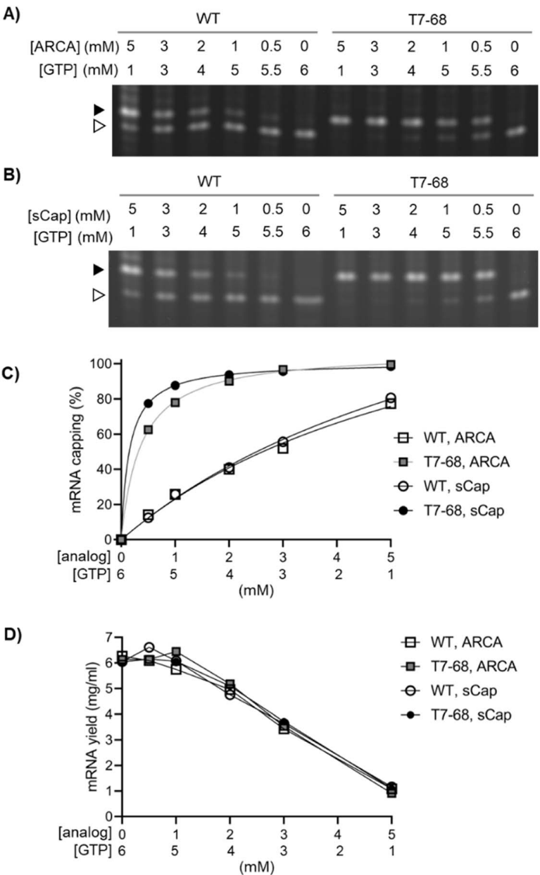
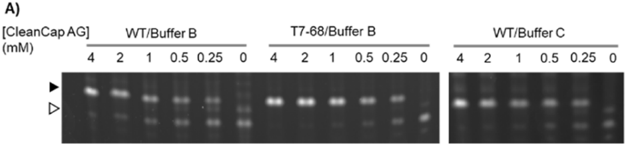
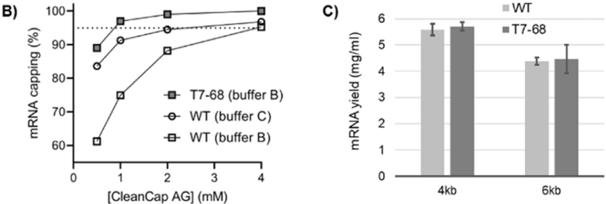
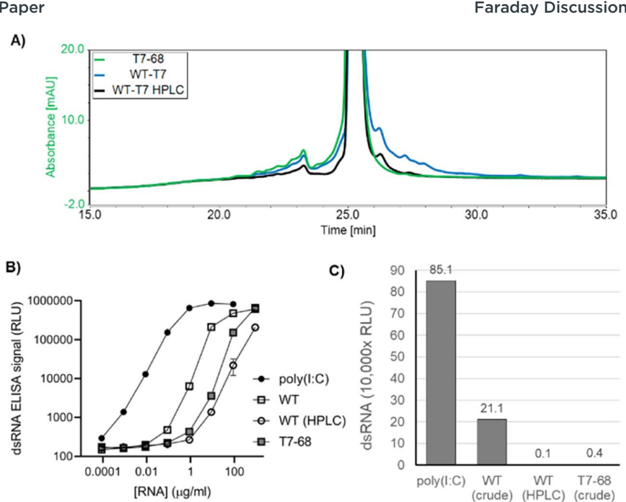
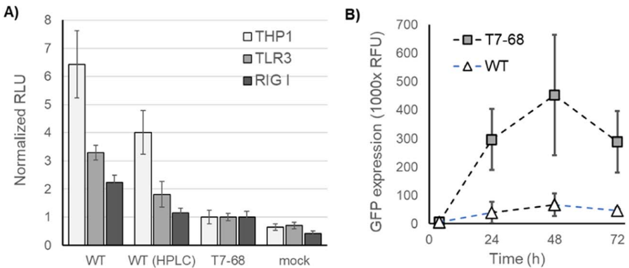
Messenger RNA (mRNA) therapies have recently gained tremendous traction with the approval of mRNA vaccines for the prevention of SARS-CoV-2 infection. However, manufacturing challenges have complicated large scale mRNA production, which is necessary for the clinical viability of these therapies. Not only can the incorporation of the required 5’ 7-methylguanosine cap analog be inefficient and costly, in vitro transcription (IVT) using wild-type T7 RNA polymerase generates undesirable double-stranded RNA (dsRNA) byproducts that elicit adverse host immune responses and are difficult to remove at large scale. To overcome these challenges, we have engineered a novel RNA polymerase, T7-68, that co-transcriptionally incorporates both di- and tri-nucleotide cap analogs with high efficiency, even at reduced cap analog concentrations. We also demonstrate that IVT products generated with T7-68 have reduced dsRNA content.
Overview
The claims and statistics of this paper haven’t been checked yet.
Free: it reads the open-access text and checks the first 5 claims that cite a source we can check. Create a free account to check every claim.
Integrity signals
Registry
Cites
Statistics
Figures
Verification
Claims the paper makes
The claims and statistics of this paper haven’t been checked yet.
Free: it reads the open-access text and checks the first 5 claims that cite a source we can check. Create a free account to check every claim.
Claims other papers make about this one
Each is checked against this paper’s own text: does it say what the citing paper says it does?
In the citing paper
“Previous studies demonstrated that the synthesis of sense–antisense RNA molecules can be base-paired with runoff transcripts contributing to the formation of dsRNA byproducts during the IVT reaction.19,32,41”
From Exploring the Impact of In Vitro-Transcribed mRNA Impurities on Cellular Responses (2024) · cites this paper as [19]
In the citing paper
“To that end, different studies have shown that using engineered T7 RNAPs with mutation-enhancing termination efficiency can reduce the synthesis of dsRNA byproducts during IVT, offering the possibility of considerably streamlining mRNA manufacturing processes.18,19”
From Exploring the Impact of In Vitro-Transcribed mRNA Impurities on Cellular Responses (2024) · cites this paper as [19]
Self-check
Percentages, sums and reported differences re-computed from the paper’s own numbers.
The self-check needs the paper’s full text.
Citations
Cites
No references could be resolved yet.
Research works printed but not linked: 50
- J. Wei and A.-M. Hui, Cancer Treat. Rev., 2022, 107, 102405. · DOI · Paper page
- P. Tang, et al., Nat. Med., 2021, 27, 2136. · DOI · Paper page
- A. Ramanathan, G. B. Robb and S.-H. Chan, Nucleic Acids Res., 2016, 44, 7511. · DOI · Paper page
- N. A. C. Jackson, K. E. Kester, D. Casimiro, S. Gurunathan and F. DeRosa, npj Vaccines, 2020, 5, 11.
- 2020, The promise of mRNA vaccines: a biotech and industrial, npj Vaccines, 5, 11, 10.1038/s41541-020-0159-8 · DOI · Paper page
- S. Vaidyanathan, K. T. Azizian, A. A. Haque, J. M. Henderson, A. Hendel, S. Shore, J. S. Antony, R. I. Hogrefe, M. S. Kormann, M. H. Porteus and A. P. McCaffrey, Mol. Ther., 2018, 12, 530. · DOI · Paper page
- A.-L. Fuchs, A. Neu and R. Sprangers, RNA, 2016, 22, 1454. · DOI · Paper page
- J. Tate, R. Boldt, B. McFadden, S. D'Costa, N. Lewandowski, A. Shatzer, P. Gollnick and R. Condit, Virology, 2016, 487, 27. · doi:10.1016/j.virol.2015.10.011
- C. Cazenave and O. C. Uhlenbeck, Proc. Natl. Acad. Sci. U. S. A., 1994, 91, 6972- 6976. · DOI · Paper page
- B. R. Anderson, H. Muramatsu, S. R. Nallagatla, P. C. Bevilacqua, L. H. Sansing, D. Weissman and K. Karikó, Nucleic Acids Res., 2010, 38, 5884. · DOI · Paper page
- U. Sahin, K. Karikó and Ö. Türeci, Nat. Rev. Drug Discovery, 2014, 13, 759. · DOI · Paper page
- I. Vlatkovic, Biomedicines, 2021, 9, 530. · DOI · Paper page
- K. Karikó, H. Muramatsu, J. Ludwig and D. Weissman, Nucleic Acids Res., 2011, 39, e142. · DOI · Paper page
- N. Pardi, M. Hogan and D. Weissman, Curr. Opin. Immunol., 2020, 65, 14. · DOI · Paper page
- M. Baiersdörfer, G. Boros, H. Muramatsu, A. J. Mahiny, I. Vlatkovic, U. Sahin and K. Karikó, Mol. Ther.-Nucleic Acids, 2019, 15, 26. · DOI · Paper page
- M. Z. Wu, H. Asahara, G. Tzertzinis and B. Roy, RNA, 2020, 26, 345. · DOI · Paper page
- J. Stepinski, C. Waddell, R. Stolarski, E. Darzynkiewicz and R. E. Rhoads, RNA, 2001, 7, 1486. · doi:10.1017/s1355838201014078
- E. Grudzien, J. Stepinski, M. Jankowska-Anyszka, R. Stolarski, E. Darzynkiewwicz and R. E. Rhoads, RNA, 2004, 10, 1479. · DOI · Paper page
- J. M. Henderson, A. Ujita, E. Hill, S. Yousif-Rosales, C. Smith, N. Ko, T. McReynolds, C. R. Cabral, J. R. Escamilla-Powers and M. E. Houston, Curr. Protoc., 2021, 1, e39. · DOI · Paper page
- J. Rehwinkel and M. U. Gack, Nat. Rev. Immunol., 2020, 20, 537.
- K. D. Nance and J. L. Meier, ACS Cent. Sci., 2021, 7, 748.
- 2020, RIG-I-like receptors: their regulation and roles in RNA sensing, Nature Reviews Immunology, 20, 537, 10.1038/s41577-020-0288-3 · DOI · Paper page
- 2021, Modifications in an Emergency: The Role of N1-Methylpseudouridine in COVID-19 Vaccines, ACS central science, 7, 748, 10.1021/acscentsci.1c00197 · DOI · Paper page
- J. Huang, L. Brieba and R. Sousa, Biochemistry, 2000, 39, 11571. · DOI
- X. Mu, E. Greenwald, S. Ahmad and S. Hur, Nucleic Acids Res., 2018, 46, 5239. · DOI · Paper page
- F. J. Triana-Alonso, M. Dabrowski, J. Wadzack and K. H. Nierhaus, J. Biol. Chem., 1995, 270, 6298. · DOI · Paper page
- Y. Gholamalipour, A. K. Mudiyanselage and C. T. Martin, Nucleic Acids Res., 2018, 46, 9253. · DOI · Paper page
- S. Hur, Annu. Rev. Immunol., 2019, 37, 349. · DOI · Paper page
- J. Schönborn, O. Oberstraß, E. Breyel, J. Tittgen, J. Schumacher and N. Lukacs, Nucleic Acids Res., 1991, 19, 2993. · DOI · Paper page
- X. Ren, M. M. Linehan, A. Iwasaki and A. M. Pyle, Cell Rep., 2019, 29, 3807.
- 2019, RIG-I Recognition of RNA Targets: The Influence of Terminal Base Pair Sequence and Overhangs on Affinity and Signaling, Cell Reports, 29, 3807, 10.1016/j.celrep.2019.11.052 · DOI
- L. Liu, I. Botos, Y. Wang, J. N. Leonard, J. Shiloach, D. M. Segal and D. R. Davies, Science, 2008, 320, 379. · DOI · Paper page
- S. Chattopadhyay and G. C. Sen, J. Interferon Cytokine Res., 2014, 34, 427.
- 2014, sRNA-activation of TLR3 and RLR signaling: gene induction-dependent and independent effects, Journal of interferon & cytokine research, 34, 427, 10.1089/jir.2014.0034 · DOI
- B. R. Anderson, H. Muramatsu, S. R. Nallagatla, P. C. Bevilacqua, L. H. Sansing, D. Weissman and K. Karikó, Nucleic Acids Res., 2010, 38, 5884. · DOI · Paper page
- S. C. Kim, S. S. Sekhon, W.-R. Shin, G. Ahn, B.-K. Cho, J.-Y. Ahn and Y.-H. Kim, Mol. Cell. Toxicol., 2022, 18, 1. · DOI · Paper page
- M. Warminski, J. Kowalska, E. Nowak, D. Kubacka, R. Tibble, R. Kasprzyk, P. J. Sikorski, J. D. Gross, M. Nowotny and J. Jemielity, ACS Chem. Biol., 2021, 16, 334. · DOI
- I. Kocmik, K. Piecyk, M. Rudzinska, A. Niedzwiecka, E. Darzynkiewicz, R. Grzela and M. Jankowska-Anyszka, Cell Cycle, 2018, 17, 1624. · DOI · Paper page
- J. A. Kern and R. H. Davis, Biotechnol. Prog., 1999, 15, 174. · doi:10.1021/bp990008g
- S. Pascolo, Viruses, 2021, 13, 270. · DOI · Paper page
- A. Dousis, K. Ravichandran, E. M. Hobert, M. J. Moore and A. Rabideau, Nat. Biotechnol., 2023, 41, 560.
- D. Weismann, N. Pardi, H. Muramatsu and K. Kariko, Synthetic Messenger RNA and Cell Metabolism Modulation, Humana Press, Totowa, N.J., 2013, pp. 43-54. · DOI · Paper page
- I. Jelinek, J. N. Leonard, G. E. Price, K. N. Brown, A. Meyer-Manlapat, P. K. Goldsmith, Y. Wang, D. Venzon, S. L. Epstein and D. M. Segal, J. Immunol., 2011, 186, 2422. · DOI · Paper page
- A. Dallas, A. V. Vlassov and S. A. Kazakov, in Articial Nucleases, ed. M. A. Zenkova, Nucleic Acids and Molecular Biology, Springer-Verlag, Berlin, 2004, pp. 61-71. · DOI
- S. Tinar, BMJ, 2021, 372, n627. · DOI
- D. T. Macleod, J. Antony, A. J. Martin, R. J. Moser, A. W. K. J. Hekele, A. E. Brown, M. A. Triggiano, J. A. Hux, C. D. Pham, V. V. Bartsevich, C. A. Turner, J. Lape, S. Kirkland, C. W. Beard, J. Smith, M. L. Hirsch, M. G. Nicholson, D. Jantz and B. McCreedy, Mol. Ther., 2017, 25, 949. · DOI · Paper page
- 10.1093/nar/gkr586 · DOI · Paper page
- 10.1038/mt.2008.200 · DOI · Paper page
- “How biomanufacturing can save the world,”, 2021, Nature Biotechnology, 39, 1315, 10.1038/s41587-021-01132-x · doi:10.1038/s41587-021-01132-x
- 10.1126/sciadv.aaz6893 · DOI · Paper page
Cited by
Exploring the Impact of In Vitro-Transcribed mRNA Impurities on Cellular Responses
Camperi, J., Roper, B., Freund, E., Leylek, R., Nissenbaum, A., Galan, C., Caothien, R., Hu, Z., Ko, P., Lee, A., et al. (2024) · Analytical Chemistry · doi:10.1021/acs.analchem.4c04162 · Cited by 22
Metadata
- Authors
- Miller, M., Alvizo, O., Chng, C., Jenne, S., Mayo, M., Mukherjee, A., Sundseth, S., Chintala, A., Penfield, J., Riggins, J., Zhang, X., Sero, A., Dassie, J., Leatherbury, N., Baskerville, S., & Huisman, G.
- Publisher
- openRxiv
- Published
- 2022-09-02
- Cited by
- 11
- References
- 0
- Type
- Preprint
About these checks
Registry, retraction, Cites and statistics results are computed, not judged, with one exception: a printed reference that no index lists is read once by a model before it counts as a citation error. Claims are extracted by a model and kept only when their quote appears verbatim in the text; each cited source is then checked, with a model’s help, for whether it says what the claim relies on. Those verdicts can be wrong — read the claim’s quote and the cited source before relying on one.
Statistics and arithmetic are recomputed, not judged.
Confidence bands are shown only for fields calibrated on our annotated test set. None is calibrated yet, so no band is shown.
What counts as a claim ›How we measure confidence ›How we check this ›
Are you an author, or do you see a problem with this page? Request a review
Data sources
Bibliographic data: Semantic Scholar, OpenAlex, Crossref.
Contains information from the Semantic Scholar Academic Graph Datasets, made available under the ODC Attribution License (ODC-BY 1.0).
Semantic Scholar’s data is described in: Kinney, R., et al. (2023). The Semantic Scholar Open Data Platform. arXiv:2301.10140.
