

Development and Validation of a Machine Learning Wrist-worn Step Detection Algorithm with Deployment in the UK Biobank
Open accessThe DOI matches its Crossref record; 34 of the 35 references it cites were found in a registry or an index, and 1 are not checked yet; 5 of the 20 sources its claims cite were checked for support.
Abstract
Background: Step count is an intuitive measure of physical activity frequently quantified in a range of health-related studies; however, accurate quantification of step count can be difficult in the free-living environment, with step counting error routinely above 20% in both consumer and research-grade wrist-worn devices. This study aims to describe the development and validation of step count derived from a wrist-worn accelerometer and to assess its association with cardiovascular and all-cause mortality in a large prospective cohort study. Methods: We developed and externally validated a hybrid step detection model that involves self-supervised machine learning, trained on a new ground truth annotated, free-living step count dataset (OxWalk, n=39, aged 19-81) and tested against other open-source step counting algorithms. This model was applied to ascertain daily step counts from raw wrist-worn accelerometer data of 75,493 UK Biobank participants without a prior history of cardiovascular disease (CVD) or cancer. Cox regression was used to obtain hazard ratios and 95% confidence intervals for the association of daily step count with fatal CVD and all-cause mortality after adjustment for potential confounders. Findings: The novel step algorithm demonstrated a mean absolute percent error of 12.5% in free-living validation, detecting 98.7% of true steps and substantially outperforming other recent wrist-worn, open-source algorithms. Our data are indicative of an inverse dose-response association, where, for example, taking 6,596 to 8,474 steps per day was associated with a 39% [24-52%] and 27% [16-36%] lower risk of fatal CVD and all-cause mortality, respectively, compared to those taking fewer steps each day. Interpretation: An accurate measure of step count was ascertained using a machine learning pipeline that demonstrates state-of-the-art accuracy in internal and external validation. The expected associations with CVD and all-cause mortality indicate excellent face validity. This algorithm can be used widely for other studies that have utilised wrist-worn accelerometers and an open-source pipeline is provided to facilitate implementation. Funding Acknowledgements: This research has been conducted using the UK Biobank Resource under Application Number 59070. This research was funded in whole or in part by the Wellcome Trust [223100/Z/21/Z]. For the purpose of open access, the author has applied a CC-BY public copyright licence to any author accepted manuscript version arising from this submission. AD and SS are supported by the Wellcome Trust. AD and DM are supported by Swiss Re, while AS is an employee of Swiss Re. AD, SC, RW, SS, and SK are supported by HDR UK, an initiative funded by UK Research and Innovation, Department of Health and Social Care (England) and the devolved administrations. AD, DB, GM, and SC are supported by NovoNordisk. AD is supported by the BHF Centre of Research Excellence (grant number RE/18/3/34214). SS is supported by the University of Oxford Clarendon Fund. DB is further supported by the Medical Research Council (MRC) Population Health Research Unit. DC holds a personal academic fellowship from EPSRC. AA, AC and DC are supported by GlaxoSmithKline. SK is supported by Amgen and UCB BioPharma outside of the scope of this work. Computational aspects of this research were funded from the National Institute for Health Research (NIHR) Oxford Biomedical Research Centre (BRC) with additional support from Health Data Research (HDR) UK and the Wellcome Trust Core Award [grant number 203141/Z/16/Z]. The views expressed are those of the author(s) and not necessarily those of the NHS, the NIHR or the Department of Health.
Verified 2026-11-19 · 1 reference not checked yet
Overview
CoChat Summary
TL;DR
The authors developed and validated a hybrid self-supervised machine-learning and peak-detection wrist-worn step-count algorithm, reporting 12.5% MAPE in free-living OxWalk validation and better accuracy than open-source comparators. Applied to 75,493 UK Biobank participants, higher daily step counts were associated with lower fatal CVD and all-cause mortality.
Key findings
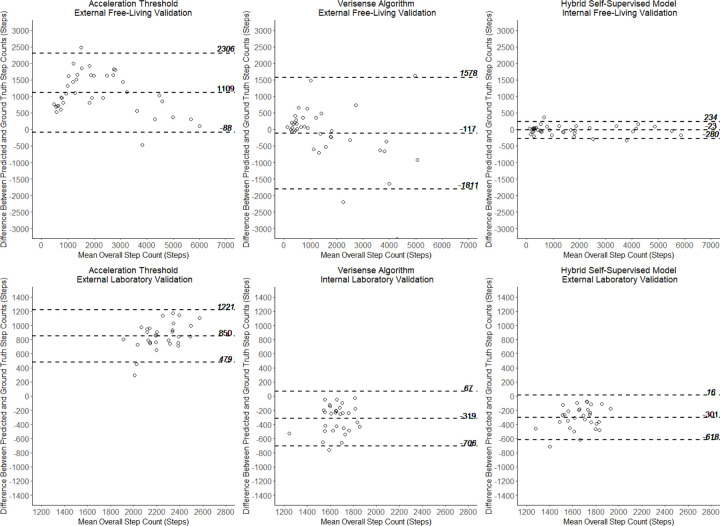
- In free-living OxWalk validation (n=39), the novel algorithm achieved 12.5% MAPE, 1.3% underestimation, and r=0.98 against ground truth, detecting 98.7% of true steps; comparators performed worse: Ducharme 231.3% MAPE with 69.1% overestimation, and Verisense 63.5% MAPE with 7.2% underestimation and r=0.85.
- In external Clemson validation (n=30), the novel algorithm had 16.5% MAPE and 16.6% underestimation overall, including 9.2% MAPE during regular walking; Verisense had 17.3% MAPE and 17.6% underestimation overall, while Ducharme had 47.5% MAPE and 46.9% overestimation.
- In UK Biobank, among 75,493 participants without prevalent CVD or cancer, median follow-up was 6.9 years with 572 CVD mortality events and 1,844 all-cause mortality events. Taking 6,596–8,474 steps/day was associated with 39% [24–52%] lower fatal CVD and 27% [16–36%] lower all-cause mortality versus fewer steps; results also report 8,474–10,284 steps/day associated with 56% [43–66%] lower CVD mortality versus <6,596 steps/day, and 39% [30–47%] and 43% [34–51%] lower all-cause mortality in the middle and most active fifths.
Methods
- OxWalk free-living ground truth: 39 adults aged 19–81 wore four triaxial accelerometers (wrist and hip) with video annotation; steps were doubly annotated. The model used a self-supervised ResNet-V2 pretrained on UK Biobank accelerometer data, trained on 10-second walk/non-walk epochs, smoothed with a Hidden Markov Model, and counted steps via peak detection on filtered acceleration; 10-fold cross-validation was used.
- External validation used the Clemson dataset (n=30, mean 37 minutes across regular, semiregular, and irregular walking sessions) and compared the novel algorithm with the Ducharme threshold and Verisense algorithms using MAPE, bias, Spearman correlation, and Bland-Altman plots.
- UK Biobank deployment processed raw wrist accelerometer data from 103,391 available participants, excluded insufficient wear or poor data, and analyzed 75,493 participants without prevalent CVD or cancer. Daily step count was the median across the 7-day measurement period; Cox proportional hazards regression with age as the timescale estimated associations with fatal CVD and all-cause mortality after confounder adjustment.
Limitations
- The paper states that training data consisted of short 1-hour free-living windows, so some overestimation may occur in multiday protocols due to lack of extended sedentary inactivity, although class rebalancing was used; future work should assess robustness across populations and against 24-hour free-living ground truth.
- Evident from the text: OxWalk validation was small (n=39) and short (mean wear 58 minutes), and Clemson external validation used scripted/laboratory activities (n=30, mean 37 minutes) rather than free-living conditions.
- Evident from the text: the UK Biobank cohort was aged 40–69 at recruitment, so mortality associations may not generalize to younger or older populations.
Model-written summary. Check it against the paper before relying on it.
Integrity signals
Registry
Cites
Statistics
Figures


Verification
Claims the paper makes
4 Valid · 0 Not valid · 10 Not checked · 39 Own results and interpretations
The cited sources support only part of this claim — read each source’s verdict below.
In the paper
“External validation of the novel model outperformed both reference algorithms, including the Verisense algorithm, which was trained and tuned using the Clemson laboratory dataset10,25.”
§ Development and Validation of a Machine Learning Wrist-worn Step Detection Algorithm with Deployment in the UK Biobank > Discussion
What the sources say
- Partly supportedcites [10] 2022, Stepping towards More Intuitive Physical Activity Metrics with Wrist-Worn Accelerometry: Validity of an Open-Source Step-Count Algorithm, Sensors sourceExperimental — accuracy not yet measured
Our copy supports only the Clemson connection in a weaker form: the Introduction states the open-source Verisense step-count algorithm 'was validated using the Clemson dataset [20]', i.e. validated, not trained/tuned, and the Clemson dataset is credited to another work [20]. The tuning/optimization described in this paper was done on free-living data, not Clemson: Section 2.4 says a training subset of 16 participants from the SMART Work and Life dataset was used to optimize the parameter thresholds (1152 combinations tested), with those files excluded from the validation. Nor is this paper a case of a 'novel model' being externally validated against 'both reference algorithms': its aim (Abstract, Introduction, Conclusions) was the concurrent validity of two versions of the Verisense algorithm (Verisense 1 original vs Verisense 2 optimized) against the thigh-worn activPAL in three free-living datasets, where the optimized version reduced bias (913 to 742 steps/day total; 2207 to 1204 steps/day MVPA steps) but still over/underestimated relative to the comparator. So the part attributed here that is not supported is 'trained and tuned using the Clemson laboratory dataset'. (LLM, conf=0.75)
- Not checked yetcites [25] Patterson MR. Verisense-Toolbox/Verisense_step_algorithm at master. ShimmerEngineering/Verisense-Toolbox. https://github.com/ShimmerEngineering/Verisense-Toolbox/tree/master/Verisense_step_algorithm (accessed Oct 20, 2022).
plain- Asserted: passes — The authors put it forward as true.
- Checkable: passes — It can be checked against evidence.
- Load-bearing: passes — The paper’s conclusions depend on it.
- Based: passes — The paper gives a reason why it holds.
- Partly supported
A result the paper reports from its own data — it cites no other source for it, so there is none to check. The quote shows it is in the paper.
In the paper
“Similar results were observed in the analysis of all-cause mortality and median daily step count, with a 39% [30–47%] and 43% [34–51%] lower risk of all-cause mortality in the middle and most active 20%, respectively.”
§ Development and Validation of a Machine Learning Wrist-worn Step Detection Algorithm with Deployment in the UK Biobank > Results > Association of Step Counts with All-Cause and Cardiovascular Mortality
plainstates an association- Asserted: passes — The authors put it forward as true.
- Checkable: passes — It can be checked against evidence.
- Load-bearing: passes — The paper’s conclusions depend on it.
- Based: passes — The paper gives a reason why it holds.
- Rests on 4 assumptions not shown here.
A result the paper reports from its own data — it cites no other source for it, so there is none to check. The quote shows it is in the paper.
In the paper
“including 9.2% MAPE during regular walking.”
§ Development and Validation of a Machine Learning Wrist-worn Step Detection Algorithm with Deployment in the UK Biobank > Results > Step Count Validation in the Clemson Dataset
plain- Asserted: passes — The authors put it forward as true.
- Checkable: passes — It can be checked against evidence.
- Load-bearing: passes — The paper’s conclusions depend on it.
- Based: passes — The paper gives a reason why it holds.
A result the paper reports from its own data — it cites no other source for it, so there is none to check. The quote shows it is in the paper.
In the paper
“For CVD mortality, a curvilinear association was observed with a linear association observed between the first and third fifths of the step count distribution and then a flattening of the association for the top two fifths of the distribution.”
§ Development and Validation of a Machine Learning Wrist-worn Step Detection Algorithm with Deployment in the UK Biobank > Results > Association of Step Counts with All-Cause and Cardiovascular Mortality
plainstates an association- Asserted: passes — The authors put it forward as true.
- Checkable: passes — It can be checked against evidence.
- Load-bearing: passes — The paper’s conclusions depend on it.
- Based: passes — The paper gives a reason why it holds.
- Rests on 4 assumptions not shown here.
A result the paper reports from its own data — it cites no other source for it, so there is none to check. The quote shows it is in the paper.
In the paper
“Peak step cadence demonstrated expected variations by self-reported usual walking pace (Supplemental Figure 3)”
§ Development and Validation of a Machine Learning Wrist-worn Step Detection Algorithm with Deployment in the UK Biobank > Results > Step Counts in the UK Biobank Physical Activity Cohort
boostedstates an associationn = 75,493- Asserted: passes — The authors put it forward as true.
- Checkable: passes — It can be checked against evidence.
- Load-bearing: unclear — It is unclear whether the paper’s conclusions depend on it.
- Based: passes — The paper gives a reason why it holds.
23 more claims
Create a free account to see all 53 claims and to verify the 15 references still open.
- It may state two separate claims as one. 17
- Probably not a substantial claim. 10
Claims other papers make about this one
Each is checked against this paper’s own text: does it say what the citing paper says it does?
The cited source says what the claim attributes to it.
In the citing paper
“Indeed, the obtained pre-trained model has already been used with success in enhancing digital monitoring for a clinical population with motor impairment37 and epidemiological research38,39.”
From Self-supervised learning for human activity recognition using 700,000 person-days of wearable data (2024) · cites this paper as [38]
Self-check
Percentages, sums and reported differences re-computed from the paper’s own numbers.
Each contradiction between two passages listed here was confirmed by an independent check.
Rated minor: it would not touch a result — a value no result rests on, a p-value that stays on the same side of the significance level, or a conflict that is clerical, resolved elsewhere in the paper, or outside its own findings.
In the paper
§ Development and Validation of a Machine Learning Wrist-worn Step Detection Algorithm with Deployment in the UK Biobank > Results > Step Count Validation in the Clemson Dataset
“producing a 16.5% MAPE and 16.6% underestimation across all gait subtypes”
§ Development and Validation of a Machine Learning Wrist-worn Step Detection Algorithm with Deployment in the UK Biobank > Methods > External Model Validation
“Prediction error was quantified by calculating MAPE and mean percent under/overcounting bias for each gait subtype and overall, at the participant level, across all gait subtypes.”
Citations
Cites
Adam: A Method for Stochastic Optimization
Kingma, D. P., & Ba, J. (2014) · arXiv · doi:10.48550/arxiv.1412.6980 · Cited by 98,946
SciPy 1.0: fundamental algorithms for scientific computing in Python
Virtanen, P., Gommers, R., Oliphant, T. E., Haberland, M., Reddy, T., Cournapeau, D., Burovski, E., Peterson, P., Weckesser, W., Bright, J., et al. (2020) · Nature Methods · doi:10.1038/s41592-019-0686-2 · Cited by 38,430
Sudlow, C., Gallacher, J., Allen, N., Beral, V., Burton, P., Danesh, J., Downey, P., Elliott, P., Green, J., Landray, M., et al. (2015) · PLOS Medicine · doi:10.1371/journal.pmed.1001779 · Cited by 12,728
Identity mappings in deep residual networks
He, K., Zhang, X., Ren, S., & Sun, J. (2016) · Lecture Notes in Computer Science · doi:10.1007/978-3-319-46493-0_38 · Cited by 10,741
SciPy 1.0: fundamental algorithms for scientific computing in Python
Virtanen, P., Gommers, R., Oliphant, T. E., Haberland, M., Reddy, T., Cournapeau, D., Burovski, E., Peterson, P., Weckesser, W., Bright, J., et al. (2019) · Apollo - University of Cambridge Repository · doi:10.17863/cam.64134 · Cited by 10,460
Modeling Survival Data: Extending the Cox Model
Therneau, T. M., & Grambsch, P. M. (2000) · Statistics for Biology and Health · doi:10.1007/978-1-4757-3294-8 · Cited by 8,674
Pipkins, H. R., Bradshaw, J. L., Keller, L. E., Swiatlo, E., & McDaniel, L. S. (2017) · PLOS ONE · doi:10.1371/journal.pone.0179159 · Cited by 1,338
Doherty, A., Jackson, D., Hammerla, N., Plötz, T., Olivier, P., Granat, M. H., White, T., van Hees, V. T., Trenell, M. I., Owen, C. G., et al. (2017) · PLOS ONE · doi:10.1371/journal.pone.0169649 · Cited by 1,250
Self-citationAssociation of daily step count and step intensity with mortality among US adults
Saint-Maurice, P. F., Troiano, R. P., Bassett, D. R., Graubard, B. I., Carlson, S. A., Shiroma, E. J., Fulton, J. E., & Matthews, C. E. (2020) · JAMA · doi:10.1001/jama.2020.1382 · Cited by 660
Self-citationDaily steps and all-cause mortality: a meta-analysis of 15 international cohorts
Paluch, A. E., Bajpai, S., Bassett, D. R., Carnethon, M. R., Ekelund, U., Evenson, K. R., Galuska, D. A., Jefferis, B. J., Kraus, W. E., Lee, I.-M., et al. (2022) · The Lancet Public Health · doi:10.1016/s2468-2667(21)00302-9 · Cited by 582
Self-citation
Research works printed but not linked: 2
- 10.1001/JAMAINTERNMED.2022.4000 · DOI · Paper page
- 2016, Regression Models and Life-Tables, J R Stat Soc Ser B, 15, 1
Cited by
Self-supervised learning for human activity recognition using 700,000 person-days of wearable data
Yuan, H., Chan, S., Creagh, A. P., Tong, C., Acquah, A., Clifton, D. A., & Doherty, A. (2024) · npj Digital Medicine · doi:10.1038/s41746-024-01062-3 · Cited by 166
“The test performance for the AoT stayed at the random chance level, and the test performance for permutation dropped roughly 10 percentage points without weighted sampling.”
Self-citationDaily steps and health outcomes in adults: a systematic review and dose-response meta-analysis
Ding, D., Nguyen, B., Nau, T., Luo, M., Cruz, B. D. P., Dempsey, P. C., Munn, Z., Jefferis, B. J. M. H., Sherrington, C., Calleja, E. A., et al. (2025) · The Lancet Public Health · doi:10.1016/s2468-2667(25)00164-1 · Cited by 184
Chan, S., Hang, Y., Tong, C., Acquah, A., Schonfeldt, A., Gershuny, J., & Doherty, A. (2024) · Scientific Data · doi:10.1038/s41597-024-03960-3 · Cited by 61
Self-citationShreves, A. H., Small, S. R., Walmsley, R., Chan, S., Saint‐Maurice, P. F., Moore, S. C., Papier, K., Gaitskell, K. L., Travis, R. C., Matthews, C. E., et al. (2025) · British Journal of Sports Medicine · doi:10.1136/bjsports-2024-109360 · Cited by 59
Self-citationBrand, Y. E., Kluge, F., Palmerini, L., Paraschiv-Ionescu, A., Becker, C., Cereatti, A., Maetzler, W., Sharrack, B., Vereijken, B., Yarnall, A. J., et al. (2024) · Scientific Reports · doi:10.1038/s41598-024-71491-3 · Cited by 19
“The model predictions made by ElderNet significantly outperformed the two other state-of-the-art algorithms 24,39 both in terms of accuracy and F1 score.”
Influential
Metadata
- Authors
- Small, S. R., Chan, S., Walmsley, R., Fritsch, L. V., Acquah, A., Mertes, G., Feakins, B. G., Creagh, A., Strange, A., Matthews, C. E., Clifton, D. A., Price, A. J., Khalid, S., Bennett, D., & Doherty, A.
- Affiliations
- University of Oxford (GB)
- Division of Cancer Epidemiology and Genetics (US)
- Corresponding author
- Doherty, Aiden
- ORCID
- Venue
- medRxiv
- Publisher
- openRxiv
- Published
- 2023-02-22
- PMC
- PMC10187326
- OpenAlex
- W4321480397
- Cited by
- 22
- References
- 34
- Citations by year
- 2026: 3 · 2025: 7 · 2024: 7 · 2023: 5
- Type
- posted content
- Language
- en
- Open access
- green
- doi.org
- Licence
- cc-by
- Locations
- medRxiv (acceptedVersion, cc-by)
- PubMed (publishedVersion)
- PubMed Central (submittedVersion, cc-by)
- Funders
- Wellcome Trust (203141/Z/16/Z, 223100/Z/21/Z)
- UK Research and Innovation
- British Heart Foundation (RE/18/3/34214)
- Department of Health and Social Care
- University of Oxford
- Swiss Re
- Clarendon Fund
- Topics
- Health Sciences › Medicine › Public Health, Environmental and Occupational Health › Physical Activity and Health
- Physical Sciences › Computer Science › Computer Vision and Pattern Recognition › Context-Aware Activity Recognition Systems
- Physical Sciences › Engineering › Biomedical Engineering › Non-Invasive Vital Sign Monitoring
- Keywords
- wrist-worn accelerometers, self-supervised learning, physical activity measurement, cardiovascular mortality, all-cause mortality, dose-response relationship, UK Biobank, wearable device validation, open-source software pipeline, machine learning deployment
About these checks
Registry, retraction, Cites and statistics results are computed, not judged, with one exception: a printed reference that no index lists is read once by a model before it counts as a citation error. Claims are extracted by a model and kept only when their quote appears verbatim in the text; each cited source is then checked, with a model’s help, for whether it says what the claim relies on. Those verdicts can be wrong — read the claim’s quote and the cited source before relying on one.
The claim verdicts this report counts are experimental: their accuracy is not yet measured.
A language model drew the claims from the paper on 2026-10-05, under version 3 of the claim definition (model deepseek-v4.1-flash, prompt extract-v3).
A second model labelled each claim on 2026-10-05 (model jev-1.13-20260917, definition revision gold-guideline-v0.2).
Cited sources are checked with a language model’s help (qwen3.8-omni-flash).
Statistics and arithmetic are recomputed, not judged.
Confidence bands are shown only for fields calibrated on our annotated test set. None is calibrated yet, so no band is shown.
What counts as a claim ›How we measure confidence ›How we check this ›
Are you an author, or do you see a problem with this page? Request a review
How to cite
Cite CoChat for the checks on this page, and the paper for its own findings.
- This page
- CoChat. (2026). Citation check: Development and Validation of a Machine Learning Wrist-worn Step Detection Algorithm with Deployment in the UK Biobank. https://app.cochat.ai/papers/10.1101/2023.02.20.23285750
- The paper
- Small, S. R., Chan, S., Walmsley, R., Fritsch, L. V., Acquah, A., Mertes, G., Feakins, B. G., Creagh, A., Strange, A., Matthews, C. E., Clifton, D. A., Price, A. J., Khalid, S., Bennett, D., & Doherty, A. (2023). Development and Validation of a Machine Learning Wrist-worn Step Detection Algorithm with Deployment in the UK Biobank. medRxiv. https://doi.org/10.1101/2023.02.20.23285750
Data sources
Bibliographic data: Semantic Scholar, OpenAlex, Crossref.
Contains information from the Semantic Scholar Academic Graph Datasets, made available under the ODC Attribution License (ODC-BY 1.0).
Semantic Scholar’s data is described in: Kinney, R., et al. (2023). The Semantic Scholar Open Data Platform. arXiv:2301.10140.
