

Interpreting Molecular Dynamics Forces as Deep Learning Gradients Improves Quality Of Predicted Protein Structures
Open accessPreprint — published as 10.1016/j.bpj.2023.12.011
The DOI matches its Crossref record; 1 of the 1 references it cites were found in a registry or an index.
Abstract
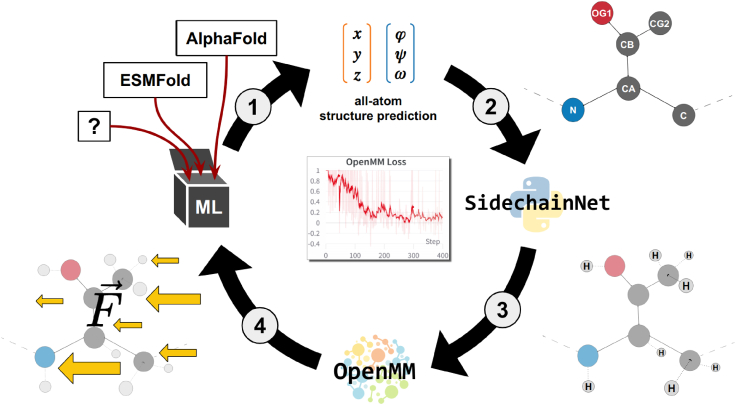
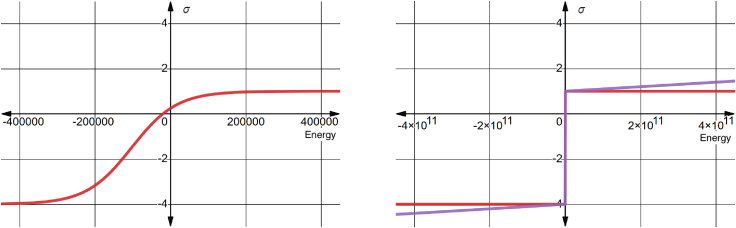
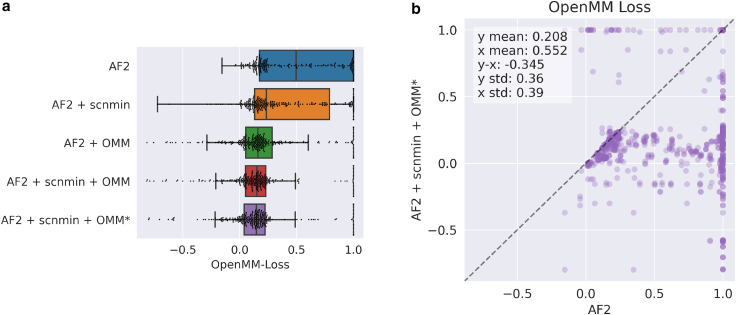
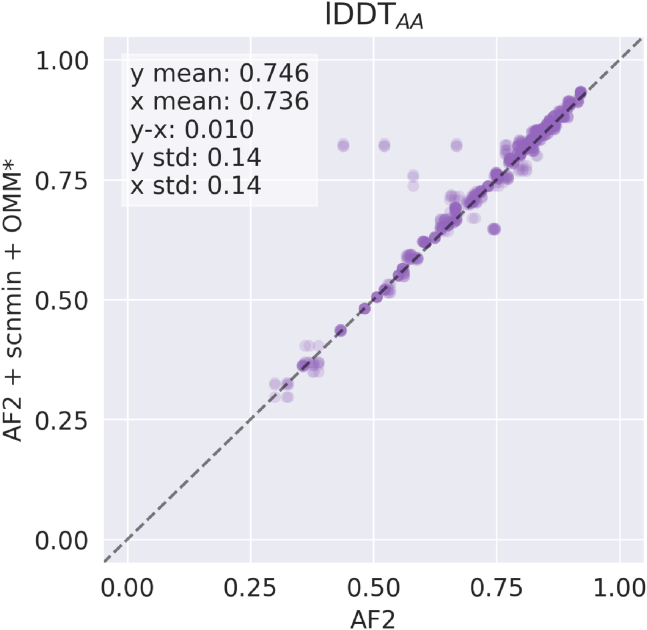
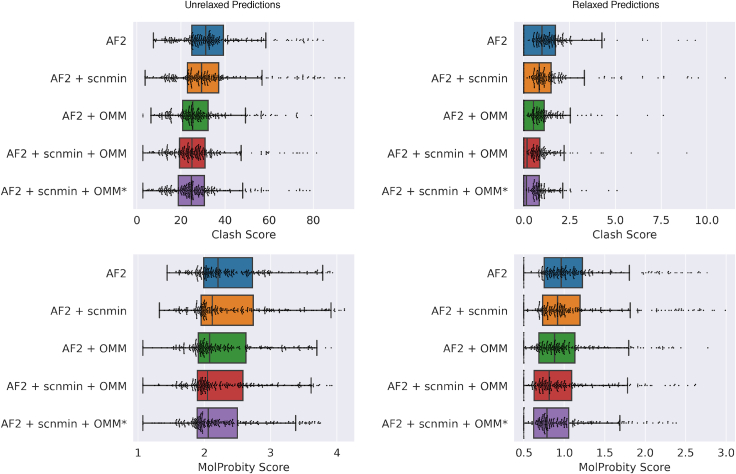
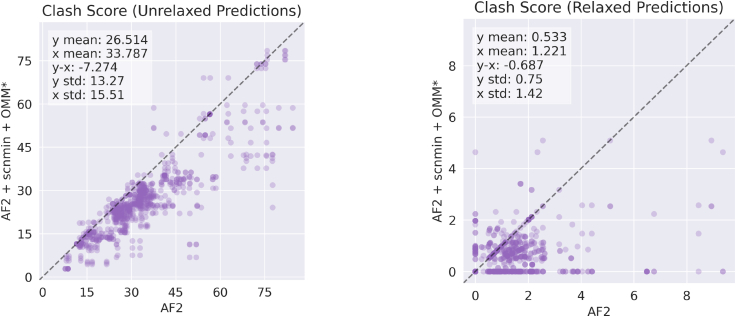
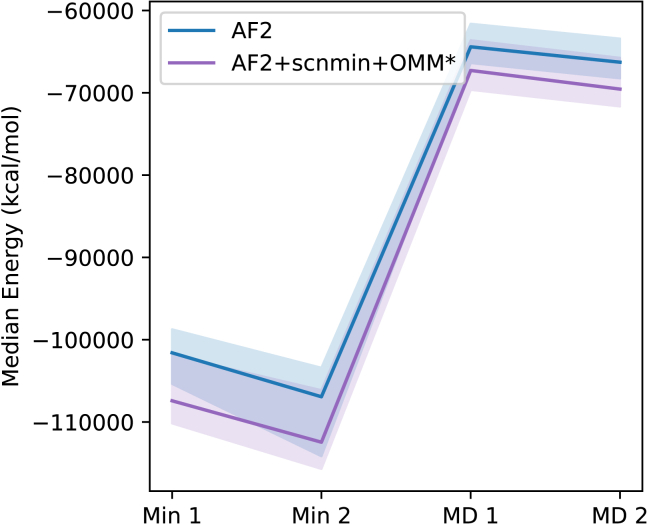
Protein structure predictions from deep learning models like AlphaFold2, despite their remarkable accuracy, are likely insufficient for direct use in downstream tasks like molecular docking. The functionality of such models could be improved with a combination of increased accuracy and physical intuition. We propose a new method to train deep learning protein structure prediction models using molecular dynamics force fields to work toward these goals. Our custom PyTorch loss function, OpenMM-Loss, represents the potential energy of a predicted structure. OpenMM-Loss can be applied to any all-atom representation of protein structure capable of mapping into our software package, SidechainNet. We demonstrate our method’s efficacy by finetuning OpenFold. We show that subsequently predicted protein structures, both before and after a relaxation procedure, exhibit comparable accuracy while displaying lower potential energy and improved structural quality as assessed by MolProbity metrics. SIGNIFICANCE: We propose a novel framework to directly incorporate forces from molecular dynamics as gradients for training deep learning models like AlphaFold2. We implement our method as a PyTorch loss function, OpenMM-Loss, which frames the potential energy of predicted protein structures as a minimization objective. When applied to OpenFold, our method demonstrates improved structural quality, lower potential energy, and comparable accuracy relative to the OpenFold baseline. Our framework may enhance the ability of deep learning models to recapitulate fundamental biophysical principles, reducing the number of structural irregularities in their predictions and paving the way for more effective downstream applications.
Overview
The claims and statistics of this paper haven’t been checked yet.
Free: it reads the open-access text and checks the first 5 claims that cite a source we can check. Create a free account to check every claim.
Integrity signals
Registry
Cites
Statistics
Figures
Verification
Claims the paper makes
The claims and statistics of this paper haven’t been checked yet.
Free: it reads the open-access text and checks the first 5 claims that cite a source we can check. Create a free account to check every claim.
Self-check
Percentages, sums and reported differences re-computed from the paper’s own numbers.
The self-check needs the paper’s full text.
Citations
Cites
Highly accurate protein structure prediction with AlphaFold
Jumper, J., Evans, R., Pritzel, A., Green, T., Figurnov, M., Ronneberger, O., Tunyasuvunakool, K., Bates, R., Žídek, A., Potapenko, A., et al. (2021) · Nature · doi:10.1038/s41586-021-03819-2 · Cited by 43,764
Research works printed but not linked: 30
- 10.1101/2022.07.21.500999 · DOI · Paper page
- 10.1126/science.abj8754 · doi:10.1126/science.abj8754 · Paper page
- 10.1126/science.ade2574 · doi:10.1126/science.ade2574 · Paper page
- 10.1093/nar/28.1.235 · DOI · Paper page
- 10.7554/eLife.89386 · doi:10.7554/elife.89386
- 10.1016/j.isci.2022.105920 · DOI · Paper page
- 10.1038/s41401-022-00938-y · DOI
- 10.1021/ci00057a005 · DOI · Paper page
- 10.1007/s10822-016-9938-8 · DOI · Paper page
- 10.48550/arXiv.1509.09292 · DOI · Paper page
- 10.48550/arXiv.2107.04340 · arXiv · doi:10.48550/arxiv.2107.04340
- 10.1186/s13321-021-00522-2 · DOI · Paper page
- 10.1021/acs.jcim.1c01497 · DOI
- 10.1038/s41524-019-0153-8 · DOI · Paper page
- 10.1021/acs.jctc.2c00752 · DOI · Paper page
- 10.26434/chemrxiv-2022-8w1q0 · DOI
- 10.1101/2022.11.20.517210 · doi:10.1101/2022.11.20.517210
- 10.1002/prot.26169 · DOI
- 10.48550/arXiv.1912.01703 · DOI · Paper page
- 10.1371/journal.pcbi.1005659 · DOI · Paper page
- 10.1021/acs.jctc.6b00567 · DOI · Paper page
- 10.1002/jcc.20237 · DOI · Paper page
- 10.1073/pnas.1211764109 · DOI
- 10.1016/S0959-440X(02)00304-4 · DOI
- 10.1002/prot.25407 · DOI · Paper page
- 10.1038/nbt.3988 · DOI · Paper page
- 10.1002/prot.26213 · DOI · Paper page
- 10.1093/bioinformatics/btt473 · DOI · Paper page
- 10.1002/pro.3330 · DOI · Paper page
- 10.1038/s41592-019-0686-2 · DOI · Paper page
Metadata
- Authors
- King, J. E., & Koes, D. R.
- Affiliations
- University of Pittsburgh (US)
- Corresponding author
- Koes, David Ryan
- Venue
- Biophysical Journal
- Publisher
- openRxiv
- Published
- 2023-10-05
- Volume
- 123
- Issue
- 17
- Pages
- 2730-2739
- ISSN
- 0006-3495 (ISSN-L)
- PMC
- PMC11393680
- OpenAlex
- W4389778249
- Cited by
- 6
- References
- 1
- Citations by year
- 2026: 2 · 2025: 1 · 2024: 3
- FWCI
- 0.53
- Type
- journal article
- Language
- en
- Open access
- hybrid
- doi.org
- Licence
- cc-by
- Locations
- Biophysical Journal (publishedVersion, cc-by)
- bioRxiv (Cold Spring Harbor Laboratory) (acceptedVersion, cc-by)
- PubMed Central (publishedVersion, cc-by)
- PubMed (publishedVersion)
- Funders
- National Science Foundation (2117681)
- Howard Hughes Medical Institute (T32 EB009403)
- University of Pittsburgh (OAC-2117681, SCR 022735)
- National Institutes of Health (OAC-2117681)
- Center for Research Computing, University of Pittsburgh (SCR_022735, OAC-2117681)
- National Institute of General Medical Sciences (R01GM108340, R35GM140753)
- National Institute of Biomedical Imaging and Bioengineering (T32EB009403)
- Topics
- Life Sciences › Biochemistry, Genetics and Molecular Biology › Molecular Biology › Protein Structure and Dynamics
- Life Sciences › Biochemistry, Genetics and Molecular Biology › Molecular Biology › Machine Learning in Bioinformatics
- Life Sciences › Pharmacology, Toxicology and Pharmaceutics › Drug Discovery › Computational Drug Discovery Methods
- Keywords
- protein structure prediction, molecular dynamics force fields, potential energy, gradient-based learning, structural quality, MolProbity, molecular docking, AlphaFold2, structural relaxation
- MeSH terms
- Deep Learning, Protein Conformation, Proteins, Molecular Dynamics Simulation
About these checks
Registry, retraction, Cites and statistics results are computed, not judged, with one exception: a printed reference that no index lists is read once by a model before it counts as a citation error. Claims are extracted by a model and kept only when their quote appears verbatim in the text; each cited source is then checked, with a model’s help, for whether it says what the claim relies on. Those verdicts can be wrong — read the claim’s quote and the cited source before relying on one.
Statistics and arithmetic are recomputed, not judged.
Confidence bands are shown only for fields calibrated on our annotated test set. None is calibrated yet, so no band is shown.
What counts as a claim ›How we measure confidence ›How we check this ›
Are you an author, or do you see a problem with this page? Request a review
Data sources
Bibliographic data: Semantic Scholar, OpenAlex, Crossref.
Contains information from the Semantic Scholar Academic Graph Datasets, made available under the ODC Attribution License (ODC-BY 1.0).
Semantic Scholar’s data is described in: Kinney, R., et al. (2023). The Semantic Scholar Open Data Platform. arXiv:2301.10140.
