

The DOI matches its Crossref record; 2 of the 2 references it cites were found in a registry or an index.
Noise robustness and metabolic load determine the principles of central dogma regulation
Open accessPreprint — published as 10.1126/sciadv.ado3095 · Paper page
Abstract
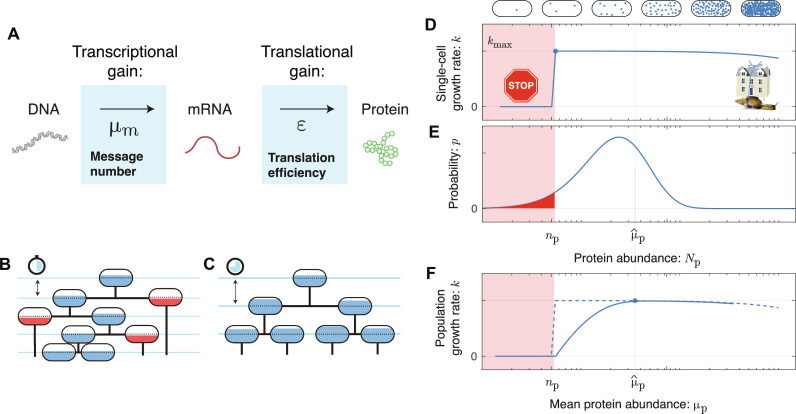
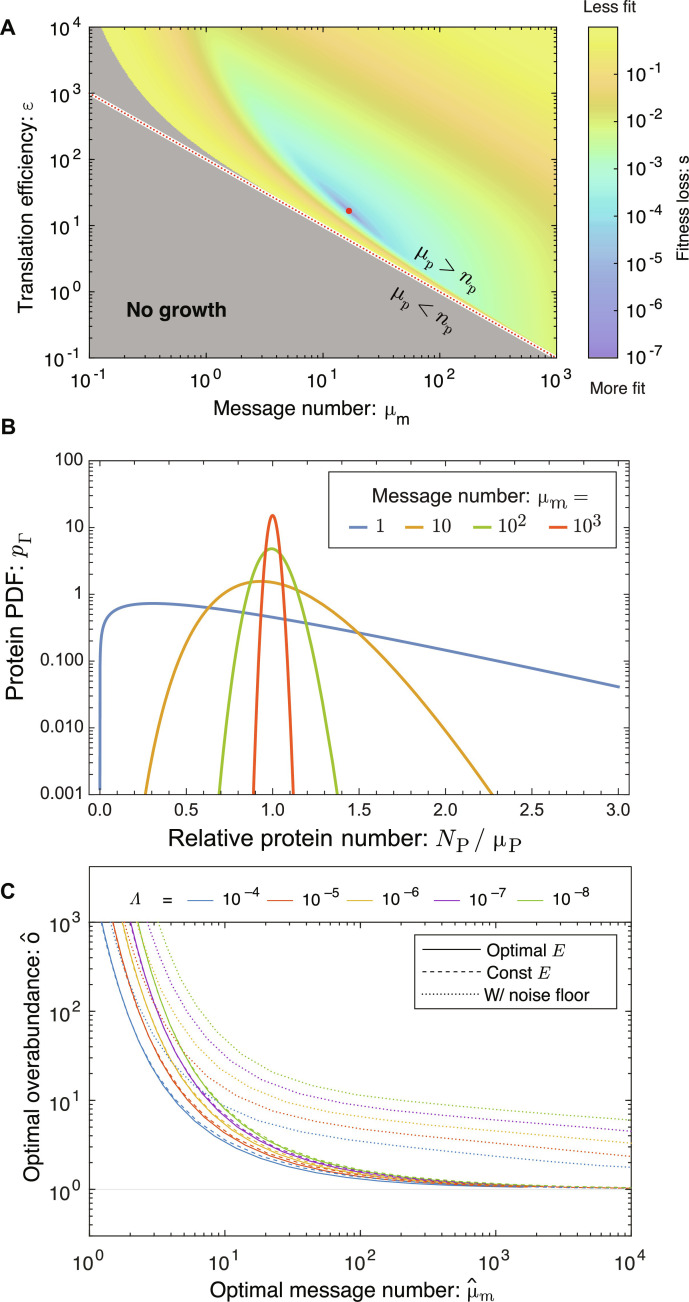
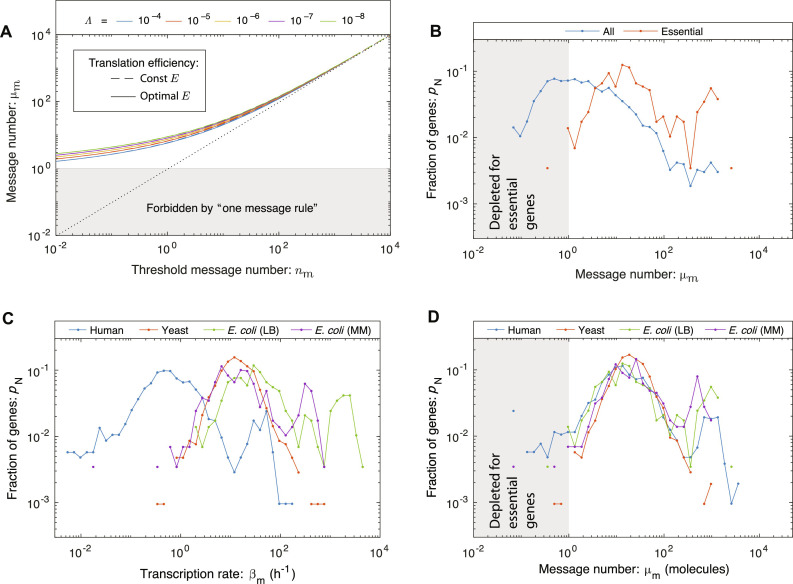
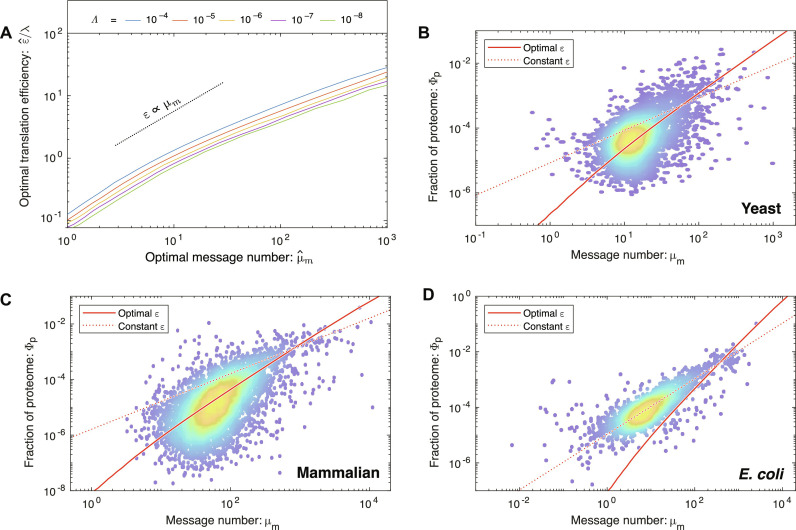
The processes of gene expression are inherently stochastic, even for essential genes required for growth. How does the cell maximize fitness in light of noise? To answer this question, we build a mathematical model to explore the trade-off between metabolic load and growth robustness. The model predicts novel principles of central dogma regulation: Optimal protein expression levels for many genes are in vast overabundance. Essential genes are transcribed above a lower limit of one message per cell cycle. Gene expression is achieved by load balancing between transcription and translation. We present evidence that each of these novel regulatory principles is observed. These results reveal that robustness and metabolic load determine the global regulatory principles that govern gene expression processes, and these principles have broad implications for cellular function. One-sentence summary: Fitness maximization predicts protein overabundance, a transcriptional floor, and the balancing of transcription and translation.
Overview
The claims and statistics of this paper haven’t been checked yet.
Run the check — free, no account needed. It reads the open-access text and checks the sources it cites.
Integrity signals
Registry
Cites
Statistics
Figures
Verification
Claims the paper makes
The claims and statistics of this paper haven’t been checked yet.
Run the check — free, no account needed. It reads the open-access text and checks the sources it cites.
Self-check
Percentages, sums and reported differences re-computed from the paper’s own numbers.
The self-check needs the paper’s full text.
Citations
Cites
Global quantification of mammalian gene expression control
Schwanhäusser, B., Busse, D., Li, N., Dittmar, G., Schuchhardt, J., Wolf, J., Chen, W., & Selbach, M. (2011) · Nature · doi:10.1038/nature10098 · Cited by 6,566 · cited 2×
“C 4).”
Milo, R. (2013) · BioEssays · doi:10.1002/bies.201300066 · Cited by 614
Research works printed but not linked: 67
- 10.1038/nature03842 · DOI · Paper page
- 10.1016/j.cell.2016.07.024 · DOI
- 10.1016/j.cell.2016.05.003 · DOI
- 10.1073/pnas.2001507117 · DOI
- J. W. Lengeler , G. Drews , H. G. Schlegel , eds., Biology of the Prokaryotes (Georg Thieme Verlag, Rüdigerstrasse 14, D-70469 Stuttgart, Germany, 1998). · DOI
- 2021, Cell Syst, 12, 924, 10.1016/j.cels.2021.06.002 · DOI
- 10.1126/science.1105891 · DOI
- 10.1038/nature04785 · DOI · Paper page
- 10.1126/science.1188308 · DOI · Paper page
- 10.1038/s41467-018-07391-8 · DOI · Paper page
- 10.1038/227561a0 · DOI · Paper page
- 10.1103/PhysRevLett.84.5447 · DOI
- 10.1103/PhysRevLett.97.168302 · DOI · Paper page
- 10.1126/science.1192588 · DOI · Paper page
- 10.1103/PhysRevLett.107.218101 · DOI
- 10.1128/mBio.02561-21 · DOI
- 2021, Cell Syst, 12, 56, 10.1016/j.cels.2020.10.011 · DOI
- 10.15252/msb.20209828 · DOI
- 10.1126/science.aac7041 · DOI · Paper page
- 10.1038/nature02046 · DOI · Paper page
- 10.1126/science.abk2066 · DOI
- 10.1371/journal.pbio.3001416 · DOI
- 10.1038/s41467-017-01242-8 · DOI
- 10.1371/journal.pgen.1004556 · DOI
- 1952, Biochim Biophys Acta, 9, 648, 10.1016/0006-3002(52)90227-8 · DOI
- 10.1016/J.CELL.2021.06.033 · DOI · Paper page
- 2022, Phys Rev E, 105, 014420
- 10.1096/fasebj.3.12.2676679 · DOI
- 10.1016/S0021-9258(18)65958-7 · DOI · Paper page
- 2017, Cell Syst, 5, 283, 10.1016/j.cels.2017.08.008 · DOI · Paper page
- 10.1016/0378-4371(92)90283-V · DOI
- 10.1021/j100540a008 · DOI
- 10.1073/pnas.112318199 · DOI
- 10.15252/msb.20159000 · DOI
- R. Phillips , J. Kondev , J. Theriot , N. Orme , Physical Biology of the Cell (Garland Science, 2013). · DOI
- M. Kafri , E. Metzl-Raz , F. Jonas , N. Barkai , FEMS Yeast Res 16 (2016). · DOI · Paper page
- 2023, Nat Commun, 14, 1762, 10.1038/s41467-023-37456-2 · DOI
- 2021, Reports on Progress in Physics, 84, 116601
- 10.1099/00221287-15-3-492 · DOI
- 2016, Cell Rep, 14, 22, 10.1016/j.celrep.2015.12.015 · DOI
- 10.1534/g3.120.401303 · DOI
- G. Arfken , Mathematical Methods for Physicists (Academic Press, Inc., San Diego, 1985), third edn.
- 10.1007/BF00337788 · DOI
- 10.1371/journal.pone.0015442 · DOI
- 10.1128/MCB.19.11.7357 · DOI · Paper page
- G. M. Cooper , The Cell: A Molecular Approach. 2nd edition (Sinauer Associates 2000, 2000).
- 10.1101/gr.1272403 · DOI
- 10.1093/nar/gkp889 · DOI · Paper page
- 10.1007/978-1-59745-321-9_12 · DOI
- 2019, Sci Rep, 9, 11005, 10.1038/s41598-019-47424-w · DOI
- 10.1016/0092-8674(77)90032-0 · DOI
- 10.1186/1752-0509-2-87 · DOI
- 10.1038/nsmb.1514 · DOI · Paper page
- 10.1186/1471-2164-9-574 · DOI · Paper page
- 10.1038/nature07341 · DOI · Paper page
- 10.1126/science.1260419 · DOI · Paper page
- 10.1038/70487 · DOI
- 10.1128/JB.185.19.5673-5684.2003 · DOI
- E. C. A. Goodall , et al., mBio 9 (2018). · DOI
- 10.1186/1471-2180-4-4 · DOI
- 10.1038/ng1807 · DOI · Paper page
- 10.1126/science.1070919 · DOI · Paper page
- 10.1073/pnas.162041399 · DOI · Paper page
- 1945, Bulletin of Calcutta Mathematical Society, 37, 81
- H. Cramer , Mathematical methods of statistics. (Princeton University Press., 1946).
- 2017, Cell Syst, 4, 495, 10.1016/j.cels.2017.03.003 · DOI · Paper page
- 2014, Scandinavian Journal of Statistics, 41, 1051, 10.1111/sjos.12083 · DOI
Metadata
- Authors
- Lo, T. W., Choi, H. J., Huang, D., & Wiggins, P. A.
- Affiliations
- University of Washington (US)
- Corresponding author
- Wiggins, Paul A.
- Venue
- Science Advances
- Publisher
- openRxiv
- Published
- 2023-10-23
- Volume
- 10
- Issue
- 34
- Pages
- eado3095-eado3095
- ISSN
- 2375-2548 (ISSN-L)
- PMC
- PMC11343026
- OpenAlex
- W4401806214
- Cited by
- 13
- References
- 2
- Citations by year
- 2026: 6 · 2025: 4 · 2024: 3
- FWCI
- 1.77
- Type
- journal article
- Language
- en
- Open access
- gold
- doi.org
- Licence
- Locations
- Science Advances (publishedVersion, cc-by-nc)
- bioRxiv (Cold Spring Harbor Laboratory) (acceptedVersion, cc-by-nc-nd)
- PubMed Central (publishedVersion, cc-by-nc)
- PubMed (publishedVersion)
- arXiv (Cornell University) (submittedVersion, cc-by)
- PubMed Central (submittedVersion, cc-by)
- PubMed Central (submittedVersion, cc-by-nc-nd)
- arXiv (Cornell University) (cc-by)
- Funders
- National Institutes of Health (5r01gm128191-03, R01-GM128191)
- National Institute of General Medical Sciences (R01-GM128191)
- Topics
- Life Sciences › Biochemistry, Genetics and Molecular Biology › Molecular Biology › Gene Regulatory Network Analysis
- Life Sciences › Biochemistry, Genetics and Molecular Biology › Molecular Biology › RNA and protein synthesis mechanisms
- Life Sciences › Biochemistry, Genetics and Molecular Biology › Genetics › Bacterial Genetics and Biotechnology
- Keywords
- stochastic gene expression, metabolic burden, essential genes, protein abundance, mathematical model of gene regulation, fitness maximization
About these checks
Registry, retraction, Cites and statistics results are computed, not judged, with one exception: a printed reference that no index lists is read once by a model before it counts as a citation error. Claims are extracted by a model and kept only when their quote appears verbatim in the text; each cited source is then checked, with a model’s help, for whether it says what the claim relies on. Those verdicts can be wrong — read the claim’s quote and the cited source before relying on one.
Statistics and arithmetic are recomputed, not judged.
Confidence bands are shown only for fields calibrated on our annotated test set. None is calibrated yet, so no band is shown.
What counts as a claim ›How we measure confidence ›How we check this ›
Are you an author, or do you see a problem with this page? Request a review
How to cite
Cite CoChat for the checks on this page, and the paper for its own findings.
- This page
- CoChat. (2026). Citation check: Noise robustness and metabolic load determine the principles of central dogma regulation. https://app.cochat.ai/papers/10.1101/2023.10.20.563172
- The paper
- Lo, T. W., Choi, H. J., Huang, D., & Wiggins, P. A. (2023). Noise robustness and metabolic load determine the principles of central dogma regulation. Science Advances. https://doi.org/10.1101/2023.10.20.563172
