

Fibroblast growth factor receptor substrate 2 interactome mapping reveals novel candidate interactors associated with migration and invasion
Open accessPreprint — published as 10.1186/s12964-026-02943-8
The DOI matches its Crossref record; 63 of the 63 references it cites were found in a registry or an index.
Abstract
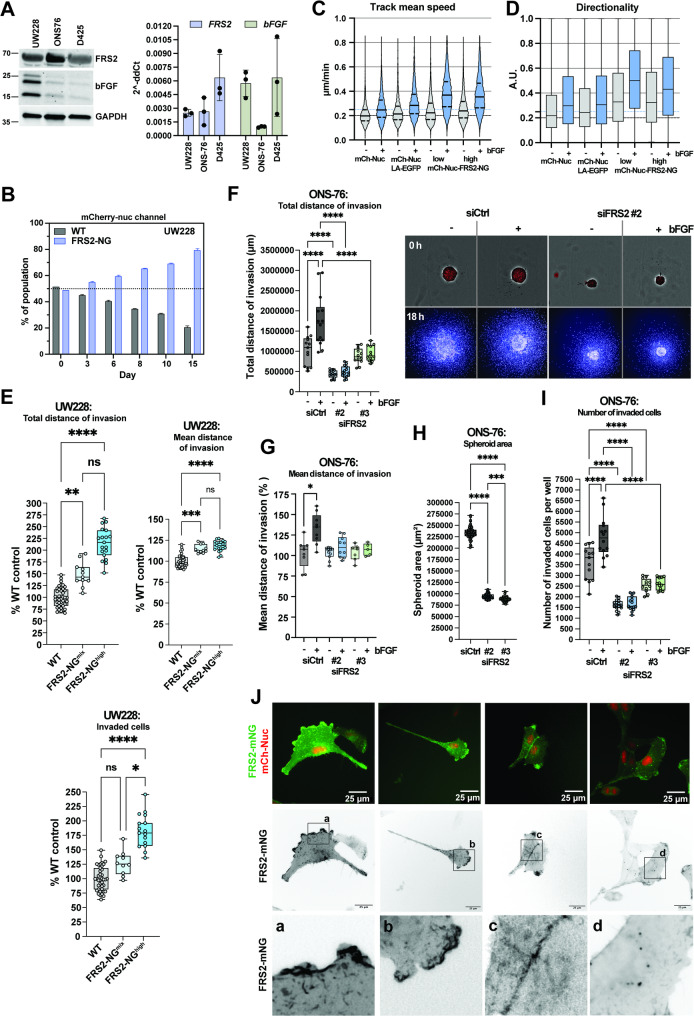
The scaffold protein FRS2 is central to FGFR signaling, linking receptor activation to MAPK/ERK and PI3K/AKT pathways. Elevated FRS2 expression correlates with aggressive tumor phenotypes and poor prognosis across multiple cancers, including the pediatric cerebellar tumor medulloblastoma (MB). Here, we characterized FRS2’s subcellular localization and interactome in MB cells, employing live-cell imaging, phosphoproteomics, immunoprecipitation, and APEX2-based proximity labeling. We found that increased FRS2 expression is associated with increased motile and invasive behavior in MB tumor cells. We furthermore identified novel candidate FRS2-associated proteins involved in actin cytoskeleton remodeling, cell junction assembly, and translation initiation, which indicate a growth factor-dependent reorganization of the FRS2 signalosome. Our data furthermore indicate a regulatory role of FRS2 in directing subcellular distribution of the cell junction and cell motility regulator TJP1. Our findings highlight the relevance of FRS2 as a mediator of cell motility and invasiveness and provide candidate proteins associated with FRS2 that are involved in cellular processes governing migration and invasion. This study thus provides a framework for exploring the FRS2 interactome as a possible target to attenuate FGFR-driven oncogenic processes with next-generation therapeutic strategies.
Overview
The claims and statistics of this paper haven’t been checked yet.
Free: it reads the open-access text and checks the first 5 claims that cite a source we can check. Create a free account to check every claim.
Integrity signals
Registry
Cites
Statistics
Figures



Verification
Claims the paper makes
The claims and statistics of this paper haven’t been checked yet.
Free: it reads the open-access text and checks the first 5 claims that cite a source we can check. Create a free account to check every claim.
Self-check
Percentages, sums and reported differences re-computed from the paper’s own numbers.
The self-check needs the paper’s full text.
Citations
Cites
Analysis of Relative Gene Expression Data Using Real-Time Quantitative PCR and the 2−ΔΔCT Method
Livak, K. J., & Schmittgen, T. D. (2001) · Methods · doi:10.1006/meth.2001.1262 · Cited by 180,860
Highly accurate protein structure prediction with AlphaFold
Jumper, J., Evans, R., Pritzel, A., Green, T., Figurnov, M., Ronneberger, O., Tunyasuvunakool, K., Bates, R., Žídek, A., Potapenko, A., et al. (2021) · Nature · doi:10.1038/s41586-021-03819-2 · Cited by 43,764
limma powers differential expression analyses for RNA-sequencing and microarray studies
Ritchie, M. E., Phipson, B., Wu, D., Hu, Y., Law, C. W., Shi, W., & Smyth, G. K. (2015) · Nucleic Acids Research · doi:10.1093/nar/gkv007 · Cited by 40,458
Universal sample preparation method for proteome analysis
Wiśniewski, J. R., Zougman, A., Nagaraj, N., & Mann, M. (2009) · Nature Methods · doi:10.1038/nmeth.1322 · Cited by 8,352
Cell Signaling by Receptor Tyrosine Kinases
Lemmon, M. A., & Schlessinger, J. (2010) · Cell · doi:10.1016/j.cell.2010.06.011 · Cited by 7,929
DIA-NN: neural networks and interference correction enable deep proteome coverage in high throughput
Demichev, V., Messner, C. B., Vernardis, S. I., Lilley, K. S., & Ralser, M. (2020) · Nature Methods · doi:10.1038/s41592-019-0638-x · Cited by 3,343
Directed evolution of APEX2 for electron microscopy and proximity labeling
Lam, S. S., Martell, J. D., Kamer, K. J., Deerinck, T. J., Ellisman, M. H., Mootha, V. K., & Ting, A. Y. (2015) · Nature Methods · doi:10.1038/nmeth.3179 · Cited by 1,377
Holz, M. K., Ballif, B. A., Gygi, S. P., & Blenis, J. (2005) · Cell · doi:10.1016/j.cell.2005.10.024 · Cited by 1,262
Kouhara, H., Hadari, Y. R., Spivak-Kroizman, T., Schilling, J., Bar-Sagi, D., Lax, I., & Schlessinger, J. (1997) · Cell · doi:10.1016/s0092-8674(00)80252-4 · Cited by 873
Regulation of elongation factor 2 kinase by p90RSK1 and p70 S6 kinase
Wang, X. (2001) · The EMBO Journal · doi:10.1093/emboj/20.16.4370 · Cited by 796
SAINTexpress: Improvements and additional features in Significance Analysis of INTeractome software
Teo, G., Liu, G., Zhang, J., Nesvizhskii, A. I., Gingras, A.-C., & Choi, H. (2014) · Journal of Proteomics · doi:10.1016/j.jprot.2013.10.023 · Cited by 682
Spatially resolved proteomic mapping in living cells with the engineered peroxidase APEX2
Hung, V., Udeshi, N. D., Lam, S. S., Loh, K. H., Cox, K. J., Pedram, K., Carr, S. A., & Ting, A. Y. (2016) · Nature Protocols · doi:10.1038/nprot.2016.018 · Cited by 555
Actinin-4, a Novel Actin-bundling Protein Associated with Cell Motility and Cancer Invasion
Honda, K., Yamada, T., Endo, R., Ino, Y., Gotoh, M., Tsuda, H., Yamada, Y., Chiba, H., & Hirohashi, S. (1998) · The Journal of Cell Biology · doi:10.1083/jcb.140.6.1383 · Cited by 483
A proximity-dependent biotinylation map of a human cell
Go, C. D., Knight, J. D. R., Rajasekharan, A., Rathod, B., Hesketh, G. G., Abe, K. T., Youn, J.-Y., Samavarchi-Tehrani, P., Zhang, H., Zhu, L. Y., et al. (2021) · Nature · doi:10.1038/s41586-021-03592-2 · Cited by 450
Phase Separation of Zonula Occludens Proteins Drives Formation of Tight Junctions
Beutel, O., Maraspini, R., Pombo-García, K., Martin-Lemaitre, C., & Honigmann, A. (2019) · Cell · doi:10.1016/j.cell.2019.10.011 · Cited by 435
Ong, S. H., Guy, G. R., Hadari, Y. R., Laks, S., Gotoh, N., Schlessinger, J., & Lax, I. (2000) · Molecular and Cellular Biology · doi:10.1128/mcb.20.3.979-989.2000 · Cited by 363
Hadari, Y. R., Kouhara, H., Lax, I., & Schlessinger, J. (1998) · Molecular and Cellular Biology · doi:10.1128/mcb.18.7.3966 · Cited by 324
Critical role for the docking-protein FRS2α in FGF receptor-mediated signal transduction pathways
Hadari, Y. R., Gotoh, N., Kouhara, H., Lax, I., & Schlessinger, J. (2001) · Proceedings of the National Academy of Sciences · doi:10.1073/pnas.161259898 · Cited by 297
Regulation of growth factor signaling by FRS2 family docking/scaffold adaptor proteins
Gotoh, N. (2008) · Cancer Science · doi:10.1111/j.1349-7006.2008.00840.x · Cited by 268
Chereau, D., Kerff, F., Graceffa, P., Grabarek, Z., Langsetmo, K., & Dominguez, R. (2005) · Proceedings of the National Academy of Sciences · doi:10.1073/pnas.0507021102 · Cited by 266
Suetsugu, S., Miki, H., & Takenawa, T. (1999) · Biochemical and Biophysical Research Communications · doi:10.1006/bbrc.1999.0894 · Cited by 246
The Signaling Adapter FRS-2 Competes with Shc for Binding to the Nerve Growth Factor Receptor TrkA
Meakin, S. O., MacDonald, J. I. S., Gryz, E. A., Kubu, C. J., & Verdi, J. M. (1999) · Journal of Biological Chemistry · doi:10.1074/jbc.274.14.9861 · Cited by 235
PtdIns(3,4,5)P3 binding is necessary for WAVE2-induced formation of lamellipodia
Oikawa, T., Yamaguchi, H., Itoh, T., Kato, M., Ijuin, T., Yamazaki, D., Suetsugu, S., & Takenawa, T. (2004) · Nature Cell Biology · doi:10.1038/ncb1125 · Cited by 224
Spatiotemporal Control of Fibroblast Growth Factor Receptor Signals by Blue Light
Kim, N., Kim, J. M., Lee, M., Kim, C. Y., Chang, K.-Y., & Heo, W. D. (2014) · Chemistry & Biology · doi:10.1016/j.chembiol.2014.05.013 · Cited by 191
Functional roles of fibroblast growth factor receptors (FGFRs) signaling in human cancers
Tiong, K. H., Mah, L. Y., & Leong, C.-O. (2013) · Apoptosis · doi:10.1007/s10495-013-0886-7 · Cited by 179
ERK-MAPK Drives Lamellipodia Protrusion by Activating the WAVE2 Regulatory Complex
Mendoza, M. C., Er, E. E., Zhang, W., Ballif, B. A., Elliott, H. L., Danuser, G., & Blenis, J. (2011) · Molecular Cell · doi:10.1016/j.molcel.2011.02.031 · Cited by 169
Lax, I., Wong, A., Lamothe, B., Lee, A., Frost, A., Hawes, J., & Schlessinger, J. (2002) · Molecular Cell · doi:10.1016/s1097-2765(02)00689-5 · Cited by 165
Xu, H., Lee, K. W., & Goldfarb, M. (1998) · Journal of Biological Chemistry · doi:10.1074/jbc.273.29.17987 · Cited by 163
CLP-36 PDZ-LIM Protein Associates with Nonmuscle α-Actinin-1 and α-Actinin-4
Vallenius, T., Luukko, K., & Mäkelä, T. P. (2000) · Journal of Biological Chemistry · doi:10.1074/jbc.275.15.11100 · Cited by 149
Eukaryotic translation initiation factors as promising targets in cancer therapy
Hao, P., Yu, J., Ward, R. J., Liu, Y., Qiao, H., An, S., & Xu, T. (2020) · Cell Communication and Signaling · doi:10.1186/s12964-020-00607-9 · Cited by 142
Melillo, R. M., Santoro, M., Ong, S.-H., Billaud, M., Fusco, A., Hadari, Y. R., Schlessinger, J., & Lax, I. (2001) · Molecular and Cellular Biology · doi:10.1128/mcb.21.13.4177-4187.2001 · Cited by 141
The midbody interactome reveals unexpected roles for PP1 phosphatases in cytokinesis
Capalbo, L., Bassi, Z. I., Geymonat, M., Todesca, S., Copoiu, L., Enright, A. J., Callaini, G., Riparbelli, M. G., Yu, L., Choudhary, J. S., et al. (2019) · Nature Communications · doi:10.1038/s41467-019-12507-9 · Cited by 121
Kurokawa, K., Iwashita, T., Murakami, H., Hayashi, H., Kawai, K., & Takahashi, M. (2001) · Oncogene · doi:10.1038/sj.onc.1204290 · Cited by 121
Sandilands, E., Akbarzadeh, S., Vecchione, A., McEwan, D. G., Frame, M. C., & Heath, J. K. (2007) · EMBO Reports · doi:10.1038/sj.embor.7401097 · Cited by 120
mSprouty2 inhibits FGF10-activated MAP kinase by differentially binding to upstream target proteins
Tefft, D., Lee, M., Smith, S., Crowe, D. L., Bellusci, S., & Warburton, D. (2002) · American Journal of Physiology-Lung Cellular and Molecular Physiology · doi:10.1152/ajplung.00372.2001 · Cited by 117
Bauer, K., Kratzer, M., Otte, M., de Quintana, K. L., Hagmann, J., Arnold, G. J., Eckerskorn, C., Lottspeich, F., & Siess, W. (2000) · Blood · doi:10.1182/blood.v96.13.4236 · Cited by 114
Goudreau, N., Cornille, F., Duchesne, M., Parker, F., Tocqué, B., Garbay, C., & Roques, B. P. (1994) · Nature Structural & Molecular Biology · doi:10.1038/nsb1294-898 · Cited by 102
prolfqua : A Comprehensive R -Package for Proteomics Differential Expression Analysis
Wolski, W., Nanni, P., Grossmann, J., d’Errico, M., Schlapbach, R., & Panse, C. (2023) · Journal of Proteome Research · doi:10.1021/acs.jproteome.2c00441 · Cited by 101
Amplification of FRS2 and Activation of FGFR/FRS2 Signaling Pathway in High-Grade Liposarcoma
Zhang, K., Chu, K., Wu, X., Gao, H., Wang, J., Yuan, Y.-C., Loera, S., Ho, K., Wang, Y., Chow, W., et al. (2013) · Cancer Research · doi:10.1158/0008-5472.can-12-2086 · Cited by 98
Subcellular mRNA Localization Regulates Ribosome Biogenesis in Migrating Cells
(2020) · doi:10.1016/j.devcel.2020.10.006 · Cited by 96
B-Fabric: the Swiss Army Knife for life sciences
Türker, C., Akal, F., Joho, D., Panse, C., Barkow-Oesterreicher, S., Rehrauer, H., & Schlapbach, R. (2010) · Proceedings of the 13th International Conference on Extending Database Technology · doi:10.1145/1739041.1739135 · Cited by 83
Zhang, Y., Zhang, J., Lin, Y., Lan, Y., Lin, C., Xuan, J. W., Shen, M. M., McKeehan, W. L., Greenberg, N. M., & Wang, F. (2008) · Development · doi:10.1242/dev.009910 · Cited by 76
Tyrosine Phosphorylation Profiling in FGF-2 Stimulated Human Embryonic Stem Cells
Ding, V., Boersema, P. J., Foong, L. Y., Preisinger, C., Koh, G., Natarajan, S., Lee, D., Boekhorst, J., Snel, B., Lemeer, S., et al. (2011) · PLoS ONE · doi:10.1371/journal.pone.0017538 · Cited by 67
Harada, A., Katoh, H., & Negishi, M. (2005) · Journal of Biological Chemistry · doi:10.1074/jbc.m411356200 · Cited by 57
Tan, B., Peng, S., Yatim, S. M. J. M., Gunaratne, J., Hunziker, W., & Ludwig, A. (2020) · STAR Protocols · doi:10.1016/j.xpro.2020.100074 · Cited by 53
Ridyard, M. S., & Robbins, S. M. (2003) · Journal of Biological Chemistry · doi:10.1074/jbc.m210245200 · Cited by 53
Luo, L. Y., Kim, E., Cheung, H. W., Weir, B. A., Dunn, G. P., Shen, R. R., & Hahn, W. C. (2014) · Molecular Cancer Research · doi:10.1158/1541-7786.mcr-14-0407 · Cited by 52
TGF-β Determines the Pro-migratory Potential of bFGF Signaling in Medulloblastoma
Santhana Kumar, K., Neve, A., Guerreiro Stucklin, A. S., Kuzan-Fischer, C. M., Rushing, E. J., Taylor, M. D., Tripolitsioti, D., Behrmann, L., Kirschenbaum, D., Grotzer, M. A., et al. (2018) · Cell Reports · doi:10.1016/j.celrep.2018.05.083 · Cited by 49
Self-citationThe FRS2 family of docking/scaffolding adaptor proteins as therapeutic targets of cancer treatment
Sato, T., & Gotoh, N. (2009) · Expert Opinion on Therapeutic Targets · doi:10.1517/14728220902942330 · Cited by 47
Fischer, U., Keller, A., Leidinger, P., Deutscher, S., Heisel, S., Urbschat, S., Lenhof, H., & Meese, E. U. (2008) · Molecular Cancer Research · doi:10.1158/1541-7786.mcr-07-0283 · Cited by 47
Tamura, N., Ohno, K., Katayama, T., Kanayama, N., & Sato, K. (2007) · Biochemical and Biophysical Research Communications · doi:10.1016/j.bbrc.2007.10.064 · Cited by 46
Zhang, Y., Lin, Y., Bowles, C. A., & Wang, F. (2004) · Journal of Biological Chemistry · doi:10.1074/jbc.m409230200 · Cited by 36
Tang, Q., Schaks, M., Koundinya, N., Yang, C., Pollard, L. W., Svitkina, T., Rottner, K., & Goode, B. L. (2020) · Molecular Biology of the Cell · doi:10.1091/mbc.e19-12-0705 · Cited by 33
Tomasovic, A., Traub, S., & Tikkanen, R. (2012) · PLoS ONE · doi:10.1371/journal.pone.0029739 · Cited by 33
Li, Q., Alsaidan, O. A., Ma, Y., Kim, S., Liu, J., Albers, T., Liu, K., Beharry, Z. M., Zhao, S., Wang, F., et al. (2018) · Journal of Biological Chemistry · doi:10.1074/jbc.ra117.000940 · Cited by 30
Computer-assisted quantification of motile and invasive capabilities of cancer cells
Kumar, K. S., Pillong, M., Kunze, J., Burghardt, I., Weller, M., Grotzer, M. A., Schneider, G., & Baumgartner, M. (2015) · Scientific Reports · doi:10.1038/srep15338 · Cited by 29
Self-citationDiscovery of a small molecule ligand of FRS2 that inhibits invasion and tumor growth
Kumar, K. S., Brunner, C., Schuster, M., Kopp, L. L., Gries, A., Shen, Y., Jurt, S., Moehle, K., Bruns, D., Grotzer, M. A., et al. (2022) · Cellular Oncology · doi:10.1007/s13402-022-00753-x · Cited by 26
Self-citationCrosstalk between SHH and FGFR Signaling Pathways Controls Tissue Invasion in Medulloblastoma
Neve, A., Migliavacca, J., Capdeville, C., Schönholzer, M. T., Gries, A., Ma, M., Kumar, K. S., Grotzer, M. A., & Baumgartner, M. (2019) · Cancers · doi:10.3390/cancers11121985 · Cited by 20
Self-citationBálek, L., Němec, P., Koník, P., Bosakova, M. K., Vařecha, M., Gudernová, I., Medalová, J., Krakow, D., & Krejčı́, P. (2017) · Cellular Signalling · doi:10.1016/j.cellsig.2017.10.003 · Cited by 19
UNC-51-like kinase regulation of fibroblast growth factor receptor substrate 2/3
Avery, A. W., Figueroa‐Romero, C., & Vojtek, A. B. (2006) · Cellular Signalling · doi:10.1016/j.cellsig.2006.06.003 · Cited by 18
Bi, J., Wang, R., & Zeng, X. (2018) · Oncology Letters · doi:10.3892/ol.2018.9466 · Cited by 13
Jing, W., Lan, T., Qiu, Y., Peng, R., Yang, L., Chen, H., Chen, M., He, X., Chen, C., & Zhang, H. (2021) · Diagnostic Pathology · doi:10.1186/s13000-021-01161-9 · Cited by 8
miR-338-3p acts as a tumor suppressor in lung squamous cell carcinoma by targeting FGFR2/FRS2
Xia, S., Zhang, C., Li, C., Fan, X., Song, G., Zhu, J., Cao, R., Zhang, X., & Zhu, W. (2022) · Cancer Pathogenesis and Therapy · doi:10.1016/j.cpt.2022.12.004 · Cited by 4
Research works printed but not linked: 6
- 10.1093/bioinformatics/btz066 · DOI
- 10.1016/j.ccell.2017.05.005 · DOI · Paper page
- 10.1038/s41586-019-1338-5 · DOI · Paper page
- 10.1038/s42003-022-03708-y · DOI
- 10.3390/ijms26052090 · DOI
- 10.1016/j.ijbiomac.2025.142478 · DOI
Metadata
- Authors
- Kopp, L. L., Versamento, D., Ciraulo, B., Schönholzer, M. T., Hochuli, D., Lin, M.-S., & Baumgartner, M.
- Affiliations
- University Children's Hospital Zurich (CH)
- Corresponding author
- Baumgartner, Martin
- Venue
- Cell Communication and Signaling
- Publisher
- openRxiv
- Published
- 2025-09-25
- Volume
- 24
- Issue
- 1
- ISSN
- 1478-811X (ISSN-L)
- PMC
- PMC13393275
- OpenAlex
- W7161983233
- Cited by
- 0
- References
- 63
- FWCI
- 0.00
- Type
- journal article
- Language
- en
- Open access
- gold
- doi.org
- Licence
- Locations
- Cell Communication and Signaling (publishedVersion, cc-by)
- bioRxiv (Cold Spring Harbor Laboratory) (acceptedVersion, cc-by)
- PubMed (publishedVersion)
- PubMed Central (publishedVersion, cc-by)
- DOAJ (DOAJ: Directory of Open Access Journals) (submittedVersion)
- Funders
- Childhood Cancer Research Foundation Switzerland (n.a.)
- Topics
- Life Sciences › Biochemistry, Genetics and Molecular Biology › Molecular Biology › Fibroblast Growth Factor Research
- Life Sciences › Biochemistry, Genetics and Molecular Biology › Cell Biology › Biotin and Related Studies
- Life Sciences › Biochemistry, Genetics and Molecular Biology › Molecular Biology › Protein Kinase Regulation and GTPase Signaling
- Keywords
- FRS2, fibroblast growth factor receptor signaling, medulloblastoma, protein-protein interaction network, cell migration, tumor invasion, cell junctions, TJP1, actin cytoskeleton remodeling, translation initiation, subcellular localization, signalosome
- MeSH terms
- Cell Movement, Humans, Medulloblastoma, Membrane Proteins, Neoplasm Invasiveness, Protein Binding, Signal Transduction, Protein Interaction Mapping, Cell Line, Tumor, Adaptor Proteins, Signal Transducing
About these checks
Registry, retraction, Cites and statistics results are computed, not judged, with one exception: a printed reference that no index lists is read once by a model before it counts as a citation error. Claims are extracted by a model and kept only when their quote appears verbatim in the text; each cited source is then checked, with a model’s help, for whether it says what the claim relies on. Those verdicts can be wrong — read the claim’s quote and the cited source before relying on one.
Statistics and arithmetic are recomputed, not judged.
Confidence bands are shown only for fields calibrated on our annotated test set. None is calibrated yet, so no band is shown.
What counts as a claim ›How we measure confidence ›How we check this ›
Are you an author, or do you see a problem with this page? Request a review
Data sources
Bibliographic data: Semantic Scholar, OpenAlex, Crossref.
Contains information from the Semantic Scholar Academic Graph Datasets, made available under the ODC Attribution License (ODC-BY 1.0).
Semantic Scholar’s data is described in: Kinney, R., et al. (2023). The Semantic Scholar Open Data Platform. arXiv:2301.10140.
