

The DOI matches its Crossref record; 224 of the 224 references it cites were found in a registry or an index.
Regulation of lipid peroxidation and ferroptosis in diverse species
Open accessAbstract
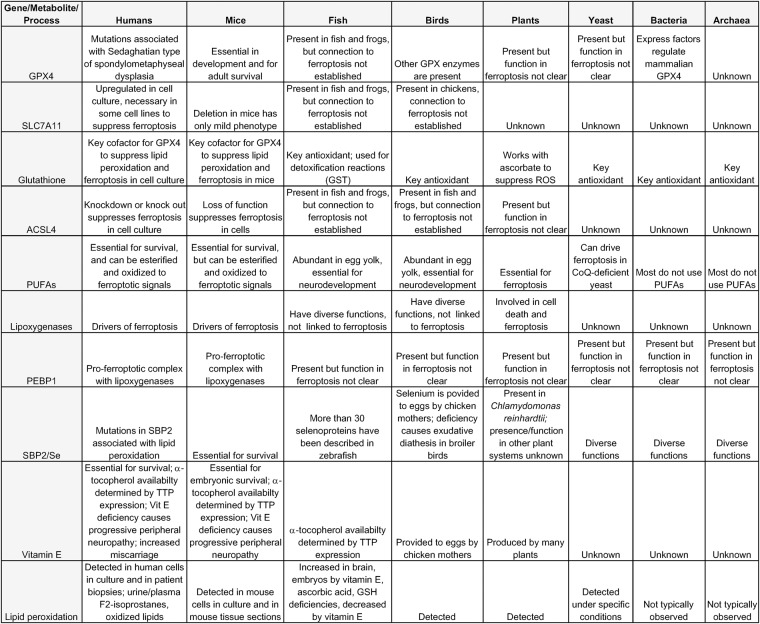
Lipid peroxidation is the process by which oxygen combines with lipids to generate lipid hydroperoxides via intermediate formation of peroxyl radicals. Vitamin E and coenzyme Q 10 react with peroxyl radicals to yield peroxides, and then these oxidized lipid species can be detoxified by glutathione and glutathione peroxidase 4 (GPX4) and other components of the cellular antioxidant defense network. Ferroptosis is a form of regulated nonapoptotic cell death involving overwhelming iron-dependent lipid peroxidation. Here, we review the functions and regulation of lipid peroxidation, ferroptosis, and the antioxidant network in diverse species, including humans, other mammals and vertebrates, plants, invertebrates, yeast, bacteria, and archaea. We also discuss the potential evolutionary roles of lipid peroxidation and ferroptosis.
Overview
The claims and statistics of this paper haven’t been checked yet.
Run the check — free, no account needed. It reads the open-access text and checks the sources it cites.
Integrity signals
Registry
Cites
Statistics
Figures
Verification
Claims the paper makes
The claims and statistics of this paper haven’t been checked yet.
Run the check — free, no account needed. It reads the open-access text and checks the sources it cites.
Claims other papers make about this one
Each is checked against this paper’s own text: does it say what the citing paper says it does?
In the citing paper
“Mitochondrial damage has been found to be involved in lipid peroxidation and imbalance of iron homeostasis in neurodegenerative diseases such as AD and PD [34].”
Self-check
Percentages, sums and reported differences re-computed from the paper’s own numbers.
The self-check needs the paper’s full text.
Citations
Cites
Ferroptosis: An Iron-Dependent Form of Nonapoptotic Cell Death
Dixon, S. J., Lemberg, K. M., Lamprecht, M. R., Skouta, R., Zaitsev, E. M., Gleason, C. E., Patel, D. N., Bauer, A. J., Cantley, A. M., Yang, W. S., et al. (2012) · Cell · doi:10.1016/j.cell.2012.03.042 · Cited by 18,691
Self-citationRegulation of Ferroptotic Cancer Cell Death by GPX4
Yang, W. S., SriRamaratnam, R., Welsch, M. E., Shimada, K., Skouta, R., Viswanathan, V. S., Cheah, J. H., Clemons, P. A., Shamji, A. F., Clish, C. B., et al. (2014) · Cell · doi:10.1016/j.cell.2013.12.010 · Cited by 7,713
Self-citationFerroptosis: A Regulated Cell Death Nexus Linking Metabolism, Redox Biology, and Disease
Stockwell, B. R., Friedmann Angeli, J. P., Bayir, H., Bush, A. I., Conrad, M., Dixon, S. J., Fulda, S., Gascón, S., Hatzios, S. K., Kagan, V. E., et al. (2017) · Cell · doi:10.1016/j.cell.2017.09.021 · Cited by 7,695
Self-citationGalluzzi, L., Vitale, I., Aaronson, S. A., Abrams, J. M., Adam, D., Agostinis, P., Alnemri, E. S., Altucci, L., Amelio, I., Andrews, D. W., et al. (2018) · Cell Death & Differentiation · doi:10.1038/s41418-017-0012-4 · Cited by 6,680
Self-citationACSL4 dictates ferroptosis sensitivity by shaping cellular lipid composition
Doll, S., Proneth, B., Tyurina, Y. Y., Panzilius, E., Kobayashi, S., Ingold, I., Irmler, M., Beckers, J., Aichler, M., Walch, A., et al. (2017) · Nature Chemical Biology · doi:10.1038/nchembio.2239 · Cited by 4,293
Self-citationInactivation of the ferroptosis regulator Gpx4 triggers acute renal failure in mice
Friedmann Angeli, J. P., Schneider, M., Proneth, B., Tyurina, Y. Y., Tyurin, V. A., Hammond, V. J., Herbach, N., Aichler, M., Walch, A., Eggenhofer, E., et al. (2014) · Nature Cell Biology · doi:10.1038/ncb3064 · Cited by 3,732
Self-citationWendel, A. (1981) · Methods in enzymology on CD-ROM/Methods in enzymology · doi:10.1016/s0076-6879(81)77046-0 · Cited by 3,032
Oxidized arachidonic and adrenic PEs navigate cells to ferroptosis
Kagan, V. E., Mao, G., Qu, F., Angeli, J. P. F., Doll, S., Croix, C. S., Dar, H. H., Liu, B., Tyurin, V. A., Ritov, V. B., et al. (2017) · Nature Chemical Biology · doi:10.1038/nchembio.2238 · Cited by 3,029
Self-citationAscorbate and Glutathione: The Heart of the Redox Hub
Foyer, C. H., & Noctor, G. (2011) · PLANT PHYSIOLOGY · doi:10.1104/pp.110.167569 · Cited by 2,559
Autophagy promotes ferroptosis by degradation of ferritin
Hou, W., Xie, Y., Song, X., Sun, X., Lotze, M. T., Zeh, H. J., Kang, R., & Tang, D. (2016) · Autophagy · doi:10.1080/15548627.2016.1187366 · Cited by 2,332
Cited by
Sorted by citations
Reactive Oxygen Species-Induced Lipid Peroxidation in Apoptosis, Autophagy, and Ferroptosis
Su, L.-J., Zhang, J.-H., Gomez, H., Murugan, R., Hong, X., Xu, D., Jiang, F., & Peng, Z.-Y. (2019) · Oxidative Medicine and Cellular Longevity · doi:10.1155/2019/5080843 · Cited by 2,166
Role of GPX4 in ferroptosis and its pharmacological implication
Seibt, T. M., Proneth, B., & Conrad, M. (2019) · Free Radical Biology and Medicine · doi:10.1016/j.freeradbiomed.2018.09.014 · Cited by 1,520
Self-citationRSL3 Drives Ferroptosis Through GPX4 Inactivation and ROS Production in Colorectal Cancer
Sui, X., Zhang, R., Liu, S., Duan, T., Zhai, L., Zhang, M., Han, X., Xiang, Y., Huang, X., Lin, H., et al. (2018) · Frontiers in Pharmacology · doi:10.3389/fphar.2018.01371 · Cited by 703
Park, M. W., Cha, H. W., Kim, J., Kim, J. H., Yang, H., Yoon, S., Boonpraman, N., Yi, S. S., Yoo, I. D., & Moon, J.-S. (2021) · Redox Biology · doi:10.1016/j.redox.2021.101947 · Cited by 683
“Mitochondrial damage has been found to be involved in lipid peroxidation and imbalance of iron homeostasis in neurodegenerative diseases such as AD and PD [34].”
BackgroundA major role for ferroptosis in Mycobacterium tuberculosis –induced cell death and tissue necrosis
Amaral, E. P., Costa, D. L., Namasivayam, S., Riteau, N., Kamenyeva, O., Mittereder, L., Mayer-Barber, K. D., Andrade, B. B., & Sher, A. (2019) · Journal of Experimental Medicine · doi:10.1084/jem.20181776 · Cited by 464
Metadata
- Authors
- Conrad, M., Kagan, V. E., Bayir, H., Pagnussat, G. C., Head, B., Traber, M. G., & Stockwell, B. R.
- Affiliations
- Helmholtz Munich (DE)
- University of Pittsburgh (US)
- Consejo Nacional de Investigaciones Científicas y Técnicas (AR)
- Oregon State University (US)
- Columbia University (US)
- ORCID
- Venue
- Genes & Development
- Publisher
- Cold Spring Harbor Laboratory
- Published
- 2018-05-01
- Volume
- 32
- Issue
- 9-10
- Pages
- 602-619
- ISSN
- 0890-9369 (ISSN-L)
- 1549-5477
- PMC
- PMC6004068
- OpenAlex
- W2804102163
- Cited by
- 544
- References
- 224
- Citations by year
- 2026: 53 · 2025: 65 · 2024: 73 · 2023: 95 · 2022: 80 · 2021: 82 · 2020: 52 · 2019: 37 · 2018: 6
- Type
- posted content
- Language
- en
- Open access
- hybrid
- doi.org
- Licence
- cc-by-nc
- Locations
- Genes & Development (publishedVersion, cc-by-nc)
- Europe PMC (PubMed Central) (publishedVersion, cc-by-nc)
- PubMed Central (publishedVersion, cc-by-nc)
- PubMed (publishedVersion)
- PuSH - Publication Server of Helmholtz Zentrum München (submittedVersion, cc-by-nc)
- HighWire Press Open Archive (submittedVersion)
- Site cant be reached (submittedVersion, cc-by-nc)
- Conicet (submittedVersion, cc-by-nc-sa)
- Funders
- National Institutes of Health (R35CA209896, P01CA087497, U19AI068021, NS076511, NS061817)
- Deutsche Forschungsgemeinschaft (CO 291/2-3, CO 291/5-1)
- Human Frontier Science Program (RGP0013)
- Agencia Nacional de Promoción Científica y Tecnológica
- Proyectos de Investigación Científica y Tecnológica (2013-1372, PICT 2016-0110)
- Topics
- Life Sciences › Biochemistry, Genetics and Molecular Biology › Cancer Research › Ferroptosis and cancer prognosis
- Health Sciences › Medicine › Biochemistry (medical) › Antioxidant Activity and Oxidative Stress
- Life Sciences › Biochemistry, Genetics and Molecular Biology › Molecular Biology › Redox biology and oxidative stress
- Keywords
- lipid peroxidation, ferroptosis, antioxidant defense, GPX4, vitamin E, coenzyme Q10, peroxy radicals, lipid hydroperoxides, non-apoptotic cell death, iron metabolism
- MeSH terms
- Animals, Antioxidants, Biological Evolution, Humans, Iron, Species Specificity, Lipid Peroxidation, Cell Death, Reactive Oxygen Species
About these checks
Registry, retraction, Cites and statistics results are computed, not judged, with one exception: a printed reference that no index lists is read once by a model before it counts as a citation error. Claims are extracted by a model and kept only when their quote appears verbatim in the text; each cited source is then checked, with a model’s help, for whether it says what the claim relies on. Those verdicts can be wrong — read the claim’s quote and the cited source before relying on one.
Statistics and arithmetic are recomputed, not judged.
Confidence bands are shown only for fields calibrated on our annotated test set. None is calibrated yet, so no band is shown.
What counts as a claim ›How we measure confidence ›How we check this ›
Are you an author, or do you see a problem with this page? Request a review
