

The DOI matches its Crossref record; 49 of the 50 references it cites were found in a registry or an index; none of the 18 sources its claims cite is checked for support yet.
A recent bottleneck of Y chromosome diversity coincides with a global change in culture
Open accessAbstract
It is commonly thought that human genetic diversity in non-African populations was shaped primarily by an out-of-Africa dispersal 50–100 thousand yr ago (kya). Here, we present a study of 456 geographically diverse high-coverage Y chromosome sequences, including 299 newly reported samples. Applying ancient DNA calibration, we date the Y-chromosomal most recent common ancestor (MRCA) in Africa at 254 (95% CI 192–307) kya and detect a cluster of major non-African founder haplogroups in a narrow time interval at 47–52 kya, consistent with a rapid initial colonization model of Eurasia and Oceania after the out-of-Africa bottleneck. In contrast to demographic reconstructions based on mtDNA, we infer a second strong bottleneck in Y-chromosome lineages dating to the last 10 ky. We hypothesize that this bottleneck is caused by cultural changes affecting variance of reproductive success among males.
Overview
CoChat Summary
Written by AI from the paper’s full text.
TL;DR
This study analyzes 456 high-coverage Y chromosome sequences, including 299 newly reported samples, to reconstruct global Y chromosome diversity and demography. It dates the Y-chromosomal MRCA in Africa at 254 kya, finds a narrow non-African founder haplogroup cluster at 47–52 kya, and infers a second strong Y-chromosome bottleneck in the last 10 ky that may reflect culturally driven changes in male reproductive success.
Key findings
- From 456 geographically diverse high-coverage Y chromosome sequences, the authors retained 8.8 Mb per individual and 35,700 SNPs with >95% call rate; they estimated the Y binary SNP mutation rate at 0.74 × 10⁻⁹ per bp per yr (95% CI 0.63–0.95 × 10⁻⁹).
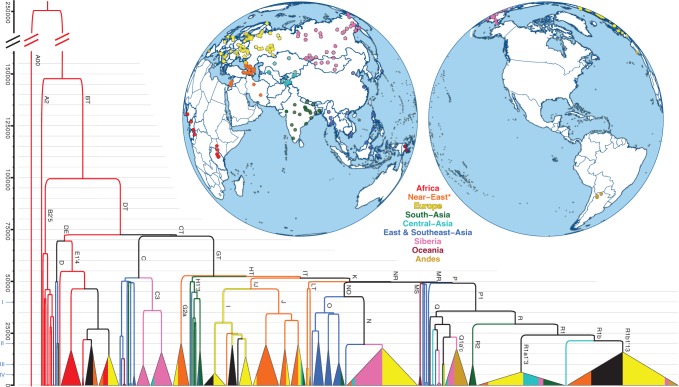
- The Y-chromosomal MRCA in Africa was dated to 254 kya (95% CI 192–307 kya); African and non-African lineages separated at 68–72 kya (95% CI 52–87 kya), followed by a narrow interval at 47–52 kya (95% CI 36–62 kya) when major non-African founder haplogroups differentiated.
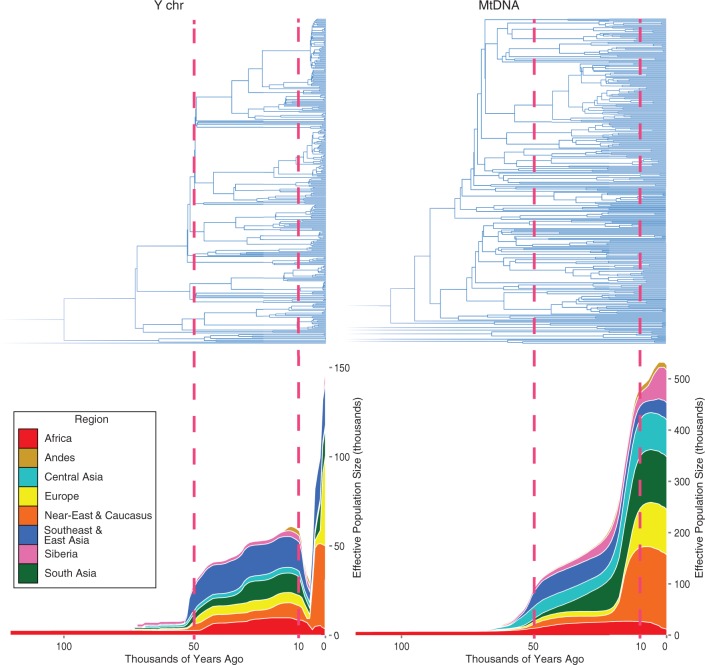
- Bayesian skyline plots of 320 Y chromosomes and mtDNA from the same individuals both showed increases in effective population size at ∼40–60 kya, but mtDNA Ne estimates were consistently more than twice as high as Y chromosome estimates; the Y plot suggested a reduction around 8–4 kya, when female Ne was up to 17-fold higher than male Ne.
- Many Eurasian Y haplogroups coalesced within the last 15 ky, with novel region-specific clades coalescing within the last 4–8 ky; regional pairwise divergence times also clustered around peopling of the Americas at ∼15 kya.
Methods
- The study combined 299 new unrelated male samples from 110 populations with publicly available data for 456 total sequences; two Mbo individuals of haplogroup A00 were sequenced to root the phylogeny, and quality checks included Estonian first-degree relatives, Dutch father-son pairs, and duplicate samples.
- Whole-genome sequencing used Complete Genomics at >40× coverage for blood and >80× for saliva, with Illumina HiSeq 2000 at 30× aimed coverage for the A00 samples; after filtering, analyses used 8.8 Mb of reliable Chr Y sequence and 35,700 high-quality biallelic SNPs.
- Coalescent times and phylogenies were estimated with BEAST v1.8.0, summary statistics with Arlequin v3.5.1.3, and demographic scenarios with FastSimCoal2 simulations; the mutation rate was calibrated using ancient DNA from the 12.6-ky-old Anzick (Q1b) and 4-ky-old Saqqaq (Q2b) specimens.
Limitations
- The paper states that the mutation rate estimate is based on only two ancient DNA samples from a relatively recent time horizon and the same Y chromosome haplogroup, though it notes an independent estimate of 0.76 × 10⁻⁹ per bp per yr from a different, older ancient DNA specimen.
- The authors note that cross-species mapping showed 4.6% discordance at positions separating A2′5 and BT, higher than the 1%–2% predicted from human-chimpanzee divergence, likely reflecting mapping uncertainties.
- The paper states that because the Y chromosome is essentially a single locus with very low Ne, the results cannot refute alternative models of earlier Middle Pleistocene dispersals (100–130 kya) from Africa; such evidence could be embedded only in the autosomal genome.
- The authors state that population structure combined with unbalanced sampling can lead Bayesian skyline plots to infer false population declines, and that most existing methods are underpowered to detect Ne changes within the past few thousand years from recombining genome-wide data.
- The cultural explanation for the male-specific bottleneck is presented as a hypothesis; the paper notes that the inferred mid-Holocene Ne dips may also represent a genuine population collapse following the introduction of farming.
Model-written summary. Check it against the paper before relying on it.
Integrity signals
Registry
Cites
Statistics
Figures
Verification
Claims the paper makes
15 Own result · 9 Own interpretation · 4 No full text of the sources · 3 Sources not found · 3 Check pending · 3 Not checked yet · 3 Own method
A result the paper reports from its own data — it cites no other source for it, so there is none to check. The quote shows it is in the paper.
In the paper
“Within the Y chromosome haplogroups common in Eurasian populations, we noticed that many coalesce within the last 15 ky”
§ A recent bottleneck of Y chromosome diversity coincides with a global change in culture > Results
plain- Asserted: passes — The authors put it forward as true.
- Checkable: passes — It can be checked against evidence.
- Load-bearing: passes — The paper’s conclusions depend on it.
- Based: passes — The paper gives a reason why it holds.
A result the paper reports from its own data — it cites no other source for it, so there is none to check. The quote shows it is in the paper.
In the paper
“The cumulative global BSP of 320 Y chromosomes with known geographic affiliation and the plot inferred from mtDNA sequences from the same individuals both showed increases in the Ne at ∼40–60 kya”
§ A recent bottleneck of Y chromosome diversity coincides with a global change in culture > Results
plainstates a cause- Asserted: passes — The authors put it forward as true.
- Checkable: passes — It can be checked against evidence.
- Load-bearing: passes — The paper’s conclusions depend on it.
- Based: passes — The paper gives a reason why it holds.
A result the paper reports from its own data — it cites no other source for it, so there is none to check. The quote shows it is in the paper.
In the paper
“We show that only the F1329 SNP (Supplemental Fig. S13) first separates the deep F and GT branches”
§ A recent bottleneck of Y chromosome diversity coincides with a global change in culture > Results
boosted- Asserted: passes — The authors put it forward as true.
- Checkable: passes — It can be checked against evidence.
- Load-bearing: unclear — It is unclear whether the paper’s conclusions depend on it.
- Based: passes — The paper gives a reason why it holds.
In the paper
“corroborate the succeeding swift split of G from HT by the single M578 SNP (Poznik et al. 2013).”
§ A recent bottleneck of Y chromosome diversity coincides with a global change in culture > Results
What the sources say
- Not checked yetcites Poznik et al. 2013 source
plainstates an association- Asserted: passes — The authors put it forward as true.
- Checkable: passes — It can be checked against evidence.
- Load-bearing: unclear — It is unclear whether the paper’s conclusions depend on it.
- Based: passes — The paper gives a reason why it holds.
A result the paper reports from its own data — it cites no other source for it, so there is none to check. The quote shows it is in the paper.
In the paper
“the separation of African and non-African lineages at 68–72 (95% CI 52–87) kya”
§ A recent bottleneck of Y chromosome diversity coincides with a global change in culture > Results
plain- Asserted: passes — The authors put it forward as true.
- Checkable: passes — It can be checked against evidence.
- Load-bearing: passes — The paper’s conclusions depend on it.
- Based: passes — The paper gives a reason why it holds.
- It may state two separate claims as one. 10
- Probably not a substantial claim. 4
Create a free account to see these claims.
Create a free account to see these assumptions.
23 more claims
Create a free account to see all 40 claims and to verify the 6 references still open.
Claims other papers make about this one
Each is checked against this paper’s own text: does it say what the citing paper says it does?
In the citing paper
“The age of haplogroup CT-M168 (71,760 years, 95% confidence interval [CI] = 69,777-73,799) [18] and the splitting time (470 ± 20 years ago) of samples (YCH508 and YCH1981) from the Aisin Gioro family [17] were used as calibration points to estimate the coalescent times of all samples in the study.”
From Whole-sequence analysis indicates that the Y chromosome C2*-Star Cluster traces back to ordinary Mongols, rather than Genghis Khan (2018) · cites this paper as [18]
In the citing paper
“In contrast, all previously studied Kazakh samples belonged to another branch of R1a, namely R1a1a-Z94 (subclade Z2125) [16, 19].”
From The medieval Mongolian roots of Y-chromosomal lineages from South Kazakhstan (2020) · cites this paper as [16]
In the citing paper
“It is believed to have originated around 150,000 years ago (Karmin et al., 2015).”
From Y chromosome evidence confirms northeast Asian origin of Xinjiang Kazakhs and genetic influence from 18th century expansion of Kerey clan (2023) · cites this paper as Karmin et al., 2015
In the citing paper
“The α-cluster TMRCA based on SNPs (four Y chromosomes sequenced) turned out to be ~ 750 years (TMRCA CI 95% 1050–400 ybp) (subclade Y12782, a sample from the Dulat clan [16], www.yfull.com), which is very close to STR dating (746 CI 95% 1104–388 years).”
From The medieval Mongolian roots of Y-chromosomal lineages from South Kazakhstan (2020) · cites this paper as [16]
In the citing paper
“previously characterized C3c1a-Z40439, which is common among Tungusic-speaking Evens and Evenks, Mongolic-speaking Buryats and Mongols [31]”
From Y-chromosomal analysis of clan structure of Kalmyks, the only European Mongol people, and their relationship to Oirat-Mongols of Inner Asia (2019) · cites this paper as [31]
20 more claims about this paper
Create a free account to see every claim other papers make about this one.
Citations
Cites
R: A Language and Environment for Statistical Computing
R Core Team (2000) · doi:10.32614/r.manuals · Cited by 355,987
The Sequence Alignment/Map format and SAMtools
Li, H., Handsaker, B., Wysoker, A., Fennell, T., Ruan, J., Homer, N., Marth, G., Abecasis, G., Durbin, R., & 1000 Genome Project Data Processing Subgroup (2009) · Bioinformatics · doi:10.1093/bioinformatics/btp352 · Cited by 62,041
Fast and accurate short read alignment with Burrows-Wheeler transform
Li, H., & Durbin, R. (2009) · Bioinformatics · doi:10.1093/bioinformatics/btp324 · Cited by 58,607
jModelTest 2: more models, new heuristics and parallel computing
Darriba, D., Taboada, G. L., Doallo, R., & Posada, D. (2012) · Nature Methods · doi:10.1038/nmeth.2109 · Cited by 17,034
Excoffier, L., & Lischer, H. E. L. (2010) · Molecular Ecology Resources · doi:10.1111/j.1755-0998.2010.02847.x · Cited by 16,266
ggplot2: Elegant Graphics for Data Analysis
Wickham, H. (2009) · doi:10.1007/978-0-387-98141-3 · Cited by 14,447
Bayesian Phylogenetics with BEAUti and the BEAST 1.7
Drummond, A. J., Suchard, M. A., Xie, D., & Rambaut, A. (2012) · Molecular Biology and Evolution · doi:10.1093/molbev/mss075 · Cited by 10,167
Initial sequence of the chimpanzee genome and comparison with the human genome
The Chimpanzee Sequencing and Analysis Consortium (2005) · Nature · doi:10.1038/nature04072 · Cited by 2,459
Human Genome Sequencing Using Unchained Base Reads on Self-Assembling DNA Nanoarrays
Drmanac, R., Sparks, A. B., Callow, M. J., Halpern, A. L., Burns, N. L., Kermani, B. G., Carnevali, P., Nazarenko, I., Nilsen, G. B., Yeung, G., et al. (2010) · Science · doi:10.1126/science.1181498 · Cited by 1,212
Inferring human population size and separation history from multiple genome sequences
Schiffels, S., & Durbin, R. (2014) · Nature Genetics · doi:10.1038/ng.3015 · Cited by 1,073
Research works printed but not linked: 1
- Fuller D . 2003. An agricultural perspective on Dravidian historical linguistics: archaeological crop packages, livestock and Dravidian crop vocabulary. In Examining the farming/language dispersal hypothesis (ed. Bellwood P , Renfrew C ), pp. 191–213. The McDonald Institute for Archaeological Research, Cambridge, UK.
Cited by
Items 301–400 of 498
Mendez, F. L. (2016) · Theoretical Population Biology · doi:10.1016/j.tpb.2016.11.002 · Cited by 2
Self-citationХарьков, В. Н., Kolesnikov, N. A., Зарубин, А. А., Валихова, Л. В., Khitrinskaya, I. Y., Voevoda, M. I., Gubina, M. A., Sukhomyasova, A. L., & Степанов, В. А. (2024) · Russian Journal of Genetics · doi:10.1134/s1022795424700236 · Cited by 2
Mihajlović, M., Tanasić, V., Marković, M. K., Kecmanović, M., & Keckarević, D. (2024) · Forensic Science International Genetics · doi:10.1016/j.fsigen.2024.103152 · Cited by 2
Köksal, Z., Preussner, A., Leinonen, J. T., & Tukiainen, T. (2025) · Molecular Biology and Evolution · doi:10.1093/molbev/msaf222 · Cited by 2
Lu, Q., Cheng, H., Li, L., Yao, H., Ru, K., Wen, S., Shi, M., Zeng, Z., & Wei, L. (2020) · Annals of Human Biology · doi:10.1080/03014460.2020.1748226 · Cited by 2
Харьков, В. Н. (2021) · Russian Journal of Genetics · doi:10.1134/s1022795421090040 · Cited by 2
Moderní chemická analýza v archeologii, I. díl
(2021) · doi:10.5507/prf.21.24459486 · Cited by 2
Rose, J. I. (2022) · Springer textbooks in archaeology and heritage · doi:10.1007/978-3-030-95667-7_9 · Cited by 2
Genetic Diversity Based on Human Y Chromosome Analysis: A Bibliometric Review Between 2014 and 2023
Hodișan, R., Zaha, D. C., Jurca, C. M., Petcheși, C. D., & Bembea, M. (2024) · Cureus · doi:10.7759/cureus.58542 · Cited by 2
Y-chromosomal STRs Mutation Rates in the Yakut Population
Adamov, D. S., & Федорова, С. А. (2024) · Russian Journal of Genetics · doi:10.1134/s1022795424040021 · Cited by 2
Primorac, D., Šarac, J., Auguštin, D. H., Novokmet, N., Bego, T., Pinhasi, R., Šlaus, M., Novak, M., & Marjanović, D. (2024) · Genes · doi:10.3390/genes15060748 · Cited by 2
Self-citationAlmawi, W. Y., Aimagambetova, G. N., Tursunov, A., Turesheva, A., Marat, А., Ilmaliyeva, A., & Atageldiyeva, K. K. (2025) · Journal of Reproductive Immunology · doi:10.1016/j.jri.2025.104524 · Cited by 2
Human Y Chromosome Mutation Rate: Problems and Perspectives
(2016) · BENTHAM SCIENCE PUBLISHERS eBooks · doi:10.2174/9781681083858116020007 · Cited by 2
Genetic Perspective on Language Replacement in Siberia
Wei, L., & Li, H. (2017) · Springer eBooks · doi:10.1007/978-981-10-4169-3_3 · Cited by 2
Une histoire de l’exploitation laitière : approches génétique, archéozoologique et biomoléculaire
Roffet‐Salque, M., Gerbault, P., & Gillis, R. E. (2017) · Editions des archives contemporaines eBooks · doi:10.17184/eac.3788 · Cited by 2
Алиевич, Д. М., Ekomasova, N. V., Litvinov, S., Khusainova, R. I., Akhmetova, V. R., Balinova, N., & Хуснутдинова, Э. К. (2017) · Генетика · doi:10.7868/s0016675817100034 · Cited by 2
Self-citationCarter, R., Lee, S., & Sanford, J. C. (2018) · Proceedings of the International Conference on Creationism/Proceedings of the ... International Conference on Creationism · doi:10.15385/jpicc.2018.8.1.15 · Cited by 2
Zakai, S. (2018) · Routledge eBooks · doi:10.4324/9781315110646-7 · Cited by 2
On Methodological issues in the Indo-European debate By Michel Danino
Silva, M. S. D., Koch, J. T., Pala, M., Edwards, C. J., Soares, P. A., & Richards, M. B. (2019) · Journal of Biosciences · doi:10.1007/s12038-019-9890-6 · Cited by 2
Yusupov, Y., Skhalyakho, R. A., Agdzhoyan, A., Asilgujin, R., Olkova, M. V., Дамировна, С. Г., Zhabagin, M. K., Михайлович, К. С., Balanovsky, O. P., Biobank of Northern Eurasia, M., et al. (2019) · Moscow University Anthropology Bulletin (Vestnik Moskovskogo Universiteta Seria XXIII Antropologia) · doi:10.32521/2074-8132.2019.4.054-066 · Cited by 2
Self-citationHigh levels of copy number variation of ampliconic genes across major human Y haplogroupsPreprint
Ye, D., Zaidi, A., Tomaszkiewicz, M., Liebowitz, C., DeGiorgio, M., Shriver, M. D., & Makova, K. D. (2017) · bioRxiv (Cold Spring Harbor Laboratory) · doi:10.1101/230342 · Cited by 2
Self-citationHoward, G. C. (2021) · Oxford University Press eBooks · doi:10.1093/oso/9780190687724.003.0010 · Cited by 1
Mai, L., Zhang, X., Liu, K., Ma, P., Li, H., Sun, J., & Wei, L. (2024) · Annals of Human Genetics · doi:10.1111/ahg.12580 · Cited by 1
Demographic History of Ancient Okunev People and Their Kin across Eurasia: A Patrilineal Perspective
Liu, L., Xie, S., Li, H., Wei, L., & Yu, H. (2025) · Nature anthropology · doi:10.70322/natanthropol.2025.10006 · Cited by 1
Sexual Selection Creates Status-Seeking Males and Unsustainable Economic Growth
Snyder, B. F. (2025) · Evolutionary Psychological Science · doi:10.1007/s40806-025-00448-0 · Cited by 1
Adamov, D., Ponomarev, G., Igor, E., Zhabagin, M. K., Maxim, B., Антоненко, А. Н., Ruslan, B., & Balanovska, E. V. (2025) · Nature anthropology · doi:10.70322/natanthropol.2025.10017 · Cited by 1
Self-citationLipp, H. (2025) · Frontiers in Human Neuroscience · doi:10.3389/fnhum.2025.1654703 · Cited by 1
Yang, T., Liu, Y., Zou, S., Li, X., Wang, Z., Luo, L., Tang, R., Liu, C., Hu, L., He, G., et al. (2025) · BMC Biology · doi:10.1186/s12915-025-02442-1 · Cited by 1
Menato, F., Pepe, G., Mercuri, E., Zangaro, F., Cangialosi, G., Jodice, C., Gulì, M., Cruciani, F., Trombetta, B., Helmer‐Citterich, M., et al. (2025) · Scientific Reports · doi:10.1038/s41598-025-31756-x · Cited by 1
Wang, M., Feng, Y., Luo, L., Wang, Z., Chen, J., Sun, Q., Huang, Y., Tang, R., Liu, C., & He, G. (2026) · International Journal of Legal Medicine · doi:10.1007/s00414-026-03798-x · Cited by 1
Non-random mutations and directed evolution
Melkikh, A. V. (2026) · Biosystems · doi:10.1016/j.biosystems.2026.105820 · Cited by 1
What Uniparental Lineages Tell Us About the Prehistoric Human Colonization of the Americas
Cabrera, V. M. (2026) · Annals of Human Genetics · doi:10.1111/ahg.70053 · Cited by 1
STABLE ADAPTIVE STRATEGY of HOMO SAPIENS and EVOLUTIONARY RISK of HIGH TECH. Transdisciplinary essay
Cheshko, V., Глазко, В. И., Kosovsky, G. Y., & Peredyadenko, A. S. (2015) · PhilPapers (PhilPapers Foundation) · Cited by 1
Crisis of Values in the European Union
Pachmann, A. (2017) · Regional Formation and Development Studies · doi:10.15181/rfds.v22i2.1484 · Cited by 1
L. Luca Cavalli-Sforza: A Renaissance Scientist
Feldman, M. W. (2020) · Theoretical Population Biology · doi:10.1016/j.tpb.2019.11.009 · Cited by 1
Structures sociales et structures génétiques dans les populations humaines
Chaix, R., Ly, G., Laurent, R., Lafosse, S., Toupance, B., Monidarin, C., Évrard, O., Bourdier, F., & Pavard, S. (2020) · Bulletins et Mémoires de la Société d anthropologie de Paris · doi:10.3166/bmsap-2020-0071 · Cited by 1
Howard, G. C. (2021) · Oxford University Press eBooks · doi:10.1093/oso/9780190687724.003.0004 · Cited by 1
Nichols, R. (2021) · World Archaeology · doi:10.1080/00438243.2021.2021108 · Cited by 1
The Biology of Death: How Dying Shapes Cells, Organisms, and Populations
Howard, G. C. (2021) · doi:10.1093/oso/9780190687724.001.0001 · Cited by 1
Якутская ветвь игрек-хромосомы в составе гаплогруппы N-M2016
Адамов, Д. (2022) · Siberian Research · doi:10.33384/26587270.2022.08.02.01r · Cited by 1
Chokobaeva, A., & Shelekpayev, N. (2023) · Sotsiologicheskoe Obozrenie / Russian Sociological Review · doi:10.17323/1728-192x-2023-1-72-81 · Cited by 1
Wang, B., Liang, J., Allen, E., Chang, X., Jiang, Z., Yu, Y., Shi, M., & Wen, S. (2023) · Frontiers in Ecology and Evolution · doi:10.3389/fevo.2023.1264718 · Cited by 1
Dalayeva, T. T., & Assymova, D. B. (2023) · Journal of history · doi:10.26577/jh.2023.v110.i3.17 · Cited by 1
Solovyev, A. V., Borisova, T. V., Romanov, G. P., Teryutin, F. M., Пшенникова, В. Г., Nikitina, S. E., Alekseev, A. N., Алексеевич, Б. Н., & Федорова, С. А. (2023) · Генетика · doi:10.31857/s0016675823090114 · Cited by 1
Schwab, M. (2019) · El Servicio de Difusión de la Creación Intelectual (National University of La Plata) · doi:10.35537/10915/72641 · Cited by 1
Betzig, L. L. (2016) · Springer eBooks · doi:10.1007/978-3-319-16999-6_114-1 · Cited by 1
Szeifert, B. (2024) · Eötvös Loránd Tudományegyetem · doi:10.15476/elte.2023.159 · Cited by 1
ybyra: Y-chromosome haplogroup calling using a tree-based scoring methodPreprint
Pinotti, T., McColl, H., Sikora, M., & Czech, L. (2025) · bioRxiv (Cold Spring Harbor Laboratory) · doi:10.1101/2025.11.20.689455 · Cited by 1
Origine génétique des descendants Africains de l'Amérique du Sud
Fortes‐Lima, C. (2015) · theses.fr (ABES) · doi:10.70675/8698b3d4zc4b9z4f32za395z194340f5c923 · Cited by 1
Fuyan human of 120–80 kya cannot challenge the Out-of-Africa theory for modern human dispersal
Wei, L., & Li, H. (2017) · 中国科学通报:英文版 · doi:10.1016/j.scib.2017.01.028
Finnish population genetics in a forensic context
Neuvonen, A. M. (2017) · Työväentutkimus Vuosikirja
5. Economic Determinants of Conflict and Fear
Fog, A. (2017) · Open Book Publishers · doi:10.11647/obp.0128.05
7. Regality Theory Applied to Ancient Cultures
Fog, A. (2017) · Open Book Publishers · doi:10.11647/obp.0128.07
(2016) · Archaeopress Publishing Ltd eBooks · doi:10.2307/j.ctvxrq1f9.12
3. Contributions from Other Theories
Fog, A. (2017) · Open Book Publishers · doi:10.11647/obp.0128.03
2. The Theory of Regal and Kungic Cultures
Fog, A. (2017) · Open Book Publishers · doi:10.11647/obp.0128.02
Fog, A. (2017) · Open Book Publishers · doi:10.11647/obp.0128.06
8. Statistical Testing of Regality Theory
Fog, A. (2017) · Open Book Publishers · doi:10.11647/obp.0128.08
4. Different Kinds of War in Human History
Fog, A. (2017) · Open Book Publishers · doi:10.11647/obp.0128.04
Tarasova, N. P., & Vasilevich, N. I. (2018) · ANALYTICS Russia · doi:10.22184/2227-572x.2018.38.1.34.44
Inferring the Genetic Ancestry of Ubykh People from North Caucasus
Balanovska, E. V., Skhalyakho, R. A., Кагазежева, Ж. А., Владимирович, З. В., Urasin, V., Agdzhoyan, A., Михайлович, К. С., Pocheshkhova, E., & Balanovsky, O. P. (2019) · Russian Journal of Genetics · doi:10.1134/s1022795419090035
Self-citationAlas, Poor Yorick: A DNA Analysis of Ancestry Using Crania
Hanson, C. (2020) · The Mathematics Enthusiast
Monogamy: exception or rule?Preprint
Alger, I. (2020) · HAL
Schregel, J. (2020) · NORA - Norwegian Open Research Archives
Viral Diseases, N-COVID-19, and Evolution: A Commentary
Ghosh, S. (2020) · Indo Global Journal of Pharmaceutical Sciences · doi:10.35652/igjps.2020.10203
Howard, G. C. (2021) · Oxford University Press eBooks · doi:10.1093/oso/9780190687724.003.0001
Howard, G. C. (2021) · Oxford University Press eBooks · doi:10.1093/oso/9780190687724.003.0007
Howard, G. C. (2021) · Oxford University Press eBooks · doi:10.1093/oso/9780190687724.003.0016
Clovis Adaptations and Pleistocene Megafaunal Extinctions
Meltzer, D. J. (2021) · Cambridge University Press eBooks · doi:10.1017/9781108632867.010
Howard, G. C. (2021) · Oxford University Press eBooks · doi:10.1093/oso/9780190687724.003.0014
Meltzer, D. J. (2021) · Cambridge University Press eBooks · doi:10.1017/9781108632867.002
Meltzer, D. J. (2021) · Cambridge University Press eBooks · doi:10.1017/9781108632867.015
Meltzer, D. J. (2021) · Cambridge University Press eBooks · doi:10.1017/9781108632867.001
Meltzer, D. J. (2021) · Cambridge University Press eBooks · doi:10.1017/9781108632867.013
Meltzer, D. J. (2021) · Cambridge University Press eBooks · doi:10.1017/9781108632867.007
What Do You Do When No One’s Been There Before?
Meltzer, D. J. (2021) · Cambridge University Press eBooks · doi:10.1017/9781108632867.009
Glaciers, Climates and Environments of Ice Age North America
Meltzer, D. J. (2021) · Cambridge University Press eBooks · doi:10.1017/9781108632867.004
Who, from Where, When, and How? The Search for Consensus
Meltzer, D. J. (2021) · Cambridge University Press eBooks · doi:10.1017/9781108632867.008
Ascertaining Archaeological Evidence of Antiquity
Meltzer, D. J. (2021) · Cambridge University Press eBooks · doi:10.1017/9781108632867.006
Settling in: Late Paleoindians and the Waning Ice Age
Meltzer, D. J. (2021) · Cambridge University Press eBooks · doi:10.1017/9781108632867.011
Meltzer, D. J. (2021) · Cambridge University Press eBooks · doi:10.1017/9781108632867.012
Meltzer, D. J. (2021) · Cambridge University Press eBooks · doi:10.1017/9781108632867.014
Meltzer, D. J. (2021) · Cambridge University Press eBooks · doi:10.1017/9781108632867.003
Howard, G. C. (2021) · Oxford University Press eBooks · doi:10.1093/oso/9780190687724.003.0005
Nagy, P. L., Olasz, J., Neparáczki, E., Rouse, N. A., Kapuria, K., Cano, S., Chen, H., Cristofaro, J. D., Runfeldt, G., Ekomasova, N. V., et al. (2021) · European Journal of Human Genetics · doi:10.1038/s41431-020-00795-5
Self-citationFog, A. (2017) · Open Book Publishers · doi:10.11647/obp.0128.01
Fog, A. (2017) · Open Book Publishers · doi:10.11647/obp.0128.09
(2019) · Wiley eBooks · doi:10.1002/9781118768853.refs
Ho, S. Y. W., & Endicott, P. (2020) · Springer eBooks · doi:10.1007/978-3-030-30018-0_3332
Betzig, L. L. (2021) · Springer eBooks · doi:10.1007/978-3-319-19650-3_114
Ho, S. Y. W., & Endicott, P. (2018) · Springer eBooks · doi:10.1007/978-3-319-51726-1_3332-1
Rose, J. I. (2022) · Springer textbooks in archaeology and heritage · doi:10.1007/978-3-030-95667-7_8
Howard, G. C. (2021) · Oxford University Press eBooks · doi:10.1093/oso/9780190687724.003.0008
Howard, G. C. (2021) · Oxford University Press eBooks · doi:10.1093/oso/9780190687724.003.0002
Ashes to Ashes and Dust to Dust
Howard, G. C. (2021) · Oxford University Press eBooks · doi:10.1093/oso/9780190687724.003.0006
Howard, G. C. (2021) · Oxford University Press eBooks · doi:10.1093/oso/9780190687724.003.0003
Death in Bacteria, Fungi, and Protista
Howard, G. C. (2021) · Oxford University Press eBooks · doi:10.1093/oso/9780190687724.003.0011
Howard, G. C. (2021) · Oxford University Press eBooks · doi:10.1093/oso/9780190687724.003.0015
Howard, G. C. (2021) · Oxford University Press eBooks · doi:10.1093/oso/9780190687724.003.0012
Metadata
- Authors
- Karmin, M., Saag, L., Vicente, M., Sayres, M. A. W., Järve, M., Talas, U. G., Rootsi, S., Ilumäe, A.-M., Mägi, R., Mitt, M., Pagani, L., Puurand, T., Faltyskova, Z., Clemente, F., Cardona, A., Metspalu, E., Sahakyan, H., Yunusbayev, B., Hudjashov, G., DeGiorgio, M., Loogväli, E.-L., Eichstaedt, C., Eelmets, M., Chaubey, G., Tambets, K., Litvinov, S., Mormina, M., Xue, Y., Ayub, Q., Zoraqi, G., Korneliussen, T. S., Akhatova, F., Lachance, J., Tishkoff, S., Momynaliev, K., Ricaut, F.-X., Kusuma, P., Razafindrazaka, H., Pierron, D., Cox, M. P., Sultana, G. N. N., Willerslev, R., Muller, C., Westaway, M., Lambert, D., Skaro, V., Kovačevic´, L., Turdikulova, S., Dalimova, D., Khusainova, R., Trofimova, N., Akhmetova, V., Khidiyatova, I., Lichman, D. V., Isakova, J., Pocheshkhova, E., Sabitov, Z., Barashkov, N. A., Nymadawa, P., Mihailov, E., Seng, J. W. T., Evseeva, I., Migliano, A. B., Abdullah, S., Andriadze, G., Primorac, D., Atramentova, L., Utevska, O., Yepiskoposyan, L., Marjanovic´, D., Kushniarevich, A., Behar, D. M., Gilissen, C., Vissers, L., Veltman, J. A., Balanovska, E., Derenko, M., Malyarchuk, B., Metspalu, A., Fedorova, S., Eriksson, A., Manica, A., Mendez, F. L., Karafet, T. M., Veeramah, K. R., Bradman, N., Hammer, M. F., Osipova, L. P., Balanovsky, O., Khusnutdinova, E. K., Johnsen, K., Remm, M., Thomas, M. G., Tyler-Smith, C., Underhill, P. A., Willerslev, E., Nielsen, R., Metspalu, M., Villems, R., & Kivisild, T.
- Affiliations
- Estonian Biocentre (EE)
- University of Cambridge (GB)
- University of California, Berkeley (US)
- University of Tartu (EE)
- Institute of Molecular Biology (AM)
- Russian Academy of Sciences (RU)
- University of Auckland (NZ)
- Pennsylvania State University (US)
- University of Winchester (GB)
- Wellcome Sanger Institute (GB)
- University of Medicine Tirana (AL)
- University of Copenhagen (DK)
- Bashkir State University (RU)
- Georgia Institute of Technology (US)
- University of Pennsylvania (US)
- Centre National de la Recherche Scientifique (FR)
- Massey University (NZ)
- University of Dhaka (BD)
- Aarhus University (DK)
- Griffith University (AU)
- Academy of Sciences Republic of Uzbekistan (UZ)
- Institute of Cytology and Genetics (RU)
- National Academy of Sciences of the Republic of Kyrgyzstan (KG)
- Kuban State Medical University (RU)
- L. N. Gumilyov Eurasian National University (KZ)
- National Cancer Centre Singapore (SG)
- Anthony Nolan (GB)
- University College London (GB)
- Raja Isteri Pengiran Anak Saleha Hospital (BN)
- V. N. Karazin Kharkiv National University (UA)
- National Academy of Sciences of Belarus (BY)
- Radboud University Medical Center (NL)
- North-Eastern Federal University (RU)
- Stanford Medicine (US)
- University of Arizona (US)
- Stony Brook University (US)
- University Hospital of North Norway (NO)
- Estonian Academy of Sciences (EE)
- Corresponding author
- Karmin, Monika
- Kivisild, Toomas
- ORCID
- Karmin, Monika
- Saag, Lauri
- Vicente, Mário
- Talas, Ulvi Gerst
- Mägi, Reedik
- Pagani, Luca
- Puurand, Tarmo
- Cardona, Alexia
- Metspalu, Ene
- Sahakyan, Hovhannes
- Hudjashov, Georgi
- Chaubey, Gyaneshwer
- Tambets, Kristiina
- Ayub, Qasim
- Korneliussen, Thorfinn Sand
- Lachance, Joseph
- Kusuma, Pradiptajati
- Razafindrazaka, Harilanto
- Pierron, Denis
- Cox, Murray P.
- Sultana, Gazi Nurun Nahar
- Lichman, Daria V.
- Sabitov, Zhaxylyk
- Nymadawa, Pagbajabyn
- Migliano, Andrea Bamberg
- Primorac, Dragan
- Gilissen, Christian
- Veltman, Joris A.
- Mendez, Fernando L.
- Veeramah, Krishna R.
- Hammer, Michael F.
- Remm, Maido
- Thomas, Mark G.
- Underhill, Peter A.
- Metspalu, Mait
- Kivisild, Toomas
- Venue
- Genome Research
- Publisher
- Cold Spring Harbor Laboratory
- Published
- 2015-03-13
- Volume
- 25
- Issue
- 4
- Pages
- 459-466
- ISSN
- 1088-9051 (ISSN-L)
- 1549-5469
- PMC
- PMC4381518
- OpenAlex
- W7014680338
- Semantic Scholar
- 1e676ee5564b690d9534a3e395d2db6de8cf7875
- Cited by
- 485
- References
- 50
- Citations by year
- 2026: 30 · 2025: 34 · 2024: 45 · 2023: 32 · 2022: 28 · 2021: 89 · 2020: 46 · 2019: 40 · 2018: 40 · 2017: 56 · 2016: 34 · 2015: 11
- Type
- posted content
- Language
- en
- Open access
- bronze
- doi.org
- Locations
- Genome Research (publishedVersion)
- PubMed (publishedVersion)
- Oxford University Research Archive (ORA) (University of Oxford) (publishedVersion)
- PubMed Central (publishedVersion, cc-by-nc)
- Winchester Research Repository (submittedVersion)
- Griffith Research Online (submittedVersion, cc-by-nc)
- Nazarbayev University Repository (Nazarbayev University) (submittedVersion)
- Arizona State University Library Digital Repository (Arizona State University) (submittedVersion, cc-by-nc-nd)
- HAL (submittedVersion, other-oa)
- UCL Discovery (University College London) (submittedVersion)
- eScholarship (California Digital Library) (submittedVersion, cc-by-nc-nd)
- eScholarship (California Digital Library) (submittedVersion, cc-by-nc)
- zvestiya of the National Academy of Sciences of Belarus (National Academy of Sciences of Belarus) (submittedVersion)
- Research at the University of Copenhagen (University of Copenhagen) (submittedVersion)
- King Abdullah University of Science and Technology Repository (King Abdullah University of Science and Technology) (submittedVersion, cc-by-nc)
- Radboud Repository (Radboud University) (submittedVersion)
- Padua Research Archive (University of Padova) (submittedVersion, cc-by-nc)
- Radboud Repository (Radboud University) (submittedVersion, other-oa)
- Funders
- Estonian and European Research (infrastructure) Roadmap (3.2.0304.11-0312)
- Estonian Biocentre and Estonian Institutional Research (IUT24-1)
- Estonian Science Foundation (8973)
- Estonian Research Council (PUT766)
- Russian Federation President (MK-2845.2014.4)
- ERC Starting Investigator (FP7-261213)
- Estonian Centre of Excellence in Genomics (3.2.0101.08-0011)
- Estonian Ministry of Education and Research (SF0180026s09)
- Centre of Translational Genomics of the University of Tartu (SP1GVARENG)
- Russian Foundation for Basic Research (14-04-00725-a)
- Russian Humanitarian Scientific Foundation (13-11-02014)
- Presidium of Russian Academy of Sciences (12-I-P30-12)
- Russian Science Foundation (14-14-00827)
- Wellcome Trust (098051)
- Leverhulme Program (RP2011-R-045)
- Topics
- Life Sciences › Biochemistry, Genetics and Molecular Biology › Genetics › Forensic and Genetic Research
- Life Sciences › Biochemistry, Genetics and Molecular Biology › Genetics › Genetic diversity and population structure
- Social Sciences › Anthropology › Pleistocene-Era Hominins and Archaeology
- Keywords
- Y chromosome, human genetic variation, dispersal out of Africa, population bottleneck, Y-chromosome lineages, reproductive success, cultural change
- MeSH terms
- Base Sequence, DNA, Mitochondrial, Genetics, Population, Haplotypes, Humans, Male, Models, Genetic, Phylogeny, Genetic Variation, Sequence Analysis, DNA, Evolution, Molecular, Chromosomes, Human, Y, Racial Groups
About these checks
Registry, retraction, Cites and statistics results are computed, not judged, with one exception: a printed reference that no index lists is read once by a model before it counts as a citation error. Claims are extracted by a model and kept only when their quote appears verbatim in the text; each cited source is then checked, with a model’s help, for whether it says what the claim relies on. Those verdicts can be wrong — read the claim’s quote and the cited source before relying on one.
A language model drew the claims from the paper on 2026-11-12, under version 3 of the claim definition (model deepseek-v4.1-flash, prompt extract-v3).
A second model labelled each claim on 2026-11-12 (model jev-1.13-20260917, definition revision gold-guideline-v0.2).
Statistics and arithmetic are recomputed, not judged.
Confidence bands are shown only for fields calibrated on our annotated test set. None is calibrated yet, so no band is shown.
What counts as a claim ›How we measure confidence ›How we check this ›
Are you an author, or do you see a problem with this page? Request a review
