

A systematic literature review of lean manufacturing implementation in manufacturing-based sectors of the developing and developed countries
The DOI matches its Crossref record; 120 of the 120 references it cites were found in a registry or an index; 1 of the 167 sources its claims cite were checked for support.
Abstract
Purpose This study aims to comparatively discuss the effect of lean manufacturing (LM) implementation in the manufacturing sectors of developing and developed countries.
Overview
CoChat Summary
TL;DR
This systematic review compares lean manufacturing (LM) implementation in manufacturing sectors of developing and developed countries using 63 papers published between 2015 and March 2020. It finds that LM generally improves operational performance in both contexts, while SMEs face greater implementation difficulties than large enterprises and no reviewed paper reported a negative LM impact in that period.
Key findings
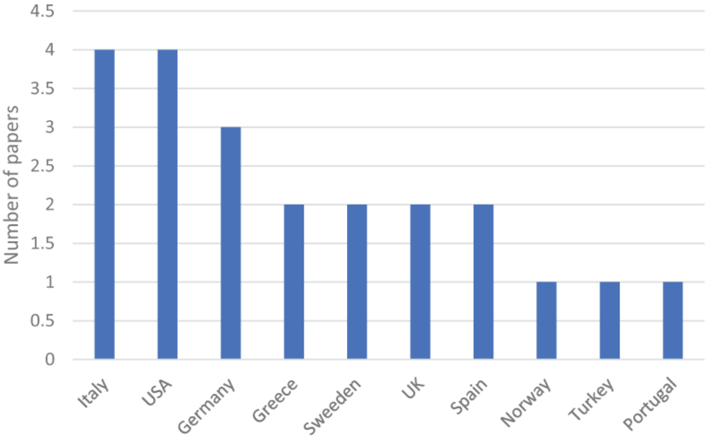
- Across 63 reviewed papers (40 from developing countries and 23 from developed countries), LM implementation improved operational performance in both groups, including product quality, delivery time, productivity, market share, sales, profit margins, cost, labour productivity, lead time, cycle time, inventory, bottlenecks, waste, flexibility and dependability.
- The review states that no paper reported a negative impact of implementing LM in manufacturing industries in developing and developed countries from 2015 to March 2020; however, it also notes that cited studies such as Negrão et al. (2016) found LM tools had a negative effect on financial or operational performance in only five studies.
- SMEs in both developed and developing countries have difficulties transforming their organizations into lean organizations compared with large enterprises. Developing-country SMEs cited lack of funding, technical know-how, tendency to return to old ways, employee resistance and management support; developed-country SMEs cited implementing fewer LM tools and a lack of resources.
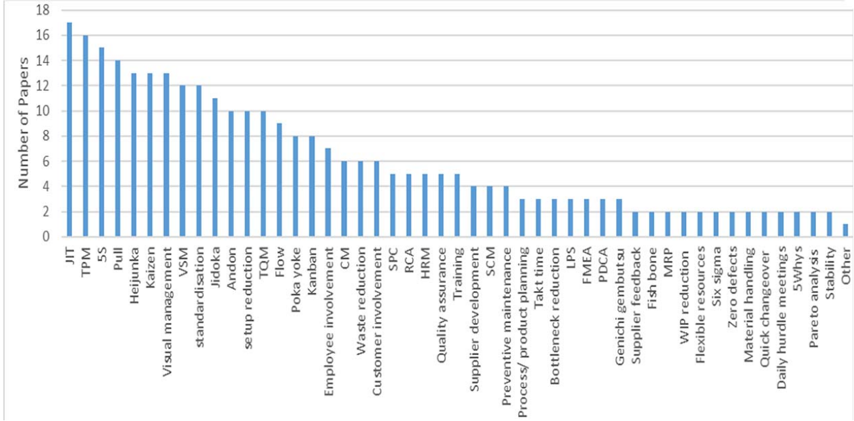
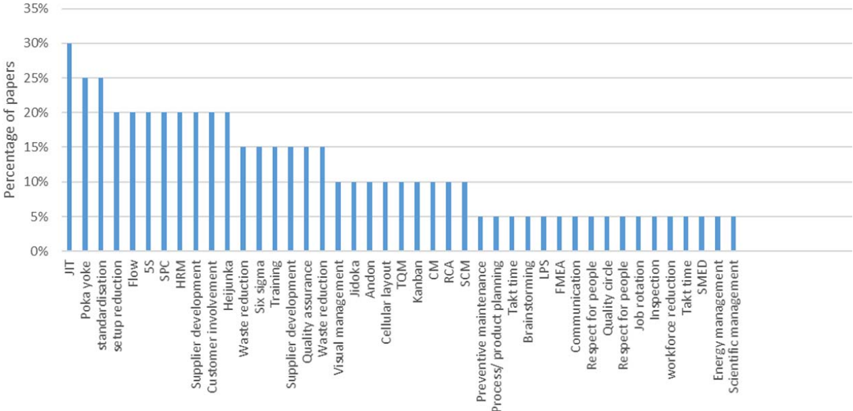
- Commonly used practices in developed countries were JIT, poka-yoke, standardization, setup reduction, 5S, SPC, HRM, supplier development, customer development and heijunka; in developing countries they were JIT, TPM, 5S, pull, heijunka, kaizen, visual management, VSM and standardization. JIT was the most commonly mentioned tool: 17 articles in developing countries and 30% of papers in developed countries.
Methods
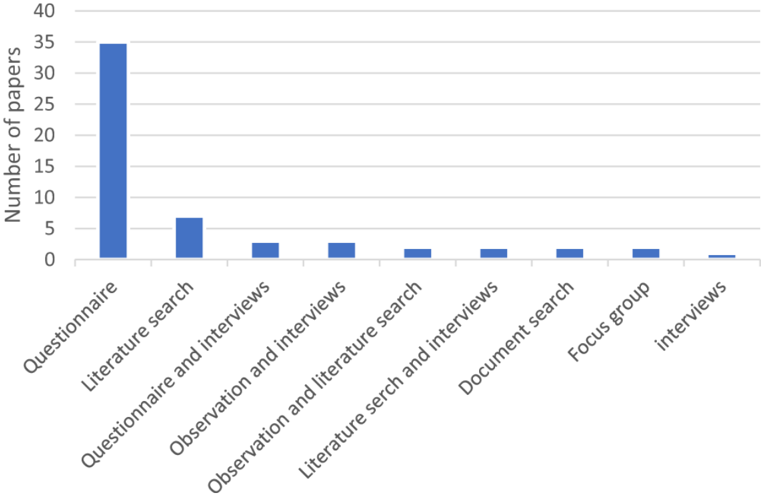
- Systematic literature review following steps given by Magnani et al. (2019), searching Google Scholar, Scopus, ProQuest and Web of Science for papers published between January 2015 and March 2020.
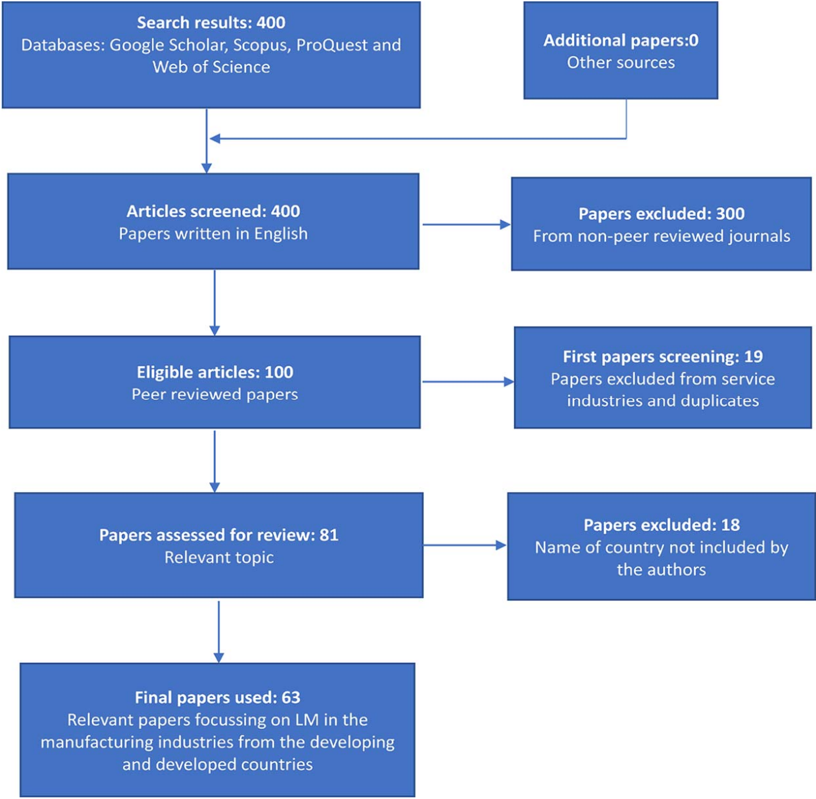
- The initial search yielded 673 articles; 273 duplicates were removed, and after filtering, 63 articles on LM application in manufacturing industries in developing and developed countries were included (40 developing, 23 developed). Inclusion criteria covered case studies and surveys on LM operational performance or LM practices/tools in manufacturing, English-language academic journal papers; exclusion criteria removed service-industry studies and studies not specifying industry type or country.
- Countries were classified using the Human Development Index (HDI > 0.8 developed, < 0.8 developing) and gross national income (GNI > $12,375 developed, < $12,375 developing). Analysis used descriptive counts and thematic summaries of research types, countries, journals, LM tools and themes.
Limitations
- Stated: the study used only research papers on manufacturing organizations from developed and developing nations, published between January 2015 and March 2020; it did not use textbooks or information from company websites; future research could compare service industries and increase collaboration between researchers in developing and developed countries.
- Stated/implicit: only English-language academic journal papers were included, excluding non-peer-reviewed journals, book chapters, reports, service-industry studies, and studies that did not specify industry type or country.
- Evident from the text: the review is a descriptive/thematic synthesis rather than a statistical meta-analysis, and several tables/figures are incomplete or fragmented in the provided text, limiting verification of some reported counts.
Model-written summary. Check it against the paper before relying on it.
Integrity signals
Registry
Cites
Statistics
Figures
Verification
Claims the paper makes
1 Valid · 4 Not valid · 135 Not checked · 72 Own results and interpretations
A result the paper states — it cites no source for it, so there is none to check. The quote shows it is in the paper.
In the paper
“Smallandmedium-sizedenterprisesin bothdevelopedanddevelopingcountrieshavedifficultiestransformingtheirorganizations intoleanorganizationscomparedtolargeenterprises.”
plainstates an association- Asserted: passes — The authors put it forward as true.
- Checkable: passes — It can be checked against evidence.
- Load-bearing: passes — The paper’s conclusions depend on it.
- Based: passes — The paper gives a reason why it holds.
A result the paper reports from its own data — it cites no other source for it, so there is none to check. The quote shows it is in the paper.
In the paper
“thereviewalsofound thatthereseemstohavebeennopaperhadreportedthenegativeimpactofimplementing LMinmanufacturingindustriesindevelopinganddevelopedcountriesfrom2015toMarch 2020.”
hedged- Asserted: passes — The authors put it forward as true.
- Checkable: passes — It can be checked against evidence.
- Load-bearing: passes — The paper’s conclusions depend on it.
- Based: passes — The paper gives a reason why it holds.
A result the paper states — it cites no source for it, so there is none to check. The quote shows it is in the paper.
In the paper
“It was observed that LM improves operational performance for manufacturing organizationsindevelopinganddevelopedcountries.”
plainstates a cause- Asserted: passes — The authors put it forward as true.
- Checkable: passes — It can be checked against evidence.
- Load-bearing: passes — The paper’s conclusions depend on it.
- Based: passes — The paper gives a reason why it holds.
In the paper
“The use of LM reduced the number of workers, improved employees' belief and behaviour, reduced disruptions in the operational systems and increased resilience and interactions among the major stakeholders”
What the sources say
- Not checked — no full text of the sourcecites Soliman et al. (2018) matched to “The impacts of lean production on the complexity of socio-technical systems” (2018) source
plainstates a cause- Asserted: passes — The authors put it forward as true.
- Checkable: passes — It can be checked against evidence.
- Load-bearing: unclear — It is unclear whether the paper’s conclusions depend on it.
- Based: passes — The paper gives a reason why it holds.
89 more claims
Create a free account to see all 212 claims and to verify the 39 references still open.
- Probably not a substantial claim. 85
- It may state two separate claims as one. 45
- The quote only partly states this claim. 14
Self-check
Percentages, sums and reported differences re-computed from the paper’s own numbers.
Each contradiction between two passages listed here was confirmed by an independent check.
Rated major: it would touch a result — a value a result rests on, reported and recomputed p-values on opposite sides of the significance level, two passages that conflict with no sign which is right, or a cited work retracted before this paper was published.
In the paper
§ 5.3.1Impactonoperationalperformance.
“product mix improvement(Bevilacqua etal. , 2016)”
§ 3.2Leanmanufacturingonmanufacturingfirmsindevelopedcountries
“while these practices negatively influenced innovation and product mix”
Rated major: it would touch a result — a value a result rests on, reported and recomputed p-values on opposite sides of the significance level, two passages that conflict with no sign which is right, or a cited work retracted before this paper was published.
In the paper
§ 5.3.2Possibilityofanegativeimpact.
“ThisstudynotedthatnopaperhadreportedanynegativeimpactofimplementingLMin manufacturingorganizationsfordevelopinganddevelopedcountriesfrom2015toMarch 2020.”
§ 3.2Leanmanufacturingonmanufacturingfirmsindevelopedcountries
“while these practices negatively influenced innovation and product mix”
Rated minor: it would not touch a result — a value no result rests on, a p-value that stays on the same side of the significance level, or a conflict that is clerical, resolved elsewhere in the paper, or outside its own findings.
In the paper
§ 4.Descriptiveresults
“The authors of this study investigated LM tools used by manufacturing organizations in developingcountries.TheLMtoolswerecategorizedaccordingtothefrequencyofthepapers that mentioned them, as shown in Figure 8.”
§ 4.Descriptiveresults
“Figure8. PercentageofpapersthatusedspecificLMtoolsinthedevelopedcountries”
Rated minor: it would not touch a result — a value no result rests on, a p-value that stays on the same side of the significance level, or a conflict that is clerical, resolved elsewhere in the paper, or outside its own findings.
In the paper
“| Annals of Operations Research | 1 | 4.1 |”
Reported 4.1 · recomputed 4.347826
Rated minor: it would not touch a result — a value no result rests on, a p-value that stays on the same side of the significance level, or a conflict that is clerical, resolved elsewhere in the paper, or outside its own findings.
In the paper
§ 4.Descriptiveresults
“JournalofProductionEconomics contributed22.7%,whichwasthehighest”
§ 4.Descriptiveresults
“| International Journal of Production Economics | 6 | 27.3 |”
Citations
Cites
Lean manufacturing: literature review and research issues
Bhamu, J., & Singh Sangwan, K. (2014) · International Journal of Operations & Production Management · doi:10.1108/ijopm-08-2012-0315 · Cited by 983
Sanders, A., Elangeswaran, C., & Wulfsberg, J. (2016) · Journal of Industrial Engineering and Management · doi:10.3926/jiem.1940 · Cited by 938
Bhasin, S., & Burcher, P. (2006) · Journal of Manufacturing Technology Management · doi:10.1108/17410380610639506 · Cited by 872
Successful lean implementation: Organizational culture and soft lean practices
Bortolotti, T., Boscari, S., & Danese, P. (2015) · International Journal of Production Economics · doi:10.1016/j.ijpe.2014.10.013 · Cited by 678
Lean production: literature review and trends
Jasti, N. V. K., & Kodali, R. (2015) · International Journal of Production Research · doi:10.1080/00207543.2014.937508 · Cited by 485
Impacts of Industry 4.0 technologies on Lean principles
Rosin, F., Forget, P., Lamouri, S., & Pellerin, R. (2020) · International Journal of Production Research · doi:10.1080/00207543.2019.1672902 · Cited by 448
Fullerton, R. R., Kennedy, F. A., & Widener, S. K. (2014) · Journal of Operations Management · doi:10.1016/j.jom.2014.09.002 · Cited by 407
Four decades of lean: a systematic literature review
Stone, K. B. (2012) · International Journal of Lean Six Sigma · doi:10.1108/20401461211243702 · Cited by 393
Doolen, T. L., & Hacker, M. E. (2005) · Journal of Manufacturing Systems · doi:10.1016/s0278-6125(05)80007-x · Cited by 347
Lean manufacturing and sustainable performance: Trends and future challenges
Henao, R., Sarache, W., & Gómez, I. (2019) · Journal of Cleaner Production · doi:10.1016/j.jclepro.2018.10.116 · Cited by 314
Research works printed but not linked: 6
- 2016, The World Bank's Classification of Countries by Income
- 2019, Lean manufacturing as a vehicle for improving productivity and customer satisfaction, International Journal of Lean Six Sigma, 10
- 2020, Costs and Trade-Offs in the Fight against the Covid-19 Pandemic: A Developing Country Perspective
- 2019, Lean manufacturing and productivity changes: the moderating role of R&D, International Journal of Productivity and Performance Management, 69
- 2020, Development of a lean manufacturing framework to enhance its adoption within manufacturing companies in developing economies, Journal of Cleaner Production, 245
- International Journal of Lean Six Sigma
Cited by
The Challenges of Lean Transformation and Implementation in the Manufacturing Sector
Maware, C., & Parsley, D. M. (2022) · Sustainability · doi:10.3390/su14106287 · Cited by 115
Self-citationNikolakis, N., Catti, P., Chaloulos, A., van de Kamp, W., Puerto, M. J., & Alexopoulos, K. (2024) · Journal of Cleaner Production · doi:10.1016/j.jclepro.2024.141289 · Cited by 57
Farrukh, A., Mathrani, S., & Sajjad, A. (2023) · Business Strategy and the Environment · doi:10.1002/bse.3412 · Cited by 47
Maware, C., & Parsley, D. M. (2023) · Sustainability · doi:10.3390/su15031962 · Cited by 48
Self-citationGaldos‐Urbizu, L., Zubeltzu‐Jaka, E., Tolosa, A. E., & Echeverría, I. Á. (2024) · Business Strategy & Development · doi:10.1002/bsd2.351 · Cited by 46
Quantitative modelling approaches for lean manufacturing under uncertainty
Rojas, T., Mula, J., & Sanchís, R. (2023) · International Journal of Production Research · doi:10.1080/00207543.2023.2293138 · Cited by 30
Reducing the Scrap Rate on a Production Process Using Lean Six Sigma Methodology
Enache, I., Chivu, O. R., Rugescu, A.-M. M., Ioniță, E., & Radu, I. V. (2023) · Processes · doi:10.3390/pr11041295 · Cited by 25
Opoku, R. K., Issifu, R., Ofori, D. F., Wafa, S., & Asiedu, A. (2024) · International Journal of Quality & Reliability Management · doi:10.1108/ijqrm-05-2024-0164 · Cited by 23
Towards Lean Manufacturing in Developing Countries: Research Gaps and Directions in Tanzania
Sinkamba, F. D., Matindana, J. M., & Mgwatu, M. I. (2023) · Tanzania Journal of Engineering and Technology · doi:10.52339/tjet.v42i1.886 · Cited by 23
Subramanian, N., Suresh, M., & John William, A. (2023) · Nankai Business Review International · doi:10.1108/nbri-09-2022-0087 · Cited by 21
Rumman, M. A. A., & Alqudah, E. (2024) · Global Journal of Flexible Systems Management · doi:10.1007/s40171-024-00406-y · Cited by 15
“These traits closely conform with characteristics of corporate flexibility, as generally resonated in the literature by Maware et al. (2021) and Boyle et al. (2009).”
Gopi, V., & Saleeshya, P. G. (2023) · Journal of Modelling in Management · doi:10.1108/jm2-05-2023-0107 · Cited by 19
Chen, Q., & Li, C. (2024) · Energies · doi:10.3390/en17143508 · Cited by 10
Burcă, V., Bogdan, O., Bunget, O.-C., & Dumitrescu, A.-C. (2024) · Sustainability · doi:10.3390/su16177744 · Cited by 27
Lean manufacturing and environmental performance: a meta-analytic approach
Santos, J. F., López, P. R. D. A., Zubeltzu‐Jaka, E., & Blanco, I. L. (2024) · International Journal of Lean Six Sigma · doi:10.1108/ijlss-11-2023-0190 · Cited by 19
Thunyachairat, A., Jangkrajarng, V., Theeranuphattana, A., & Ramingwong, S. (2023) · International Journal of Professional Business Review · doi:10.26668/businessreview/2023.v8i5.2137 · Cited by 12
“…et al., 2020) no significant impact (Fullerton et al., 2003:Green Jr et al., 2014) and partially negative impact (Marin-Garcia and Bonavia, 2015; Maware et al., 2022) But, Jadhav et al. (2014) argued that not all manufacturing firms can successfully transform themselves into a lean…”
BackgroundGreen Entrepreneurship—Added Value as a Strategic Orientation Business Model
Castillo-Benancio, S., Álvarez-Risco, A., Almanza-Cruz, C., Leclercq-Machado, L., Esquerre-Botton, S., Anderson-Seminario, M. D. L. M., & Del-Aguila-Arcentales, S. (2023) · Environmental footprints and eco-design of products and processes · doi:10.1007/978-981-19-8895-0_2 · Cited by 20
Calçado, R., Ávila, L., & Rosa, M. J. (2024) · Business Process Management Journal · doi:10.1108/bpmj-10-2023-0773 · Cited by 12
Lean –Green Practices and Firm Performance Assessment: An ANP Method
Sarwar, A., Hamza, M., & Shahzad, S. (2023) · International Journal of Management Science and Engineering Management · doi:10.1080/17509653.2023.2177760 · Cited by 7
“The implementation of lean-green (LG) practices might be helpful for manufacturing firms to minimize operational costs, improve production processes, reduce wastage, and promote sustainability (Maware, Okwu, & Adetunji, 2022).”
BackgroundMohamud, I. H. (2023) · Management Systems in Production Engineering · doi:10.2478/mspe-2023-0047 · Cited by 16
“[20]said that lean was a way to give people the most value by getting rid of waste through process and human design.”
Background(2024) · Jordan Journal of Mechanical and Industrial Engineering · doi:10.59038/jjmie/180109 · Cited by 8
Ruwanpura, U. D. R. E., Perera, B. A. K. S., & Ranadewa, T. (2023) · Construction Innovation · doi:10.1108/ci-03-2023-0057 · Cited by 14
Investigating the mediating impact of supplier quality integration in pharmaceutical supply chains
Alkalha, Z., Dehe, B., Reid, I. R., & Al-Zu’bi, Z. M. F. (2024) · International Journal of Quality & Reliability Management · doi:10.1108/ijqrm-04-2023-0135 · Cited by 9
Ojubanire, O. A., Marhraoui, M. A., Sebti, H., & Berbain, S. (2025) · International Journal of Lean Six Sigma · doi:10.1108/ijlss-05-2024-0110 · Cited by 15
ARAÚJO, A. D., Alves, A. C., & Romero, F. C. C. (2023) · International Journal of Lean Six Sigma · doi:10.1108/ijlss-12-2022-0253 · Cited by 12
Diagnostics of production processes using selected Lean Manufacturing tools
Sobczuk, S., Jakub, L., & Borucka, A. (2024) · Diagnostyka · doi:10.29354/diag/190140 · Cited by 6
“For example, it requires the employment of an experienced specialist involved in the implementation of this type of tools by the companies [1, 29].”
BackgroundFrom Micro to Macro: A Comprehensive Study of Lean Manufacturing Tools in Tanzanian Industries
Sinkamba, F. D., Matindana, J. M., & Mgwatu, M. I. (2025) · Engineering Reports · doi:10.1002/eng2.70020 · Cited by 9
Aplicación del Lean Manufacturing a una pequeña empresa de fundición metálica
Instituto Superior Tecnológico 17 de Julio, U., BENÍTEZ, F. R. F., Silva, G. B. N., & Instituto Superior Tecnológico 17 de Julio, U. (2022) · E-IDEA 4 0 Revista Multidisciplinar · doi:10.53734/mj.vol4.id216 · Cited by 20
Neves, Â., Erikstad, S. O., & Godina, R. (2025) · Journal of Marine Science and Technology · doi:10.1007/s00773-025-01078-8 · Cited by 23
Salman, S., Taqi, H. M. M., Nur, S. M. S. A., Awan, U., & Ali, S. M. (2024) · Journal of responsible production and consumption. · doi:10.1108/jrpc-10-2023-0009 · Cited by 11
Inuwa, M. L., Islam, K. M. A., & Male, I. G. (2022) · The Millennium University Journal · doi:10.58908/tmuj.v7i1.43 · Cited by 5
Kang, C. K.-T., Lin, C., & Ho, Y. (2022) · Information Management and Business Review · doi:10.22610/imbr.v14i2(i).3335 · Cited by 6
Chen, C. K. (2026) · International Journal of Lean Six Sigma · doi:10.1108/ijlss-06-2025-0161 · Cited by 12
Boysana, M., Mbohwa, C., & Pretorius, J. H. C. (2023) · Sustainability · doi:10.3390/su15086621 · Cited by 8
Quality improvement in retail-distribution of Saudi thobe using six-sigma
Abualsauod, E. H. (2023) · International Journal of Retail & Distribution Management · doi:10.1108/ijrdm-02-2023-0091 · Cited by 4
Haszainul, M. Z., Osman, A. A., Aziz, K. A., Rahamaddulla, S. R., & Kamar, A. N. N. (2024) · Springer Proceedings in Materials · doi:10.1007/978-981-99-9848-7_14 · Cited by 7
Analysis of Sustainable Lean Manufacturing Implementation in Pune Region Manufacturing Industries
Aher, D. H., Ubale, S., & Ubale, D. S. (2025) · Journal of Advanced Manufacturing Systems · doi:10.1142/s0219686725500337 · Cited by 5
Unraveling the dynamics of lean manufacturing enablers on operational performance
Zaman, S. I., Khan, S. A., Gunasekaran, A., & Zaman, S. A. A. (2024) · International Journal of Quality & Reliability Management · doi:10.1108/ijqrm-10-2023-0304 · Cited by 7
Singh, B. J. (2025) · International Journal of Lean Six Sigma · doi:10.1108/ijlss-04-2024-0071 · Cited by 4
Determinants of lean manufacturing adoption by Chinese manufacturers
Lin, C., Kang, C. K.-T., & Ho, Y. (2024) · International Journal of Lean Six Sigma · doi:10.1108/ijlss-09-2023-0151 · Cited by 3
Algethami, A., Assad, F., Patsavellas, J., & Salonitis, K. (2025) · Administrative Sciences · doi:10.3390/admsci15070241 · Cited by 8
Matindana, J. M., Sinkamba, F. D., & Mgwatu, M. I. (2025) · Engineering Reports · doi:10.1002/eng2.70414 · Cited by 4
Effect of lean manufacturing practices on manufacturing firms’ sustainability performance
Lyama, L. A., & Salema, G. L. (2025) · International Journal of Industrial Engineering and Operations Management · doi:10.1108/ijieom-02-2025-0019 · Cited by 4
Quality management research in Arab countries: current status and future directions
Yousef, D. A. (2023) · International Journal of Quality & Reliability Management · doi:10.1108/ijqrm-10-2022-0294 · Cited by 4
Aplicación de la 5S en las pymes dedicadas a la fabricación estructural
Amaguaya, M. A., & Viejó, J. L. M. (2022) · ConcienciaDigital · doi:10.33262/concienciadigital.v5i2.2132 · Cited by 2
Minh, N. D., & Quyen, N. T. H. (2023) · The TQM Journal · doi:10.1108/tqm-11-2022-0330 · Cited by 5
Vera, C., & González, Y. (2023) · doi:10.18687/laccei2023.1.1.1457 · Cited by 1
Gopi, V., & Saleeshya, P. G. (2024) · Benchmarking An International Journal · doi:10.1108/bij-04-2024-0331 · Cited by 3
dos Santos, V. A., Loures, E. D. F. R., Ramos, L. F. P., Deschamps, F., & Szejka, A. L. (2025) · Journal of Industrial Integration and Management · doi:10.1142/s2424862224300011 · Cited by 1
Kovach, J. V., Gomes, D., & Cardoso-Grilo, T. (2025) · Management Decision · doi:10.1108/md-11-2023-2036 · Cited by 1
A Framework for the Optimization of Complex Cyber-Physical Systems via Directed Acyclic Graph
Castejón‐Limas, M., Fernández-Robles, L., Aláiz‐Moretón, H., Cifuentes-Rodríguez, J., & Fernández, C. (2022) · Sensors · doi:10.3390/s22041490 · Cited by 4
Cruz-Rivero, L., Madrigal-Martínez, A., Ángeles-Herrera, D., et al. (2024) · Ciencia Latina Revista Científica Multidisciplinar · doi:10.37811/cl_rcm.v7i6.9142 · Cited by 1
Inuwa, M. L., & Male, I. G. (2024) · IIARD INTERNATIONAL JOURNAL OF ECONOMICS AND BUSINESS MANAGEMENT · doi:10.56201/ijebm.v9.no3.2023.pg15.30 · Cited by 2
Kashyap, S., Singh, M., Mann, G. S., & Singh, V. K. (2025) · International Journal on Interactive Design and Manufacturing (IJIDeM) · doi:10.1007/s12008-024-02207-0
“Literature reveals that small and medium scale industries of developing and developed countries are still struggling to adopt LM in their system efficiently [27].”
Yun, M., & Crippen, K. J. (2025) · Australasian journal of engineering education · doi:10.1080/22054952.2025.2485010 · Cited by 1
Langton, I., & Mafini, C. (2025) · Proceedings of the International Conference on Management and Economics · doi:10.33422/icmeconf.v1i1.824 · Cited by 1
Lean Manufacturing and Competitive Advantage of Selected Sugar Manufacturing Firms in Nigeria
Iherobiem, A. C., Adegboyega, L. O., Ariyibi, M. E., et al. (2025) · AKSU Journal of Administration and Corporate Governance · doi:10.61090/aksujacog.2025.024 · Cited by 1
A case study on improving productivity in paint booth assembly
Jayakumar, P., & Kumar, V. (2022) · Materials Today Proceedings · doi:10.1016/j.matpr.2022.04.288 · Cited by 1
Increasing Line Efficiency By Using Line Balancing In A Steel Manufacturing Company
Pham, C. V., Tra, T. T., Vu, H. M. C., Tu, H. C., & Vo, T. C. (2023) · Tập san Khoa học và kỹ thuật trường Đại học Bình Dương · doi:10.56097/binhduonguniversityjournalofscienceandtechnology.v6i2.158
“Lean manufacturing Nowadays, Lean Manufacturing is developed and applied all over the world, bringing many breakthrough results, it helps businesses develop effectively and sustainably, especially for developing countries [3].”
BackgroundDesenvolvimento de válvula aplicadora de fluídos e otimização do processo de produção
Kelly, C. A., Ribeiro, R. A., de Oliveira, R. R., Neto, G. M. P., Oliveira, T. R. D. S., Milad, S. R. C., Miguel, A. M., de Siqueira, M. C. G., & de Siqueira, M. C. G. (2022) · Research Society and Development · doi:10.33448/rsd-v11i16.38117
Trends in Lean Maintenance Implementation in Production Companies
Antosz, K., Jasiulewicz–Kaczmarek, M., Sá, J. C., et al. (2023) · Advances in logistics, operations, and management science book series · doi:10.4018/978-1-6684-5606-4.ch011
Key Factors of Manufacturing Operations Successfully Applying Lean Manufacturing
CHIEH-YU, L., & Kang, C. K.-T. (2022) · The Proceedings of the International Conference on Applied Research in Management, Business and Economics. · doi:10.33422/5th.icarbme.2022.07.102
Inuwa, M. L., Male, I. G., & Aminu, A. (2023) · IIARD INTERNATIONAL JOURNAL OF ECONOMICS AND BUSINESS MANAGEMENT · doi:10.56201/ijebm.v9.no1.2023.pg78.99 · Cited by 1
González, S. M., & Rios, J. M. (2023) · ScienceRise · doi:10.21303/2313-8416.2023.003237 · Cited by 3
Üretim seviyelendirme problemi için çok amaçlı programlama yaklaşımı: Bir otomotiv yan sanayi örneği
Tutumlu, B., Baş, S. A., & Kırış, Ş. (2023) · Gazi Üniversitesi Mühendislik-Mimarlık Fakültesi Dergisi · doi:10.17341/gazimmfd.1341993
Ssali, F. P. (2023) · DUT Open Scholar (Durban University of Technology) · doi:10.51415/10321/5311
Erbs, M. D. M., Detro, S. P., & Rosa, C. R. M. (2024) · Revista Foco · doi:10.54751/revistafoco.v17n10-078
A method for reducing energy costs in the production of construction components
Lisienkova, L., Budnikova, O., & Komarova, L. (2024) · E3S Web of Conferences · doi:10.1051/e3sconf/202458306003
Bernardino, S., & Ávila, L. (2025) · Gestão & Produção · doi:10.1590/1806-9649-2025v32e7624 · Cited by 4
Aplicación de Lean Manufacturing en el sector sanitario. Un análisis bibliométrico
Condori, D. G., & Likhodei, M. (2025) · Esprint Investigación · doi:10.61347/ei.v4i1.118
Harnessing Lean and FMEA techniques to eliminate waste and enhance performance in poultry processing
Husna, R., Sukmono, R. A., & Turekulova, D. M. (2025) · Jurnal Sistem dan Manajemen Industri · doi:10.30656/jsmi.v9i1.10078 · Cited by 1
Critical Success Factors for Lean Manufacturing Implementation: The Case of Egypt
Ahmed, M. M. M. (2025) · Journal of African Business · doi:10.1080/15228916.2025.2574123
Improving Poka-Yoke thinking: A comparative analysis and proposal of a novel classification model
Peric, J., Lazarević, M., Čep, R., Jocanović, M., Grković, V., Kuric, I., & Antić, A. (2026) · The International Journal of Advanced Manufacturing Technology · doi:10.1007/s00170-026-18161-y
Digitalizing the Automotive Assembly Supply Chain Using Multi-Agent-Based Digital Twins
Mykoniatis, K., & Katsigiannis, M. (2025) · International series in management science/operations research/International series in operations research & management science · doi:10.1007/978-3-032-08147-6_11
Integrating Industry 4.0 in Lean Manufacturing: A Review
Rachidi, A., Serrou, D., Mharzi, H., & Tchoffa, D. (2026) · Lecture notes in networks and systems · doi:10.1007/978-3-032-18548-8_15
Naranjo, F., Moyano‐Fuentes, J., & Marín, J. M. M. (2026) · International Journal of Lean Six Sigma · doi:10.1108/ijlss-05-2025-0142 · Cited by 2
Lean manufacturing model for productivity improvement: application in an apparel SME
Chavez-Escobedo, J. J., Gress, E. S. H., Antonio-Cruz, M., & Merlo-Zapata, C. A. (2026) · International Journal of Lean Six Sigma · doi:10.1108/ijlss-08-2025-0211
Beloor, V., Nanjundeswaraswamy, T. S., & Krishna, N. (2026) · International Journal of Lean Six Sigma · doi:10.1108/ijlss-01-2025-0009
Ihsan, T., Ferdian, R., & Oktaviani, M. (2026) · Industrial and Domestic Waste Management · doi:10.53623/idwm.v6i1.1098
Lean-driven Innovation in Apparel Manufacturing: A Case Study
Essila, J. C., Haque, N., & Motwani, J. G. (2026) · Journal of Operations and Strategic Planning · doi:10.1177/2516600x261446128
“Smaller lines are inherently more adaptable, making it easier to implement changes and maintain a consistent flow, which is crucial for meeting the evolving demands of fast fashion and similar industries (Maware et al., 2022).”
Sefenu, F. Y., Appiah, N. A., Siaw, A. O., Kansanba, R. F., & Howard, E. K. (2026) · African Journal Of Applied Research · doi:10.26437/991m4785
“Wast e in enterprises’ production processes that affect productivity and competitiveness are from varied sources such as overproduction, stockpiling, transport and travel that is unnecessary, over-processing, unnecessary movements, errors, defects, rejects and waiting times (Maware et al., 2022).”
Singh, R., Pandey, A., Kumar, V., Joshi, A., & Dsilva, J. (2026) · De Gruyter eBooks · doi:10.1515/9783112237687-017
Krstovska-Ilijoska, S., Andronikov, D., Zhezhova, S., et al. (2026) · doi:10.5937/ct_iti26434k
Islam, M. H. (2026) · Cleaner Manufacturing · doi:10.1016/j.clman.2026.100011
Maheshwari, P., & Kumar, L. (2026) · International Journal of Production Research · doi:10.1080/00207543.2026.2739604
Metadata
- Authors
- Maware, C., Okwu, M. O., & Adetunji, O.
- Affiliations
- University of Pretoria (ZA)
- University of Johannesburg (ZA)
- Venue
- International Journal of Lean Six Sigma
- Publisher
- Emerald
- Published
- 2021-06-28
- Volume
- 13
- Issue
- 3
- Pages
- 521-556
- ISSN
- 2040-4166 (ISSN-L)
- OpenAlex
- W3177115849
- Semantic Scholar
- dc1ff3874bcfe1c1964f8e208b1b94575c2c0088
- Cited by
- 88
- References
- 120
- Citations by year
- 2026: 14 · 2025: 20 · 2024: 21 · 2023: 24 · 2022: 9
- FWCI
- 3.86
- Type
- journal article
- Language
- en
- Open access
- closed
- Licence
- www.emerald.com/insight/site-policies (tdm)
- Locations
- International Journal of Lean Six Sigma (publishedVersion)
- UpSpace Institutional Repository (University of Pretoria) (submittedVersion)
- Topics
- Social Sciences › Business, Management and Accounting › Management Information Systems › Quality and Supply Management
- Social Sciences › Business, Management and Accounting › Strategy and Management › Management and Optimization Techniques
- Physical Sciences › Engineering › Industrial and Manufacturing Engineering › Digital Transformation in Industry
- Keywords
- lean manufacturing, lean implementation, manufacturing industry, developing countries, developed countries, small and medium-sized enterprises, operational performance, lean practices, cross-national comparison
About these checks
Registry, retraction, Cites and statistics results are computed, not judged, with one exception: a printed reference that no index lists is read once by a model before it counts as a citation error. Claims are extracted by a model and kept only when their quote appears verbatim in the text; each cited source is then checked, with a model’s help, for whether it says what the claim relies on. Those verdicts can be wrong — read the claim’s quote and the cited source before relying on one.
The claim verdicts this report counts are experimental: their accuracy is not yet measured.
A language model drew the claims from the paper on 2026-10-10, under version 3 of the claim definition (model deepseek-v4.1-flash, prompt extract-v3).
A second model labelled each claim on 2026-10-10 (model jev-1.13-20260917, definition revision gold-guideline-v0.2).
Statistics and arithmetic are recomputed, not judged.
Confidence bands are shown only for fields calibrated on our annotated test set. None is calibrated yet, so no band is shown.
What counts as a claim ›How we measure confidence ›How we check this ›
Are you an author, or do you see a problem with this page? Request a review
Data sources
Bibliographic data: Semantic Scholar, OpenAlex, Crossref.
Contains information from the Semantic Scholar Academic Graph Datasets, made available under the ODC Attribution License (ODC-BY 1.0).
Semantic Scholar’s data is described in: Kinney, R., et al. (2023). The Semantic Scholar Open Data Platform. arXiv:2301.10140.
