

Financial development and economic growth: panel evidence from BRICS
Open accessThe DOI matches its Crossref record; 43 of the 43 references it cites were found in a registry or an index.
Abstract
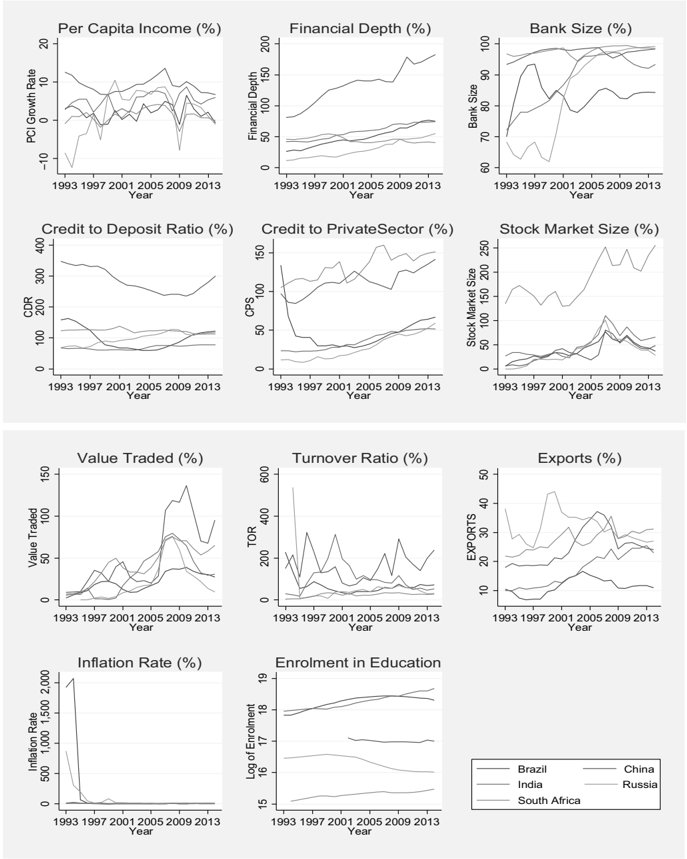
Purpose: The purpose of this paper is to examine the relationship between financial development and economic growth for five major emerging economies: Brazil, Russia, India, China and South (BRICS) during 1993 to 2014 using banking sector and stock market development indicators. Design/methodology/approach: To begin with, the study first examined some of the principal indicators of financial development and macroeconomic variables of the selected economies. Next, using generalized method of moment system estimation (SYS-GMM), the relationship between financial development and growth is investigated. The banking sector development indicators used in the study include size of the financial intermediaries, credit to deposit ratio (CDR) and domestic credit to private sector (CPS), whereas the stock market development indicators are value of shares traded and turnover ratio. Also, some macroeconomic control variables such as inflation, exports and the enrolment in secondary education were used. Findings: The examination of the principal indicators of financial development and macroeconomic variables have shown considerable differences between the selected economies. Results from the dynamic one-step SYS-GMM estimates confirm that in presence of turnover ratio, all the selected banking development indicators such as size of financial intermediaries, CDR and CPS are positively significantly determining economic growth. Similarly, in presence of all the selected banking sector development indicators, value of shares traded is found to be positively significantly associated with economic growth. However, the same is not true when turnover ratio is regressed in presence of banking sector variables. Overall, the evidence suggests that banking sector development and stock market development indicators are complementary to each other in stimulating economic growth. Practical implications: A positive association between financial development and growth indicates that the policymakers should take necessary measures toward simultaneous development of both banking sector as well as stock market for inducing growth. Originality/value: The present paper attempts to examine the relationship between financial development and growth using both banking sector and stock market development indicators which has not been attempted before for BRICS. Also, most of the existing studies are found in case of developed economies. This paper tries to fill this void by studying five major emerging economies.
Overview
The claims and statistics of this paper haven’t been checked yet.
Free: it reads the open-access text and checks the first 5 claims that cite a source we can check. Create a free account to check every claim.
Integrity signals
Registry
Cites
Statistics
Figures
Verification
Claims the paper makes
The claims and statistics of this paper haven’t been checked yet.
Free: it reads the open-access text and checks the first 5 claims that cite a source we can check. Create a free account to check every claim.
Claims other papers make about this one
Each is checked against this paper’s own text: does it say what the citing paper says it does?
The check wasn’t confident either way, so it gives no verdict — never disputed.
In the citing paper
“Thus, regardless of which measure of financial development (FD) is used, there is evidence of bi-directional causality running from FD to GROWTH and from GROWTH to FD in Europe and Central Asia, South Asia, and the all-countries sample, but not for the other regions.”
From The Nexus between Financial Development and Economic Growth: Panel Data Evidence from Developing Countries (2021) · cites this paper as Guru and Yadav (2019)
Experimental — accuracy not yet measured
Self-check
Percentages, sums and reported differences re-computed from the paper’s own numbers.
The self-check needs the paper’s full text.
Citations
Cites
Arellano, M., & Bond, S. (1991) · The Review of Economic Studies · doi:10.2307/2297968 · Cited by 33,272
On the mechanics of economic development
Lucas, R. E. (1988) · Journal of Monetary Economics · doi:10.1016/0304-3932(88)90168-7 · Cited by 24,085
Initial conditions and moment restrictions in dynamic panel data models
Blundell, R., & Bond, S. (1998) · Journal of Econometrics · doi:10.1016/s0304-4076(98)00009-8 · Cited by 22,571
The Theory of Economic Development
Schumpeter, J., & Backhaus, U. (2006) · The European Heritage in Economics and the Social Sciences · doi:10.1007/0-306-48082-4_3 · Cited by 22,506 · cited 2×
“The seminal exertion by Schumpeter (1934), Goldsmith (1969), McKinnon (1973) and Shaw (1973) underscores the relevance of financial development for economic growth for some considerable time.”
BackgroundResultInitial conditions and moment restrictions in dynamic panel data models
Blundell, R., & Bond, S. (1995) · Working Paper Series · doi:10.1920/wp.ifs.1995.9517 · Cited by 14,755
Finance and Growth: Schumpeter Might Be Right
King, R. G., & Levine, R. (1993) · The Quarterly Journal of Economics · doi:10.2307/2118406 · Cited by 8,657
Financial intermediation and delegated monitoring
Diamond, D. W. (1984) · The Review of Economic Studies · doi:10.2307/2297430 · Cited by 8,476
Hsiao, C. (2022) · doi:10.1017/9781009057745 · Cited by 7,869
Hsiao, C. (2014) · doi:10.1017/cbo9781139839327 · Cited by 7,869
Hsiao, C. (2003) · doi:10.1017/cbo9780511754203 · Cited by 7,869
Research works printed but not linked: 3
- 1952, The generalization of the general theory
- 33. Shaw, E.S. (1973), Financial Deepening in Economic Development, Oxford University Press, New York, NY.
- 35. Wachtel, P. and Rousseau, P.L. (1995), "Financial intermediation and economic growth: a historical comparison of the United States, the United Kingdom, and Canada", in Bordo, M.D. and Sylla, R. (Eds), Anglo-American Financial Systems: Institutions and Markets in the Twentieth Century, Irwin Professional Publishing, New York, NY, pp. 329-381.
Cited by
Khan, I., Hou, F., Irfan, M., Zakari, A., & Le, H. P. (2021) · Renewable and Sustainable Energy Reviews · doi:10.1016/j.rser.2021.111157 · Cited by 363
Natural resources, green innovation, fintech, and sustainability: A fresh insight from BRICS
Lisha, L., Mousa, S., Arnone, G., Muda, I., Huerta-Soto, R., & Shiming, Z. (2023) · Resources Policy · doi:10.1016/j.resourpol.2022.103119 · Cited by 203
Redmond, T., & Nasir, M. A. (2020) · Resources Policy · doi:10.1016/j.resourpol.2020.101591 · Cited by 182
Batool, Z., Raza, S. M. F., Ali, S., & Abidin, S. Z. U. (2022) · Environmental Science and Pollution Research · doi:10.1007/s11356-022-18664-7 · Cited by 182
“It is believed that a developed financial sector contributes to the economic growth of the country by stimulating economic activities (Guru and Yadav 2019; Yang 2019; Raheem et al.”
BackgroundFinancial development and institutional quality among emerging economies
Abaidoo, R., & Agyapong, E. K. (2022) · Journal of Economics and Development · doi:10.1108/jed-08-2021-0135 · Cited by 178
Mtar, K., & Belazreg, W. (2020) · Journal of the Knowledge Economy · doi:10.1007/s13132-020-00628-2 · Cited by 160
“Several empirical studies have agreed that financial sector development has positive effect on growth (King and Levine 1993; Levine et al. 2000; Saci et al. 2009; Beck et al. 2000; Christopoulos and Tsionas 2004; Wu et al. 2010; Leitao 2010; Azman-Saini et al. 2010;Hassan et al. 2011;Uddin et al. 2013;Nazlioglu et al.…”
BackgroundEffects of digitalization on financialization: Empirical evidence from European countries
Hà, L. T. (2022) · Technology in Society · doi:10.1016/j.techsoc.2021.101851 · Cited by 155
Zheng, G.-W., Murshed, M., Siddik, A. B., Alam, M. S., Balsalobre‐Lorente, D., & Mahmood, H. (2022) · Sustainable Development · doi:10.1002/sd.2411 · Cited by 163
Sadiq, M., Paramaiah, C., Joseph, R., Dong, Z., Nawaz, M. A., & Khajimuratov, N. S. (2023) · Resources Policy · doi:10.1016/j.resourpol.2023.104494 · Cited by 111
Yadav, A., Bekun, F. V., Öztürk, İ., Ferreira, P., & Karalinç, T. (2024) · Energy Strategy Reviews · doi:10.1016/j.esr.2024.101434 · Cited by 105
COVID-19 economic policy response, resilience and tourism recovery
Okafor, L. E., Khalid, U., & Gopalan, S. (2022) · Annals of Tourism Research Empirical Insights · doi:10.1016/j.annale.2022.100073 · Cited by 98
Asafo‐Adjei, E., Boateng, E., Isshaq, Z., Idun, A. A., Owusu, P., & Adam, A. M. (2021) · PLoS ONE · doi:10.1371/journal.pone.0259303 · Cited by 90
“Moreover, Guru and Yadav [21] show that proxies for the financial sector also explains differences in existing results.”
BackgroundMusah, M., Owusu-Akomeah, M. N., Kumah, E. A., Mensah, I. A., Nyeadi, J. D., Murshed, M., & Alfred, M. (2022) · Environmental Science and Pollution Research · doi:10.1007/s11356-021-17685-y · Cited by 82
“Angeliki (2021) and Guru and Yadav (2019) explained FD as the scope, stability, and efficiency of financial institutions, as well as having a better access to those institutions with the prime intention of boosting economic viability.”
RetractedBayraktar, Y., Özyılmaz, A., Toprak, M., Olgun, M. F., & Işık, E. (2023) · Borsa Istanbul Review · doi:10.1016/j.bir.2023.10.002 · Cited by 83
A Panel Data Analysis on Sustainable Economic Growth in India, Brazil, and Romania
Bătrâncea, I., Kumaran, R., Larissa, B., Anca, N., Lucian, G., Gheorghe, F., Tulai, H. I., Ioan, B., & Rus, M.-I. (2020) · Journal of risk and financial management · doi:10.3390/jrfm13080170 · Cited by 73
“Guru and Yadav (2019) examined this relationship using banking sector and stock market indicators from emerging BRICS economies during the period of 1993–2014, and found a complementary link between the development of the banking sector and stock market (on one hand) and economic growth (on the…”
BackgroundMethodDestek, M. A., Adedoyin, F. F., Bekun, F. V., & Aydın, S. (2022) · Resources Policy · doi:10.1016/j.resourpol.2022.103234 · Cited by 82
Bekele, D. T., & Degu, A. A. (2021) · International Journal of Finance & Economics · doi:10.1002/ijfe.2566 · Cited by 86
Li, N., & Wu, D. (2023) · Resources Policy · doi:10.1016/j.resourpol.2023.103883 · Cited by 65
Impact of ICT diffusion and financial development on economic growth in developing countries
Verma, A., Dandgawhal, P. S., & Giri, A. K. (2023) · Journal of Economics Finance and Administrative Science · doi:10.1108/jefas-09-2021-0185 · Cited by 82
Azmeh, C., & Al‐Raeei, M. (2024) · PLoS ONE · doi:10.1371/journal.pone.0315174 · Cited by 74
Determinants of women's financial inclusion: Evidence from India
Govindapuram, S., Bhupatiraju, S., & Sirohi, R. A. (2022) · Annals of Public and Cooperative Economics · doi:10.1111/apce.12376 · Cited by 63
Zhou, D., Saeed, U. F., Kongkuah, M., & Wiredu, I. (2024) · Environment Development and Sustainability · doi:10.1007/s10668-024-05430-7 · Cited by 48
FINANCIAL INTERMEDIATION AND ECONOMIC GROWTH IN NIGERIA
Oluranti, O. A., Muritala, T. A., Yusuf, W. A., George, S., & Oyegoke, E. O. (2024) · Journal of Law and Sustainable Development · doi:10.55908/sdgs.v12i6.3797 · Cited by 48
Alsamara, M., Mrabet, Z., & Mimouni, K. (2023) · International Review of Economics & Finance · doi:10.1016/j.iref.2023.10.015 · Cited by 53
Ekanayake, E. M., & Thaver, R. (2021) · Journal of Risk and Financial Management · doi:10.3390/jrfm14100489 · Cited by 43
“These results are supported by those of Botev et al. (2019), Guru and Yadav (2019), and Ibrahim and Alagidede (2018).”
MethodResultThe effect of mining foreign direct investment inflow on the economic growth of Zimbabwe
Gochero, P., & Seetanah, B. (2020) · Journal of Economic Structures · doi:10.1186/s40008-020-00230-4 · Cited by 55
Murrar, A., Asfour, B. Y., & Paz, V. C. (2024) · Asian Journal of Economics and Banking · doi:10.1108/ajeb-12-2023-0122 · Cited by 45
Chowdhury, J. R., Parida, Y., & Goel, P. A. (2021) · World Development · doi:10.1016/j.worlddev.2021.105394 · Cited by 49
Stock Market Development and Economic Growth: Empirical Evidence from Nepal
Bhattarai, J. K., Gautam, R., & Chettri, K. K. (2021) · Global Business Review · doi:10.1177/09721509211016818 · Cited by 46
“Annual real GDP per capita growth in percentage (RGDP) is taken as an indicator of economic growth (Guru & Yadav, 2019; Pradhan et al., 2020) expressed in base year 2001.”
Alshwayat, D., Elrehail, H., Shehadeh, E., Salhi, N. A., Shamout, M. D., & Rehman, S. U. (2022) · International Journal of Innovation Studies · doi:10.1016/j.ijis.2022.12.005 · Cited by 46
Does financial development improve economic growth? The role of asymmetrical relationships
Singh, S., Arya, V., Yadav, M. P., & Power, G. J. (2023) · Global Finance Journal · doi:10.1016/j.gfj.2023.100831 · Cited by 51
Financial Development, Human Resources, and Economic Growth in Transition Countries
Nguyen, T. A. N. (2022) · Economies · doi:10.3390/economies10060138 · Cited by 42
Islamic banks' contribution to Indonesia districts' economic growth and poverty alleviation
Junaidi, J. (2024) · Journal of Economics, Finance and Administrative Science · doi:10.1108/jefas-06-2021-0097 · Cited by 40
Халатур, С. М., Валентинівна, К. С., Oleksiuk, V., Kravchenko, M., & Klymenko, S. (2023) · Financial and credit activity problems of theory and practice · doi:10.55643/fcaptp.5.52.2023.4169 · Cited by 40
“Guru and Yadav (2019) conducted a panel study on BRICS countries to examine the relationship between financial development and economic growth.”
BackgroundZhe, D., Su, N., Zhu, X., Mahmoud, H. A., & Akhtar, T. (2024) · Resources Policy · doi:10.1016/j.resourpol.2024.104902 · Cited by 40
Financial development and sustainable development: A review of literature
Akhtar, N., & Rashid, A. (2024) · Sustainable Development · doi:10.1002/sd.3068 · Cited by 48
Saeed, U. F., Kamil, R., & Wiredu, I. (2025) · Cogent Economics & Finance · doi:10.1080/23322039.2024.2448228 · Cited by 41
“…of the private sector and EG (Alhassan et al., 2022; Ali et al., 2021; Aluko & Ibrahim, 2020), FD of financial institutions and economic progress (Guru & Yadav, 2019; Hunjra et al., 2021), FD of the banking sector and EG (Mohieldin et al. 2019; Rahman et al., 2020) and the growth rate of broad…”
InfluentialOlaniyi, C. O., & Oladeji, S. I. (2020) · Journal of Public Affairs · doi:10.1002/pa.2562 · Cited by 39
Nguyen, T. T., & Nguyen, V. C. (2021) · Sustainability · doi:10.3390/su13168748 · Cited by 38
“In some previous studies, financial development has been denoted as the process of establishing and the growing of financial institutions, instruments, and markets [27].”
BackgroundOlaniyi, C. O. (2021) · Economic Change and Restructuring · doi:10.1007/s10644-020-09313-5 · Cited by 42
“(2) (Guru and Yadav 2019).”
BackgroundAnti-money laundering measures and financial sector development: Empirical evidence from Africa
Antwi, S., Tetteh, A. B., Armah, P., & Dankwah, E. O. (2023) · Cogent Economics & Finance · doi:10.1080/23322039.2023.2209957 · Cited by 41
“Financial development gives better information about possible profitable investments and promotes optimum allocation of capital (Guru & Yadav, 2019).”
BackgroundBayar, Y., Gavriletea, M. D., & Dănulețiu, D. C. (2021) · Journal of Business Economics and Management · doi:10.3846/jbem.2021.14287 · Cited by 45
“(2017), Guru and Yadav (2019), Sulemana and Dramani (2020), have underlined that the development of the financial sector can influence in a positive manner economic growth, but other studies conducted by Ram (1999), Ang and McKibbin (2007), Adusei (2013), Mmolainyane and Ahmed (2015) have found a…”
ResultGeopolitical risk and economic security: Exploring natural resources extraction from BRICS region
Cao, L., Gu, M., Ding, J., & Wang, C. (2023) · Resources Policy · doi:10.1016/j.resourpol.2023.103800 · Cited by 34
Financial development impact on domestic investment: does income level matter?
He, Y., & Yoo, T. H. (2024) · Cogent Economics & Finance · doi:10.1080/23322039.2024.2321811 · Cited by 35
Does green investment affect environment pollution: Evidence from asymmetric ARDL approach?
Shen, Y., Rahman, S. U., Shahzadi, H. N., Meo, M. S., & Sibt‐e‐Ali, M. (2024) · PLoS ONE · doi:10.1371/journal.pone.0292260 · Cited by 31
RetractedBibi, R., & Sumaira (2022) · Journal of Environmental Science and Economics · doi:10.56556/jescae.v1i1.1 · Cited by 30
“Our result of this study is reinforced by the study of other researchers such as the study of (Guru & Yadav, 2019) who also have studied the same association and have found that banks exert positive impact on growth level in BRICS economies.”
ResultTouati, K., & Ben‐Salha, O. (2024) · Sustainability · doi:10.3390/su16093576 · Cited by 30
Nexus Among Innovations, Financial Development and Economic Growth in Developing Countries
Amjad, A. L. I., Audi, M., & HAMADEH, H. F. (2022) · Journal of Applied Economic Sciences (JAES) · doi:10.57017/jaes.v17.4(78).09 · Cited by 64
“With the passage of time, the structural and innovative changes in the financial system tie the individuals and firms together for the welfare of the economy as whole (Guru and Yadav 2019).”
BackgroundYuan, X., Murshed, M., & Khan, S. (2022) · Evaluation Review · doi:10.1177/0193841x221145777 · Cited by 31
“Among these, using different indicators of fi nancial development, Guru and Yadav (2019) asserted that higher number of fi nancial intermediaries, larger credit-to-deposit ratios, and greater credits provided to the domestic private sector positively in fl uence the economic growth levels of China and…”
MethodBakar, H. O., Sulong, Z., & Chowdhury, M. A. F. (2020) · International Journal of Emerging Markets · doi:10.1108/ijoem-08-2019-0638 · Cited by 35
Azmeh, C. (2025) · Research in Globalization · doi:10.1016/j.resglo.2025.100277 · Cited by 33
Pandey, A., Kiran, R., & Sharma, R. K. (2023) · Sustainability · doi:10.3390/su15021603 · Cited by 38
“Guru and Yadav [57] have used financial intermediaries, credit-to-deposit ratio, and domestic credit to the private sector of BRICS nations as determinants to investigate the factors that influence FI.”
BackgroundTu, Y. (2024) · Resources Policy · doi:10.1016/j.resourpol.2024.104832 · Cited by 26
Nilashi, M., Abumalloh, R. A., Ooi, K., Tan, G. W.-H., Cham, T., & Aw, E. C. (2024) · Resources Policy · doi:10.1016/j.resourpol.2024.105028 · Cited by 27
Olaniyi, C. O., & Olayeni, O. R. (2020) · Journal of Social and Economic Development · doi:10.1007/s40847-020-00103-3 · Cited by 29
“In order to deal with this problem of endogeneity, this study follows the studies of Olaniyi (2019), Guru and Yadav (2019), Chen et al.”
BackgroundHassan, A. S. (2022) · Mineral Economics · doi:10.1007/s13563-022-00330-6 · Cited by 27
“This also calls for the adoption of an estimation method that can take care of endogeneity of the regressors in the model (Guru and Yadav 2019).”
MethodAlam, W., Ikram, F., Kumar, P., Haseeb, M., & Ali, N. (2022) · Millennial Asia · doi:10.1177/09763996221122205 · Cited by 31
Meniago, C., Mazorodze, B. T., & Mah, G. (2025) · Cogent Economics & Finance · doi:10.1080/23322039.2025.2460067 · Cited by 28
“Notwithstanding, Guru and Yadav (2019) examined the relationship in Brazil, Russia, India, China and South Africa (BRICS).”
Shaari, M. S., Majekodunmi, T. B., Zainal, N. F., Harun, N. H., & Ridzuan, A. R. (2023) · Energy · doi:10.1016/j.energy.2023.129395 · Cited by 24
Islamic finance and economic growth: Global evidence
Hanif, M., Chaker, M. N., & Sabah, A. (2024) · Digest of Middle East Studies · doi:10.1111/dome.12313 · Cited by 31
Financial Development and Economic Growth: Evidence from Low-Income Nations in the SADC Region
Mlambo, C. (2024) · International Journal of Financial Studies · doi:10.3390/ijfs12030062 · Cited by 35
Akpiliç, F. (2025) · Journal of International Trade & Economic Development · doi:10.1080/09638199.2025.2459911 · Cited by 23
“It refers to the expansion of market size, efficiency, and stability, along with increased access to financial markets, offering numerous benefits to the economy (Guru and Yadav 2019).”
Financial and Economic Determinants of Banks Financial Distress in MENA Region
Metwally, A. B. M., Yasser, M., Ahmed, E. A., & Ali, M. A. S. (2025) · Economies · doi:10.3390/economies13020056 · Cited by 23
Ibrahiem, D. M., & Sameh, R. (2021) · International Journal of Energy Sector Management · doi:10.1108/ijesm-04-2021-0003 · Cited by 27
Coal mining and environmental sustainability in South Africa: do institutions matter?
Hassan, A. S. (2022) · Environmental Science and Pollution Research · doi:10.1007/s11356-022-23585-6 · Cited by 23
“Furthermore, the models have a propensity for endogenous independent variables, which might cause the simultaneity issue and this necessitates the use of a technique that can account for the endogeneity of regressors (Guru and Yadav 2019).”
MethodSmooth transition regression model relating inflation to economic growth in Tunisia
Becha, H., Kalai, M., & Helali, K. (2023) · Journal of Economic Structures · doi:10.1186/s40008-023-00308-9 · Cited by 26
“Similarly, a financial system development can be defined as the development of the size, efficiency, and stability of financial markets along with increased access to financial markets that can have multiple benefits on the economy (Guru and Yadav 2019).”
BackgroundWang, X., Sarwar, B., Haseeb, M., Samour, A., Hossain, M. E., Kamal, M., & Khan, M. F. (2023) · Heliyon · doi:10.1016/j.heliyon.2023.e20584 · Cited by 25
“For instance, some studies [30, 52,53] and [54,55] have illustrated that a significant improvement in the finance sector positively affects the rate of economic growth, which eventually affects energy utilisation and ecological quality.”
BackgroundTrebicka, B., Harizi, A., Krasniqi, M., Kalaja, R., & Tartaraj, A. (2024) · Risk Governance and Control Financial Markets & Institutions · doi:10.22495/rgcv14i3p8 · Cited by 23
Huy, N. Q., & Quoc, D. L. (2025) · Research on World Agricultural Economy · doi:10.36956/rwae.v6i4.2643 · Cited by 24
Causality relationship between human capital, technological development and economic growth
Sulisnaningrum, E., Widarni, E. L., & Bawono, S. (2022) · Journal of Management, Economics, and Industrial Organization · doi:10.31039/jomeino.2022.6.2.1 · Cited by 24
Multilevel determinants of FDI: A regional comparative analysis
Sarker, B., & Serieux, J. E. (2023) · Economic Systems · doi:10.1016/j.ecosys.2023.101095 · Cited by 25
Can energy efficiency and natural resources foster economic growth? Evidence from BRICS countries
Li, T., Yue, G. X.-G., Waheed, H., & Yıldırım, B. (2023) · Resources Policy · doi:10.1016/j.resourpol.2023.103643 · Cited by 21
Financial development and economic growth in Ethiopia: Is there a causal link?
Mengesha, S. T., & Berde, É. (2023) · Cogent Economics & Finance · doi:10.1080/23322039.2023.2245309 · Cited by 25
“…of some other studies such Teklu and Jemal (2019), Durusu-Ciftci et al. (2017), Taddese Bekele and Abebaw Degu (2021), Bist and Read (2018), and Guru and Yadav (2019) 2019), Odhiambo and Nyasha (2022) and Okuyan (2022), who reported no causal relationship between financial development and…”
InfluentialZioło, M., Bąk, I. D., Spoz, A., Oesterreich, M., Niedzielski, P., & Raczkowski, K. (2023) · Frontiers in Environmental Science · doi:10.3389/fenvs.2023.1244119 · Cited by 23
Hunjra, A. I., Arunachalam, M., & Hanif, M. (2021) · Springer eBooks · doi:10.1007/978-3-030-79003-5_9 · Cited by 27
Stock market development and nexus of market liquidity: The case of Fiji
Saliya, C. A. (2020) · International Journal of Finance & Economics · doi:10.1002/ijfe.2376 · Cited by 24
The Impact of Entrepreneurship on Economic Growth in 95 Developing and Emerging Countries
Zouita, M. S. (2021) · Scientific Annals of Economics and Business · doi:10.47743/saeb-2021-0014 · Cited by 21
“All these variables are regarded as possible determinants of economic growth in the preceding literature (De Gregorio and Guidotti, 1995; Gylfason and Herbertsson, 2001; Wu et al., 2010; Keho, 2017; Peterson, 2017; Guru and Yadav, 2019).”
BackgroundKwakwa, P. A., Aboagye, S., Acheampong, V., & Achaamah, A. (2023) · International Journal of Energy Sector Management · doi:10.1108/ijesm-02-2022-0001 · Cited by 20
Opoku, E., Poku, K., & Domeher, D. (2024) · SAGE Open · doi:10.1177/21582440241271285 · Cited by 21
“Furthermore, the available studies attempt to estimate the inclusion growth nexus based on the adoption of single measures of financial inclusion (Guru & Yadav, 2019; Makina & Walle, 2019; Moyo, 2018; Osei et al., 2019; Rasheed et al., 2016) and often limited in scope to single-country studies…”
Una mirada al desarrollo económico local con enfoque al crecimiento socioeconómico
Vásquez, A. C., & Dávila, K. S. (2021) · Ciencia Latina Revista Científica Multidisciplinar · doi:10.37811/cl_rcm.v5i5.920 · Cited by 18
Impact of Governance and Financial Development on Foreign Direct Investment in BRICS Nations
Wasnik, A. P., & Sarraf, I. K. (2023) · Journal of Economics and Business · doi:10.31014/aior.1992.06.03.519 · Cited by 20
“As part of economic openness, capital openness led to more capital interchange and increased capital productivity, which encourages economic growth (Guru & Yadav, 2019; Krueger, 1985).”
BackgroundDo internet and mobile usage affect the democracy-economic growth nexus in Africa?
Dossou, T. A. M., Jotham, K., Dossou, K. P., Kambaye, E. N., Asongu, S. A., & Alinsato, A. S. (2024) · Information Development · doi:10.1177/02666669231223136 · Cited by 22
“Our fi nding is not consistent with Guru and Yadav (2019) who indicated that the improvement of fi nancial system could provide social gains through promoting innovation in the entire economy.”
Song, X., & Hou, W. (2024) · Resources Policy · doi:10.1016/j.resourpol.2024.104847 · Cited by 18
Financial development and economic diversification in Qatar: does Islamic finance matters
Shawtari, F. A., Elsalem, B. A., Salem, M. A., & Rasid, M. E. S. M. (2023) · Journal of Islamic accounting and business research · doi:10.1108/jiabr-01-2022-0021 · Cited by 23
Interactions of services export, financial development and growth: evidence from India
Azmi, S. N., & Akhtar, S. (2022) · Quality & Quantity · doi:10.1007/s11135-022-01566-8 · Cited by 19
“Working with BRICS economies, Guru and Yadav (2019) show that the development of banks and the stock market are complimentary in the process of economic growth, indicating the role of overall financial development in growth.”
Singh, V. K., Abosedra, S. S., Fakih, A., Ghosh, S., & Kanjilal, K. (2023) · Empirical Economics · doi:10.1007/s00181-023-02415-9 · Cited by 21
“Financial development is hypothesised to promote economic growth by mobilising savings and providing credit to entrepreneurs (Cole and Shaw 1974; McKinnon 1974; Becker et al. 2012; Madsen et al. 2018; Guru and Yadav 2019).”
Popkova, E. G., Савельева, Н. К., & Sozinova, A. A. (2020) · Lecture notes in networks and systems · doi:10.1007/978-3-030-59126-7_188 · Cited by 17
Khoury, R. M. E., Harb, E. G., & Nasrallah, N. H. (2021) · International Journal of Emerging Markets · doi:10.1108/ijoem-07-2021-1060 · Cited by 20
YILDIRIM, H., Akdağ, S., & Alola, A. A. (2022) · Journal of Economics Finance and Administrative Science · doi:10.1108/jefas-04-2021-0025 · Cited by 17
“…the Brazil, Russia, India, China, and South Africa (BRICS) countries, the banking sector indicators such as the size of the financial intermediaries, domestic credit to the private sector and credit to deposit ratio are vital to the economic stability of the bloc countries (Guru and Yadav, 2019).”
BackgroundKhanday, I. N., & Tarique, M. (2023) · The Journal of Economic Asymmetries · doi:10.1016/j.jeca.2023.e00341 · Cited by 17
Multidimensional analysis of finance-growth nexus in Africa: evidence from a panel ARDL model
Girma, A. G., & Huseynov, F. (2025) · Journal of Economics and Finance · doi:10.1007/s12197-025-09712-2 · Cited by 20
“…of financial institutions, markets, and instruments, is widely recognized as a critical factor for economic growth by facilitating the efficient flow of funds, sharing risk, and increasing financial inclusion (De Gregorio and Guidotti 1995; Levine 1997; Uddin et al. 2013; Guru and Yadav 2019).”
Turhan, G. T., Tokal, P., & Sart, G. (2023) · Sustainability · doi:10.3390/su15065527 · Cited by 17
Yan, H. (2024) · Resources Policy · doi:10.1016/j.resourpol.2023.104546 · Cited by 18
Are Trade Openness Drivers Relevant to Carbon Dioxide Emission? A Study of Emerging Economies
Suleman, S., Boukhris, M., Kayani, U. N., Thaker, H. M. T., Cheong, C. W. H., Hadili, A., & Tehseen, S. (2024) · International Journal of Energy Economics and Policy · doi:10.32479/ijeep.15665 · Cited by 20
Azmi, S. N., & Akhtar, S. (2024) · Journal of International Trade & Economic Development · doi:10.1080/09638199.2024.2361658 · Cited by 18
“Additionally, Guru and Yadav (2019) extend the earlier findings by giving empirical evidence from BRICS economies that the simultaneous development of the banking sector and stock market complement each other in the growth process.”
Majeed, A. H., Wang, J., Zhou, Y., & Muniba (2024) · Sustainability · doi:10.3390/su16125051 · Cited by 16
Afful, S. L., Bentum-Ennin, I., & Bondzie, E. A. (2024) · Development and sustainability in economics and finance. · doi:10.1016/j.dsef.2024.100038 · Cited by 17
Manta, A. G., Badareu, G., Bădîrcea, R. M., & Doran, N. M. (2023) · Electronics · doi:10.3390/electronics12020279 · Cited by 16
Bank profitability and economic growth in the emerging markets: The mediating role of stability
Mashamba, T., Magweva, R., & Gani, S. (2023) · Corporate and Business Strategy Review · doi:10.22495/cbsrv4i2siart18 · Cited by 19
“Literature from both developed and developing economies has shown that financial development stimulates economic growth (Guru & Yadav, 2019; Karimo & Ogbonna, 2017; Midrigan & Xu, 2014; Levine, 2005).”
BackgroundResultTürkiye’de Finansal Gelişme ve Ekonomik Büyüme İlişkisi: RALS-EG Eşbütünleşme Testi
Eyüboğlu, K., & Kadir, A. K. A. N. (2020) · Afyon Kocatepe Üniversitesi Sosyal Bilimler Dergisi · doi:10.32709/akusosbil.627788 · Cited by 20
Metadata
- Authors
- Guru, B. K., & Yadav, I. S.
- Affiliations
- Indian Institute of Technology Kharagpur (IN)
- Corresponding author
- Yadav, Inder Sekhar
- Venue
- Journal of Economics, Finance and Administrative Science
- Publisher
- Emerald
- Published
- 2019-02-20
- Volume
- 24
- Issue
- 47
- Pages
- 113-126
- ISSN
- 2077-1886 (ISSN-L)
- OpenAlex
- W2917318128
- Semantic Scholar
- 23aaa5dd945b55ac14b0843fe0f9461c26e0d02e
- Cited by
- 370
- References
- 41
- Citations by year
- 2026: 29 · 2025: 44 · 2024: 84 · 2023: 97 · 2022: 61 · 2021: 35 · 2020: 17 · 2019: 3
- FWCI
- 62.44
- Type
- journal article
- Language
- en
- Open access
- diamond
- doi.org
- Licence
- cc-by
- www.emerald.com/insight/site-policies (tdm)
- Locations
- Journal of Economics Finance and Administrative Science (publishedVersion, cc-by)
- LA Referencia (Red Federada de Repositorios Institucionales de Publicaciones Científicas) (submittedVersion, cc-by)
- SSRN Electronic Journal (submittedVersion)
- RePEc: Research Papers in Economics (submittedVersion)
- Americanae (AECID Library) (submittedVersion, cc-by)
- DOAJ (DOAJ: Directory of Open Access Journals) (submittedVersion, cc-by-sa)
- Econstor (Econstor) (submittedVersion, cc-by)
- Topics
- Social Sciences › Economics, Econometrics and Finance › General Economics, Econometrics and Finance › Monetary Policy and Economic Impact
- Social Sciences › Economics, Econometrics and Finance › Finance › Banking stability, regulation, efficiency
- Social Sciences › Economics, Econometrics and Finance › Economics and Econometrics › Economic Growth and Development
- Keywords
- financial development, economic growth, banking sector development, stock market development, credit-deposit ratio, domestic credit to private sector, financial intermediaries, emerging markets, BRICS, Brazil, Russia, India, China
About these checks
Registry, retraction, Cites and statistics results are computed, not judged, with one exception: a printed reference that no index lists is read once by a model before it counts as a citation error. Claims are extracted by a model and kept only when their quote appears verbatim in the text; each cited source is then checked, with a model’s help, for whether it says what the claim relies on. Those verdicts can be wrong — read the claim’s quote and the cited source before relying on one.
Statistics and arithmetic are recomputed, not judged.
Confidence bands are shown only for fields calibrated on our annotated test set. None is calibrated yet, so no band is shown.
What counts as a claim ›How we measure confidence ›How we check this ›
Are you an author, or do you see a problem with this page? Request a review
Data sources
Bibliographic data: Semantic Scholar, OpenAlex, Crossref.
Contains information from the Semantic Scholar Academic Graph Datasets, made available under the ODC Attribution License (ODC-BY 1.0).
Semantic Scholar’s data is described in: Kinney, R., et al. (2023). The Semantic Scholar Open Data Platform. arXiv:2301.10140.
