

Financial development and economic growth: panel evidence from BRICS
Open accessThe DOI matches its Crossref record; 43 of the 43 references it cites were found in a registry or an index.
Abstract
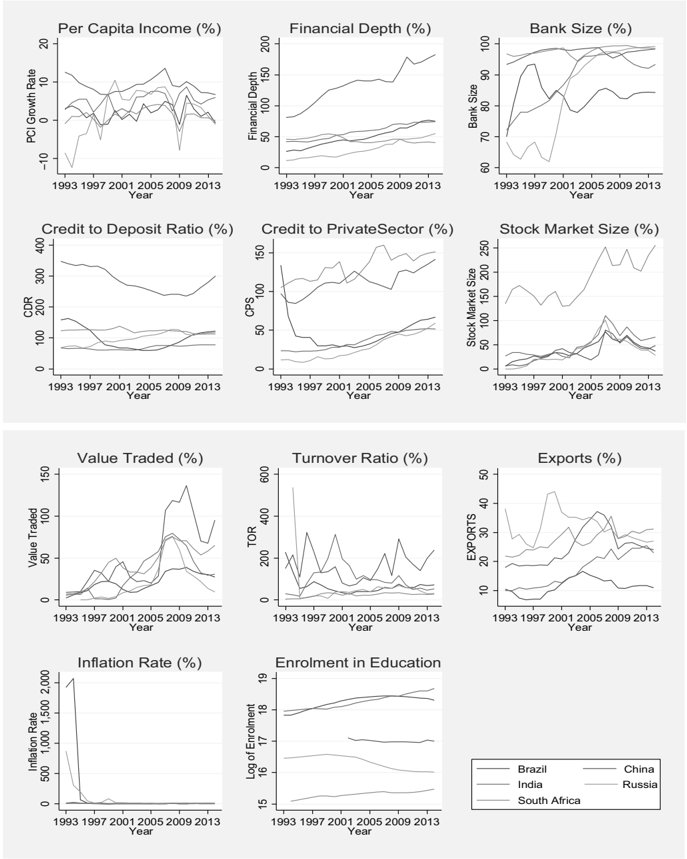
Purpose: The purpose of this paper is to examine the relationship between financial development and economic growth for five major emerging economies: Brazil, Russia, India, China and South (BRICS) during 1993 to 2014 using banking sector and stock market development indicators. Design/methodology/approach: To begin with, the study first examined some of the principal indicators of financial development and macroeconomic variables of the selected economies. Next, using generalized method of moment system estimation (SYS-GMM), the relationship between financial development and growth is investigated. The banking sector development indicators used in the study include size of the financial intermediaries, credit to deposit ratio (CDR) and domestic credit to private sector (CPS), whereas the stock market development indicators are value of shares traded and turnover ratio. Also, some macroeconomic control variables such as inflation, exports and the enrolment in secondary education were used. Findings: The examination of the principal indicators of financial development and macroeconomic variables have shown considerable differences between the selected economies. Results from the dynamic one-step SYS-GMM estimates confirm that in presence of turnover ratio, all the selected banking development indicators such as size of financial intermediaries, CDR and CPS are positively significantly determining economic growth. Similarly, in presence of all the selected banking sector development indicators, value of shares traded is found to be positively significantly associated with economic growth. However, the same is not true when turnover ratio is regressed in presence of banking sector variables. Overall, the evidence suggests that banking sector development and stock market development indicators are complementary to each other in stimulating economic growth. Practical implications: A positive association between financial development and growth indicates that the policymakers should take necessary measures toward simultaneous development of both banking sector as well as stock market for inducing growth. Originality/value: The present paper attempts to examine the relationship between financial development and growth using both banking sector and stock market development indicators which has not been attempted before for BRICS. Also, most of the existing studies are found in case of developed economies. This paper tries to fill this void by studying five major emerging economies.
Overview
The claims and statistics of this paper haven’t been checked yet.
Free: it reads the open-access text and checks the first 5 claims that cite a source we can check. Create a free account to check every claim.
Integrity signals
Registry
Cites
Statistics
Figures
Verification
Claims the paper makes
The claims and statistics of this paper haven’t been checked yet.
Free: it reads the open-access text and checks the first 5 claims that cite a source we can check. Create a free account to check every claim.
Claims other papers make about this one
Each is checked against this paper’s own text: does it say what the citing paper says it does?
The check wasn’t confident either way, so it gives no verdict — never disputed.
In the citing paper
“Thus, regardless of which measure of financial development (FD) is used, there is evidence of bi-directional causality running from FD to GROWTH and from GROWTH to FD in Europe and Central Asia, South Asia, and the all-countries sample, but not for the other regions.”
From The Nexus between Financial Development and Economic Growth: Panel Data Evidence from Developing Countries (2021) · cites this paper as Guru and Yadav (2019)
Experimental — accuracy not yet measured
Self-check
Percentages, sums and reported differences re-computed from the paper’s own numbers.
The self-check needs the paper’s full text.
Citations
Cites
Arellano, M., & Bond, S. (1991) · The Review of Economic Studies · doi:10.2307/2297968 · Cited by 33,272
On the mechanics of economic development
Lucas, R. E. (1988) · Journal of Monetary Economics · doi:10.1016/0304-3932(88)90168-7 · Cited by 24,085
Initial conditions and moment restrictions in dynamic panel data models
Blundell, R., & Bond, S. (1998) · Journal of Econometrics · doi:10.1016/s0304-4076(98)00009-8 · Cited by 22,571
The Theory of Economic Development
Schumpeter, J., & Backhaus, U. (2006) · The European Heritage in Economics and the Social Sciences · doi:10.1007/0-306-48082-4_3 · Cited by 22,506 · cited 2×
“The seminal exertion by Schumpeter (1934), Goldsmith (1969), McKinnon (1973) and Shaw (1973) underscores the relevance of financial development for economic growth for some considerable time.”
BackgroundResultInitial conditions and moment restrictions in dynamic panel data models
Blundell, R., & Bond, S. (1995) · Working Paper Series · doi:10.1920/wp.ifs.1995.9517 · Cited by 14,755
Finance and Growth: Schumpeter Might Be Right
King, R. G., & Levine, R. (1993) · The Quarterly Journal of Economics · doi:10.2307/2118406 · Cited by 8,657
Financial intermediation and delegated monitoring
Diamond, D. W. (1984) · The Review of Economic Studies · doi:10.2307/2297430 · Cited by 8,476
Hsiao, C. (2022) · doi:10.1017/9781009057745 · Cited by 7,869
Hsiao, C. (2014) · doi:10.1017/cbo9781139839327 · Cited by 7,869
Hsiao, C. (2003) · doi:10.1017/cbo9780511754203 · Cited by 7,869
Research works printed but not linked: 3
- 1952, The generalization of the general theory
- 33. Shaw, E.S. (1973), Financial Deepening in Economic Development, Oxford University Press, New York, NY.
- 35. Wachtel, P. and Rousseau, P.L. (1995), "Financial intermediation and economic growth: a historical comparison of the United States, the United Kingdom, and Canada", in Bordo, M.D. and Sylla, R. (Eds), Anglo-American Financial Systems: Institutions and Markets in the Twentieth Century, Irwin Professional Publishing, New York, NY, pp. 329-381.
Cited by
Items 401–411 of 411
Unlocking SME Financing for BRICS Economies: Insights from Case Studies
Agarwal, P., Jain, S., Kavala, K., Sharma, M., & Vaidya, M. (2026) · doi:10.64503/20260825
Financial Inclusion and Economic Growth in Turkey: A Causality Analysis
Özkaya, M. H. (2022) · International Journal of Applied Business and Management Studies · doi:10.68099/ijabms.2022.216
“…investigated the influence of financial sector development on economic growth and other variables and a significant number of the studies have discovered a positive influence of financial sector development on economic growth (e.g. see Guru and Yadav, 2019; Nguyen et al., 2021; Shen and He, 2022).”
Afiq, M. K., Mildawati, T., & Riharjo, I. B. (2026) · Eqien Jurnal Ekonomi dan Bisnis · doi:10.34308/eqien.v15i3.2263
The Role of Stock Market Development in Enhancing Financial Concepts
Tilehnouei, M. H., Javad, N., & Kamandi, M. (2026) · Iranian Journal of Finance · doi:10.66224/ijf.2026.566573.1565
“These results are consistent with the study's theoretical framework and align with the empirical evidence reported by Kumar and Yadav (2019).”
InfluentialSzalai, I. (2026) · Széchenyi István Egyetem · doi:10.15477/sze.rgdi.2026.018
Tutar, H., Saldanlı, A., KAVAS, Y. B., Medetoğlu, B., & Gün, M. (2026) · The Annals of Regional Science · doi:10.1007/s00168-026-01577-5
“Contemporary literature recognizes that both theories may not necessarily conflict or exclude each other; they tend to represent two sides of a dynamic relationship between finance and development (Guru and Yadav 2019).”
Nguyen, H. A. T. (2023) · International Journal of Economics and Finance Studies · Cited by 1
THE IMPACT STRUCTURE OF THE PRODUCTIVE ECONOMY ON THE ECONOMIC GROWTH: EVIDENCE FROM IRAQ
Hussein, M. Y. (2022) · International Journal of Economics and Finance Studies
FINANCIAL EFFICIENCY, INSTITUTIONAL QUALITY AND ECONOMIC GROWTH IN NIGERIA
Babaita, K. A., & Ijaiya, M. A. (2020) · Ilorin Journal of Finance
Fundamentos de las Operaciones Financieras y la Economía de la Banca
Proaño-Rivera, W. B. (2026) · doi:10.33324/w3t57q65
Cheng, Y. (2026) · International Journal of Academic Research in Accounting Finance and Management Sciences · doi:10.6007/ijarafms/v16-i4/29050
Metadata
- Authors
- Guru, B. K., & Yadav, I. S.
- Affiliations
- Indian Institute of Technology Kharagpur (IN)
- Corresponding author
- Yadav, Inder Sekhar
- Venue
- Journal of Economics, Finance and Administrative Science
- Publisher
- Emerald
- Published
- 2019-02-20
- Volume
- 24
- Issue
- 47
- Pages
- 113-126
- ISSN
- 2077-1886 (ISSN-L)
- OpenAlex
- W2917318128
- Semantic Scholar
- 23aaa5dd945b55ac14b0843fe0f9461c26e0d02e
- Cited by
- 370
- References
- 41
- Citations by year
- 2026: 29 · 2025: 44 · 2024: 84 · 2023: 97 · 2022: 61 · 2021: 35 · 2020: 17 · 2019: 3
- FWCI
- 62.44
- Type
- journal article
- Language
- en
- Open access
- diamond
- doi.org
- Licence
- cc-by
- www.emerald.com/insight/site-policies (tdm)
- Locations
- Journal of Economics Finance and Administrative Science (publishedVersion, cc-by)
- LA Referencia (Red Federada de Repositorios Institucionales de Publicaciones Científicas) (submittedVersion, cc-by)
- SSRN Electronic Journal (submittedVersion)
- RePEc: Research Papers in Economics (submittedVersion)
- Americanae (AECID Library) (submittedVersion, cc-by)
- DOAJ (DOAJ: Directory of Open Access Journals) (submittedVersion, cc-by-sa)
- Econstor (Econstor) (submittedVersion, cc-by)
- Topics
- Social Sciences › Economics, Econometrics and Finance › General Economics, Econometrics and Finance › Monetary Policy and Economic Impact
- Social Sciences › Economics, Econometrics and Finance › Finance › Banking stability, regulation, efficiency
- Social Sciences › Economics, Econometrics and Finance › Economics and Econometrics › Economic Growth and Development
- Keywords
- financial development, economic growth, banking sector development, stock market development, credit-deposit ratio, domestic credit to private sector, financial intermediaries, emerging markets, BRICS, Brazil, Russia, India, China
About these checks
Registry, retraction, Cites and statistics results are computed, not judged, with one exception: a printed reference that no index lists is read once by a model before it counts as a citation error. Claims are extracted by a model and kept only when their quote appears verbatim in the text; each cited source is then checked, with a model’s help, for whether it says what the claim relies on. Those verdicts can be wrong — read the claim’s quote and the cited source before relying on one.
Statistics and arithmetic are recomputed, not judged.
Confidence bands are shown only for fields calibrated on our annotated test set. None is calibrated yet, so no band is shown.
What counts as a claim ›How we measure confidence ›How we check this ›
Are you an author, or do you see a problem with this page? Request a review
Data sources
Bibliographic data: Semantic Scholar, OpenAlex, Crossref.
Contains information from the Semantic Scholar Academic Graph Datasets, made available under the ODC Attribution License (ODC-BY 1.0).
Semantic Scholar’s data is described in: Kinney, R., et al. (2023). The Semantic Scholar Open Data Platform. arXiv:2301.10140.
