

Financial development and economic growth: panel evidence from BRICS
Open accessThe DOI matches its Crossref record; 43 of the 43 references it cites were found in a registry or an index.
Abstract
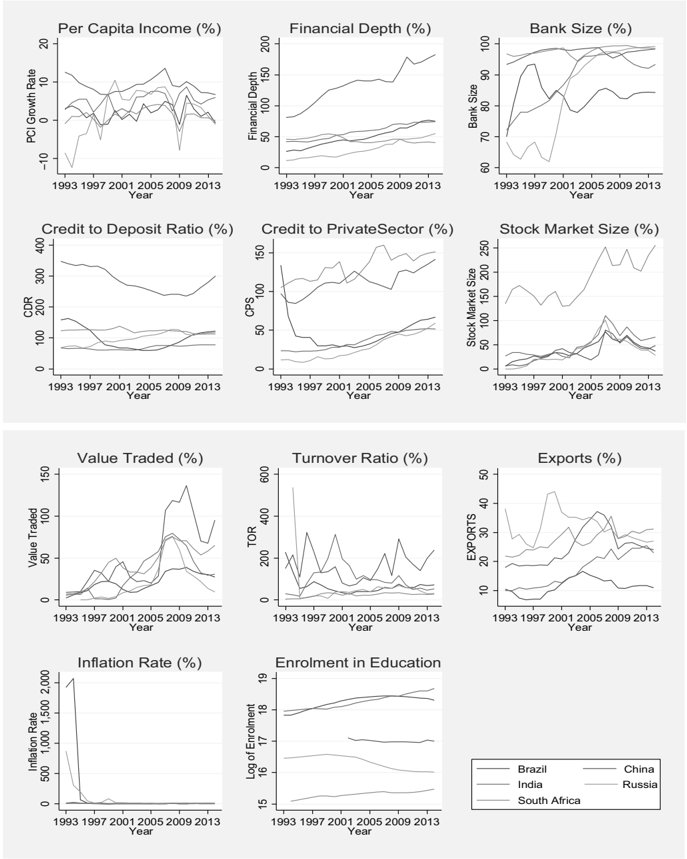
Purpose: The purpose of this paper is to examine the relationship between financial development and economic growth for five major emerging economies: Brazil, Russia, India, China and South (BRICS) during 1993 to 2014 using banking sector and stock market development indicators. Design/methodology/approach: To begin with, the study first examined some of the principal indicators of financial development and macroeconomic variables of the selected economies. Next, using generalized method of moment system estimation (SYS-GMM), the relationship between financial development and growth is investigated. The banking sector development indicators used in the study include size of the financial intermediaries, credit to deposit ratio (CDR) and domestic credit to private sector (CPS), whereas the stock market development indicators are value of shares traded and turnover ratio. Also, some macroeconomic control variables such as inflation, exports and the enrolment in secondary education were used. Findings: The examination of the principal indicators of financial development and macroeconomic variables have shown considerable differences between the selected economies. Results from the dynamic one-step SYS-GMM estimates confirm that in presence of turnover ratio, all the selected banking development indicators such as size of financial intermediaries, CDR and CPS are positively significantly determining economic growth. Similarly, in presence of all the selected banking sector development indicators, value of shares traded is found to be positively significantly associated with economic growth. However, the same is not true when turnover ratio is regressed in presence of banking sector variables. Overall, the evidence suggests that banking sector development and stock market development indicators are complementary to each other in stimulating economic growth. Practical implications: A positive association between financial development and growth indicates that the policymakers should take necessary measures toward simultaneous development of both banking sector as well as stock market for inducing growth. Originality/value: The present paper attempts to examine the relationship between financial development and growth using both banking sector and stock market development indicators which has not been attempted before for BRICS. Also, most of the existing studies are found in case of developed economies. This paper tries to fill this void by studying five major emerging economies.
Overview
The claims and statistics of this paper haven’t been checked yet.
Free: it reads the open-access text and checks the first 5 claims that cite a source we can check. Create a free account to check every claim.
Integrity signals
Registry
Cites
Statistics
Figures
Verification
Claims the paper makes
The claims and statistics of this paper haven’t been checked yet.
Free: it reads the open-access text and checks the first 5 claims that cite a source we can check. Create a free account to check every claim.
Claims other papers make about this one
Each is checked against this paper’s own text: does it say what the citing paper says it does?
The check wasn’t confident either way, so it gives no verdict — never disputed.
In the citing paper
“Thus, regardless of which measure of financial development (FD) is used, there is evidence of bi-directional causality running from FD to GROWTH and from GROWTH to FD in Europe and Central Asia, South Asia, and the all-countries sample, but not for the other regions.”
From The Nexus between Financial Development and Economic Growth: Panel Data Evidence from Developing Countries (2021) · cites this paper as Guru and Yadav (2019)
Experimental — accuracy not yet measured
Self-check
Percentages, sums and reported differences re-computed from the paper’s own numbers.
The self-check needs the paper’s full text.
Citations
Cites
Arellano, M., & Bond, S. (1991) · The Review of Economic Studies · doi:10.2307/2297968 · Cited by 33,272
On the mechanics of economic development
Lucas, R. E. (1988) · Journal of Monetary Economics · doi:10.1016/0304-3932(88)90168-7 · Cited by 24,085
Initial conditions and moment restrictions in dynamic panel data models
Blundell, R., & Bond, S. (1998) · Journal of Econometrics · doi:10.1016/s0304-4076(98)00009-8 · Cited by 22,571
The Theory of Economic Development
Schumpeter, J., & Backhaus, U. (2006) · The European Heritage in Economics and the Social Sciences · doi:10.1007/0-306-48082-4_3 · Cited by 22,506 · cited 2×
“The seminal exertion by Schumpeter (1934), Goldsmith (1969), McKinnon (1973) and Shaw (1973) underscores the relevance of financial development for economic growth for some considerable time.”
BackgroundResultInitial conditions and moment restrictions in dynamic panel data models
Blundell, R., & Bond, S. (1995) · Working Paper Series · doi:10.1920/wp.ifs.1995.9517 · Cited by 14,755
Finance and Growth: Schumpeter Might Be Right
King, R. G., & Levine, R. (1993) · The Quarterly Journal of Economics · doi:10.2307/2118406 · Cited by 8,657
Financial intermediation and delegated monitoring
Diamond, D. W. (1984) · The Review of Economic Studies · doi:10.2307/2297430 · Cited by 8,476
Hsiao, C. (2022) · doi:10.1017/9781009057745 · Cited by 7,869
Hsiao, C. (2014) · doi:10.1017/cbo9781139839327 · Cited by 7,869
Hsiao, C. (2003) · doi:10.1017/cbo9780511754203 · Cited by 7,869
Research works printed but not linked: 3
- 1952, The generalization of the general theory
- 33. Shaw, E.S. (1973), Financial Deepening in Economic Development, Oxford University Press, New York, NY.
- 35. Wachtel, P. and Rousseau, P.L. (1995), "Financial intermediation and economic growth: a historical comparison of the United States, the United Kingdom, and Canada", in Bordo, M.D. and Sylla, R. (Eds), Anglo-American Financial Systems: Institutions and Markets in the Twentieth Century, Irwin Professional Publishing, New York, NY, pp. 329-381.
Cited by
Items 101–200 of 411
Li, C., & Gong, K. (2023) · Resources Policy · doi:10.1016/j.resourpol.2023.103975 · Cited by 15
Zhang, H., Fahlevi, M., Aljuaid, M. M., KILIÇ, N. Ö., Çabaş, M., & lominchar, J. (2024) · Resources Policy · doi:10.1016/j.resourpol.2024.105017 · Cited by 18
Yusuf, N., & Nasrulddin, V. (2023) · Journal of the Knowledge Economy · doi:10.1007/s13132-023-01245-5 · Cited by 19
“Similarly, another study focusing on the BRICS states, including Brazil, Russia, India, China, and South Africa, concluded that financial development significantly correlates with economic growth in the five emerging yet large economies (Guru & Yadav, 2019).”
Financial outreach, financial innovation, and sustainable development in Africa
Archer, C., & Idun, A. A. (2023) · Environmental Science and Pollution Research · doi:10.1007/s11356-023-27304-7 · Cited by 14
“The few studies that assess the finance and growth/development nexus concentrate either on the influence of financial outreach or inclusion and growth/development nexus (Guru and Yadav 2019; Kumar et al.”
BackgroundAbaidoo, R., & Agyapong, E. K. (2023) · Journal of Financial Economic Policy · doi:10.1108/jfep-07-2023-0180 · Cited by 16
Saeed, U. F., & Klugah, G. E. (2025) · Cogent Economics & Finance · doi:10.1080/23322039.2025.2523955 · Cited by 16
“Guru and Yadav (2019) focus on African countries to examine the relationship between internet access, financial inclusion and IG.”
Ali, M., Tariq, M., & Khan, M. A. (2022) · iRASD Journal of Economics · doi:10.52131/joe.2022.0401.0057 · Cited by 16
“An extensive literature has examined the relationship between financial deepening and economic growth, and the importance of finance for economic performance has been widely acknowledged (Guru & Yadav, 2019; King & Levine, 1993; Yang & Shafiq, 2020).”
BackgroundFinancial institutions depth and growth in Nepal: Sensitivity to the choice of depth proxy
Chettri, K. K. (2022) · Cogent Economics & Finance · doi:10.1080/23322039.2022.2087288 · Cited by 16
“indicators showed positive significant influence on economic growth. In the short-run, however, only money supply showed significant positive influence, but domestic credit to private sector and deposits showed negative non-significant influence. In Cyprus, Tursoy and Faisal (2018) used total bank deposits as the fina…”
BackgroundResultThe Nexus of Financial Development and Economic Growth Across Developing Economies
Okuyan, H. A. (2022) · South East European Journal of Economics and Business · doi:10.2478/jeb-2022-0009 · Cited by 18
Majekodunmi, T. B., Shaari, M. S., Abidin, N. Z., & Esquivias, M. A. (2023) · Environmental Science and Pollution Research · doi:10.1007/s11356-023-28865-3 · Cited by 15
“Financial development has also been found to significantly impact national savings, with positive influences observed in Nigeria (Osuji 2020; Odi and Oji 2020) and the BRICS countries (Guru and Yadav 2019).”
BackgroundFinancial development and economic growth in Asian countries: evidence from the DCCE approach
Wang, Y., Mazlan, N. S., Ngah, W. A. S. W., Faheem, M., & Liang, Y. (2024) · Eurasian economic review : · doi:10.1007/s40822-024-00262-2 · Cited by 18
“Various methodological studies have shown a strong link between these two variables in different economies (Asteriou & Spanos, 2019; Guru & Yadav, 2019; Ibrahim & Alagidede, 2018).”
Patricia, M. C. (2023) · Journal of Management and Entrepreneurship Research · doi:10.34001/jmer.2023.6.04.1-35 · Cited by 29
“The financial sector has become the engine of real sector growth through capital accumulation and technological innovation (Guru & Yadav, 2019).”
BackgroundAlhassan, U., Maswana, J., & Inaba, K. (2025) · Journal of the Knowledge Economy · doi:10.1007/s13132-025-02819-1 · Cited by 13
The contribution of bank intermediation to economic growth: Empirical evidence from CESEE countries
Miftari, F. (2023) · Journal of Governance and Regulation · doi:10.22495/jgrv12i4art19 · Cited by 13
The relationship between financial development and economic growth in Eswatini (formerly Swaziland)
Fakudze, S.-O., Tsegaye, A., & Sibanda, K. (2021) · African Journal of Economic and Management Studies · doi:10.1108/ajems-06-2021-0291 · Cited by 14
Analysis of Economic Improvement to Reduce Poverty in 2016-2020
Fatmasari, D., Harjadi, D., & Hidayat, A. (2022) · Khazanah Sosial · doi:10.15575/ks.v4i4.23445 · Cited by 13
The Credit–Output–Productivity Nexus: A Comprehensive Review
Magazzino, C., Santeramo, F. G., & Schneider, N. (2024) · International Review of Environmental and Resource Economics · doi:10.1561/101.00000164 · Cited by 14
Examining the co-integrating relationship between financial development and economic growth
Chiwira, O. (2023) · International Journal of Research in Business and Social Science (2147-4478) · doi:10.20525/ijrbs.v12i5.2439 · Cited by 14
Sethi, N., Behera, B., & Dash, D. P. (2023) · The International Trade Journal · doi:10.1080/08853908.2023.2253319 · Cited by 12
“A study by Guru and Yadav (2018) examined the relationship between financial development and economic growth for BRICS nations using system GMM over the period from 1993 to 2014 and documented that economic growth in BRICS countries is significantly and positively influenced by the advancement in…”
Relevancy and drivers of trade openness: a study of GIPSI countries
Suleman, S., Thaker, H. M. T., Ariff, M., & Cheong, C. W. H. (2023) · Journal of economic and administrative sciences. · doi:10.1108/jeas-01-2023-0014 · Cited by 16
Equity return volatility in Africa’s stock markets: A dynamic panel approach
Aawaar, G., Logogye, L., & Domeher, D. (2023) · Cogent Economics & Finance · doi:10.1080/23322039.2023.2258704 · Cited by 12
“These policies will enhance market rules and regulations and predict an economy’s growth path (Guru & Yadav, 2019; Poon & Granger, 2003; Suhaibu et al., 2017).”
BackgroundTinta, A. A., Ouédraogo, S., & Thiombiano, N. (2021) · Natural Resources Forum · doi:10.1111/1477-8947.12240 · Cited by 12
An integrated perspective on fintech, green innovation and natural resource rent: Evidence from Asia
Chien, F., Zhang, Y., Lin, Z., Lin, Y., & Sadiq, M. (2024) · Resources Policy · doi:10.1016/j.resourpol.2024.104945 · Cited by 11
Kumar, N. (2024) · Resources Policy · doi:10.1016/j.resourpol.2024.105260 · Cited by 13
Natural resources led growth and the role of financial development: Evidence from Next-11 economies
Zhou, R., Su, K., & Li, Z. (2022) · Resources Policy · doi:10.1016/j.resourpol.2022.103105 · Cited by 11
Do credit risks deter FDI? Empirical evidence from the SAARC countries
Alam, M. B., Tahir, M., & Ali, N. O. (2023) · Journal of Economics Finance and Administrative Science · doi:10.1108/jefas-09-2021-0191 · Cited by 11
Religiosity and financial development in Africa: evidence from panel quantile regression
Kwatia, B. O., Amewu, G., & Armah, M. (2024) · Cogent Business & Management · doi:10.1080/23311975.2024.2315313 · Cited by 13
Global Value Chain: Islamic Economics and Finance Position
Pimada, L. M. (2021) · Shirkah Journal of Economics and Business · doi:10.22515/shirkah.v6i3.353 · Cited by 14
“The financial and banking sector is a significant factor that positively influences economic growth (Guru & Yadav, 2019).”
BackgroundSelvasundaram, K., Sagathevan, S., & Abdu, M. (2022) · International Social Science Journal · doi:10.1111/issj.12364 · Cited by 11
Can sustainable development goals go hand in hand with economic growth? Evidence from Morocco
Ziky, M., & abdellaoui, L. E. (2023) · Problems and Perspectives in Management · doi:10.21511/ppm.21(3).2023.51 · Cited by 14
“…that Morocco has made significant progress in promoting financial inclusion, as evidenced by the positive impact of financial inclusion on economic growth, poverty reduction, and overall well-being, as highlighted in the literature (Guru & Yadav, 2019; Cull et al., 2021; Huang & Zhang, 2020).”
Apau, R., Sibindi, A. B., & Jeke, L. (2023) · Risks · doi:10.3390/risks11090158 · Cited by 10
Fairuzi, M. I., EkoPujianto, W., Larassaty, A. L., & Sholikhah, A. (2025) · Jurnal Manajemen dan Organisasi · doi:10.29244/jmo.v16i2.63697 · Cited by 11
Khan, K. A., Kaya, E., Çitil, M., Pilatin, A., & Barut, A. (2025) · Energy Strategy Reviews · doi:10.1016/j.esr.2025.101903 · Cited by 11
Financial development, digitalization, and the trajectories of sustainable development
Nguyen, T. H. P., & Le, H. P. (2026) · International Review of Economics & Finance · doi:10.1016/j.iref.2026.105248 · Cited by 11
Micro Macro Economics Fundamental Factors and Indonesia Stock Exchange Return
Yusfiarto, R. (2020) · EkBis Jurnal Ekonomi dan Bisnis · doi:10.14421/ekbis.2019.3.1.1183 · Cited by 10
“…sector and the real interest rate that is often a reference in investment, so that it will affect the motivation or interest of investment to reduce and will reduce the level of real income that investors get from their investment (Doh-Khul Kim & Sung Chul No, 2013; Guru & Yadav, 2019; Wu, 2012).”
BackgroundRamzan, M., & Li, H. Y. (2023) · Environment Development and Sustainability · doi:10.1007/s10668-023-03908-4 · Cited by 11
“The size, potential, progress, and stability of financial markets and a good environment of financial access reflect a nation’s financial development (Guru & Yadav, 2019).”
Alfred, C. D., Somoye, O. A., & Özdeşer, H. (2023) · SN Business & Economics · doi:10.1007/s43546-023-00603-4 · Cited by 14
“Moreover, while previous studies have predominantly utilized OLS regression and other linear techniques, this study has opted for the ARDL method due to its robust policy implications.”
MethodSu, T. (2023) · Journal of the Knowledge Economy · doi:10.1007/s13132-023-01502-7 · Cited by 10
“Moreover, the development of financial systems is positively correlated with economic growth (Guru & Yadav, 2019; Mtar & Belazreg, 2021).”
RetractedConvergence in Financial Development and Growth
He, Z., & You, Y. (2024) · Open Economies Review · doi:10.1007/s11079-024-09767-4 · Cited by 11
“The relationship is also discussed by a set of recent papers (e.g., Guru and Yadav 2019; Asteriou and Spanos 2019; Zhang and Naceur 2019; Shahbaz et al. 2022) 1 Some specific financial correlates also exhibit divergence among countries: Kiss et al. (2006) identify the growth of credit to the…”
Aydın, Ş., Öztutuş, F., & Polat, İ. H. (2024) · Fiscaoeconomia · doi:10.25295/fsecon.1513450 · Cited by 12
Energy finance strategy and governance nexus with economic growth: Results from emerging economies
Rahman, M. M., Zahan, F., & Islam, M. F. (2024) · PLoS ONE · doi:10.1371/journal.pone.0314286 · Cited by 9
Topić-Pavković, B., Kovačević, S., & Kurušić, D. (2023) · Economics · doi:10.2478/eoik-2022-0022 · Cited by 9
Hidayat, A., Liliana, Harunurrasyid, & Shodrokova, X. (2023) · Organizations and Markets in Emerging Economies · doi:10.15388/omee.2023.14.8 · Cited by 11
Solaymani, S., Falahati, A., Darabi, K. D., & Kaviar, H. (2024) · Journal of Asian Energy Studies · doi:10.24112/jaes.080002 · Cited by 9
“Financial development provides valuable insights into potential productive investments and facilitates optimal capital allocation [9].”
BackgroundZioło, M., Bąk, I. D., & Spoz, A. (2024) · Energies · doi:10.3390/en17133332 · Cited by 10
Pang, X., Fatima, S., Yağış, O., Haseeb, M., & Hossain, M. E. (2024) · Natural Resource Modeling · doi:10.1111/nrm.12413 · Cited by 9
“” For instance, Erdo ğ an et al. (2020), Cheng et al. (2021), and Guru and Yadav (2019) suggested a decisive role between finance sectors and EG rate.”
Impact of analyst report on the behavior of retail investors: a study during COVID-19 in India
Chakraborty, B., Chatterjee, M., & Bhattacharjee, T. (2022) · Journal of financial reporting & accounting · doi:10.1108/jfra-10-2021-0310 · Cited by 9
New Insights and Different Economic Factors in Banking Sectors and Current Challenges
Piracha, S., Hiba, H., Farooq, U., Fatima, U., Aslam, F., Ishaq, A., & Sial, H. (2022) · Scholars Bulletin · doi:10.36348/sb.2022.v08i02.005 · Cited by 9
“Cross-country regressions, on the other hand, have been chastised for failing to account for significant changes between nations [7, 8].”
BackgroundStatistical Analysis of the Economic Development of the Brics Countries
Балыхин, М. Г., Shajlieva, M. M., & Цыпин, А. П. (2020) · Statistics and Economics · doi:10.21686/2500-3925-2020-2-18-28 · Cited by 9
Effects of Financial Development on Economic Growth in Pakistan: Does FDI Matter?
Mehmood, K. A., Riaz, H., Munir, F., & Ilyas, S. (2025) · Qlantic journal of social sciences. · doi:10.55737/qjss.v-iv.24319 · Cited by 8
Akinyemi, J. O. O. (2025) · Cogent Economics & Finance · doi:10.1080/23322039.2025.2551159 · Cited by 10
“Guru and Yadav (2019) documented that financial sector development indicators such as banking sector development and stock market development in the five BRICS countries, Brazil, Russia, India, China, and South Africa, using data analyzed with the system GMM for the period 1993 – 2014 have a…”
Hashmi, N. I., Makhmudov, S., Ghardallou, W., & Alam, M. M. (2025) · Journal of Environmental Management · doi:10.1016/j.jenvman.2025.127527 · Cited by 8
Ayenew, B. B. (2022) · Journal of East-West Business · doi:10.1080/10669868.2022.2077505 · Cited by 8
Bank Market Structure and SMMEs’ Access to Finance: A South African Perspective
Ngonisa, P., Mgxekwa, B., Ndlovu, N., Ngonyama, N., & Mlambo, C. (2023) · Economies · doi:10.3390/economies11010030 · Cited by 11
Oil price fluctuations and economic growth–banking sector nexus: modeling for MENA countries
Belkhaoui, S. (2023) · EuroMed Journal of Business · doi:10.1108/emjb-03-2023-0079 · Cited by 10
A count model of financial inclusion in Ghana: evidence from living standards surveys
Issahaku, H., Alhassan, M. M., & Abu, B. M. (2023) · Journal of Economics Finance and Administrative Science · doi:10.1108/jefas-10-2021-0204 · Cited by 8
Mabeba, M. (2024) · Social Science Studies · doi:10.47153/sss42.8022024 · Cited by 9
“The financial sector in developing countries has grown at a faster rate than other sectors of the economy, leading to concerns about their potential negative impact on economic growth (Guru et al., 2019).”
BackgroundKuscuoglu, S. Y., & Çiçek, M. (2021) · International Journal of Scientific and Technological Research · doi:10.7176/jstr/7-01-07 · Cited by 10
Appiah, M., Gyau, E. B., Gyamfi, B. A., & Asongu, S. A. (2025) · Sustainable Development · doi:10.1002/sd.70079 · Cited by 7
From digital finance to green growth: the role of FinTech in sustainable manufacturing
Bu, Y., Du, X., & Li, H. (2025) · Applied Economics · doi:10.1080/00036846.2025.2560685 · Cited by 9
“First, it promotes green investment and financing (Guru and Yadav 2019; Lin and Ma 2022), alleviates financing constraints, and enhances R&D expenditure (W. Chen et al. 2024; Huang, Lai, and Tang 2020).”
Khan, S. N., Hassan, N. M., Abdullah, N. N., Alhebri, A. A., Antohi, V. M., Forțea, C., Zlati, M. L., & Breaz, T. O. (2026) · International Review of Economics & Finance · doi:10.1016/j.iref.2026.105235 · Cited by 7
Modeling Life Expectancy in Indonesia Using System GMM Model
Tirtayasa, U. S. A., Setyadi, S., Didu, S., Tirtayasa, U. S. A., Indriyani, L., Tirtayasa, U. S. A., Fitri, A. K., Tirtayasa, U. S. A., Wiidiastuti, A., & Development Planning Agency at Sub-National Level, B. P. (2023) · Review of Applied Socio-Economic Research · doi:10.54609/reaser.v25i1.338 · Cited by 9
“…assumption that: 1) the disturbance term is not serially correlated, 2) the regressor is weakly exogenous, which indicates that it does not correlate with the present and future values of the disturbance term, but can correlate with the past realization of the disturbance term (Guru & Yadav, 2019).”
Feng, J., & Gao, J. (2023) · Resources Policy · doi:10.1016/j.resourpol.2023.103906 · Cited by 8
Financial development and non-resource economic growth: Empirical evidence from Azerbaijan
Seyfullayev, İ. (2023) · Problems and Perspectives in Management · doi:10.21511/ppm.21(4).2023.20 · Cited by 9
“Guru and Yadav (2019), researching BRICS countries, found that the growth of the banking sector and stock market indicators stimulate economic growth.”
BackgroundThe Relationship Between Financial Development and Carbon Emissions: A Systematic Review
Darweesh, F., Khudari, M., & Othman, N. S. (2023) · International Journal of Professional Business Review · doi:10.26668/businessreview/2023.v8i7.2718 · Cited by 7
Çeştepe, H., & Tatar, H. E. (2022) · Mehmet Akif Ersoy Üniversitesi İktisadi ve İdari Bilimler Fakültesi Dergisi · doi:10.30798/makuiibf.913434 · Cited by 9
Türkiye’de Katılım Bankalarınca Sağlanan Finansman Türlerinin Ekonomik Büyüme Üzerine Etkisi
Göksu, S. (2023) · Kocatepe İslami İlimler Dergisi · doi:10.52637/kiid.1352885 · Cited by 7
Monetary Policy in the Age of CryptocurrenciesPreprint
Thanh, B. N., Perera, D., Thanh, P. N., Nguyen, T. V. H., Thu, T. P. T., My, L. N. T., Chu, T. T., & Kok, S. K. (2023) · SSRN Electronic Journal · doi:10.2139/ssrn.4407460 · Cited by 7
Cheng, S., Yu, C., & Hou, H. (2025) · Manchester School · doi:10.1111/manc.70004 · Cited by 6
Imomkulov, T., Samiyev, S., Shanyazov, N., Mamadiyarov, Z. T., Kurbonbekova, M. T., Kuralbaev, J., & Odamboev, O. (2026) · Economies · doi:10.3390/economies14040138 · Cited by 8
FINANCIAL DEVELOPMENT AND ECONOMIC GROWTH: EVIDENCE FROM WESTERN BALKAN COUNTRIES
Bilalli, A., Beka, A., & Gara, A. (2023) · InterEULawEast journal for the international and european law economics and market integrations · doi:10.22598/iele.2023.10.1.11 · Cited by 6
Modeling Finance–Growth Nexus in MENA Region Economies: A Panel Data Analysis
Kamal, A. L. M., AboElsoud, M. E., & Abdella, K. (2023) · Economies · doi:10.3390/economies11120290 · Cited by 8
“Recent literature on the finance–growth nexus underscores the significance of examining this relationship through the lens of endogenous growth theory, as advocated by Bist and Bista (2018), Guru and Yadav (2019), Haque et al. (2022), Mengesha and Berde (2023), and Pradhan et al. (2017).”
BackgroundFinancial Development Contribution to Economic Growth and Poverty Reduction
Junaidi, J. (2024) · Journal of the Knowledge Economy · doi:10.1007/s13132-024-02032-6 · Cited by 8
“The same pattern in Brazil, Russia, India, and China (BRICS) during 1993–2014, financial intermediaries, credit to deposit ratio (CDR), and domestic credit to the private sector (CPS) are positively significantly determining economic growth (Guru & Yadav, 2019).”
What is the Relationship Between Financial Stability and Economic Growth in APEC?
Aimon, H., Kurniadi, A. P., Sentosa, S. U., & Yahya, Y. (2024) · International Journal of Sustainable Development and Planning · doi:10.18280/ijsdp.190725 · Cited by 6
“In European countries, banking competition and stability are key drivers of long-term EG [36].”
Magnetic Macro Drivers of Trade Openness: A Study of BRICS Economies
Suleman, S., Thaker, H. M. T., & Cheong, C. W. H. (2024) · South Asian Journal of Macroeconomics and Public Finance · doi:10.1177/22779787241288940 · Cited by 6
“The Solow growth model focuses on the significance of capital accumulation, labour and technical advancement in promoting prosperity in the economy (Guru & Yadav, 2019; Vella, 2018); yet, it falls short in explaining the association between macro determinates and TOP, particularly in the context of…”
Interdependence between WTI Crude Oil Prices and the US Equity Market
Pruchnicka-Grabias, I. (2022) · International Journal of Energy Economics and Policy · doi:10.32479/ijeep.12675 · Cited by 6
He, X., Xu, R., Sun, K., & Wang, J. C. (2024) · International Review of Financial Analysis · doi:10.1016/j.irfa.2024.103271 · Cited by 7
PENGARUH RASIO KEUANGAN DAERAH TERHADAP PERTUMBUHAN EKONOMI KABUPATEN/KOTA DI PROVINSI ACEH
Azhari, M., Zulfa, A., & Murtala, M. (2021) · J-MIND (Jurnal Manajemen Indonesia) · doi:10.29103/j-mind.v5i1.3427 · Cited by 6
Pourahmadi, B., & Kałkowska, J. (2022) · Sustainability · doi:10.3390/su14095561 · Cited by 7
Ullah, W., Zubir, A. S. M., & Ariff, A. M. (2024) · Sage Open · doi:10.1177/21582440241267142 · Cited by 5
“Guru and Yadav (2019) used credit-to-deposit ratio and domestic credit to private sector as proxy for Banking sector development and stock market development and observed that financial development stimulates economic growth and the financial institutions and financial markets’ development…”
Rahman, S. U., Faisal, F., Ali, A., Mansor, N. N. A., Haq, Z. U., Sulimany, H. G. H., & Ramakrishnan, S. (2024) · The Quarterly Review of Economics and Finance · doi:10.1016/j.qref.2024.02.005 · Cited by 6
Decomposing rural-urban inequalities in financial inclusion in Tanzania
Mwaseba, S. L., Mwang’onda, E. S., & Ngwilizi, D. (2025) · Cogent Economics & Finance · doi:10.1080/23322039.2025.2537185 · Cited by 7
“…financial systems, financial institutions and banks are essential in allocating resources towards their most productive uses, thereby enhancing overall economic efficiency and facilitating access to capital for businesses, leading to increased productivity and economic growth (Guru & Yadav, 2019).”
Unequal Economic Growth Between Regions in Indonesia: Hard Infrastructure or Soft Infrastructure?
Siahaan, C. J., Taufiqurahman, M. K., Andrianto, B., & Iman, M. N. (2020) · International Journal of Business and Administrative Studies · doi:10.20469/ijbas.6.10004-2 · Cited by 5
“But the occurring economic growth of a country is not always followed by the creation of justice and equal distribution of people’s welfare, especially in a developing country (Acquah & Ibrahim, 2020; Guru & Yadav, 2019).”
BackgroundThe Heterogeneous Impact of Financialisation on Economic Growth in the Long Run
Šetikienė, A., & Butkus, M. (2021) · Journal of risk and financial management · doi:10.3390/jrfm14050209 · Cited by 6
“…of financialisation results in various economic outcomes and changes, it can have not only a positive (Williams 2019; He et al. 2019; Nguyen 2019; Guru and Yadav 2019; Nazir et al. 2020) but also a negative (Law and Singh 2014; Arcand et al. 2015; Ibrahim and Alagidede 2018) effect on economic…”
BackgroundRehman, A., Ecobici, N., Chirtoc, I.-E., & Buşan, G. (2023) · Applied Economics · doi:10.1080/00036846.2023.2290590 · Cited by 5
“As technology advances, financial innovations in the economy have increased financial institution efficiency, allowing for improved financial services and goods (Guru and Yadav 2019; Wong and Zhou 2011).”
Zioło, M., Spoz, A., & Szaruga, E. (2025) · Technological and Economic Development of Economy · doi:10.3846/tede.2025.22864 · Cited by 6
Bogari, A. (2019) · European Journal of Business Management and Research · doi:10.24018/ejbmr.2019.4.6.168 · Cited by 5
BALKI, A. (2023) · Kocatepe İslami İlimler Dergisi · doi:10.52637/kiid.1353457 · Cited by 6
Does Financial & Social Development are Important for Economic Growth? An International Scenario
Rehman, A., Saba, I., & Kousar, R. (2019) · Journal of Business and Social Review in Emerging Economies · doi:10.26710/jbsee.v5i2.923 · Cited by 5
Brıcs-T Ülkelerinde Finansal Gelişmenin Ekonomik Büyümeye Etkisi
ERGÜR, H. O., & Özek, Y. (2020) · Kahramanmaraş Sütçü İmam Üniversitesi Sosyal Bilimler Dergisi · doi:10.33437/ksusbd.690132 · Cited by 8
Shadow economy in Palestinian territories using currency demand approach
Abuamsha, M. K., & Shumali, S. (2022) · Journal of Economics Finance and Administrative Science · doi:10.1108/jefas-04-2021-0021 · Cited by 5
Khayati, A., & Terzi, C. (2023) · Investment Management and Financial Innovations · doi:10.21511/imfi.20(3).2023.27 · Cited by 5
Islam, M. A., Ahmed, M. E., Ali, N. M., Gomes, C. A., & Faisal-E-Alam, M. (2026) · Sustainable Development · doi:10.1002/sd.71220 · Cited by 4
Hewage, R. S., Pyeman, J., & Othman, N. (2024) · Journal International Studies · doi:10.32890/jis2024.20.1.5 · Cited by 8
Ali, A. Y. S., Gutale, A. A. A., & Dalmar, M. S. (2024) · Cogent Economics & Finance · doi:10.1080/23322039.2024.2386390 · Cited by 5
“The relationship between financial development and economic growth has been extensively studied, with varying estimates but an overall significant impact (Valickova et al., 2014; Moradbeigi & Hook Law, 2017; Guru & Yadav, 2019; Yusheng et al., 2020).”
Esposito, L., & Tedeschi, M. (2025) · International Review of Financial Analysis · doi:10.1016/j.irfa.2025.104416 · Cited by 5
Sustainability in ASEAN: The Roles of Financial Development towards Climate Change
Kumaran, V. V., Munawwarah, S. N., & Ismail, M. K. (2021) · Asian Journal of Economics and Empirical Research · doi:10.20448/journal.501.2021.81.1.9 · Cited by 6
“The financial development can be described as the development of the size, efficiency and stability of the financial markets, along with the growth of access to financial markets, which can have multiple economic benefits (Guru & Yadav, 2019).”
BackgroundRegional Convergence between Western and Eastern Indonesia
Aurelia, V., Permana, L., Hasudungan, A., & Desfiandi, A. (2022) · Jurnal Ekonomi Pembangunan · doi:10.29259/jep.v19i2.15366 · Cited by 4
“Over the years, various studies have portrayed financial development as a significant factor in increasing economic growth (Guru & Yadav, 2019; Lestari et al., 2020).”
BackgroundResultAssessing the possibility of winning a WTO dispute before being involved
Klishch, N., & Ларионов, А. В. (2022) · Journal of Economics Finance and Administrative Science · doi:10.1108/jefas-08-2020-0301 · Cited by 4
Şeyranlıoğlu, O. (2024) · Akademik Hassasiyetler · doi:10.58884/akademik-hassasiyetler.1299131 · Cited by 4
Metadata
- Authors
- Guru, B. K., & Yadav, I. S.
- Affiliations
- Indian Institute of Technology Kharagpur (IN)
- Corresponding author
- Yadav, Inder Sekhar
- Venue
- Journal of Economics, Finance and Administrative Science
- Publisher
- Emerald
- Published
- 2019-02-20
- Volume
- 24
- Issue
- 47
- Pages
- 113-126
- ISSN
- 2077-1886 (ISSN-L)
- OpenAlex
- W2917318128
- Semantic Scholar
- 23aaa5dd945b55ac14b0843fe0f9461c26e0d02e
- Cited by
- 370
- References
- 41
- Citations by year
- 2026: 29 · 2025: 44 · 2024: 84 · 2023: 97 · 2022: 61 · 2021: 35 · 2020: 17 · 2019: 3
- FWCI
- 62.44
- Type
- journal article
- Language
- en
- Open access
- diamond
- doi.org
- Licence
- cc-by
- www.emerald.com/insight/site-policies (tdm)
- Locations
- Journal of Economics Finance and Administrative Science (publishedVersion, cc-by)
- LA Referencia (Red Federada de Repositorios Institucionales de Publicaciones Científicas) (submittedVersion, cc-by)
- SSRN Electronic Journal (submittedVersion)
- RePEc: Research Papers in Economics (submittedVersion)
- Americanae (AECID Library) (submittedVersion, cc-by)
- DOAJ (DOAJ: Directory of Open Access Journals) (submittedVersion, cc-by-sa)
- Econstor (Econstor) (submittedVersion, cc-by)
- Topics
- Social Sciences › Economics, Econometrics and Finance › General Economics, Econometrics and Finance › Monetary Policy and Economic Impact
- Social Sciences › Economics, Econometrics and Finance › Finance › Banking stability, regulation, efficiency
- Social Sciences › Economics, Econometrics and Finance › Economics and Econometrics › Economic Growth and Development
- Keywords
- financial development, economic growth, banking sector development, stock market development, credit-deposit ratio, domestic credit to private sector, financial intermediaries, emerging markets, BRICS, Brazil, Russia, India, China
About these checks
Registry, retraction, Cites and statistics results are computed, not judged, with one exception: a printed reference that no index lists is read once by a model before it counts as a citation error. Claims are extracted by a model and kept only when their quote appears verbatim in the text; each cited source is then checked, with a model’s help, for whether it says what the claim relies on. Those verdicts can be wrong — read the claim’s quote and the cited source before relying on one.
Statistics and arithmetic are recomputed, not judged.
Confidence bands are shown only for fields calibrated on our annotated test set. None is calibrated yet, so no band is shown.
What counts as a claim ›How we measure confidence ›How we check this ›
Are you an author, or do you see a problem with this page? Request a review
Data sources
Bibliographic data: Semantic Scholar, OpenAlex, Crossref.
Contains information from the Semantic Scholar Academic Graph Datasets, made available under the ODC Attribution License (ODC-BY 1.0).
Semantic Scholar’s data is described in: Kinney, R., et al. (2023). The Semantic Scholar Open Data Platform. arXiv:2301.10140.
