

A consumer behavioural approach to food waste
Open accessThe DOI matches its Crossref record; 29 of the 30 references it cites were found in a registry or an index; 2 of the 29 sources its claims cite were checked for support.
Abstract
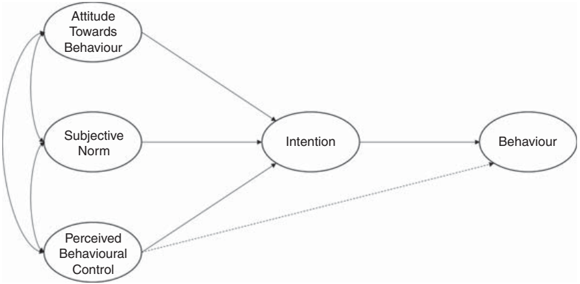
Purpose Food waste occurs in every stage of the supply chain, but the value-added lost to waste is the highest when consumers waste food. The purpose of this paper is to understand the food waste behaviour of consumers to support policies for minimising food waste. Design/methodology/approach Using the theory of planned behaviour (TPB) as a theoretical lens, the authors design a questionnaire that incorporates contextual factors to explain food waste behaviour. The authors test two models: base (four constructs of TPB) and extended (four constructs of TPB plus six contextual factors). The authors build partial least squares structural equation models to test the hypotheses. Findings The data confirm significant relationships between food waste and contextual factors such as motives, financial attitudes, planning routines, food surplus, social relationships and Ramadan. Research limitations/implications The data comes from an agriculturally resource-constrained country: Qatar. Practical implications Food waste originating from various causes means more food should flow through the supply chains to reach consumers’ homes. Contextual factors identified in this work increase the explanatory power of the base model by 75 per cent. Social implications Changing eating habits during certain periods of the year and food surplus have a strong impact on food waste behaviour. Originality/value A country is considered to be food secure if it can provide its citizens with stable access to sufficient, safe and nutritious food. The findings and conclusions inform and impact upon the development of food waste and food security policies.
Overview
CoChat Summary
TL;DR
Using the Theory of Planned Behaviour (TPB) plus six contextual factors, this study explains consumer food-waste behaviour in Qatar with survey data and PLS-SEM. The extended model outperforms the base TPB model, and the paper finds especially strong effects for Ramadan and food surplus.
Key findings
- The survey yielded 305 responses, reduced to 277 Qatar-based responses after a location filter; respondents were all working and living in Qatar, from 56 countries.
- The base model (TPB only) explains 20% of the variance in food-waste behaviour, while the extended model explains 35%, a 75% increase in predictive power.
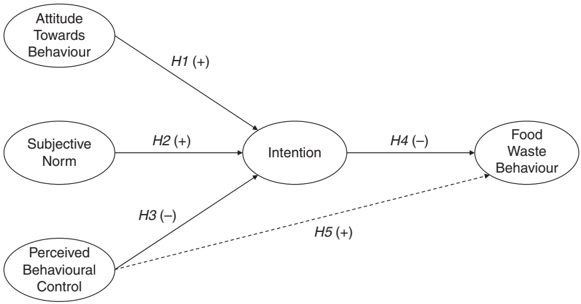
- All tested hypotheses were supported: attitudes → intentions (0.42, p ≤ 0.01), subjective norms → intentions (0.12, p = 0.03), perceived behavioural control → intentions (-0.13, p = 0.03), intentions → food waste (-0.29, p ≤ 0.01), and perceived behavioural control → food waste (0.14, p = 0.010).
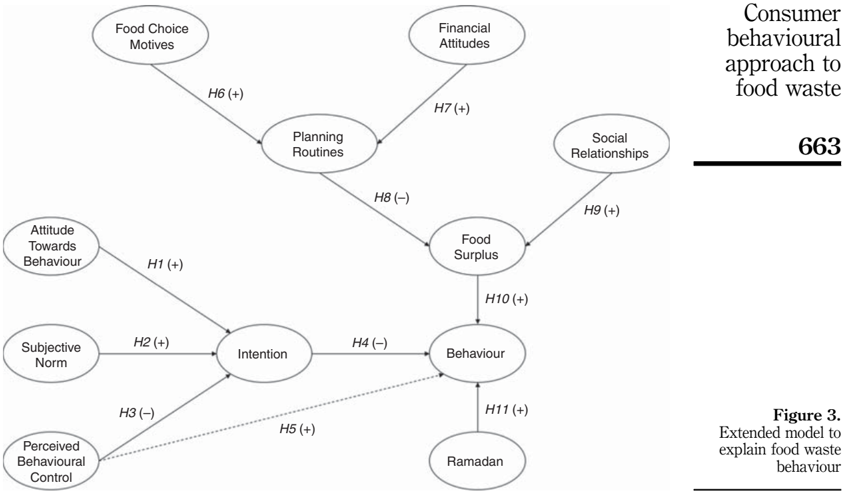
- Contextual effects were also supported: motives → planning (0.23, p ≤ 0.01), financial attitudes → planning (0.21, p ≤ 0.01), planning → food surplus (-0.25, p ≤ 0.01), social relationships → food surplus (0.26, p ≤ 0.01), food surplus → food waste (0.25, p ≤ 0.01), and Ramadan → food waste (0.26, p ≤ 0.01).
Methods
- Cross-sectional online questionnaire study of consumers in Qatar; the survey was translated into Arabic, piloted in December 2016, and deployed January-April 2017.
- The model combined the TPB constructs (attitudes, subjective norms, perceived behavioural control, intentions, behaviour) with six contextual factors: food choice motives, financial attitudes, planning routines, social relationships, food surplus, and Ramadan.
- Analysis used partial least squares structural equation modelling (PLS-SEM) in SmartPLS 3, with 1,000 bootstrap subsamples; measurement-model checks included reliability, AVE, and discriminant validity.
Limitations
- The paper explicitly notes that the data come from Qatar, described as an agriculturally resource-constrained country; it also says the sample was limited to people currently based in Qatar. This limits generalisability beyond Qatar.
- The paper states that food waste was measured with a self-reported scale and suggests future research should use a direct measurement of food waste.
- Evident from the text: the sample is not population-representative in a strict sense because it was drawn through the SAFE-Q network, a public blog link, universities, and ministry channels, and includes a multinational but convenience-style sample of residents in Qatar.
Model-written summary. Check it against the paper before relying on it.
Integrity signals
Registry
Cites
Statistics
Figures
Verification
Claims the paper makes
2 Valid · 0 Not valid · 25 Not checked · 38 Own results and interpretations
A result the paper reports from its own data — it cites no other source for it, so there is none to check. The quote shows it is in the paper.
In the paper
“Contextual factors identified in this work increase the explanatory power of the base model by 75 per cent.”
- Also stated in: § Results and research synthesis · plain
“With the inclusion of contextual factors in H6-H11, the Extended Model explains 35 per cent of the variation in food waste behaviour, a 75 per cent increase in the predictive power.”
§ A consumer behavioural approach to food waste > Abstract
plainstates a cause- Asserted: passes — The authors put it forward as true.
- Checkable: passes — It can be checked against evidence.
- Load-bearing: passes — The paper’s conclusions depend on it.
- Based: passes — The paper gives a reason why it holds.
- Rests on an assumption not shown here.
- Also stated in: § Results and research synthesis · plain
A result the paper reports from its own data — it cites no other source for it, so there is none to check. The quote shows it is in the paper.
In the paper
“The data confirm significant relationships between food waste and contextual factors such as motives, financial attitudes, planning routines, food surplus, social relationships and Ramadan.”
§ A consumer behavioural approach to food waste > Abstract
plainstates an association- Asserted: passes — The authors put it forward as true.
- Checkable: passes — It can be checked against evidence.
- Load-bearing: passes — The paper’s conclusions depend on it.
- Based: passes — The paper gives a reason why it holds.
- Rests on an assumption not shown here.
A result the paper reports from its own data — it cites no other source for it, so there is none to check. The quote shows it is in the paper.
In the paper
“H7: Financial attitudes W Planning routines (+) 0.21 o 0.01 Supported”
§ A consumer behavioural approach to food waste > Results and research synthesis
plainstates an association- Asserted: passes — The authors put it forward as true.
- Checkable: passes — It can be checked against evidence.
- Load-bearing: unclear — It is unclear whether the paper’s conclusions depend on it.
- Based: passes — The paper gives a reason why it holds.
- Rests on an assumption not shown here.
A result the paper reports from its own data — it cites no other source for it, so there is none to check. The quote shows it is in the paper.
In the paper
“Subjective norms and intentions are positively correlated, as H2 is supported.”
- Also stated in: § Results and research synthesis · plain
“H2: Subjective norms W Intentions (+) 0.12 0.03 Supported”
§ A consumer behavioural approach to food waste > Results and research synthesis
plainstates an association- Asserted: passes — The authors put it forward as true.
- Checkable: passes — It can be checked against evidence.
- Load-bearing: passes — The paper’s conclusions depend on it.
- Based: passes — The paper gives a reason why it holds.
- Rests on an assumption not shown here.
- Also stated in: § Results and research synthesis · plain
A result the paper reports from its own data — it cites no other source for it, so there is none to check. The quote shows it is in the paper.
In the paper
“H8: Planning routines W Food surplus (-) -0.25 o 0.01 Supported”
§ A consumer behavioural approach to food waste > Results and research synthesis
plainstates an association- Asserted: passes — The authors put it forward as true.
- Checkable: passes — It can be checked against evidence.
- Load-bearing: passes — The paper’s conclusions depend on it.
- Based: passes — The paper gives a reason why it holds.
- Rests on an assumption not shown here.
28 more claims
Create a free account to see all 65 claims and to verify the 3 references still open.
- Probably not a substantial claim. 20
- It may state two separate claims as one. 25
Claims other papers make about this one
Each is checked against this paper’s own text: does it say what the citing paper says it does?
The cited source doesn’t support the claim as written.
In the citing paper
“perceived behavior control (a = 0.937)”
From The Impact of Religiosity and Food Consumption Culture on Food Waste Intention in Saudi Arabia (2021) · cites this paper as [63]
Checked by a reasoning model — may be wrong.
Experimental — accuracy not yet measuredThe cited source doesn’t support the claim as written.
In the citing paper
“food waste intentions (a = 0.926)”
From The Impact of Religiosity and Food Consumption Culture on Food Waste Intention in Saudi Arabia (2021) · cites this paper as [63]
Checked by a reasoning model — may be wrong.
Experimental — accuracy not yet measuredThe cited source doesn’t support the claim as written.
In the citing paper
“subjective norms (a = 0.987)”
From The Impact of Religiosity and Food Consumption Culture on Food Waste Intention in Saudi Arabia (2021) · cites this paper as [63]
Checked by a reasoning model — may be wrong.
Experimental — accuracy not yet measuredThe cited source doesn’t support the claim as written.
In the citing paper
“attitude toward behavior (a = 0.981)”
From The Impact of Religiosity and Food Consumption Culture on Food Waste Intention in Saudi Arabia (2021) · cites this paper as [63]
Checked by a reasoning model — may be wrong.
Experimental — accuracy not yet measuredThe check wasn’t confident either way, so it gives no verdict — never disputed.
In the citing paper
“Food consumption culture three items scale was extracted from the study of [63] (a = 0.954).”
From The Impact of Religiosity and Food Consumption Culture on Food Waste Intention in Saudi Arabia (2021) · cites this paper as [63]
Experimental — accuracy not yet measured
1 more claim about this paper
Create a free account to see every claim other papers make about this one.
Self-check
Percentages, sums and reported differences re-computed from the paper’s own numbers.
Each contradiction between two passages listed here was confirmed by an independent check.
Rated minor: it would not touch a result — a value no result rests on, a p-value that stays on the same side of the significance level, or a conflict that is clerical, resolved elsewhere in the paper, or outside its own findings.
In the paper
§ A consumer behavioural approach to food waste > Results and research synthesis
“H5: Perceived behavioural control W Food waste behaviour (-) 0.14 0.010 Supported”
§ A consumer behavioural approach to food waste > Results and research synthesis
“The positive relationship between the difficulty to control food waste (perceived behavioural control) and food waste behaviour in H5 is also supported in line with the TPB.”
Citations
Cites
The theory of planned behavior
Ajzen, I. (1991) · Organizational Behavior and Human Decision Processes · doi:10.1016/0749-5978(91)90020-t · Cited by 134,657
Evaluating Structural Equation Models with Unobservable Variables and Measurement Error
Fornell, C., & Larcker, D. F. (1981) · Journal of Marketing Research · doi:10.2307/3151312 · Cited by 109,314
Evaluating structural equation models with unobservable variables and measurement error
Fornell, C., & Larcker, D. F. (1981) · Journal of Marketing Research · doi:10.1177/002224378101800104 · Cited by 109,190
Hu, L., & Bentler, P. M. (1999) · Structural Equation Modeling A Multidisciplinary Journal · doi:10.1080/10705519909540118 · Cited by 108,788
(2014) · DigitalCommons - Kennesaw State University (Kennesaw State University) · Cited by 12,785
Diamantopoulos, A., & Siguaw, J. A. (2006) · British Journal of Management · doi:10.1111/j.1467-8551.2006.00500.x · Cited by 3,410
Common Beliefs and Reality About PLS: Comments on Rönkkö and Evermann (2013)
Henseler, J., Dijkstra, T. K., Sarstedt, M., Ringle, C. M., Diamantopoulos, A., Straub, D. W., Ketchen, D. J., Hair, J. F., Hult, G. T. M., & Calantone, R. J. (2014) · Organizational Research Methods · doi:10.1177/1094428114526928 · Cited by 3,332
Sarstedt, M., Ringle, C. M., Smith, D., Reams, R., & Hair, J. F. (2014) · Journal of Family Business Strategy · doi:10.1016/j.jfbs.2014.01.002 · Cited by 2,212
Partial least squares structural equation modeling in HRM research
Ringle, C. M., Sarstedt, M., Mitchell, R., & Gudergan, S. P. (2020) · The International Journal of Human Resource Management · doi:10.1080/09585192.2017.1416655 · Cited by 1,943
Statistical analysis of sets of congeneric tests
Jöreskog, K. G. (1971) · Psychometrika · doi:10.1007/bf02291393 · Cited by 1,481
Research works printed but not linked: 3
- 2. Aktas, E., Topaloglu, Z., Oledinma, A., Sharif, A., Huda, A.K.S., Sahin, H. and Irani, Z. (2017), "Contextual factors affecting food security: a behavioural framework", The 22nd Logistics Research Network Annual Conference and PhD Workshop, Southampton, 6-8 September, pp. 6-8.
- 14. Gustavsson, J., Cederberg, C., Sonesson, U., van Otterdijk, R. and Meybeck, A. (2011), Global Food Losses and Food Waste, FAO, Rome.
- 27. Ringle, C.M., Wende, S. and Becker, J.-M. (2015), SmartPLS 3, SmartPLS GmbH, Boenningstedt.
Cited by
Items 101–200 of 282
Mucha, L., & Oravecz, T. (2025) · Scientific Reports · doi:10.1038/s41598-025-86252-z · Cited by 28
Chalak, A., Hassan, H. F., Aoun, P., & Abiad, M. G. (2021) · Sustainability · doi:10.3390/su13116358 · Cited by 25
“Middle-class customers are price conscious and are reluctant to waste money [38,39]; therefore, they tend to produce less waste [40,41].”
BackgroundLong, F., Aziz, N. A., Chia, K.-W., & Zhang, H. (2024) · Cogent Business & Management · doi:10.1080/23311975.2024.2321796 · Cited by 17
Decoding the influence mechanism of restaurant plate waste behaviors in urban China
Wu, Y., Tian, X., Qin, J., Li, X., & Liu, G. (2023) · Resources Conservation and Recycling · doi:10.1016/j.resconrec.2023.107059 · Cited by 20
Modeling the intention and adoption of food waste prevention practices among Chinese households
Ma, Y., Mamun, A. A., Ali, M. H., Hoque, M. E., & Lili, Z. (2023) · Humanities and Social Sciences Communications · doi:10.1057/s41599-023-02348-9 · Cited by 30
Decisional Factors Driving Household Food Waste Prevention: Evidence from Taiwanese Families
Teng, C.-C. C., Chih, C., & Wang, Y. (2020) · Sustainability · doi:10.3390/su12166666 · Cited by 22
Palmieri, N., & Palmieri, S. (2022) · Journal of International Food & Agribusiness Marketing · doi:10.1080/08974438.2022.2066594 · Cited by 21
Modelling the mass adoption potential of food waste composting among rural Chinese farmers
Mamun, A. A., Yang, Q. Y., Naznen, F., Aziz, N. A., & Masud, M. M. (2023) · Heliyon · doi:10.1016/j.heliyon.2023.e18998 · Cited by 19
Drivers, barriers and interventions for food waste behaviour change: a food system approach
Zeinstra, G. G., van der Haar, S., & van Bergen, G. (2020) · doi:10.18174/511479 · Cited by 28
Masotti, M., van der Haar, S., Janssen, A. M., Iori, E., Zeinstra, G. G., Bos-Brouwers, H. E. J., & Vittuari, M. (2022) · Appetite · doi:10.1016/j.appet.2022.106313 · Cited by 24
Ghaziani, S., Ghodsi, D., Schweikert, K., Dehbozorgi, G., Rasekhi, H., Faghih, S., & Doluschitz, R. (2022) · Foods · doi:10.3390/foods11182886 · Cited by 20
Viccaro, M., Coppola, A., D’Angelo, M. C., Genovese, F., Romano, S., & Cozzi, M. (2023) · Sustainability · doi:10.3390/su152014741 · Cited by 24
Deliberador, L. R., Santos, A. B., Carrijo, P. R. S., Batalha, M. O., César, A. D. S., & Ferreira, L. M. D. F. (2023) · Socio-Economic Planning Sciences · doi:10.1016/j.seps.2023.101511 · Cited by 22
Chakraborty, D. (2025) · British Food Journal · doi:10.1108/bfj-10-2024-0990 · Cited by 19
Food Waste in Restaurants: Evidence from Brazil and the United States
Watanabe, E. A. D. M., de Freitas, M. G. M. T., & Demo, G. (2021) · Journal of International Food & Agribusiness Marketing · doi:10.1080/08974438.2021.1996500 · Cited by 23
Salem, M., & Wagner, R. (2025) · Journal of Foodservice Business Research · doi:10.1080/15378020.2025.2458336 · Cited by 24
Determining sustainability key performance indicators for food loss reduction
AL-Dalaeen, Q. R., Sivarajah, U., & Irani, Z. (2021) · Journal of Enterprise Information Management · doi:10.1108/jeim-04-2021-424 · Cited by 17
Self-citationSun, J. L., Wang, Y., Yang, C. K., Chen, J., Wei, W., Miao, W., Sun, H., & Gu, C. (2024) · BMC Psychology · doi:10.1186/s40359-024-01587-y · Cited by 25
Socioeconomic Relations of Food Waste in Selected European Countries
Tkáč, F., Košičiarová, I., Horská, E., & Mušinská, K. (2022) · Economies · doi:10.3390/economies10060144 · Cited by 13
Sitompul, C., Gunawan, T., Mesiranta, N., Närvänen, E., & Octavia, J. R. (2025) · International Journal of Sustainability in Higher Education · doi:10.1108/ijshe-04-2024-0244 · Cited by 26
Buy Three to Waste One? How Real-World Purchase Data Predict Groups of Food Wasters
Merian, S., Stöckli, S., Fuchs, K., & Natter, M. (2022) · Sustainability · doi:10.3390/su141610183 · Cited by 14
Disentangling Drivers of Food Waste in Households: Evidence from Nigeria
Sunday, C. O., Sowunmi, F. A., Obayelu, O. A., Awoyemi, A. E., Omotayo, A. O., & Ogunniyi, A. I. (2022) · Foods · doi:10.3390/foods11081103 · Cited by 21
Factors affecting food waste at food festivals: the moderating effect of “Camera Eats First”
Zhang, S., & Zhang, D. (2024) · Journal of Sustainable Tourism · doi:10.1080/09669582.2024.2345693 · Cited by 17
Circular economy in agro food supply chain: Bibliometric and network analysis
Banerjee, P., Singh, D. A., & Kunja, S. R. (2024) · Business Strategy & Development · doi:10.1002/bsd2.360 · Cited by 18
Asyari, A., Susanto, P., Hoque, M. E., Widianita, R., Alam, M. K., & Mamun, A. A. (2024) · International Journal of Ethics and Systems · doi:10.1108/ijoes-10-2023-0231 · Cited by 32
Transforming Food Systems: A Review of Sustainable Approaches to Minimize Food Loss and Waste
Kilemile, W. H., Vulla, K. E., Mihafu, F. D., & Chandrasekaran, V. (2025) · Food Science & Nutrition · doi:10.1002/fsn3.71167 · Cited by 31
Food waste impact on Romanian households
Dumitru, O. M., Iorga, S., & Sanmartín, A. M. (2021) · ROMANIAN BIOTECHNOLOGICAL LETTERS · doi:10.25083/rbl/26.1/2207.2213 · Cited by 15
Why we waste: A meta-analysis of food waste behavior using the Theory of Planned Behavior (TPB)
Malau, L. R. E., Khaliqi, M., Yulni, T., Rambe, K. R., Novanda, R. R., & Wibowo, R. P. (2025) · Sustainable Futures · doi:10.1016/j.sftr.2025.101421 · Cited by 23
Sapawi, S., Ahmad, A., Valeri, M., & Azman, N. B. (2024) · Sustainability · doi:10.3390/su16020919 · Cited by 24
Tawfik, H. (2024) · Technological Sustainability · doi:10.1108/techs-12-2023-0057 · Cited by 16
Hassan, S. H., & Chee, L. E. (2024) · British Food Journal · doi:10.1108/bfj-10-2023-0917 · Cited by 15
Li, C., Zhou, Z., Liu, Z., Fang, Q., & Han, G. (2024) · Foods · doi:10.3390/foods13142201 · Cited by 14
Widayat, W., Handayanto, E., Irfani, A. D., & Masudin, I. (2025) · Sustainable Futures · doi:10.1016/j.sftr.2025.100491 · Cited by 20
APAKAH KONSUMEN RESTO HOTEL MENGETAHUI ISU FOOD WASTE?
Ramadhita, A. N., Ekayani, M., & Suharti, S. (2021) · Jurnal Ilmu Keluarga dan Konsumen · doi:10.24156/jikk.2021.14.1.88 · Cited by 18
Residents’ perceptions of household food waste during the COVID-19 outbreak in Korea
Chang, M., Muthukumari, W. A. C. S., Karunarathne, W. A. H. M., & Kim, M. (2022) · Heliyon · doi:10.1016/j.heliyon.2022.e11439 · Cited by 16
Household food waste in domestic gatherings – the negotiation between social and moral duties
Aleshaiwi, A. (2023) · British Food Journal · doi:10.1108/bfj-02-2022-0166 · Cited by 17
Food Waste and Consumer Behavior: A Bibliometric and Review Study and Future Research Directions
Salume, P. K., Barbosa, M. W., & Pinto, M. D. R. (2026) · Foods · doi:10.3390/foods15020380 · Cited by 15
Baybars, M., Keskin, F. D., Kazançoğlu, İ., & Kazançoğlu, Y. (2024) · Sustainability · doi:10.3390/su16114408 · Cited by 11
Of Practices and (Micro)politics: Challenges of Organic Waste Segregation in Dschang, Cameroon
Kongnso, E. M., Yemmafouo, A., Moumbe, J. S., et al. (2024) · The Journal of Environment & Development · doi:10.1177/10704965241246708 · Cited by 9
Unpackaging the Determinants of Food Waste Reduction
Abbate, S., Centobelli, P., & Gregorio, M. D. (2025) · Sustainable Development · doi:10.1002/sd.70315 · Cited by 11
Pro-Environmental Behaviour to Minimize Food Waste in Agricultural Supply Chain
Roy, M., & Akbar, D. (2024) · Advances in human resources management and organizational development book series · doi:10.4018/979-8-3693-6289-1.ch003 · Cited by 7
Factors affecting food waste awareness in Turkey. The case of Çorum province
Karakaş, G. (2022) · Eastern Journal of European Studies · doi:10.47743/ejes-2022-0113 · Cited by 10
Food Wastage Awareness Among Restaurant Consumers In Subang Jaya
Juliana, J., Salehudin, Ahmad, A., Ahmad, A., Jamaludin, A., Nurfarzana, Ridzduan, Norazam, S., & Kamal, S. M. (2020) · International journal of scientific and technology research · Cited by 10
Wasted pumpkins: a real Halloween horror story
Surucu-Balci, E., & Berberoglu, B. (2022) · British Food Journal · doi:10.1108/bfj-07-2021-0823 · Cited by 11
What Drives Generation Z to Avoid Food Waste in China? An Empirical Investigation
Qi, X., Li, M., Chen, J., Zhan, G., & Niu, L. (2025) · Foods · doi:10.3390/foods14020323 · Cited by 11
The Wicked Problem of Packaging and Consumers: Innovative Approaches for Sustainability Research
Brennan, L. L., Parker, L., Lockrey, S., Verghese, K., Chin, S., Langley, S., Hill, A., Phan-Le, N. T., Francis, C., Ryder, M., et al. (2021) · Environmental footprints and eco-design of products and processes · doi:10.1007/978-981-16-4609-6_6 · Cited by 12
Yang, C. Y., Yan, L., & Pengfei, J. (2024) · British Food Journal · doi:10.1108/bfj-01-2024-0114 · Cited by 9
Chai, D., Yu, S., & Meng, T. (2024) · Food Policy · doi:10.1016/j.foodpol.2024.102767 · Cited by 10
Abusin, S., Al-Emadi, N., & Mandikiana, B. W. (2023) · Sustainability · doi:10.3390/su151612355 · Cited by 11
Ko, W., & Hong, Y.-L. (2023) · International Journal of Sustainability in Higher Education · doi:10.1108/ijshe-08-2022-0284 · Cited by 9
What Really Drives Food Waste in the Restaurant Industry? Evidence from Lithuania
Morkūnas, M., Wang, Y., & Borsellino, V. (2025) · Journal of Quality Assurance in Hospitality & Tourism · doi:10.1080/1528008x.2025.2462651 · Cited by 11
Ting, S.-H., Leong, C.-M., Lim, T.-Y., Kuek, T.-Y., & Lim, B. (2024) · Asia-Pacific Journal of Business Administration · doi:10.1108/apjba-01-2024-0018 · Cited by 8
Food Shopping Behavior: A Long Way to Prevent Food Waste
Krisjanti, M. N., & Quita, A. G. (2020) · Media Ekonomi dan Manajemen · doi:10.24856/mem.v35i1.1251 · Cited by 10
Factors Influencing Behavior to Reducing Household Food Waste in Indonesia
Niha, S. S., Amaral, M. A. L., & Tisu, R. (2022) · KINERJA · doi:10.24002/kinerja.v26i1.5493 · Cited by 13
Tuu, H. H. (2025) · British Food Journal · doi:10.1108/bfj-11-2024-1125 · Cited by 9
Sharma, J., Tyagi, M., & Bhardwaj, A. (2023) · Journal of Enterprise Information Management · doi:10.1108/jeim-02-2022-0057 · Cited by 6
Dekšne, J., Lonska, J., Kodors, S., Litavniece, L., Zvaigzne, A., Silicka, I., & Kotāne, I. (2025) · Resources · doi:10.3390/resources14040059 · Cited by 11
The Antecedents of Household Acceptance on Food Waste Innovation Products in Terengganu
Ramli, N., Majid, H. A. M. A., Nawawi, W. N. W., Ishak, F. A. C., & Maarof, S. (2022) · International Academic Symposium of Social Science 2022 · doi:10.3390/proceedings2022082075 · Cited by 12
Siaputra, H., Chealsea, N., & Angela, M. (2022) · Jurnal Manajemen Perhotelan · doi:10.9744/jmp.8.1.14-25 · Cited by 8
Niyaz, Ö. C., & Demirbaş, N. (2020) · New Medit · doi:10.30682/nm2003i · Cited by 10
Addressing food waste in UAE hospitality: a path to sustainability
Alamirah, H., & Khoukhi, M. (2025) · Waste Management Bulletin · doi:10.1016/j.wmb.2025.100255 · Cited by 8
Bytyqi, H., Künili, İ. E., Mestani, M., Antoniak, M. A., Berisha, K., Dinç, S. Ö., Guzik, P., Szymkowiak, A., & Kulawik, P. (2025) · Trends in Food Science & Technology · doi:10.1016/j.tifs.2025.104898 · Cited by 7
Pokorski, P., & Trząskowska, M. (2023) · Foods · doi:10.3390/foods12122279 · Cited by 5
Food Management in Pesantren based on Integrated Farm Education and Entrepreneurship
Umam, K. S., Janan, M. J., & Roslan, I. A. (2023) · Santri Journal of Pesantren and Fiqh Sosial · doi:10.35878/santri.v4i2.959 · Cited by 8
Baybars, M., Keskin, F. D., Kazançoğlu, İ., & Kazançoğlu, Y. (2023) · E3S Web of Conferences · doi:10.1051/e3sconf/202340801005 · Cited by 6
Household food waste: what to expect from midwest Brazilians’ intention
Cheung, T. L., de Lima, L. M., & Reindel, C. C. (2023) · Revista de Economia e Sociologia Rural · doi:10.1590/1806-9479.2022.272071 · Cited by 6
Exploring the household food-wasting behaviour: A bibliometric review
Liu, Y., & Minamikawa, K. (2024) · Waste Management & Research The Journal for a Sustainable Circular Economy · doi:10.1177/0734242x241259630 · Cited by 7
Bulhões, M. D. S., da Fonseca, M. D. C. P., Pereira, D. A., & Martins, M. A. F. (2023) · Sustainability · doi:10.3390/su15108044 · Cited by 10
Tahoun, N., El-Bassiouny, N. M., Hammad, H., & Adib, H. (2025) · Qualitative Market Research An International Journal · doi:10.1108/qmr-07-2024-0144 · Cited by 4
Mind your food manners: Investigating consumers' wasteful behaviour - A systematic literature review
Sujata, M., & Ramayah, T. (2024) · Journal of Cleaner Production · doi:10.1016/j.jclepro.2024.144617 · Cited by 6
Attitude, intention, and behavior to reduce food waste among generation X
Purwanto, E., Biasini, N., Yulianto, A., Gunawan, T. A., & Wati, V. (2023) · IOP Conference Series Earth and Environmental Science · doi:10.1088/1755-1315/1168/1/012056 · Cited by 6
Kennedy, L., Safi, S. K., Osaili, T. M., Rajabi, A. A., Alblooshi, A., Jawarneh, D. A., Kaabi, A. A., Rubaei, F. A., Albreiki, M., Alfadli, M., et al. (2023) · F1000Research · doi:10.12688/f1000research.135678.1 · Cited by 12
Lizcano‐Prada, J., Ayouaz, R., Díaz, F. J. M., & Maestre‐Matos, L. M. (2025) · Foods · doi:10.3390/foods14132306 · Cited by 4
Exploratory analysis of food waste causes in Romanian households
Bobeıcă, M., Arghiroiu, G. A., & Beciu, S. (2024) · Ciência Rural · doi:10.1590/0103-8478cr20230247 · Cited by 6
Leveraging Household Food Waste Consumer Behaviour to Optimise Logistics
Ntai, S., Kontopanou, M., & Anastasiadis, F. (2025) · Logistics · doi:10.3390/logistics9030126 · Cited by 5
Household-scale anaerobic digestion of food waste—a community case study from Bozeman, Montana
Ebel, R. H., Eberly, J. O., Grimberg, B. I., Seipel, T. F., & Menalled, F. D. (2025) · Frontiers in Sustainable Food Systems · doi:10.3389/fsufs.2025.1561457 · Cited by 7
Unravelling the dynamics of food waste and food delivery apps: insights from SEM and FSQCA
Shamim, K., & Misra, S. C. (2025) · British Food Journal · doi:10.1108/bfj-11-2024-1226 · Cited by 5
Assessing Consumers’ Behavior Towards Food Waste in Pahang, Malaysia
Ismail, S. N., & Azeman, A. S. (2021) · Jurnal Intelek · doi:10.24191/ji.v16i2.399 · Cited by 4
Shen, X., Wang, J., Wang, L., & Jiao, C. (2023) · Journal of Forecasting · doi:10.1002/for.3017 · Cited by 7
Household food waste behaviour in Sarawak, Malaysia: a hierarchical regression analysis
Rahman, M. M., & TUNG, W. L. (2023) · Rwanda medical journal · doi:10.4314/rmj.v80i2.5 · Cited by 4
Akoğul, E. (2025) · Food Quality and Preference · doi:10.1016/j.foodqual.2025.105838 · Cited by 4
Malau, L. R. E., Rambe, K. R., Wibowo, H. E., Novanda, R. R., & Khaliqi, M. (2025) · Cleaner and Circular Bioeconomy · doi:10.1016/j.clcb.2025.100165 · Cited by 4
TUNG, W. L., & Rahman, M. M. (2022) · The Indonesian Journal of Public Health · doi:10.20473/ijph.v17i2.2022.184-195 · Cited by 4
Analysis of food waste behavior by muslim generation Z through online food delivery
Mariyah, M. S., Arsyianti, L. D., & Aurahma, A. (2024) · Halal Studies and Society · doi:10.29244/hass.1.3.20-24 · Cited by 2
Drivers of Young Consumers’ Willingness to Reduce Food Waste and Buy Intelligent Packaging
Suwandi, H., Bakrie, N. R. Z., Vianney, A., & Hendriana, E. (2023) · MIX JURNAL ILMIAH MANAJEMEN · doi:10.22441/jurnal_mix.2023.v13i2.005 · Cited by 5
UNDERSTANDING MALAYSIAN HOUSEHOLD WASTE SEPARATION: AN EXTENDED THEORY OF PLANNED BEHAVIOUR
Mustafa, M. A. S., Noor, N. H. M., Saharom, N. A. M., & Kamal, N. S. S. S. (2022) · Malaysian Journal of Sustainable Environment · doi:10.24191/myse.v9i1.17285 · Cited by 16
Exploring The Dimensionality for Sustainable Food Waste Management Framework: A Pilot Study Approach
Masdek, N. R. N. M., Wong, K. K. S., Nawi, N. M., Sharifuddin, J., & Li, W. W. (2022) · The Journal of Management Theory and Practice (JMTP) · doi:10.37231/jmtp.2022.3.2.241 · Cited by 1
Studi Literatur: Intensi Mengurangi Food Waste Behavior Ditinjau dari Theory of Planned Behavior
Anggraini, A. (2024) · Buletin Riset Psikologi dan Kesehatan Mental (BRPKM) · doi:10.20473/brpkm.v4i2.65094 · Cited by 1
Aghaei, İ., Nadiri, H., Uludağ, O., & Karadaş, G. (2026) · Journal of Foodservice Business Research · doi:10.1080/15378020.2026.2628024 · Cited by 4
Determinants of Household Food Wasting Behavior: Applying the Theory of Planned Behavior
Nugroho, F. W., Maswadi, M., & Kusrini, N. (2025) · Jurnal Ilmu Pertanian Indonesia · doi:10.18343/jipi.30.2.340 · Cited by 6
Hutagalung, I. R., & Rachman, I. (2023) · Jurnal Presipitasi Media Komunikasi dan Pengembangan Teknik Lingkungan · doi:10.14710/presipitasi.v20i1.85-92 · Cited by 3
Cultivating demand: A systematic literature review on agroecology's role in consumer behavior
Kleisiari, C., Kyrgiakos, L. S., Vasileiou, M., Angelopoulos, V., Oikonomou, A., Kleftodimos, G., Belhouchette, H., Melfou, K., & Vlontzos, G. (2026) · Cleaner and Responsible Consumption · doi:10.1016/j.clrc.2026.100413 · Cited by 3
Topaloglu, O., Calkan, Z. T., & Topaloglu, E. (2025) · Journal of Foodservice Business Research · doi:10.1080/15378020.2025.2523623 · Cited by 3
Safraa, C. W. N., Ahmad, A., & Azman, N. B. (2023) · Journal of Law and Sustainable Development · doi:10.55908/sdgs.v11i12.1303 · Cited by 2
Consumer Food Waste Intention in Klang Valley: A Review and Analysis
Azeman, A. S., Ismail, S. N., Mohamad, M. A., Mohamad, N. H., & Mohd, N. S. (2021) · International Journal of Academic Research in Business and Social Sciences · doi:10.6007/ijarbss/v11-i16/11222 · Cited by 2
Singh, J., Sowdhanya, D., Rasane, P., Kumar, M., & Assouguem, A. (2025) · Elsevier eBooks · doi:10.1016/b978-0-443-13985-7.00005-1 · Cited by 3
Diniary, A., Indraswari, K. D., & Arundina, T. (2024) · Al-Muzara ah · doi:10.29244/jam.12.1.123-136 · Cited by 5
Understanding drivers of food waste reduction behavior in online food ordering
Wang, J., Wang, S., & Xing, Y. (2025) · British Food Journal · doi:10.1108/bfj-11-2024-1193 · Cited by 4
Aljubairah, M., & Petrie, H. (2023) · Electronic workshops in computing · doi:10.14236/ewic/bcshci2023.25 · Cited by 2
Metadata
- Authors
- Aktas, E., Sahin, H., Topaloglu, Z., Oledinma, A., Huda, A. K. S., Irani, Z., Sharif, A. M., van’t Wout, T., & Kamrava, M.
- Affiliations
- Georgetown University (US)
- University of Warwick (GB)
- Western Sydney University (AU)
- University of Bradford (GB)
- Venue
- Journal of Enterprise Information Management
- Publisher
- Emerald
- Published
- 2018-08-03
- Volume
- 31
- Issue
- 5
- Pages
- 658-673
- ISSN
- 1741-0398 (ISSN-L)
- OpenAlex
- W2886362214
- Semantic Scholar
- 981bd475fb7f5bc107353f12813d055bde164ee8
- Cited by
- 285
- References
- 30
- Citations by year
- 2026: 35 · 2025: 49 · 2024: 40 · 2023: 50 · 2022: 51 · 2021: 31 · 2020: 23 · 2019: 6
- FWCI
- 14.12
- Type
- journal article
- Language
- en
- Open access
- hybrid
- doi.org
- Licence
- cc-by
- www.emerald.com/insight/site-policies (tdm)
- Locations
- Journal of Enterprise Information Management (publishedVersion, cc-by)
- Breda University of Applied Sciences Portal (submittedVersion, cc-by)
- CERES (Cranfield University) (submittedVersion, cc-by)
- Funders
- Qatar Foundation (NPRP 7)
- Fonds National de la Recherche Luxembourg
- Qatar National Research Fund (NPRP: 7)
- Topics
- Life Sciences › Agricultural and Biological Sciences › Food Science › Food Waste Reduction and Sustainability
- Physical Sciences › Environmental Science › Ecology › Agriculture Sustainability and Environmental Impact
- Health Sciences › Nursing › Nutrition and Dietetics › Nutrition, Health and Food Behavior
- Keywords
- food waste, consumer behavior, theory of planned behavior, contextual factors, food security, food surplus, Ramadan, dietary habits, food waste policy, Qatar
About these checks
Registry, retraction, Cites and statistics results are computed, not judged, with one exception: a printed reference that no index lists is read once by a model before it counts as a citation error. Claims are extracted by a model and kept only when their quote appears verbatim in the text; each cited source is then checked, with a model’s help, for whether it says what the claim relies on. Those verdicts can be wrong — read the claim’s quote and the cited source before relying on one.
A language model drew the claims from the paper on 2026-10-10, under version 3 of the claim definition (model deepseek-v4.1-flash, prompt extract-v3).
A second model labelled each claim on 2026-10-10 (model jev-1.13-20260917, definition revision gold-guideline-v0.2).
Statistics and arithmetic are recomputed, not judged.
Confidence bands are shown only for fields calibrated on our annotated test set. None is calibrated yet, so no band is shown.
What counts as a claim ›How we measure confidence ›How we check this ›
Are you an author, or do you see a problem with this page? Request a review
Data sources
Bibliographic data: Semantic Scholar, OpenAlex, Crossref.
Contains information from the Semantic Scholar Academic Graph Datasets, made available under the ODC Attribution License (ODC-BY 1.0).
Semantic Scholar’s data is described in: Kinney, R., et al. (2023). The Semantic Scholar Open Data Platform. arXiv:2301.10140.
