

A consumer behavioural approach to food waste
Open accessThe DOI matches its Crossref record; 29 of the 30 references it cites were found in a registry or an index; 2 of the 29 sources its claims cite were checked for support.
Abstract
Purpose Food waste occurs in every stage of the supply chain, but the value-added lost to waste is the highest when consumers waste food. The purpose of this paper is to understand the food waste behaviour of consumers to support policies for minimising food waste. Design/methodology/approach Using the theory of planned behaviour (TPB) as a theoretical lens, the authors design a questionnaire that incorporates contextual factors to explain food waste behaviour. The authors test two models: base (four constructs of TPB) and extended (four constructs of TPB plus six contextual factors). The authors build partial least squares structural equation models to test the hypotheses. Findings The data confirm significant relationships between food waste and contextual factors such as motives, financial attitudes, planning routines, food surplus, social relationships and Ramadan. Research limitations/implications The data comes from an agriculturally resource-constrained country: Qatar. Practical implications Food waste originating from various causes means more food should flow through the supply chains to reach consumers’ homes. Contextual factors identified in this work increase the explanatory power of the base model by 75 per cent. Social implications Changing eating habits during certain periods of the year and food surplus have a strong impact on food waste behaviour. Originality/value A country is considered to be food secure if it can provide its citizens with stable access to sufficient, safe and nutritious food. The findings and conclusions inform and impact upon the development of food waste and food security policies.
Overview
CoChat Summary
TL;DR
Using the Theory of Planned Behaviour (TPB) plus six contextual factors, this study explains consumer food-waste behaviour in Qatar with survey data and PLS-SEM. The extended model outperforms the base TPB model, and the paper finds especially strong effects for Ramadan and food surplus.
Key findings
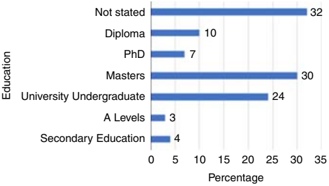
- The survey yielded 305 responses, reduced to 277 Qatar-based responses after a location filter; respondents were all working and living in Qatar, from 56 countries.
- The base model (TPB only) explains 20% of the variance in food-waste behaviour, while the extended model explains 35%, a 75% increase in predictive power.
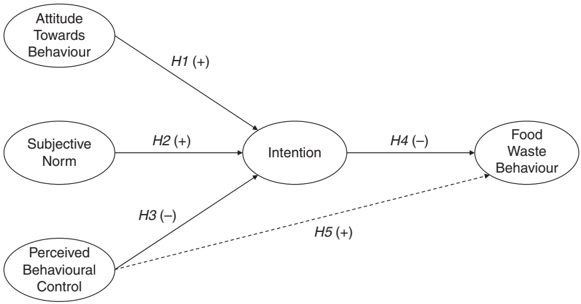
- All tested hypotheses were supported: attitudes → intentions (0.42, p ≤ 0.01), subjective norms → intentions (0.12, p = 0.03), perceived behavioural control → intentions (-0.13, p = 0.03), intentions → food waste (-0.29, p ≤ 0.01), and perceived behavioural control → food waste (0.14, p = 0.010).
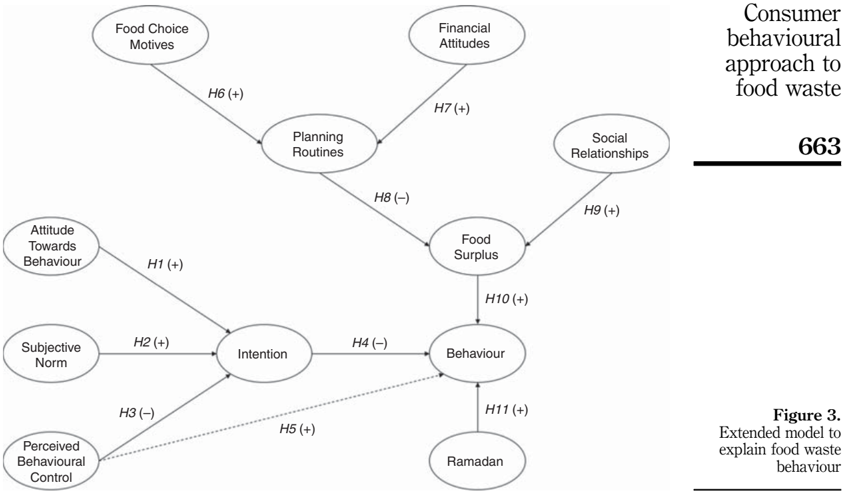
- Contextual effects were also supported: motives → planning (0.23, p ≤ 0.01), financial attitudes → planning (0.21, p ≤ 0.01), planning → food surplus (-0.25, p ≤ 0.01), social relationships → food surplus (0.26, p ≤ 0.01), food surplus → food waste (0.25, p ≤ 0.01), and Ramadan → food waste (0.26, p ≤ 0.01).
Methods
- Cross-sectional online questionnaire study of consumers in Qatar; the survey was translated into Arabic, piloted in December 2016, and deployed January-April 2017.
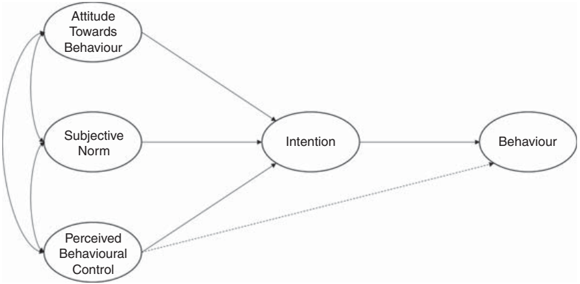
- The model combined the TPB constructs (attitudes, subjective norms, perceived behavioural control, intentions, behaviour) with six contextual factors: food choice motives, financial attitudes, planning routines, social relationships, food surplus, and Ramadan.
- Analysis used partial least squares structural equation modelling (PLS-SEM) in SmartPLS 3, with 1,000 bootstrap subsamples; measurement-model checks included reliability, AVE, and discriminant validity.
Limitations
- The paper explicitly notes that the data come from Qatar, described as an agriculturally resource-constrained country; it also says the sample was limited to people currently based in Qatar. This limits generalisability beyond Qatar.
- The paper states that food waste was measured with a self-reported scale and suggests future research should use a direct measurement of food waste.
- Evident from the text: the sample is not population-representative in a strict sense because it was drawn through the SAFE-Q network, a public blog link, universities, and ministry channels, and includes a multinational but convenience-style sample of residents in Qatar.
Model-written summary. Check it against the paper before relying on it.
Integrity signals
Registry
Cites
Statistics
Figures
Verification
Claims the paper makes
2 Valid · 0 Not valid · 25 Not checked · 38 Own results and interpretations
A result the paper reports from its own data — it cites no other source for it, so there is none to check. The quote shows it is in the paper.
In the paper
“Contextual factors identified in this work increase the explanatory power of the base model by 75 per cent.”
- Also stated in: § Results and research synthesis · plain
“With the inclusion of contextual factors in H6-H11, the Extended Model explains 35 per cent of the variation in food waste behaviour, a 75 per cent increase in the predictive power.”
§ A consumer behavioural approach to food waste > Abstract
plainstates a cause- Asserted: passes — The authors put it forward as true.
- Checkable: passes — It can be checked against evidence.
- Load-bearing: passes — The paper’s conclusions depend on it.
- Based: passes — The paper gives a reason why it holds.
- Rests on an assumption not shown here.
- Also stated in: § Results and research synthesis · plain
A result the paper reports from its own data — it cites no other source for it, so there is none to check. The quote shows it is in the paper.
In the paper
“The data confirm significant relationships between food waste and contextual factors such as motives, financial attitudes, planning routines, food surplus, social relationships and Ramadan.”
§ A consumer behavioural approach to food waste > Abstract
plainstates an association- Asserted: passes — The authors put it forward as true.
- Checkable: passes — It can be checked against evidence.
- Load-bearing: passes — The paper’s conclusions depend on it.
- Based: passes — The paper gives a reason why it holds.
- Rests on an assumption not shown here.
A result the paper reports from its own data — it cites no other source for it, so there is none to check. The quote shows it is in the paper.
In the paper
“H7: Financial attitudes W Planning routines (+) 0.21 o 0.01 Supported”
§ A consumer behavioural approach to food waste > Results and research synthesis
plainstates an association- Asserted: passes — The authors put it forward as true.
- Checkable: passes — It can be checked against evidence.
- Load-bearing: unclear — It is unclear whether the paper’s conclusions depend on it.
- Based: passes — The paper gives a reason why it holds.
- Rests on an assumption not shown here.
A result the paper reports from its own data — it cites no other source for it, so there is none to check. The quote shows it is in the paper.
In the paper
“Subjective norms and intentions are positively correlated, as H2 is supported.”
- Also stated in: § Results and research synthesis · plain
“H2: Subjective norms W Intentions (+) 0.12 0.03 Supported”
§ A consumer behavioural approach to food waste > Results and research synthesis
plainstates an association- Asserted: passes — The authors put it forward as true.
- Checkable: passes — It can be checked against evidence.
- Load-bearing: passes — The paper’s conclusions depend on it.
- Based: passes — The paper gives a reason why it holds.
- Rests on an assumption not shown here.
- Also stated in: § Results and research synthesis · plain
A result the paper reports from its own data — it cites no other source for it, so there is none to check. The quote shows it is in the paper.
In the paper
“H8: Planning routines W Food surplus (-) -0.25 o 0.01 Supported”
§ A consumer behavioural approach to food waste > Results and research synthesis
plainstates an association- Asserted: passes — The authors put it forward as true.
- Checkable: passes — It can be checked against evidence.
- Load-bearing: passes — The paper’s conclusions depend on it.
- Based: passes — The paper gives a reason why it holds.
- Rests on an assumption not shown here.
28 more claims
Create a free account to see all 65 claims and to verify the 3 references still open.
- Probably not a substantial claim. 20
- It may state two separate claims as one. 25
Claims other papers make about this one
Each is checked against this paper’s own text: does it say what the citing paper says it does?
The cited source doesn’t support the claim as written.
In the citing paper
“perceived behavior control (a = 0.937)”
From The Impact of Religiosity and Food Consumption Culture on Food Waste Intention in Saudi Arabia (2021) · cites this paper as [63]
Checked by a reasoning model — may be wrong.
Experimental — accuracy not yet measuredThe cited source doesn’t support the claim as written.
In the citing paper
“food waste intentions (a = 0.926)”
From The Impact of Religiosity and Food Consumption Culture on Food Waste Intention in Saudi Arabia (2021) · cites this paper as [63]
Checked by a reasoning model — may be wrong.
Experimental — accuracy not yet measuredThe cited source doesn’t support the claim as written.
In the citing paper
“subjective norms (a = 0.987)”
From The Impact of Religiosity and Food Consumption Culture on Food Waste Intention in Saudi Arabia (2021) · cites this paper as [63]
Checked by a reasoning model — may be wrong.
Experimental — accuracy not yet measuredThe cited source doesn’t support the claim as written.
In the citing paper
“attitude toward behavior (a = 0.981)”
From The Impact of Religiosity and Food Consumption Culture on Food Waste Intention in Saudi Arabia (2021) · cites this paper as [63]
Checked by a reasoning model — may be wrong.
Experimental — accuracy not yet measuredThe check wasn’t confident either way, so it gives no verdict — never disputed.
In the citing paper
“Food consumption culture three items scale was extracted from the study of [63] (a = 0.954).”
From The Impact of Religiosity and Food Consumption Culture on Food Waste Intention in Saudi Arabia (2021) · cites this paper as [63]
Experimental — accuracy not yet measured
1 more claim about this paper
Create a free account to see every claim other papers make about this one.
Self-check
Percentages, sums and reported differences re-computed from the paper’s own numbers.
Each contradiction between two passages listed here was confirmed by an independent check.
Rated minor: it would not touch a result — a value no result rests on, a p-value that stays on the same side of the significance level, or a conflict that is clerical, resolved elsewhere in the paper, or outside its own findings.
In the paper
§ A consumer behavioural approach to food waste > Results and research synthesis
“H5: Perceived behavioural control W Food waste behaviour (-) 0.14 0.010 Supported”
§ A consumer behavioural approach to food waste > Results and research synthesis
“The positive relationship between the difficulty to control food waste (perceived behavioural control) and food waste behaviour in H5 is also supported in line with the TPB.”
Citations
Cites
The theory of planned behavior
Ajzen, I. (1991) · Organizational Behavior and Human Decision Processes · doi:10.1016/0749-5978(91)90020-t · Cited by 134,657
Evaluating Structural Equation Models with Unobservable Variables and Measurement Error
Fornell, C., & Larcker, D. F. (1981) · Journal of Marketing Research · doi:10.2307/3151312 · Cited by 109,314
Evaluating structural equation models with unobservable variables and measurement error
Fornell, C., & Larcker, D. F. (1981) · Journal of Marketing Research · doi:10.1177/002224378101800104 · Cited by 109,190
Hu, L., & Bentler, P. M. (1999) · Structural Equation Modeling A Multidisciplinary Journal · doi:10.1080/10705519909540118 · Cited by 108,788
(2014) · DigitalCommons - Kennesaw State University (Kennesaw State University) · Cited by 12,785
Diamantopoulos, A., & Siguaw, J. A. (2006) · British Journal of Management · doi:10.1111/j.1467-8551.2006.00500.x · Cited by 3,410
Common Beliefs and Reality About PLS: Comments on Rönkkö and Evermann (2013)
Henseler, J., Dijkstra, T. K., Sarstedt, M., Ringle, C. M., Diamantopoulos, A., Straub, D. W., Ketchen, D. J., Hair, J. F., Hult, G. T. M., & Calantone, R. J. (2014) · Organizational Research Methods · doi:10.1177/1094428114526928 · Cited by 3,332
Sarstedt, M., Ringle, C. M., Smith, D., Reams, R., & Hair, J. F. (2014) · Journal of Family Business Strategy · doi:10.1016/j.jfbs.2014.01.002 · Cited by 2,212
Partial least squares structural equation modeling in HRM research
Ringle, C. M., Sarstedt, M., Mitchell, R., & Gudergan, S. P. (2020) · The International Journal of Human Resource Management · doi:10.1080/09585192.2017.1416655 · Cited by 1,943
Statistical analysis of sets of congeneric tests
Jöreskog, K. G. (1971) · Psychometrika · doi:10.1007/bf02291393 · Cited by 1,481
Research works printed but not linked: 3
- 2. Aktas, E., Topaloglu, Z., Oledinma, A., Sharif, A., Huda, A.K.S., Sahin, H. and Irani, Z. (2017), "Contextual factors affecting food security: a behavioural framework", The 22nd Logistics Research Network Annual Conference and PhD Workshop, Southampton, 6-8 September, pp. 6-8.
- 14. Gustavsson, J., Cederberg, C., Sonesson, U., van Otterdijk, R. and Meybeck, A. (2011), Global Food Losses and Food Waste, FAO, Rome.
- 27. Ringle, C.M., Wende, S. and Becker, J.-M. (2015), SmartPLS 3, SmartPLS GmbH, Boenningstedt.
Cited by
Items 201–282 of 282
Finding Alternatives to Reduce Food Waste: An Experimental Study on Food Consumers
Hong, Y. A., Kim, N., & Yun, C. (2024) · Journal of Family and Economic Issues · doi:10.1007/s10834-024-09964-w · Cited by 4
The role of responsible consumption in explaining Vietnamese household food waste
Tuu, H. H., & Hien, D. H. T. (2026) · Journal of Foodservice Business Research · doi:10.1080/15378020.2026.2649038 · Cited by 2
Analysis of Government Policies in Padang City in Food Waste Management at the Household Level
Rahman, D., Elfindri, E., Henmaidi, H., & Rahman, H. (2023) · Jurnal Riset Multidisiplin dan Inovasi Teknologi · doi:10.59653/jimat.v2i01.307 · Cited by 2
Reducing food and water waste in hotels: Sustainability at risk?
Avi, M. S. (2023) · International Journal of Tourism and Hotel Management · doi:10.22271/27069583.2023.v5.i1a.61 · Cited by 2
Lee, A.-S., Yusof, N. A. M., Khor, S. C., Ng, Y.-H., Ching, S., Lau, L.-S., & Sakti, M. R. P. (2026) · Discover Food · doi:10.1007/s44187-025-00795-8 · Cited by 5
Effects of food sources on food waste behaviour: evidence from urban regions of Vietnam
Ngo, M. H., Ha, T. M., Lucas, B. F., Nguyen, A. D., Bui, T. L., Le, N. T., Delley, M., Götze, F., Markoni, E., Pham, B. D., et al. (2025) · Agricultural and Food Economics · doi:10.1186/s40100-025-00445-8 · Cited by 2
Voća, N., Donsì, F., Sandu, M. A., Voronova, V., Žlabur, J. Š., Feo, G. D., Vîrsta, A., Klõga, M., Lubura, J., Peter, A., et al. (2026) · Foods · doi:10.3390/foods15040696 · Cited by 1
Assessment of Self-reported Food Waste from Households via Two Routes in Pakistan
Zafar, S., Ullah, E., Naqvi, S. A. A., Anwar, S., & Hussain, B. (2024) · Journal of the Knowledge Economy · doi:10.1007/s13132-024-02244-w · Cited by 5
Seçer, A. (2020) · Çukurova Üniversitesi Ziraat Fakültesi dergisi/Çukurova tarım ve gıda bilimleri dergisi :/Çukurova tarım ve gıda bilimleri dergisi · doi:10.36846/cjafs.2020.21 · Cited by 1
Srijuntrapun, P., & Ket-um, P. (2026) · PLoS ONE · doi:10.1371/journal.pone.0343534 · Cited by 2
Food Waste from the Perspective of Assessment of Attitudes and Behaviours of Young Consumers
Radzymińska, M., & Platta, A. M. (2022) · Scientific Journal of Gdynia Maritime University · doi:10.26408/122.06 · Cited by 4
IoT-Enabled Quality-Triggered Markdown Pricing for Perishable Food: Equity and Waste Implications
Hassini, E., Ben-Daya, M., & Bahroun, Z. (2026) · Foods · doi:10.3390/foods15040742 · Cited by 1
Cao, Z., Williams, N. L., Ali, I. L., Periola, O., & Kayıkçı, Y. (2025) · Business Strategy and the Environment · doi:10.1002/bse.70443 · Cited by 3
Lahath, A., Omar, N. A., Hamid, S. N. A., Jannat, T., Ayob, A. H., Alam, S. S., & Nazri, M. A. (2025) · Discover Sustainability · doi:10.1007/s43621-025-02121-9 · Cited by 1
Alkindi, M. Z. H., Haddad, A. M., Saidu, M. B., & Abushammala, H. (2026) · Frontiers in Sustainable Food Systems · doi:10.3389/fsufs.2026.1736201 · Cited by 2
Indiahono, D. (2023) · KnE Social Sciences · doi:10.18502/kss.v8i3.12817
PROCRASTINAÇÃO, CONTROLE E ESFORÇO PERCEBIDO NO COMPORTAMENTO DE DESPERDÍCIO DE ALIMENTOS
da Costa, M. F., Campos, P. D. O., & de Santana, P. N. (2021) · Revista de Administração de Empresas · doi:10.1590/s0034-759020210504 · Cited by 4
Peningkatan Kesadaran Masyarakat Dalam Pengurangan Food Waste Untuk Membentuk Cinta Lingkungan
Timoty, N. S., & Yuliati, L. N. (2022) · Policy Brief Pertanian Kelautan dan Biosains Tropika · doi:10.29244/agro-maritim.0402.245-248 · Cited by 3
Andesta, I. (2020) · Tourisma Jurnal Pariwisata · doi:10.22146/gamajts.v2i2.56853 · Cited by 2
Voinea, L., Popescu, D. V., Negrea, T. M., & Dina, R. (2022) · Proceeding Papers · doi:10.24818/basiq/2022/08/045 · Cited by 1
Behavioral Drivers of Food Waste Reduction in Urban Vietnam
Nguyen, T. T. G., & Nguyen, G. H. (2025) · The Journal of Behavioral Science · doi:10.69523/tjbs.2025.278953 · Cited by 3
Karani, C., Gido, E. O., & Bett, H. K. (2022) · Applied Studies in Agribusiness and Commerce · doi:10.19041/apstract/2021/1-2/10 · Cited by 2
Household food waste across multiple food groups in Dodoma, Tanzania: A Multinomial Probit approach
Silayo, D. M., Kulwijila, M., & Bongole, A. J. (2025) · Waste Management Bulletin · doi:10.1016/j.wmb.2025.100276 · Cited by 2
Hsiao, C., & Tang, K. (2026) · Cleaner and Responsible Consumption · doi:10.1016/j.clrc.2026.100487 · Cited by 2
Özkan, B., Koçoğlu, B., & Koç, F. (2024) · OPUS Toplum Araştırmaları Dergisi · doi:10.26466/opusjsr.1579462 · Cited by 4
Intergenerational food waste behavior: how gen X and millennials differ in Indonesia
Octavia, J. R., Sitompul, C., Purwanto, E., & Biasini, N. (2025) · International Review on Public and Nonprofit Marketing · doi:10.1007/s12208-025-00462-9 · Cited by 1
Jung, H., Hwang, Y. H., & Yoon, H. H. (2026) · Foods · doi:10.3390/foods15071194 · Cited by 1
A two-stage quantitative study on consumers’ behavioral intentions toward ugly food consumption
Chang, H. S. (2026) · British Food Journal · doi:10.1108/bfj-08-2025-1034 · Cited by 2
Natural resource dependence and war nexus: new insights
Shami, F. A., Arayssi, M., Marrouch, W., & Sayour, N. (2025) · Defence and Peace Economics · doi:10.1080/10242694.2025.2450842 · Cited by 3
Food waste and consumer behavior: A SPAR-4-SLR compliant hybrid systematic review
Awasthi, A., Uddin, S. M. F., & Shukla, A. V. (2026) · Food and Humanity · doi:10.1016/j.foohum.2026.101289
Yadav, S. S., & Kar, S. K. (2026) · International Journal of Quality and Service Sciences · doi:10.1108/ijqss-09-2025-0229
An Investigation on Best Practices to Increase Food Security and Reduce Food Waste in Qatar
Makda, T. J., & Freundt, V. L. M. A. (2025) · World sustainability series · doi:10.1007/978-3-032-00098-9_78
Decoding the Influence Mechanism of Plate Waste Behaviors in Restaurants at Urban ChinaPreprint
Wu, Y., Tian, X., Qin, J., Li, X., & Liu, G. (2022) · SSRN Electronic Journal · doi:10.2139/ssrn.4181526
Untari, D. R., Lenggogeni, S., & Verinita, V. (2023) · Journal of Economics Finance and Management Studies · doi:10.47191/jefms/v6-i11-23
Mamun, A. A., Reza, M. N. H., Yang, Q., & Gao, J. (2025) · Mitigation and Adaptation Strategies for Global Change · doi:10.1007/s11027-025-10267-0 · Cited by 1
Behind the Apron: Employee Food Waste Behavior and Food Safety Concerns in Dining Halls
Appiah, M. O. (2025) · University of North Texas Digital Library (University of North Texas) · doi:10.12794/metadc2443156
Algılanan Değerin Evsel Atık Ayırma Davranışı Üzerindeki Etkisi: Çevre Bilincinin Düzenleyici Rolü
Yilmazoğlu, D., & Gökçek, N. (2026) · Uluslararası Beşeri ve Sosyal Bilimler İnceleme Dergisi · doi:10.55243/ihssr.1957387
Food Waste and Lunar Phases: Evidence from a Randomized Controlled Trial
Shan, P., Zhang, L., & Jiang, S. (2024) · Foods · doi:10.3390/foods13050705 · Cited by 1
Opoku-Mensah, F. A., Tsegah, J. A. D., Brakoh, H., et al. (2026) · Discover Public Health · doi:10.1186/s12982-026-02605-7
Uncovering Food Waste Behavior and Its Determinants among Students at Universitas Ahmad Dahlan
Budijati, S. M., Edoardo, V. A. S., & Putri, I. K. C. (2026) · Bincang Sains dan Teknologi · doi:10.56741/bst.v5i01.1788
Yangui, A., Ouertani, E., & Gandouzi, G. (2026) · Foods · doi:10.3390/foods15162880 · Cited by 1
Hassan, S. H., Chee, L. E., Al-Kumaim, N. H., & Mansouri, H. (2026) · SSRN Electronic Journal · doi:10.2139/ssrn.7008247
Understanding consumer patterns in food sharing behaviours: a cluster analysis approach
Morgante, A., Rinallo, E., & Michelini, L. (2026) · Cleaner Food Systems · doi:10.1016/j.clfs.2026.100059
Multi-group Analysis of Consumer’s Food Waste Behavior at Household Level
Zafar, S., Anwar, S., Naqvi, S. A. A., & Nadeem, A. M. (2023) · Sustainable Business and Society in Emerging Economies · doi:10.26710/sbsee.v5i3.2682
Eze, P. E., Oosthuizen, D., & Mofokeng, J. (2026) · Frontiers in Sustainable Resource Management · doi:10.3389/fsrma.2026.1921659
Survey and analysis of consumer behavior for food waste management in Bangladesh
Haque, M. A., Azad, A. M. A. S., Ankhi, I. J., Faisal, A. K. M., & Masud, M. H. (2026) · Energy Nexus · doi:10.1016/j.nexus.2026.100695
Reducing food waste for environmental sustainability: study in Indonesia
Setiawan, M., Kirana, D. C., Rahmah, R., & Sabiella, I. (2024) · IOP Conference Series Earth and Environmental Science · doi:10.1088/1755-1315/1413/1/012012
Saputra, E., & Alhamdi, R. (2025) · Industrial and Domestic Waste Management · doi:10.53623/idwm.v5i2.844 · Cited by 1
The 13 steps to create innovation in hotels
Avi, M. S. (2022) · International Journal of Tourism and Hotel Management · doi:10.22271/27069583.2022.v4.i1a.42
Kulshrestha, R., Malakar, S. K., & Farhan, M. (2024) · Practice, progress, and proficiency in sustainability · doi:10.4018/979-8-3693-2181-2.ch020
DESPERDÍCIOS DE ALIMENTOS EM DOMICÍLIOS: COMO A LITERATURA TEM ABORDADO ESSE DESAFIO?
Deliberador, L. R., Santos, M. C. B., BATALHA, M. O., & César, A. D. S. (2023) · Anais do 60º Congresso da Sociedade Brasileira de Economia, Administração e Sociologia Rural (SOBER) · doi:10.29327/sober2023.626643
Nilasari, W. A., Haniffa, R., Rizal, C. F., Ratnasari, R. T., & Hasib, F. (2026) · Journal of Islamic Accounting and Business Research · doi:10.1108/jiabr-07-2025-0470 · Cited by 1
Doukas, Y. E., Maravegias, N., Zorpas, A. A., Sotiropoulos, A., & Vardopoulos, I. (2026) · Journal of Agribusiness in Developing and Emerging Economies · doi:10.1108/jadee-10-2025-0512 · Cited by 8
Emerging food systems: challenges and opportunities for the future food security in GCC countries
Hussain, M. A., Rahman, M. S., Karam, L., Huda, N., & Huda, A. K. S. (2026) · Cogent Food & Agriculture · doi:10.1080/23311932.2026.2722437
Self-citationHow Responsible Are Consumers? Analysis of Food Waste Behavior of Households
Kapoor, N. (2022) · Advances in finance, accounting, and economics book series · doi:10.4018/978-1-7998-9664-7.ch012
Exploring the Influence of Affect on Food Waste: Do Social Media Usage Matters?
Omar, N. A., & Lahath, A. (2023) · IEEE International Symposium on Technology and Society (ISTAS) · doi:10.1109/istas57930.2023.10306029
ÇETİN, B., & ARPACI, S. (2025) · Kayseri Üniversitesi Sosyal Bilimler Dergisi · doi:10.51177/kayusosder.1689500
Bernzen, A., Bonnin, C., & Friedrich, H. (2026) · Geoforum · doi:10.1016/j.geoforum.2026.104784
O comportamento de desperdício de alimentos pelos consumidores no contexto de pandemia
Mouco, E. A. (2021) · Digital Library of Theses and Dissertations (Universidade de São Paulo) · doi:10.11606/d.12.2021.tde-14052024-143446
Cultural insights and policy challenges: A thematic analysis of food-saving campaigns in East Asia
Wang, Y., Morkūnas, M., & Wei, J. (2025) · Food and Humanity · doi:10.1016/j.foohum.2025.100978 · Cited by 2
Gıda Atıklarının Azaltılmasına Yönelik Tutum ve Davranışların Araştırılması
Kalfa, V. R., Yılmaz, V., & Gündüz, H. M. (2025) · Alanya Akademik Bakış · doi:10.29023/alanyaakademik.1523444
Reducing Food Waste Through Sharing Platforms: Unveiling the Rebound Effect
Michelini, L., Rinallo, E., Scopelliti, M., & Pisoni, A. (2026) · Business Strategy and the Environment · doi:10.1002/bse.70501 · Cited by 3
Danish, T., Wardle, K., & Hossain, M. (2026) · Strategic Business Research · doi:10.1016/j.sbr.2026.100055
Faradisa, S., Romadlon, F., & Permatasari, R. D. (2025) · International Conference on Data Analytics for Business and Industry (ICDABI) · doi:10.1109/icdabi67967.2025.11547738
WIELKOŚĆ GOSPODARSTWA DOMOWEGO I DZIEŃ TYGODNIA A POZIOM ZMARNOWANEJ ŻYWNOŚCI
TOMASZEWSKA, M., BILSKA, B., & Kołożyn‐Krajewska, D. (2023) · Zywnosc-nauka Technologia Jakosc · doi:10.15193/zntj/2023/136/464
Ali, A. N. M. A. (2025) · Cleaner Waste Systems · doi:10.1016/j.clwas.2025.100466
Food waste (un)sustainability: A social-psychological perspective
Barbera, F. L., & Altamura, C. (2025) · Elsevier eBooks · doi:10.1016/b978-0-443-33140-4.00010-5
Zhou, Y., & Liu, Y. (2026) · Frontiers in Sustainable Food Systems · doi:10.3389/fsufs.2026.1907566
What really drives food waste? Advancing food waste prevention through behavioral evidence
Deliberador, L. R., Batalha, M. O., & César, A. D. S. (2026) · Socio-Economic Planning Sciences · doi:10.1016/j.seps.2026.102530
Shah, I. A., Khan, N., & Abdellatif, S. H. (. R. S. (2025) · SSRN Electronic Journal · doi:10.2139/ssrn.5995703
Saboori, B., Zaibet, L., Abri, I. A., & Ghodsi, D. (2026) · Sustainable Futures · doi:10.1016/j.sftr.2026.102077 · Cited by 1
Mansoor, R., Rūtelionė, A., & Bhutto, M. Y. (2026) · Sustainability · doi:10.3390/su18010495 · Cited by 2
Rethinking Household Food Waste: What Really Matters in Everyday Food Management
Veselá, L., Podroužek, J., & Kubíčková, L. (2026) · International Journal of Consumer Studies · doi:10.1111/ijcs.70223 · Cited by 1
Metadata
- Authors
- Aktas, E., Sahin, H., Topaloglu, Z., Oledinma, A., Huda, A. K. S., Irani, Z., Sharif, A. M., van’t Wout, T., & Kamrava, M.
- Affiliations
- Georgetown University (US)
- University of Warwick (GB)
- Western Sydney University (AU)
- University of Bradford (GB)
- Venue
- Journal of Enterprise Information Management
- Publisher
- Emerald
- Published
- 2018-08-03
- Volume
- 31
- Issue
- 5
- Pages
- 658-673
- ISSN
- 1741-0398 (ISSN-L)
- OpenAlex
- W2886362214
- Semantic Scholar
- 981bd475fb7f5bc107353f12813d055bde164ee8
- Cited by
- 285
- References
- 30
- Citations by year
- 2026: 35 · 2025: 49 · 2024: 40 · 2023: 50 · 2022: 51 · 2021: 31 · 2020: 23 · 2019: 6
- FWCI
- 14.12
- Type
- journal article
- Language
- en
- Open access
- hybrid
- doi.org
- Licence
- cc-by
- www.emerald.com/insight/site-policies (tdm)
- Locations
- Journal of Enterprise Information Management (publishedVersion, cc-by)
- Breda University of Applied Sciences Portal (submittedVersion, cc-by)
- CERES (Cranfield University) (submittedVersion, cc-by)
- Funders
- Qatar Foundation (NPRP 7)
- Fonds National de la Recherche Luxembourg
- Qatar National Research Fund (NPRP: 7)
- Topics
- Life Sciences › Agricultural and Biological Sciences › Food Science › Food Waste Reduction and Sustainability
- Physical Sciences › Environmental Science › Ecology › Agriculture Sustainability and Environmental Impact
- Health Sciences › Nursing › Nutrition and Dietetics › Nutrition, Health and Food Behavior
- Keywords
- food waste, consumer behavior, theory of planned behavior, contextual factors, food security, food surplus, Ramadan, dietary habits, food waste policy, Qatar
About these checks
Registry, retraction, Cites and statistics results are computed, not judged, with one exception: a printed reference that no index lists is read once by a model before it counts as a citation error. Claims are extracted by a model and kept only when their quote appears verbatim in the text; each cited source is then checked, with a model’s help, for whether it says what the claim relies on. Those verdicts can be wrong — read the claim’s quote and the cited source before relying on one.
A language model drew the claims from the paper on 2026-10-10, under version 3 of the claim definition (model deepseek-v4.1-flash, prompt extract-v3).
A second model labelled each claim on 2026-10-10 (model jev-1.13-20260917, definition revision gold-guideline-v0.2).
Statistics and arithmetic are recomputed, not judged.
Confidence bands are shown only for fields calibrated on our annotated test set. None is calibrated yet, so no band is shown.
What counts as a claim ›How we measure confidence ›How we check this ›
Are you an author, or do you see a problem with this page? Request a review
Data sources
Bibliographic data: Semantic Scholar, OpenAlex, Crossref.
Contains information from the Semantic Scholar Academic Graph Datasets, made available under the ODC Attribution License (ODC-BY 1.0).
Semantic Scholar’s data is described in: Kinney, R., et al. (2023). The Semantic Scholar Open Data Platform. arXiv:2301.10140.
