

A consumer behavioural approach to food waste
Open accessThe DOI matches its Crossref record; 29 of the 30 references it cites were found in a registry or an index; 2 of the 29 sources its claims cite were checked for support.
Abstract
Purpose Food waste occurs in every stage of the supply chain, but the value-added lost to waste is the highest when consumers waste food. The purpose of this paper is to understand the food waste behaviour of consumers to support policies for minimising food waste. Design/methodology/approach Using the theory of planned behaviour (TPB) as a theoretical lens, the authors design a questionnaire that incorporates contextual factors to explain food waste behaviour. The authors test two models: base (four constructs of TPB) and extended (four constructs of TPB plus six contextual factors). The authors build partial least squares structural equation models to test the hypotheses. Findings The data confirm significant relationships between food waste and contextual factors such as motives, financial attitudes, planning routines, food surplus, social relationships and Ramadan. Research limitations/implications The data comes from an agriculturally resource-constrained country: Qatar. Practical implications Food waste originating from various causes means more food should flow through the supply chains to reach consumers’ homes. Contextual factors identified in this work increase the explanatory power of the base model by 75 per cent. Social implications Changing eating habits during certain periods of the year and food surplus have a strong impact on food waste behaviour. Originality/value A country is considered to be food secure if it can provide its citizens with stable access to sufficient, safe and nutritious food. The findings and conclusions inform and impact upon the development of food waste and food security policies.
Overview
CoChat Summary
TL;DR
Using the Theory of Planned Behaviour (TPB) plus six contextual factors, this study explains consumer food-waste behaviour in Qatar with survey data and PLS-SEM. The extended model outperforms the base TPB model, and the paper finds especially strong effects for Ramadan and food surplus.
Key findings
- The survey yielded 305 responses, reduced to 277 Qatar-based responses after a location filter; respondents were all working and living in Qatar, from 56 countries.
- The base model (TPB only) explains 20% of the variance in food-waste behaviour, while the extended model explains 35%, a 75% increase in predictive power.
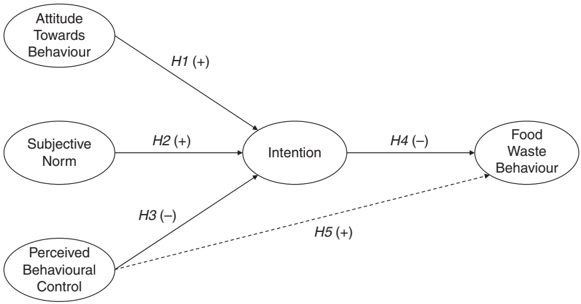
- All tested hypotheses were supported: attitudes → intentions (0.42, p ≤ 0.01), subjective norms → intentions (0.12, p = 0.03), perceived behavioural control → intentions (-0.13, p = 0.03), intentions → food waste (-0.29, p ≤ 0.01), and perceived behavioural control → food waste (0.14, p = 0.010).
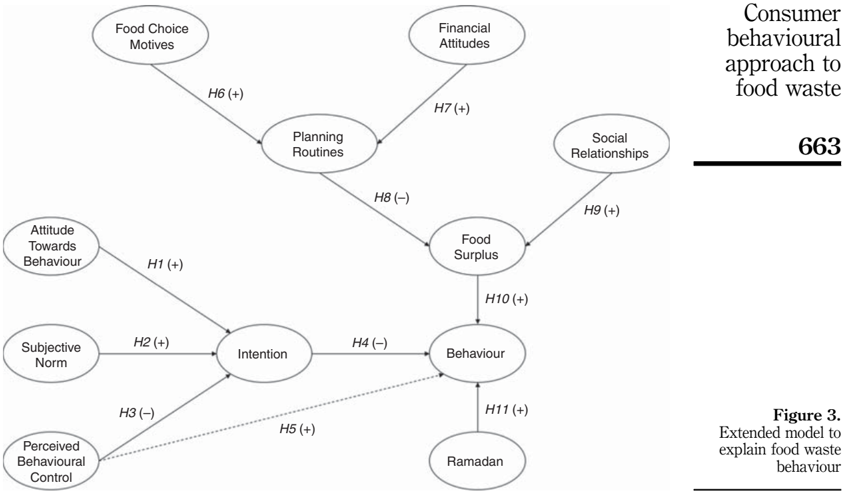
- Contextual effects were also supported: motives → planning (0.23, p ≤ 0.01), financial attitudes → planning (0.21, p ≤ 0.01), planning → food surplus (-0.25, p ≤ 0.01), social relationships → food surplus (0.26, p ≤ 0.01), food surplus → food waste (0.25, p ≤ 0.01), and Ramadan → food waste (0.26, p ≤ 0.01).
Methods
- Cross-sectional online questionnaire study of consumers in Qatar; the survey was translated into Arabic, piloted in December 2016, and deployed January-April 2017.
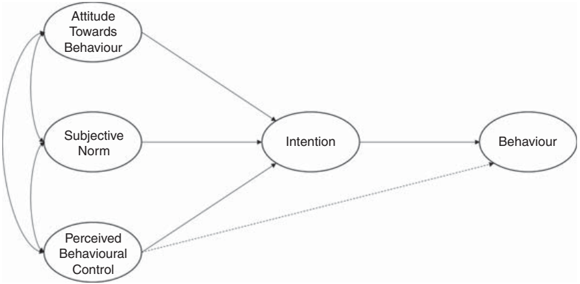
- The model combined the TPB constructs (attitudes, subjective norms, perceived behavioural control, intentions, behaviour) with six contextual factors: food choice motives, financial attitudes, planning routines, social relationships, food surplus, and Ramadan.
- Analysis used partial least squares structural equation modelling (PLS-SEM) in SmartPLS 3, with 1,000 bootstrap subsamples; measurement-model checks included reliability, AVE, and discriminant validity.
Limitations
- The paper explicitly notes that the data come from Qatar, described as an agriculturally resource-constrained country; it also says the sample was limited to people currently based in Qatar. This limits generalisability beyond Qatar.
- The paper states that food waste was measured with a self-reported scale and suggests future research should use a direct measurement of food waste.
- Evident from the text: the sample is not population-representative in a strict sense because it was drawn through the SAFE-Q network, a public blog link, universities, and ministry channels, and includes a multinational but convenience-style sample of residents in Qatar.
Model-written summary. Check it against the paper before relying on it.
Integrity signals
Registry
Cites
Statistics
Figures
Verification
Claims the paper makes
2 Valid · 0 Not valid · 25 Not checked · 38 Own results and interpretations
A result the paper reports from its own data — it cites no other source for it, so there is none to check. The quote shows it is in the paper.
In the paper
“Contextual factors identified in this work increase the explanatory power of the base model by 75 per cent.”
- Also stated in: § Results and research synthesis · plain
“With the inclusion of contextual factors in H6-H11, the Extended Model explains 35 per cent of the variation in food waste behaviour, a 75 per cent increase in the predictive power.”
§ A consumer behavioural approach to food waste > Abstract
plainstates a cause- Asserted: passes — The authors put it forward as true.
- Checkable: passes — It can be checked against evidence.
- Load-bearing: passes — The paper’s conclusions depend on it.
- Based: passes — The paper gives a reason why it holds.
- Rests on an assumption not shown here.
- Also stated in: § Results and research synthesis · plain
A result the paper reports from its own data — it cites no other source for it, so there is none to check. The quote shows it is in the paper.
In the paper
“The data confirm significant relationships between food waste and contextual factors such as motives, financial attitudes, planning routines, food surplus, social relationships and Ramadan.”
§ A consumer behavioural approach to food waste > Abstract
plainstates an association- Asserted: passes — The authors put it forward as true.
- Checkable: passes — It can be checked against evidence.
- Load-bearing: passes — The paper’s conclusions depend on it.
- Based: passes — The paper gives a reason why it holds.
- Rests on an assumption not shown here.
A result the paper reports from its own data — it cites no other source for it, so there is none to check. The quote shows it is in the paper.
In the paper
“H7: Financial attitudes W Planning routines (+) 0.21 o 0.01 Supported”
§ A consumer behavioural approach to food waste > Results and research synthesis
plainstates an association- Asserted: passes — The authors put it forward as true.
- Checkable: passes — It can be checked against evidence.
- Load-bearing: unclear — It is unclear whether the paper’s conclusions depend on it.
- Based: passes — The paper gives a reason why it holds.
- Rests on an assumption not shown here.
A result the paper reports from its own data — it cites no other source for it, so there is none to check. The quote shows it is in the paper.
In the paper
“Subjective norms and intentions are positively correlated, as H2 is supported.”
- Also stated in: § Results and research synthesis · plain
“H2: Subjective norms W Intentions (+) 0.12 0.03 Supported”
§ A consumer behavioural approach to food waste > Results and research synthesis
plainstates an association- Asserted: passes — The authors put it forward as true.
- Checkable: passes — It can be checked against evidence.
- Load-bearing: passes — The paper’s conclusions depend on it.
- Based: passes — The paper gives a reason why it holds.
- Rests on an assumption not shown here.
- Also stated in: § Results and research synthesis · plain
A result the paper reports from its own data — it cites no other source for it, so there is none to check. The quote shows it is in the paper.
In the paper
“H8: Planning routines W Food surplus (-) -0.25 o 0.01 Supported”
§ A consumer behavioural approach to food waste > Results and research synthesis
plainstates an association- Asserted: passes — The authors put it forward as true.
- Checkable: passes — It can be checked against evidence.
- Load-bearing: passes — The paper’s conclusions depend on it.
- Based: passes — The paper gives a reason why it holds.
- Rests on an assumption not shown here.
28 more claims
Create a free account to see all 65 claims and to verify the 3 references still open.
- Probably not a substantial claim. 20
- It may state two separate claims as one. 25
Claims other papers make about this one
Each is checked against this paper’s own text: does it say what the citing paper says it does?
The cited source doesn’t support the claim as written.
In the citing paper
“perceived behavior control (a = 0.937)”
From The Impact of Religiosity and Food Consumption Culture on Food Waste Intention in Saudi Arabia (2021) · cites this paper as [63]
Checked by a reasoning model — may be wrong.
Experimental — accuracy not yet measuredThe cited source doesn’t support the claim as written.
In the citing paper
“food waste intentions (a = 0.926)”
From The Impact of Religiosity and Food Consumption Culture on Food Waste Intention in Saudi Arabia (2021) · cites this paper as [63]
Checked by a reasoning model — may be wrong.
Experimental — accuracy not yet measuredThe cited source doesn’t support the claim as written.
In the citing paper
“subjective norms (a = 0.987)”
From The Impact of Religiosity and Food Consumption Culture on Food Waste Intention in Saudi Arabia (2021) · cites this paper as [63]
Checked by a reasoning model — may be wrong.
Experimental — accuracy not yet measuredThe cited source doesn’t support the claim as written.
In the citing paper
“attitude toward behavior (a = 0.981)”
From The Impact of Religiosity and Food Consumption Culture on Food Waste Intention in Saudi Arabia (2021) · cites this paper as [63]
Checked by a reasoning model — may be wrong.
Experimental — accuracy not yet measuredThe check wasn’t confident either way, so it gives no verdict — never disputed.
In the citing paper
“Food consumption culture three items scale was extracted from the study of [63] (a = 0.954).”
From The Impact of Religiosity and Food Consumption Culture on Food Waste Intention in Saudi Arabia (2021) · cites this paper as [63]
Experimental — accuracy not yet measured
1 more claim about this paper
Create a free account to see every claim other papers make about this one.
Self-check
Percentages, sums and reported differences re-computed from the paper’s own numbers.
Each contradiction between two passages listed here was confirmed by an independent check.
Rated minor: it would not touch a result — a value no result rests on, a p-value that stays on the same side of the significance level, or a conflict that is clerical, resolved elsewhere in the paper, or outside its own findings.
In the paper
§ A consumer behavioural approach to food waste > Results and research synthesis
“H5: Perceived behavioural control W Food waste behaviour (-) 0.14 0.010 Supported”
§ A consumer behavioural approach to food waste > Results and research synthesis
“The positive relationship between the difficulty to control food waste (perceived behavioural control) and food waste behaviour in H5 is also supported in line with the TPB.”
Citations
Cites
The theory of planned behavior
Ajzen, I. (1991) · Organizational Behavior and Human Decision Processes · doi:10.1016/0749-5978(91)90020-t · Cited by 134,657
Evaluating Structural Equation Models with Unobservable Variables and Measurement Error
Fornell, C., & Larcker, D. F. (1981) · Journal of Marketing Research · doi:10.2307/3151312 · Cited by 109,314
Evaluating structural equation models with unobservable variables and measurement error
Fornell, C., & Larcker, D. F. (1981) · Journal of Marketing Research · doi:10.1177/002224378101800104 · Cited by 109,190
Hu, L., & Bentler, P. M. (1999) · Structural Equation Modeling A Multidisciplinary Journal · doi:10.1080/10705519909540118 · Cited by 108,788
(2014) · DigitalCommons - Kennesaw State University (Kennesaw State University) · Cited by 12,785
Diamantopoulos, A., & Siguaw, J. A. (2006) · British Journal of Management · doi:10.1111/j.1467-8551.2006.00500.x · Cited by 3,410
Common Beliefs and Reality About PLS: Comments on Rönkkö and Evermann (2013)
Henseler, J., Dijkstra, T. K., Sarstedt, M., Ringle, C. M., Diamantopoulos, A., Straub, D. W., Ketchen, D. J., Hair, J. F., Hult, G. T. M., & Calantone, R. J. (2014) · Organizational Research Methods · doi:10.1177/1094428114526928 · Cited by 3,332
Sarstedt, M., Ringle, C. M., Smith, D., Reams, R., & Hair, J. F. (2014) · Journal of Family Business Strategy · doi:10.1016/j.jfbs.2014.01.002 · Cited by 2,212
Partial least squares structural equation modeling in HRM research
Ringle, C. M., Sarstedt, M., Mitchell, R., & Gudergan, S. P. (2020) · The International Journal of Human Resource Management · doi:10.1080/09585192.2017.1416655 · Cited by 1,943
Statistical analysis of sets of congeneric tests
Jöreskog, K. G. (1971) · Psychometrika · doi:10.1007/bf02291393 · Cited by 1,481
Research works printed but not linked: 3
- 2. Aktas, E., Topaloglu, Z., Oledinma, A., Sharif, A., Huda, A.K.S., Sahin, H. and Irani, Z. (2017), "Contextual factors affecting food security: a behavioural framework", The 22nd Logistics Research Network Annual Conference and PhD Workshop, Southampton, 6-8 September, pp. 6-8.
- 14. Gustavsson, J., Cederberg, C., Sonesson, U., van Otterdijk, R. and Meybeck, A. (2011), Global Food Losses and Food Waste, FAO, Rome.
- 27. Ringle, C.M., Wende, S. and Becker, J.-M. (2015), SmartPLS 3, SmartPLS GmbH, Boenningstedt.
Cited by
Coşkun, A., & Yetkin Özbük, R. M. (2020) · Waste Management · doi:10.1016/j.wasman.2020.08.011 · Cited by 227
Data-driven optimal dynamic pricing strategy for reducing perishable food waste at retailers
Kayikci, Y., Demir, S., Mangla, S. K., Subramanian, N., & Koc, B. (2022) · Journal of Cleaner Production · doi:10.1016/j.jclepro.2022.131068 · Cited by 125
The internet of things in the food supply chain: adoption challenges
Aamer, A. M., Al‐Awlaqi, M. A., Affia, I., Arumsari, S. S., & Mandahawi, N. (2021) · Benchmarking An International Journal · doi:10.1108/bij-07-2020-0371 · Cited by 139
Flanagan, A., & Priyadarshini, A. (2021) · Journal of Environmental Management · doi:10.1016/j.jenvman.2021.112046 · Cited by 138
Religiosity and food waste reduction intentions: A conceptual model
Elhoushy, S., & Jang, S. (. (2021) · International Journal of Consumer Studies · doi:10.1111/ijcs.12624 · Cited by 109
Smart packaging − A pragmatic solution to approach sustainable food waste management
Ganeson, K., Mouriya, G. K., Bhubalan, K., Razali, R. M., Jasmine, R., Sowmiya, S., Amirul, A.-A. A., Vigneswari, S., & Ramakrishna, S. (2023) · Food Packaging and Shelf Life · doi:10.1016/j.fpsl.2023.101044 · Cited by 125
Integrating the Theory of Planned Behavior With Norm Activation in a Pro-Environmental Context
Setiawan, B., Afiff, A. Z., & Heruwasto, I. (2020) · Social Marketing Quarterly · doi:10.1177/1524500420949220 · Cited by 134
“In addition, perceived control in waste sorting and recycling has a significant effect on intentions and in conducting household waste management (Aktas et al., 2018; Heidari et al., 2018; Kumar, 2019; Liao & Li, 2019; Visschers et al., 2016).”
BackgroundAmeliorating food loss and waste in the supply chain through multi-stakeholder collaboration
Bhattacharya, A., & Fayezi, S. (2021) · Industrial Marketing Management · doi:10.1016/j.indmarman.2021.01.009 · Cited by 121
Exploring the green waste management problem in food supply chains: A circular economy context
Kharola, S., Ram, M., Mangla, S. K., Goyal, N., Nautiyal, O. P., Pant, D., & Kazançoğlu, Y. (2022) · Journal of Cleaner Production · doi:10.1016/j.jclepro.2022.131355 · Cited by 101
Kumar, A., Mangla, S. K., & Kumar, P. (2022) · Science of The Total Environment · doi:10.1016/j.scitotenv.2022.153411 · Cited by 90
Abadi, B., Mahdavian, S., & Fattahi, F. (2020) · Journal of Cleaner Production · doi:10.1016/j.jclepro.2020.123802 · Cited by 105
The Impact of Religiosity and Food Consumption Culture on Food Waste Intention in Saudi Arabia
Elshaer, I., Sobaih, A. E. E., Alyahya, M., & Abu Elnasr, A. (2021) · Sustainability · doi:10.3390/su13116473 · Cited by 84
“Food consumption culture three items scale was extracted from the study of [63] (a = 0.”
MethodInfluentialRandall, T., Cousins, A. L., Neilson, L., Price, M. J., Hardman, C. A., & Wilkinson, L. L. (2024) · Food Quality and Preference · doi:10.1016/j.foodqual.2023.105086 · Cited by 110
Factors Affecting Sustainable Consumer Behavior in the MENA Region: A Systematic Review
Elhoushy, S., & Lanzini, P. (2020) · Journal of International Consumer Marketing · doi:10.1080/08961530.2020.1781735 · Cited by 125
“Further, in the food waste context, Aktas et al. (2018) found a negative (positive) relationship between the difficulty to store food and intentions (behavior) to reduce food waste.”
BackgroundWaste watchers: A food waste reduction intervention among households in Arizona
Wharton, C., Vizcaino, M., Berardy, A., & Opejin, A. (2021) · Resources, Conservation and Recycling · doi:10.1016/j.resconrec.2020.105109 · Cited by 79
Food Waste in the Countries of the Gulf Cooperation Council: A Systematic Review
Bilali, H. E., & Hassen, T. B. (2020) · Foods · doi:10.3390/foods9040463 · Cited by 98
Fruits and vegetable waste management behavior among retailers in Kumasi, Ghana
Obuobi, B., Zhang, Y., Adu‐Gyamfi, G., Nketiah, E., Grant, M. K., Adjei, M., & Cudjoe, D. (2022) · Journal of Retailing and Consumer Services · doi:10.1016/j.jretconser.2022.102971 · Cited by 90
The role of social media in food waste prevention behaviour
Teoh, C. W., Koay, K. Y., & Chai, P. S. (2021) · British Food Journal · doi:10.1108/bfj-04-2021-0368 · Cited by 95
Mamun, A. A., Ma, Y., Reza, M. N. H., Ahmad, J., Hussain, W. M. H. W., & Lili, Z. (2024) · Food Quality and Preference · doi:10.1016/j.foodqual.2024.105247 · Cited by 106
How to influence consumer food waste behavior with interventions? A systematic literature review
Simões, J., Carvalho, A. I. C. D. S. G., & de Matos, M. G. (2022) · Journal of Cleaner Production · doi:10.1016/j.jclepro.2022.133866 · Cited by 96
Wahbeh, S. Y., Anastasiadis, F., Sundarakani, B., & Manikas, I. (2022) · Foods · doi:10.3390/foods11233804 · Cited by 103
Salins, M., & Aithal, P. S. (2023) · International Journal of Management Technology and Social Sciences · doi:10.47992/ijmts.2581.6012.0279 · Cited by 64
Lahath, A., Omar, N. A., Ali, M. H., Tseng, M., & Yazid, Z. (2021) · Sustainable Production and Consumption · doi:10.1016/j.spc.2021.06.008 · Cited by 89
Households’ Food Waste Behavior at Local Scale: A Cluster Analysis after the COVID-19 Lockdown
Amicarelli, V., Tricase, C., Spada, A., & Bux, C. (2021) · Sustainability · doi:10.3390/su13063283 · Cited by 76
The determinants of food waste behavior in young consumers in a developing country
Bhatti, S. H., Saleem, F., Zakariya, R., & Ahmad, A. (2019) · British Food Journal · doi:10.1108/bfj-06-2019-0450 · Cited by 93
Vittuari, M., Masotti, M., Iori, E., Falasconi, L., Toschi, T. G., & Segrè, A. (2021) · Resources Conservation and Recycling · doi:10.1016/j.resconrec.2021.105815 · Cited by 74
“Its applications were extensively adopted also in the food waste domain (Aktas et al., 2018; Hobbs & Goddard, 2015; Katt & Meixner, 2020; Macready et al., 2020; Savelli et al., 2019; Soorani & Ahmadvand, 2019 among others).”
BackgroundImpact of information hiding on circular food supply chains in business-to-business context
Mangla, S. K., Börühan, G., Ersoy, P., Kazançoğlu, Y., & Song, M. (2021) · Journal of Business Research · doi:10.1016/j.jbusres.2021.06.013 · Cited by 81
Consumer behaviour in relation to food waste: a systematic literature review
dos Santos, J. I. A. S., da Silveira, D. S., da Costa, M. F., & Duarte, R. B. (2022) · British Food Journal · doi:10.1108/bfj-09-2021-1075 · Cited by 84
Factors influencing consumers' food waste reduction behaviour at university canteens
Pandey, S., Budhathoki, M., Pérez-Cueto, F. J. A., & Thomsen, M. (2023) · Food Quality and Preference · doi:10.1016/j.foodqual.2023.104991 · Cited by 84
What influences students’ food waste behaviour in campus canteens?
Wang, H., Ma, B., Cudjoe, D., Farrukh, M. H. M., & Bai, R. (2022) · British Food Journal · doi:10.1108/bfj-10-2021-1103 · Cited by 81
Hatab, A. A., Tirkaso, W. T., Tadesse, E., & Lagerkvist, C. J. (2021) · Resources Conservation and Recycling · doi:10.1016/j.resconrec.2021.106073 · Cited by 79
“…obvious limitation of the reviewed literature is that previous studies relied mostly on self-reported information regarding the amount of food thrown away by households (e.g. Aktas et al., 2018; Aydin and Yildirim; 2021; Heidari et al., 2019), which may differ significantly from the actual amounts.”
MethodResultThe future of food waste: Application of circular economy
Jamaludin, H. B., Elmaky, H. S. E., & Sulaiman, S. (2022) · Energy Nexus · doi:10.1016/j.nexus.2022.100098 · Cited by 73
Food waste prevention behavior in the context of hedonic and utilitarian shopping value
Katt, F., & Meixner, O. (2020) · Journal of Cleaner Production · doi:10.1016/j.jclepro.2020.122878 · Cited by 70
Religious values and family upbringing as antecedents of food waste avoidance
Filimonau, V., Mika, M., Kubal-Czerwińska, M., Zajadacz, A., & Durydiwka, M. (2022) · Global Environmental Change · doi:10.1016/j.gloenvcha.2022.102547 · Cited by 73
Sousa, P. M., Moreira, M. J., de Moura, A. P., Lima, R. C., & Cunha, L. M. (2021) · Sustainability · doi:10.3390/su132011340 · Cited by 93
“In addition, there is also a lack of legislation associated with the marketing of these products [34].”
BackgroundThe role of norms in predicting waste sorting behavior
Setiawan, B., Afiff, A. Z., & Heruwasto, I. (2021) · Journal of Social Marketing · doi:10.1108/jsocm-05-2020-0088 · Cited by 72
Household Food Waste: The Meaning of Product’s Attributes and Food-Related Lifestyle
Szymkowiak, A., Borusiak, B., Pierański, B., Kotyza, P., & Smutka, Ľ. (2022) · Frontiers in Environmental Science · doi:10.3389/fenvs.2022.918485 · Cited by 60
“Although the share of households in total food waste generation differs strongly among countries—from 50% in Canada (Gooch et al., 2010) to about 15% in Netherlands (Aktas et al., 2018)—consumers in highly developed countries generally cause about 40%–50% of global food waste (Aschemann-Witzel et al., 2018).”
BackgroundInfluentialHuang, C., & Tseng, H.-Y. (2020) · Sustainability · doi:10.3390/su12229784 · Cited by 64
Research on Food Behavior in Romania from the Perspective of Supporting Healthy Eating Habits
Voinea, L., Vrânceanu, D. M., Filip, A., Popescu, D. V., Negrea, T. M., & Dina, R. (2019) · Sustainability · doi:10.3390/su11195255 · Cited by 52
Etim, E., Choedron, K. T., Ajai, O., Duke, O. O., & Jijingi, H. E. (2024) · Waste Management & Research The Journal for a Sustainable Circular Economy · doi:10.1177/0734242x241285423 · Cited by 92
“The TPB suggests that attitudes, subjective norms and perceived behavioural control (PBC) shape food waste behaviour (Aktas et al., 2018; Lin and Guan, 2021; Oehman et al., 2022).”
What drives diners' eco-friendly behaviour? The moderating role of planning routine
Talwar, S., Kaur, P., Yadav, R., Bilgihan, A., & Dhir, A. (2021) · Journal of Retailing and Consumer Services · doi:10.1016/j.jretconser.2021.102678 · Cited by 54
Intention to reduce food waste: A study among Malaysians
T’ing, L. C., Moorthy, K., Gunasaygaran, N., Li, C. S., Omapathi, D., Yi, H. J., Anandan, K. M., & Sivakumar, K. (2021) · Journal of the Air & Waste Management Association · doi:10.1080/10962247.2021.1900001 · Cited by 80
“Aktas et al. (2018) applied TPB to investigate household food waste reduction and found that higher intention to reduce waste leads to lower food waste.”
BackgroundMethodExploring the Drivers behind Self-Reported and Measured Food Wastage
Elimelech, E., Ert, E., & Ayalon, O. (2019) · Sustainability · doi:10.3390/su11205677 · Cited by 56
“, daily, weekly, never, most mealtimes) [36,37].”
BackgroundResultLiu, C., & Nguyen, T. T. (2020) · Sustainability · doi:10.3390/su12166565 · Cited by 63
“Factors such as the rapidly growing urban middle class [13] and increased income [14], greater spending power [15], dietary transitions towards westernised consumption patterns [16], modern retail diffusion [17], and time scarcity [18] impact the generation of food waste in rapidly urbanising localities.”
BackgroundFrom the Shopping Basket to the Landfill: Drivers of Consumer Food Waste Behaviour
Veselá, L., Králíková, A., & Kubíčková, L. (2022) · Waste Management · doi:10.1016/j.wasman.2023.07.002 · Cited by 60
Household food waste and theory of planned behavior: A systematic review and meta-analysis
Srivastava, S. K., Mishra, A., Singh, S., & Jaiswal, D. (2023) · Environmental Science and Pollution Research · doi:10.1007/s11356-023-29141-0 · Cited by 65
“Food waste is a common phenomenon that is observed in every stage of the supply chain but the ratio becomes highest when consumers waste it (Aktas et al. 2018).”
BackgroundFoon, P. Y., Ganesan, Y., Iranmanesh, M., & Foroughi, B. (2020) · Environmental Science and Pollution Research · doi:10.1007/s11356-020-09125-0 · Cited by 61
“Besides, in the context of waste management, Aktas et al. (2018) showed that SN have a positive effect on intention to reduce food waste (Aktas et al. 2018).”
BackgroundResultInfluentialSchrank, J., Hanchai, A., Thongsalab, S., Sawaddee, N., Chanrattanagorn, K., & Ketkaew, C. (2023) · Resources · doi:10.3390/resources12080093 · Cited by 65
“Almost half of the quantity of food waste is produced at the household level, making this level one of the greatest producers of wasted food [34].”
BackgroundMinimizing losses at red meat supply chain with circular and central slaughterhouse model
Kayıkçı, Y., Pala, M. Ö., & Kazançoğlu, Y. (2019) · Journal of Enterprise Information Management · doi:10.1108/jeim-01-2019-0025 · Cited by 55
Raghu, S. J., & Rodrigues, L. L. R. (2021) · Journal of Environmental Planning and Management · doi:10.1080/09640568.2021.1949969 · Cited by 66
“It is also acknowledged that there has been an ongoing debate as to whether beliefs and attitudes do necessarily result in more SWMBs (Bertoldo et al. 2013; Steg and Vlek 2009).”
ResultInfluentialMumtaz, S., Chu, A. M. Y., Attiq, S., Shah, H. J., & Wong, W. (2022) · International Journal of Environmental Research and Public Health · doi:10.3390/ijerph19106312 · Cited by 62
“The association of FW reduction intention with the amount of FW was proved to be negative, suggesting that FW reduction intention assists in decreasing the behavior towards FW reduction [12].”
BackgroundChen, M. (2022) · British Food Journal · doi:10.1108/bfj-07-2021-0788 · Cited by 57
Agri-Food Markets in Qatar: Drivers, Trends, and Policy Responses
Hassen, T. B., Bilali, H. E., & Al-Maadeed, M. (2020) · Sustainability · doi:10.3390/su12093643 · Cited by 54
“Nevertheless, there are different food waste recovery strategies, ranging from food waste prevention [86,160,164,165] to food surplus redistribution [164] and food waste reuse (e.”
BackgroundAttiq, S., Chu, A. M. Y., Azam, R. I., Wong, W., & Mumtaz, S. (2021) · International Journal of Environmental Research and Public Health · doi:10.3390/ijerph182312457 · Cited by 58
“Consumer food choice, financial attitude, and social and situational factors are important to describe food waste behavior [87].”
BackgroundTargeting Youths’ Intentions to Avoid Food Waste: Segmenting for Better Policymaking
Marek, E., & Wielicka‐Regulska, A. (2021) · Agriculture · doi:10.3390/agriculture11040284 · Cited by 46
“Factors that limit PBC may be the pickiness of other household members, the irregularity of meals at home, the need to use large food packages, or perceived difficulty preparing meals from food leftovers [17].”
BackgroundCarvalho, R., Lucas, M. R., & Marta‐Costa, A. (2025) · Sustainability · doi:10.3390/su17073236 · Cited by 59
Adaryani, R. L., Palouj, M., Gholami, H., Baghestany, A. A., Damirchi, M. J., Dadar, M., & Seifollahi, N. (2024) · Journal of Retailing and Consumer Services · doi:10.1016/j.jretconser.2024.104119 · Cited by 47
Religiosity and food waste behavior at home and away
Filimonau, V., Kadum, H., Mohammed, N. K., Algboory, H. L., Qasem, J. M., Ермолаев, В. А., & Muhialdin, B. J. (2022) · Journal of Hospitality Marketing & Management · doi:10.1080/19368623.2022.2080145 · Cited by 60
Mariyam, S., Cochrane, L., Zuhara, S., & McKay, G. (2022) · Sustainability · doi:10.3390/su14158991 · Cited by 51
Food waste concerns, eating behaviour and body weight
Sheen, F., Hardman, C. A., & Robinson, E. (2020) · Appetite · doi:10.1016/j.appet.2020.104692 · Cited by 38
Yadav, S. S., Kar, S. K., & Kumar, P. (2022) · Frontiers in Environmental Science · doi:10.3389/fenvs.2022.1007959 · Cited by 57
“In previous literature, both the TRA and TPB have been used in the sustainability context of apparel and food (Aktas et al., 2018; Rausch and Kopplin, 2021) as depicted in the Table 1.”
MethodCoşkun, A., & Filimonau, V. (2021) · Journal of Cleaner Production · doi:10.1016/j.jclepro.2021.129695 · Cited by 46
Responsible consumption: addressing individual food waste behavior
Ang, W.-Z., Narayanan, S., & Hong, M. (2021) · British Food Journal · doi:10.1108/bfj-03-2021-0328 · Cited by 45
Barbera, F. L., Amato, M., Riverso, R., & Verneau, F. (2022) · Sustainability · doi:10.3390/su14159681 · Cited by 45
“Although self-report measures of behavior have often been employed in previous research on food waste guided by TPB [15,16,46], further investigation of the role of social emotions and Good Provider norms could be fruitfully conducted with direct behavioral measures.”
Islam, S. A., Jones, R. P., Akhi, A. A., & Talukder, M. S. (2023) · British Food Journal · doi:10.1108/bfj-07-2023-0648 · Cited by 37
Why digital goods have not replaced traditional goods: the case of e-books
Kim, J., Seo, J., Zo, H., & Lee, H. (2020) · Journal of Enterprise Information Management · doi:10.1108/jeim-05-2019-0129 · Cited by 43
Systematic literature review on the nexus of food waste, food loss and cultural background
Morkūnas, M., Wang, Y., Wei, J., & Galati, A. (2024) · International Marketing Review · doi:10.1108/imr-12-2023-0366 · Cited by 48
Domestic Food Waste and Covid-19 Concern: An Application of the Theory of Planned Behaviour
Amato, M., Verneau, F., Coppola, A., & Barbera, F. L. (2021) · Sustainability · doi:10.3390/su13158366 · Cited by 37
“relationships, are important predictors of food waste behaviours [35].”
BackgroundConsumer Behaviour and Food Waste: Understanding and Mitigating Waste with a Technology Probe
Jones-Garcia, E., Bakalis, S., & Flintham, M. (2022) · Foods · doi:10.3390/foods11142048 · Cited by 51
“Three exceptions identified for this review were in Uruguay [12], Qatar [36] and Egypt [37].”
BackgroundJia, L., Zhang, Y., & Qiao, G. (2022) · Foods · doi:10.3390/foods11193098 · Cited by 38
“Since food consumption behavior is influenced by one’s attitudes, social context, and sense of control, this measure has also been used to explain consumers’ food waste behavioral intentions [34,37,63].”
BackgroundInfluentialBetween perceptions and practices: The religious and cultural aspects of food wastage in households
Elimelech, E., Mintz, K. K., Katz‐Gerro, T., Segal-Klein, H., Hussein, L., & Ayalon, O. (2022) · Appetite · doi:10.1016/j.appet.2022.106374 · Cited by 49
Lourenço, C. E., Porpino, G., Araújo, C. L., Vieira, L. M., & Matzembacher, D. E. (2022) · Sustainable Production and Consumption · doi:10.1016/j.spc.2022.06.014 · Cited by 41
van der Haar, S., & Zeinstra, G. G. (2019) · doi:10.18174/501904 · Cited by 30
Chengqin, E. K., Zailani, S. H. M., Rahman, M. K., Aziz, A. A., Bhuiyan, M. A., & Gazi, M. A. I. (2022) · Nankai Business Review International · doi:10.1108/nbri-01-2022-0011 · Cited by 49
PERSONAL NORM AND PRO-ENVIRONMENTAL CONSUMER BEHAVIOR: AN APPLICATION OF NORM ACTIVATION THEORY
Setiawan, B., Afiff, A. Z., & Heruwasto, I. (2021) · ASEAN Marketing Journal · doi:10.21002/amj.v13i1.13213 · Cited by 53
Who Buys Surplus Meals? An Exploratory Survey in Danish Canteens
Pandey, S., Budhathoki, M., Feng, K., Thomsen, M., & Reinbach, H. C. (2023) · Foods · doi:10.3390/foods12051035 · Cited by 27
“The most reported variables that have been added previously to the model include perceived behavioural control [25,59,60] to predict food waste reduction behaviour.”
BackgroundBardus, M., & Massoud, M. A. (2022) · International Journal of Environmental Research and Public Health · doi:10.3390/ijerph19159383 · Cited by 35
“For example, in a study focusing on food waste practices in Qatar [62], the authors found that attitude and subjective norms were positively and significantly associated with the behavioural intention to reduce waste, whereas PBC was negatively associated with it.”
BackgroundWhy do we waste so much food? Understanding household food waste through a theoretical framework
Deliberador, L. R., Batalha, M. O., César, A. D. S., Azeem, M. M., Lane, J. L., & Carrijo, P. R. S. (2023) · Journal of Cleaner Production · doi:10.1016/j.jclepro.2023.137974 · Cited by 31
Does Sustainability Pay? Evidence from the Food Sector
Açar, M. F., Aktaş, E., Ağan, Y., & Bourlakis, M. (2019) · Journal of Foodservice Business Research · doi:10.1080/15378020.2019.1597672 · Cited by 29
Self-citationKristia, K., Kovács, S., & Erdey, L. (2023) · Cleaner and Responsible Consumption · doi:10.1016/j.clrc.2023.100152 · Cited by 53
Kajian Food Waste untuk Mendukung Ketahanan Pangan
Hidayat, S. I., Ardhany, Y. H., & Nurhadi, E. (2020) · Agriekonomika · doi:10.21107/agriekonomika.v9i2.8787 · Cited by 24
Matharu, M., Gupta, N., & Swarnakar, V. (2022) · Asia-Pacific Journal of Business Administration · doi:10.1108/apjba-07-2021-0303 · Cited by 46
Food waste prevention and reduction: Practices, cultural and personal determinants
Elimelech, E., Segal-Klein, H., Mintz, K. K., Katz‐Gerro, T., & Ayalon, O. (2024) · Appetite · doi:10.1016/j.appet.2024.107565 · Cited by 32
Eco-Feedback for Food Waste Reduction in a Student Residence
Lim, V., Bartram, L., Funk, M., & Rauterberg, M. (2021) · Frontiers in Sustainable Food Systems · doi:10.3389/fsufs.2021.658898 · Cited by 22
“In order to reduce food waste levels, cultural and social norms as well as material and structural conditions need to be addressed simultaneously (Aktas et al., 2018).”
BackgroundLi, C., Bremer, P. J., Jowett, T. W. D., Harder, M. K., Lee, M. S., Parker, K., Gaugler, E. C., & Mirosa, M. (2024) · Cogent Food & Agriculture · doi:10.1080/23311932.2024.2330728 · Cited by 31
“For example, if people feel pressure when wasting food, their intention not to waste food increases (aktas et al., 2018, Barone et al., 2019). however, studies have also reported that subjective norms have a relatively insignificant impact on the intention of not wasting food (Stefan et al., 2013,…”
Chakraborty, D., & Mattila, A. S. (2024) · Journal of Sustainable Tourism · doi:10.1080/09669582.2024.2406532 · Cited by 25
Food wastage and consumerism in circular economy: a review and research directions
Agarwal, A., Srivastava, S., Gupta, A. K., & Singh, G. (2024) · British Food Journal · doi:10.1108/bfj-04-2023-0272 · Cited by 30
Rastegari, H., Petrescu, D. C., & Petrescu‐Mag, R. M. (2023) · Environmental Development · doi:10.1016/j.envdev.2023.100913 · Cited by 27
Consumer Behaviour Regarding Food Waste in Romania, Rural versus Urban
Chereji, A.-I., Chiurciu, I.-A., Popa, A. R., Chereji, I., & Iorga, A. M. (2023) · Agronomy · doi:10.3390/agronomy13020571 · Cited by 36
“Luxembourg, but before others such as Malta (61.5) or Bulgaria (54.5) [18].”
InfluentialSupply-disposition storage of fresh fruits and vegetables and food loss in the Canadian supply chain
Chowdhury, R., Mim, S. J., Tasnim, A., Ng, K. T. W., & Richter, A. (2025) · Ecological Indicators · doi:10.1016/j.ecolind.2024.113063 · Cited by 27
Sobaih, A. E. E. (2023) · International Journal of Environmental Research and Public Health · doi:10.3390/ijerph20043126 · Cited by 28
“[45] FCC_1 It is my culture to serve a lot of food to show my hospitality”
BackgroundExternal or internal beauty? A study on the mechanism influencing food waste behavior
Chen, F., Jiang, S., Gu, X., Zhiwei, W., & Yang, L. (2023) · Journal of Environmental Planning and Management · doi:10.1080/09640568.2023.2168524 · Cited by 25
“2007), food waste behavior (Visschers, Wickli, and Siegrist 2016, Aktas et al .”
BackgroundSeçer, A., Masotti, M., Iori, E., & Vittuari, M. (2023) · Sustainable Production and Consumption · doi:10.1016/j.spc.2023.03.024 · Cited by 28
Iriyadi, I., Setiawan, B., & Puspitasari, R. (2023) · Heliyon · doi:10.1016/j.heliyon.2023.e13399 · Cited by 34
Pienwisetkaew, T., Wongsaichia, S., Pinyosap, B., Prasertsil, S., Poonsakpaisarn, K., & Ketkaew, C. (2023) · Foods · doi:10.3390/foods12122341 · Cited by 35
“Customers’ food waste habits can be better understood, and evidence of the positive effect of behavioral intentions on actual waste reduction can be provided [91].”
BackgroundAzazz, A. M. S., & Elshaer, I. A. (2022) · Sustainability · doi:10.3390/su14116786 · Cited by 29
Masdek, N. R. N. M., Wong, K. K. S., Nawi, N. M., Sharifuddin, J., & Wong, W. L. (2023) · Management & Marketing · doi:10.2478/mmcks-2023-0004 · Cited by 38
“…al. (2021) to measure perceived benefit, and six items each to measure attitude, subjective norm, and perceived behavioural control, adapted from Yazdanpanah & Forouzani (2015), Ru et al. (2018), Karim Ghani et al. (2013), Russell et al. (2017), Aktas et al. (2018), and Graham-Rowe et al. (2015).”
From Food to Gods to Food to Waste
Knorr, D., & Augustin, M. A. (2022) · Critical Reviews in Food Science and Nutrition · doi:10.1080/10408398.2022.2153795 · Cited by 27
“However, changes in eating habits associated with different periods of the year such as Ramadan result in more surplus food and food waste (Aktas et al. 2018).”
BackgroundHousehold Food Waste Behavior in Klang Valley, Malaysia, and Its Potential in the Circular Economy
Ariffin, Z. Z., Anuar, S. N., Mangadi, N. F., Yaakop, A. Y., Sakawi, Z., Jusoh, S., & Ibrahim, M. A. (2023) · Sustainability · doi:10.3390/su15129431 · Cited by 35
A framework to support localized solid waste management decision making: Evidence from Qatar
Mariyam, S., Cochrane, L., Al‐Ansari, T. A., & McKay, G. (2024) · Environmental Development · doi:10.1016/j.envdev.2024.100986 · Cited by 29
Metadata
- Authors
- Aktas, E., Sahin, H., Topaloglu, Z., Oledinma, A., Huda, A. K. S., Irani, Z., Sharif, A. M., van’t Wout, T., & Kamrava, M.
- Affiliations
- Georgetown University (US)
- University of Warwick (GB)
- Western Sydney University (AU)
- University of Bradford (GB)
- Venue
- Journal of Enterprise Information Management
- Publisher
- Emerald
- Published
- 2018-08-03
- Volume
- 31
- Issue
- 5
- Pages
- 658-673
- ISSN
- 1741-0398 (ISSN-L)
- OpenAlex
- W2886362214
- Semantic Scholar
- 981bd475fb7f5bc107353f12813d055bde164ee8
- Cited by
- 285
- References
- 30
- Citations by year
- 2026: 35 · 2025: 49 · 2024: 40 · 2023: 50 · 2022: 51 · 2021: 31 · 2020: 23 · 2019: 6
- FWCI
- 14.12
- Type
- journal article
- Language
- en
- Open access
- hybrid
- doi.org
- Licence
- cc-by
- www.emerald.com/insight/site-policies (tdm)
- Locations
- Journal of Enterprise Information Management (publishedVersion, cc-by)
- Breda University of Applied Sciences Portal (submittedVersion, cc-by)
- CERES (Cranfield University) (submittedVersion, cc-by)
- Funders
- Qatar Foundation (NPRP 7)
- Fonds National de la Recherche Luxembourg
- Qatar National Research Fund (NPRP: 7)
- Topics
- Life Sciences › Agricultural and Biological Sciences › Food Science › Food Waste Reduction and Sustainability
- Physical Sciences › Environmental Science › Ecology › Agriculture Sustainability and Environmental Impact
- Health Sciences › Nursing › Nutrition and Dietetics › Nutrition, Health and Food Behavior
- Keywords
- food waste, consumer behavior, theory of planned behavior, contextual factors, food security, food surplus, Ramadan, dietary habits, food waste policy, Qatar
About these checks
Registry, retraction, Cites and statistics results are computed, not judged, with one exception: a printed reference that no index lists is read once by a model before it counts as a citation error. Claims are extracted by a model and kept only when their quote appears verbatim in the text; each cited source is then checked, with a model’s help, for whether it says what the claim relies on. Those verdicts can be wrong — read the claim’s quote and the cited source before relying on one.
A language model drew the claims from the paper on 2026-10-10, under version 3 of the claim definition (model deepseek-v4.1-flash, prompt extract-v3).
A second model labelled each claim on 2026-10-10 (model jev-1.13-20260917, definition revision gold-guideline-v0.2).
Statistics and arithmetic are recomputed, not judged.
Confidence bands are shown only for fields calibrated on our annotated test set. None is calibrated yet, so no band is shown.
What counts as a claim ›How we measure confidence ›How we check this ›
Are you an author, or do you see a problem with this page? Request a review
Data sources
Bibliographic data: Semantic Scholar, OpenAlex, Crossref.
Contains information from the Semantic Scholar Academic Graph Datasets, made available under the ODC Attribution License (ODC-BY 1.0).
Semantic Scholar’s data is described in: Kinney, R., et al. (2023). The Semantic Scholar Open Data Platform. arXiv:2301.10140.
