

Bridging the gap: why, how and when HR analytics can impact organizational performance
Open accessThe DOI matches its Crossref record; 117 of the 122 references it cites were found in a registry or an index; 2 of the 29 sources its claims cite were checked for support.
Abstract
Purpose Despite the growth and adoption of human resource (HR) analytics, it remains unknown whether HR analytics can impact organizational performance. As such, this study aims to address this important issue by understanding why, how and when HR analytics leads to increased organizational performance and uncover the mechanisms through which this increased performance occurs. Design/methodology/approach Using data collected from 155 Irish organizations, structural equation modeling was performed to test the chain mediation model linking HR technology, HR analytics, evidence-based management (EBM) and organizational performance. Findings The study's findings support the proposed chain model, suggesting that access to HR technology enables HR analytics which facilitates EBM, which in turn enhances organizational performance. Originality/value This research contributes significantly to the HR analytics and EBM literature. First, the study extends our understanding of why and how HR analytics leads to higher organizational performance. Second, the authors identify that access to HR technology enables and is an antecedent of HR analytics. Finally, empirical evidence is offered to support EBM and its impact on organizational performance.
Overview
CoChat Summary
TL;DR
This study tests a chain model in which access to HR technology enables HR analytics, which facilitates evidence-based management (EBM), which in turn improves organizational performance. Using survey data from 155 Irish organizations, the authors find support for the full chain model.
Key findings
- Access to HR technology was positively associated with HR analytics (β = 0.71, p < 0.001), supporting H4.
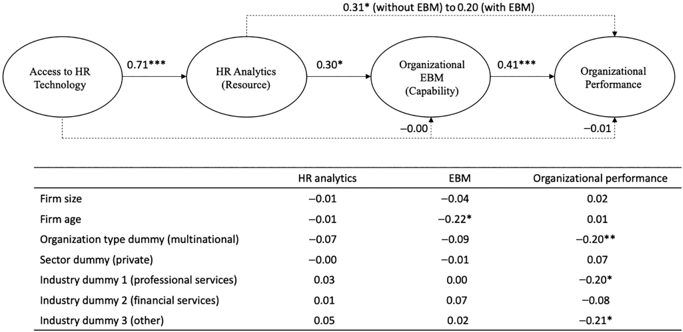
- HR analytics was positively associated with EBM (β = 0.30, p < 0.05), and EBM was positively associated with organizational performance (β = 0.41, p < 0.001), supporting H1 and H2.
- EBM mediated the HR analytics–organizational performance relationship: the indirect effect was 0.16 (p < 0.05, 95% CI 0.007–0.321), while the direct HR analytics–performance coefficient dropped from 0.31 (p < 0.05) to 0.20 (n.s.) after including EBM, supporting H3.
- The full chain model was supported: the indirect effect of HR technology on organizational performance via HR analytics and EBM was 0.06 (p < 0.05, 95% CI 0.0013–0.117), supporting H5.
Methods
- An online survey was developed with a large professional recruitment agency in Ireland and distributed to HR managers, business partners, and senior management teams in 8,116 organizations; after 51 bounces and 117 opt-outs, the final population was 7,948. A total of 260 responses were received (3% response rate), and 155 valid responses from 155 organizations were analyzed.
- Measures included organizational performance (7 items, α = 0.87), EBM (6 items, α = 0.93), HR analytics as a second-order construct with high-quality data (5 items, α = 0.91), analytical competency (5 items, α = 0.95), and strategic ability to act (3 items, α = 0.86), and access to HR technology (3 items, α = 0.93). Controls included organization size, age, type, sector, and industry.
- Structural equation modeling was conducted in Mplus 8.0, with confirmatory factor analysis, model comparison, and bootstrapping tests; common method bias was assessed and indicated 3% common variance.
Limitations
- The paper states that the cross-sectional design does not allow testing causality, and that the small sample size, low response rate, and Irish context limit generalizability; future research should use longitudinal, multi-industry, multi-sector, and multi-country data.
- The paper states that organizational performance was measured subjectively and that future studies should use objective measures such as ROI, ROA, or revenue growth; it also notes the high HR technology–HR analytics correlation (r = 0.66, p < 0.01) and path coefficient (β = 0.71, p < 0.001) as a measurement-validity concern.
- The paper states possible endogeneity from omitted variables, simultaneity, measurement error, and selection; it addressed some omitted-variable and measurement-error issues but calls for future research to pay more attention to endogeneity. The text also makes evident that the second-round performance validation had only 36 responses and a significant but modest correlation (r = 0.36, p < 0.05).
Model-written summary. Check it against the paper before relying on it.
Integrity signals
Registry
Cites
Statistics
Figures

Verification
Claims the paper makes
2 Valid · 0 Not valid · 16 Not checked · 36 Own results and interpretations
The cited sources support only part of this claim — read each source’s verdict below.
In the paper
“At the same time, HR analytics contributes to organizational evidence creation through acquiring and translating high-quality workforce data into information, resulting in critical organizational insights (Marler and Boudreau, 2017;Minbaeva, 2018;Coron, 2021).”
§ Bridging the gap: why, how and when HR analytics can impact organizational performance > Introduction
What the sources say
- Not checked — no full text of the sourcecites Marler and Boudreau, 2017 matched to “An evidence-based review of HR Analytics” (2017) source
- Not checked yetcites Minbaeva, 2018 matched to “Building credible human capital analytics for organizational competitive advantage” (2018) source
- Partly supportedcites Coron, 2021 matched to “Quantifying human resource management: a literature review” (2022) sourceExperimental — accuracy not yet measured
The Data sources used in HRM quantification section (page unavailable) describes workforce-related data used in the literature, and the Categorization section (page unavailable) identifies improving decision-making as a use of quantification results. The copy does not establish the claimed sequence of acquiring high-quality workforce data, translating it into information, and thereby creating critical organizational insights. (LLM, conf=0.78)
plainstates a cause- Asserted: passes — The authors put it forward as true.
- Checkable: passes — It can be checked against evidence.
- Load-bearing: passes — The paper’s conclusions depend on it.
- Based: passes — The paper gives a reason why it holds.
The cited sources support only part of this claim — read each source’s verdict below.
In the paper
“Furthermore, the significant growth of access to HR technology, including human resource information systems (HRISs), cloud platforms and apps, has offered HR departments the ability to collect, manage and analyze large volumes of employee data, compared to earlier legacy IT systems (Bondarouk and Brewster, 2016;Marler and Boudreau, 2017;Kim et al., 2021).”
§ Bridging the gap: why, how and when HR analytics can impact organizational performance > Introduction
What the sources say
- Partly supportedcites Bondarouk and Brewster, 2016 matched to “Conceptualising the future of HRM and technology research” (2016) sourceExperimental — accuracy not yet measured
The Abstract and “New technology in HRM” section (page not provided) describe rapid technological developments, HRM cloud computing, apps and big data, and say advanced e-HRM can expand HRM information and enable analysis. They do not establish significant growth in access to these technologies or compare the volume of employee data HR departments can collect and manage with earlier legacy IT systems. (LLM, conf=0.84)
- Not checked — no full text of the sourcecites Marler and Boudreau, 2017 matched to “An evidence-based review of HR Analytics” (2017) source
- Not checked yetcites Kim et al., 2021 matched to “Sixty years of research on technology and human resource management: Looking back and looking forward” (2021) source
plainstates a cause- Asserted: passes — The authors put it forward as true.
- Checkable: passes — It can be checked against evidence.
- Load-bearing: unclear — It is unclear whether the paper’s conclusions depend on it.
- Based: passes — The paper gives a reason why it holds.
- Partly supported
A result the paper reports from its own data — it cites no other source for it, so there is none to check. The quote shows it is in the paper.
In the paper
“The study's findings support the proposed chain model, suggesting that access to HR technology enables HR analytics which facilitates EBM, which in turn enhances organizational performance.”
§ Bridging the gap: why, how and when HR analytics can impact organizational performance > Abstract
hedgedstates a cause- Asserted: passes — The authors put it forward as true.
- Checkable: passes — It can be checked against evidence.
- Load-bearing: passes — The paper’s conclusions depend on it.
- Based: passes — The paper gives a reason why it holds.
A result the paper reports from its own data — it cites no other source for it, so there is none to check. The quote shows it is in the paper.
In the paper
“Figure 2 shows that the standardized coefficient of organizational performance on EBM was 0.41 (p < 0.001).”
- Also stated in: § Structural models · plain
“Thus, Hypothesis 2 was supported.”
§ Bridging the gap: why, how and when HR analytics can impact organizational performance > Structural models
plainstates an association- Asserted: passes — The authors put it forward as true.
- Checkable: passes — It can be checked against evidence.
- Load-bearing: passes — The paper’s conclusions depend on it.
- Based: passes — The paper gives a reason why it holds.
- Also stated in: § Structural models · plain
A result the paper reports from its own data — it cites no other source for it, so there is none to check. The quote shows it is in the paper.
In the paper
“In addition, the indirect impact of organizational performance on HR technology via HR analytics and organizational EBM was calculated as 0.06 (p < 0.05) with a 95% confidence interval between 0.0013 and 0.117.”
- Also stated in: § Structural models · plain
“Therefore, Hypothesis 5 on the chain model of HR technology-HR analytics-organizational EBM-organizational performance was supported.”
§ Bridging the gap: why, how and when HR analytics can impact organizational performance > Structural models
plainstates a cause- Asserted: passes — The authors put it forward as true.
- Checkable: passes — It can be checked against evidence.
- Load-bearing: passes — The paper’s conclusions depend on it.
- Based: passes — The paper gives a reason why it holds.
- Also stated in: § Structural models · plain
27 more claims
Create a free account to see all 54 claims and to verify the 4 references still open.
- Probably not a substantial claim. 15
- It may state two separate claims as one. 11
- The quote only partly states this claim. 1
Claims other papers make about this one
Each is checked against this paper’s own text: does it say what the citing paper says it does?
The source backs part of the claim, not all of it — or backs it for a different population, condition or comparison.
In the citing paper
“McCartney and Fu (2022) show that combining HR analytics with organizational agility makes evidence-based management practices a lot better.”
From How HR analytics catalyzes bank competitiveness: Investigating the mediating role of data-driven decision-making and the moderating effect of organizational agility (2025) · cites this paper as McCartney and Fu (2022)
Experimental — accuracy not yet measured
Self-check
Percentages, sums and reported differences re-computed from the paper’s own numbers.
Each contradiction between two passages listed here was confirmed by an independent check.
Rated minor: it would not touch a result — a value no result rests on, a p-value that stays on the same side of the significance level, or a conflict that is clerical, resolved elsewhere in the paper, or outside its own findings.
In the paper
§ Bridging the gap: why, how and when HR analytics can impact organizational performance > HR analytics and organizational performance
“The Cronbach's alpha for analytical capability was 0.95.”
§ Bridging the gap: why, how and when HR analytics can impact organizational performance > HR analytics and organizational performance
“The Cronbach's alpha for analytical capability was 0.86.”
Citations
Cites
Baron, R. M., & Kenny, D. A. (1986) · Journal of Personality and Social Psychology · doi:10.1037/0022-3514.51.6.1173 · Cited by 91,532
Podsakoff, P. M., MacKenzie, S. B., Lee, J.-Y., & Podsakoff, N. P. (2003) · Journal of Applied Psychology · doi:10.1037/0021-9010.88.5.879 · Cited by 82,194 · cited 1×
“To address this concern, this study follows several recommendations made by Podsakoff et al. (2003) and Podsakoff et al. (2012).”
MethodSources of method bias in social science research and recommendations on how to control it
Podsakoff, P. M., MacKenzie, S. B., & Podsakoff, N. P. (2012) · Annual Review of Psychology · doi:10.1146/annurev-psych-120710-100452 · Cited by 15,744 · cited 2×
“Likewise, we added one unrelated common factor to the CFA with enforced equal factor loadings to all items in evaluating the common method variance (Podsakoff et al., 2012).”
MethodEstimating Nonresponse Bias in Mail Surveys
Armstrong, J. S., & Overton, T. S. (1977) · Journal of Marketing Research · doi:10.2307/3150783 · Cited by 12,222
Understanding dynamic capabilities
Winter, S. G. (2003) · Strategic Management Journal · doi:10.1002/smj.318 · Cited by 5,315
Managing Firm Resources in Dynamic Environments to Create Value: Looking Inside the Black Box
Sirmon, D. G., Hitt, M. A., & Ireland, R. D. (2007) · Academy of Management Review · doi:10.5465/amr.2007.23466005 · Cited by 3,701
Survey response rate levels and trends in organizational research
Baruch, Y., & Holtom, B. C. (2008) · Human Relations · doi:10.1177/0018726708094863 · Cited by 3,462
Statistical mediation analysis with a multicategorical independent variable
Hayes, A. F., & Preacher, K. J. (2014) · British Journal of Mathematical and Statistical Psychology · doi:10.1111/bmsp.12028 · Cited by 3,403
THE IMPACT OF HUMAN RESOURCE MANAGEMENT PRACTICES ON PERCEPTIONS OF ORGANIZATIONAL PERFORMANCE.
DELANEY, J. T., & HUSELID, M. A. (1996) · Academy of Management Journal · doi:10.2307/256718 · Cited by 3,147
Big data analytics and firm performance: Effects of dynamic capabilities
Wamba, S. F., Gunasekaran, A., Akter, S., Ren, S. J.-F., Dubey, R., & Childe, S. J. (2017) · Journal of Business Research · doi:10.1016/j.jbusres.2016.08.009 · Cited by 2,474
Research works printed but not linked: 4
- 9. Barends, E., Rousseau, D.M. and Briner, R.B. (2014), Evidence-Based Management: The Basic Principals, The Center for Evidence-Based Management, Amsterdam.
- 47. Hayes, A. (2013), Introduction to Mediation, Moderation, and Conditional Process Analysis, The Guilford Press, New York.
- 76. Nielsen, C. and McCullough, N. (2018), "How people analytics can help you change process, culture, and strategy", Harvard Business Review, No. May, pp. 2-6.
- 79. Pfeffer, J. and Sutton, R.I. (2006), "Evidence-based management", Harvard Business Review, pp. 63-74.
Cited by
Exploring the Evolution of Human Resource Analytics: A Bibliometric Study
Bonilla-Chaves, E. F., & Palos-Sánchez, P. R. (2023) · Behavioral Sciences · doi:10.3390/bs13030244 · Cited by 76
Trends in the thematic landscape of HR analytics research: a structural topic modeling approach
Thakral, P., Srivastava, P. R., Dash, S. S., Jasimuddin, S. M., & Zhang, Z. (2023) · Management Decision · doi:10.1108/md-01-2023-0080 · Cited by 82
Mahmoud, M. H., Ali, A., Alrifae, A. A. M., Eitah, R. A., & Alzubi, M. (2025) · Discover Sustainability · doi:10.1007/s43621-025-01713-9 · Cited by 78
“The role of HR analytics is to deliver implementable insights that have the potential to enhance HR decision-making processes and reinforce organizational performance [62].”
Li-jun, W., Zhou, Y., Sanders, K., Marler, J. H., & Zou, Y. (2023) · Journal of Business Research · doi:10.1016/j.jbusres.2023.114312 · Cited by 113
Help me help you: How HR analytics forecasts foster organizational creativity
Di Prima, C., Cepel, M., Kotaskova, A., & Ferraris, A. (2024) · Technological Forecasting and Social Change · doi:10.1016/j.techfore.2024.123540 · Cited by 46
Turi, J. A., Khwaja, M. G., Tariq, F., & Hameed, A. (2023) · Business Process Management Journal · doi:10.1108/bpmj-01-2023-0058 · Cited by 63
Lee, J. Y., & Lee, Y. (2024) · Human Resource Development Review · doi:10.1177/15344843231217181 · Cited by 38
“Addressing strategic questions relevant to the organization and implementing solutions based on insights derived from analytics are also crucial aspects of strategic alignment (McCartney & Fu, 2022; McCartney et al., 2021; Rasmussen & Ulrich, 2015).”
BackgroundMethodInfluentialKiran, P. R., Chaubey, A., & Shastri, R. K. (2023) · Benchmarking An International Journal · doi:10.1108/bij-06-2023-0412 · Cited by 72
Kiran, V. S., Vasantha, S., Raju, R. K., & Kanagasabapathy, J. R. (2022) · International Journal of Professional Business Review · doi:10.26668/businessreview/2022.v7i3.0667 · Cited by 51
“The organization benefits from human capital management by having a committed staff that supports its objectives (McCartney & Fu, 2021).”
BackgroundIdentifying the enablers of HR digitalization and HR analytics using ISM and MICMAC analysis
Verma, S., Rana, N., & Meher, J. R. (2023) · International journal of organizational analysis · doi:10.1108/ijoa-01-2023-3611 · Cited by 52
Arora, M., Prakash, A., Mittal, A., & Singh, S. (2022) · Engineering Construction & Architectural Management · doi:10.1108/ecam-09-2021-0795 · Cited by 39
Mental well-being through HR analytics: investigating an employee supportive framework
Lathabhavan, R. (2023) · Personnel Review · doi:10.1108/pr-11-2022-0836 · Cited by 46
Digital technology and global mobility: Narrative review and directions for future research
Bucher, J., Lazarova, M. B., & Deller, J. (2024) · International Business Review · doi:10.1016/j.ibusrev.2024.102294 · Cited by 45
Savastano, M., Biclesanu, I., Anagnoste, S., Laviola, F. A., & Cucari, N. (2024) · Management Decision · doi:10.1108/md-10-2023-1967 · Cited by 49
Prima, C. D., Kotásková, A., Yildiz, H., & Ferraris, A. (2023) · Management Decision · doi:10.1108/md-06-2023-0973 · Cited by 44
The duality of HR analysts' storytelling: Showcasing and curbing
Fu, N., Keegan, A. E., & McCartney, S. (2022) · Human Resource Management Journal · doi:10.1111/1748-8583.12466 · Cited by 45
Self-citationCavanagh, J., Bartram, T., Walker, M., Pariona-Cabrera, P., & Halvorsen, B. (2024) · Personnel Review · doi:10.1108/pr-09-2021-0690 · Cited by 28
Hülter, S. M., Ertel, C., & Heidemann, A. (2024) · Technological Forecasting and Social Change · doi:10.1016/j.techfore.2024.123709 · Cited by 51
Thakur, S. J., Bhatnagar, J., Farndale, E., & Aeron, P. (2024) · Personnel Review · doi:10.1108/pr-11-2021-0809 · Cited by 47
Lim, A., Lee, V., Ooi, K., Foo, P. Y., & Tan, G. W. (2024) · Management Decision · doi:10.1108/md-04-2023-0485 · Cited by 38
Rigamonti, E., Gastaldi, L., & Corso, M. (2024) · Management Decision · doi:10.1108/md-11-2023-2087 · Cited by 54
(How) do advanced data and analyses enable HR analytics success? A neo-configurational analysis
Strohmeier, S., Collet, J., & Kabst, R. (2022) · Baltic Journal of Management · doi:10.1108/bjm-05-2021-0188 · Cited by 32
Shahiduzzaman, M. (2025) · Administrative Sciences · doi:10.3390/admsci15020051 · Cited by 25
Arora, M., Prakash, A., Mittal, A., & Singh, S. (2022) · Evidence-based HRM a Global Forum for Empirical Scholarship · doi:10.1108/ebhrm-12-2021-0249 · Cited by 38
Human resources analytics in practice: A knowledge discovery process
Belizón, M. J., Majarín, D., & Aguado, D. (2023) · European Management Review · doi:10.1111/emre.12605 · Cited by 51
McCartney, S., & Fu, N. (2023) · Human Resource Management · doi:10.1002/hrm.22194 · Cited by 40
Self-citationAl-Zoubi, M. O., Masa’deh, R. M. T., & Twaissi, N. M. (2022) · VINE Journal of Information and Knowledge Management Systems · doi:10.1108/vjikms-06-2022-0199 · Cited by 59
Kiu, T. C. T., & Chan, J. H. (2023) · Industrial Management & Data Systems · doi:10.1108/imds-07-2023-0430 · Cited by 30
Fattah, I. A. (2024) · Business Process Management Journal · doi:10.1108/bpmj-11-2023-0894 · Cited by 39
The Effect of Human Resource Analytics on Organizational Performance: Insights from Ethiopia
Adugna, T. S., Yang, S., & Chen, C. (2025) · Systems · doi:10.3390/systems13020134 · Cited by 59
Alam, S., Dong, Z., Kularatne, I., & Rashid, M. S. (2025) · Management Review Quarterly · doi:10.1007/s11301-025-00491-y · Cited by 44
HR data analytics and evidence based practice as a strategic business partner
Patil, B. S., & Priya, M. R. S. R. (2024) · Vilakshan – XIMB Journal of Management · doi:10.1108/xjm-07-2023-0148 · Cited by 36
How HR analytics evolved over time: a bibliometric analysis on Scopus database
Sakib, M. N., Chowdhury, S. R., Younus, M., Sanju, N. L., Satata, F. F., & Islam, M. (2024) · Future Business Journal · doi:10.1186/s43093-024-00375-9 · Cited by 44
“HR analytics represents the advancement of information technology through the descriptive, visual, and statistical analysis of data related to HR capital, processes, and organizational performance [6, 7].”
The future of marketing and communications in a digital era: data, analytics and narratives
Dutt, A., Kasilingam, D. L., Angell, R. J., & Singh, J. (2024) · Journal of Strategic Marketing · doi:10.1080/0965254x.2024.2386002 · Cited by 37
“Access to technology strengthens the impact of digital leadership on data analytics capabilities, while EBM amplifies the effect of data analytics on organizational performance (McCartney & Fu, 2022).”
No more war (for talent): the impact of HR analytics on talent management activities
Prima, C. D., Hussain, W. M. H. W., & Ferraris, A. (2024) · Management Decision · doi:10.1108/md-07-2023-1198 · Cited by 32
Developing human resource analytics capability architecture in organizations
Shet, S. V. (2025) · Person-centered review · doi:10.1108/pr-01-2024-0009 · Cited by 12
The levels of artificial intelligence application in human resource systems
Ćormarković, T., Dražeta, L., & Njeguš, A. (2022) · The European Journal of Applied Economics · doi:10.5937/ejae19-39535 · Cited by 30
“With the development of the analytical type of information systems, called Business Intelligence (BI) systems, the HRM is expanded with human resource analytics (Margherita, 2022; McCartney & Fu, 2021).”
MethodChaudhary, M., Gaur, L., Chakrabarti, A., Singh, G., Jones, P. K., & Kraus, S. (2025) · Journal of Innovation & Knowledge · doi:10.1016/j.jik.2025.100700 · Cited by 31
Big Data and the disillusioned employee: Inside the ethical Internet of Things
Randolph-Seng, B., Atinc, Y. O., Bui, S., & Malik, Z. (2024) · Technological Forecasting and Social Change · doi:10.1016/j.techfore.2024.123271 · Cited by 15
Di Lauro, S., Tursunbayeva, A., Antonelli, G., & Moschera, L. (2025) · Personnel Review · doi:10.1108/pr-11-2023-0927 · Cited by 12
“This is particularly important considering that PA projects sometimes do not live up to their promises (McCartney and Fu, 2022).”
BackgroundArora, M., & Mittal, A. (2024) · The International Journal of Human Resource Management · doi:10.1080/09585192.2024.2403541 · Cited by 24
“Further, various HR analytics teams have been formed to use employee’s data to formulate people-related decisions (McCartney & Fu, 2022).”
InfluentialChourasia, A., & Bahuguna, P. C. (2024) · Benchmarking An International Journal · doi:10.1108/bij-11-2023-0778 · Cited by 37
Vadithe, R. N., & Kesari, B. (2025) · Human Systems Management · doi:10.1177/01672533251314403 · Cited by 20
“8 Figure 1 follows the proposed model of the study.”
InfluentialRaad, N. G., Fick, J., Shah, N., & Srinivas, S. (2025) · Journal of the Operational Research Society · doi:10.1080/01605682.2025.2568162 · Cited by 10
“…show that sentiment extracted from passenger reviews correlates with operational metrics including on timeliness and cabin service quality (Srinivas & Ramachandiran, 2024), while employee narratives can reveal signals related to workforce productivity and financial outcomes (McCartney & Fu, 2022).”
Research across disciplines: influence of human resource management practices
Alcázar, F. M., Ruiz-Martínez, M., & Sánchez‐Gardey, G. (2024) · Management Decision · doi:10.1108/md-03-2023-0397 · Cited by 15
Stor, M. (2024) · International Journal of Productivity and Performance Management · doi:10.1108/ijppm-02-2023-0092 · Cited by 13
Tawalbeh, M., Alzghoul, A., & Alsheikh, G. A. A. (2025) · AIP conference proceedings · doi:10.1063/5.0255240 · Cited by 11
Bottesch, S., Schwenke, C., Förster, M., & Klier, M. (2025) · Electronic Markets · doi:10.1007/s12525-025-00842-3 · Cited by 25
“We base our framework on the resource-based view of the firm (RBV), as suggested, e.g., by McCartney and Fu (2022b).”
InfluentialHuman resource analytics adoption: a framework-based analysis, fuzzy Delphi method and fuzzy SWARA
malekinezhad, M. K., Rahimnia, F., Eslami, G., & Farahi, M. M. (2025) · Journal of Advances in Management Research · doi:10.1108/jamr-05-2024-0181 · Cited by 15
Alzghoul, A. (2025) · Banks and Bank Systems · doi:10.21511/bbs.20(2).2025.09 · Cited by 7
“To build on this idea, McCartney and Fu (2022) show that combining HR analytics with organizational agility makes evidence-based management practices a lot better.”
InfluentialTransformation Human Resource Management Using Advanced Business Analytics
Shukla, R. (2023) · Advances in computational intelligence and robotics book series · doi:10.4018/978-1-6684-9151-5.ch003 · Cited by 6
The Relationship between Business Intelligence and Sustainable Human Resources
Al-Kasasbeh, O., & Alhmoud, B. (2025) · HISTORICAL Journal of History and Social Sciences · doi:10.58355/historical.v3i3.117 · Cited by 7
Human Resource Analytics on Talent Acquisition: A Systematic Review
Vadithe, R. N., & Kesari, B. (2023) · Journal of Development Economics and Management Research Studies · doi:10.53422/jdms.2023.101803 · Cited by 14
“Although organisations believe in evidence-based decision-making as showed by the increasing number of HR sections adopting HR analytics to advance decision-making (Mccartney, 2022).”
BackgroundMuchowe, R. M., Mubango, H., Soko, M., Dumba, E., & Chivabvu, E. (2025) · Cogent Business & Management · doi:10.1080/23311975.2025.2514810 · Cited by 17
“…variable is present. the second research tradition is a tendency to investigate the effect of HR analytics on performance in the absence of HPWs (mccartney & Fu, 2022; cho et al., 2023). most researchers have not answered the question about the impact of HR analytics on performance where HPWs…”
InfluentialChong, L. Y. Q., Lim, T. S., & Nipo, D. T. (2026) · Journal of Modelling in Management · doi:10.1108/jm2-06-2025-0307 · Cited by 16
Douglas, S. K., & Haley, G. (2025) · Strategic HR Review · doi:10.1108/shr-12-2024-0101 · Cited by 5
Potential Application of HR Analytics to Talent Management in the Public Sector: a Literature Review
Ali, E., & Elias, H. (2023) · International Conference on Cyber Management and Engineering (CyMaEn) · doi:10.1109/cymaen57228.2023.10051107 · Cited by 5
HR Analytics: An Effective Tool for Performance Management and Business Development
Gupta, P. (2023) · Advances in human resources management and organizational development book series · doi:10.4018/978-1-6684-8942-0.ch008 · Cited by 6
Sattar, S., Bukhari, M., Saleem, S., Ijaz, S., Ejaz, S., & Abbas, J. (2024) · Journal of excellence in management sciences. · doi:10.69565/jems.v3i3.343 · Cited by 7
“Through HR analytics, the business can transform data to inform HR decisions; organizations can expect greater rigor, improved credibility of the HR function, and a strategic advantage stemming from a deeper understanding of their workforce (Huselid, 2018; McCartney & Fu, 2022; Starodub, 2015).”
BackgroundA person-centered approach to individual people analytics adoption
Bentvelzen, M., Boon, C. T., & Hartog, D. N. D. (2024) · Journal of Organizational Effectiveness People and Performance · doi:10.1108/joepp-07-2023-0276 · Cited by 12
Faiz, M. N. M., Sarwar, N., Tariq, A., Jordão, R. V. D., & Memon, M. A. (2024) · Journal of Intellectual Capital · doi:10.1108/jic-02-2024-0033 · Cited by 11
HR Analytics and Future of Work: A Systematic Literature Review
Elrehail, H. (2023) · International Conference on Business Analytics for Technology and Security (ICBATS) · doi:10.1109/icbats57792.2023.10111370 · Cited by 9
“5 McCartney & Fu, 2022 [2] The main aim of this paper was to develop an understanding why, how and when HR analytics leads to increased organizational performance.”
BackgroundManagement Strategies to Address Human Resources Challenges in the Information Technology Era
Rokhadi, R., Sukistanto, S., Hariyanti, H., & Mariyani, D. (2023) · Jurnal Minfo Polgan · doi:10.33395/jmp.v12i2.13152 · Cited by 6
“By monitoring the results and impact of HR initiatives, organisations can identify areas that require improvement or changes in their strategy (McCartney & Fu, 2022).”
BackgroundAnalíticas de recursos humanos para la gestión del cambio y de la felicidad
Abellán-Sevilla, A.-J., Ortiz‐de‐Urbina‐Criado, M., & Valentín, E. M. M. (2024) · Retos · doi:10.17163/ret.n28.2024.03 · Cited by 9
Digitalisation and the Future of HRM
Ilyushina, N., Walker, M., & Timming, A. R. (2024) · Springer eBooks · doi:10.1007/978-3-031-58912-6_10 · Cited by 7
Human Resource Management Strategies in Improving Lecturer Performance in Higher Education
Muhamad, L. F. (2023) · Indo-MathEdu Intellectuals Journal · doi:10.54373/imeij.v4i2.283 · Cited by 5
“In this narrative, we will outline some human resource management strategies that can be used to improve lecturer performance in higher education (McCartney & Fu, 2022).”
BackgroundThe Role of HR Analytics in Enhancing Organizational Performance: A Review Literature
Zebua, D. K., Santosa, T. A., & Putra, F. D. (2024) · Indonesia Journal of Engineering and Education Technology (IJEET) · doi:10.61991/ijeet.v2i2.69 · Cited by 19
“In the context of management, data analytics enables operational optimization (McCartney & Fu, 2022), product development, and improved customer service.”
BackgroundRana, A., & Sachdeva, G. (2025) · Digital Transformation and Society · doi:10.1108/dts-07-2025-0218 · Cited by 4
Prima, C. D., Martin, Č., Perotti, F. A., & Bresciani, S. (2026) · International Entrepreneurship and Management Journal · doi:10.1007/s11365-026-01178-w · Cited by 3
“…on HR analytics is its predominant focus on two streams: examining the direct impact of HR analytics on organiza - tional phenomena (e.g., McCartney & Fu, 2022; Samson & Bhanugopan, 2022) and assessing its ability to enhance the outcomes of HR practices (e.g. Di Prima et al., 2024a, b;…”
InfluentialRistandi, D. K., Maarif, M. S., Affandi, J., & Sukmawati, A. (2026) · Cogent Business & Management · doi:10.1080/23311975.2026.2642549 · Cited by 7
Dubey, R. (2023) · Advances in computational intelligence and robotics book series · doi:10.4018/978-1-6684-9151-5.ch005 · Cited by 3
Employee Training Policies of High Revenue Companies: Analysis of Case Examples From Turkey
Balkar, B., & Karadağ, N. (2023) · International Journal for Research in Vocational Education and Training · doi:10.13152/ijrvet.11.1.1 · Cited by 12
Rethinking the HR Role: How Digital Transformation is Changing HR Departments
Prima, C. D., & Ferraris, A. (2024) · Springer proceedings in complexity · doi:10.1007/978-3-031-44721-1_48 · Cited by 8
Human Resource Analytics: A Hybrid Review
Goswami, T. G., & Mansi (2025) · South Asian Journal of Human Resources Management · doi:10.1177/23220937251322236 · Cited by 7
Opatha, H. H. D. P. J., Dayarathna, N. W. K. D. K., Dowling, P. J., & Bartram, T. (2025) · Journal of Management Analytics · doi:10.1080/23270012.2025.2515112 · Cited by 4
Vadithe, R. N., & Kesari, B. (2025) · Benchmarking An International Journal · doi:10.1108/bij-03-2024-0242 · Cited by 5
Using Analytics to Manage Employee Behavioural Traits and Predict Employee Performance
Mangal, N. (2023) · Springer eBooks · doi:10.1007/978-981-19-9658-0_9 · Cited by 6
Garg, N., & Sharma, N. (2023) · International Journal of Emerging Markets · doi:10.1108/ijoem-07-2022-1129 · Cited by 5
Ontrup, G., Moeschke, J., Buechsenschuss, R., & Biemann, T. (2023) · Zeitschrift für Arbeits- und Organisationspsychologie A&O · doi:10.1026/0932-4089/a000418 · Cited by 2
Breaking barriers: driving HR analytics adoption in small and medium-sized enterprises
Ilyas, M., Alam, W., & Ahmad, A. (2025) · Evidence-based HRM a Global Forum for Empirical Scholarship · doi:10.1108/ebhrm-01-2024-0015 · Cited by 9
The Impact of Technology on Company Values and Employee Well-Being
Peddi, S., & Manoharan, G. (2025) · IGI Global eBooks · doi:10.4018/979-8-3373-0720-6.ch008 · Cited by 4
McCartney, S., Minbaeva, D., Crean, S., & Fahy, A. (2026) · Human Resource Management Review · doi:10.1016/j.hrmr.2026.101147 · Cited by 2
Self-citationVlados, C. M., & Chatzinikolaou, D. (2025) · The Journal of Entrepreneurship · doi:10.1177/09713557251349310 · Cited by 4
Future of HR Analytics: Applications to Recruitment, Employee Engagement, and Retention
Bulsari, S., & Pandya, K. (2023) · Advances in human resources management and organizational development book series · doi:10.4018/978-1-6684-6745-9.ch009 · Cited by 8
Takawira, B., Musaigwa, M., & Kalitanyi, V. (2024) · Advances in human resources management and organizational development book series · doi:10.4018/979-8-3693-2889-7.ch005 · Cited by 2
Human Resource Analytics and Organizational Performance: Mediating Role of Evidence-Based Management
Thapliyal, S. (2024) · Advances in e-business research series · doi:10.4018/979-8-3693-9230-0.ch006 · Cited by 2
Predictive Analytics in Recruitment and Selection Practices
Sasirekha, V., Nithyashree, N., & Sarulatha, N. (2024) · BENTHAM SCIENCE PUBLISHERS eBooks · doi:10.2174/9789815274196124010006 · Cited by 2
Nikmah, S., & Syafnan, S. (2024) · RADINKA JOURNAL OF SCIENCE AND SYSTEMATIC LITERATURE REVIEW · doi:10.56778/rjslr.v2i3.403 · Cited by 2
Vadithe, R. N., & Kesari, B. (2025) · South Asian Journal of Human Resources Management · doi:10.1177/23220937251326985 · Cited by 10
The HR Data Landscape: Transforming HR with Data-Driven Insights
Singh, A. (2025) · Engineering and Applied Sciences Journal · doi:10.64030/3067-8005.02.01.06 · Cited by 2
Mohamed, D., & Shehata, G. M. (2023) · Journal of Applied Business and Economics · doi:10.33423/jabe.v25i3.6201 · Cited by 6
Lathabhavan, R., & Moovendhan, V. (2024) · Journal of Strategic Marketing · doi:10.1080/0965254x.2024.2340463 · Cited by 5
“It had three dimensions-data quality, analytical competency and strategic ability (Mccartney & Fu, 2022).”
InfluentialHossain, Q., Ikbal, M. Z., & Rahman, M. M. (2025) · SSRN Electronic Journal · doi:10.2139/ssrn.5362677 · Cited by 2
Irigaray, H. A. R., & Stocker, F. (2023) · Cadernos EBAPE BR · doi:10.1590/1679-395190281x · Cited by 1
Gerber, M., Krause, A., Probst, J., & Heimann, M. (2024) · Gruppe Interaktion Organisation Zeitschrift für Angewandte Organisationspsychologie (GIO) · doi:10.1007/s11612-024-00743-7 · Cited by 12
“A central weakness is a lack of high-quality empirical studies (Edwards et al. 2022; McCartney and Fu 2022a).”
InfluentialIndoria, P., Chishti, M. D., & Junaid, A. B. (2024) · Advances in business strategy and competitive advantage book series · doi:10.4018/979-8-3693-7362-0.ch006 · Cited by 1
Solís, C. L. F., Gonzalez, M., & Gascó, J. L. (2025) · INNOVA Research Journal · doi:10.33890/innova.v10.n1.2025.2706 · Cited by 3
Budak, M. C., & Soyer, A. (2025) · International Journal of Intelligent Computing and Cybernetics · doi:10.1108/ijicc-10-2024-0535 · Cited by 3
A Paradoxical Rartnership Between HR and AI: Insights From Multimedia Data
Invalli, S., Rai, V. S., & Anchan, R. (2025) · IGI Global eBooks · doi:10.4018/979-8-3373-0720-6.ch011 · Cited by 1
Vadithe, R. N., & Kesari, B. (2025) · FIIB Business Review · doi:10.1177/23197145251346629 · Cited by 1
Metadata
- Authors
- McCartney, S., & Fu, N.
- Affiliations
- National University of Ireland, Maynooth (IE)
- Trinity College Dublin (IE)
- Corresponding author
- McCartney, Steven
- Venue
- Management Decision
- Publisher
- Emerald
- Published
- 2022-01-12
- Volume
- 60
- Issue
- 13
- Pages
- 25-47
- ISSN
- 0025-1747 (ISSN-L)
- OpenAlex
- W4214713189
- Semantic Scholar
- 71b91a9cffde59dad5b6e6fe64f8bacb85399981
- Cited by
- 173
- References
- 115
- Citations by year
- 2026: 32 · 2025: 46 · 2024: 49 · 2023: 38 · 2022: 8
- FWCI
- 33.30
- Type
- journal article
- Language
- en
- Open access
- hybrid
- doi.org
- Licence
- cc-by
- www.emerald.com/insight/site-policies (tdm)
- Locations
- Management Decision (publishedVersion, cc-by)
- Maynooth University ePrints and eTheses Archive (Maynooth University) (acceptedVersion)
- Topics
- Social Sciences › Business, Management and Accounting › Organizational Behavior and Human Resource Management › AI and HR Technologies
- Social Sciences › Business, Management and Accounting › Management Information Systems › Big Data and Business Intelligence
- Social Sciences › Business, Management and Accounting › Organizational Behavior and Human Resource Management › Human Resource and Talent Management
- Keywords
- HR analytics, organizational performance, evidence-based management, HR technology, chain mediation model, HR analytics adoption, human resource management
About these checks
Registry, retraction, Cites and statistics results are computed, not judged, with one exception: a printed reference that no index lists is read once by a model before it counts as a citation error. Claims are extracted by a model and kept only when their quote appears verbatim in the text; each cited source is then checked, with a model’s help, for whether it says what the claim relies on. Those verdicts can be wrong — read the claim’s quote and the cited source before relying on one.
The claim verdicts this report counts are experimental: their accuracy is not yet measured.
A language model drew the claims from the paper on 2026-09-28, under version 3 of the claim definition (prompt extract-v3).
A second model labelled each claim on 2026-09-28 (model jev-1.13-20260917, definition revision gold-guideline-v0.2).
Cited sources are checked with a language model’s help (gpt-6-sol).
Statistics and arithmetic are recomputed, not judged.
Confidence bands are shown only for fields calibrated on our annotated test set. None is calibrated yet, so no band is shown.
What counts as a claim ›How we measure confidence ›How we check this ›
Are you an author, or do you see a problem with this page? Request a review
Data sources
Bibliographic data: Semantic Scholar, OpenAlex, Crossref.
Contains information from the Semantic Scholar Academic Graph Datasets, made available under the ODC Attribution License (ODC-BY 1.0).
Semantic Scholar’s data is described in: Kinney, R., et al. (2023). The Semantic Scholar Open Data Platform. arXiv:2301.10140.
