

Bridging the gap: why, how and when HR analytics can impact organizational performance
Open accessThe DOI matches its Crossref record; 117 of the 122 references it cites were found in a registry or an index; 2 of the 29 sources its claims cite were checked for support.
Abstract
Purpose Despite the growth and adoption of human resource (HR) analytics, it remains unknown whether HR analytics can impact organizational performance. As such, this study aims to address this important issue by understanding why, how and when HR analytics leads to increased organizational performance and uncover the mechanisms through which this increased performance occurs. Design/methodology/approach Using data collected from 155 Irish organizations, structural equation modeling was performed to test the chain mediation model linking HR technology, HR analytics, evidence-based management (EBM) and organizational performance. Findings The study's findings support the proposed chain model, suggesting that access to HR technology enables HR analytics which facilitates EBM, which in turn enhances organizational performance. Originality/value This research contributes significantly to the HR analytics and EBM literature. First, the study extends our understanding of why and how HR analytics leads to higher organizational performance. Second, the authors identify that access to HR technology enables and is an antecedent of HR analytics. Finally, empirical evidence is offered to support EBM and its impact on organizational performance.
Overview
CoChat Summary
TL;DR
This study tests a chain model in which access to HR technology enables HR analytics, which facilitates evidence-based management (EBM), which in turn improves organizational performance. Using survey data from 155 Irish organizations, the authors find support for the full chain model.
Key findings
- Access to HR technology was positively associated with HR analytics (β = 0.71, p < 0.001), supporting H4.
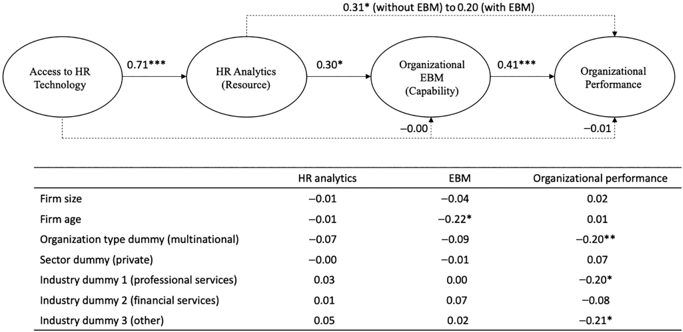
- HR analytics was positively associated with EBM (β = 0.30, p < 0.05), and EBM was positively associated with organizational performance (β = 0.41, p < 0.001), supporting H1 and H2.
- EBM mediated the HR analytics–organizational performance relationship: the indirect effect was 0.16 (p < 0.05, 95% CI 0.007–0.321), while the direct HR analytics–performance coefficient dropped from 0.31 (p < 0.05) to 0.20 (n.s.) after including EBM, supporting H3.
- The full chain model was supported: the indirect effect of HR technology on organizational performance via HR analytics and EBM was 0.06 (p < 0.05, 95% CI 0.0013–0.117), supporting H5.
Methods
- An online survey was developed with a large professional recruitment agency in Ireland and distributed to HR managers, business partners, and senior management teams in 8,116 organizations; after 51 bounces and 117 opt-outs, the final population was 7,948. A total of 260 responses were received (3% response rate), and 155 valid responses from 155 organizations were analyzed.
- Measures included organizational performance (7 items, α = 0.87), EBM (6 items, α = 0.93), HR analytics as a second-order construct with high-quality data (5 items, α = 0.91), analytical competency (5 items, α = 0.95), and strategic ability to act (3 items, α = 0.86), and access to HR technology (3 items, α = 0.93). Controls included organization size, age, type, sector, and industry.
- Structural equation modeling was conducted in Mplus 8.0, with confirmatory factor analysis, model comparison, and bootstrapping tests; common method bias was assessed and indicated 3% common variance.
Limitations
- The paper states that the cross-sectional design does not allow testing causality, and that the small sample size, low response rate, and Irish context limit generalizability; future research should use longitudinal, multi-industry, multi-sector, and multi-country data.
- The paper states that organizational performance was measured subjectively and that future studies should use objective measures such as ROI, ROA, or revenue growth; it also notes the high HR technology–HR analytics correlation (r = 0.66, p < 0.01) and path coefficient (β = 0.71, p < 0.001) as a measurement-validity concern.
- The paper states possible endogeneity from omitted variables, simultaneity, measurement error, and selection; it addressed some omitted-variable and measurement-error issues but calls for future research to pay more attention to endogeneity. The text also makes evident that the second-round performance validation had only 36 responses and a significant but modest correlation (r = 0.36, p < 0.05).
Model-written summary. Check it against the paper before relying on it.
Integrity signals
Registry
Cites
Statistics
Figures

Verification
Claims the paper makes
2 Valid · 0 Not valid · 16 Not checked · 36 Own results and interpretations
The cited sources support only part of this claim — read each source’s verdict below.
In the paper
“At the same time, HR analytics contributes to organizational evidence creation through acquiring and translating high-quality workforce data into information, resulting in critical organizational insights (Marler and Boudreau, 2017;Minbaeva, 2018;Coron, 2021).”
§ Bridging the gap: why, how and when HR analytics can impact organizational performance > Introduction
What the sources say
- Not checked — no full text of the sourcecites Marler and Boudreau, 2017 matched to “An evidence-based review of HR Analytics” (2017) source
- Not checked yetcites Minbaeva, 2018 matched to “Building credible human capital analytics for organizational competitive advantage” (2018) source
- Partly supportedcites Coron, 2021 matched to “Quantifying human resource management: a literature review” (2022) sourceExperimental — accuracy not yet measured
The Data sources used in HRM quantification section (page unavailable) describes workforce-related data used in the literature, and the Categorization section (page unavailable) identifies improving decision-making as a use of quantification results. The copy does not establish the claimed sequence of acquiring high-quality workforce data, translating it into information, and thereby creating critical organizational insights. (LLM, conf=0.78)
plainstates a cause- Asserted: passes — The authors put it forward as true.
- Checkable: passes — It can be checked against evidence.
- Load-bearing: passes — The paper’s conclusions depend on it.
- Based: passes — The paper gives a reason why it holds.
The cited sources support only part of this claim — read each source’s verdict below.
In the paper
“Furthermore, the significant growth of access to HR technology, including human resource information systems (HRISs), cloud platforms and apps, has offered HR departments the ability to collect, manage and analyze large volumes of employee data, compared to earlier legacy IT systems (Bondarouk and Brewster, 2016;Marler and Boudreau, 2017;Kim et al., 2021).”
§ Bridging the gap: why, how and when HR analytics can impact organizational performance > Introduction
What the sources say
- Partly supportedcites Bondarouk and Brewster, 2016 matched to “Conceptualising the future of HRM and technology research” (2016) sourceExperimental — accuracy not yet measured
The Abstract and “New technology in HRM” section (page not provided) describe rapid technological developments, HRM cloud computing, apps and big data, and say advanced e-HRM can expand HRM information and enable analysis. They do not establish significant growth in access to these technologies or compare the volume of employee data HR departments can collect and manage with earlier legacy IT systems. (LLM, conf=0.84)
- Not checked — no full text of the sourcecites Marler and Boudreau, 2017 matched to “An evidence-based review of HR Analytics” (2017) source
- Not checked yetcites Kim et al., 2021 matched to “Sixty years of research on technology and human resource management: Looking back and looking forward” (2021) source
plainstates a cause- Asserted: passes — The authors put it forward as true.
- Checkable: passes — It can be checked against evidence.
- Load-bearing: unclear — It is unclear whether the paper’s conclusions depend on it.
- Based: passes — The paper gives a reason why it holds.
- Partly supported
A result the paper reports from its own data — it cites no other source for it, so there is none to check. The quote shows it is in the paper.
In the paper
“The study's findings support the proposed chain model, suggesting that access to HR technology enables HR analytics which facilitates EBM, which in turn enhances organizational performance.”
§ Bridging the gap: why, how and when HR analytics can impact organizational performance > Abstract
hedgedstates a cause- Asserted: passes — The authors put it forward as true.
- Checkable: passes — It can be checked against evidence.
- Load-bearing: passes — The paper’s conclusions depend on it.
- Based: passes — The paper gives a reason why it holds.
A result the paper reports from its own data — it cites no other source for it, so there is none to check. The quote shows it is in the paper.
In the paper
“Figure 2 shows that the standardized coefficient of organizational performance on EBM was 0.41 (p < 0.001).”
- Also stated in: § Structural models · plain
“Thus, Hypothesis 2 was supported.”
§ Bridging the gap: why, how and when HR analytics can impact organizational performance > Structural models
plainstates an association- Asserted: passes — The authors put it forward as true.
- Checkable: passes — It can be checked against evidence.
- Load-bearing: passes — The paper’s conclusions depend on it.
- Based: passes — The paper gives a reason why it holds.
- Also stated in: § Structural models · plain
A result the paper reports from its own data — it cites no other source for it, so there is none to check. The quote shows it is in the paper.
In the paper
“In addition, the indirect impact of organizational performance on HR technology via HR analytics and organizational EBM was calculated as 0.06 (p < 0.05) with a 95% confidence interval between 0.0013 and 0.117.”
- Also stated in: § Structural models · plain
“Therefore, Hypothesis 5 on the chain model of HR technology-HR analytics-organizational EBM-organizational performance was supported.”
§ Bridging the gap: why, how and when HR analytics can impact organizational performance > Structural models
plainstates a cause- Asserted: passes — The authors put it forward as true.
- Checkable: passes — It can be checked against evidence.
- Load-bearing: passes — The paper’s conclusions depend on it.
- Based: passes — The paper gives a reason why it holds.
- Also stated in: § Structural models · plain
27 more claims
Create a free account to see all 54 claims and to verify the 4 references still open.
- Probably not a substantial claim. 15
- It may state two separate claims as one. 11
- The quote only partly states this claim. 1
Claims other papers make about this one
Each is checked against this paper’s own text: does it say what the citing paper says it does?
The source backs part of the claim, not all of it — or backs it for a different population, condition or comparison.
In the citing paper
“McCartney and Fu (2022) show that combining HR analytics with organizational agility makes evidence-based management practices a lot better.”
From How HR analytics catalyzes bank competitiveness: Investigating the mediating role of data-driven decision-making and the moderating effect of organizational agility (2025) · cites this paper as McCartney and Fu (2022)
Experimental — accuracy not yet measured
Self-check
Percentages, sums and reported differences re-computed from the paper’s own numbers.
Each contradiction between two passages listed here was confirmed by an independent check.
Rated minor: it would not touch a result — a value no result rests on, a p-value that stays on the same side of the significance level, or a conflict that is clerical, resolved elsewhere in the paper, or outside its own findings.
In the paper
§ Bridging the gap: why, how and when HR analytics can impact organizational performance > HR analytics and organizational performance
“The Cronbach's alpha for analytical capability was 0.95.”
§ Bridging the gap: why, how and when HR analytics can impact organizational performance > HR analytics and organizational performance
“The Cronbach's alpha for analytical capability was 0.86.”
Citations
Cites
Baron, R. M., & Kenny, D. A. (1986) · Journal of Personality and Social Psychology · doi:10.1037/0022-3514.51.6.1173 · Cited by 91,532
Podsakoff, P. M., MacKenzie, S. B., Lee, J.-Y., & Podsakoff, N. P. (2003) · Journal of Applied Psychology · doi:10.1037/0021-9010.88.5.879 · Cited by 82,194 · cited 1×
“To address this concern, this study follows several recommendations made by Podsakoff et al. (2003) and Podsakoff et al. (2012).”
MethodSources of method bias in social science research and recommendations on how to control it
Podsakoff, P. M., MacKenzie, S. B., & Podsakoff, N. P. (2012) · Annual Review of Psychology · doi:10.1146/annurev-psych-120710-100452 · Cited by 15,744 · cited 2×
“Likewise, we added one unrelated common factor to the CFA with enforced equal factor loadings to all items in evaluating the common method variance (Podsakoff et al., 2012).”
MethodEstimating Nonresponse Bias in Mail Surveys
Armstrong, J. S., & Overton, T. S. (1977) · Journal of Marketing Research · doi:10.2307/3150783 · Cited by 12,222
Understanding dynamic capabilities
Winter, S. G. (2003) · Strategic Management Journal · doi:10.1002/smj.318 · Cited by 5,315
Managing Firm Resources in Dynamic Environments to Create Value: Looking Inside the Black Box
Sirmon, D. G., Hitt, M. A., & Ireland, R. D. (2007) · Academy of Management Review · doi:10.5465/amr.2007.23466005 · Cited by 3,701
Survey response rate levels and trends in organizational research
Baruch, Y., & Holtom, B. C. (2008) · Human Relations · doi:10.1177/0018726708094863 · Cited by 3,462
Statistical mediation analysis with a multicategorical independent variable
Hayes, A. F., & Preacher, K. J. (2014) · British Journal of Mathematical and Statistical Psychology · doi:10.1111/bmsp.12028 · Cited by 3,403
THE IMPACT OF HUMAN RESOURCE MANAGEMENT PRACTICES ON PERCEPTIONS OF ORGANIZATIONAL PERFORMANCE.
DELANEY, J. T., & HUSELID, M. A. (1996) · Academy of Management Journal · doi:10.2307/256718 · Cited by 3,147
Big data analytics and firm performance: Effects of dynamic capabilities
Wamba, S. F., Gunasekaran, A., Akter, S., Ren, S. J.-F., Dubey, R., & Childe, S. J. (2017) · Journal of Business Research · doi:10.1016/j.jbusres.2016.08.009 · Cited by 2,474
Research works printed but not linked: 4
- 9. Barends, E., Rousseau, D.M. and Briner, R.B. (2014), Evidence-Based Management: The Basic Principals, The Center for Evidence-Based Management, Amsterdam.
- 47. Hayes, A. (2013), Introduction to Mediation, Moderation, and Conditional Process Analysis, The Guilford Press, New York.
- 76. Nielsen, C. and McCullough, N. (2018), "How people analytics can help you change process, culture, and strategy", Harvard Business Review, No. May, pp. 2-6.
- 79. Pfeffer, J. and Sutton, R.I. (2006), "Evidence-based management", Harvard Business Review, pp. 63-74.
Cited by
Items 101–170 of 170
The Role of HR Analytics in Strategic Workforce Planning
Singh, D. (2025) · International Journal of Global Research Innovations & Technology (IJGRIT). · doi:10.62823/ijgrit/03.02.7553 · Cited by 3
Vadithe, R. N., & Kesari, B. (2025) · Journal of Human Values · doi:10.1177/09716858251364994 · Cited by 6
HR 4.0: A Systematic Review of Design Thinking and People Analytics for Future Work Transformations
Pareek, A. (2025) · Emerald Group Publishing Limited eBooks · doi:10.1108/978-1-83708-808-920251006 · Cited by 2
Forecasting Employee Performance and Training Needs with HR Data
Jadhav, R. A., & Kumaraswamy, K. S. N. (2025) · IEEE Pune Section International Conference (PuneCon) · doi:10.1109/punecon67554.2025.11378908 · Cited by 2
“…based insights which can lead to higher value predictions and can reinforce the conclusion drawn by the researchers that the richness of the features, rather than the complexity of the model is the basis on which the predictive success factors so defined by the organizations can be determined [23].”
Roy, A. (2026) · Knowledge Management Research & Practice · doi:10.1080/14778238.2026.2648157 · Cited by 2
Developing an organizational measurement instrument for HR analytics capability
Budak, M. C., & Soyer, A. (2026) · Quality & Quantity · doi:10.1007/s11135-026-02719-9 · Cited by 1
“While there are a few empirical studies that have successfully depicted the positive role of HRA on organizational dynamics and overall performance (McCartney and Fu 2022; Thakur et al. 2024; Arora and Mittal 2024; Muchowe et al. 2025), they all lacked a standard HRA measurement scale to show the…”
InfluentialIn which time and world do we live?
van den Hoogen, T. (2023) · HTS Teologiese Studies / Theological Studies · doi:10.4102/hts.v79i2.8637 · Cited by 1
HR ANALYTICS MODELLING DALAM RECRUITMENT & CAREER MANAGEMENT PADA INDUSTRI MANUFAKTUR
Nelson, A., Oktalia, A., Emilya, Willyanto, L., & Ella, M. (2023) · E-Bisnis Jurnal Ilmiah Ekonomi dan Bisnis · doi:10.51903/e-bisnis.v16i1.1162 · Cited by 2
“Data SDM ini dapat digunakan untuk meningkatkan, melindungi nilai, yang kemudian dapat menjadi perkembangan untuk menjadi lebih maju [7].”
BackgroundPEMANFAATAN DATA ANALITIK DALAM KEPEGAWAIAN
Basalamah, A. S. (2023) · Jurnal BPPK Badan Pendidikan dan Pelatihan Keuangan · doi:10.48108/jurnalbppk.v16i2.747 · Cited by 1
HR Analytics: Opportunities and Challenges for Implementation in SME
Bolbotinović, Ž. Z., Popovac, R. M., Vukmirović, D., et al. (2024) · Lecture notes in networks and systems · doi:10.1007/978-3-031-60840-7_4 · Cited by 1
Demystifying People Analytics Adoption: Insights from Italy
Lauro, S. D., Tursunbayeva, A., Sarti, D., Antonelli, G., & Torre, T. (2024) · Springer eBooks · doi:10.1007/978-3-031-58912-6_9 · Cited by 2
Enhancing Workforce Diversity: Leveraging Diversity and Inclusivity Dashboards in HR Practices
Bharadkar, P., Pandey, A., Warrier, D., et al. (2024) · International Conference for Emerging Technology (INCET) · doi:10.1109/incet61516.2024.10593487 · Cited by 1
“The significant increase in access to HR technology, such as Human Resource Information Systems (HRISs), cloud platforms, and applications, enables HR departments to collect, manage, and analyze large amounts of employee data [4].”
BackgroundParker, G. (2024) · Advances in business strategy and competitive advantage book series · doi:10.4018/979-8-3693-3759-2.ch009 · Cited by 1
Mapping the Adoption of Big Data and Predictive Analytics in Strategic Human Resource Management
Al‐Alawi, A. I., Ali, F. A. A. B., Al-Rashidi, M., & Albuainain, M. S. (2024) · Studies in systems, decision and control · doi:10.1007/978-3-031-65207-3_46 · Cited by 1
Evidence-Based Management in Healthcare Companies
Gallo, A. M., & Comite, U. (2025) · IGI Global eBooks · doi:10.4018/979-8-3693-2230-7.ch010 · Cited by 1
Irigaray, H. A. R., & Stocker, F. (2023) · Cadernos EBAPE BR · doi:10.1590/1679-395190281 · Cited by 1
From Business Analytics to Hr Analytics: A Thematic Comparison and Research AgendaPreprint
Yin, J., Fernández, V., & Mikalef, P. (2023) · SSRN Electronic Journal · doi:10.2139/ssrn.4499273 · Cited by 1
Hossain, M. Z., Urme, U. N., & Akash, M. A. U. H. (2026) · European Journal of Management, Economics and Business · doi:10.59324/ejmeb.2026.3(2).06
What Is Next for Companies with Low Human Efficiency: The Quantitative Talent Planning Model
Gu, Y., Kan, J., Wang, Z., Sun, R., Song, Y., Guo, Z., Xu, C., Xie, M., Dong, X., Li, W., et al. (2023) · BCP Business & Management · doi:10.54691/bcpbm.v36i.3409
Optimizing Manpower: Exploring Critical Task Analysis Approach
Shaari, R., Sarip, A., Samah, I. H. A., & Norazman, I. B. (2023) · IntechOpen eBooks · doi:10.5772/intechopen.1002666 · Cited by 1
Chhetri, S. D., Kumar, D., Ranabhat, D., & Sapkota, P. (2023) · Lecture notes in networks and systems · doi:10.1007/978-3-031-50158-6_1 · Cited by 1
Human Resources Analytics Usage in Turkish Organizations
Budak, M. C., & Soyer, A. (2023) · The Eurasia Proceedings of Science Technology Engineering and Mathematics · doi:10.55549/epstem.1411087 · Cited by 1
Oladayo, G. O., Bakare, S. S., Abdul, A. A., Adewusi, O. E., & Babalola, F. I. (2023) · Journal Of Third World Economics · doi:10.26480/jtwe.02.2023.112.118
A IMPLEMENTATION PAPER ON HR ANALYSIS
V., G. H., & V., G. H. (2024) · INTERANTIONAL JOURNAL OF SCIENTIFIC RESEARCH IN ENGINEERING AND MANAGEMENT · doi:10.55041/ijsrem33946
Abston, K. A., Arik, M., & Gamble, K. J. (2024) · ACM SIGCPR Conference on Computer Personnel Research (SIGCPR) · doi:10.1145/3632634.3655888
Nosal, O. (2024) · THEORETICAL AND APPLIED ISSUES OF ECONOMICS · doi:10.17721/tppe.2024.48.14
Singha, S., Singha, R., Natal, M. S., Ruben, V. M., & Haokip, A. D. (2024) · Advances in human resources management and organizational development book series · doi:10.4018/979-8-3693-1938-3.ch014 · Cited by 1
Sapili, A. R., & Tajuddin, S. N. A. A. (2024) · Human Resources Management and Services · doi:10.18282/hrms.v6i2.3456
Smart HRM: Kluger Einsatz von digitalen Tools und KI in der Personalarbeit
Gärtner, C. (2024) · Springer eBooks · doi:10.1007/978-3-658-44904-9_1
Usage of HR Analytics Tools Restoring Data Privacy in Data-Driven Organizations
Bakshi, G. J., Penkar, D., Singh, C., & Godase, M. (2024) · Lecture notes in networks and systems · doi:10.1007/978-981-97-3973-8_33
Predicting Employee Performance Using Predictive Models
Sasirekha, V., Gomuprakash, P., & Suresh, R. (2024) · BENTHAM SCIENCE PUBLISHERS eBooks · doi:10.2174/9789815274196124010009
Rathee, R., & Lamba, M. (2024) · BENTHAM SCIENCE PUBLISHERS eBooks · doi:10.2174/9789815274196124010010 · Cited by 1
Muchowe, R. M., & Mubango, H. (2025) · IGI Global eBooks · doi:10.4018/979-8-3693-8679-8.ch018
THE IMPACT OF HR ANALYTICS ON ORGANIZATIONAL CULTURE AND CHANGE MANAGEMENT
Phadnis, A., & Ansari, I.-S. S. (2024) · ShodhKosh Journal of Visual and Performing Arts · doi:10.29121/shodhkosh.v5.i6.2024.5196 · Cited by 1
Transforming Organizational Structure
Singh, M., Singhal, A., Ghai, S., Sharma, H., Ali, A., & Saluja, K. (2025) · IGI Global eBooks · doi:10.4018/979-8-3373-0720-6.ch009
Ndjama, J. D. N. (2025) · International Journal of Research in Business and Social Science (2147-4478) · doi:10.20525/ijrbs.v14i6.4276 · Cited by 6
Human Resource (HR) Analytics and Its Modus Operandi—An Explorative Study
Thumiki, V. R. R., Susendiran, S., & Seranmadevi, R. (2025) · Studies in systems, decision and control · doi:10.1007/978-3-031-92240-4_36
Nsair, V., Ugarte, S. M., & Laulié, L. (2025) · Personnel Review · doi:10.1108/pr-12-2024-1069
Navigating Digital Transformation: The Role of Technology in HRM Efficiency and Effectiveness
Khan, S., & Singh, K. (2025) · Emerald Group Publishing Limited eBooks · doi:10.1108/978-1-83708-808-920251013 · Cited by 2
Strategic Integration of HR Technology and its Impact on Marketing Performance in Tourism
Gunawan, ., Nuraeni, N., Purnamasari, P., Zed, E. Z., Rakhmat, A. S., & Austin, M. (2025) · International Conference on Creative Communication and Innovative Technology (ICCIT) · doi:10.1109/iccit65724.2025.11167240
“Through this analysis, it will be known whether Competitive advantage acts as a mediator between competence and marketing performance [24].”
Gifford, J., & Velghe, C. (2025) · Oxford University Press eBooks · doi:10.1093/obo/9780199846740-0242
malekinezhad, M. K., Rahimnia, F., Eslami, G., & Farahi, M. M. (2025) · Roshd -e- Fanavari · doi:10.61882/jstpi.44758.21.83.79
Innovation in Education: Technology to Improve Gender Equality in Palangka Raya City Schools
Sentosa, A., Karya, B., Arianti, S., Susilowati, E., & Norsandi, D. (2026) · KnE Social Sciences · doi:10.18502/kss.v11i1.20632
Transforming HR: The Evolution from Operational Tasks to Data-Driven Strategic Insights
Sahoo, C., Sahoo, D. K., & REPAKULA, D. P. (2026) · Springer eBooks · doi:10.1007/978-3-032-11296-5_2 · Cited by 1
Становление HR как отдельной управленческой функции
Олегович, Г. А. (2026) · Innovative Economy Information Analytics Forecasts · doi:10.47576/2949-1894.2026.1.1.025
Impact of Digital Human Resource Management on Organizational Efficiency from AI perspective
Armoti, A. A., Al-Qaruty, R., Balawi, M. Y., Hadi, S. A. A., Jawabri, A., & Mohammed, B. (2025) · IEEE Smart World Congress (SWC) · doi:10.1109/swc65939.2025.00046
“Investigate multidisciplinary collaboration to bridge technical and HR expertise gaps [8, 39].”
The Disruptive Impact of People Analytics on Manager-Employee Relations
Levi, C., Pickett, K., Smith, R., & Germain, M. (2026) · IGI Global eBooks · doi:10.4018/979-8-3693-3844-5.ch009
Elidrissi, R. (2024) · theses.fr (ABES) · doi:10.70675/88fd060az4797z4b20zb1f4zf08f9a464906 · Cited by 1
Assessing People Analytics Maturity in Indian Firms: An Empirical Exploration
Suri, N. (2026) · International Conference on Innovative Practices in Technology and Management (ICIPTM) · doi:10.1109/iciptm69057.2026.11465669
“The HR field would benefit from more empirical work in the area of people analytics (McCartney and Fu, 2022).”
Abaker, M. O. S. M., Siddiqua, S. I., & Kibria, A. (2026) · Advances in Science, Technology & Innovation/Advances in science, technology & innovation · doi:10.1007/978-3-031-98211-8_3
Deriving personalized HRM practices using employee-AI collaboration: A shared mental model approach
Awan, S. N., & Muhammad, G. (2026) · Acta Psychologica · doi:10.1016/j.actpsy.2026.107029
Human Resources Analytics: A Holistic Review
Mund, P., & Mishra, M. (2026) · Palgrave studies in democracy, innovation, and entrepreneurship for growth · doi:10.1007/978-3-032-09791-0_21
Stevens, R., & Negre, E. (2026) · IntechOpen eBooks · doi:10.5772/intechopen.1013679
Rana, A., & Sachdeva, G. (2026) · Advances in computational intelligence and robotics book series · doi:10.4018/979-8-3373-6229-8.ch007
de Brito, A. P., & Santos, R. (2026) · World · doi:10.3390/world7070112
“The literature presents HRA as a capability that can move HR from intuition-based judgement to evidence-informed decisions on recruitment, retention, performance, development, and employee well-being [1,6,17].”
Siby, S. S., & Patel, J. D. (2026) · SA Journal of Human Resource Management · doi:10.4102/sajhrm.v24i0.3636 · Cited by 3
Artificial Intelligence as a Catalyst for HR Analytics Adoption and Strategic Value Creation
Sharma, A., Joshi, J., & Bedia, D. D. (2026) · IEEE International Conference on Intelligent Technologies for a Sustainable and Inclusive Future (ICITSIF) · doi:10.1109/icitsif69060.2026.11608593
Budak, M. C., & Soyer, A. (2026) · Quality & Quantity · doi:10.1007/s11135-026-03005-4 · Cited by 1
People Analytics and Artificial Intelligence: Challenges and Ethical Considerations
Suri, N. (2026) · Advances in computational intelligence and robotics book series · doi:10.4018/979-8-3373-5213-8.ch006
Exploration of Artificial Intelligence As a Catalyst for Human Resource Management Effectiveness
Ojapinwa, A. F., Azeez, R. O., & JAYEOBA, F. I. (2026) · Springer eBooks · doi:10.1007/978-981-92-2623-8_6
Novos papéis da gestão estratégica de pessoas
Félix, B., & Fernandes, B. H. R. (2026) · GV executivo \b (Impresso)/GV Executivo · doi:10.12660/gvexec.v25n3.2026.93537
Jagadeeswari, I. U., Shukla, N., Toni, M., Kesavan, K. R., & Mishra, A. K. (2026) · SN Business & Economics · doi:10.1007/s43546-026-01325-z · Cited by 1
Dragusha, B., & Josimovski, S. (2026) · Journal of East European Management Studies · doi:10.31083/jeems44429
HR-Analytics of Corporate Culture: A Conceptual Model and Practical Tools for University Management
Акіліна, О., Ilich, L., & Zvonar, V. (2026) · Lecture notes in networks and systems · doi:10.1007/978-3-032-33581-4_6
malekinezhad, M. K., Rahimnia, F., Eslami, G., & Farahi, M. M. (2026) · Technological Forecasting and Social Change · doi:10.1016/j.techfore.2026.124880
Khader, A. G. P. A., & Sreejith, S. S. (2026) · IIM Kozhikode Society & Management Review · doi:10.1177/22779752261485386
Odom, G. (2026) · Advances in computational intelligence and robotics book series · doi:10.4018/979-8-3373-9599-9.ch008
Nateeprasittiporn, C., & Phinaitrup, B.-A. (2026) · Community and Social Development Journal · doi:10.57260/csdj.2026.287914 · Cited by 1
“This involves not only descriptive reporting but predictive modeling to forecast talent gaps, thereby linking HR metrics to firm-level performance indicators (Marler & Boudreau, 2017; McCartney & Fu, 2022).”
Школенко, О., Chernyshov, O., & Krapko, O. (2026) · Цифрова економіка та економічна безпека · doi:10.32782/dees.25-3
Metadata
- Authors
- McCartney, S., & Fu, N.
- Affiliations
- National University of Ireland, Maynooth (IE)
- Trinity College Dublin (IE)
- Corresponding author
- McCartney, Steven
- Venue
- Management Decision
- Publisher
- Emerald
- Published
- 2022-01-12
- Volume
- 60
- Issue
- 13
- Pages
- 25-47
- ISSN
- 0025-1747 (ISSN-L)
- OpenAlex
- W4214713189
- Semantic Scholar
- 71b91a9cffde59dad5b6e6fe64f8bacb85399981
- Cited by
- 173
- References
- 115
- Citations by year
- 2026: 32 · 2025: 46 · 2024: 49 · 2023: 38 · 2022: 8
- FWCI
- 33.30
- Type
- journal article
- Language
- en
- Open access
- hybrid
- doi.org
- Licence
- cc-by
- www.emerald.com/insight/site-policies (tdm)
- Locations
- Management Decision (publishedVersion, cc-by)
- Maynooth University ePrints and eTheses Archive (Maynooth University) (acceptedVersion)
- Topics
- Social Sciences › Business, Management and Accounting › Organizational Behavior and Human Resource Management › AI and HR Technologies
- Social Sciences › Business, Management and Accounting › Management Information Systems › Big Data and Business Intelligence
- Social Sciences › Business, Management and Accounting › Organizational Behavior and Human Resource Management › Human Resource and Talent Management
- Keywords
- HR analytics, organizational performance, evidence-based management, HR technology, chain mediation model, HR analytics adoption, human resource management
About these checks
Registry, retraction, Cites and statistics results are computed, not judged, with one exception: a printed reference that no index lists is read once by a model before it counts as a citation error. Claims are extracted by a model and kept only when their quote appears verbatim in the text; each cited source is then checked, with a model’s help, for whether it says what the claim relies on. Those verdicts can be wrong — read the claim’s quote and the cited source before relying on one.
The claim verdicts this report counts are experimental: their accuracy is not yet measured.
A language model drew the claims from the paper on 2026-09-28, under version 3 of the claim definition (prompt extract-v3).
A second model labelled each claim on 2026-09-28 (model jev-1.13-20260917, definition revision gold-guideline-v0.2).
Cited sources are checked with a language model’s help (gpt-6-sol).
Statistics and arithmetic are recomputed, not judged.
Confidence bands are shown only for fields calibrated on our annotated test set. None is calibrated yet, so no band is shown.
What counts as a claim ›How we measure confidence ›How we check this ›
Are you an author, or do you see a problem with this page? Request a review
Data sources
Bibliographic data: Semantic Scholar, OpenAlex, Crossref.
Contains information from the Semantic Scholar Academic Graph Datasets, made available under the ODC Attribution License (ODC-BY 1.0).
Semantic Scholar’s data is described in: Kinney, R., et al. (2023). The Semantic Scholar Open Data Platform. arXiv:2301.10140.
