

The ethics of people analytics: risks, opportunities and recommendations
Open accessThe DOI matches its Crossref record; 37 of the 37 references it cites were found in a registry or an index; 6 of the 45 sources its claims cite were checked for support.
Abstract
Purpose This research analyzed the existing academic and grey literature concerning the technologies and practices of people analytics (PA), to understand how ethical considerations are being discussed by researchers, industry experts and practitioners, and to identify gaps, priorities and recommendations for ethical practice. Design/methodology/approach An iterative “scoping review” method was used to capture and synthesize relevant academic and grey literature. This is suited to emerging areas of innovation where formal research lags behind evidence from professional or technical sources. Findings Although the grey literature contains a growing stream of publications aimed at helping PA practitioners to “be ethical,” overall, research on ethical issues in PA is still at an early stage. Optimistic and technocentric perspectives dominate the PA discourse, although key themes seen in the wider literature on digital/data ethics are also evident. Risks and recommendations for PA projects concerned transparency and diverse stakeholder inclusion, respecting privacy rights, fair and proportionate use of data, fostering a systemic culture of ethical practice, delivering benefits for employees, including ethical outcomes in business models, ensuring legal compliance and using ethical charters. Research limitations/implications This research adds to current debates over the future of work and employment in a digitized, algorithm-driven society. Practical implications The research provides an accessible summary of the risks, opportunities, trade-offs and regulatory issues for PA, as well as a framework for integrating ethical strategies and practices. Originality/value By using a scoping methodology to surface and analyze diverse literatures, this study fills a gap in existing knowledge on ethical aspects of PA. The findings can inform future academic research, organizations using or considering PA products, professional associations developing relevant guidelines and policymakers adapting regulations. It is also timely, given the increase in digital monitoring of employees working from home during the Covid-19 pandemic.
Overview
CoChat Summary
TL;DR
This scoping review maps academic and grey literature on ethical issues in people analytics (PA), finding that research remains early-stage and dominated by optimistic, technocentric perspectives. It identifies risks around bias, profiling, behavior shaping, performance quantification, privacy/surveillance, and organizational compliance, and clusters recommendations around transparency, legal compliance, stakeholder inclusion, data rights, and ethical business models.
Key findings
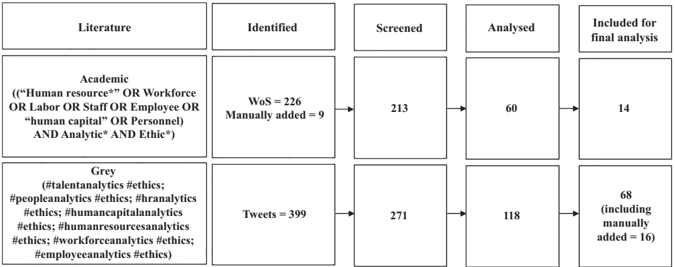
- Academic searching in Web of Science yielded 226 articles, 204 in English; after screening and snowballing, 14 academic papers were included: 10 discussion/conceptual papers, 3 empirical papers, and 1 experiment. Grey literature searching identified 399 tweets, 271 after duplicates, 118 tweets with links, 52 unique articles for full-text analysis, plus 16 additional grey publications.
- Risks for employees included operationalizing bias and discrimination, psychological/social profiling, behavior shaping, reducing performance/people to numbers, creating inconvenience or income insecurity, and threatening privacy or autonomy through tracking and surveillance. Organizational risks included ethics as a point of project risk: in an Insight222 survey of 57 companies, 81% reported workforce analytics projects were sometimes or often jeopardized by data ethics/privacy concerns; 63% of employees believed their employer was tracking or gathering sensitive data, and 72% believed companies were not telling them what data were collected.
- Recommendations clustered into transparency and fairness, legal compliance, ethical guidelines and charters, proportionality and protection, data rights and consent, inclusion of stakeholders, people skills and culture, evaluation, and ethical business models. Legal context reported: 57 countries had passed privacy legislation and 37 had pending efforts; GDPR fines could reach €20m or 4% of annual worldwide turnover; only 53% of companies reported getting ready for GDPR and 22% reported excellent safeguards to protect employee data.
- The review concludes that discussion of ethical issues in PA appeared mainly in the last three years, more than a decade after the first PA articles, and that PA ethics has received relatively little attention compared with areas such as education or medicine.
Methods
- Iterative scoping review suited to an emerging area where formal research lags behind professional/technical sources. Academic literature was searched in Web of Science Core Collection using HR-related keywords combined with ethics-related keywords, for literature published prior to December 31, 2019, with snowballing from reference lists.
- Socially curated grey literature was identified via Twitter advanced search using seven PA hashtags combined with #ethics, covering March 21, 2006 to December 31, 2019; full texts of linked articles were located and analyzed, with additional snowballed or author-known publications integrated.
- Analysis used open-coding to identify themes and categories because no theoretically informed framework for classifying PA ethical risks existed; journal disciplinary affiliation was assessed via SJR (with seven articles classified manually), and Google Scholar citations were checked to identify impactful articles.
Limitations
- Stated: scoping review methods are not intended to be exhaustive or replicable; no theoretically informed framework for classifying PA ethical risks existed, so open-coding was used; academic research on PA ethics was sparse and mostly discussion/conceptual rather than empirical; the search ends December 31, 2019, pre-dating Covid-19; the authors note that as more research is published, systematic review methods may become preferable.
- Stated: no theoretically driven PA ethics guidelines exist, and the authors chose to be guided by the data rather than a specific framework.
- Evident from the text: the grey literature was drawn heavily from Twitter/professional communities and may skew optimistic or technocentric; no formal quality appraisal of included grey sources is described; findings are descriptive mapping rather than causal or empirical testing.
Model-written summary. Check it against the paper before relying on it.
Integrity signals
Registry
Cites
Statistics
Figures

Verification
Claims the paper makes
5 Valid · 8 Not valid · 38 Not checked · 43 Own results and interpretations
The cited sources support only part of this claim — read each source’s verdict below.
In the paper
“few are meaningfully engaging with the important ethical challenges and risks these present for employees' privacy, autonomy and future work opportunities (Tursunbayeva et al., 2018).”
§ The ethics of people analytics: risks, opportunities and recommendations > Introduction
What the sources say
- Partly supportedcites Tursunbayeva et al., 2018 matched to “People analytics—A scoping review of conceptual boundaries and value propositions” (2018) sourceExperimental — accuracy not yet measured
The Conclusions report a marked absence of ethical considerations in the sources reviewed and call ethics a blind spot for the people-analytics profession. They identify privacy, consent, and bias in recruitment or promotion as risks. The review does not establish how many organizations meaningfully engage with those risks, so the claim’s organization-level assertion goes beyond its evidence. (LLM, conf=0.83)
plain- Asserted: passes — The authors put it forward as true.
- Checkable: passes — It can be checked against evidence.
- Load-bearing: passes — The paper’s conclusions depend on it.
- Based: passes — The paper gives a reason why it holds.
- Rests on an assumption not shown here.
- Partly supported
The cited sources that could be checked couldn’t confirm or dispute this claim.
In the paper
“They have also been shown to affect employees' inclusion in and access to future training and development opportunities (Jeske and Calvard, 2020).”
§ The ethics of people analytics: risks, opportunities and recommendations > Behavior shaping
What the sources say
- Could not verifycites Jeske and Calvard, 2020 matched to “Big data: lessons for employers and employees” (2020) sourceExperimental — accuracy not yet measured
Our copy of Jeske and Calvard (2020) holds only the institutional-repository metadata record: the citation/BIBTEX block (no section, no page) and a keywords/access-to-document entry listing 'big data, consent, data analytics, employment, ethics' plus a link to the accepted author manuscript. No article body text is present, so nothing in our copy states or discusses effects of big-data technologies on employees' inclusion in or access to future training and development opportunities. Searched: 'training and development opportunities', 'algorithmic decision making hiring promotion inclusion access to jobs', 'employees may be excluded from job opportunities ... privacy consent', 'lessons for employers ... recommendations ethical use', 'training development career opportunities' — every call returned only the two metadata passages. (LLM, conf=0.68)
plainstates a cause- Asserted: passes — The authors put it forward as true.
- Checkable: passes — It can be checked against evidence.
- Load-bearing: unclear — It is unclear whether the paper’s conclusions depend on it.
- Based: passes — The paper gives a reason why it holds.
- Could not verify
The cited sources support only part of this claim — read each source’s verdict below.
In the paper
“there has been little academic research on the topic of PA, despite the mushrooming market penetration of vendor solutions and widespread corporate interest in engaging with these innovations.”
§ The ethics of people analytics: risks, opportunities and recommendations > Introduction
What the sources say
- Not checked — no full text of the sourcecites Marler and Boudreau, 2017 matched to “An evidence-based review of HR Analytics” (2017) source
- Partly supportedcites Tursunbayeva et al., 2018 matched to “People analytics—A scoping review of conceptual boundaries and value propositions” (2018) sourceExperimental — accuracy not yet measured
The Conclusions report finding few empirical studies and call for more academic research; the Introduction describes growing interest in workforce analytics. Section 3.3 identifies numerous PA vendors, but the paper’s vendor-webpage survey does not establish mushrooming market penetration or widespread corporate uptake of their solutions. (LLM, conf=0.82)
plain- Asserted: passes — The authors put it forward as true.
- Checkable: passes — It can be checked against evidence.
- Load-bearing: passes — The paper’s conclusions depend on it.
- Based: passes — The paper gives a reason why it holds.
The cited sources support only part of this claim — read each source’s verdict below.
In the paper
“Scoping review methods are suited to emerging areas of innovation, where formal research may be sparse but sources of relevant evidence and knowledge are nonetheless accumulating (Arksey and O'Malley, 2005).”
§ The ethics of people analytics: risks, opportunities and recommendations > Method
What the sources say
- Partly supportedcites Arksey and O'Malley, 2005 matched to “Scoping studies: towards a methodological framework” (2005) sourceExperimental — accuracy not yet measured
In “What is a scoping study?” (page unavailable), the paper describes mapping evidence in complex or insufficiently reviewed areas. Its discussion of research gaps and its account of searching for unpublished work also support using scoping methods when the formal literature is limited. It does not specifically identify emerging areas of innovation or say that knowledge in such areas is accumulating. (LLM, conf=0.83)
plain- Asserted: passes — The authors put it forward as true.
- Checkable: passes — It can be checked against evidence.
- Load-bearing: passes — The paper’s conclusions depend on it.
- Based: passes — The paper gives a reason why it holds.
- Partly supported
The cited sources support only part of this claim — read each source’s verdict below.
In the paper
“Our analysis indicates that discussion of ethical issues in PA has appeared in the academic and grey literature mainly (although not extensively) in the last three yearsmore than a decade after the first PA articles were published (Tursunbayeva et al., 2018).”
§ The ethics of people analytics: risks, opportunities and recommendations > Conclusions and implications
What the sources say
- Partly supportedcites Tursunbayeva et al., 2018 matched to “People analytics—A scoping review of conceptual boundaries and value propositions” (2018) sourceExperimental — accuracy not yet measured
Section 2.2 dates a list of PA articles back to 2002, and the Conclusions report a marked absence of ethical considerations while citing discussions from 2015 and 2017. The paper does not establish that discussion of PA ethics in academic and grey literature appeared mainly in the last three years; that timing is presented as the citing authors’ own analysis. (LLM, conf=0.83)
hedged- Asserted: passes — The authors put it forward as true.
- Checkable: passes — It can be checked against evidence.
- Load-bearing: passes — The paper’s conclusions depend on it.
- Based: passes — The paper gives a reason why it holds.
- Partly supported
34 more claims
Create a free account to see all 94 claims and to verify the 3 references still open.
- It may state two separate claims as one. 34
- Probably not a substantial claim. 37
- The quote only partly states this claim. 1
Claims other papers make about this one
Each is checked against this paper’s own text: does it say what the citing paper says it does?
In the citing paper
“As noted by Tursunbayeva et al. (2021), research on the ethical issues of HR analytics -where HRM algorithms are mostly used for augmenting decision making -is still at an early stage and focused mainly on ethical risks such as discrimination, bias, privacy concerns and excessive surveillance (Tursunbayeva et al., 2021).”
From Algorithmic human resource management: Synthesizing developments and cross-disciplinary insights on digital HRM (2021) · cites this paper as Tursunbayeva et al., 2021
Citations
Cites
Scoping studies: towards a methodological framework
Arksey, H., & O'Malley, L. (2005) · International Journal of Social Research Methodology · doi:10.1080/1364557032000119616 · Cited by 36,742
The global landscape of AI ethics guidelines
Jobin, A., Ienca, M., & Vayena, E. (2019) · Nature Machine Intelligence · doi:10.1038/s42256-019-0088-2 · Cited by 6,220 · cited 1×
“of AI ethics guidelines, published in the Nature journal (Jobin et al., 2019) whose authors remark on the variation in interpretation and the difficulty of translating principles into regulations and practices.”
BackgroundGood Gig, Bad Gig: Autonomy and Algorithmic Control in the Global Gig Economy
Wood, A. J., Graham, M., Lehdonvirta, V., & Hjorth, I. (2019) · Work, Employment and Society · doi:10.1177/0950017018785616 · Cited by 2,209
Amazon Scraps Secret AI Recruiting Tool that Showed Bias against Women *
Dastin, J. (2022) · Ethics of Data and Analytics · doi:10.1201/9781003278290-44 · Cited by 1,165
Duggan, J., Sherman, U., Carbery, R., & McDonnell, A. (2020) · Human Resource Management Journal · doi:10.1111/1748-8583.12258 · Cited by 1,050
An evidence-based review of HR Analytics
Marler, J. H., & Boudreau, J. W. (2017) · The International Journal of Human Resource Management · doi:10.1080/09585192.2016.1244699 · Cited by 913
What do Workplace Wellness Programs do? Evidence from the Illinois Workplace Wellness Study*
Jones, D., Molitor, D., & Reif, J. (2019) · The Quarterly Journal of Economics · doi:10.1093/qje/qjz023 · Cited by 403
O’Reilly, J., Eichhorst, W., Gábos, A., Hadjivassiliou, K., Lain, D., Leschke, J., McGuinness, S., Kureková, L. M., Nazio, T., Ortlieb, R., et al. (2015) · Sage Open · doi:10.1177/2158244015574962 · Cited by 360
Will artificial intelligence solve the human resource crisis in healthcare?
Meskó, B., Hetényi, G., & Győrffy, Z. (2018) · BMC Health Services Research · doi:10.1186/s12913-018-3359-4 · Cited by 360
The global landscape of AI ethics guidelines
Jobin, A., Ienca, M., & Vayena, E. (2019) · Repository for Publications and Research Data (ETH Zurich) · doi:10.3929/ethz-b-000375277 · Cited by 360
Research works printed but not linked: 27
- 7. Bodie, M.T., Cherry, M.A. and McCormick, M.L. (2016), "The law and policy of people analytics", University of Colorado Law Review, Paper No. 2016-6, available at: https://papers.ssrn.com/sol3/ papers.cfm?abstract_id=2769980 (accessed 3 March 2021).
- 10. Cappelli, B. (2019), "Your approach to hiring is all wrong", Harvard Business Review, May-June 2019, pp. 48-58.
- 15. Clark, S. (2015), "Ethical decision-making: eight perspectives on workplace dilemmas. Research report", CIPD, available at: https://www.cipd.co.uk/knowledge/culture/ethics/workplace- decisions-report#gref (accessed 3 March 2021).
- 17. Cross, R.L., Singer, J., Colella, S., Thomas, R.J. and Silverstone, Y. (2010), The Organizational Network Fieldbook: Best Practices, Techniques and Exercises to Drive Organizational Innovation and Performance, Jossey-Bass, ISBN: 9780470542200.
- 18. Dale, B. (2017), "The differences between workplace privacy for Americans and Europeans", Observer, 20 September, available at: https://observer.com/2017/09/workplace-privacy-america-europe/ (accessed 3 March 2021).
- 29. Fleming, O., Fountaine, T., Henke, N. and Saleh, T. (2018), "Ten red flags signaling your analytics program will fail", McKinsey Analytics, 14 May, available at: https://www.mckinsey.com/ business-functions/mckinsey-analytics/our-insights/ten-red-flags-signaling-your-analytics- program-will-fail (accessed 3 March 2021).
- 30. Geller, L.W. (2018), "How your hiring process could predict unethical behavior", StrategyþBusiness, 29 January, available at: https://www.strategy-business.com/article/How-Your-Hiring-Process- Could-Predict-Unethical-Behavior?gko=744f0 (accessed 3 March 2021).
- 31. Gifford, C. (2020), "COVID-19 raises questions about employee surveillance technology", European CEO, 22 June, available at: https://www.europeanceo.com/home/featured/covid-19-raises- questions-about-employee-surveillance-technology/ (accessed 3 March 2021).
- 35. Guenole, N., Feinzig, S. and Green, D. (2018), "The grey area: ethical dilemmas in HR analytics. Perspectives from the global workforce", IBM, available at: https://www.ibm.com/watson/ talent/talent-management-institute/ethical-dilemmas-hr-analytics/hr-ethical-dilemmas.pdf (accessed 3 March 2021).
- 43. Jacobs, K. (2017), "The ethics of gathering employee data", HR Magazine, 21 March, available at: https://www.hrmagazine.co.uk/content/features/the-ethics-of-gathering-employee-data (accessed 3 March 2021).
- 48. Joseph, G. (2019), "Data company directly powers immigration raids in workplace", WNYC, available at: https://www.wnyc.org/story/palantir-directly-powers-ice-workplace-raids-emails-show/ (accessed 3 March 2021).
- 51. Kim, P. (2017), "Data-driven discrimination at work", William and Mary Law Review, Vol. 48, pp. 857-936.
- 52. Kirke, M. (2019), "AI in HR: the good, the bad and the scary", The People Space, 29 May, available at: https://www.thepeoplespace.com/leaders/articles/ai-hr-good-bad-and-scary (accessed 3 March 2021).
- 53. Kumar, T. (2018), "Ethics and workforce data: is legislation enough?", Analytics in HR, available at: https://laptrinhx.com/ethics-and-workforce-data-is-legislation-enough-1620079341/ (accessed 3 March 2021).
- 55. Lingard, S. (2018), "GDPR compliance: practical steps to take control of your HR data", HRZone, 13 February, available at: https://www.hrzone.com/perform/business/gdpr-compliance-practical- steps-to-take-control-of-your-hr-data (accessed 3 March 2021).
- 57. Manyika, J. (2019), "Tackling bias in artificial intelligence (and in humans)", McKinsey, 6 June, available at: https://www.mckinsey.com/featured-insights/artificial-intelligence/tackling-bias-in- artificial-intelligence-and-in-humans#:~:text=AI%20can%20help%20reduce%20bias,bake% 20in%20and%20scale%20bias&text=In%20many%20cases%2C%20AI%20can,on%20the% 20training%20data%20used (accessed 3 March 2021).
- 60. Marritt, A. (2016), "People analytics, what's in it for the employees?", Organization View, available at: https://www.organizationview.com/insights-articles/2016/7/5/people-analytics-whats-in-it-for- the-employees-(accessed 3 March 2021).
- 62. Mixson, E. (2019), "People analytics: 10 trends to watch in 2020", HR Gazette, 20 December, available at: https://hr-gazette.com/people-analytics-10-trends-to-watch-in-2020/ (accessed 3 March 2021).
- 66. Nguyen, A. (2020), "On the clock and at home: post-COVID-19 employee monitoring in the workplace", PeopleþStrategy, available at: https://www.shrm.org/executive/resources/people-strategy- journal/summer2020/Pages/feature-nguyen.aspx?utm_source=postcard&utm_medium=dir ectmail&utm_campaign=hrps~2020engagement~nguyensummer2020twitter (accessed 3 March 2021).
- 2016, Rogue Algorithms' and the dark side of big data, Knowledge@Wharton
- 2018, Personality tests are failing American workers, Bloomberg
- 72. Pease, G. (2018), "People analytics -privacy vs. transparency", Gene Pease, 14 March, available at: https://genepease.com/people-analytics-privacy-vs-transparency/ (accessed 3 March 2021).
- 73. Petersen, D. (2018), "Data ethics: 6 steps for ethically sound people analytics", Visier, available at: https://www.visier.com/clarity/six-steps-ethically-sound-people-analytics/ (accessed 3 March 2021).
- 77. RRI Tools Consortium (2016), "A practical guide to responsible research and innovation", Key lessons from RRI Tools, 1 December, available at: https://rri-tools.eu/-/rri-tools-a-practical-guide-to- responsible-research-and-innovation-key-lessons-from-rri-tools-(accessed 3 March 2021).
- 78. Schwartz, M.J. (2020), "Employee surveillance: who's the boss(ware)?", Bank Info Security, 8 July, available at: https://www.bankinfosecurity.com/employee-surveillance-whos-bossware-a- 14579 (accessed 3 March 2021).
- 79. Scimago Journal Ranking Portal (2019), Scimago journal and country rank, available at: https://www. scimagojr.com/.
- 81. Sodeman, W.A. and Hamilton, B. (2019), "Legal and ethical challenges for Human resources in the big data era", Academy of Management Specialized Conference on Big Data and Managing in a Digital Economy, Surrey, UK.
Cited by
Items 101–192 of 192
Hossain, Q., Ikbal, M. Z., & Rahman, M. M. (2025) · SSRN Electronic Journal · doi:10.2139/ssrn.5362677 · Cited by 2
A tale of three associate professors: A grassroots approach to supporting women in higher education
Thong, C., Wheeler, M. A., Mackelprang, J. L., Shafiei, M., Scheepers, H., & Kilborn, V. A. (2023) · Australian Journal of Management · doi:10.1177/03128962231188453 · Cited by 1
“People and Culture’s reluctance to share data stemmed from ethical considerations that pit transparency and diverse stakeholder inclusion against employees’ right to privacy (see Tursunbayeva et al., 2022, for a review).”
BackgroundIrigaray, H. A. R., & Stocker, F. (2023) · Cadernos EBAPE BR · doi:10.1590/1679-395190281x · Cited by 1
Gerber, M., Krause, A., Probst, J., & Heimann, M. (2024) · Gruppe Interaktion Organisation Zeitschrift für Angewandte Organisationspsychologie (GIO) · doi:10.1007/s11612-024-00743-7 · Cited by 12
“Overall, while it is important to remember that HR Analytics is an emerging innovation with as-yet unknown consequences, current research tends to cast it in a positive light (Tursunbayeva et al. 2021) and the dark side of HR Analytics is predominantly overlooked (Giermindl et al. 2022).”
Matos, S. V., Leminen, S., Petruzzelli, A. M., & Wu, J. (2025) · Technovation · doi:10.1016/j.technovation.2024.103156 · Cited by 1
AI-Driven Insights: Enhancing Personality Type Prediction with Advanced Machine Learning Algorithms
Semwal, R. L., Tripathi, N., Rana, A., Pandey, U. K., Parihar, S., & Bairwa, M. K. (2024) · International Conference on Contemporary Computing and Informatics (IC3I) · doi:10.1109/ic3i61595.2024.10829303 · Cited by 2
Machine Learning for Predicting Employee Attrition: A Bibliometric Analysis
Al‐Shammari, M., & Ghanem, Y. A. (2024) · International Conference on Decision Aid Sciences and Applications (DASA) · doi:10.1109/dasa63652.2024.10836251 · Cited by 1
People Analytics am Scheideweg: Vier Thesen für eine nachhaltige Kurskorrektur
Hüllmann, J. A., Schafheitle, S. D., & Weritz, P. (2025) · Schmalenbach IMPULSE · doi:10.54585/dycv6691 · Cited by 2
Abbas, S. M., & Irshad, M. (2025) · Advances in computational intelligence and robotics book series · doi:10.4018/979-8-3373-0159-4.ch008 · Cited by 1
The Ethical and Social Impact of Digital Innovation: A Critical Literature Review
Elviani, S., Supitriyani, Muda, I., & Abdullah, N. M. H. (2026) · Studies in systems, decision and control · doi:10.1007/978-3-031-85398-2_86 · Cited by 1
Bahanni, K., Fujimoto, Y., & Bolt, E. E. T. (2026) · Personnel Review · doi:10.1108/pr-04-2024-0375 · Cited by 3
Balancing Bytes and Behaviour: The Role of Technology in Shaping Modern Organisational Dynamics
Chakraborty, T., Sharada, V. S., & Vedula, K. (2025) · Emerald Group Publishing Limited eBooks · doi:10.1108/978-1-83662-046-420251005 · Cited by 2
People analytics, trust erosion and intention to leave: the role of information asymmetry
Klöpper, M., & Rowe, F. (2026) · Information & Management · doi:10.1016/j.im.2026.104346 · Cited by 7
Keller, T., Warwas, J., Guggemos, J., & Zengerle, V. (2026) · Computers & Security · doi:10.1016/j.cose.2026.104952 · Cited by 2
Arya, V., Purohit, S., & Frau, M. (2026) · Journal of Business Ethics · doi:10.1007/s10551-026-06409-2 · Cited by 1
Kim, J., Kim, J., & Lee, J.-H. (2023) · Asia-pacific Journal of Convergent Research Interchange · doi:10.47116/apjcri.2023.03.11 · Cited by 2
(Ir)responsible uses of technologies and the future of work: Managerial and organizational dilemmas
(2023) · European Management Journal · doi:10.1016/j.emj.2023.05.007 · Cited by 1
Integrating Diversity, Equity, and Inclusion (DEI) Effectiveness Metrics Into Recruitment Analytics
Arunima, K. V., & Bolar, K. P. (2023) · Advances in human resources management and organizational development book series · doi:10.4018/978-1-6684-8942-0.ch001 · Cited by 2
HR Analytics in The Commercial Aviation Sector: a literature review
de Brito, A. P., & Sousa, M. J. (2023) · European Conference on Management, Leadership and Governance (ECMLG) · doi:10.34190/ecmlg.19.1.1706 · Cited by 4
“According to the Global Human Capital Trends survey (Deloitte Insights, 2018), 84% of respondents reported HR Analytics as being important or very important, making it the second highest ranked HR trend (Tursunbayeva et al. , 2021).”
MethodDemystifying People Analytics Adoption: Insights from Italy
Lauro, S. D., Tursunbayeva, A., Sarti, D., Antonelli, G., & Torre, T. (2024) · Springer eBooks · doi:10.1007/978-3-031-58912-6_9 · Cited by 2
Self-citationParker, G. (2024) · Advances in business strategy and competitive advantage book series · doi:10.4018/979-8-3693-3759-2.ch009 · Cited by 1
Artificial Intelligence and Human Resource Management
Tursunbayeva, A. (2024) · Contributions to management science · doi:10.1007/978-3-031-75266-7_1 · Cited by 3
Self-citationTursunbayeva, A. (2024) · Contributions to management science · doi:10.1007/978-3-031-75266-7_7 · Cited by 1
Self-citationA Multilevel Responsible Artificial Intelligence Approach
Tursunbayeva, A. (2024) · Contributions to management science · doi:10.1007/978-3-031-75266-7_8 · Cited by 1
Self-citationStankevičiūtė, Ž., Tursunbayeva, A., & Moschera, L. (2024) · Lecture notes in information systems and organisation · doi:10.1007/978-3-031-76970-2_10 · Cited by 3
Self-citationPersonal Data Privacy and Security at Individual and Organizational Levels
Kaur, J., Chib, S., Aradhya, S. G. B., Chordiya, P. B., Anute, N., Selvakumar, P., & Manjunath, T. C. (2025) · IGI Global eBooks · doi:10.4018/979-8-3373-3171-3.ch005 · Cited by 1
Algorithmic Transparency and Algorithmic Accountability in Organizations
Mastrogiorgio, A., Nauta, P. D., & Martinez, M. (2025) · Lecture notes in information systems and organisation · doi:10.1007/978-3-032-01396-5_8 · Cited by 1
Digital Skills and Maturity in the Public Sector: A Review of EU Guidelines
Gaysina, L., Tursunbayeva, A., Berni, A., & Tomo, A. (2025) · Lecture notes in information systems and organisation · doi:10.1007/978-3-032-01396-5_21 · Cited by 1
Self-citationIrigaray, H. A. R., & Stocker, F. (2023) · Cadernos EBAPE BR · doi:10.1590/1679-395190281 · Cited by 1
From Business Analytics to Hr Analytics: A Thematic Comparison and Research AgendaPreprint
Yin, J., Fernández, V., & Mikalef, P. (2023) · SSRN Electronic Journal · doi:10.2139/ssrn.4499273 · Cited by 1
Can Digital Technologies Tackle Gender Inequality? A ReviewPreprint
Shikongo, S., Iyawa, G. E., & Hamunyela, S. L. (2023) · SSRN Electronic Journal · doi:10.2139/ssrn.4663419 · Cited by 3
Editorial: The ethics of digitalization and emerging corporate responsibilities in the digital age
Schreck, P., Edinger‐Schons, L. M., & Uhl, M. (2024) · Journal of Business Economics · doi:10.1007/s11573-024-01202-x · Cited by 3
“…Dietvorst et al. 2018 ; Ibrahim et al. 2021; Kawaguchi 2021; Logg et al. 2019 ); the diffusion of responsibility between humans and machines (Gogoll/Uhl 2018; Kirchkamp/Strobel 2019; Parasuraman et al. 2000 ), and the role of AI in Peo - ple Analytics (Newman et al. 2020; Tursunbayeva et al. 2021).”
Online Platforms as Labour Market IntermediariesPreprint
Ratti, L. (2025) · SSRN Electronic Journal · doi:10.2139/ssrn.5087834 · Cited by 1
Guraja, P. K., Nagasundaram, K., & Nalluri, M. (2026) · International Journal of Emerging Research in Science Engineering and Management · doi:10.66710/ijersem.v2si1.5 · Cited by 1
Khan, I. A., Qian, D., Waheduzzaman, W., & Luu, T. T. (2026) · Research Square · doi:10.21203/rs.3.rs-9965931/v1 · Cited by 1
Cross-Functionality in Practice: Electronic Performance Monitoring
Jeske, D., & Calvard, T. S. (2022) · Advances in human resources management and organizational development book series · doi:10.4018/978-1-7998-9840-5.ch019
İNSAN KAYNAKLARI ANALİTİĞİ OLGUNLUĞU ÖLÇEĞİ (İKAOÖ): BİR ÖLÇEK GELİŞTİRME ÇALIŞMASI
Özkanlı, F. M., & Gök, S. (2022) · Journal of Research in Business · doi:10.54452/jrb.1107177
Defining the Leader in an Agile and Remote Working Environment
Pontillo, S., Lauro, S. D., & Antonelli, G. (2022) · puntOorg International Journal · doi:10.19245/25.05.pij.7.2.5 · Cited by 7
Self-citationLee, J. H. (2023) · Asia-pacific Journal of Convergent Research Interchange · doi:10.47116/apjcri.2023.03.10
Modeling and Analysis of Organizational Network Analysis Graphs Based on Employee Data
Korichi, A.-R., Kheddouci, H., & Tehseen, T. (2023) · Communications in computer and information science · doi:10.1007/978-3-031-34020-8_27
‘Alam, G. F., Wiyono, B. B., Burhanuddin, B., & Muslihati, M. (2023) · doi:10.1109/icet59790.2023.10435257
“Have morality and ethics accordance with virtues, provide benefits to users, ensure legal compliance and good ethical use [18].”
BackgroundTursunbayeva, A. (2024) · Contributions to management science · doi:10.1007/978-3-031-75266-7_6
Self-citationTursunbayeva, A. (2024) · Contributions to management science · doi:10.1007/978-3-031-75266-7_11
Self-citationUmsetzung von People Management
Borchert, M. (2024) · Springer eBooks · doi:10.1007/978-3-662-70277-2_6
The Development of HR Analytics in Research: A Bibliometric Study
Chatterjee, T. (2025) · Springer proceedings in business and economics · doi:10.1007/978-981-96-2548-2_21 · Cited by 2
Employee performance as a predictor of turnover: a machine learning approach in the DACH region
Bernard, D., Silberer, J., Baumann, A., & Müller, P. A. (2025) · International journal of organizational analysis · doi:10.1108/ijoa-01-2025-5142 · Cited by 4
HR analytics maturity indicators: developing a measurement scale
Özkanlı, F. M., & Gök, S. (2025) · Journal of Work-Applied Management · doi:10.1108/jwam-05-2025-0083 · Cited by 4
Systemic Human Capital Dynamics in Emerging Economies and National Comparative Models
Reyes-Sánchez, J. D. J., Rueda, S. V., Murillo, R. R., & Velázquez, D. J. (2025) · IGI Global eBooks · doi:10.4018/979-8-3373-4022-7.ch006
Cayrat, C., & Cossette, M. (2025) · SSRN Electronic Journal · doi:10.2139/ssrn.5774564
Dang, N. T. T., Ha, V. D., & Pham, D. T. H. (2025) · Journal of Asia Business Studies · doi:10.1108/jabs-08-2024-0483 · Cited by 2
Gerber, M., Krause, A., Probst, J., et al. (2024) · Zürcher Hochschule für Angewandte Wissenschaften digital collection (Zurich University of Applied Sciences) · doi:10.21256/zhaw-30797
Shaikh, M., Akbar, W., Zainal, N. A. B., & Mubarik, M. S. (2025) · SSRN Electronic Journal · doi:10.2139/ssrn.5679819 · Cited by 1
Data Privacy and Informed Consent in Immersive Extended Reality: A Literature ReviewPreprint
Estens, P. M. (2025) · SSRN Electronic Journal · doi:10.2139/ssrn.5957276
HR analytics: a centralizing or decentralizing force?
Lehmann, J. (2025) · The International Journal of Human Resource Management · doi:10.1080/09585192.2025.2602086 · Cited by 2
“Practical applications range from Starbucks using a scheduling software that analyzes data including weather and pedestrian patterns (Tursunbayeva et al., 2022), Tesco reusing its customer analytics tool to better understand its employees, McDonalds leveraging information about management behavior…”
Connecting Education with Reality: AI as a Catalyst for Situated Learning
Vargas, E. G., Chiappe, A., & de Bedout, L. F. (2026) · The Educational Forum · doi:10.1080/00131725.2025.2596001 · Cited by 2
“Additionally, there is a risk that AI may perpetuate existing biases in the data, which could lead to unfair or inaccurate assessments (Koshiyama et al., 2024; Tursunbayeva et al., 2022).”
Akther, N., Hamid, Z. A., & Juhdi, N. (2026) · Multidisciplinary Reviews · doi:10.31893/multirev.2026419
AI for Employee Wellness: A Dual-Framework Approach to E-Health Transformation
Pandita, D., Verma, A., Mishra, P., & Rastogi, S. (2025) · International Conference on Innovation and Intelligence for Informatics, Computing, and Technologies (3ICT) · doi:10.1109/3ict68299.2025.11442053
“Machine learning facilitates data-driven decision-making, allowing HR staff to discover the best talent and create personalized career planning [12].”
Under the Gaze: How and When Being Observed Facilitates Innovative Behavior
Zhang, X., Tian, G., Liang, L., Tian, Y., & Li, Z. (2026) · Behavioral Sciences · doi:10.3390/bs16040532
“…by 2025 an estimated 70% of large corporations adopted AI-augmented monitoring systems, and AI-enabled monitoring expanded sharply during the shift to remote (Ravid et al., 2023; Yam et al., 2023) and hybrid work following the COVID-19 pandemic (Bernstein et al., 2020; Tursunbayeva et al., 2022).”
InfluentialHuman Resources Analytics In Theory and Practice
Izquierdo, A. L. G., Aguado, D., Belizón, M. J., Castaño, A. M., & Zuazua, M. (2025) · Emerald Group Publishing Limited eBooks · doi:10.1108/979-8-88730-816-620251008 · Cited by 2
Korichi, A.-R. (2023) · theses.fr (ABES) · doi:10.70675/07808923z2721z4bc2z8617z0ac32bc7961e · Cited by 3
Beyond the Visible: Harnessing Dark Data Ethically for Strategic Advantage
Smuts, H., Badenhorst, D., Abrahams, N., & van der Merwe, E. (2026) · IFIP advances in information and communication technology · doi:10.1007/978-3-032-16779-8_3
Leveraging Social Media Analytics to Transform Employer Branding and Recruitment
Kumar, D. K. (2026) · Lecture notes in electrical engineering · doi:10.1007/978-981-95-5835-3_152
Junior, Ê. A. N. (2026) · Research Society and Development · doi:10.33448/rsd-v15i4.50948
Johnson, A.-M., Haydon, R., & Golay, L. M. (2026) · Oxford University Press eBooks · doi:10.1093/9780197807309.003.0013
Manoharan, S., Shamsi, D. I. R. A., Thangam, D., Sthapit, A., & Jahan, R. (2026) · Advances in computational intelligence and robotics book series · doi:10.4018/979-8-3373-6390-5.ch010
Border Free Branding: The Power of Crowdsourcing in Talent Magnetism
Shukla, R., Raina, A., Gupta, K., & Kansara, M. K. (2026) · Emerald Group Publishing Limited eBooks · doi:10.1108/978-1-80592-601-620261010
Emotional Intelligence of Gig Employees: Enhancing Work-Life Balance for Sustainable Productivity
Manoharan, G., Kumar, S., & Mahmoud, E. S. (2026) · IGI Global eBooks · doi:10.4018/979-8-3373-6395-0.ch008
Dewettinck, K., Legrand, V., Quataert, S., & Buyens, D. (2026) · Springer eBooks · doi:10.1007/978-981-95-3588-0_17 · Cited by 3
Privacy, Fairness, and Model Risk Governance in Sustainable People Analytics
Şimşek, T., & Şimşek, A. B. (2026) · IGI Global eBooks · doi:10.4018/979-8-3373-8546-4.ch010
Şeremet, G. G. (2026) · Advances in computational intelligence and robotics book series · doi:10.4018/979-8-3373-6650-0.ch001
Afifah, Z., Atina, V. Z., & Kurniawan, D. A. (2026) · Technology Analysis and Strategic Management · doi:10.1080/09537325.2026.2688268
Önaçan, M. B. K. (2026) · International Journal of Advances in Engineering and Pure Sciences · doi:10.7240/jeps.1787301
Smart HR Systems: A Blended Approach of AI, Automation, and People Analytics in the Digital Era
Rana, T., & Rani, K. (2026) · Advances in computational intelligence and robotics book series · doi:10.4018/979-8-2600-2726-4.ch011
Parent‐Rocheleau, X., Savard, Y. P., & Ollier‐Malaterre, A. (2026) · European Management Journal · doi:10.1016/j.emj.2026.07.006 · Cited by 1
The Role of AI in Promoting Engagement, DEI, and Happiness
Swathi, Y., & Goyal, S. B. (2026) · BENTHAM SCIENCE PUBLISHERS eBooks · doi:10.2174/9798898815554126010011
Dark Side of Human Resource Analytics: A Systematic Integrative Review
Mukuze, K. (2026) · Journal of Management Sciences Innovation and Technology · doi:10.63726/jmsit.v2i2.516
Mahajan, P. P. (2026) · Cureus Journal of Computer Science. · doi:10.7759/s44389-026-00180-1
People Analytics and Artificial Intelligence: Challenges and Ethical Considerations
Suri, N. (2026) · Advances in computational intelligence and robotics book series · doi:10.4018/979-8-3373-5213-8.ch006
Aftimos, S., Aftimos, M., & Aftimos, A. (2026) · IGI Global eBooks · doi:10.4018/979-8-3373-8959-2.ch005
Li, S., & Yu, S. (2026) · Educational Management Administration & Leadership · doi:10.1177/17411432261476651
Risk Mitigation in the Digital Financial Landscape
Zaheer, A., Mishra, K. K., Pant, P., et al. (2026) · IGI Global eBooks · doi:10.4018/979-8-3373-5437-8.ch013
Strategic Human Resource Analytics and Intelligent Data-Driven Systems: A Conclusion
Dzingirai, M., & Atiku, S. O. (2026) · Springer eBooks · doi:10.1007/978-981-92-2623-8_12
Onward and upward: strategies for overcoming challenges in algorithmic HR implementation
Qamar, Y., Ture, R. S., & Samad, T. A. (2026) · Global Knowledge, Memory and Communication · doi:10.1108/gkmc-06-2025-0482
Digital Surveillance and the Breach of Psychological Contracts
Hassan, L., Khalaf, O., Jaber, R., & Mostafa, R. B. (2024) · Journal of Applied Organizational Systems and Behavior · doi:10.51847/cmvpvaqffn
Friends or foes? Framing contests and the co-creation and counter-creation of digital technologies
Bader, V., & Loscher, G. J. (2026) · European Management Journal · doi:10.1016/j.emj.2026.08.002
Zakaria, K. S., & Khattak, M. N. (2026) · Discover Artificial Intelligence · doi:10.1007/s44163-026-01926-5 · Cited by 3
Zero Trust Security Technologies, Applications, and Adoption Challenges
Anderson, J., Aldeen, M. S., Zhang, S., Liao, S., Hu, H., Chowdhury, M., & Cheng, L. (2026) · Lecture notes of the Institute for Computer Sciences, Social Informatics and Telecommunications Engineering · doi:10.1007/978-3-032-33701-6_11
malekinezhad, M. K., Rahimnia, F., Eslami, G., & Farahi, M. M. (2026) · Technological Forecasting and Social Change · doi:10.1016/j.techfore.2026.124880
Leadership in the Age of AI: Aristotelian Rhetoric and Human-Centered Management
Manoli, A., Triantari, S., & Zervas, I. M. (2026) · Dia-noesis. · doi:10.12681/dia.46975
Manikeswari, D., & Ratnakaram, S. P. K. (2026) · Advances in computational intelligence and robotics book series · doi:10.4018/979-8-3373-9599-9.ch013
Leadership: Past, Present, and Future
Huria, G., & Raut, S. (2026) · IGI Global eBooks · doi:10.4018/979-8-3373-2920-8.ch001
Jain, V., Bedi, S. S., & Lathabhavan, R. (2026) · International Journal of Productivity and Performance Management · doi:10.1108/ijppm-11-2025-1158
Metadata
- Authors
- Tursunbayeva, A., Pagliari, C., Di Lauro, S., & Antonelli, G.
- Affiliations
- University of Twente (NL)
- University of Edinburgh (GB)
- University of Sannio (IT)
- Venue
- Personnel Review
- Publisher
- Emerald
- Published
- 2021-03-23
- Volume
- 51
- Issue
- 3
- Pages
- 900-921
- ISSN
- 0048-3486 (ISSN-L)
- OpenAlex
- W3137784937
- Cited by
- 193
- References
- 37
- Citations by year
- 2026: 49 · 2025: 41 · 2024: 39 · 2023: 45 · 2022: 14 · 2021: 5
- FWCI
- 24.98
- Type
- journal article
- Language
- en
- Open access
- hybrid
- doi.org
- Licence
- cc-by
- www.emerald.com/insight/site-policies (tdm)
- Locations
- Personnel Review (publishedVersion, cc-by)
- University of Twente Research Information (publishedVersion, cc-by)
- Edinburgh Research Explorer (University of Edinburgh) (submittedVersion, cc-by)
- CINECA IRIS Institutial research information system (Parthenope University of Naples) (submittedVersion)
- University of Twente Research Information (submittedVersion, cc-by)
- Topics
- Social Sciences › Business, Management and Accounting › Organizational Behavior and Human Resource Management › AI and HR Technologies
- Physical Sciences › Computer Science › Artificial Intelligence › Ethics and Social Impacts of AI
- Social Sciences › Business, Management and Accounting › Organizational Behavior and Human Resource Management › Ethics in Business and Education
- Keywords
- HR analytics, ethics, employee monitoring, data privacy, transparency, stakeholder inclusion, algorithmic decision-making, future of work, working from home, COVID-19 pandemic, regulatory compliance, ethical charter
About these checks
Registry, retraction, Cites and statistics results are computed, not judged, with one exception: a printed reference that no index lists is read once by a model before it counts as a citation error. Claims are extracted by a model and kept only when their quote appears verbatim in the text; each cited source is then checked, with a model’s help, for whether it says what the claim relies on. Those verdicts can be wrong — read the claim’s quote and the cited source before relying on one.
The claim verdicts this report counts are experimental: their accuracy is not yet measured.
A language model drew the claims from the paper on 2026-10-10, under version 3 of the claim definition (model deepseek-v4.1-flash, prompt extract-v3).
A second model labelled each claim on 2026-10-10 (model jev-1.13-20260917, definition revision gold-guideline-v0.2).
Cited sources are checked with a language model’s help (gpt-6-sol and qwen3.8-omni-flash).
Statistics and arithmetic are recomputed, not judged.
Confidence bands are shown only for fields calibrated on our annotated test set. None is calibrated yet, so no band is shown.
What counts as a claim ›How we measure confidence ›How we check this ›
Are you an author, or do you see a problem with this page? Request a review
Data sources
Bibliographic data: Semantic Scholar, OpenAlex, Crossref.
Contains information from the Semantic Scholar Academic Graph Datasets, made available under the ODC Attribution License (ODC-BY 1.0).
Semantic Scholar’s data is described in: Kinney, R., et al. (2023). The Semantic Scholar Open Data Platform. arXiv:2301.10140.
