

The ethics of people analytics: risks, opportunities and recommendations
Open accessThe DOI matches its Crossref record; 37 of the 37 references it cites were found in a registry or an index; 6 of the 45 sources its claims cite were checked for support.
Abstract
Purpose This research analyzed the existing academic and grey literature concerning the technologies and practices of people analytics (PA), to understand how ethical considerations are being discussed by researchers, industry experts and practitioners, and to identify gaps, priorities and recommendations for ethical practice. Design/methodology/approach An iterative “scoping review” method was used to capture and synthesize relevant academic and grey literature. This is suited to emerging areas of innovation where formal research lags behind evidence from professional or technical sources. Findings Although the grey literature contains a growing stream of publications aimed at helping PA practitioners to “be ethical,” overall, research on ethical issues in PA is still at an early stage. Optimistic and technocentric perspectives dominate the PA discourse, although key themes seen in the wider literature on digital/data ethics are also evident. Risks and recommendations for PA projects concerned transparency and diverse stakeholder inclusion, respecting privacy rights, fair and proportionate use of data, fostering a systemic culture of ethical practice, delivering benefits for employees, including ethical outcomes in business models, ensuring legal compliance and using ethical charters. Research limitations/implications This research adds to current debates over the future of work and employment in a digitized, algorithm-driven society. Practical implications The research provides an accessible summary of the risks, opportunities, trade-offs and regulatory issues for PA, as well as a framework for integrating ethical strategies and practices. Originality/value By using a scoping methodology to surface and analyze diverse literatures, this study fills a gap in existing knowledge on ethical aspects of PA. The findings can inform future academic research, organizations using or considering PA products, professional associations developing relevant guidelines and policymakers adapting regulations. It is also timely, given the increase in digital monitoring of employees working from home during the Covid-19 pandemic.
Overview
CoChat Summary
TL;DR
This scoping review maps academic and grey literature on ethical issues in people analytics (PA), finding that research remains early-stage and dominated by optimistic, technocentric perspectives. It identifies risks around bias, profiling, behavior shaping, performance quantification, privacy/surveillance, and organizational compliance, and clusters recommendations around transparency, legal compliance, stakeholder inclusion, data rights, and ethical business models.
Key findings
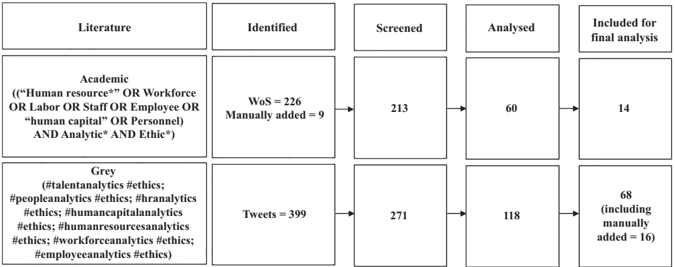
- Academic searching in Web of Science yielded 226 articles, 204 in English; after screening and snowballing, 14 academic papers were included: 10 discussion/conceptual papers, 3 empirical papers, and 1 experiment. Grey literature searching identified 399 tweets, 271 after duplicates, 118 tweets with links, 52 unique articles for full-text analysis, plus 16 additional grey publications.
- Risks for employees included operationalizing bias and discrimination, psychological/social profiling, behavior shaping, reducing performance/people to numbers, creating inconvenience or income insecurity, and threatening privacy or autonomy through tracking and surveillance. Organizational risks included ethics as a point of project risk: in an Insight222 survey of 57 companies, 81% reported workforce analytics projects were sometimes or often jeopardized by data ethics/privacy concerns; 63% of employees believed their employer was tracking or gathering sensitive data, and 72% believed companies were not telling them what data were collected.
- Recommendations clustered into transparency and fairness, legal compliance, ethical guidelines and charters, proportionality and protection, data rights and consent, inclusion of stakeholders, people skills and culture, evaluation, and ethical business models. Legal context reported: 57 countries had passed privacy legislation and 37 had pending efforts; GDPR fines could reach €20m or 4% of annual worldwide turnover; only 53% of companies reported getting ready for GDPR and 22% reported excellent safeguards to protect employee data.
- The review concludes that discussion of ethical issues in PA appeared mainly in the last three years, more than a decade after the first PA articles, and that PA ethics has received relatively little attention compared with areas such as education or medicine.
Methods
- Iterative scoping review suited to an emerging area where formal research lags behind professional/technical sources. Academic literature was searched in Web of Science Core Collection using HR-related keywords combined with ethics-related keywords, for literature published prior to December 31, 2019, with snowballing from reference lists.
- Socially curated grey literature was identified via Twitter advanced search using seven PA hashtags combined with #ethics, covering March 21, 2006 to December 31, 2019; full texts of linked articles were located and analyzed, with additional snowballed or author-known publications integrated.
- Analysis used open-coding to identify themes and categories because no theoretically informed framework for classifying PA ethical risks existed; journal disciplinary affiliation was assessed via SJR (with seven articles classified manually), and Google Scholar citations were checked to identify impactful articles.
Limitations
- Stated: scoping review methods are not intended to be exhaustive or replicable; no theoretically informed framework for classifying PA ethical risks existed, so open-coding was used; academic research on PA ethics was sparse and mostly discussion/conceptual rather than empirical; the search ends December 31, 2019, pre-dating Covid-19; the authors note that as more research is published, systematic review methods may become preferable.
- Stated: no theoretically driven PA ethics guidelines exist, and the authors chose to be guided by the data rather than a specific framework.
- Evident from the text: the grey literature was drawn heavily from Twitter/professional communities and may skew optimistic or technocentric; no formal quality appraisal of included grey sources is described; findings are descriptive mapping rather than causal or empirical testing.
Model-written summary. Check it against the paper before relying on it.
Integrity signals
Registry
Cites
Statistics
Figures

Verification
Claims the paper makes
5 Valid · 8 Not valid · 38 Not checked · 43 Own results and interpretations
The cited sources support only part of this claim — read each source’s verdict below.
In the paper
“few are meaningfully engaging with the important ethical challenges and risks these present for employees' privacy, autonomy and future work opportunities (Tursunbayeva et al., 2018).”
§ The ethics of people analytics: risks, opportunities and recommendations > Introduction
What the sources say
- Partly supportedcites Tursunbayeva et al., 2018 matched to “People analytics—A scoping review of conceptual boundaries and value propositions” (2018) sourceExperimental — accuracy not yet measured
The Conclusions report a marked absence of ethical considerations in the sources reviewed and call ethics a blind spot for the people-analytics profession. They identify privacy, consent, and bias in recruitment or promotion as risks. The review does not establish how many organizations meaningfully engage with those risks, so the claim’s organization-level assertion goes beyond its evidence. (LLM, conf=0.83)
plain- Asserted: passes — The authors put it forward as true.
- Checkable: passes — It can be checked against evidence.
- Load-bearing: passes — The paper’s conclusions depend on it.
- Based: passes — The paper gives a reason why it holds.
- Rests on an assumption not shown here.
- Partly supported
The cited sources that could be checked couldn’t confirm or dispute this claim.
In the paper
“They have also been shown to affect employees' inclusion in and access to future training and development opportunities (Jeske and Calvard, 2020).”
§ The ethics of people analytics: risks, opportunities and recommendations > Behavior shaping
What the sources say
- Could not verifycites Jeske and Calvard, 2020 matched to “Big data: lessons for employers and employees” (2020) sourceExperimental — accuracy not yet measured
Our copy of Jeske and Calvard (2020) holds only the institutional-repository metadata record: the citation/BIBTEX block (no section, no page) and a keywords/access-to-document entry listing 'big data, consent, data analytics, employment, ethics' plus a link to the accepted author manuscript. No article body text is present, so nothing in our copy states or discusses effects of big-data technologies on employees' inclusion in or access to future training and development opportunities. Searched: 'training and development opportunities', 'algorithmic decision making hiring promotion inclusion access to jobs', 'employees may be excluded from job opportunities ... privacy consent', 'lessons for employers ... recommendations ethical use', 'training development career opportunities' — every call returned only the two metadata passages. (LLM, conf=0.68)
plainstates a cause- Asserted: passes — The authors put it forward as true.
- Checkable: passes — It can be checked against evidence.
- Load-bearing: unclear — It is unclear whether the paper’s conclusions depend on it.
- Based: passes — The paper gives a reason why it holds.
- Could not verify
The cited sources support only part of this claim — read each source’s verdict below.
In the paper
“there has been little academic research on the topic of PA, despite the mushrooming market penetration of vendor solutions and widespread corporate interest in engaging with these innovations.”
§ The ethics of people analytics: risks, opportunities and recommendations > Introduction
What the sources say
- Not checked — no full text of the sourcecites Marler and Boudreau, 2017 matched to “An evidence-based review of HR Analytics” (2017) source
- Partly supportedcites Tursunbayeva et al., 2018 matched to “People analytics—A scoping review of conceptual boundaries and value propositions” (2018) sourceExperimental — accuracy not yet measured
The Conclusions report finding few empirical studies and call for more academic research; the Introduction describes growing interest in workforce analytics. Section 3.3 identifies numerous PA vendors, but the paper’s vendor-webpage survey does not establish mushrooming market penetration or widespread corporate uptake of their solutions. (LLM, conf=0.82)
plain- Asserted: passes — The authors put it forward as true.
- Checkable: passes — It can be checked against evidence.
- Load-bearing: passes — The paper’s conclusions depend on it.
- Based: passes — The paper gives a reason why it holds.
The cited sources support only part of this claim — read each source’s verdict below.
In the paper
“Scoping review methods are suited to emerging areas of innovation, where formal research may be sparse but sources of relevant evidence and knowledge are nonetheless accumulating (Arksey and O'Malley, 2005).”
§ The ethics of people analytics: risks, opportunities and recommendations > Method
What the sources say
- Partly supportedcites Arksey and O'Malley, 2005 matched to “Scoping studies: towards a methodological framework” (2005) sourceExperimental — accuracy not yet measured
In “What is a scoping study?” (page unavailable), the paper describes mapping evidence in complex or insufficiently reviewed areas. Its discussion of research gaps and its account of searching for unpublished work also support using scoping methods when the formal literature is limited. It does not specifically identify emerging areas of innovation or say that knowledge in such areas is accumulating. (LLM, conf=0.83)
plain- Asserted: passes — The authors put it forward as true.
- Checkable: passes — It can be checked against evidence.
- Load-bearing: passes — The paper’s conclusions depend on it.
- Based: passes — The paper gives a reason why it holds.
- Partly supported
The cited sources support only part of this claim — read each source’s verdict below.
In the paper
“Our analysis indicates that discussion of ethical issues in PA has appeared in the academic and grey literature mainly (although not extensively) in the last three yearsmore than a decade after the first PA articles were published (Tursunbayeva et al., 2018).”
§ The ethics of people analytics: risks, opportunities and recommendations > Conclusions and implications
What the sources say
- Partly supportedcites Tursunbayeva et al., 2018 matched to “People analytics—A scoping review of conceptual boundaries and value propositions” (2018) sourceExperimental — accuracy not yet measured
Section 2.2 dates a list of PA articles back to 2002, and the Conclusions report a marked absence of ethical considerations while citing discussions from 2015 and 2017. The paper does not establish that discussion of PA ethics in academic and grey literature appeared mainly in the last three years; that timing is presented as the citing authors’ own analysis. (LLM, conf=0.83)
hedged- Asserted: passes — The authors put it forward as true.
- Checkable: passes — It can be checked against evidence.
- Load-bearing: passes — The paper’s conclusions depend on it.
- Based: passes — The paper gives a reason why it holds.
- Partly supported
34 more claims
Create a free account to see all 94 claims and to verify the 3 references still open.
- It may state two separate claims as one. 34
- Probably not a substantial claim. 37
- The quote only partly states this claim. 1
Claims other papers make about this one
Each is checked against this paper’s own text: does it say what the citing paper says it does?
In the citing paper
“As noted by Tursunbayeva et al. (2021), research on the ethical issues of HR analytics -where HRM algorithms are mostly used for augmenting decision making -is still at an early stage and focused mainly on ethical risks such as discrimination, bias, privacy concerns and excessive surveillance (Tursunbayeva et al., 2021).”
From Algorithmic human resource management: Synthesizing developments and cross-disciplinary insights on digital HRM (2021) · cites this paper as Tursunbayeva et al., 2021
Citations
Cites
Scoping studies: towards a methodological framework
Arksey, H., & O'Malley, L. (2005) · International Journal of Social Research Methodology · doi:10.1080/1364557032000119616 · Cited by 36,742
The global landscape of AI ethics guidelines
Jobin, A., Ienca, M., & Vayena, E. (2019) · Nature Machine Intelligence · doi:10.1038/s42256-019-0088-2 · Cited by 6,220 · cited 1×
“of AI ethics guidelines, published in the Nature journal (Jobin et al., 2019) whose authors remark on the variation in interpretation and the difficulty of translating principles into regulations and practices.”
BackgroundGood Gig, Bad Gig: Autonomy and Algorithmic Control in the Global Gig Economy
Wood, A. J., Graham, M., Lehdonvirta, V., & Hjorth, I. (2019) · Work, Employment and Society · doi:10.1177/0950017018785616 · Cited by 2,209
Amazon Scraps Secret AI Recruiting Tool that Showed Bias against Women *
Dastin, J. (2022) · Ethics of Data and Analytics · doi:10.1201/9781003278290-44 · Cited by 1,165
Duggan, J., Sherman, U., Carbery, R., & McDonnell, A. (2020) · Human Resource Management Journal · doi:10.1111/1748-8583.12258 · Cited by 1,050
An evidence-based review of HR Analytics
Marler, J. H., & Boudreau, J. W. (2017) · The International Journal of Human Resource Management · doi:10.1080/09585192.2016.1244699 · Cited by 913
What do Workplace Wellness Programs do? Evidence from the Illinois Workplace Wellness Study*
Jones, D., Molitor, D., & Reif, J. (2019) · The Quarterly Journal of Economics · doi:10.1093/qje/qjz023 · Cited by 403
O’Reilly, J., Eichhorst, W., Gábos, A., Hadjivassiliou, K., Lain, D., Leschke, J., McGuinness, S., Kureková, L. M., Nazio, T., Ortlieb, R., et al. (2015) · Sage Open · doi:10.1177/2158244015574962 · Cited by 360
Will artificial intelligence solve the human resource crisis in healthcare?
Meskó, B., Hetényi, G., & Győrffy, Z. (2018) · BMC Health Services Research · doi:10.1186/s12913-018-3359-4 · Cited by 360
The global landscape of AI ethics guidelines
Jobin, A., Ienca, M., & Vayena, E. (2019) · Repository for Publications and Research Data (ETH Zurich) · doi:10.3929/ethz-b-000375277 · Cited by 360
Research works printed but not linked: 27
- 7. Bodie, M.T., Cherry, M.A. and McCormick, M.L. (2016), "The law and policy of people analytics", University of Colorado Law Review, Paper No. 2016-6, available at: https://papers.ssrn.com/sol3/ papers.cfm?abstract_id=2769980 (accessed 3 March 2021).
- 10. Cappelli, B. (2019), "Your approach to hiring is all wrong", Harvard Business Review, May-June 2019, pp. 48-58.
- 15. Clark, S. (2015), "Ethical decision-making: eight perspectives on workplace dilemmas. Research report", CIPD, available at: https://www.cipd.co.uk/knowledge/culture/ethics/workplace- decisions-report#gref (accessed 3 March 2021).
- 17. Cross, R.L., Singer, J., Colella, S., Thomas, R.J. and Silverstone, Y. (2010), The Organizational Network Fieldbook: Best Practices, Techniques and Exercises to Drive Organizational Innovation and Performance, Jossey-Bass, ISBN: 9780470542200.
- 18. Dale, B. (2017), "The differences between workplace privacy for Americans and Europeans", Observer, 20 September, available at: https://observer.com/2017/09/workplace-privacy-america-europe/ (accessed 3 March 2021).
- 29. Fleming, O., Fountaine, T., Henke, N. and Saleh, T. (2018), "Ten red flags signaling your analytics program will fail", McKinsey Analytics, 14 May, available at: https://www.mckinsey.com/ business-functions/mckinsey-analytics/our-insights/ten-red-flags-signaling-your-analytics- program-will-fail (accessed 3 March 2021).
- 30. Geller, L.W. (2018), "How your hiring process could predict unethical behavior", StrategyþBusiness, 29 January, available at: https://www.strategy-business.com/article/How-Your-Hiring-Process- Could-Predict-Unethical-Behavior?gko=744f0 (accessed 3 March 2021).
- 31. Gifford, C. (2020), "COVID-19 raises questions about employee surveillance technology", European CEO, 22 June, available at: https://www.europeanceo.com/home/featured/covid-19-raises- questions-about-employee-surveillance-technology/ (accessed 3 March 2021).
- 35. Guenole, N., Feinzig, S. and Green, D. (2018), "The grey area: ethical dilemmas in HR analytics. Perspectives from the global workforce", IBM, available at: https://www.ibm.com/watson/ talent/talent-management-institute/ethical-dilemmas-hr-analytics/hr-ethical-dilemmas.pdf (accessed 3 March 2021).
- 43. Jacobs, K. (2017), "The ethics of gathering employee data", HR Magazine, 21 March, available at: https://www.hrmagazine.co.uk/content/features/the-ethics-of-gathering-employee-data (accessed 3 March 2021).
- 48. Joseph, G. (2019), "Data company directly powers immigration raids in workplace", WNYC, available at: https://www.wnyc.org/story/palantir-directly-powers-ice-workplace-raids-emails-show/ (accessed 3 March 2021).
- 51. Kim, P. (2017), "Data-driven discrimination at work", William and Mary Law Review, Vol. 48, pp. 857-936.
- 52. Kirke, M. (2019), "AI in HR: the good, the bad and the scary", The People Space, 29 May, available at: https://www.thepeoplespace.com/leaders/articles/ai-hr-good-bad-and-scary (accessed 3 March 2021).
- 53. Kumar, T. (2018), "Ethics and workforce data: is legislation enough?", Analytics in HR, available at: https://laptrinhx.com/ethics-and-workforce-data-is-legislation-enough-1620079341/ (accessed 3 March 2021).
- 55. Lingard, S. (2018), "GDPR compliance: practical steps to take control of your HR data", HRZone, 13 February, available at: https://www.hrzone.com/perform/business/gdpr-compliance-practical- steps-to-take-control-of-your-hr-data (accessed 3 March 2021).
- 57. Manyika, J. (2019), "Tackling bias in artificial intelligence (and in humans)", McKinsey, 6 June, available at: https://www.mckinsey.com/featured-insights/artificial-intelligence/tackling-bias-in- artificial-intelligence-and-in-humans#:~:text=AI%20can%20help%20reduce%20bias,bake% 20in%20and%20scale%20bias&text=In%20many%20cases%2C%20AI%20can,on%20the% 20training%20data%20used (accessed 3 March 2021).
- 60. Marritt, A. (2016), "People analytics, what's in it for the employees?", Organization View, available at: https://www.organizationview.com/insights-articles/2016/7/5/people-analytics-whats-in-it-for- the-employees-(accessed 3 March 2021).
- 62. Mixson, E. (2019), "People analytics: 10 trends to watch in 2020", HR Gazette, 20 December, available at: https://hr-gazette.com/people-analytics-10-trends-to-watch-in-2020/ (accessed 3 March 2021).
- 66. Nguyen, A. (2020), "On the clock and at home: post-COVID-19 employee monitoring in the workplace", PeopleþStrategy, available at: https://www.shrm.org/executive/resources/people-strategy- journal/summer2020/Pages/feature-nguyen.aspx?utm_source=postcard&utm_medium=dir ectmail&utm_campaign=hrps~2020engagement~nguyensummer2020twitter (accessed 3 March 2021).
- 2016, Rogue Algorithms' and the dark side of big data, Knowledge@Wharton
- 2018, Personality tests are failing American workers, Bloomberg
- 72. Pease, G. (2018), "People analytics -privacy vs. transparency", Gene Pease, 14 March, available at: https://genepease.com/people-analytics-privacy-vs-transparency/ (accessed 3 March 2021).
- 73. Petersen, D. (2018), "Data ethics: 6 steps for ethically sound people analytics", Visier, available at: https://www.visier.com/clarity/six-steps-ethically-sound-people-analytics/ (accessed 3 March 2021).
- 77. RRI Tools Consortium (2016), "A practical guide to responsible research and innovation", Key lessons from RRI Tools, 1 December, available at: https://rri-tools.eu/-/rri-tools-a-practical-guide-to- responsible-research-and-innovation-key-lessons-from-rri-tools-(accessed 3 March 2021).
- 78. Schwartz, M.J. (2020), "Employee surveillance: who's the boss(ware)?", Bank Info Security, 8 July, available at: https://www.bankinfosecurity.com/employee-surveillance-whos-bossware-a- 14579 (accessed 3 March 2021).
- 79. Scimago Journal Ranking Portal (2019), Scimago journal and country rank, available at: https://www. scimagojr.com/.
- 81. Sodeman, W.A. and Hamilton, B. (2019), "Legal and ethical challenges for Human resources in the big data era", Academy of Management Specialized Conference on Big Data and Managing in a Digital Economy, Surrey, UK.
Cited by
The dark sides of people analytics: Reviewing the perils for organisations and employees
Giermindl, L. M., Strich, F., Christ, O., Leicht-Deobald, U., & Redzepi, A. (2022) · European Journal of Information Systems · doi:10.1080/0960085x.2021.1927213 · Cited by 331
“Thus, scholars highlight “the role of AI in replicating and replacing the human workforce” (Tursunbayeva et al., 2021, p. 15) owing to the ability of AI “to perform tasks that normally require human cognition, including adaptive decision making“ (Tambe et al., 2019, p. 16).”
BackgroundMeijerink, J., Boons, M., Keegan, A., & Marler, J. (2021) · The International Journal of Human Resource Management · doi:10.1080/09585192.2021.1925326 · Cited by 267
“…et al. (2021), research on the ethical issues of HR analytics – where HRM algorithms are mostly used for augmenting decision making – is still at an early stage and focused mainly on ethical risks such as discrimination, bias, privacy concerns and excessive surveillance (Tursunbayeva et al., 2021).”
When technology meets people: the interplay of artificial intelligence and human resource management
Qamar, Y., Agrawal, R. K., Samad, T. A., & Chiappetta Jabbour, C. J. (2021) · Journal of Enterprise Information Management · doi:10.1108/jeim-11-2020-0436 · Cited by 213
Bridging the gap: why, how and when HR analytics can impact organizational performance
McCartney, S., & Fu, N. (2022) · Management Decision · doi:10.1108/md-12-2020-1581 · Cited by 173
Ren, S., Cooke, F. L., Stahl, G. K., Fan, D., & Timming, A. R. (2023) · Human Resource Management · doi:10.1002/hrm.22169 · Cited by 148
Chang, Y.-L., & Ke, J. (2024) · Human Resource Development Review · doi:10.1177/15344843231200930 · Cited by 131
“…prone to the US Constitution and Bill of Rights, data regulation, such as the General Data Protection Regulations (GDPR) (McCartney & Fu, 2022; Sun et al., 2018; Tursunbayeva et al., 2018, 2021), as well as the US Employment Act (Kim, 2017) and the Americans with Disabilities Act (Anderson, 2017).”
BackgroundResultInfluentialBujold, A., Roberge‐Maltais, I., Parent‐Rocheleau, X., Boasen, J., Sénécal, S., & Léger, P. (2023) · AI and Ethics · doi:10.1007/s43681-023-00325-1 · Cited by 278
Adoption of artificial intelligence: a TOP framework-based checklist for digital leaders
Tursunbayeva, A., & Chalutz-Ben Gal, H. (2024) · Business Horizons · doi:10.1016/j.bushor.2024.04.006 · Cited by 102
Self-citationMori, M., Sassetti, S., Cavaliere, V. F., & Bonti, M. (2024) · Personnel Review · doi:10.1108/pr-03-2023-0257 · Cited by 161
PHILOSOPHY IN BUSINESS ANALYTICS: A REVIEW OF SUSTAINABLE AND ETHICAL APPROACHES
Adaga, E. M., Egieya, Z. E., Ewuga, S. K., Abdul, A. A., & Abrahams, T. O. (2024) · International Journal of Management & Entrepreneurship Research · doi:10.51594/ijmer.v6i1.710 · Cited by 86
Human Resources Analytics for Public Personnel Management: Concepts, Cases, and Caveats
Cho, W., Choi, S., & Choi, H. (2023) · Administrative Sciences · doi:10.3390/admsci13020041 · Cited by 216
“Employees may be concerned about compromised privacy or the feeling of being surveilled (Gumzej 2021; Tursunbayeva et al. 2021).”
BackgroundInfluentialPromise versus reality: a systematic review of the ongoing debates in people analytics
McCartney, S., & Fu, N. (2022) · Journal of Organizational Effectiveness People and Performance · doi:10.1108/joepp-01-2021-0013 · Cited by 123
Exploring the Evolution of Human Resource Analytics: A Bibliometric Study
Bonilla-Chaves, E. F., & Palos-Sánchez, P. R. (2023) · Behavioral Sciences · doi:10.3390/bs13030244 · Cited by 76
Marabelli, M., & Newell, S. (2023) · The Journal of Strategic Information Systems · doi:10.1016/j.jsis.2023.101774 · Cited by 101
Big data and decision quality: the role of management accountants’ data analytics skills
Franke, F., & Hiebl, M. R. W. (2022) · International Journal of Accounting and Information Management · doi:10.1108/ijaim-12-2021-0246 · Cited by 131
Edwards, M. R., Charlwood, A., Guenole, N., & Marler, J. (2024) · Human Resource Management Journal · doi:10.1111/1748-8583.12435 · Cited by 66
Dutta, D., & Mishra, S. K. (2023) · Personnel Review · doi:10.1108/pr-11-2022-0832 · Cited by 89
Li-jun, W., Zhou, Y., Sanders, K., Marler, J. H., & Zou, Y. (2023) · Journal of Business Research · doi:10.1016/j.jbusres.2023.114312 · Cited by 112
Where knowledge management and information management meet: Research directions
Edwards, J. S. (2021) · International Journal of Information Management · doi:10.1016/j.ijinfomgt.2021.102458 · Cited by 51
The ethical implications of big data in human resource management
Manroop, L., Malik, A., & Milner, M. (2024) · Human Resource Management Review · doi:10.1016/j.hrmr.2024.101012 · Cited by 106
A Comparative Analysis of Information and Artificial Intelligence Toward National Security
Al‐Suqri, M. N., & Gillani, M. (2022) · IEEE Access · doi:10.1109/access.2022.3183642 · Cited by 65
“Secondly, maliciously induced delays for strategic actions also allows information to spread that causes potential harm and results in cyberspace violations [92].”
BackgroundCayrat, C., & Boxall, P. (2022) · Journal of Organizational Effectiveness: People and Performance · doi:10.1108/joepp-08-2021-0238 · Cited by 41
Objectivity by design: The impact of AI-driven approach on employees' soft skills evaluation
Gafni, R., Aviv, I., Kantsepolsky, B., Sherman, S., Rika, H., Itzkovich, Y., & Barger, A. (2024) · Information and Software Technology · doi:10.1016/j.infsof.2024.107430 · Cited by 59
Yoon, S. W., Han, S., & Chae, C. (2023) · Human Resource Development Review · doi:10.1177/15344843231209362 · Cited by 65
“…raised several concerns about PA, including issues related to controlling people (Kellogg et al., 2020), the presence of hypes and a lack of value-adding insights (Levenson & Fink, 2017), ethical considerations (Edwards et al., 2022; Tursunbayeva et al., 2022), and cynicism (J¨orden et al., 2022).”
BackgroundMastering digital transformation in workforce management
Akter, S., Biswas, K., Vrontis, D., Cooper, C. L., & Tarba, S. Y. (2023) · Production Planning & Control · doi:10.1080/09537287.2023.2270465 · Cited by 78
Lee, J. Y., & Lee, Y. (2024) · Human Resource Development Review · doi:10.1177/15344843231217181 · Cited by 38
“Organizations can track and monitor employees ’ activity in depth when the employees are using their social media accounts at work or even when they are working remotely using company-provided equipment (Isson & Harriott, 2016; Tursunbayeva et al., 2022).”
BackgroundInfluentialRenkema, M., & Tursunbayeva, A. (2024) · Futures · doi:10.1016/j.futures.2024.103453 · Cited by 62
Self-citationIdentifying the enablers of HR digitalization and HR analytics using ISM and MICMAC analysis
Verma, S., Rana, N., & Meher, J. R. (2023) · International journal of organizational analysis · doi:10.1108/ijoa-01-2023-3611 · Cited by 52
Weibel, A. A., Schafheitle, S. D., & van der Werff, L. (2023) · Journal of Management Studies · doi:10.1111/joms.12940 · Cited by 50
“A more inclusive option involves a multistakeholder discussion regarding the possible impact of technology on work and issues such as (employee) identities, relations, norms, and values (see also Tursunbayeva et al., 2022).”
BackgroundMental well-being through HR analytics: investigating an employee supportive framework
Lathabhavan, R. (2023) · Personnel Review · doi:10.1108/pr-11-2022-0836 · Cited by 46
Algorithmic human resource management: toward a functional affordance perspective
Gong, Q., Fan, D., & Bartram, T. (2024) · Personnel Review · doi:10.1108/pr-01-2024-0099 · Cited by 47
AI and discriminative decisions in recruitment: Challenging the core assumptions
Seppälä, P., & Małecka, M. (2024) · Big Data & Society · doi:10.1177/20539517241235872 · Cited by 95
“…of these groups (Birzhandi and Cho, 2023; Bogen and Rieke, 2018; Cho et al. 2023; Fernandes França et al., 2023; Hofeditz et al., 2022; Hunkenschroer and Luetge, 2022; Köchling and Wehner, 2020; Nadeem et al., 2021; Pessach and Shmueli, 2022; Raghavan et al., 2020; Tursunbayeva et al., 2022).”
Nankervis, A., & Cameron, R. (2022) · Asia Pacific Journal of Human Resources · doi:10.1111/1744-7941.12354 · Cited by 60
HR analytics-as-practice: a systematic literature review
Espegren, Y., & Hugosson, M. (2023) · Journal of Organizational Effectiveness People and Performance · doi:10.1108/joepp-11-2022-0345 · Cited by 74
Recruitment Analytics: Hiring in the Era of Artificial Intelligence
Uma, V. R., Ilango, V., & Upadhyay, D. (2023) · Emerald Group Publishing Limited eBooks · doi:10.1108/978-1-80382-027-920231008 · Cited by 50
Hülter, S. M., Ertel, C., & Heidemann, A. (2024) · Technological Forecasting and Social Change · doi:10.1016/j.techfore.2024.123709 · Cited by 51
People Analytics Enabling HR Strategic Partnership: A Review
Suri, N., & Lakhanpal, P. (2022) · South Asian Journal of Human Resources Management · doi:10.1177/23220937221119599 · Cited by 52
“Tursunbayeva et al. (2021), in a review, express the need to address ethical issues in the field of people analytics.”
BackgroundKong, Y., & Ding, H. (2023) · Journal of Business and Technical Communication · doi:10.1177/10506519231199478 · Cited by 40
“Moreover, social pro fi ling may collect and use personal data in ways that are not transparent to job applicants, potentially violating their privacy rights and harming their perceived credibility and career prospects (Tursunbayeva et al., 2022).”
BackgroundThakur, S. J., Bhatnagar, J., Farndale, E., & Aeron, P. (2024) · Personnel Review · doi:10.1108/pr-11-2021-0809 · Cited by 47
Handa, A., Maini, R., & Sharma, V. (2025) · Advances in computational intelligence and robotics book series · doi:10.4018/979-8-3373-7057-6.ch008 · Cited by 24
Ioakeimidou, D., Chatzoudes, D., Symeonidis, S., & Chatzoglou, P. (2023) · International Journal of Manpower · doi:10.1108/ijm-10-2022-0496 · Cited by 33
Human resources analytics in practice: A knowledge discovery process
Belizón, M. J., Majarín, D., & Aguado, D. (2023) · European Management Review · doi:10.1111/emre.12605 · Cited by 51
Core competencies for digital leadership development: a perspective from the lens of paradox theory
Shahzad, M. U. (2024) · The Bottom Line Managing Library Finances · doi:10.1108/bl-10-2023-0278 · Cited by 48
Tursunbayeva, A., Fernández, V., Gallardo-Gallardo, E., & Moschera, L. (2025) · European Management Journal · doi:10.1016/j.emj.2025.03.002 · Cited by 68
Self-citationApplication of AI on Human Resource Management: A Review
Afzal, M. N. İ., Shohan, A. H. N., Siddiqui, S. A., & Tasnim, N. (2023) · Journal of Human Resource Management · doi:10.46287/fhev4889 · Cited by 59
Data-Driven Decision Making: Application of People Analytics in Human Resource Management
Stankevičiūtė, Ž. (2024) · Intelligent systems reference library · doi:10.1007/978-3-031-55952-5_12 · Cited by 35
Employees’ acceptance of AI-based emotion analytics from speech on a group level in virtual meetings
Behn, O., Leyer, M., & İren, D. (2024) · Technology in Society · doi:10.1016/j.techsoc.2024.102466 · Cited by 29
Varriale, V., Cammarano, A., Michelino, F., & Caputo, M. (2024) · European Management Journal · doi:10.1016/j.emj.2024.09.007 · Cited by 21
Data science in sports analytics: A review of performance optimization and fan engagemen
Obi, O. C., Dawodu, S. O., Onwusinkwue, S., Osasona, F., Atadoga, A., & Daraojimba, A. I. (2024) · World Journal of Advanced Research and Reviews · doi:10.30574/wjarr.2024.21.1.0370 · Cited by 17
“Ensuring fairness and mitigating bias in analytics models becomes imperative (Tursunbayeva et al., 2022).”
BackgroundAlam, S., Dong, Z., Kularatne, I., & Rashid, M. S. (2025) · Management Review Quarterly · doi:10.1007/s11301-025-00491-y · Cited by 44
Creating accountability through HR analytics – An audit society perspective
Loscher, G. J., & Bader, V. (2023) · Human Resource Management Review · doi:10.1016/j.hrmr.2023.100974 · Cited by 22
Post-COVID-19 ethics of people analytics
Bryce, V., McBride, N. K., & Cunden, M. (2022) · Journal of Information Communication and Ethics in Society · doi:10.1108/jices-09-2021-0096 · Cited by 22
Buonocore, F., de Gennaro, D., & Barone, L. D. (2025) · Personnel Review · doi:10.1108/pr-05-2024-0506 · Cited by 24
Changing landscapes in recruitment: a critical analysis of past, present and future
Aparna, S. M., & Kumar, S. (2025) · Personnel Review · doi:10.1108/pr-01-2024-0098 · Cited by 23
Bolis, I., Marques, J. N., Cagno, E., & Morioka, S. N. (2025) · Applied Ergonomics · doi:10.1016/j.apergo.2025.104475 · Cited by 18
Di Lauro, S., Tursunbayeva, A., Antonelli, G., & Moschera, L. (2025) · Personnel Review · doi:10.1108/pr-11-2023-0927 · Cited by 12
“In comparison to previous studies that discussed mainly enablers for PA, our study also recognizes that organizations face challenges in their PA initiatives that they need to mitigate (Tursunbayeva et al ., 2022).”
ResultSelf-citationRethinking People Analytics With Inverse Transparency by Design
Zieglmeier, V., & Pretschner, A. (2023) · Proceedings of the ACM on Human-Computer Interaction · doi:10.1145/3610083 · Cited by 18
“Data-based insights can play a role in deciding if a person should be invited for a job interview, if they should be assigned to a project, or qualify for a promotion [87].”
BackgroundKhadpe, P., Le, L., Nowak, K., Iqbal, S. T., & Suh, J. (2024) · CHI Conference on Human Factors in Computing Systems · doi:10.1145/3613904.3642685 · Cited by 18
“Digitalization of work-related activities has led to commercial and research interest in how data can be leveraged to speed up work-place decision-making [64].”
BackgroundArora, M., & Mittal, A. (2024) · The International Journal of Human Resource Management · doi:10.1080/09585192.2024.2403541 · Cited by 24
“HR analytics has been hailed as a new generation of ‘must-have capa-bilities’ which facilitates senior management to use statistical methods to analyze HR data for making better choices about investing in people (Ellmer & Reichel, 2021; Marler & Boudreau, 2017; Tursunbayeva et al., 2022).”
Hernández-Tamurejo, Á., Fernández-Fernández, M., & González-Padilla, P. (2025) · European Journal of Innovation Management · doi:10.1108/ejim-07-2024-0811 · Cited by 14
Decentralized Inverse Transparency with Blockchain
Zieglmeier, V., Daiqui, G. L., & Pretschner, A. (2023) · Distributed Ledger Technologies Research and Practice · doi:10.1145/3592624 · Cited by 17
Marabelli, M., & Newell, S. (2023) · SSRN Electronic Journal · doi:10.2139/ssrn.4430550 · Cited by 9
Increasing Employees’ Willingness to Share: Introducing Appeal Strategies for People Analytics
Zieglmeier, V., Gierlich-Joas, M., & Pretschner, A. (2022) · Lecture notes in business information processing · doi:10.1007/978-3-031-20706-8_15 · Cited by 11
“At the same time, employees under analysis may be subject to workplace surveillance or data misusage [8], leading to privacy concerns.”
BackgroundCredibility and trust of information privacy at the workplace in Slovakia. The use of intuition
Svenson, F., Mikušková, E. B., & Launer, M. А. (2023) · Journal of Information Communication and Ethics in Society · doi:10.1108/jices-02-2022-0011 · Cited by 11
Kaaria, A. G. (2024) · East African Journal of Business and Economics · doi:10.37284/eajbe.7.1.1976 · Cited by 24
Espegren, Y. (2024) · Personnel Review · doi:10.1108/pr-03-2024-0219 · Cited by 20
Rigamonti, E., Colaiacovo, B., Gastaldi, L., & Corso, M. (2024) · Journal of Organizational Effectiveness People and Performance · doi:10.1108/joepp-06-2023-0246 · Cited by 21
Human resource analytics adoption: a framework-based analysis, fuzzy Delphi method and fuzzy SWARA
malekinezhad, M. K., Rahimnia, F., Eslami, G., & Farahi, M. M. (2025) · Journal of Advances in Management Research · doi:10.1108/jamr-05-2024-0181 · Cited by 14
From data to knowledge in four decades: a systematic literature review of human resource analytics
Ioakeimidou, D., Symeonidis, S., Chatzoudes, D., & Chatzoglou, P. (2025) · Journal of Management Analytics · doi:10.1080/23270012.2025.2465236 · Cited by 9
Exploring the Role of Ethical Issues in the Context of Digital Transformation
Rosha, A. (2021) · Trends Economics and Management · doi:10.13164/trends.2021.38.23 · Cited by 13
Potential Application of HR Analytics to Talent Management in the Public Sector: a Literature Review
Ali, E., & Elias, H. (2023) · International Conference on Cyber Management and Engineering (CyMaEn) · doi:10.1109/cymaen57228.2023.10051107 · Cited by 5
“[10] Projects in HR/people analytics have some risks.”
BackgroundEroding Boundaries and Creeping Control: “Digital Regulation” as New Normal Work
Ollier‐Malaterre, A. (2023) · Springer eBooks · doi:10.1007/978-3-031-06813-3_16 · Cited by 11
HR Analytics and Future of Work: A Systematic Literature Review
Elrehail, H. (2023) · International Conference on Business Analytics for Technology and Security (ICBATS) · doi:10.1109/icbats57792.2023.10111370 · Cited by 9
Are immersive platforms the future of work? The role of generative AI and DEI considerations
Marabelli, M., Newell, S., Ahuja, M. K., & Galliers, B. (2025) · The Journal of Strategic Information Systems · doi:10.1016/j.jsis.2025.101943 · Cited by 7
Empirical insights on perceived fairness violation in algorithm-supported managerial decisions
Klöpper, M., & Messer, U. (2025) · Journal of Business Analytics · doi:10.1080/2573234x.2025.2482645 · Cited by 6
“…assess metrics such as the length and frequency of phone calls, the number of emails sent or the time spent in meetings (Marler & Boudreau, 2017; Tursunbayeva et al., 2022), or more invasive forms, such as regular screenshots and photos of employees taken by the front-facing camera of the work…”
Chen, J., Zhao, Y., Cao, M., & Li, R. (2025) · Asia Pacific Journal of Human Resources · doi:10.1111/1744-7941.70035 · Cited by 10
Tursunbayeva, A., & Pagliari, C. (2023) · Springer eBooks · doi:10.1007/978-3-031-06813-3_17 · Cited by 4
Self-citationDifference between genders in attitudes toward ethics in digital business. Evidence from Croatia
Benjak, I., Mandarić, D., & Hunjet, A. (2023) · MAP Social Sciences · doi:10.53880/2744-2454.2023.4.31 · Cited by 4
Shi, Y., & Ma, C. (2024) · Personnel Review · doi:10.1108/pr-01-2024-0052 · Cited by 7
Aljuaid, A. A. (2025) · SAGE Open · doi:10.1177/21582440241310306 · Cited by 7
“Moreover, the moderating effect of digital talent acquisition between work engagement and firm performance was established and endorsed by prior researchers’ findings (Shrivastava et al., 2022; Tursunbayeva et al., 2022).”
Beyond aversion – principles of appropriate algorithmic decision-making in human resource management
Strohmeier, S., Becker, M., & Scheer-Weller, E. (2025) · Expert Systems with Applications · doi:10.1016/j.eswa.2025.128954 · Cited by 9
Sustainable HRM in the age of analytics: capabilities, risks and a path forward
Yin, J. (2025) · Employee Relations · doi:10.1108/er-12-2024-0786 · Cited by 13
Prima, C. D., Martin, Č., Perotti, F. A., & Bresciani, S. (2026) · International Entrepreneurship and Management Journal · doi:10.1007/s11365-026-01178-w · Cited by 3
The evolution of HR governance: A systematic review and integrative framework for future research
Pirannejad, A., Nargesian, A., & Dehghani, P. (2026) · Human Resource Management Review · doi:10.1016/j.hrmr.2026.101150 · Cited by 7
Human Resource Analytics: A Hybrid Review
Goswami, T. G., & Mansi (2025) · South Asian Journal of Human Resources Management · doi:10.1177/23220937251322236 · Cited by 7
Pagnozzi, F. (2022) · puntOorg International Journal · doi:10.19245/25.05.pij.7.2.2 · Cited by 7
Ghosh, V., Mukherjee, R., Liu, Y., Upadhyay, S., & Puniyani, A. R. (2025) · Journal of Global Information Management · doi:10.4018/jgim.366390 · Cited by 11
Exploring the Role of AI in Career Access Through a Social Justice Lens
Buchanan, R. (2025) · Nordic Journal of Transitions Careers and Guidance · doi:10.16993/njtcg.77 · Cited by 4
Güldenberg, S., Langhof, J. G., & Moser, K. S. (2023) · Die Unternehmung · doi:10.5771/0042-059x-2023-3-232 · Cited by 3
McCartney, S., Minbaeva, D., Crean, S., & Fahy, A. (2026) · Human Resource Management Review · doi:10.1016/j.hrmr.2026.101147 · Cited by 2
Data Owner Benefit-Driven Design of People Analytics
Zander, P., & Zieglmeier, V. (2023) · Proceedings of the ACM on Human-Computer Interaction · doi:10.1145/3593225 · Cited by 6
“For instance, employees might not trust PA projects if they believe that their employers collect too much information about them, and thus be more reluctant to provide accurate information [37].”
BackgroundArtificial Intelligence Adoption and Change Management
Tursunbayeva, A. (2024) · Contributions to management science · doi:10.1007/978-3-031-75266-7_9 · Cited by 3
Self-citationÖzkanlı, F. M., & Turgut, T. (2025) · Yönetim Bilimleri Dergisi · doi:10.35408/comuybd.1482858 · Cited by 5
Mohammadi, N., & Mohammadian, B. (2025) · Results in Engineering · doi:10.1016/j.rineng.2025.107973 · Cited by 10
Entrepreneurial orientation in the digital world: orchestrating innovation, ESG, and sustainability
Riaz, A., Rehman, S. U., Quaglia, R., & Giovando, G. (2026) · International Entrepreneurship and Management Journal · doi:10.1007/s11365-025-01156-8 · Cited by 8
“AI and data analytics can help a firm enhance workforce diversity, monitor employee well-being, and promote ethical labor practices (Tursunbayeva et al., 2022 ).”
Chang, Y.-L. (2026) · Journal of Organizational Effectiveness People and Performance · doi:10.1108/joepp-09-2025-0781 · Cited by 7
Kozová, K., Húževka, M., Grenčíková, A., & Navickas, V. (2026) · Problems and Perspectives in Management · doi:10.21511/ppm.24(2).2026.05 · Cited by 5
“…regarding algorithmic transparency, bias, and ethical decision-making have become increasingly prominent in the literature, highlighting the importance of responsible artificial intelligence in HRM systems (Bujold et al., 2024; Langer & König, 2023; Rodgers et al., 2023; Tursunbayeva et al., 2022).”
Leveraging HR analytics for employee development: good for employees, organizations, and society
Yin, J. (2024) · Strategic HR Review · doi:10.1108/shr-09-2024-0072 · Cited by 5
Naidoo, C. M., Obi, C. L., & Mkolo, N. M. (2025) · Advances in computational intelligence and robotics book series · doi:10.4018/979-8-3693-9301-7.ch006 · Cited by 6
Review of ethics for occupational hygiene hazard monitoring surveys using sensors
EVANS, G. S., Kloke, H., & Jahn, S. D. (2023) · Journal of Occupational and Environmental Hygiene · doi:10.1080/15459624.2023.2247018 · Cited by 3
“The EU GDPR supports access to such data for legitimate reasons despite the regulation focusing on individual privacy rights (Tursunbayeva et al. 2022).”
Background
Metadata
- Authors
- Tursunbayeva, A., Pagliari, C., Di Lauro, S., & Antonelli, G.
- Affiliations
- University of Twente (NL)
- University of Edinburgh (GB)
- University of Sannio (IT)
- Venue
- Personnel Review
- Publisher
- Emerald
- Published
- 2021-03-23
- Volume
- 51
- Issue
- 3
- Pages
- 900-921
- ISSN
- 0048-3486 (ISSN-L)
- OpenAlex
- W3137784937
- Cited by
- 193
- References
- 37
- Citations by year
- 2026: 49 · 2025: 41 · 2024: 39 · 2023: 45 · 2022: 14 · 2021: 5
- FWCI
- 24.98
- Type
- journal article
- Language
- en
- Open access
- hybrid
- doi.org
- Licence
- cc-by
- www.emerald.com/insight/site-policies (tdm)
- Locations
- Personnel Review (publishedVersion, cc-by)
- University of Twente Research Information (publishedVersion, cc-by)
- Edinburgh Research Explorer (University of Edinburgh) (submittedVersion, cc-by)
- CINECA IRIS Institutial research information system (Parthenope University of Naples) (submittedVersion)
- University of Twente Research Information (submittedVersion, cc-by)
- Topics
- Social Sciences › Business, Management and Accounting › Organizational Behavior and Human Resource Management › AI and HR Technologies
- Physical Sciences › Computer Science › Artificial Intelligence › Ethics and Social Impacts of AI
- Social Sciences › Business, Management and Accounting › Organizational Behavior and Human Resource Management › Ethics in Business and Education
- Keywords
- HR analytics, ethics, employee monitoring, data privacy, transparency, stakeholder inclusion, algorithmic decision-making, future of work, working from home, COVID-19 pandemic, regulatory compliance, ethical charter
About these checks
Registry, retraction, Cites and statistics results are computed, not judged, with one exception: a printed reference that no index lists is read once by a model before it counts as a citation error. Claims are extracted by a model and kept only when their quote appears verbatim in the text; each cited source is then checked, with a model’s help, for whether it says what the claim relies on. Those verdicts can be wrong — read the claim’s quote and the cited source before relying on one.
The claim verdicts this report counts are experimental: their accuracy is not yet measured.
A language model drew the claims from the paper on 2026-10-10, under version 3 of the claim definition (model deepseek-v4.1-flash, prompt extract-v3).
A second model labelled each claim on 2026-10-10 (model jev-1.13-20260917, definition revision gold-guideline-v0.2).
Cited sources are checked with a language model’s help (gpt-6-sol and qwen3.8-omni-flash).
Statistics and arithmetic are recomputed, not judged.
Confidence bands are shown only for fields calibrated on our annotated test set. None is calibrated yet, so no band is shown.
What counts as a claim ›How we measure confidence ›How we check this ›
Are you an author, or do you see a problem with this page? Request a review
Data sources
Bibliographic data: Semantic Scholar, OpenAlex, Crossref.
Contains information from the Semantic Scholar Academic Graph Datasets, made available under the ODC Attribution License (ODC-BY 1.0).
Semantic Scholar’s data is described in: Kinney, R., et al. (2023). The Semantic Scholar Open Data Platform. arXiv:2301.10140.
