

Federated Learning for UAVs-Enabled Wireless Networks: Use Cases, Challenges, and Open Problems
Open accessThe DOI matches its Crossref record; 23 of the 25 references it cites were found in a registry or an index.
Abstract
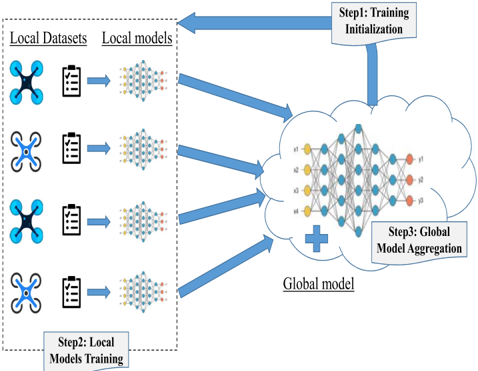
The use of Unmanned Aerial Vehicles (UAVs) for wireless networks is rapidly growing as key enablers of new applications, including: surveillance and monitoring, military, delivery of medical supplies, telecommunications, etc. In particular, due to their unique proprieties such as flexibility, mobility, and adaptive altitude, UAVs can act as mobile base stations to improve capacity, coverage, and energy efficiency of wireless networks. On the other hand, UAVs can operate as mobile terminals to enable many applications such as item delivery and real-time video streaming. In such context, data-driven Deep Learning-assisted (DL) approaches are gaining a growing interest to not only exploit the huge amount of generated data, but also to optimize the network operations, and hence ensure the QoS requirements of these emerging wireless networks. However, UAVs are resource-constrained devices especially in terms of computing and power resources, and traditional DL-assisted schemes are cloud-centric, which require UAVs' data to be sent and stored in a centralized server. This represents a critical issue since it generates a huge network communication overhead to send raw data towards the centralized entity, and hence may lead to network bandwidth and energy inefficiency of UAV devices. In addition, the transferred data may contain personnel data such as UAVs' localization and identity, which can directly affect UAVs' privacy concerns. As a solution, Federated Deep Learning (FDL), or distributed DL, was introduced, where the basic idea is to keep raw data where it is generated, while sending only users' local trained DL models to the centralized entity for aggregation. Due to its privacy-preserving and low communication overhead and latency, FDL is much more adequate for many UAVs-enabled wireless applications. In this work, we provide a general introduction of FDL application for UAV-enabled wireless networks. We first introduce the FDL concept and its fundamentals. Then, we highlight the possible applications of FDL in UAVs-enabled wireless networks by addressing the suitability and how to use FDL to deal with target challenges. Finally, we discuss about key technical challenges, open issues, and future research directions on FDL-based approaches in such context.
Overview
The claims and statistics of this paper haven’t been checked yet.
Free: it reads the open-access text and checks the first 5 claims that cite a source we can check. Create a free account to check every claim.
Integrity signals
Registry
Cites
Statistics
Figures


Verification
Claims the paper makes
The claims and statistics of this paper haven’t been checked yet.
Free: it reads the open-access text and checks the first 5 claims that cite a source we can check. Create a free account to check every claim.
Claims other papers make about this one
Each is checked against this paper’s own text: does it say what the citing paper says it does?
The cited source says what the claim attributes to it.
In the citing paper
“The ability of federated learning to avoid the sending of raw data off-device (just local model updates need to be sent), results in not only privacy advantages but also reduces latency and network overhead [62].”
From A Survey on the Convergence of Edge Computing and AI for UAVs: Opportunities and Challenges (2022) · cites this paper as [62]
Self-check
Percentages, sums and reported differences re-computed from the paper’s own numbers.
The self-check needs the paper’s full text.
Citations
Cites
Human-level control through deep reinforcement learning
Mnih, V., Kavukcuoglu, K., Silver, D., Rusu, A. A., Veness, J., Bellemare, M. G., Graves, A., Riedmiller, M., Fidjeland, A. K., Ostrovski, G., et al. (2015) · Nature · doi:10.1038/nature14236 · Cited by 30,357
Communication-Efficient Learning of Deep Networks from Decentralized Data
McMahan, H. B., Moore, E., Ramage, D., Hampson, S., & Arcas, B. A. Y. (2016) · arXiv · doi:10.48550/arxiv.1602.05629 · Cited by 14,215
Convolutional LSTM Network: A Machine Learning Approach for Precipitation Nowcasting
Shi, X., Chen, Z., Wang, H., Yeung, D.-Y., Wong, W.-K., & Woo, W.-C. (2015) · arXiv · doi:10.48550/arxiv.1506.04214 · Cited by 7,709 · cited 2×
“Indeed, CNN with LSTM can extract the relationship between spatiotemporal features of UAVs mobility [24].”
MethodLearning to forget: Continual prediction with LSTM
Gers, F. A., Schmidhuber, J., & Cummins, F. (2000) · Neural Computation · doi:10.1162/089976600300015015 · Cited by 4,823
Next generation 5G wireless networks: a comprehensive survey
Agiwal, M., Roy, A., & Saxena, N. (2016) · IEEE Communications Surveys & Tutorials · doi:10.1109/comst.2016.2532458 · Cited by 3,444 · cited 1×
“Besides the need of high data rates – which has been the main requirement of conventional wireless networks in the last decade – UAVs-based wireless networks have to deliver low-latency and ultra-reliable services to cope with the dynamics of end users [4], [5].”
BackgroundFederated Learning in Mobile Edge Networks: A Comprehensive Survey
Lim, W. Y. B., Luong, N. C., Hoang, D. T., Jiao, Y., Liang, Y.-C., Yang, Q., Niyato, D., & Miao, C. (2020) · IEEE Communications Surveys & Tutorials · doi:10.1109/comst.2020.2986024 · Cited by 2,565 · cited 3×
“The authors in [13] extend the original FDL work [10], [11] and discuss about its use cases in cellular 5G architecture, while the authors in [14] focus on the mobile edge networks, aiming at bringing the intelligence, learning models, closer to the edge where data is generated.”
BackgroundLearning to forget: continual prediction with LSTM
Gers, F. A. (1999) · 9th International Conference on Artificial Neural Networks: ICANN '99 · doi:10.1049/cp:19991218 · Cited by 2,337
Towards Federated Learning at Scale: System Design
Bonawitz, K., Eichner, H., Grieskamp, W., Huba, D., Ingerman, A., Ivanov, V., Kiddon, C., Konečný, J., Mazzocchi, S., McMahan, H. B., et al. (2019) · arXiv · doi:10.48550/arxiv.1902.01046 · Cited by 2,334
Adaptive Federated Learning in Resource Constrained Edge Computing Systems
Wang, S., Tuor, T., Salonidis, T., Leung, K. K., Makaya, C., He, T., & Chan, K. (2019) · IEEE Journal on Selected Areas in Communications · doi:10.1109/jsac.2019.2904348 · Cited by 2,232
Artificial Neural Networks-Based Machine Learning for Wireless Networks: A Tutorial
Chen, M., Challita, U., Saad, W., Yin, C., & Debbah, M. (2019) · IEEE Communications Surveys & Tutorials · doi:10.1109/comst.2019.2926625 · Cited by 1,117
Research works printed but not linked: 4
- 6. M. Mozaffari, W. Saad, M. Bennis, and M. Debbah, ''Communications and control for wireless drone-based antenna array,'' IEEE Trans. Commun., vol. 67, no. 1, pp. 820-834, Jan. 2019. · DOI
- 5. Study on Latency Reduction Techniques for LTE, document TR 36.881, 3GPP, 2016.
- 1. The Future of IoT Miniguide: The Burgeoning IoT Market Contin- ues. Accessed: Nov. 25, 2019 [Online]. Available: https://www.cisco. com/c/en/us/solutions/internet-of-things/future-of-iot.html
- 20. Enhanced LTE Support for Aerial Vehicles, document TR 36.777, 3GPP, May 2017.
Cited by
Federated Learning for Internet of Things: A Comprehensive Survey
Nguyen, D. C., Ding, M., Pathirana, P. N., Seneviratne, A., Li, J., & Vincent Poor, H. (2021) · IEEE Communications Surveys & Tutorials · doi:10.1109/comst.2021.3075439 · Cited by 1,503
“[24] FL and UAVs A brief survey on the application of FL in UAVs networks.”
BackgroundMethodFederated Learning: A Survey on Enabling Technologies, Protocols, and Applications
Aledhari, M., Razzak, R., Parizi, R. M., & Saeed, F. (2020) · IEEE Access · doi:10.1109/access.2020.3013541 · Cited by 733
Wu, Q., Xu, J., Zeng, Y., Ng, D. W. K., Al-Dhahir, N., Schober, R., & Swindlehurst, A. L. (2021) · IEEE Journal on Selected Areas in Communications · doi:10.1109/jsac.2021.3088681 · Cited by 562
Federated learning review: Fundamentals, enabling technologies, and future applications
Banabilah, S., Aloqaily, M., Alsayed, E., Malik, N., & Jararweh, Y. (2022) · Information Processing & Management · doi:10.1016/j.ipm.2022.103061 · Cited by 556
A Survey on the Convergence of Edge Computing and AI for UAVs: Opportunities and Challenges
McEnroe, P., Wang, S., & Liyanage, M. (2022) · IEEE Internet of Things Journal · doi:10.1109/jiot.2022.3176400 · Cited by 482
Aerial imagery pile burn detection using deep learning: The FLAME dataset
Shamsoshoara, A., Afghah, F., Razi, A., Zheng, L., Fulé, P. Z., & Blasch, E. (2021) · Computer Networks · doi:10.1016/j.comnet.2021.108001 · Cited by 406
Federated Learning for Vehicular Internet of Things: Recent Advances and Open Issues
Du, Z., Wu, C., Yoshinaga, T., Yau, K.-L. A., Ji, Y., & Li, J. (2020) · IEEE Open Journal of the Computer Society · doi:10.1109/ojcs.2020.2992630 · Cited by 393
“BRIK et al. [109] A discussion on possible applications of FL for UAVs.”
BackgroundFederated Learning in Edge Computing: A Systematic Survey
Abreha, H. G., Hayajneh, M., & Serhani, M. A. (2022) · Sensors · doi:10.3390/s22020450 · Cited by 342
Yang, H., Zhao, J., Xiong, Z., Lam, K.-Y., Sun, S., & Xiao, L. (2021) · IEEE Journal on Selected Areas in Communications · doi:10.1109/jsac.2021.3088655 · Cited by 306
Federated learning for smart cities: A comprehensive survey
Pandya, S., Srivastava, G., Jhaveri, R., Babu, M. R., Bhattacharya, S., Maddikunta, P. K. R., Mastorakis, S., Piran, M. J., & Gadekallu, T. R. (2023) · Sustainable Energy Technologies and Assessments · doi:10.1016/j.seta.2022.102987 · Cited by 297
Unmanned aerial vehicles: A review
Laghari, A. A., Jumani, A. K., Laghari, R. A., & Nawaz, H. (2023) · Cognitive Robotics · doi:10.1016/j.cogr.2022.12.004 · Cited by 261
Zhou, X., Liang, W., She, J., Yan, Z., & Wang, K. (2021) · IEEE Transactions on Vehicular Technology · doi:10.1109/tvt.2021.3077893 · Cited by 307
Space-Air-Ground Integrated Wireless Networks for 6G: Basics, Key Technologies, and Future Trends
Xiao, Y., Ye, Z., Wu, M., Li, H., Xiao, M., Alouini, M.-S., Al-Hourani, A., & Cioni, S. (2024) · IEEE Journal on Selected Areas in Communications · doi:10.1109/jsac.2024.3492720 · Cited by 216
Applications of federated learning in smart cities: recent advances, taxonomy, and open challenges
Zheng, Z., Zhou, Y., Sun, Y., Wang, Z., Liu, B., & Li, K. (2022) · Connection Science · doi:10.1080/09540091.2021.1936455 · Cited by 206
Banafaa, M. K., Pepeoğlu, Ö., Shayea, I., Alhammadi, A., Shamsan, Z. A., Razaz, M. A., Alsagabi, M., & Al-Sowayan, S. (2024) · IEEE Access · doi:10.1109/access.2023.3349208 · Cited by 186
Federated Learning: A signal processing perspective
Gafni, T., Shlezinger, N., Cohen, K., Eldar, Y. C., & Poor, H. V. (2022) · IEEE Signal Processing Magazine · doi:10.1109/msp.2021.3125282 · Cited by 176
Dynamic Digital Twin and Federated Learning With Incentives for Air-Ground Networks
Sun, W., Xu, N., Wang, L., Zhang, H., & Zhang, Y. (2022) · IEEE Transactions on Network Science and Engineering · doi:10.1109/tnse.2020.3048137 · Cited by 173
Large Language Models for UAVs: Current State and Pathways to the Future
Javaid, S., Fahim, H., He, B., & Saeed, N. (2024) · IEEE Open Journal of Vehicular Technology · doi:10.1109/ojvt.2024.3446799 · Cited by 208
Handling privacy-sensitive medical data with federated learning: Challenges and future directions
Aouedi, O., Sacco, A., Piamrat, K., & Marchetto, G. (2023) · IEEE Journal of Biomedical and Health Informatics · doi:10.1109/jbhi.2022.3185673 · Cited by 165
“Moreover, Brik et al. [24] present the integration of FL and Unmanned Aerial Vehicles (UAVs)- enabled wireless networks.”
BackgroundDecentralized Federated Learning for UAV Networks: Architecture, Challenges, and Opportunities
Qu, Y., Dai, H., Zhuang, Y., Chen, J., Dong, C., Wu, F., & Guo, S. (2021) · IEEE Network · doi:10.1109/mnet.001.2100253 · Cited by 135
Wireless Distributed Learning: A New Hybrid Split and Federated Learning Approach
Liu, X., Deng, Y., & Mahmoodi, T. (2022) · IEEE Transactions on Wireless Communications · doi:10.1109/twc.2022.3213411 · Cited by 169
Deep Learning for B5G Open Radio Access Network: Evolution, Survey, Case Studies, and Challenges
Brik, B., Boutiba, K., & Ksentini, A. (2022) · IEEE Open Journal of the Communications Society · doi:10.1109/ojcoms.2022.3146618 · Cited by 168
Self-citationLevel-5 Autonomous Driving—Are We There Yet? A Review of Research Literature
Khan, M. A., Sayed, H. E., Malik, S., Zia, T., Khan, J., Alkaabi, N., & Ignatious, H. A. (2022) · ACM Computing Surveys · doi:10.1145/3485767 · Cited by 172
Drones’ Edge Intelligence Over Smart Environments in B5G: Blockchain and Federated Learning Synergy
Alsamhi, S. H., Almalki, F. A., Afghah, F., Hawbani, A., Shvetsov, A. V., Lee, B., & Song, H. (2022) · IEEE Transactions on Green Communications and Networking · doi:10.1109/tgcn.2021.3132561 · Cited by 139
Houda, Z. A. E., Hafid, A. S., & Khoukhi, L. (2023) · IEEE Transactions on Network Science and Engineering · doi:10.1109/tnse.2023.3237367 · Cited by 128
Alsamhi, S. H., Shvetsov, A. V., Kumar, S., Hassan, J. A., Alhartomi, M. A., Shvetsova, S. V., Sahal, R., & Hawbani, A. (2022) · Drones · doi:10.3390/drones6070177 · Cited by 149
Lee, J., Solat, F., Kim, T. Y., & Poor, H. V. (2024) · IEEE Communications Surveys & Tutorials · doi:10.1109/comst.2024.3352910 · Cited by 155
Distributed Machine Learning for UAV Swarms: Computing, Sensing, and Semantics
Ding, Y., Yang, Z., Pham, Q., Hu, Y., Zhang, Z., & Shikh‐Bahaei, M. (2023) · IEEE Internet of Things Journal · doi:10.1109/jiot.2023.3341307 · Cited by 146
Saraswat, D., Verma, A., Bhattacharya, P., Tanwar, S., Sharma, G., Bokoro, P. N., & Sharma, R. (2022) · IEEE Access · doi:10.1109/access.2022.3161132 · Cited by 127
Houda, Z. A. E., Moudoud, H., Brik, B., & Khoukhi, L. (2024) · IEEE Transactions on Intelligent Transportation Systems · doi:10.1109/tits.2024.3351699 · Cited by 122
Self-citationMachine Learning for Security in Vehicular Networks: A Comprehensive Survey
Talpur, A., & Gurusamy, M. (2022) · IEEE Communications Surveys & Tutorials · doi:10.1109/comst.2021.3129079 · Cited by 107
“FL is a recent learning strategy for collaborative training of a series of learning models to reduce communication and processing overhead [130].”
BackgroundFederated learning for 6G-enabled secure communication systems: a comprehensive survey
Sirohi, D., Kumar, N., Rana, P. S., Tanwar, S., Iqbal, R., & Hijji, M. (2023) · Artificial Intelligence Review · doi:10.1007/s10462-023-10417-3 · Cited by 118
AI-Enabled UAV Communications: Challenges and Future Directions
Hashesh, A. O., Hashima, S., Zaki, R. M., Fouda, M. M., Hatano, K., & Eldien, A. S. T. (2022) · IEEE Access · doi:10.1109/access.2022.3202956 · Cited by 103
Adil, M., Song, H., Mastorakis, S., Abulkasim, H., Farouk, A., & Jin, Z. (2023) · IEEE Transactions on Intelligent Vehicles · doi:10.1109/tiv.2023.3309548 · Cited by 114
Adil, M., Jan, M. A., Liu, Y., Abulkasim, H., Farouk, A., & Song, H. (2022) · IEEE Transactions on Intelligent Transportation Systems · doi:10.1109/tits.2022.3220043 · Cited by 122
Split Federated Learning for 6G Enabled-Networks: Requirements, Challenges, and Future Directions
Hafi, H., Brik, B., Frangoudis, P. A., Ksentini, A., & Bagaa, M. (2024) · IEEE Access · doi:10.1109/access.2024.3351600 · Cited by 90
“In this section, we give an overview of the main collaborative deep learning schemes, ranging from federated learning, to the recent split learning and SplitFed learning paradigms. own data [50], [51].”
Self-citationVinh, Q., Pham, Q., & Hwang, W. (2021) · IEEE Communications Letters · doi:10.1109/lcomm.2021.3122129 · Cited by 95
Joint Training and Resource Allocation Optimization for Federated Learning in UAV Swarm
Shen, Y. C., Qu, Y., Dong, C., Zhou, F., & Wu, Q. (2022) · IEEE Internet of Things Journal · doi:10.1109/jiot.2022.3152829 · Cited by 93
Federated learning for big data: A survey on opportunities, applications, and future directions
Gadekallu, T. R., Pham, Q., Huynh‐The, T., Feng, H., Fang, K., Pandya, S., Liyanage, M., Wang, W. W., & Nguyen, T. T. (2025) · Engineering Applications of Artificial Intelligence · doi:10.1016/j.engappai.2025.113614 · Cited by 94
Blika, A., Palmos, S., Doukas, G. S., Lamprou, V., Pelekis, S., Kontoulis, M., Ntanos, C., & Askounis, D. (2024) · IEEE Open Journal of the Communications Society · doi:10.1109/ojcoms.2024.3449563 · Cited by 116
When Collaborative Federated Learning Meets Blockchain to Preserve Privacy in Healthcare
Houda, Z. A. E., Hafid, A. S., Khoukhi, L., & Brik, B. (2022) · IEEE Transactions on Network Science and Engineering · doi:10.1109/tnse.2022.3211192 · Cited by 93
Self-citationA Multi-Agent Collaborative Environment Learning Method for UAV Deployment and Resource Allocation
Dai, Z., Zhang, Y., Zhang, W., Luo, X., & He, Z. (2022) · IEEE Transactions on Signal and Information Processing over Networks · doi:10.1109/tsipn.2022.3150911 · Cited by 92
A Review of Indoor Positioning Systems for UAV Localization with Machine Learning Algorithms
Sandamini, C., Maduranga, M. W. P., Tilwari, V., Yahaya, J. B., Qamar, F., Nguyễn, Q. N., & Ibrahim, S. R. A. (2023) · Electronics · doi:10.3390/electronics12071533 · Cited by 82
Abir, M. A. B. S., Chowdhury, M. Z., & Jang, Y. M. (2023) · IEEE Open Journal of the Communications Society · doi:10.1109/ojcoms.2023.3323200 · Cited by 85
Bao, W., Wu, C., Guleng, S., Zhang, J., Yau, K.-L. A., & Ji, Y. (2021) · China Communications · doi:10.23919/jcc.2021.06.004 · Cited by 71
Papadopoulos, G. T., Antona, M., & Stephanidis, C. (2021) · IEEE Access · doi:10.1109/access.2021.3080517 · Cited by 75
Exploring privacy mechanisms and metrics in federated learning
Shenoy, D., Bhat, R., & Prakash, K. (2025) · Artificial Intelligence Review · doi:10.1007/s10462-025-11170-5 · Cited by 82
Federated Learning for Cyber Physical Systems: A Comprehensive Survey
Quan, M. K., Pathirana, P. N., Wijayasundara, M., Setunge, S., Nguyen, D. C., Brinton, C. G., Love, D. J., & Poor, H. V. (2025) · IEEE Communications Surveys & Tutorials · doi:10.1109/comst.2025.3570288 · Cited by 97
Dynamic Online Trajectory Planning for a UAV-Enabled Data Collection System
Li, S., Wu, F., Luo, S., Fan, Z., Chen, J., & Fu, S. (2022) · IEEE Transactions on Vehicular Technology · doi:10.1109/tvt.2022.3200458 · Cited by 64
Network Slicing-Based Learning Techniques for IoV in 5G and Beyond Networks
Hamdi, W., Ksouri, C., Bulut, H., & Mosbah, M. (2024) · IEEE Communications Surveys & Tutorials · doi:10.1109/comst.2024.3372083 · Cited by 63
Reinforcement Learning in the Sky: A Survey on Enabling Intelligence in NTN-Based Communications
Naous, T., Itani, M., Awad, M., & Sharafeddine, S. (2023) · IEEE Access · doi:10.1109/access.2023.3236801 · Cited by 71
Empowering Edge Intelligence by Air-Ground Integrated Federated Learning
Qu, Y., Dong, C., Zheng, J., Dai, H., Wu, F., Guo, S., & Anpalagan, A. (2021) · IEEE Network · doi:10.1109/mnet.111.2100044 · Cited by 62
An IoT-based deep learning approach to analyse indoor thermal comfort of disabled people
Brik, B., Esseghir, M., Merghem, L., & Snoussi, H. (2021) · Building and Environment · doi:10.1016/j.buildenv.2021.108056 · Cited by 62
Self-citationBlockchain-Enabled Federated Learning for UAV Edge Computing Network: Issues and Solutions
Zhu, C., Zhu, X., Ren, J., & Qin, T. (2022) · IEEE Access · doi:10.1109/access.2022.3174865 · Cited by 59
A novel federated learning-based IDS for enhancing UAVs privacy and security
Ceviz, Ö., Sadioglu, P., Şen, S., & Vassilakis, V. G. (2025) · Internet of Things · doi:10.1016/j.iot.2025.101592 · Cited by 68
Kaleem, Z., Orakzai, F. A., Ishaq, W., Latif, K., Zhao, J., & Jamalipour, A. (2024) · IEEE Transactions on Consumer Electronics · doi:10.1109/tce.2024.3434971 · Cited by 76
Blockchain-Federated-Learning and Deep Learning Models for COVID-19 Detection Using CT Imaging
Kumar, R., Khan, A. A., Kumar, J., Zakria, Golilarz, N. A., Zhang, S., Ting, Y., Zheng, C., & Wang, W. (2021) · IEEE Sensors Journal · doi:10.1109/jsen.2021.3076767 · Cited by 57
“In this context, federated learning is used to secure data and aggregates the parameters for the multiple organizations[65], [66], [67], [68], [69].”
MethodWireless for Machine Learning: A Survey
Hellström, H., da Silva, J. M. B., Amiri, M. M., Chen, M., Fodor, V., Poor, H. V., & Fischione, C. (2022) · doi:10.1561/9781638280071 · Cited by 57
Baker, T., Asim, M., Samwini, H., Shamim, N., Alani, M. M., & Buyya, R. (2021) · Computer Networks · doi:10.1016/j.comnet.2021.108676 · Cited by 62
Security and Privacy Issues and Solutions for UAVs in B5G Networks: A Review
Khan, M. A., Kumar, N., Alsamhi, S. H., Barb, G., Żywiołek, J., Ullah, I., Noor, F., Shah, J. A., & Almuhaideb, A. M. (2024) · IEEE Transactions on Network and Service Management · doi:10.1109/tnsm.2024.3487265 · Cited by 66
Shvetsov, A. V., Alsamhi, S. H., Hawbani, A., Kumar, S., Srivastava, S., Agarwal, S., Rajput, N. S., Alammari, A. A., & Nashwan, F. (2023) · IEEE Access · doi:10.1109/access.2023.3323399 · Cited by 58
5G Experimentation for Public Safety: Technologies, Facilities and Use Cases
Volk, M., & Sterle, J. (2021) · IEEE Access · doi:10.1109/access.2021.3064405 · Cited by 55
Pasandideh, F., da Costa, J. P. C. L., Kunst, R., Hardjawana, W., & de Freitas, E. P. (2023) · Journal of Field Robotics · doi:10.1002/rob.22157 · Cited by 57
SemiPFL: Personalized Semi-Supervised Federated Learning Framework for Edge Intelligence
Tashakori, A., Zhang, W., Wang, Z. J., & Servati, P. (2023) · IEEE Internet of Things Journal · doi:10.1109/jiot.2022.3233599 · Cited by 60
Wu, Y., Ma, Y., Dai, H., & Wang, H. H. (2020) · Computer Networks · doi:10.1016/j.comnet.2020.107743 · Cited by 51
Federated learning meets remote sensing
Moreno‐Álvarez, S., Paoletti, M. E., Sanchez‐Fernandez, A. J., Rico‐Gallego, J., Han, L., & Haut, J. M. (2024) · Expert Systems with Applications · doi:10.1016/j.eswa.2024.124583 · Cited by 60
Hierarchical Federated Learning for Edge-Aided Unmanned Aerial Vehicle Networks
Tursunboev, J., Kang, Y.-S., Huh, S.-B., Lim, D.-W., Kang, J., & Jung, H. (2022) · Applied Sciences · doi:10.3390/app12020670 · Cited by 49
Toward Smart Traffic Management With 3D Placement Optimization in UAV-Assisted NOMA IIoT Networks
Adam, A. B. M., Muthanna, M. S. A., Muthanna, A., Nguyen, T. N., & El‐Latif, A. A. A. (2022) · IEEE Transactions on Intelligent Transportation Systems · doi:10.1109/tits.2022.3182651 · Cited by 48
Federated Learning with Differential Privacy for Resilient Vehicular Cyber Physical Systems
Olowononi, F. O., Rawat, D. B., & Liu, C. (2021) · 2021 IEEE 18th Annual Consumer Communications & Networking Conference (CCNC) · doi:10.1109/ccnc49032.2021.9369480 · Cited by 47
AI-Inspired Non-Terrestrial Networks for IIoT: Review on Enabling Technologies and Applications
Michailidis, E. T., Potirakis, S. M., & Kanatas, Α. G. (2020) · IoT · doi:10.3390/iot1010003 · Cited by 54
A Comprehensive Survey on Federated Learning: Concept and Applications
Mahlool, D. H., & Alsalihi, M. H. (2022) · Lecture notes on data engineering and communications technologies · doi:10.1007/978-981-19-2069-1_37 · Cited by 57
On Predicting Service-oriented Network Slices Performances in 5G: A Federated Learning Approach
Brik, B., & Ksentini, A. (2020) · Conference on Local Computer Networks · doi:10.1109/lcn48667.2020.9314849 · Cited by 56
Self-citationFederated Learning for Human Activity Recognition: Overview, Advances, and Challenges
Aouedi, O., Sacco, A., Khan, L. U., Nguyen, D. C., & Guizani, M. (2024) · IEEE Open Journal of the Communications Society · doi:10.1109/ojcoms.2024.3484228 · Cited by 55
Privacy and Security Challenges in Federated Learning for UAV Systems: A Systematic Review
Farsi, A. A., Khan, A., Mughal, M. R., & Bait‐Suwailam, M. M. (2025) · IEEE Access · doi:10.1109/access.2025.3570538 · Cited by 49
UAV Communications with Machine Learning: Challenges, Applications and Open Issues
Aissa, S. B., & Letaïfa, A. B. (2021) · Arabian Journal for Science and Engineering · doi:10.1007/s13369-021-05932-w · Cited by 46
Hammedi, W., Brik, B., & Senouci, S. (2022) · IEEE Transactions on Intelligent Transportation Systems · doi:10.1109/tits.2022.3154158 · Cited by 45
Self-citationFederated learning-based UAVs for the diagnosis of Plant Diseases
Khan, F. S., Khan, S., Mohd, M. N. H., Waseem, A., Khan, M. N., Ali, S., & Ahmed, R. (2022) · International Conference on Engineering and Emerging Technologies (ICEET) · doi:10.1109/iceet56468.2022.10007133 · Cited by 44
Energy Efficient User Scheduling for Hybrid Split and Federated Learning in Wireless UAV Networks
Liu, X., Deng, Y., & Mahmoodi, T. (2022) · International Conference on Communications · doi:10.1109/icc45855.2022.9882277 · Cited by 45
Yuan, J., Peng, J., Yan, Q. W., He, G., Xiang, H., & Liu, Z. (2024) · Sensors · doi:10.3390/s24051632 · Cited by 40
A Waveform Parameter Assignment Framework for 6G With the Role of Machine Learning
Yazar, A., & Arslan, H. (2020) · IEEE Open Journal of Vehicular Technology · doi:10.1109/ojvt.2020.2992502 · Cited by 43
Mutalemwa, L. C., & Shin, S. (2020) · IEEE Access · doi:10.1109/access.2020.3037357 · Cited by 41
A Privacy-Preserving Collaborative Jamming Attacks Detection Framework Using Federated Learning
Houda, Z. A. E., Naboulsi, D., & Kaddoum, G. (2023) · IEEE Internet of Things Journal · doi:10.1109/jiot.2023.3333870 · Cited by 43
Al-lahham, A., Zaheer, M. Z., Tastan, N., & Nandakumar, K. (2024) · IEEE Computer Society Conference on Computer Vision and Pattern Recognition/Proceedings - IEEE Computer Society Conference on Computer Vision and Pattern Recognition/Proceedings · doi:10.1109/cvpr52733.2024.01180 · Cited by 54
Cui, Z., Yang, T., Wu, X., Feng, H., & Hu, B. (2023) · IEEE Transactions on Mobile Computing · doi:10.1109/tmc.2023.3331906 · Cited by 42
Federated Learning and Proactive Computation Reuse at the Edge of Smart Homes
Nour, B., Cherkaoui, S., & Mlika, Z. (2021) · IEEE Transactions on Network Science and Engineering · doi:10.1109/tnse.2021.3131246 · Cited by 42
A journey towards fully autonomous driving - fueled by a smart communication system
Khan, M. A., Sayed, H. E., Malik, S., Zia, M. T., Alkaabi, N., & Khan, J. (2022) · Vehicular Communications · doi:10.1016/j.vehcom.2022.100476 · Cited by 42
Mahbub, M., Saym, M. M., Jahan, S., Paul, A. K., Vahid, A., Hosseinalipour, S., Barua, B., Yeh, H., Shubair, R. M., & Taleb, T. (2025) · Journal of Network and Computer Applications · doi:10.1016/j.jnca.2025.104131 · Cited by 41
Survey on Federated Learning enabling indoor navigation for industry 4.0 in B5G
Alsamhi, S. H., Shvetsov, A. V., Hawbani, A., Shvetsov, A. V., Kumar, S., & Zhao, L. (2023) · Future Generation Computer Systems · doi:10.1016/j.future.2023.06.001 · Cited by 39
Tripathy, S. S., Bebortta, S., & Gadekallu, T. R. (2023) · IEEE Transactions on Consumer Electronics · doi:10.1109/tce.2023.3332454 · Cited by 36
AI/ML for beyond 5G systems: Concepts, technology enablers & solutions
Taleb, T., Benzaïd, C., Addad, R. A., & Samdanis, K. (2023) · Computer Networks · doi:10.1016/j.comnet.2023.110044 · Cited by 46
Ensemble Learning for Intrusion Detection in SDN-Based Zero Touch Smart Grid Systems
Houda, Z. A. E., Brik, B., & Khoukhi, L. (2022) · Conference on Local Computer Networks · doi:10.1109/lcn53696.2022.9843645 · Cited by 42
Self-citationFederated Learning Over-the-Air by Retransmissions
Hellström, H., Fodor, V., & Fischione, C. (2023) · IEEE Transactions on Wireless Communications · doi:10.1109/twc.2023.3268742 · Cited by 38
Kapoor, A., & Kumar, D. (2024) · IEEE Communications Surveys & Tutorials · doi:10.1109/comst.2024.3434510 · Cited by 39
Federated Reinforcement Learning‐Based UAV Swarm System for Aerial Remote Sensing
Lee, W. (2022) · Wireless Communications and Mobile Computing · doi:10.1155/2022/4327380 · Cited by 39
A Survey on Energy-Efficient Design for Federated Learning over Wireless Networks
Dang, X.-T., Vu, B., Nguyen, Q.-S., Tran, T.-D., Eom, J.-S., & Shin, O. (2024) · Energies · doi:10.3390/en17246485 · Cited by 36
Brik, B., Messaadia, M., Sahnoun, M., Bettayeb, B., & Benatia, M. A. (2022) · ACM Transactions on Cyber-Physical Systems · doi:10.1145/3477272 · Cited by 33
Self-citationEnhancing Federated Learning With Spectrum Allocation Optimization and Device Selection
Zhang, T., Lam, K., Zhao, J., Li, F., Han, H., & Jamil, N. (2023) · IEEE/ACM Transactions on Networking · doi:10.1109/tnet.2022.3231986 · Cited by 36
Rahbari, D., Alam, M. M., Moullec, Y. L., & Jenihhin, M. (2021) · IEEE Access · doi:10.1109/access.2021.3104117 · Cited by 32
Zhu, C., Xiao, Z., & Qin, T. (2024) · Sensors · doi:10.3390/s24051364 · Cited by 32
Radio Link Failure Prediction in 5G Networks
Boutiba, K., Bagaa, M., & Ksentini, A. (2021) · Globecom · doi:10.1109/globecom46510.2021.9685587 · Cited by 28
Self-citation
Metadata
- Authors
- Brik, B., Ksentini, A., & Bouaziz, M.
- Affiliations
- EURECOM (FR)
- Venue
- IEEE Access
- Published
- 2020
- Volume
- 8
- Pages
- 53841-53849
- ISSN
- 2169-3536 (ISSN-L)
- OpenAlex
- W3011766871
- Cited by
- 258
- References
- 25
- Citations by year
- 2026: 21 · 2025: 37 · 2024: 51 · 2023: 47 · 2022: 55 · 2021: 35 · 2020: 12
- FWCI
- 22.38
- Type
- journal article
- Language
- en
- Open access
- gold
- doi.org
- Locations
- IEEE Access (publishedVersion, cc-by)
- DOAJ (DOAJ: Directory of Open Access Journals) (submittedVersion, cc-by-sa)
- Funders
- European Union’s H2020 5G!Drones project (857031)
- Topics
- Physical Sciences › Engineering › Aerospace Engineering › UAV Applications and Optimization
- Physical Sciences › Computer Science › Artificial Intelligence › Privacy-Preserving Technologies in Data
- Physical Sciences › Computer Science › Computer Networks and Communications › IoT and Edge/Fog Computing
- Keywords
- federated deep learning, unmanned aerial vehicles, privacy preservation, communication overhead, resource-constrained devices, open problems
About these checks
Registry, retraction, Cites and statistics results are computed, not judged, with one exception: a printed reference that no index lists is read once by a model before it counts as a citation error. Claims are extracted by a model and kept only when their quote appears verbatim in the text; each cited source is then checked, with a model’s help, for whether it says what the claim relies on. Those verdicts can be wrong — read the claim’s quote and the cited source before relying on one.
Statistics and arithmetic are recomputed, not judged.
Confidence bands are shown only for fields calibrated on our annotated test set. None is calibrated yet, so no band is shown.
What counts as a claim ›How we measure confidence ›How we check this ›
Are you an author, or do you see a problem with this page? Request a review
Data sources
Bibliographic data: Semantic Scholar, OpenAlex, Crossref.
Contains information from the Semantic Scholar Academic Graph Datasets, made available under the ODC Attribution License (ODC-BY 1.0).
Semantic Scholar’s data is described in: Kinney, R., et al. (2023). The Semantic Scholar Open Data Platform. arXiv:2301.10140.
