

Classification of Remote Sensing Images Using EfficientNet-B3 CNN Model With Attention
Open accessThe DOI matches its Crossref record; 89 of the 89 references it cites were found in a registry or an index.
Abstract
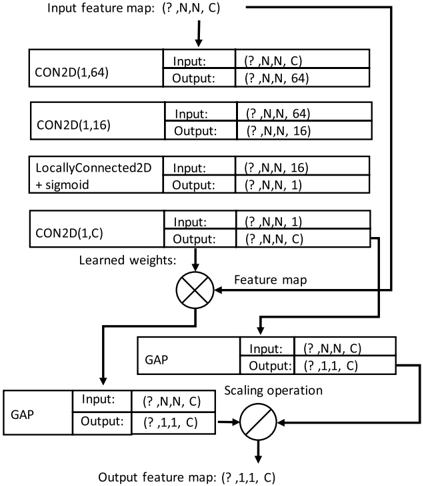
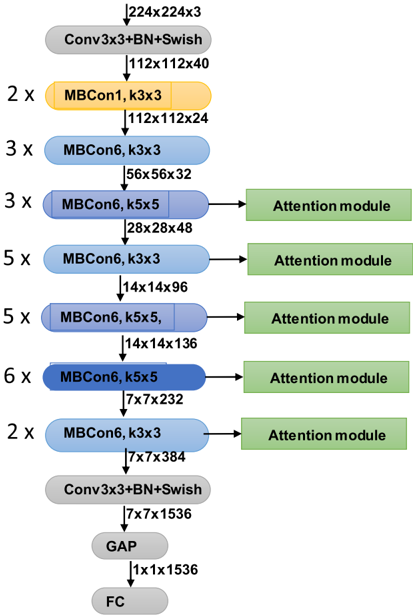
Scene classification is a highly useful task in Remote Sensing (RS) applications. Many efforts have been made to improve the accuracy of RS scene classification. Scene classification is a challenging problem, especially for large datasets with tens of thousands of images with a large number of classes and taken under different circumstances. One problem that is observed in scene classification is the fact that for a given scene, only one part of it indicates which class it belongs to, whereas the other parts are either irrelevant or they actually tend to belong to another class. To address this issue, this paper proposes a deep attention Convolutional Neural Network (CNN) for scene classification in remote sensing. CNN models use successive convolutional layers to learn feature maps from larger and larger regions (or receptive fields) of the scene. The attention mechanism computes a new feature map as a weighted average of these original feature maps. In particular, we propose a solution, named EfficientNet-B3-Attn-2, based on the pre-trained EfficientNet-B3 CNN enhanced with an attention mechanism. A dedicated branch is added to layer 262 of the network, to compute the required weights. These weights are learned automatically by training the whole CNN model end-to-end using the backpropagation algorithm. In this way, the network learns to emphasize important regions of the scene and suppress the regions that are irrelevant to the classification. We tested the proposed EfficientNet-B3-Attn-2 on six popular remote sensing datasets, namely UC Merced, KSA, OPTIMAL-31, RSSCN7, WHU-RS19, and AID datasets, showing its strong capabilities in classifying RS scenes.
Overview
The claims and statistics of this paper haven’t been checked yet.
Free: it reads the open-access text and checks the first 5 claims that cite a source we can check. Create a free account to check every claim.
Integrity signals
Registry
Cites
Statistics
Figures











Verification
Claims the paper makes
The claims and statistics of this paper haven’t been checked yet.
Free: it reads the open-access text and checks the first 5 claims that cite a source we can check. Create a free account to check every claim.
Claims other papers make about this one
Each is checked against this paper’s own text: does it say what the citing paper says it does?
The cited source says what the claim attributes to it.
In the citing paper
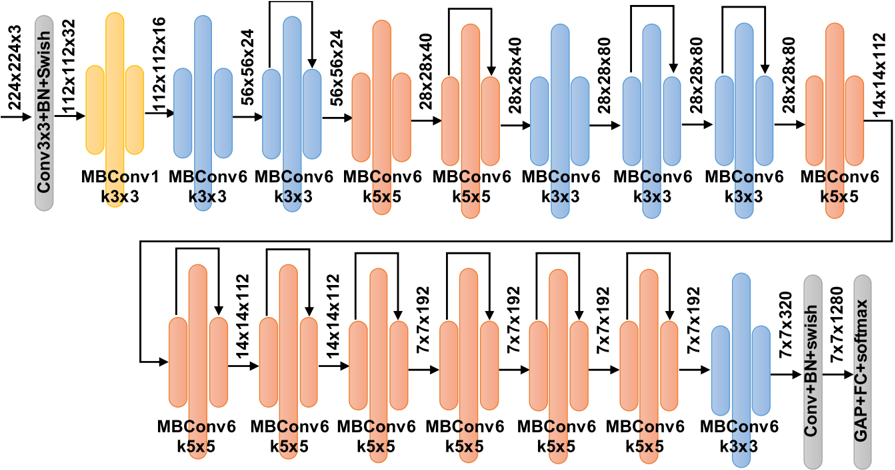
“For the extraction of features, the network uses the Mobile inverted bottleneck convolution (MB Conv) block that uses inverted residual connections28.”
From Image adaptive encryption using EfficientNet B3 feature guided multi scroll chaotic map with modulo controlled pseudo parallel processing (2025) · cites this paper as [28]
Experimental — accuracy not yet measured
Self-check
Percentages, sums and reported differences re-computed from the paper’s own numbers.
The self-check needs the paper’s full text.
Citations
Cites
1 retracted
Zhu, R., Li, Y., Mo, N., & Liu, Y. (2019) · Remote Sensing · doi:10.3390/rs11171996 · Cited by 45
RetractedDeep Residual Learning for Image Recognition
He, K., Zhang, X., Ren, S., & Sun, J. (2016) · 2016 IEEE Conference on Computer Vision and Pattern Recognition (CVPR) · doi:10.1109/cvpr.2016.90 · Cited by 235,474 · cited 1×
“In the original residual blocks defined ResidualNets [53], the skip connections exist between layers with wide number of channels (64 in Fig.”
BackgroundVaswani, A., Shazeer, N., Parmar, N., Uszkoreit, J., Jones, L., Gomez, A. N., Kaiser, L., & Polosukhin, I. (2017) · arXiv · doi:10.48550/arxiv.1706.03762 · Cited by 120,404 · cited 1×
“The attention mechanism (the idea of focusing on spe-cific parts of the input) has been applied in deep learning for speech recognition [30], Natural Language processing [31], multimodal reasoning and matching [32], object detection [33], and image recognition [34]–[36].”
BackgroundImageNet classification with deep convolutional neural networks
Krizhevsky, A., Sutskever, I., & Hinton, G. E. (2017) · Communications of the ACM · doi:10.1145/3065386 · Cited by 112,155 · cited 1×
“Tan and Le [50] show that the EfficientNet CNN models outperform all previous models both in term of the number of parameters and Top-1 accuracy when applied to the ImageNet dataset [51].”
MethodExploiting Generative AI to Scale up Intelligent Tutoring Systems
Jakubův, J., Chvalovský, K., Goertzel, Z., Kaliszyk, C., Olšák, M., Piotrowski, B., Schulz, S., Suda, M., & Urban, J. (2023) · DROPS (Schloss Dagstuhl – Leibniz Center for Informatics) · doi:10.4230/lipics.itp.2023.19 · Cited by 76,658
Squeeze-and-Excitation Networks
Hu, J., Shen, L., & Sun, G. (2018) · 2018 IEEE/CVF Conference on Computer Vision and Pattern Recognition · doi:10.1109/cvpr.2018.00745 · Cited by 35,667
MobileNetV2: Inverted Residuals and Linear Bottlenecks
Sandler, M., Howard, A., Zhu, M., Zhmoginov, A., & Chen, L.-C. (2018) · 2018 IEEE/CVF Conference on Computer Vision and Pattern Recognition · doi:10.1109/cvpr.2018.00474 · Cited by 28,755 · cited 1×
“MBConv is based on concepts borrowed from the MobileNet models [52].”
MethodEfficientNet: Rethinking Model Scaling for Convolutional Neural Networks
Tan, M., & Le, Q. V. (2019) · arXiv · doi:10.48550/arxiv.1905.11946 · Cited by 17,072 · cited 3×
“Recently, Tan and Le [50] studied the relationship between width and depth of CNNmodels and came upwith an efficient way to design CNN models that have less parameters, yet they provide better classification accuracy.”
BackgroundMethodSqueeze-and-Excitation Networks
Hu, J., Shen, L., Albanie, S., Sun, G., & Wu, E. (2020) · IEEE Transactions on Pattern Analysis and Machine Intelligence · doi:10.1109/tpami.2019.2913372 · Cited by 12,157
Review Article Digital change detection techniques using remotely-sensed data
SINGH, A. (1989) · International Journal of Remote Sensing · doi:10.1080/01431168908903939 · Cited by 3,849 · cited 1×
“Recent years have witnessed a rapid development in remote sensing (RS) technologies [1]–[3].”
Background
Research works printed but not linked: 3
- H. Alhichri. KSA Remote Sensing Datasets. Alhichri Research Page. Accessed: Dec. 1, 2020. [Online]. Available: http://alhichri.36bit.com/ksa_ dataset.html
- Z. Chen, S. Wang, X. Hou, and L. Shao, ''Recurrent transformer networks for remote sensing scene categorisation,'' in Proc. Brit. Mach. Vis. Conf., Newcastle upon Tyne, U.K., Sep. 2018.
- M. Castelluccio, G. Poggi, C. Sansone, and L. Verdoliva, ''Land Use classification in remote sensing images by convolutional neural networks,'' ArXiv, vol. abs/1508.00092, p. 12, 2015. · arXiv
Cited by
Items 101–200 of 357
A Leading but Simple Classification Method for Remote Sensing Images
Song, H. (2023) · Annals of Emerging Technologies in Computing · doi:10.33166/aetic.2023.03.001 · Cited by 13
“[14] employed attention maps to guide a pre-trained CNN to learn so-called discriminative representation.”
MethodShi, C., Zhang, X., Sun, J., & Wang, L. (2021) · Remote Sensing · doi:10.3390/rs14010161 · Cited by 15
Ni, H., Zhou, G., Chen, X., Ren, J. L., Yang, M., Zhang, Y., Zhang, Q., Zhang, L., Mao, C., & Li, X. (2023) · Bioengineering · doi:10.3390/bioengineering10070828 · Cited by 13
“Unet is an FCN variant that displays good performance in medical image processing [21].”
BackgroundRecognizing materials in cultural relic images using computer vision and attention mechanism
Pei, H., Zhang, C., Zhang, X., Liu, X., & Ma, Y. (2023) · Expert Systems with Applications · doi:10.1016/j.eswa.2023.122399 · Cited by 16
Computer vision-based hybrid efficient convolution for isolated dynamic sign language recognition
Chowdhury, P. K., Oyshe, K. U., Rahaman, M. A., Debnath, T., Rahman, A., & Kumar, N. (2024) · Neural Computing and Applications · doi:10.1007/s00521-024-10258-3 · Cited by 16
Yang, S., Song, F., Jeon, G., & Sun, R. (2022) · Remote Sensing · doi:10.3390/rs14153709 · Cited by 12
“Eight cutting-edge scene classification techniques are put up against the suggested LSRL approach in this comparison: MDFR (Multi-scale Deep Feature Representation) [21], VGG19 [22], SAFF (Self-attention-based Deep Feature Fusion) [23], EfficientNetB3-Attn2 [24], H-GCN (High-order Graph Convolutional Network) [25], DM…”
MethodNeggaz, I., Neggaz, N., & Fizazi, H. (2022) · Neural Computing and Applications · doi:10.1007/s00521-022-07925-8 · Cited by 13
“Nowadays, deep features based on pre-trained CNNs are widely used in machine learning, particularly in computer vision [1], biomedical application [2, 3] and remote sensing [4, 5].”
BackgroundEnd-to-End Convolutional Neural Network Feature Extraction for Remote Sensed Images Classification
Alem, A., & Kumar, S. (2022) · Applied Artificial Intelligence · doi:10.1080/08839514.2022.2137650 · Cited by 12
“This is a challenging problem in large datasets with many classes and different conditions (Alhichri et al. 2021).”
BackgroundGoing Smaller: Attention-based models for automated melanoma diagnosis
Nazari, S., & García, R. (2024) · Computers in Biology and Medicine · doi:10.1016/j.compbiomed.2024.109492 · Cited by 17
Copper Strip Surface Defect Detection Model Based on Deep Convolutional Neural Network
Xu, Y., Wang, D., Duan, B., Yu, H., & Liu, H. (2021) · Applied Sciences · doi:10.3390/app11198945 · Cited by 11
Bidirectional Flow Decision Tree for Reliable Remote Sensing Image Scene Classification
Feng, J., Wang, D., & Gu, Z. (2022) · Remote Sensing · doi:10.3390/rs14163943 · Cited by 11
Sengan, S., Karn, A. L., Pustokhin, D. A., Pustokhina, I. V., & Alharbi, M. (2022) · Physics and Chemistry of the Earth Parts A/B/C · doi:10.1016/j.pce.2022.103284 · Cited by 11
A hybrid EfficientNet-DbneAlexnet for brain tumor detection using MRI images
Vasavi, G., Rani, V. V., Ponnada, S., & Jyothi, S. (2024) · Computational Biology and Chemistry · doi:10.1016/j.compbiolchem.2024.108279 · Cited by 10
Mekala, S., & Phani Kumar, S. (2025) · Scientific Reports · doi:10.1038/s41598-025-00512-6 · Cited by 11
“Efficient DenseNet is developed by combining EfficientNet 30 and DenseNet 31 .”
Shi, C., Zhang, X., & Wang, L. (2021) · Remote Sensing · doi:10.3390/rs14010009 · Cited by 10
“15% higher than that of EfficientNetB3-Attn-2 [40], and 1.”
BackgroundInfluentialHuman Action Detection using EfficientNetB3 Model
Gill, K. S., Sharma, A., Anand, V., Sharma, K., & Gupta, R. (2023) · International Conference on Computing Methodologies and Communication (ICCMC) · doi:10.1109/iccmc56507.2023.10083926 · Cited by 11
“The EfficientNet as shown in Fig.2. uses a scaling method that evenly scales network breadth, depth, and resolution using a set of preset scaling coefficients, in contrast to typical practice that varies the scaling of these variables [21].”
MethodBio-Inspired Multi-Scale Contourlet Attention Networks
Liu, M., Jiao, L., Liu, X., Li, L., Liu, F., Yang, S., & Zhang, X. (2023) · IEEE Transactions on Multimedia · doi:10.1109/tmm.2023.3304448 · Cited by 16
“Third, the contourlet pooling could help BMCAnet to keep the 1.26%, 0.30% and 0.08% higher than the methods in [49], [91], [102], [103], [104], and [105] respectively.”
MethodInfluentialOptimized Convolutional Forest by Particle Swarm Optimizer for Pothole Detection
Aljohani, A. A. (2024) · International Journal of Computational Intelligence Systems · doi:10.1007/s44196-023-00390-8 · Cited by 12
“Different versions of the CNN model with various sizes and depths are already developed for classification and object detection [34].”
A hybrid CNN–vision transformer structure for remote sensing scene classification
Li, N., Hao, S., & Zhao, K. (2024) · Remote Sensing Letters · doi:10.1080/2150704x.2024.2302348 · Cited by 9
“(Xu, Zhu, and Shu 2020a) 90.23 ± 0.13 93.25 ± 0.12 LiG with Sigmoid Kernel (Xu, Zhu, and Shu 2020b) 90.19 ± 0.11 93.21 ± 0.12 ResNet50 (Li et al. 2020) 81.34 ± 0.32 83.57 ± 0.37 VGG19 (Li et al. 2020) 86.23 ± 0.41 88.93 ± 0.12 InceptionV3 (Li et al. 2020) 85.46 ± 0.33 87.75 ± 0.43 MobileNet (Pan et al. 2020) 80.32 ± 0…”
InfluentialGuo, N., Jiang, M., Wang, D., Zhou, X., Song, Z., Li, Y., Gao, L., & Luo, J. (2024) · International Journal of Digital Earth · doi:10.1080/17538947.2024.2353166 · Cited by 14
“The original features have also been replaced by multiplying the attention coefficients with the features of EfficientNet-B3 (Alhichri et al. 2021).”
Improving remote sensing classification: A deep-learning-assisted model
Davydzenka, T., Tahmasebi, P., & Carroll, M. (2022) · Computers & Geosciences · doi:10.1016/j.cageo.2022.105123 · Cited by 10
Bosco, M. J., Wang, G., & Hategekimana, Y. (2021) · IEEE Access · doi:10.1109/access.2021.3122569 · Cited by 10
Multiobjective Evolutionary Optimization for Prototype-Based Fuzzy Classifiers
Gu, X., Li, M., Shen, L., Tang, G., Ni, Q., Peng, T., & Shen, Q. (2022) · IEEE Transactions on Fuzzy Systems · doi:10.1109/tfuzz.2022.3214241 · Cited by 11
“Although the employed feature descriptors in the present experiments are not fine-tuned on any of these datasets, the performance of MOOSOFIS is on par with that attainable by the best performing DNN models, including GBNet [69], EfficientNet-B3-Basic [70], EfficientNet-B3-Basic [70].”
MethodBangladeshi Crop Disease Detection Using Convolutional Neural Network
Mizan, M. A. I., Ahmed, M., & Ali, M. H. (2024) · International Conference on Electrical Engineering and Information Communication Technology · doi:10.1109/iceeict62016.2024.10534332 · Cited by 8
“EfficientNet’s main concept was to proportionally increase the network’s depth, width, and resolution to achieve enhanced performance across various tasks [19].”
BackgroundImage Captioning Using Multimodal Deep Learning Approach
Farkh, R., Oudinet, G., & Foued, Y. (2024) · Computers, materials & continua/Computers, materials & continua (Print) · doi:10.32604/cmc.2024.053245 · Cited by 10
Developing Novel Deep Learning Models for Automated Quality Inspection in Casting
Ojha, V. K., Goyal, S., & Chand, M. (2025) · International Journal of Metalcasting · doi:10.1007/s40962-024-01542-y · Cited by 8
Multi-sensor data anomaly detection for super high-rise buildings based on EfficientNet modeling
Hou, H., Yang, Y., Wu, J., & Zhang, Q. (2025) · Journal of Building Engineering · doi:10.1016/j.jobe.2025.112906 · Cited by 11
Enhancing leukemia detection in medical imaging using deep transfer learning
Soladoye, A. A., Olawade, D. B., Adeyanju, I., Adereni, T., Olagunju, K. M., & David-Olawade, A. C. (2025) · International Journal of Medical Informatics · doi:10.1016/j.ijmedinf.2025.106023 · Cited by 8
Deep visual detection system for oral squamous cell carcinoma
Akram, K., Aslam, M., Waheed, T., Ayesha, N., Alamri, F. S., Mirdad, A., & Rehman, A. (2026) · Scientific Reports · doi:10.1038/s41598-025-34332-5 · Cited by 11
A deep learning network for Gleason grading of prostate biopsies using EfficientNet
Karthik, R., Varikuti, A. R., Gupta, B., & Aswani, N. (2022) · Biomedizinische Technik/Biomedical Engineering · doi:10.1515/bmt-2022-0201 · Cited by 8
Improving remote sensing scene classification using quality-based data augmentation
Alharbi, R. M., Alhichri, H. S., Ouni, R., Bazi, Y., & Alsabaan, M. (2023) · International Journal of Remote Sensing · doi:10.1080/01431161.2023.2184213 · Cited by 8
“Deep learning (DL) has produced impressive results in the area of remote sensing scene classification (Cheng et al. 2020; Alhichri et al. 2021).”
BackgroundMethodInfluentialSelf-citationCrop Mapping Based on Sentinel-2 Images Using Semantic Segmentation Model of Attention Mechanism
Gao, M., Lu, T.-Y., & Wang, L. (2023) · Italian National Conference on Sensors · doi:10.3390/s23157008 · Cited by 12
“The attention mechanism has achieved success in tasks such as semantic segmentation [29]. image classification [30]. and object detection [31].”
MethodRabehi, W., Larabi, M. E. A., Benabbou, O., Kreri, S., & Dellani, H. (2023) · Journal of Coastal Research · doi:10.2112/jcoastres-d-22-00110.1 · Cited by 9
HFCC-Net: A Dual-Branch Hybrid Framework of CNN and CapsNet for Land-Use Scene Classification
Guo, N., Jiang, M., Gao, L., Li, K., Zheng, F., Chen, X., & Wang, M. (2023) · Remote Sensing · doi:10.3390/rs15205044 · Cited by 8
BayesNet: Enhancing UAV-Based Remote Sensing Scene Understanding with Quantifiable Uncertainties
Sagar, A. S. M. S., Tanveer, J., Chen, Y., Dang, L. M., Haider, A., Song, H., & Moon, H. (2024) · Remote Sensing · doi:10.3390/rs16050925 · Cited by 8
“…[44] 2020 99.05 ResNet50 with transfer learning [41] 2020 98.76 VGG-VD16 with SAFF [46] 2021 97.02 Coutourlet CNN [58] 2021 99.25 EfficientNetB3 [47] 2021 99.21 Channel Multi-Group Fusion [49] 2022 99.52 Inception-ResNet-v2 [66] 2023 99.05 MGSNet [54] 2023 99.76 BayesNet - 99.99 Figure 12 shows…”
InfluentialEffBaGAN: An Efficient Balancing GAN for Earth Observation in Data Scarcity Scenarios
Vilela-Pérez, N., Heras, D. B., & Argüello, F. (2024) · IEEE Journal of Selected Topics in Applied Earth Observations and Remote Sensing · doi:10.1109/jstars.2024.3510859 · Cited by 10
“Similarly, EfficientNet-basednetworks alsoobtainverycompetitiveresults in terms of classification accuracy for remote sensing problems, also with a lower computational cost [36], [37], [38], [39].”
Identification of Specific Substances in the FAIMS Spectra of Complex Mixtures Using Deep Learning
Li, H., Pan, J., Zeng, H., Chen, Z., Du, X., & Xiao, W. (2021) · Sensors · doi:10.3390/s21186160 · Cited by 9
Brain Tumor Classification for MR Images Using Transfer Learning and EfficientNetB3
Huri, A. D., Suseno, R. A., & Azhar, Y. (2022) · Jurnal RESTI (Rekayasa Sistem dan Teknologi Informasi) · doi:10.29207/resti.v6i6.4357 · Cited by 8
“However, deeper tissues are also harder to train due to missing gradients Width (w): Scales the width typically used on small-sized models [21].”
BackgroundPranata, Y. F., Magdalena, R., & Pratiwi, N. K. C. (2023) · AIP conference proceedings · doi:10.1063/5.0123261 · Cited by 8
Label Semantic Dynamic Guidance Network for Remote Sensing Image Scene Classification
Chai, B., Zhao, T., Yang, R., Zhang, N., Tian, T., & Tian, J. (2025) · IEEE Transactions on Geoscience and Remote Sensing · doi:10.1109/tgrs.2025.3540080 · Cited by 9
Martins, O. O., Oosthuizen, C. C., & Desai, D. A. (2025) · Discover Applied Sciences · doi:10.1007/s42452-025-07798-1 · Cited by 9
“The compound scaling approach of EfficientNet yields high accuracy but at the expense of increased computational requirements [41, 44–47].”
Barsagade, A. G. (2024) · Communications on Applied Nonlinear Analysis · doi:10.52783/cana.v31.661 · Cited by 7
MSCAC: A Multi-Scale Swin–CNN Framework for Progressive Remote Sensing Scene Classification
Solomon, A. A., & Agnes, S. A. (2024) · Geographies · doi:10.3390/geographies4030025 · Cited by 7
“Alhichri et al. [31] utilized an EfficientNet-B3 CNN with attention, showing strong capabilities in classifying RS scenes.”
MethodYou, D., Wang, S., Wang, F., Zhou, Y., Wang, Z., Wang, Y., Wang, J., Xiong, Y., & Ji, J. (2023) · Remote Sensing · doi:10.3390/rs15143646 · Cited by 7
Rajakani, M., Kavitha, R. J., & Rajesh, S. (2024) · International Journal of Information Technology · doi:10.1007/s41870-024-01867-1 · Cited by 6
Combine EfficientNet and CNN for 3D model classification
Gao, X.-Y., Yang, B., & Zhang, C. (2023) · Mathematical Biosciences & Engineering · doi:10.3934/mbe.2023398 · Cited by 6
3ENB2: end-to-end EfficientNetB2 model with online data augmentation for fire detection
Zia, E., Vahdat‐Nejad, H., Zeraatkar, M. A., Joloudari, J. H., & Hoseini, S. A. (2024) · Signal Image and Video Processing · doi:10.1007/s11760-024-03384-x · Cited by 8
“These three features have a direct relationship with each other, as increasing resolution leads to more features being extracted for training, allowing for a deeper network [40, 41 ].”
A Study on the Classification of Atopic Dermatitis by Spectral Features of Hyperspectral Imaging
Kim, E. B., Baek, Y. S., & Lee, O. (2024) · IEEE Access · doi:10.1109/access.2024.3482557 · Cited by 6
Hybrid EfficientNet feed forward neural network for ransomware detection in blockchain
Maram, B., Gullipalli, N., Nayak, R. K., Tripathy, R., Muppidi, S., & Saini, M. L. (2025) · Engineering Applications of Artificial Intelligence · doi:10.1016/j.engappai.2025.110292 · Cited by 6
ML-CapsNet meets VB-DI-D: A novel distortion-tolerant baseline for perturbed object recognition
Lin, Z., Zheng, Z., Jia, J., Gao, W., & Huang, F. (2023) · Engineering Applications of Artificial Intelligence · doi:10.1016/j.engappai.2023.105937 · Cited by 8
Wang, Z., Wang, Z., Yan, D., Mo, Z., Zhang, H., & Zhang, Q. (2023) · International Journal of Digital Earth · doi:10.1080/17538947.2023.2220619 · Cited by 10
“…principles, although both ResNet101 and ResNeXt-101 used a multi-branch structure, the width and depth of the modi fi ed RepVGG-B2g4 were relatively deeper than theirs, and recent related studies also demonstrated that a deeper model had a stronger feature extraction ability (Alhichri et al. 2021).”
ResultContextual Learning in Fourier Complex Field for VHR Remote Sensing Images
Zhang, Y., Gao, X., Duan, Q., Leng, J., Pu, X., & Gao, X. (2023) · IEEE Transactions on Neural Networks and Learning Systems · doi:10.1109/tnnls.2023.3319363 · Cited by 9
“…multi-level (MGML) [16], multi-granularity canonical appearance pooling (MG-CAP) [38], gated recurrent multiattention network (GRMA-Net) [22], Attn-2 [39], channel-attention based DenseNet (CAD) [40], and key filter bank based network (KFBNet) [41] for VHR RS image scene classification task.”
Classification of Citrus Canker and Black Spot Diseases using a Deep Learning based Approach
Adeem, G., Rehman, S. U., & Ahmad, S. (2022) · VFAST Transactions on Software Engineering · doi:10.21015/vtess.v15i3.976 · Cited by 6
Sparse Pixel Training of Convolutional Neural Networks for Land Cover Classification
Laban, N., Abdellatif, B., Ebied, H. M., Shedeed, H. A., & Tolba, M. F. (2021) · IEEE Access · doi:10.1109/access.2021.3069882 · Cited by 7
“Among the most popular and widely used CNN models, we find Fully Convolutional Networks (FCNS) [17], SegNet [18], EfficientNet [19], U-Net [20], and extensions of these frameworks.”
MethodDeep Learning untuk Klasifikasi Glaukoma dengan menggunakan Arsitektur EfficientNet
PERDANI, W. R., Magdalena, R., & Pratiwi, N. K. C. (2022) · ELKOMIKA Jurnal Teknik Energi Elektrik Teknik Telekomunikasi & Teknik Elektronika · doi:10.26760/elkomika.v10i2.322 · Cited by 6
Scene Classification of Remote Sensing Images Using EfficientNetV2 with Coordinate Attention
Wang, Z., Cao, Y., Yu, H., Sun, C., Chen, X., Jin, Z., & Kong, W. (2022) · Journal of Physics Conference Series · doi:10.1088/1742-6596/2289/1/012026 · Cited by 6
“Alhichri H et al. [15] proposed an attention method that calculates the weighted average of the original feature matrix as the feature matrix, and uses the attention module on the 262nd layer of EfficientNet-B3, which has obvious classification effects.”
MethodResultInfluentialA Deeper Look Into Remote Sensing Scene Image Misclassification by CNNs
Balarabe, A. T., & Jordanov, I. (2024) · IEEE Access · doi:10.1109/access.2024.3354976 · Cited by 11
A hybrid framework for enhanced segmentation and classification of colorectal cancer histopathology
Aaseegha, M. D., & Venkataramana, B. (2025) · Frontiers in Artificial Intelligence · doi:10.3389/frai.2025.1647074 · Cited by 5
Nuhash, M. N. I., Sohag, M. A., Ramit, S. S., & Tusher, R. T. H. (2025) · Smart Agricultural Technology · doi:10.1016/j.atech.2025.101541 · Cited by 5
Ujilast, N. A., Firdausita, N. S., Aditya, C. S. K., & Azhar, Y. (2024) · Jurnal RESTI (Rekayasa Sistem dan Teknologi Informasi) · doi:10.29207/resti.v8i1.5457 · Cited by 11
Classification of Electronics Components using Deep Learning
Soylu, E., & Kaya, İ. (2024) · Sakarya University Journal of Computer and Information Sciences · doi:10.35377/saucis...1391636 · Cited by 6
Deep and shallow feature fusion framework for remote sensing open pit coal mine scene recognition
Liu, Y., & Zhang, J. (2024) · Scientific Reports · doi:10.1038/s41598-024-72855-5 · Cited by 7
“As one of the representative algorithms of deep learning, CNN can mine the rich semantic information in RS scene images to obtain better performance 18–20 .”
BackgroundSantoso, I. B., Utama, S. N., & Supriyono, S. (2025) · Array · doi:10.1016/j.array.2025.100398 · Cited by 5
Tarafdar, A., Middya, A. I., Banerjee, S., Khatua, S., & Roy, S. (2025) · Neural Computing and Applications · doi:10.1007/s00521-025-11314-2 · Cited by 7
STD-net: saree texture detection via deep learning framework for E-commerce applications
Priya, D. K., Bama, B. S., P, R. M., & Roomi, S. M. M. (2023) · Signal Image and Video Processing · doi:10.1007/s11760-023-02757-y · Cited by 5
“The fundamental structure of EfficientNet [28] is constructed with the reversed bottleneck MBConv as exposed in Fig.”
Kumar, V. D. R., Muchina, F. E., Singh, P., & Nizami, T. K. (2024) · International Conference on Communication Systems & Networks (COMSNETS) · doi:10.1109/comsnets59351.2024.10427364 · Cited by 5
Weighted Voting Ensemble Learning of CNN Architectures for Diabetic Retinopathy Classification
Desiani, A., Primartha, R., Hanum, H., Dewi, S. R. P., Al-Filambany, M. G., Suedarmin, M., & Suprihatin, B. (2024) · JURNAL INFOTEL · doi:10.20895/infotel.v16i1.999 · Cited by 14
A Novel Depth-Wise Separable Convolutional Model for Remote Sensing Scene Classification
Sahu, S. R., & Panda, S. (2024) · Journal of the Indian Society of Remote Sensing · doi:10.1007/s12524-024-01904-3 · Cited by 5
Song, H., Li, Y., Li, X., Zhang, Y., Zhu, Y., & Zhou, Y. Z. (2024) · EAI Endorsed Transactions on Industrial Networks and Intelligent Systems · doi:10.4108/eetinis.v11i3.4748 · Cited by 5
Drone-based inspection of wind turbine blades: a comparative study of deep learning models
Laib, L., Obaidi, T., Elbar, M., Naas, T. T., Bensaci, A., & Dabelo, L. H. (2024) · Wind Energy · doi:10.1002/we.70123 · Cited by 5
Efficient deep learning models for land cover image classificationPreprint
Papoutsis, I., Bountos, N. I., Zavras, A., Michail, D., & Tryfonopoulos, C. (2021) · arXiv (Cornell University) · Cited by 7
Rami Naidji, M., & Elberrichi, Z. (2024) · International Journal of Computing and Digital Systems · doi:10.12785/ijcds/1501102 · Cited by 4
Subathra, S., & Thanikaiselvan, V. (2025) · Scientific Reports · doi:10.1038/s41598-025-27080-z · Cited by 4
“For the extraction of features, the network uses the Mobile inverted bottleneck convolution (MB Conv) block that uses inverted residual connections 28 .”
Hybrid EfficientQNet for brain tumor detection using MRI images
Kotti, J., Ananth, M. B. J., & Regunathan, R. (2025) · Computers & Electrical Engineering · doi:10.1016/j.compeleceng.2025.110601 · Cited by 4
Hybrid HRNet-Swin Transformer: Multi-Scale Feature Fusion for Aerial Segmentation and Classification
Algarni, A. M., Naseer, A., Alshehri, M. S., Alqahtani, Y., Alshahrani, A., & Park, J. (2025) · Computers, materials & continua/Computers, materials & continua (Print) · doi:10.32604/cmc.2025.064268 · Cited by 4
Yang, M., Shi, C., Tan, K., Wu, H., Wang, S., & Wang, L. (2025) · Remote Sensing · doi:10.3390/rs17193279 · Cited by 4
BGSC-Net: Boundary-guided semantic compensation network for remote sensing image segmentation
Wang, X., Lu, Z., Yang, Q., Lu, J., Yang, H., Qin, Q., Lian, G., & Wang, J. (2026) · PLoS ONE · doi:10.1371/journal.pone.0345762 · Cited by 4
Navaneethakrishnan, M., Joel, M. R., Palani, S. K., & Gnanaprakasam, G. J. (2024) · Network Computation in Neural Systems · doi:10.1080/0954898x.2024.2361093 · Cited by 4
“EfficientNet-B3-Attn-2 (Alhichri et al. 2021) is the modified form of EfficientNet-B3 CNN, wherein the branch is added for learning group of weights that are utilized to incorporate convolutional features in centre layers of a network.”
Manivannan, P., Sathyaprakash, P., Vaithiyashankar, J., Chandrasekaran, J., Bragadeesh, S. A., & Sayeed, M. S. (2024) · Computers, materials & continua/Computers, materials & continua (Print) · doi:10.32604/cmc.2024.055628 · Cited by 8
Automated image classification of minerals using convolutional neural networks
Kim, D. Y., Jeong, C. J., Kim, S. S., Lee, G. W., Diaz, M. B., & Kim, K. Y. (2025) · Earth Science Informatics · doi:10.1007/s12145-025-02048-9 · Cited by 4
“In detail, EfficientNet B3 provides an optimal trade-off between model complexity and accu - racy, enabling it to achieve state-of-the-art performance on various benchmark image classification tasks, while requiring fewer parameters and incurring lower compu - tational cost (measured in…”
Self-organizing Divisive Hierarchical Voronoi Tessellation-based classifier
Gu, X., & Shen, Q. (2022) · Information Sciences · doi:10.1016/j.ins.2022.04.049 · Cited by 5
Li, F., & Wang, J. (2022) · IEEE Geoscience and Remote Sensing Letters · doi:10.1109/lgrs.2022.3233374 · Cited by 4
“In Table V, the final classification accuracy of the proposed method is 96.93% on the RSSCN7 dataset with 50% training ratio, which is a substantial improvement of 0.76% in comparison with the best method EfficientNetB3-attn [13].”
ResultInfluentialChen, J., Liu, Q., Wei, Z., Luo, X., Lai, M., Chen, H., Liu, J., Xu, Y., & Li, J. (2023) · Frontiers in Medicine · doi:10.3389/fmed.2023.1198054 · Cited by 4
“Many accomplishments based on CNN have been realized, including image feature extraction and classification (14), pattern recognition (15), etc.”
BackgroundZhao, K., Li, S., Zhou, L., Sun, J., & Hao, S. (2023) · International Journal of Remote Sensing · doi:10.1080/01431161.2023.2285741 · Cited by 4
“Haikel et al. proposed a deep attention convolutional neural network for remote sensing scene classification (Alhichri et al. 2021).”
BackgroundWang, Y. (2024) · Evolutionary Intelligence · doi:10.1007/s12065-024-00913-y · Cited by 4
“( The proposed technique was compared with three other methods, namely CNN-CapsNet [31], combined CNN and GCN (CNN/GCN) [32], and the EfficientNet-B3 CNN model [33], to verify its performance.”
Perdana, R. A., Arimurthy, A. M., & Risnandar, R. (2024) · Jurnal RESTI (Rekayasa Sistem dan Teknologi Informasi) · doi:10.29207/resti.v8i3.5731 · Cited by 9
Automated evaluation and parameter estimation of brain tumor using deep learning techniques
Vijayakumari, B., Kiruthiga, N., & Bushkala, C. P. (2024) · Neural Computing and Applications · doi:10.1007/s00521-024-10255-6 · Cited by 4
“MobileNetV2 [30], VGG16 [31], and EfficientNetB3 [32] are all convolutional neural network [33, 34]models that can be used for brain tumor classification.”
Wan, T. K., & Chan, K. H. K. (2024) · Annual International Conference of the IEEE Engineering in Medicine and Biology Society (EMBC) · doi:10.1109/embc53108.2024.10782201 · Cited by 4
“The application of the EfficientNet3D[12] model has proven to be highly effective in 3D image classification.”
Hyex-net: hybrid efficient Xception network for human activity recognition using multimodalities
Gupta, S., & Mahapatra, R. P. (2025) · Cluster Computing · doi:10.1007/s10586-024-04998-z · Cited by 4
“Here, HAR is performed by HyEx-Net, which is formed by a combination of the Xception model [24] and EfficientNet [25].”
InfluentialDragon Fruit Maturity Detection and Quality Grading with Scalable Deep Neural Networks
Aishwarya, N., Devisowjanya, P., Shah, D. V., & Niharika, R. (2025) · International Conference on Intelligent Data Communication Technologies and Internet of Things (IDCIoT) · doi:10.1109/idciot64235.2025.10914783 · Cited by 5
“EfficientNetB0 is the heavy-weight version that employs a method called compound scaling to increase systemically dimension, widths, and clarity but lessen the number of parameters and computations needed [26, 27].”
Ibrahim, A., Anayi, F., & Packianather, M. (2022) · International Conference on Advance Computing and Innovative Technologies in Engineering (ICACITE) · doi:10.1109/icacite53722.2022.9823821 · Cited by 4
Ganashree, K. C. G., Hemavathy, R., & Anala, M. R. (2023) · International Journal of Power Electronics and Drive Systems/International Journal of Electrical and Computer Engineering · doi:10.11591/ijece.v14i1.pp347-357 · Cited by 4
Partial Label Learning With Focal Loss for Sea Ice Classification Based on Ice Charts
Vahedi, B., Lucas, B., Banaei‐Kashani, F., Barrett, A. P., Meier, W. N., Khalsa, S. S., & Karimzadeh, M. (2024) · IEEE Journal of Selected Topics in Applied Earth Observations and Remote Sensing · doi:10.1109/jstars.2024.3413003 · Cited by 8
Quantifying the Performance Gap between Real and Ai-Generated Synthetic Images in Computer VisionPreprint
Bhinge, S. A., & Nagpal, P. (2023) · SSRN Electronic Journal · doi:10.2139/ssrn.4594547 · Cited by 4
Early Glaucoma Detection through ANSAN-Infused Retinal Vessel Segmentation
Keerthivasan, E., Thangavel, S. K., Nalluri, M. R., Somasundaram, K., Parthasaradhi, S., Dhar, M. Y., & Bindu, A. (2024) · International Conference on Inventive Computation Technologies (ICICT) · doi:10.1109/icict60155.2024.10544615 · Cited by 3
Deep models optimization on embedded devices to improve the orientation estimation task at sea
Russo, P., & Ciaccio, F. D. (2022) · IEEE International Workshop on Metrology for the Sea; Learning to Measure Sea Health Parameters (MetroSea) · doi:10.1109/metrosea55331.2022.9950745 · Cited by 4
“For example, the ResNet50 model with its 23.5M parameters still underperforms the smallest EfficientNet (the EffecientNet-B0, which will be used in this work), which only has 5.3M parameters in total, when testing on standard benchmark datasets like ImageNet [20].”
MethodDual-branch Branch Networks Based on Contrastive Learning for Long-Tailed Remote Sensing
Zhang, L., Peng, L., Xia, P., Wei, C., Yang, C., & Zhang, Y. (2023) · Photogrammetric Engineering & Remote Sensing · doi:10.14358/pers.23-00055r2 · Cited by 3
Khan, M. A. B. A., & Reddy, E. S. (2024) · EngMedicine · doi:10.1016/j.engmed.2024.100021 · Cited by 3
El-Aziz, A. A. A., Elmogy, M. M., & El-Ghany, S. A. (2025) · Egyptian Informatics Journal · doi:10.1016/j.eij.2025.100694 · Cited by 6
A fast adaptive SVDIncExtreme learning machine framework for remote sensing image classification
Vidhya, M., Sudha, S. K., & Aji, S. (2021) · International Journal of Remote Sensing · doi:10.1080/01431161.2021.1976875 · Cited by 3
“A deep attention Convolutional Neural Network (CNN) model for the scene classification of RS images has been introduced (Alhichri et al. 2021).”
Background
Metadata
- Authors
- Alhichri, H., Alswayed, A. S., Bazi, Y., Ammour, N., & Alajlan, N. A.
- Affiliations
- King Saud University (SA)
- Venue
- IEEE Access
- Published
- 2021
- Volume
- 9
- Pages
- 14078-14094
- ISSN
- 2169-3536 (ISSN-L)
- OpenAlex
- W3118660027
- Cited by
- 357
- References
- 86
- Citations by year
- 2026: 40 · 2025: 81 · 2024: 83 · 2023: 68 · 2022: 60 · 2021: 25
- FWCI
- 26.48
- Type
- journal article
- Language
- en
- Open access
- gold
- doi.org
- Locations
- IEEE Access (publishedVersion, cc-by)
- DOAJ (DOAJ: Directory of Open Access Journals) (submittedVersion, cc-by-sa)
- Funders
- Researchers Supporting Project through the King Saud University, Riyadh, Saudi Arabia (RSP-2020/69)
- Topics
- Physical Sciences › Computer Science › Computer Vision and Pattern Recognition › Remote-Sensing Image Classification
- Physical Sciences › Computer Science › Computer Vision and Pattern Recognition › Advanced Neural Network Applications
- Social Sciences › Geography, Planning and Development › Remote Sensing and Land Use
- Keywords
- remote sensing scene classification, EfficientNetB3, attention mechanism, pre-trained CNN fine-tuning, feature map weighting
About these checks
Registry, retraction, Cites and statistics results are computed, not judged, with one exception: a printed reference that no index lists is read once by a model before it counts as a citation error. Claims are extracted by a model and kept only when their quote appears verbatim in the text; each cited source is then checked, with a model’s help, for whether it says what the claim relies on. Those verdicts can be wrong — read the claim’s quote and the cited source before relying on one.
Statistics and arithmetic are recomputed, not judged.
Confidence bands are shown only for fields calibrated on our annotated test set. None is calibrated yet, so no band is shown.
What counts as a claim ›How we measure confidence ›How we check this ›
Are you an author, or do you see a problem with this page? Request a review
Data sources
Bibliographic data: Semantic Scholar, OpenAlex, Crossref.
Contains information from the Semantic Scholar Academic Graph Datasets, made available under the ODC Attribution License (ODC-BY 1.0).
Semantic Scholar’s data is described in: Kinney, R., et al. (2023). The Semantic Scholar Open Data Platform. arXiv:2301.10140.
