

Uncertainty Due to Meniscus Reading on Conical Graduated Volumetric Instruments
Open accessThe DOI matches its Crossref record; 11 of the 11 references it cites were found in a registry or an index; 7 of the 23 sources its claims cite were checked for support.
Abstract
A method to determine the uncertainty in reading the location of a concave meniscus in conical graduated volumetric instruments (CGVI) is presented.
Overview
CoChat Summary
TL;DR
The paper presents a method to estimate the uncertainty contribution from reading a concave meniscus in conical graduated volumetric instruments (CGVI), where internal diameter varies with each graduation line. It measures selected internal diameters with an optical comparator, interpolates the rest using cubic splines, and computes meniscus reading uncertainty from the local cross-section area.
Key findings
- Optical comparator relative measurement uncertainties ranged between 0.004% and 0.05%, while the internal diameter interpolation error was one percent at most.
- When interpolated internal diameters were used instead of measured ones, the meniscus reading uncertainty contribution had absolute errors of two percent at most.
- For a 100 mL centrifuge tube, the meniscus reading uncertainty contribution, \(u_{\text{meniscus}}\), ranged from 0.0136 mL at 0.05 mL nominal volume to 0.4285 mL at 30 mL nominal volume, with relative errors up to 1.99% when using interpolated diameters.
- Internal diameter measurements are reported for a 1 L Imhoff cone, e.g., 5.530 mm at 0.1 mL and 96.184 mm at 1000 mL, and for a 100 mL centrifuge tube, e.g., 5.892 mm at 0.05 mL and 33.039 mm at 30 mL.
Methods
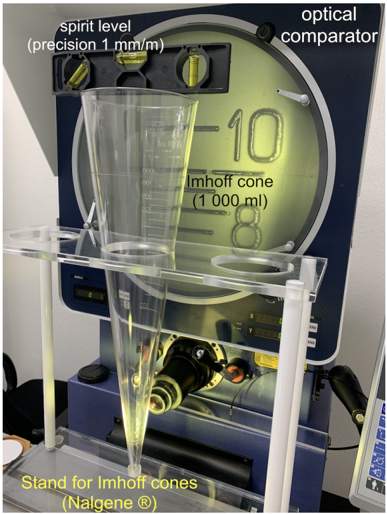
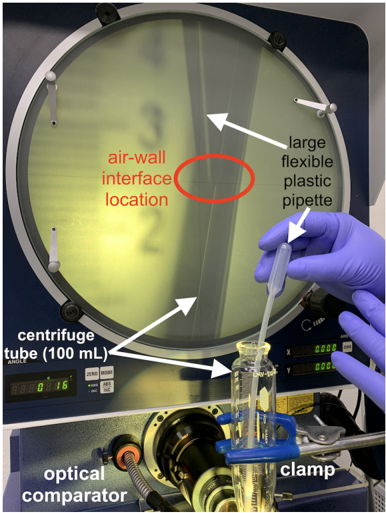
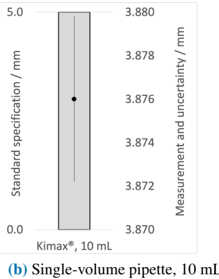
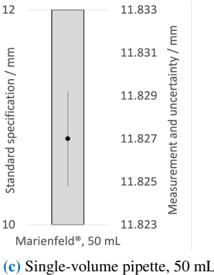
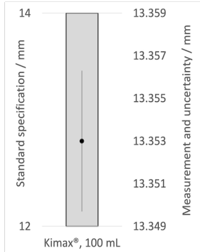
- Internal diameters of CGVI were measured with an optical comparator having X-axis range 0–250 mm, Y-axis range 0–150 mm, 0.001 mm display resolution, and a 20X lens; six repetitions were used for every internal diameter measurement.
- Cubic splines were fitted in R using `splines::interpSpline(V,D)$coef` to interpolate internal diameters at unmeasured graduation lines; the paper suggests less than half of the total required internal diameter values may be enough.
- Meniscus reading uncertainty was computed as \(u_{\text{meniscus}} = u_{\text{position}} \cdot A\), with \(u_{\text{position}} = 0.05\) mm assumed and \(A\) the cross-section area at the meniscus location; the measurement method was assessed against international standards for cylindrical glassware.
Limitations
- The paper does not include an explicit limitations section.
- Evident from the text: the internal diameter measurement method was validated against international standards for cylindrical glassware, not against CGVI reference standards; interpolation performance was assessed with eleven additional internal diameters for one centrifuge tube, while the Imhoff cone interpolation was not similarly evaluated.
- The paper states that the optical comparator is more expensive and more complex equipment than a Vernier caliper, and that measuring all graduation lines of CGVI would be impractical, time-consuming, and expensive.
Model-written summary. Check it against the paper before relying on it.
Integrity signals
Registry
Cites
Statistics
Figures



Verification
Claims the paper makes
5 Valid · 2 Not valid · 6 Not checked · 22 Own results and interpretations
The cited sources support only part of this claim — read each source’s verdict below.
In the paper
“A value of u position = 0.05 mm is easily achieved using simple optical aids [20], and the cross-section calculation is straightforward once the internal diameter has been measured or interpolated as described above.”
§ Uncertainty due to Meniscus Reading on Conical Graduated Volumetric Instruments > F. UNCERTAINTY IN READING THE POSITION OF THE MENISCUS
What the sources say
- Partly supportedcites [20] 20. O-J. Purata-Sifuentes, H-L. González-Gómez, J-A. Echavarri-Rodríguez and E. Funes-Rodríguez, "Estimation of meniscus reading uncertainty in volume calibration of conical volumetric instruments, " J.Phys.:Conf.Ser., vol. 1065, pp. 092021, 2018, 10.1088/1742-6596/1065/9/092021. sourceExperimental — accuracy not yet measured
The Introduction (page unavailable) says visual aids affect meniscus-reading error, supporting a general connection between aids and position uncertainty. It does not say that 0.05 mm is easily achievable with simple optical aids; the optical-comparator precision in §§2.1–2.2 concerns internal-diameter measurement, not meniscus position. (LLM, conf=0.82)
plain- Asserted: passes — The authors put it forward as true.
- Checkable: passes — It can be checked against evidence.
- Load-bearing: unclear — It is unclear whether the paper’s conclusions depend on it.
- Based: passes — The paper gives a reason why it holds.
- Partly supported
Every source the paper cites for this claim was checked and supports it.
In the paper
“However, the CGVI do not meet the assumptions of either of the two cases addressed in [20] because the CGVI do not have a constant volume between graduation lines along the scale of the volumetric apparatus, nor are they one-mark instruments.”
§ Uncertainty due to Meniscus Reading on Conical Graduated Volumetric Instruments > I. INTRODUCTION
What the sources say
- Supportedcites [20] 20. O-J. Purata-Sifuentes, H-L. González-Gómez, J-A. Echavarri-Rodríguez and E. Funes-Rodríguez, "Estimation of meniscus reading uncertainty in volume calibration of conical volumetric instruments, " J.Phys.:Conf.Ser., vol. 1065, pp. 092021, 2018, 10.1088/1742-6596/1065/9/092021. source
The Introduction contrasts one-mark volumetric flasks with conical volumetric instruments and says the latter have graduation lines. That supports the attributed claim that these conical graduated volumetric instruments are not one-mark instruments. (LLM, conf=0.90)
plainn = 2- Asserted: passes — The authors put it forward as true.
- Checkable: passes — It can be checked against evidence.
- Load-bearing: passes — The paper’s conclusions depend on it.
- Based: passes — The paper gives a reason why it holds.
- Supported
The cited sources that could be checked couldn’t confirm or dispute this claim.
In the paper
“In both cases, assuming there is only one internal diameter value for the entire instrument, which is valid for the cylindrical instruments whose values are included in the corresponding standards cited above.”
§ Uncertainty due to Meniscus Reading on Conical Graduated Volumetric Instruments > I. INTRODUCTION
What the sources say
- Not matchedcites [5] 5. Laboratory glassware -Burettes, ISO Standard, ISO 385, 2005.
We searched by its title and found no matching paper.
- Not matchedcites [6] 6. Laboratory glassware -Single-volume pipettes, ISO Standard, ISO 648, 2008.
We searched by its title and found no matching paper.
- Could not verifycites [8] 8. T. S. Arturi, C. J. Seijas and G. L. Bianchi, "A comparative study on the treatment of gelatin production plant wastewater using electrocoag- ulation and chemical coagulation," Heliyon, vol. 5, pp. e01738, 2019, 10.1016/j.heliyon.2019.e01738. sourceExperimental — accuracy not yet measured
The Materials and methods section describes instruments used to measure wastewater properties, but gives no internal-diameter measurements or standards for cylindrical volumetric instruments. Searches for “internal diameter cylindrical volumetric instruments standards” and “one internal diameter value for the entire instrument” found no passage addressing the claim. Page numbers were unavailable in our copy. (LLM, conf=0.76)
plain- Asserted: passes — The authors put it forward as true.
- Checkable: passes — It can be checked against evidence.
- Load-bearing: passes — The paper’s conclusions depend on it.
- Based: passes — The paper gives a reason why it holds.
- Not matched
Every source the paper cites for this claim was checked and supports it.
In the paper
“For cylindrical volumetric instruments, how to address the un-certainty due to meniscus reading has been stated for both graduated scale or one-mark volumetric apparatus [20].”
§ Uncertainty due to Meniscus Reading on Conical Graduated Volumetric Instruments > I. INTRODUCTION
What the sources say
- Supportedcites [20] 20. O-J. Purata-Sifuentes, H-L. González-Gómez, J-A. Echavarri-Rodríguez and E. Funes-Rodríguez, "Estimation of meniscus reading uncertainty in volume calibration of conical volumetric instruments, " J.Phys.:Conf.Ser., vol. 1065, pp. 092021, 2018, 10.1088/1742-6596/1065/9/092021. source
The Introduction explains that meniscus-setting uncertainty for cylindrical instruments depends on the reading error and cross-sectional area at the graduation line, and says the calculation is straightforward for instruments including one-mark volumetric flasks. Section 2.4 also gives the calculation for a cylindrical volumetric container, supporting the statement that the uncertainty can be addressed for graduated and one-mark apparatus. (LLM, conf=0.85)
plainn = 2- Asserted: passes — The authors put it forward as true.
- Checkable: passes — It can be checked against evidence.
- Load-bearing: passes — The paper’s conclusions depend on it.
- Based: passes — The paper gives a reason why it holds.
- Supported
The cited sources support only part of this claim — read each source’s verdict below.
In the paper
“However, the CGVI do not meet the assumptions of either of the two cases addressed in [20] because the CGVI do not have a constant volume between graduation lines along the scale of the volumetric apparatus, nor are they one-mark instruments.”
§ Uncertainty due to Meniscus Reading on Conical Graduated Volumetric Instruments > I. INTRODUCTION
What the sources say
- Partly supportedcites [20] 20. O-J. Purata-Sifuentes, H-L. González-Gómez, J-A. Echavarri-Rodríguez and E. Funes-Rodríguez, "Estimation of meniscus reading uncertainty in volume calibration of conical volumetric instruments, " J.Phys.:Conf.Ser., vol. 1065, pp. 092021, 2018, 10.1088/1742-6596/1065/9/092021. sourceExperimental — accuracy not yet measured
The Introduction describes conical instruments with multiple graduation lines and contrasts them with one-mark instruments. It also says the meniscus correction changes with the calibration point, unlike in cylindrical instruments. But our copy does not establish that the volume between successive graduation lines is nonconstant; it addresses the changing cross-section and meniscus correction instead. (LLM, conf=0.78)
plainn = 2- Asserted: passes — The authors put it forward as true.
- Checkable: passes — It can be checked against evidence.
- Load-bearing: passes — The paper’s conclusions depend on it.
- Based: passes — The paper gives a reason why it holds.
- Partly supported
18 more claims
Create a free account to see all 35 claims and every source verdict.
- Probably not a substantial claim. 4
- It may state two separate claims as one. 6
- The quote only partly states this claim. 2
Self-check
Percentages, sums and reported differences re-computed from the paper’s own numbers.
Each contradiction between two passages listed here was confirmed by an independent check.
Rated major: it would touch a result — a value a result rests on, reported and recomputed p-values on opposite sides of the significance level, two passages that conflict with no sign which is right, or a cited work retracted before this paper was published.
In the paper
§ Uncertainty due to Meniscus Reading on Conical Graduated Volumetric Instruments > B. MENISCUS READING UNCERTAINTY RESULTS
“A value of u position = 0.05 mm was assumed when using (3), and the computation of A follows the formula for a circle area.”
§ Uncertainty due to Meniscus Reading on Conical Graduated Volumetric Instruments > IV. CONCLUSION
“| 0.05 | 0.013 6 | | |”
Rated minor: it would not touch a result — a value no result rests on, a p-value that stays on the same side of the significance level, or a conflict that is clerical, resolved elsewhere in the paper, or outside its own findings.
In the paper
§ Uncertainty due to Meniscus Reading on Conical Graduated Volumetric Instruments > D. MEASUREMENT METHOD ASSESSMENT
“one-mark volumetric flask [8]”
§ Uncertainty due to Meniscus Reading on Conical Graduated Volumetric Instruments > References
“8. T. S. Arturi, C. J. Seijas and G. L. Bianchi, "A comparative study on the treatment of gelatin production plant wastewater using electrocoag- ulation and chemical coagulation," Heliyon, vol. 5, pp. e01738, 2019, 10.1016/j.heliyon.2019.e01738.”
Rated minor: it would not touch a result — a value no result rests on, a p-value that stays on the same side of the significance level, or a conflict that is clerical, resolved elsewhere in the paper, or outside its own findings.
In the paper
§ Uncertainty due to Meniscus Reading on Conical Graduated Volumetric Instruments > IV. CONCLUSION
“| 30 | 33.039 |”
§ Uncertainty due to Meniscus Reading on Conical Graduated Volumetric Instruments > IV. CONCLUSION
“| 30 | 33.033 8 0.364 9 | 0.000 0 | 0.000 0 |”
Rated minor: it would not touch a result — a value no result rests on, a p-value that stays on the same side of the significance level, or a conflict that is clerical, resolved elsewhere in the paper, or outside its own findings.
In the paper
§ Uncertainty due to Meniscus Reading on Conical Graduated Volumetric Instruments > III. RESULTS
“the centrifuge tubes have a conical section followed by a cylindrical section [12]”
§ Uncertainty due to Meniscus Reading on Conical Graduated Volumetric Instruments > References
“12. Quality management system -Requirements, ISO Standard, ISO 9001, 2015.”
Citations
Cites
Numerical Methods for Engineers
Chapra, S. C., & Canale, R. P. (1986) · CERN Document Server (European Organization for Nuclear Research) · Cited by 2,136
Numerical Methods for Engineers: A Practical Approach
Mohamad, A. A., & Benselama, A. M. (2022) · WORLD SCIENTIFIC eBooks · doi:10.1142/12809 · Cited by 189
Arturi, T. S., Seijas, C. J., & Bianchi, G. L. (2019) · Heliyon · doi:10.1016/j.heliyon.2019.e01738 · Cited by 40
Liang, D., Steinert, C., Bammesberger, S., Tanguy, L., Ernst, A., Zengerle, R., & Koltay, P. (2013) · Measurement Science and Technology · doi:10.1088/0957-0233/24/2/025301 · Cited by 31
Traceability and uncertainty analysis in volume measurements
Lorefice, S. (2009) · Measurement · doi:10.1016/j.measurement.2009.07.016 · Cited by 24
Liu, X., Bamberg, S. J. M., & Bamberg, E. (2011) · Measurement · doi:10.1016/j.measurement.2011.01.001 · Cited by 17
Aisyah, L., Bethari, S. A., Wibowo, C. S., Hermawan, N., Alwi, D. U., Rulianto, D., & Anggarani, R. (2019) · IOP Conference Series: Materials Science and Engineering · doi:10.1088/1757-899x/494/1/012082 · Cited by 13
Ortiz, E. G., Quintero, I., & Arévalo, K. (2016) · International Journal of Environmental Science and Technology · doi:10.1007/s13762-016-0980-9 · Cited by 11
Metrological Analysis by Measurement Uncertainty of Water and Sediment in Crude Oil
Biazon, C. L., de Jesus, V. C. B. M., & de Oliveira, E. C. (2015) · Petroleum Science and Technology · doi:10.1080/10916466.2014.980000 · Cited by 10
Estimation of meniscus reading uncertainty in volume calibration of conical volumetric instruments
Purata-Sifuentes, O.-J., González-Gómez, H.-L., Echavarri-Rodríguez, J.-A., & Funes-Rodríguez, E. (2018) · Journal of Physics: Conference Series · doi:10.1088/1742-6596/1065/9/092021 · Cited by 3 · cited 1×
“This paper is an extension of work initially presented in the XXII World Congress of the International Measurement Confederation (IMEKO 2018) and published [22].”
MethodSelf-citationUNCERTAINTY ANALYSIS IN CALIBRATION OF STANDARD VOLUME MEASURES
BATISTA, E., ALMEIDA, N., & FILIPE, E. (2009) · Series on Advances in Mathematics for Applied Sciences · doi:10.1142/9789812839527_0005 · Cited by 2
Research works printed but not linked: 19
- 10. Standard Test Method for Water and Sediment in Fuel Oils by the Centrifuge Method (Laboratory Procedure), ASTM Standard, D1796-11, 2011.
- 11. Method for Imhoff Cone Test, Bureau of Indian Standards, IS 7232, 2007.
- 12. Quality management system -Requirements, ISO Standard, ISO 9001, 2015.
- 13. Environmental management system -Requirements with guidance for use, ISO Standard, ISO 14001, 2015.
- 16. Determination of uncertainty for volume measurements made using the gravimetric method, ISO Standard, ISO 20461, 2000.
- 17. Laboratory glassware -Volumetric instruments -Methods for testing of capacity and for use, ISO Standard, ISO 4787, 2010.
- 6. Laboratory glassware -Single-volume pipettes, ISO Standard, ISO 648, 2008.
- 5. Laboratory glassware -Burettes, ISO Standard, ISO 385, 2005.
- 7. Laboratory glassware -One-mark volumetric flasks, ISO Standard, ISO 1042, 1998.
- 2007, Laboratory Glassware—Graduated Pipettes
- 2005, Laboratory Glassware—Graduated Measuring Cylinders
- 18. Guidelines on the determination of uncertainty in gravimetric volume calibration, EURAMET cg-19, 2018.
- 19. Standard Practice for Calibration of Laboratory Volumetric Apparatus, ASTM Standard, E542-01, 2012.
- 22. Laboratory glass or plastics ware -Imhoff sedimentation cones, DIN 12672, 2001.
- 21. S. S. Zumdahl, S. A. Zumdahl and J. Hall, "Lab Manual Experimental Chemistry, 9 th ed., "USA: Cengage Learning, 2014, pp. ix.
- 25. OMAR-JAIR PURATA-SIFUENTES received the B.S. degree in chemical engineering from the Instituto Tecnológico de Ciudad Madero, Tamauli- pas, México, in 1994 and the M.S. and Ph.D. degrees in chemical engineering from the Instituto Tecnológico de Celaya, Guanajuato, México, in 2004. He also received a M.Eng. degree in quality and productivity systems from the Instituto Tec- nológico y de Estudios Superiores de Monterrey, in 2013. From 2004 to 2013 he was working as a Laboratory Manager or Quality Manager in various companies. Since 2013, he is a full-time Professor with the Organizational Studies Department, Universidad de Guanajuato. He has authored several journals and proceedings papers. His research lines covers applied metrology, integration of management systems and lean six-sigma.
- 27. HAIDEÉ-LUCÍA GONZÁLEZ-GÓMEZ re- ceived the B.S. in industrial engineering from the Instituto Tecnológico de León, Guanajuato, México, in 2003. Since 2004 she has been working in the accred- ited metrology laboratories, in CIATEC, León, Guanajuato, México, where she is currently a Lead Specialist in Volume, Density and Viscosity. She has several technical stays at the Centro Nacional de Metrología (CENAM) in volume, density, hard- ness, mass and viscosity. She has co-authored several proceedings papers.
- 28. Ms. González-Gómez is currently an Authorized Signatory by the Mex- ican Accreditation Entity, a.c. (ema) in the volume, density and viscosity quantities. JOSÉ-ALBERTO ECHAVARRI-RODRÍGUEZ received the B.S. degree in industrial engineering from the Universidad Tecnológica de León, Gua- najuato, México, in 2012. Since 2006 he has been working in the accred- ited metrology laboratories, in CIATEC, León, Guanajuato, México. He has several technical stays at the Centro Nacional de Metrología (CE- NAM) in volume, density, hardness, mass and viscosity. He has co-authored several proceedings papers.
- 29. Mr. Echavarri-Rodríguez is currently an Authorized Signatory by the Mexican Accreditation Entity, a.c. (ema) in the volume and dimensional quantities, and holds an AUKON certification from Zeiss. ELVIA FUNES-RODRÍGUEZ received the B.S. degree in chemical engineering from the Univer- sidad de Guanajuato, México, in 1992 and the M.S. in chemical engineering from the Instituto Tecnológico de Celaya, Guanajuato, México, in 1995. She also has graduated studies in statistics from the Centro de Investigación en Matemáticas, A.C. (CIMAT), Guanajuato, México, in 2007. From 2003 to 2018 he was working as a Metrol- ogy Manager in the accredited metrology labora- tories, in CIATEC, León, Guanajuato, México. Since 2019 she becomes an Independent Metrologist in León, Guanajuato. She has several technical stays at the Centro Nacional de Metrología (CENAM) in mass and density. She has led more than 50 technological development projects related to metrology. She has co-authored several journals and proceedings papers.
Cited by
Nolandy, H., Utomo, M. T. S., Kiono, B. F. T., et al. (2024) · Cogent Engineering · doi:10.1080/23311916.2024.2345512 · Cited by 14
“(Purata-Sifuentes et al., 2021).”
Indirect Determination of the Internal Diameter of Glass Conical Volumetric Instruments
Purata Sifuentes, O. J. (2023) · Entreciencias: Diálogos en la Sociedad del Conocimiento · doi:10.22201/enesl.20078064e.2023.25.85557 · Cited by 1
Self-citationInternal diameter determination in conical glassware: A comparative analysis of measurement methods
Tornero-Navarro, M.-G., Mederos-Gutiérrez, G.-A., Valencia-Velázquez, E.-J., & Purata-Sifuentes, O.-J. (2024) · Measurement Sensors · doi:10.1016/j.measen.2024.101554
Self-citation
Metadata
- Authors
- Purata-Sifuentes, O.-J., Gonzalez-Gomez, H.-L., Echavarri-Rodriguez, J.-A., & Funes-Rodriguez, E.
- Affiliations
- Universidad de Guanajuato (MX)
- Centro de Innovación Aplicada en Tecnologías Competitivas (MX)
- Venue
- IEEE Access
- Published
- 2021
- Volume
- 9
- Pages
- 147801-147808
- ISSN
- 2169-3536 (ISSN-L)
- OpenAlex
- W3209340290
- Cited by
- 3
- References
- 11
- Citations by year
- 2024: 2 · 2023: 1
- FWCI
- 0.44
- Type
- journal article
- Language
- en
- Open access
- gold
- doi.org
- Licence
- Locations
- IEEE Access (publishedVersion, cc-by)
- DOAJ (DOAJ: Directory of Open Access Journals) (submittedVersion, cc-by-sa)
- Funders
- Universidad de Guanajuato
- Topics
- Physical Sciences › Physics and Astronomy › Instrumentation › Scientific Measurement and Uncertainty Evaluation
- Physical Sciences › Engineering › Mechanical Engineering › Advanced Measurement and Metrology Techniques
- Physical Sciences › Engineering › Electrical and Electronic Engineering › Advanced Electrical Measurement Techniques
- Keywords
- volume measurement, internal diameter measurement, optical comparator, cubic spline interpolation, measurement uncertainty
About these checks
Registry, retraction, Cites and statistics results are computed, not judged, with one exception: a printed reference that no index lists is read once by a model before it counts as a citation error. Claims are extracted by a model and kept only when their quote appears verbatim in the text; each cited source is then checked, with a model’s help, for whether it says what the claim relies on. Those verdicts can be wrong — read the claim’s quote and the cited source before relying on one.
The claim verdicts this report counts are experimental: their accuracy is not yet measured.
A language model drew the claims from the paper on 2026-10-11, under version 3 of the claim definition (model deepseek-v4.1-flash, prompt extract-v3).
A second model labelled each claim on 2026-10-11 (model jev-1.13-20260917, definition revision gold-guideline-v0.2).
Cited sources are checked with a language model’s help (gpt-6-sol).
Statistics and arithmetic are recomputed, not judged.
Confidence bands are shown only for fields calibrated on our annotated test set. None is calibrated yet, so no band is shown.
What counts as a claim ›How we measure confidence ›How we check this ›
Are you an author, or do you see a problem with this page? Request a review
Data sources
Bibliographic data: Semantic Scholar, OpenAlex, Crossref.
Contains information from the Semantic Scholar Academic Graph Datasets, made available under the ODC Attribution License (ODC-BY 1.0).
Semantic Scholar’s data is described in: Kinney, R., et al. (2023). The Semantic Scholar Open Data Platform. arXiv:2301.10140.
