

MusCaps: Generating Captions for Music Audio
Open accessThe DOI matches its Crossref record; 53 of the 57 references it cites were found in a registry or an index; 3 of the 11 sources its claims cite were checked for support.
Abstract
Content-based music information retrieval has seen rapid progress with the adoption of deep learning. Current approaches to high-level music description typically make use of classification models, such as in auto-tagging or genre and mood classification. In this work, we propose to address music description via audio captioning, defined as the task of generating a natural language description of music audio content in a human-like manner. To this end, we present the first music audio captioning model, MusCaps, consisting of an encoder-decoder with temporal attention. Our method combines convolutional and recurrent neural network architectures to jointly process audio-text inputs through a multimodal encoder and leverages pretraining on audio data to obtain representations that effectively capture and summarise musical features in the input. Evaluation of the generated captions through automatic metrics shows that our method outperforms a baseline designed for non-music audio captioning. Through an ablation study, we unveil that this performance boost can be mainly attributed to pre-training of the audio encoder, while other design choices - modality fusion, decoding strategy and the use of attention - contribute only marginally. Our model represents a shift away from classification-based music description and combines tasks requiring both auditory and linguistic understanding to bridge the semantic gap in music information retrieval11Code available at https://github.com/ilaria-manco/muscaps.
Overview
CoChat Summary
## TL;DR
MusCaps is presented as the first music audio captioning model, using a multimodal CNN-LSTM encoder-decoder with optional temporal attention and pre-trained music tagging features. On a private dataset of 6,035 audio-caption pairs, it outperforms a DCASE 2020 audio-captioning baseline, with the strongest gains coming from pre-training the audio feature extractor rather than from fusion or attention design choices.
## Key findings
- The cleaned dataset contains 6,035 audio-caption pairs, split 60/20/20 into train/validation/test.
- Compared with the DCASE baseline, MusCaps-Musicnn reaches BLEU-1 34.3, BLEU-4 5.4, METEOR 29.3, CIDEr 33.0, SPIDEr 28.6; MusCaps-HCNN reaches BLEU-1 37.3, BLEU-4 5.9, METEOR 29.6, CIDEr 36.9, SPIDEr 30.2.
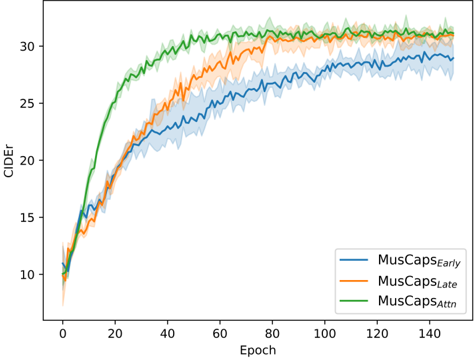
- In the ablation study, removing pre-training lowers performance; for example, MusCaps Early with pre-training has CIDEr 37.6 versus 29.2 without pre-training, and the paper says this also causes slower convergence.
- Retrieval results are modest but improve with MusCaps variants: Recall@1 rises from 1.2 for the baseline to 5.7 for MusCaps Late; Median Rank improves from 41.8 to 37.8.
## Methods
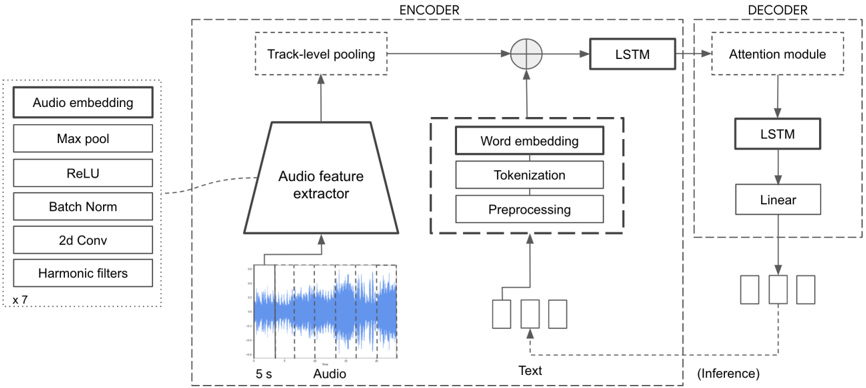
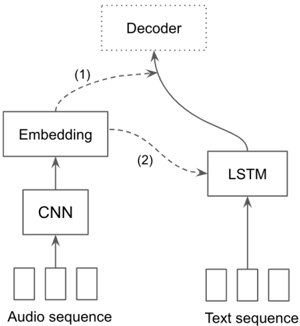
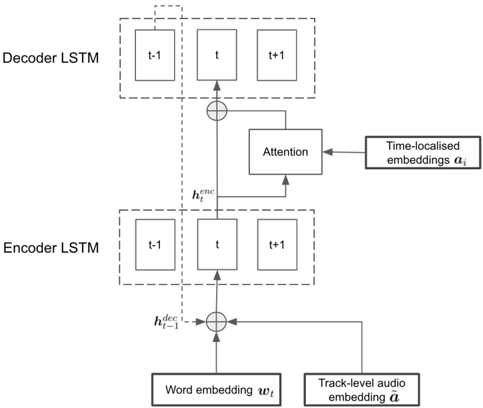
- The model is an encoder-decoder architecture for music captioning with a text embedding module, audio feature extractor, multimodal encoder, attention mechanism, and LSTM decoder.
- Audio features come from two pre-trained music auto-tagging CNNs: Musicnn and Harmonic CNN, both trained on MagnaTagATune; the classification heads are removed and the feature extractors are frozen in the main comparison.
- Experiments use a private production music dataset of audio-caption pairs, with captions tokenized and special tokens added; training uses teacher forcing, cross-entropy loss, Adam, up to 200 epochs, batch size 16, and beam search is evaluated as an alternative decoder.
## Limitations
- The paper states that only one caption per example is available, which makes automatic caption metrics less reliable; it says additional data collection or augmentation may be needed to obtain several reference captions per example.
- The retrieval evaluation may be ill-defined because multiple textual descriptions can be acceptable for one audio clip and vice versa, while the dataset and evaluation do not account for this.
- Evident from the text: the dataset is private and there is no benchmark dataset, so comparability to prior music-captioning work is limited.
Model-written summary. Check it against the paper before relying on it.
Integrity signals
Registry
Cites
Statistics
Figures
Verification
Claims the paper makes
2 Valid · 1 Not valid · 8 Not checked · 46 Own results and interpretations
Every source the paper cites for this claim was checked and supports it.
In the paper
“This is consistent with observations from previous studies [41], which attribute the performance degradation to overfitting or discrepancy between optimisation of the metrics and of the learning objective.”
What the sources say
- Supportedcites [41] [41] O. Vinyals, A. Toshev, S. Bengio, and D. Erhan, 'Show and Tell: Lessons Learned from the 2015 MSCOCO Image Captioning Challenge,' IEEE Transactions on Pattern Analysis and Machine Intelligence , vol. 39, no. 4, pp. 652-663, 4 2017. source
Section 5.2.5 (p. 9) reports that a small beam size of 3 performed best and interprets this as an indication of either overfitting or a mismatch between the training objective (likelihood) and human judgement. The section also says beam sizes were selected using CIDEr, supporting the claim’s description of a metric–objective discrepancy. (LLM, conf=0.93)
plainstates an association- Asserted: passes — The authors put it forward as true.
- Checkable: passes — It can be checked against evidence.
- Load-bearing: unclear — It is unclear whether the paper’s conclusions depend on it.
- Based: passes — The paper gives a reason why it holds.
- Supported
Every source the paper cites for this claim was checked and supports it.
In the paper
“However, the method proposed in [24] fails to generate grammatically correct sentences”
What the sources say
- Supportedcites [24] [24] K. Choi, G. Fazekas, M. Sandler, B. Mcfee, and K. Cho, 'Towards Music Captioning: Generating Music Playlist Descriptions,' arXiv preprint , 2016. - source
Section 4 'Experiments and Conclusions' (p. 2) states outright that 'The model currently overfits and fails to generate correct sentences', and illustrates this with a generated word sequence ('dramatic motivating the intense epic action adventure soaring soaring soaring gloriously Roger Deakins cinematography Maryse Alberti'), which is ungrammatical — so 'grammatically correct' is a fair paraphrase of 'correct'. The tested model is the pre-training sequence-to-sequence approach of Section 3.1 (p. 2) trained on a private 374-album dataset, and the paper attributes the failure to overfitting from limited data rather than to a flaw in the architecture; the citing sentence drops that causal qualifier but does not misstate the paper's point. (LLM, conf=0.85)
plain- Asserted: passes — The authors put it forward as true.
- Checkable: passes — It can be checked against evidence.
- Load-bearing: passes — The paper’s conclusions depend on it.
- Based: unclear — It is unclear why the paper says it holds.
- Supported
A result the paper reports from its own data — it cites no other source for it, so there is none to check. The quote shows it is in the paper.
In the paper
“Overall, we do not observe a significant difference across these three variants.”
plain- Asserted: passes — The authors put it forward as true.
- Checkable: passes — It can be checked against evidence.
- Load-bearing: passes — The paper’s conclusions depend on it.
- Based: passes — The paper gives a reason why it holds.
A result the paper reports from its own data — it cites no other source for it, so there is none to check. The quote shows it is in the paper.
In the paper
“we also train MusCaps with pre-training using shorter, randomly selected chunks as the audio input, to ensure that this does not significantly affect performance, and find that only a small decrease in some of the scores is observed in this case.”
plainstates a cause- Asserted: passes — The authors put it forward as true.
- Checkable: passes — It can be checked against evidence.
- Load-bearing: unclear — It is unclear whether the paper’s conclusions depend on it.
- Based: passes — The paper gives a reason why it holds.
A result the paper reports from its own data — it cites no other source for it, so there is none to check. The quote shows it is in the paper.
In the paper
“Through an ablation study, we unveil that this performance boost can be mainly attributed to pre-training of the audio encoder, while other design choices - modality fusion, decoding strategy and the use of attention -contribute only marginally.”
plain- Asserted: passes — The authors put it forward as true.
- Checkable: passes — It can be checked against evidence.
- Load-bearing: passes — The paper’s conclusions depend on it.
- Based: passes — The paper gives a reason why it holds.
20 more claims
Create a free account to see all 57 claims and to verify the 3 references still open.
- Probably not a substantial claim. 16
- It may state two separate claims as one. 20
Citations
Cites
BERT: Pre-training of Deep Bidirectional Transformers for Language Understanding
Devlin, J., Chang, M.-W., Lee, K., & Toutanova, K. (2018) · arXiv · doi:10.48550/arxiv.1810.04805 · Cited by 73,173
BERT: Pre-training of Deep Bidirectional Transformers for Language Understanding
Devlin, J., Chang, M.-W., Lee, K., & Toutanova, K. (2019) · Proceedings of the 2019 Conference of the North American Chapter of the Association for Computational Linguistics: Human Language Technologies, Volume 1 (Long and Short Papers) · doi:10.18653/v1/n19-1423 · Cited by 54,325 · cited 1×
“More recently, the success of BERT [11] has motivated research into its adaptation to V&L tasks, allowing to achieve state-of-the-art (SOTA) performance in all of them, both for still image and video [12], [13].”
BackgroundGlove: Global Vectors for Word Representation
Pennington, J., Socher, R., & Manning, C. (2014) · Proceedings of the 2014 Conference on Empirical Methods in Natural Language Processing (EMNLP) · doi:10.3115/v1/d14-1162 · Cited by 34,071 · cited 1×
“This is initialised with 300-dimensional GloVe word embeddings [29], pre-”
MethodBLEU: a method for automatic evaluation of machine translation
Papineni, K., Roukos, S., Ward, T., & Zhu, W.-J. (2001) · Proceedings of the 40th Annual Meeting on Association for Computational Linguistics - ACL '02 · doi:10.3115/1073083.1073135 · Cited by 21,344 · cited 1×
“com/audio-captioning/dcase-2020-baseline/ [34], METEOR [35] and ROUGEL [36], is a set of metrics first proposed to evaluate text generated through machine translation; the second, including CIDEr [37], SPICE [38] and SPIDEr [39], was instead introduced for the evaluation of image captioning models.”
Background(2004) · Cited by 9,718
Show, Attend and Tell: Neural Image Caption Generation with Visual Attention
Xu, K., Ba, J., Kiros, R., Cho, K., Courville, A., Salakhutdinov, R., Zemel, R., & Bengio, Y. (2015) · arXiv · doi:10.48550/arxiv.1502.03044 · Cited by 8,248 · cited 2×
“The attention model used is a soft top-down attention mechanism, similar to approaches first proposed for the image captioning task in [5], [32].”
BackgroundMethodShow and tell: A neural image caption generator
Vinyals, O., Toshev, A., Bengio, S., & Erhan, D. (2015) · 2015 IEEE Conference on Computer Vision and Pattern Recognition (CVPR) · doi:10.1109/cvpr.2015.7298935 · Cited by 6,318 · cited 4×
“Our work is inspired by CNN-RNN architectures developed for image and audio captioning, but focusses on how such approaches can be extended to the music domain for the first time.”
BackgroundMethodInfluentialBottom-Up and Top-Down Attention for Image Captioning and Visual Question Answering
Anderson, P., He, X., Buehler, C., Teney, D., Johnson, M., Gould, S., & Zhang, L. (2018) · 2018 IEEE/CVF Conference on Computer Vision and Pattern Recognition · doi:10.1109/cvpr.2018.00636 · Cited by 4,948 · cited 2×
“The attention model used is a soft top-down attention mechanism, similar to approaches first proposed for the image captioning task in [5], [32].”
MethodCIDEr: Consensus-based image description evaluation
Vedantam, R., Zitnick, C. L., & Parikh, D. (2015) · 2015 IEEE Conference on Computer Vision and Pattern Recognition (CVPR) · doi:10.1109/cvpr.2015.7299087 · Cited by 4,845 · cited 7×
“com/audio-captioning/dcase-2020-baseline/ [34], METEOR [35] and ROUGEL [36], is a set of metrics first proposed to evaluate text generated through machine translation; the second, including CIDEr [37], SPICE [38] and SPIDEr [39], was instead introduced for the evaluation of image captioning models.”
BackgroundResultInfluentialA Learning Algorithm for Continually Running Fully Recurrent Neural Networks
Williams, R. J., & Zipser, D. (1989) · Neural Computation · doi:10.1162/neco.1989.1.2.270 · Cited by 4,369 · cited 1×
“Our caption generation model is trained using teacher forcing [33].”
Method(2005) · Cited by 4,152
ViLBERT: Pretraining Task-Agnostic Visiolinguistic Representations for Vision-and-Language Tasks
Lu, J., Batra, D., Parikh, D., & Lee, S. (2019) · arXiv · doi:10.48550/arxiv.1908.02265 · Cited by 2,109 · cited 3×
“More recently, following the success of self-attention in V&L models, a small body of work has also started exploring the use of Transformer-based models in audio captioning [19], [23].”
BackgroundMethodSPICE: Semantic Propositional Image Caption Evaluation
Anderson, P., Fernando, B., Johnson, M., & Gould, S. (2016) · Lecture Notes in Computer Science · doi:10.1007/978-3-319-46454-1_24 · Cited by 1,986 · cited 4×
“Among the second set of metrics, CIDEr computes the cosine similarity between tfidf weighted n-grams and is observed to better correlate with human judgement compared to previous metrics [37], SPICE is based on a comparison of semantic similarity of scene graphs parsed from the candidate and reference caption, and SPI…”
BackgroundInfluentialVisualBERT: A Simple and Performant Baseline for Vision and Language
Li, L. H., Yatskar, M., Yin, D., Hsieh, C.-J., & Chang, K.-W. (2019) · arXiv · doi:10.48550/arxiv.1908.03557 · Cited by 1,198 · cited 1×
“Inspired by the established practice of using CNN-based image feature extraction for vision-and-language tasks [7], [9], [12] and further motivated by the development of similar feature extraction networks specifically designed for music audio data [3], [28], we make”
MethodVideoBERT: A Joint Model for Video and Language Representation Learning
Sun, C., Myers, A., Vondrick, C., Murphy, K., & Schmid, C. (2019) · 2019 IEEE/CVF International Conference on Computer Vision (ICCV) · doi:10.1109/iccv.2019.00756 · Cited by 1,172 · cited 1×
“More recently, the success of BERT [11] has motivated research into its adaptation to V&L tasks, allowing to achieve state-of-the-art (SOTA) performance in all of them, both for still image and video [12], [13].”
BackgroundUnified Vision-Language Pre-Training for Image Captioning and VQAPreprint
Zhou, L., Palangi, H., Zhang, L., Hu, H.-D., Corso, J., & Gao, J. (2019) · AAAI Conference on Artificial Intelligence · doi:10.48550/arxiv.1909.11059 · Cited by 1,094
Deep Visual-Semantic Alignments for Generating Image Descriptions
Karpathy, A., & Fei-Fei, L. (2017) · IEEE Transactions on Pattern Analysis and Machine Intelligence · doi:10.1109/tpami.2016.2598339 · Cited by 1,048 · cited 2×
“Following prior work on image description [4], [6], we provide results for the following retrieval metrics: Recall @ K (higher is better) with k = {1, 5, 10}, the percentage of correctly retrieved items within the top-K results, and the median rank (lower is better) of the ground-truth items across all queries.”
BackgroundMethodMeteor: an automatic metric for MT evaluation with high levels of correlation with human judgments
Lavie, A., & Agarwal, A. (2007) · Proceedings of the Second Workshop on Statistical Machine Translation - StatMT '07 · doi:10.3115/1626355.1626389 · Cited by 1,047
VL-BERT: Pre-training of Generic Visual-Linguistic Representations
Su, W., Zhu, X., Cao, Y., Li, B., Lu, L., Wei, F., & Dai, J. (2019) · arXiv · doi:10.48550/arxiv.1908.08530 · Cited by 950
Show and Tell: Lessons Learned from the 2015 MSCOCO Image Captioning Challenge
Vinyals, O., Toshev, A., Bengio, S., & Erhan, D. (2017) · IEEE Transactions on Pattern Analysis and Machine Intelligence · doi:10.1109/tpami.2016.2587640 · Cited by 875 · cited 1×
“This is consistent with observations from previous studies [41], which attribute the performance degradation to overfitting or discrepancy between optimisation of the metrics and of the learning objective.”
ResultUnified Vision-Language Pre-Training for Image Captioning and VQA
Zhou, L., Palangi, H., Zhang, L., Hu, H., Corso, J., & Gao, J. (2020) · Proceedings of the AAAI Conference on Artificial Intelligence · doi:10.1609/aaai.v34i07.7005 · Cited by 864 · cited 1×
“Most V&L models can be classified under two paradigms: CNN-RNN [4]–[6] and Transformer-based [7]– [10].”
BackgroundVL-BERT: Pre-training of Generic Visual-Linguistic Representations
Su, W., Zhu, X., Cao, Y., Li, B., Lu, L., Wei, F., & Dai, J. (2020) · International Conference on Learning Representations · Cited by 713
Improved Image Captioning via Policy Gradient optimization of SPIDEr
Liu, S., Zhu, Z., Ye, N., Guadarrama, S., & Murphy, K. (2017) · 2017 IEEE International Conference on Computer Vision (ICCV) · doi:10.1109/iccv.2017.100 · Cited by 430 · cited 3×
“Among the second set of metrics, CIDEr computes the cosine similarity between tfidf weighted n-grams and is observed to better correlate with human judgement compared to previous metrics [37], SPICE is based on a comparison of semantic similarity of scene graphs parsed from the candidate and reference caption, and SPI…”
BackgroundEvaluation Of Algorithms Using Games: The Case Of Music Tagging.
Law, E., West, K., Mandel, M. I., Bay, M., & Downie, J. S. (2009) · Zenodo · doi:10.5281/zenodo.1417646 · Cited by 168
Sample-Level CNN Architectures for Music Auto-Tagging Using Raw Waveforms
Kim, T., Lee, J., & Nam, J. (2018) · IEEE International Conference on Acoustics Speech and Signal Processing · doi:10.1109/icassp.2018.8462046 · Cited by 126
Transfer learning for music classification and regression tasks
Choi, K., Fazekas, G., Sandler, M. B., & Cho, K. (2017) · arXiv (Cornell University) · doi:10.48550/arxiv.1703.09179 · Cited by 123
Self-citationTransfer Learning For Music Classification And Regression Tasks.
Choi, K., Fazekas, G., Sandler, M. B., & Cho, K. (2017) · Queen Mary Research Online (Queen Mary University of London) · doi:10.5281/zenodo.1418014 · Cited by 105
Self-citationEvaluation of CNN-based Automatic Music Tagging ModelsPreprint
Won, M., Ferraro, A., Bogdanov, D., & Serra, X. (2020) · arXiv (Cornell University) · doi:10.48550/arxiv.2006.00751 · Cited by 102
Automated audio captioning with recurrent neural networks
Drossos, K., Adavanne, S., & Virtanen, T. (2017) · 2017 IEEE Workshop on Applications of Signal Processing to Audio and Acoustics (WASPAA) · doi:10.1109/waspaa.2017.8170058 · Cited by 100 · cited 5×
“Most prior audio captioning methods make use of encoder-decoder models, frequently including sequence modelling modules, such as RNNs [20] or variants like gated recurrent units (GRU) [14], [17]”
BackgroundMethodInfluentialTransfer Learning By Supervised Pre-Training For Audio-Based Music Classification.
van den Oord, A., Dieleman, S., & Schrauwen, B. (2014) · Ghent University Academic Bibliography (Ghent University) · doi:10.5281/zenodo.1415889 · Cited by 97
AudioCaps: Generating Captions for Audios in The Wild
Kim, C. D., Kim, B., Lee, H., & Kim, G. (2019) · Proceedings of the 2019 Conference of the North American Chapter of the Association for Computational Linguistics: Human Language Technologies, Volume 1 (Long and Short Papers) · doi:10.18653/v1/n19-1011 · Cited by 96 · cited 2×
“and long short-term memory (LSTM) networks [18], in their encoder to take care of the temporal structure of audio inputs.”
BackgroundBottom-Up and Top-Down Attention for Image Captioning and Visual Question AnsweringPreprint
Anderson, P., He, X., Buehler, C., et al. (2017) · arXiv (Cornell University) · doi:10.48550/arxiv.1707.07998 · Cited by 94
Data-Driven Harmonic Filters for Audio Representation Learning
Won, M., Chun, S., Nieto, O., & Serrc, X. (2020) · IEEE International Conference on Acoustics Speech and Signal Processing · doi:10.1109/icassp40776.2020.9053669 · Cited by 85 · cited 9×
“For each n-second chunk, where n is the input length of the feature extraction network (3s for musicnn and 5s for Harmonic CNN, both at a sampling rate of 16 kHz), we obtain a feature vector of dimension k, such that the whole input sequence is encoded by a variably sized set of L audio features A = {a1, ...,aL},ai ∈…”
MethodInfluentialAudio Caption: Listen and Tell
Wu, M., Dinkel, H., & Yu, K. (2019) · IEEE International Conference on Acoustics, Speech, and Signal Processing · doi:10.48550/arxiv.1902.09254 · Cited by 75
End-to-end Learning for Music Audio Tagging at Scale
(2018) · International Symposium/Conference on Music Information Retrieval · doi:10.5072/zenodo.251644 · Cited by 68 · cited 6×
“Tasks such as music tagging have been shown to successfully extract salient characteristics and learn musically relevant concepts such as mood, genre, era, and emotional content [1], [3].”
BackgroundMethodInfluentialAutomatic Tagging Using Deep Convolutional Neural Networks.
(2016) · arXiv (Cornell University) · doi:10.5072/zenodo.242702 · Cited by 65 · cited 2×
“A prominent example is music auto-tagging [1]– [3], in which descriptive keywords are assigned to a music clip so as to convey high-level characteristics of the input such as genre, instrumentation and emotion.”
BackgroundSelf-citationA Transformer-Based Audio Captioning Model with Keyword Estimation
Koizumi, Y., Masumura, R., Nishida, K., Yasuda, M., & Saito, S. (2020) · Interspeech (USB) · doi:10.21437/interspeech.2020-2087 · Cited by 63 · cited 1×
“of Transformer-based models in audio captioning [19], [23].”
MethodA Transformer-based Audio Captioning Model with Keyword Estimation
Koizumi, Y., Masumura, R., Nishida, K., Yasuda, M., & Saito, S. (2020) · Interspeech · doi:10.48550/arxiv.2007.00222 · Cited by 57
Audio Caption: Listen and Tell
Wu, M., Dinkel, H., & Yu, K. (2019) · ICASSP 2019 - 2019 IEEE International Conference on Acoustics, Speech and Signal Processing (ICASSP) · doi:10.1109/icassp.2019.8682377 · Cited by 52 · cited 2×
“Most of these works also make use of attention mechanisms to align the audio and text modalities [14], [15], [18], [21].”
BackgroundVideo Understanding as Machine TranslationPreprint
Korbar, B., Petroni, F., Girdhar, R., & Torresani, L. (2020) · arXiv (Cornell University) · doi:10.48550/arxiv.2006.07203 · Cited by 40 · cited 2×
“Inspired by the established practice of using CNN-based image feature extraction for vision-and-language tasks [7], [9], [12] and further motivated by the development of similar feature extraction networks specifically designed for music audio data [3], [28], we make”
BackgroundMethodCIDEr: Consensus-based Image Description Evaluation
Vedantam, R., Zitnick, C. L., & Parikh, D. (2014) · arXiv (Cornell University) · doi:10.48550/arxiv.1411.5726 · Cited by 40
Neural Audio Captioning Based on Conditional Sequence-to-Sequence Model
Ikawa, S., & Kashino, K. (2019) · Detection and Classification of Acoustic Scenes and Events Workshop (DCASE) · doi:10.33682/7bay-bj41 · Cited by 24 · cited 2×
“Most prior audio captioning methods make use of encoder-decoder models, frequently including sequence modelling modules, such as RNNs [20] or variants like gated recurrent units (GRU) [14], [17]”
MethodCOALA: Co-Aligned Autoencoders for Learning Semantically Enriched Audio Representations
Favory, X., Drossos, K., Virtanen, T., & Serra, X. (2020) · arXiv · doi:10.48550/arxiv.2006.08386 · Cited by 20 · cited 1×
“Similarly, prior work on audio-text representation learning also makes use of tags [26], while we”
BackgroundKoizumi, Y., Ohishi, Y., Niizumi, D., Takeuchi, D., & Yasuda, M. (2020) · arXiv (Cornell University) · doi:10.48550/arxiv.2012.07331 · Cited by 20 · cited 1×
“audio captioning has seen a rapid progress over the last few years [15]–[22], greatly encouraged by the recently introduced DCASE Challenge dedicated to the task2.”
BackgroundMulti-task Regularization Based on Infrequent Classes for Audio Captioning
Çakır, E., Drossos, K., & Virtanen, T. I. (2020) · Tampere University Institutional Repository (Tampere University) · doi:10.48550/arxiv.2007.04660 · Cited by 19
Audio Captioning using Gated Recurrent UnitsPreprint
Eren, A. Ö., & Sert, M. (2020) · arXiv (Cornell University) · doi:10.48550/arxiv.2006.03391 · Cited by 13 · cited 1×
“Most prior audio captioning methods make use of encoder-decoder models, frequently including sequence modelling modules, such as RNNs [20] or variants like gated recurrent units (GRU) [14], [17]”
MethodPerez-Castanos, S., Naranjo-Alcazar, J., Zuccarello, P., & Cobos, M. (2020) · arXiv (Cornell University) · doi:10.48550/arxiv.2006.15406 · Cited by 13 · cited 1×
“Most of these works also make use of attention mechanisms to align the audio and text modalities [14], [15], [18], [21].”
BackgroundSample-level CNN Architectures for Music Auto-tagging Using Raw WaveformsPreprint
Kim, T., Lee, J., & Nam, J. (2017) · arXiv (Cornell University) · doi:10.48550/arxiv.1710.10451 · Cited by 13
Tran, A., Drossos, K., & Virtanen, T. I. (2021) · European Signal Processing Conference (EUSIPCO) · doi:10.23919/eusipco54536.2021.9616340 · Cited by 12
Tran, A., Drossos, K., & Virtanen, T. I. (2020) · arXiv (Cornell University) · doi:10.48550/arxiv.2010.11098 · Cited by 11 · cited 1×
“of Transformer-based models in audio captioning [19], [23].”
MethodTowards Music Captioning: Generating Music Playlist Descriptions
Choi, K., Fazekas, G., McFee, B., Cho, K., & Sandler, M. (2016) · arXiv · doi:10.48550/arxiv.1608.04868 · Cited by 5 · cited 2×
“However, the method proposed in [24] fails to generate grammatically correct sentences, while [25] simplifies the task by reframing it as the generation of a sequence of tags.”
BackgroundMethodSelf-citationEnd-to-end learning for music audio tagging at scale
Pons, J., Nieto, O., Prockup, M., Schmidt, E., Ehmann, A., & Serra, X. (2017) · arXiv · doi:10.48550/arxiv.1711.02520
Automatic tagging using deep convolutional neural networks
Choi, K., Fazekas, G., & Sandler, M. (2016) · arXiv · doi:10.48550/arxiv.1606.00298
Self-citation
Research works printed but not linked: 2
- [31] M. Won, A. Ferraro, D. Bogdanov, and X. Serra, 'Evaluation of CNNbased Automatic Music Tagging Models,' in Proceedings of the 17th Sound and Music Computing Conference , 2020, pp. 331-337. -
- [25] C. Tian, M. Michael, and H. Di, 'Music autotagging as captioning,' in Proceedings of the 1st Workshop on NLP for Music and Audio (NLP4MusA) . Association for Computational Linguistics, 2020. -
Cited by
Bandi, A., Adapa, P. V. S. R., & Kuchi, Y. E. V. P. K. (2023) · Future Internet · doi:10.3390/fi15080260 · Cited by 638
Cao, Y., Li, S., Liu, Y., Yan, Z., Dai, Y., Yu, P. S., & Sun, L. (2023) · arXiv · doi:10.48550/arxiv.2303.04226 · Cited by 463
“MusCaps [161] is a music audio captioning model that generates descriptions of music audio content by processing audio-text inputs through a multimodal encoder and leveraging audio data pre-training to obtain effective musical feature representations.”
BackgroundThe Internet of Sounds: Convergent Trends, Insights, and Future Directions
Turchet, L., Lagrange, M., Rottondi, C., Fazekas, G., Peters, N., Østergaard, J., Font, F., Bäckström, T., & Fischione, C. (2023) · IEEE Internet of Things Journal · doi:10.1109/jiot.2023.3253602 · Cited by 112
“This involves the use of an acoustic model and a large language model [108].”
BackgroundMethodSelf-citationRetrieving Multimodal Information for Augmented Generation: A Survey
Zhao, R., Chen, H., Wang, W., Jiao, F., Long, D., Qin, C., Ding, B., Guo, X., Li, M., Li, X., et al. (2023) · Findings of the Association for Computational Linguistics: EMNLP 2023 · doi:10.18653/v1/2023.findings-emnlp.314 · Cited by 63
Music Understanding LLaMA: Advancing Text-to-Music Generation with Question Answering and Captioning
Liu, S., Hussain, A. S., Sun, C., & Shan, Y. (2024) · ICASSP 2024 - 2024 IEEE International Conference on Acoustics, Speech and Signal Processing (ICASSP) · doi:10.1109/icassp48485.2024.10447027 · Cited by 38
“Several models have been proposed for generating cap-tions for music, including MusCaps [5], audio captioning transformer [6], audio captioning with audio-text retrieval pretraining [7], Whisper tiny audio captioning 2 , and LP-MusicCaps [8].”
Metadata
- Authors
- Manco, I., Benetos, E., Quinton, E., & Fazekas, G.
- Affiliations
- Queen Mary University of London (GB)
- Venue
- 2021 International Joint Conference on Neural Networks (IJCNN)
- Publisher
- IEEE
- Published
- 2021-07-18
- Pages
- 1-8
- ISSN
- 2161-4407 (ISSN-L)
- OpenAlex
- W3159642309
- Semantic Scholar
- f13bbe25e59fef5a209091b6192841367b2a87a4
- Cited by
- 36
- References
- 57
- Citations by year
- 2026: 4 · 2025: 9 · 2024: 7 · 2023: 12 · 2022: 4
- FWCI
- 3.51
- Type
- conference paper
- Language
- en
- Open access
- green
- arxiv.org
- Licence
- Locations
- International Joint Conference on Neural Networks (IJCNN) (publishedVersion)
- arXiv (Cornell University) (submittedVersion)
- Queen Mary Research Online (Queen Mary University of London) (submittedVersion)
- arXiv (Cornell University)
- Funders
- UK Research and Innovation (EP/S022694/1)
- Queen Mary University of London
- Topics
- Physical Sciences › Computer Science › Signal Processing › Music and Audio Processing
- Social Sciences › Arts and Humanities › Music › Music Technology and Sound Studies
- Physical Sciences › Computer Science › Computer Vision and Pattern Recognition › Multimodal Machine Learning Applications
- Keywords
- music description, multimodal encoder, semantic gap, music information retrieval, convolutional recurrent neural network, modality fusion
About these checks
Registry, retraction, Cites and statistics results are computed, not judged, with one exception: a printed reference that no index lists is read once by a model before it counts as a citation error. Claims are extracted by a model and kept only when their quote appears verbatim in the text; each cited source is then checked, with a model’s help, for whether it says what the claim relies on. Those verdicts can be wrong — read the claim’s quote and the cited source before relying on one.
The claim verdicts this report counts are experimental: their accuracy is not yet measured.
A language model drew the claims from the paper on 2026-10-09, under version 3 of the claim definition (model deepseek-v4.1-flash, prompt extract-v3).
A second model labelled each claim on 2026-10-09 (model jev-1.13-20260917, definition revision gold-guideline-v0.2).
Cited sources are checked with a language model’s help (gpt-6-sol and qwen3.8-omni-flash).
Statistics and arithmetic are recomputed, not judged.
Confidence bands are shown only for fields calibrated on our annotated test set. None is calibrated yet, so no band is shown.
What counts as a claim ›How we measure confidence ›How we check this ›
Are you an author, or do you see a problem with this page? Request a review
Data sources
Bibliographic data: Semantic Scholar, OpenAlex, Crossref.
Contains information from the Semantic Scholar Academic Graph Datasets, made available under the ODC Attribution License (ODC-BY 1.0).
Semantic Scholar’s data is described in: Kinney, R., et al. (2023). The Semantic Scholar Open Data Platform. arXiv:2301.10140.
