

Deep CNN-LSTM With Self-Attention Model for Human Activity Recognition Using Wearable Sensor
Open accessThe DOI matches its Crossref record; 55 of the 61 references it cites were found in a registry or an index; 5 of the 51 sources its claims cite were checked for support.
Abstract
Human Activity Recognition (HAR) systems are devised for continuously observing human behavior - primarily in the fields of environmental compatibility, sports injury detection, senior care, rehabilitation, entertainment, and the surveillance in intelligent home settings. Inertial sensors, e.g., accelerometers, linear acceleration, and gyroscopes are frequently employed for this purpose, which are now compacted into smart devices, e.g., smartphones. Since the use of smartphones is so widespread now-a-days, activity data acquisition for the HAR systems is a pressing need. In this article, we have conducted the smartphone sensor-based raw data collection, namely H-Activity, using an Android-OS-based application for accelerometer, gyroscope, and linear acceleration. Furthermore, a hybrid deep learning model is proposed, coupling convolutional neural network and long-short term memory network (CNN-LSTM), empowered by the self-attention algorithm to enhance the predictive capabilities of the system. In addition to our collected dataset (H-Activity), the model has been evaluated with some benchmark datasets, e.g., MHEALTH, and UCI-HAR to demonstrate the comparative performance of our model. When compared to other models, the proposed model has an accuracy of 99.93% using our collected H-Activity data, and 98.76% and 93.11% using data from MHEALTH and UCI-HAR databases respectively, indicating its efficacy in recognizing human activity recognition.We hope that our developed model could be applicable in the clinical settings and collected data could be useful for further research.
Overview
CoChat Summary
TL;DR
The paper proposes a deep CNN-LSTM model with self-attention for smartphone/wearable-sensor human activity recognition, trained on a new H-Activity dataset and evaluated on MHEALTH and UCI-HAR. It reports 99.93% accuracy on H-Activity, 98.76% on MHEALTH, and 93.11% on UCI-HAR.
Key findings
- The proposed M4 model achieved 99.93% accuracy on H-Activity (4,888 correctly classified instances), 98.76% on MHEALTH, and 93.11% on UCI-HAR.
- On H-Activity, recall was 99.92% for sitting/standing, 100% for walking, 99.75% for jogging, and 100% for running; precision was 100%, 99.83%, 100%, and 99.83%, respectively, with weak differentiation between jogging and running.
- On UCI-HAR, sitting and standing were confused (recall 74.95% and 82.70%, respectively); on MHEALTH, the confusion matrix shows low recall for some classes (e.g., Std 19.90%, Sit 42.79%) despite 98.76% overall accuracy.
- Compared with prior models, the proposed model outperformed LSTM-CNN (95.56%) and CNN,LSTM (93.80%) on MHEALTH, and on UCI-HAR outperformed CNN-LSTM (92%), CNN (91.98%), Stacked LSTM (93%), and Res-LSTM (91.6%).
Methods
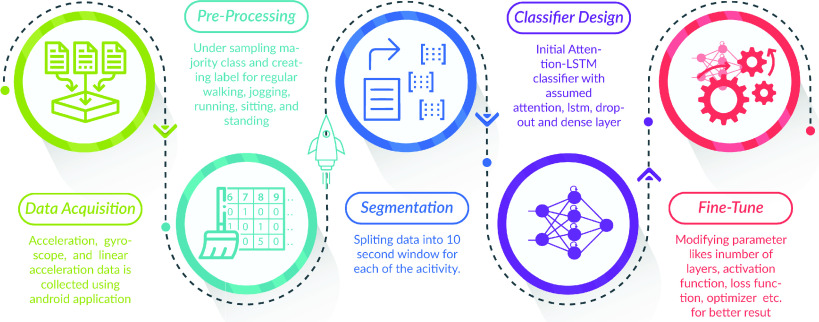
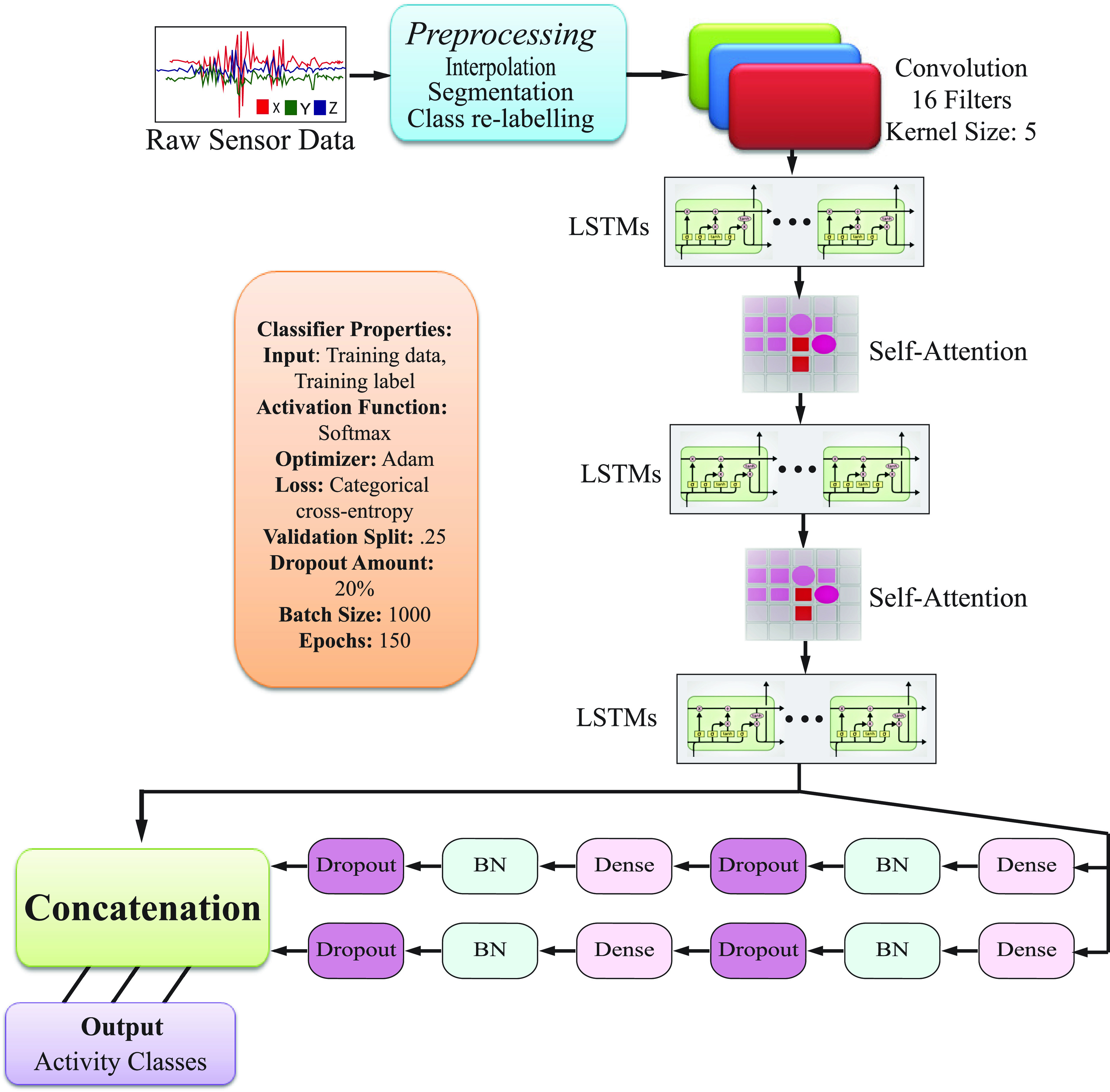
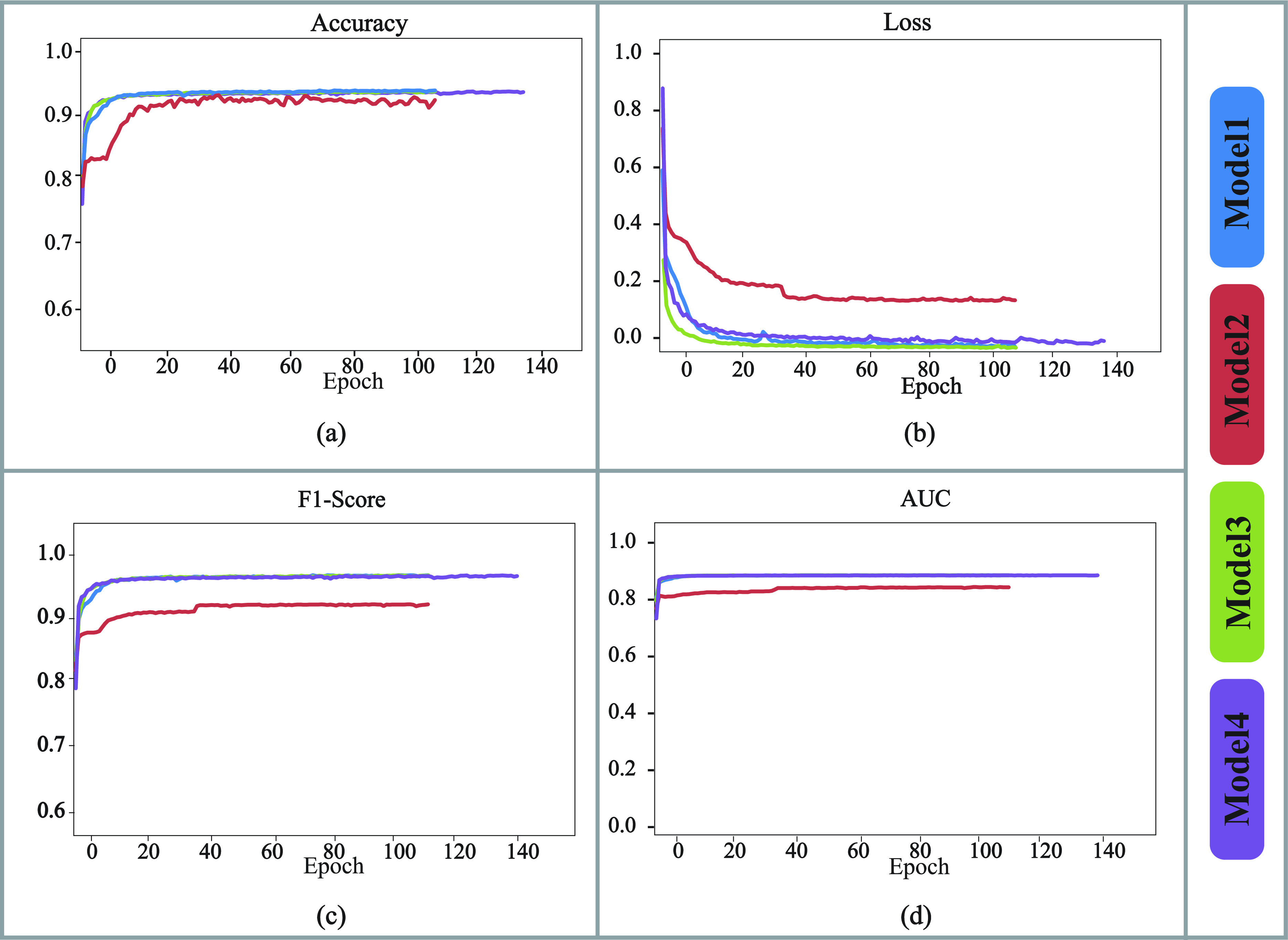
- Design: hybrid deep CNN-LSTM with self-attention; proposed M4 has 19 layers (CNN, LSTM, attention, dense, dropout, batch normalization, concatenate) with 633,188 trainable parameters, input size 10×9, trained for 150 epochs with batch size 1000, Adam optimizer, categorical cross-entropy, sigmoid/softmax activations.
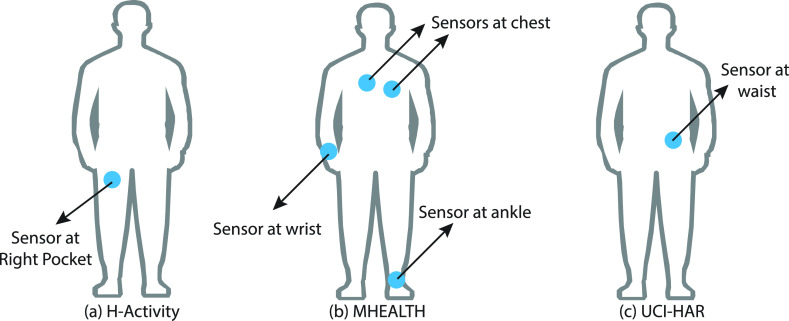
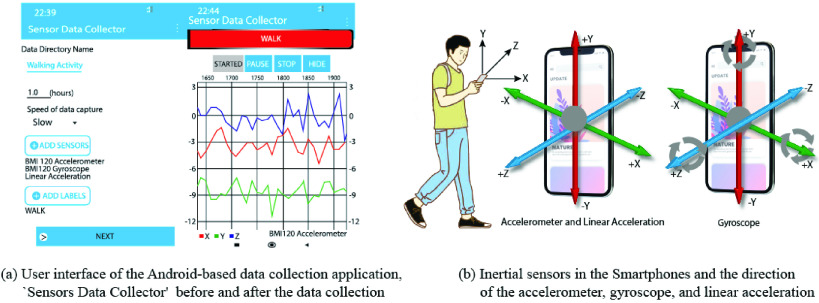
- Data: H-Activity was collected via an Android app from 10 volunteers aged 20–30, smartphone in the right trouser pocket, for 4 activities (sitting/standing, walking, jogging, running), at 10 Hz, yielding 48,920 samples with 9 features (accelerometer, gyroscope, linear acceleration on x/y/z); benchmark datasets were MHEALTH (10 volunteers, 12 activities, 50 Hz) and UCI-HAR (30 participants, 6 activities, 50 Hz, 10,299 samples).
- Preprocessing and analysis: under/oversampling, linear interpolation for missing values, sliding-window segmentation of size 10, one-hot encoding; evaluation used accuracy, precision, recall, F1, and AUC, with 25% of the whole dataset used for testing and four architectures (M1–M4) compared.
Limitations
- Stated: future work will add more participants and adjust the network structure; the paper also notes that comparison using final statistical measures with other existing approaches was not conducted because datasets and experimental settings differ.
- Stated/evident: H-Activity is small (10 volunteers, ages 20–30), uses a single sensor placement (right trouser pocket), a low 10 Hz sampling rate, and only four activities; the data were not subjected to noise cancellation, and the Android platform cannot read sensor data at a particular moment, only when a shift is detected.
- Evident: class imbalance required resampling; confusion remains between jogging/running and sitting/standing, and the MHEALTH confusion matrix shows low recall for some classes despite high overall accuracy.
Model-written summary. Check it against the paper before relying on it.
Integrity signals
Registry
Cites
Statistics
Figures


Verification
Claims the paper makes
2 Valid · 13 Not valid · 34 Not checked · 58 Own results and interpretations
At least one cited source doesn’t support this claim or points to a different paper, and none confirmed it — see the verdicts below.
In the paper
“deep learning norms are still underutilized for training time series of inertial sensor data for action detection [3], [5]–[8].”
§ Deep CNN-LSTM With Self-Attention Model for Human Activity Recognition Using Wearable Sensor > Introduction
What the sources say
- Disputedcites [3] sourceExperimental — accuracy not yet measured
Our copy of the survey states the opposite of the claim: the Abstract (p. 2) says 'deep learning based methods have been widely adopted for the sensor-based activity recognition tasks', and Section 3.1 (p. 4) states that body-worn inertial sensors (accelerometer, gyroscope, magnetometer) 'were widely used in deep learning based HAR', with the raw signal fed directly to the networks rather than hand-crafted features. Section 1 (p. 2) adds that deep learning 'is an ideal approach for HAR and has been widely explored in existing work'. The paper's remaining gaps (Section 7, p. 9: heavy reliance on labeled samples, distance from online/mobile deployment) concern supervision and on-device training, not underuse of deep learning on inertial time series. (LLM, conf=0.78)
Checked by a reasoning model — may be wrong.
- Not checked yetcites [5]–[8]
plain- Asserted: passes — The authors put it forward as true.
- Checkable: passes — It can be checked against evidence.
- Load-bearing: passes — The paper’s conclusions depend on it.
- Based: passes — The paper gives a reason why it holds.
- Disputed
A result the paper reports from its own data — it cites no other source for it, so there is none to check. The quote shows it is in the paper.
In the paper
“we have conducted the smartphone sensor-based raw data collection, namely H-Activity, using an Android-OS-based application for accelerometer, gyroscope, and linear acceleration.”
§ Deep CNN-LSTM With Self-Attention Model for Human Activity Recognition Using Wearable Sensor > Abstract
plain- Asserted: passes — The authors put it forward as true.
- Checkable: passes — It can be checked against evidence.
- Load-bearing: passes — The paper’s conclusions depend on it.
- Based: passes — The paper gives a reason why it holds.
A result the paper reports from its own data — it cites no other source for it, so there is none to check. The quote shows it is in the paper.
In the paper
“We proposed the deep CNN-LSTM with self-attention model for activity classification problem using our own dataset H-Activity as well as two public datasets; MHEALTH and UCI HAR.”
§ Deep CNN-LSTM With Self-Attention Model for Human Activity Recognition Using Wearable Sensor > Introduction
plainn = 10- Asserted: passes — The authors put it forward as true.
- Checkable: passes — It can be checked against evidence.
- Load-bearing: passes — The paper’s conclusions depend on it.
- Based: passes — The paper gives a reason why it holds.
A result the paper states — it cites no source for it, so there is none to check. The quote shows it is in the paper.
In the paper
“Our system is the combination of deep learning with self-attention model and wearable sensor-based human activity recognition framework that utilizes various smartphone sensors.”
§ Deep CNN-LSTM With Self-Attention Model for Human Activity Recognition Using Wearable Sensor > Introduction
plainn = 10- Asserted: passes — The authors put it forward as true.
- Checkable: passes — It can be checked against evidence.
- Load-bearing: passes — The paper’s conclusions depend on it.
- Based: passes — The paper gives a reason why it holds.
A result the paper states — it cites no source for it, so there is none to check. The quote shows it is in the paper.
In the paper
“a hybrid deep learning model is proposed, coupling convolutional neural network and long-short term memory network (CNN-LSTM), empowered by the self-attention algorithm to enhance the predictive capabilities of the system.”
§ Deep CNN-LSTM With Self-Attention Model for Human Activity Recognition Using Wearable Sensor > Abstract
plainstates a cause- Asserted: passes — The authors put it forward as true.
- Checkable: passes — It can be checked against evidence.
- Load-bearing: passes — The paper’s conclusions depend on it.
- Based: passes — The paper gives a reason why it holds.
29 more claims
Create a free account to see all 107 claims and to verify the 46 references still open.
- It may state two separate claims as one. 37
- Probably not a substantial claim. 52
Claims other papers make about this one
Each is checked against this paper’s own text: does it say what the citing paper says it does?
The source backs part of the claim, not all of it — or backs it for a different population, condition or comparison.
In the citing paper
“The architecture of BiGRU is simpler than that of BiLSTM, resulting in reduced computational overhead while effectively modeling long-term dependencies, which is essential for complex activities involving extended temporal sequences, such as conversational gestures. This differs from [24], in which LSTM-based models entail greater computational expenses.”
From Adaptive temporal attention mechanism and hybrid deep CNN model for wearable sensor-based human activity recognition (2025) · cites this paper as [24]
Experimental — accuracy not yet measuredThe source backs part of the claim, not all of it — or backs it for a different population, condition or comparison.
In the citing paper
“This leads to more reduced error rates in the confusion matrix (Fig. 8) when compared to CNN-BiGRU [10] and CNN-LSTM [24].”
From Adaptive temporal attention mechanism and hybrid deep CNN model for wearable sensor-based human activity recognition (2025) · cites this paper as [24]
Experimental — accuracy not yet measuredThe cited source says what the claim attributes to it.
In the citing paper
“This parallel design minimizes redundancy and improves efficiency relative to the sequential attention in [24] or the resource-intensive Transformer-based attention in [23].”
From Adaptive temporal attention mechanism and hybrid deep CNN model for wearable sensor-based human activity recognition (2025) · cites this paper as [24]
The cited source says what the claim attributes to it.
In the citing paper
“Previous studies, including [10, 18, 23, 24], have amalgamated convolutional neural networks (CNN), recurrent neural networks (RNN), and attention mechanisms;”
From Adaptive temporal attention mechanism and hybrid deep CNN model for wearable sensor-based human activity recognition (2025) · cites this paper as [24]
In the citing paper
“In contrast, models such as CNN-LSTM [24] and CNN-BiLSTM [18] utilize standard convolutions, which restrict their capacity to effectively capture a range of spatial scales.”
From Adaptive temporal attention mechanism and hybrid deep CNN model for wearable sensor-based human activity recognition (2025) · cites this paper as [24]
Self-check
Percentages, sums and reported differences re-computed from the paper’s own numbers.
Each contradiction between two passages listed here was confirmed by an independent check.
Rated major: it would touch a result — a value a result rests on, reported and recomputed p-values on opposite sides of the significance level, two passages that conflict with no sign which is right, or a cited work retracted before this paper was published.
In the paper
§ Deep CNN-LSTM With Self-Attention Model for Human Activity Recognition Using Wearable Sensor > Experimental Result Analysis > Evaluation on H-Activity, MHEALTH, and UCI-HAR Datasets
“There were 2714 properly categorized occurrences for the UCI-HAR data set, with total accuracy reaching 93.11%.”
§ Deep CNN-LSTM With Self-Attention Model for Human Activity Recognition Using Wearable Sensor > Experimental Result Analysis > Evaluation on H-Activity, MHEALTH, and UCI-HAR Datasets
“| Actual | Walk | 474 | 7 | 15 | 0 | 0 | 0 | 93.55 | | Actual | Up | 0 | 456 | 15 | 0 | 0 | 0 | 98.30 | | Actual | Down | 0 | 9 | 411 | 0 | 0 | 0 | 96.67 | | Actual | Sit | 0 | 22 | 0 | 396 | 71 | 2 | 74.95 | | Actual | Std | 0 | 49 | 0 | 99 | 440 | 0 | 82.70 | | Actual | Lay | 0 | 0 | 0 | 0 | 0 | 537 | 100 |”
Rated minor: it would not touch a result — a value no result rests on, a p-value that stays on the same side of the significance level, or a conflict that is clerical, resolved elsewhere in the paper, or outside its own findings.
In the paper
§ Deep CNN-LSTM With Self-Attention Model for Human Activity Recognition Using Wearable Sensor > Experimental Result Analysis > Hyper Parameter Selection
“The number of trainable parameters for these models was 152 902, 156 292, 197 508, and 633,188 respectively.”
§ Deep CNN-LSTM With Self-Attention Model for Human Activity Recognition Using Wearable Sensor > Experimental Result Analysis > Hyper Parameter Selection
“| Model M2 | 12 | LSTM, Dropout, BN, Dense | 197,508 | 196,484 | 1024 | | Model M3 | 11 | LSTM, Dropout, BN, Dense | 156,292 | 155,268 | 1024 |”
Rated minor: it would not touch a result — a value no result rests on, a p-value that stays on the same side of the significance level, or a conflict that is clerical, resolved elsewhere in the paper, or outside its own findings.
In the paper
§ Deep CNN-LSTM With Self-Attention Model for Human Activity Recognition Using Wearable Sensor > Experimental Result Analysis > Evaluation on H-Activity, MHEALTH, and UCI-HAR Datasets
“There were 4888 occurrences properly categorized for the H-Activity data set and the total accuracy was 99.93%.”
§ Deep CNN-LSTM With Self-Attention Model for Human Activity Recognition Using Wearable Sensor > Experimental Result Analysis > Evaluation on H-Activity, MHEALTH, and UCI-HAR Datasets
“| Actual | Sitting/Standing | 1222 | 1 | 0 | 0 | 99.92 | | | | Actual | Walking | 0 | 1223 | 0 | 0 | 100 | | | | Actual | Jogging | 0 | 1 | 1220 | 2 | 99.75 | | | | Actual | Running | 0 | 0 | 0 | 1223 | 100 | | |”
Rated minor: it would not touch a result — a value no result rests on, a p-value that stays on the same side of the significance level, or a conflict that is clerical, resolved elsewhere in the paper, or outside its own findings.
In the paper
“| Actual | Jog | 0 | 4 | 0 | 39 | 33 | 0 | 8 | 7 | 3 | 30157 | 243 | 226 | 90.11 | | |”
§ Deep CNN-LSTM With Self-Attention Model for Human Activity Recognition Using Wearable Sensor > Experimental Result Analysis > Evaluation on H-Activity, MHEALTH, and UCI-HAR Datasets
Reported 90.11 · recomputed 98.167318
Rated minor: it would not touch a result — a value no result rests on, a p-value that stays on the same side of the significance level, or a conflict that is clerical, resolved elsewhere in the paper, or outside its own findings.
In the paper
“| Actual | Walk | 0 | 0 | 0 | 30312 | 190 | 78 | 0 | 136 | 0 | 0 | 3 | 1 | 78.79 | | |”
§ Deep CNN-LSTM With Self-Attention Model for Human Activity Recognition Using Wearable Sensor > Experimental Result Analysis > Evaluation on H-Activity, MHEALTH, and UCI-HAR Datasets
Reported 78.79 · recomputed 98.671875
3 more findings
Create a free account to see every finding of this check.
Citations
Cites
Hochreiter, S., & Schmidhuber, J. (1997) · Neural Computation · doi:10.1162/neco.1997.9.8.1735 · Cited by 102,318 · cited 1×
“To address the challenge of long-term dependency, [51] proposed a novel neuron to the RNN group called LSTM.”
Learning long-term dependencies with gradient descent is difficult
Bengio, Y., Simard, P., & Frasconi, P. (1994) · IEEE Transactions on Neural Networks · doi:10.1109/72.279181 · Cited by 8,542 · cited 1×
“However, due to the disintegrating gradient problem, [50] states that RNN systems can only identify data for a short period of time.”
Activity recognition using cell phone accelerometers
Kwapisz, J. R., Weiss, G. M., & Moore, S. A. (2011) · ACM SIGKDD Explorations Newsletter · doi:10.1145/1964897.1964918 · Cited by 2,912 · cited 1×
“The way in which machine learning algorithms function was not to read a huge quantity of data at once, so that each entry in the H-Activity dataset was done with 10-sec segments, as recommended in [45].”
Deep Convolutional and LSTM Recurrent Neural Networks for Multimodal Wearable Activity Recognition
Ordóñez, F., & Roggen, D. (2016) · Sensors · doi:10.3390/s16010115 · Cited by 2,761 · cited 1×
“Proposed deep CNN-LSTM with self-attention model was compared with LSTM-CNN from Lyu et al. [53] and CNN-LSTM [54] under the same experimental scenario in order to further verify the model performance.”
A Survey on Human Activity Recognition using Wearable Sensors
Lara, O. D., & Labrador, M. A. (2013) · IEEE Communications Surveys & Tutorials · doi:10.1109/surv.2012.110112.00192 · Cited by 2,662 · cited 1×
“There have been numerous suggestions in the literature [3], [9]–[12] of traditional machine learning and profoundly trained methods for HAR using accelerometers over the last decade.”
Deep learning for sensor-based activity recognition: A survey
Wang, J., Chen, Y., Hao, S., Peng, X., & Hu, L. (2019) · Pattern Recognition Letters · doi:10.1016/j.patrec.2018.02.010 · Cited by 2,014 · cited 3×
“Wearable activity detectors, like the well-known Pedometer, are utilized in various healthcare applications for day-to-day fitness tracking [2], [3].”
Human activity recognition with smartphone sensors using deep learning neural networks
Ronao, C. A., & Cho, S.-B. (2016) · Expert Systems with Applications · doi:10.1016/j.eswa.2016.04.032 · Cited by 1,215
Nweke, H. F., Teh, Y. W., Al-garadi, M. A., & Alo, U. R. (2018) · Expert Systems with Applications · doi:10.1016/j.eswa.2018.03.056 · Cited by 930 · cited 1×
“Although deep learning techniques for machine learning have recently taken a lot of consideration in the research community, deep learning norms are still underutilized for training time series of inertial sensor data for action detection [3], [5]–[8].”
LSTM-CNN Architecture for Human Activity Recognition
Xia, K., Huang, J., & Wang, H. (2020) · IEEE Access · doi:10.1109/access.2020.2982225 · Cited by 851 · cited 3×
“…linear units (ReLU) are used by convolutional layers in the calculation of the feature maps, where the non-linear function is denoted like the following : In general, it is examined that the more convolution kernels are used, the more hidden features of the input samples could be extracted [48].”
mHealthDroid: A Novel Framework for Agile Development of Mobile Health Applications
Banos, O., Garcia, R., Holgado-Terriza, J. A., Damas, M., Pomares, H., Rojas, I., Saez, A., & Villalonga, C. (2014) · Lecture Notes in Computer Science · doi:10.1007/978-3-319-13105-4_14 · Cited by 583
Fusion of Smartphone Motion Sensors for Physical Activity Recognition
Shoaib, M., Bosch, S., Incel, O., Scholten, H., & Havinga, P. (2014) · Sensors · doi:10.3390/s140610146 · Cited by 552 · cited 1×
“In previous studies, features extracted from Micro-Electro-Mechanical Systems (MEMS) signals revealed that the gyroscope and accelerometer signals contain the most information about human motion because they measure kinematic motion indirectly [19].”
A Study on Human Activity Recognition Using Accelerometer Data from Smartphones
Bayat, A., Pomplun, M., & Tran, D. A. (2014) · Procedia Computer Science · doi:10.1016/j.procs.2014.07.009 · Cited by 531
Deep Recurrent Neural Networks for Human Activity Recognition
Murad, A., & Pyun, J.-Y. (2017) · Sensors · doi:10.3390/s17112556 · Cited by 524 · cited 1×
“Although deep learning techniques for machine learning have recently taken a lot of consideration in the research community, deep learning norms are still underutilized for training time series of inertial sensor data for action detection [3], [5]–[8].”
Ensembles of Deep LSTM Learners for Activity Recognition using Wearables
Guan, Y., & Plötz, T. (2017) · Proceedings of the ACM on Interactive, Mobile, Wearable and Ubiquitous Technologies · doi:10.1145/3090076 · Cited by 511
A Survey of Online Activity Recognition Using Mobile Phones
Shoaib, M., Bosch, S., Incel, O., Scholten, H., & Havinga, P. (2015) · Sensors · doi:10.3390/s150102059 · Cited by 489
Evaluation of Accelerometer-Based Fall Detection Algorithms on Real-World Falls
Bagalà, F., Becker, C., Cappello, A., Chiari, L., Aminian, K., Hausdorff, J. M., Zijlstra, W., & Klenk, J. (2012) · PLoS ONE · doi:10.1371/journal.pone.0037062 · Cited by 464
A CNN-LSTM Approach to Human Activity Recognition
Mutegeki, R., & Han, D. S. (2020) · 2020 International Conference on Artificial Intelligence in Information and Communication (ICAIIC) · doi:10.1109/icaiic48513.2020.9065078 · Cited by 452
Demrozi, F., Pravadelli, G., Bihorac, A., & Rashidi, P. (2020) · IEEE Access · doi:10.1109/access.2020.3037715 · Cited by 368 · cited 2×
“The deep learning technique, which employs numerous layers in the system, identifies ideal characteristics from raw data without the need for human interaction [31].”
Deep Residual Bidir-LSTM for Human Activity Recognition Using Wearable Sensors
Zhao, Y., Yang, R., Chevalier, G., Xu, X., & Zhang, Z. (2018) · Mathematical Problems in Engineering · doi:10.1155/2018/7316954 · Cited by 348
Banos, O., Villalonga, C., Garcia, R., Saez, A., Damas, M., Holgado-Terriza, J. A., Lee, S., Pomares, H., & Rojas, I. (2015) · BioMedical Engineering OnLine · doi:10.1186/1475-925x-14-s2-s6 · Cited by 321 · cited 2×
“H-Activity and two additional publicly available datasets, namely MHEALTH [20], [21] and UCI-HAR [22] were used for evaluating the proposed method.”
Ha, S., & Choi, S. (2016) · 2016 International Joint Conference on Neural Networks (IJCNN) · doi:10.1109/ijcnn.2016.7727224 · Cited by 307 · cited 1×
“According to several research, this method can produce very accurate activity classification findings [32]–[34].”
Deep Learning-Based Gait Recognition Using Smartphones in the Wild
Zou, Q., Wang, Y., Wang, Q., Zhao, Y., & Li, Q. (2020) · IEEE Transactions on Information Forensics and Security · doi:10.1109/tifs.2020.2985628 · Cited by 305 · cited 2×
“…[48], sequential Convolution and dropout layers (CNN-LSTM) before LSTM layer [59], parallel LSTM layers (Parrallel LSTM-CNN) with Convolution layer [60], our chosen model achieved the best testing result of 99.93% for H-Activity dataset and 98.76% and 93.11% for MHEALTH and UCI-HAR dataset…”
InfluentialDeep Learning-Based Gait Recognition Using Smartphones in the Wild
Zou, Q., Wang, Y., Wang, Q., Zhao, Y., & Li, Q. (2018) · arXiv · doi:10.48550/arxiv.1811.00338 · Cited by 305
Comparison of Feature Learning Methods for Human Activity Recognition Using Wearable Sensors
Li, F., Shirahama, K., Nisar, M., Köping, L., & Grzegorzek, M. (2018) · Sensors · doi:10.3390/s18020679 · Cited by 302 · cited 2×
“,sequential LSTM layers (LSTM-CNN) before Convolution layer [48], sequential Convolution and dropout layers (CNN-LSTM) before LSTM layer [59], parallel LSTM layers (Parrallel LSTM-CNN) with Convolution layer [60], our chosen model achieved the best testing result of 99.”
Cell phone-based biometric identification
Kwapisz, J. R., Weiss, G. M., & Moore, S. A. (2010) · 2010 Fourth IEEE International Conference on Biometrics: Theory, Applications and Systems (BTAS) · doi:10.1109/btas.2010.5634532 · Cited by 281
A long short‐term memory‐based model for greenhouse climate prediction
Liu, Y., Li, D., Wan, S., Wang, F., Dou, W., Xu, X., Li, S., Ma, R., & Qi, L. (2022) · International Journal of Intelligent Systems · doi:10.1002/int.22620 · Cited by 209 · cited 1×
“In [35] Long Short Term Memory has been used because of its nonlinear properties.”
Smartphone-Based Gait Recognition: From Authentication to Imitation
Muaaz, M., & Mayrhofer, R. (2017) · IEEE Transactions on Mobile Computing · doi:10.1109/tmc.2017.2686855 · Cited by 189 · cited 1×
“Activity recognition has been used in a number of situations [23]–[25], like individual authentication [26]–[28], medical examination [29], [30], elderly person wellness monitoring, development of wearable and smartphone based tracking systems, and impersonation attack protection [56].”
Detecting Falls as Novelties in Acceleration Patterns Acquired with Smartphones
Medrano, C., Igual, R., Plaza, I., & Castro, M. (2014) · PLoS ONE · doi:10.1371/journal.pone.0094811 · Cited by 176 · cited 1×
“While extensive explore has been completed on the effects of human traits on recognition accuracy, few studies have looked into the effects of position and device features [13], [15]–[18].”
Lane, N. D., Xu, Y., Lu, H., Hu, S., Choudhury, T., Campbell, A. T., & Zhao, F. (2011) · Proceedings of the 13th international conference on Ubiquitous computing · doi:10.1145/2030112.2030160 · Cited by 171 · cited 2×
“The proposed approach by Lane et al. [17] merits further investigation, which stems the research conducted in different disciplines.”
Semwal, V. B., Gupta, A., & Lalwani, P. (2021) · The Journal of Supercomputing · doi:10.1007/s11227-021-03768-7 · Cited by 151 · cited 1×
“Gupta et al. suggested a hybrid strategy for recognizing human walking behaviors using an ensemble learning method in [40].”
Cruciani, F., Vafeiadis, A., Nugent, C., Cleland, I., McCullagh, P., Votis, K., Giakoumis, D., Tzovaras, D., Chen, L., & Hamzaoui, R. (2020) · CCF Transactions on Pervasive Computing and Interaction · doi:10.1007/s42486-020-00026-2 · Cited by 142 · cited 1×
“Activity recognition has been used in a number of situations [23]–[25], like individual authentication [26]–[28], medical examination [29], [30], elderly person wellness monitoring, development of wearable and smartphone based tracking systems, and impersonation attack protection [56].”
An attention‐based category‐aware GRU model for the next POI recommendation
Liu, Y., Pei, A., Wang, F., Yang, Y., Zhang, X., Wang, H., Dai, H., Qi, L., & Ma, R. (2021) · International Journal of Intelligent Systems · doi:10.1002/int.22412 · Cited by 136 · cited 1×
“In addition, the authors of [37] demonstrated that a category-aware gated recurrent unit model for the next POI category recommendation performs better than other baseline methods.”
Stacked Lstm Network for Human Activity Recognition Using Smartphone Data
Ullah, M., Ullah, H., Khan, S. D., & Cheikh, F. A. (2019) · 2019 8th European Workshop on Visual Information Processing (EUVIP) · doi:10.1109/euvip47703.2019.8946180 · Cited by 134
User Verification Leveraging Gait Recognition for Smartphone Enabled Mobile Healthcare Systems
Ren, Y., Chen, Y., Chuah, M. C., & Yang, J. (2015) · IEEE Transactions on Mobile Computing · doi:10.1109/tmc.2014.2365185 · Cited by 123 · cited 1×
“RELATED WORK Activity recognition has been used in a number of situations [23]–[25], like individual authentication [26]–[28], medical examination [29], [30], elderly person wellness”
Fusion of Multi-Sensor-Based Biomechanical Gait Analysis Using Vision and Wearable Sensor
Bijalwan, V., Semwal, V. B., & Mandal, T. K. (2021) · IEEE Sensors Journal · doi:10.1109/jsen.2021.3066473 · Cited by 122 · cited 1×
“In [41], Bijalwan et al. presented a combination of wearable sensor-based and kinect sensor-based strategies for generating person stepping patterns, as well as constitutive models of the work.”
Gait-ID on the move: Pace independent human identification using cell phone accelerometer dynamics
Juefei-Xu, F., Bhagavatula, C., Jaech, A., Prasad, U., & Savvides, M. (2012) · 2012 IEEE Fifth International Conference on Biometrics: Theory, Applications and Systems (BTAS) · doi:10.1109/btas.2012.6374552 · Cited by 110 · cited 1×
“RELATED WORK Activity recognition has been used in a number of situations [23]–[25], like individual authentication [26]–[28], medical examination [29], [30], elderly person wellness”
Deep ensemble learning approach for lower extremity activities recognition using wearable sensors
Jain, R., Semwal, V. B., & Kaushik, P. (2021) · Expert Systems · doi:10.1111/exsy.12743 · Cited by 106 · cited 1×
“One way to compare the data is to make them similar, as done in [43].”
Filling Missing Data Using Interpolation Methods: Study on the Effect of Fitting Distribution
Noor, M. N., Yahaya, A. S., Ramli, N. A., & Al Bakri, A. M. M. (2013) · Key Engineering Materials · doi:10.4028/www.scientific.net/kem.594-595.889 · Cited by 100 · cited 1×
“This problem can be overcome by using the linear interpolation algorithm and filling the missing value [47].”
A comparison of public datasets for acceleration-based fall detection
Igual, R., Medrano, C., & Plaza, I. (2015) · Medical Engineering & Physics · doi:10.1016/j.medengphy.2015.06.009 · Cited by 98 · cited 1×
“In contrast, real-world HAR systems may fail to distinct to new members and/or situations, resulting in low computational efficiency in practical applications [13], [14].”
Clinical Human Gait Classification: Extreme Learning Machine Approach
Patil, P., Kumar, K. S., Gaud, N., & Semwal, V. B. (2019) · 2019 1st International Conference on Advances in Science, Engineering and Robotics Technology (ICASERT) · doi:10.1109/icasert.2019.8934463 · Cited by 97 · cited 2×
“Human activity recognition and classification, among other things, aid in the identification of neurological problem patients, hemiparetic patients, and the examination of sports-person activity patterns [38].”
Toward Personalized Activity Recognition Systems With a Semipopulation Approach
Hong, J.-H., Ramos, J., & Dey, A. K. (2016) · IEEE Transactions on Human-Machine Systems · doi:10.1109/thms.2015.2489688 · Cited by 94 · cited 2×
“While extensive explore has been completed on the effects of human traits on recognition accuracy, few studies have looked into the effects of position and device features [13], [15]–[18].”
Bijalwan, V., Semwal, V. B., Singh, G., & Mandal, T. K. (2022) · Neural Processing Letters · doi:10.1007/s11063-022-10744-6 · Cited by 89 · cited 1×
“According to several research, this method can produce very accurate activity classification findings [32]–[34].”
Health Monitors for Chronic Disease by Gait Analysis with Mobile Phones
Juen, J., Cheng, Q., Prieto-Centurion, V., Krishnan, J. A., & Schatz, B. (2014) · Telemedicine and e-Health · doi:10.1089/tmj.2014.0025 · Cited by 84
Privacy-Preserving Collaborative Deep Learning with Application to Human Activity Recognition
Lyu, L., He, X., Law, Y. W., & Palaniswami, M. (2017) · Proceedings of the 2017 ACM on Conference on Information and Knowledge Management · doi:10.1145/3132847.3132990 · Cited by 81 · cited 1×
“Proposed deep CNN-LSTM with self-attention model was compared with LSTM-CNN from Lyu et al. [53] and CNN-LSTM [54] under the same experimental scenario in order to further verify the model performance.”
Overcoming the vanishing gradient problem in plain recurrent networks
Hu, Y., Huber, A. E. G., Anumula, J., & Liu, S. (2018) · arXiv (Cornell University) · doi:10.48550/arxiv.1801.06105 · Cited by 80 · cited 2×
“When collecting data on human action in natural settings, class-imbalances in data categories are common [52], and in this article, our data sets are not different from that aspect.”
Gait Characteristic Analysis and Identification Based on the iPhone’s Accelerometer and Gyrometer
Sun, B. S., Wang, Y., & Banda, J. (2014) · Sensors · doi:10.3390/s140917037 · Cited by 68 · cited 1×
“RELATED WORK Activity recognition has been used in a number of situations [23]–[25], like individual authentication [26]–[28], medical examination [29], [30], elderly person wellness”
Human Activity Recognition Using Wearable Sensors: Review, Challenges, Evaluation Benchmark
Abdel-Salam, R., Mostafa, R., & Hadhood, M. (2021) · Communications in Computer and Information Science · doi:10.1007/978-981-16-0575-8_1 · Cited by 60 · cited 1×
“It adds a new dimension to moving with fewer environmental constraints than the video-based method and provides the privacy of the user [1].”
Semwal, V. B., Lalwani, P., Mishra, M. K., Bijalwan, V., & Chadha, J. S. (2021) · Computing · doi:10.1007/s00607-021-01008-7 · Cited by 55 · cited 1×
“Semwal et al. [39] proposed an optimized feature for gait data categorization based on incremental feature analysis.”
The bit doesn’t fit: Evaluation of a commercial activity-tracker at slower walking speeds
Wong, C. K., Mentis, H. M., & Kuber, R. (2018) · Gait & Posture · doi:10.1016/j.gaitpost.2017.10.010 · Cited by 46 · cited 1×
“Despite this, the efficiency of those methods remains debatable [4], and much work is being done to enhance the contribution of inertial sensors for Human Activity Recognition (HAR).”
Accelerometer-Based Human Activity Recognition in Smartphones for Healthcare Services
Torres-Huitzil, C., & Alvarez-Landero, A. (2015) · Springer Series in Bio-/Neuroinformatics · doi:10.1007/978-3-319-12817-7_7 · Cited by 45 · cited 1×
“healthcare applications for day-to-day fitness tracking [2], [3].”
Malik, M. N., Azam, M. A., Ehatisham-Ul-Haq, M., Ejaz, W., & Khalid, A. (2019) · Sensors · doi:10.3390/s19112466 · Cited by 39 · cited 1×
“The following are some of the advantages of the suggested approach over existing techniques: In contrast to present systems [42], which only recognize walking as an activity, the suggested concept recognizes four different activities.”
Smartphone-based gait assessment to infer Parkinson's disease severity using crowdsourced data
Abujrida, H., Agu, E., & Pahlavan, K. (2017) · IEEE Healthcare Innovations and Point of Care Technologies Conference (HI-POCT) · doi:10.1109/hic.2017.8227621 · Cited by 31
Efficient Smartphone-Based Human Activity Recognition Using Convolutional Neural Network
Dhanraj, S., De, S., & Dash, D. (2019) · doi:10.1109/icit48102.2019.00061 · Cited by 21
Liu, Q., Wu, X., Jiang, Y., Liu, X., Zhang, Y., Xu, X., & Qi, L. (2021) · International Journal of Intelligent Systems · doi:10.1002/int.22383 · Cited by 16 · cited 1×
“To recognize the upper limb gesture in a rehabilitation setting, the authors in [36] used a fully connected deep learning approach.”
The Smartphone as a Gait Recognition Device - Impact of Selected Parameters on Gait Recognition
Moing, J. L., & Stengel, I. (2015) · International Conference on Information Systems Security and Privacy (ICISSP) · doi:10.5220/0005243003220328 · Cited by 12
Research works printed but not linked: 6
- Yang, Deep convolutional neural networks on multichannel time series for human activity recognition, 3995
- Weiss, The impact of personalization on smartphone-based activity recognition
- Anguita, A public domain dataset for human activity recognition using smartphones, 437
- 2020, Sensors Data Collector—Apps on Google Play
- Krizhevsky, Imagenet classification with deep convolutional neural networks, 25
- 10.3390/s16010115 · DOI · Paper page
Cited by
Kumar, P., Chauhan, S., & Awasthi, L. K. (2024) · Archives of Computational Methods in Engineering · doi:10.1007/s11831-023-09986-x · Cited by 206
Chen, S., Fan, S., Qiao, Z., Wu, Z., Lin, B., Li, Z., Riegler, M. A., Wong, M. Y. H., Opheim, A., Korostynska, O., et al. (2025) · Advanced Materials · doi:10.1002/adma.202500412 · Cited by 164
Long Short-Term Memory Networks: A Comprehensive Survey
Krichen, M., & Mihoub, A. (2025) · AI · doi:10.3390/ai6090215 · Cited by 179
Human activity recognition from multiple sensors data using deep CNNs
Kaya, Y., & Topuz, E. K. (2023) · Multimedia Tools and Applications · doi:10.1007/s11042-023-15830-y · Cited by 94
“Khatun et al. reached 99.93%, 98.76%, and 93.11% accuracies in H-Activity, MHEALTH, and UCI-HAR datasets using the hybrid CNN-LSTM model, respectively [28].”
InfluentialAl‐qaness, M. A. A., Dahou, A., Trouba, N. T., Elaziz, M. A., & Helmi, A. M. (2024) · Future Generation Computer Systems · doi:10.1016/j.future.2024.06.016 · Cited by 80
Metadata
- Authors
- Khatun, M. A., Yousuf, M. A., Ahmed, S., Uddin, M. Z., Alyami, S. A., Al-Ashhab, S., Akhdar, H. F., Khan, A., Azad, A., & Moni, M. A.
- Affiliations
- Jahangirnagar University (BD)
- SINTEF Digital (NO)
- Imam Mohammad ibn Saud Islamic University (SA)
- The University of Queensland (AU)
- Swinburne University of Technology (AU)
- Corresponding author
- Moni, Mohammad Ali
- ORCID
- Venue
- IEEE Journal of Translational Engineering in Health and Medicine
- Published
- 2022
- Volume
- 10
- Pages
- 1-16
- ISSN
- 2168-2372 (ISSN-L)
- PMC
- PMC9252338
- OpenAlex
- W4285079306
- Cited by
- 288
- References
- 61
- Citations by year
- 2026: 68 · 2025: 84 · 2024: 75 · 2023: 54 · 2022: 7
- FWCI
- 17.97
- Type
- journal article
- Language
- en
- Open access
- gold
- doi.org
- Locations
- IEEE Journal of Translational Engineering in Health and Medicine (publishedVersion, cc-by)
- PubMed Central (publishedVersion, cc-by)
- PubMed (publishedVersion)
- Charles Sturt University Research Output (CRO) (submittedVersion, cc-by-nc-nd)
- DOAJ (DOAJ: Directory of Open Access Journals) (submittedVersion)
- NORA - Norwegian Open Research Archives (submittedVersion, cc-by)
- Greater South Information System
- Funders
- Deanship of Scientific Research at Imam Mohammad Ibn Saud Islamic University through Research Group (RG-21-09-20)
- Topics
- Physical Sciences › Computer Science › Computer Vision and Pattern Recognition › Context-Aware Activity Recognition Systems
- Physical Sciences › Engineering › Biomedical Engineering › Gait Recognition and Analysis
- Health Sciences › Medicine › Public Health, Environmental and Occupational Health › Physical Activity and Health
- Keywords
- human activity recognition, wearable sensors, smartphone sensors, inertial sensors, accelerometer, gyroscope, linear acceleration, CNN-LSTM, self-attention, mobile health, UCI-HAR, Android application
- MeSH terms
- Wearable Electronic Devices, Algorithms, Attention, Humans, Human Activities, Neural Networks, Computer
About these checks
Registry, retraction, Cites and statistics results are computed, not judged, with one exception: a printed reference that no index lists is read once by a model before it counts as a citation error. Claims are extracted by a model and kept only when their quote appears verbatim in the text; each cited source is then checked, with a model’s help, for whether it says what the claim relies on. Those verdicts can be wrong — read the claim’s quote and the cited source before relying on one.
The claim verdicts this report counts are experimental: their accuracy is not yet measured.
A language model drew the claims from the paper on 2026-10-07, under version 3 of the claim definition (model deepseek-v4.1-flash, prompt extract-v3).
A second model labelled each claim on 2026-10-07 (model jev-1.13-20260917, definition revision gold-guideline-v0.2).
Cited sources are checked with a language model’s help (qwen3.8-omni-flash).
Statistics and arithmetic are recomputed, not judged.
Confidence bands are shown only for fields calibrated on our annotated test set. None is calibrated yet, so no band is shown.
What counts as a claim ›How we measure confidence ›How we check this ›
Are you an author, or do you see a problem with this page? Request a review
Data sources
Bibliographic data: Semantic Scholar, OpenAlex, Crossref.
Contains information from the Semantic Scholar Academic Graph Datasets, made available under the ODC Attribution License (ODC-BY 1.0).
Semantic Scholar’s data is described in: Kinney, R., et al. (2023). The Semantic Scholar Open Data Platform. arXiv:2301.10140.
