

An Introduction to Deep Learning for the Physical Layer
Open accessThe DOI matches its Crossref record; 92 of the 92 references it cites were found in a registry or an index; 8 of the 32 sources its claims cite were checked for support.
Abstract
We present and discuss several novel applications of deep learning for the physical layer. By interpreting a communications system as an autoencoder, we develop a fundamental new way to think about communications system design as an end-to-end reconstruction task that seeks to jointly optimize transmitter and receiver components in a single process. We show how this idea can be extended to networks of multiple transmitters and receivers and present the concept of radio transformer networks as a means to incorporate expert domain knowledge in the machine learning model. Lastly, we demonstrate the application of convolutional neural networks on raw IQ samples for modulation classification which achieves competitive accuracy with respect to traditional schemes relying on expert features. This paper is concluded with a discussion of open challenges and areas for future investigation.
Overview
CoChat Summary
TL;DR
The paper introduces deep learning for the physical layer by treating a communications system as an autoencoder that jointly learns transmitter and receiver implementations end-to-end. It also extends this idea to multi-user interference channels, proposes radio transformer networks (RTNs) to inject expert domain knowledge, and shows CNNs on raw IQ samples can outperform expert-feature modulation classifiers.
Key findings
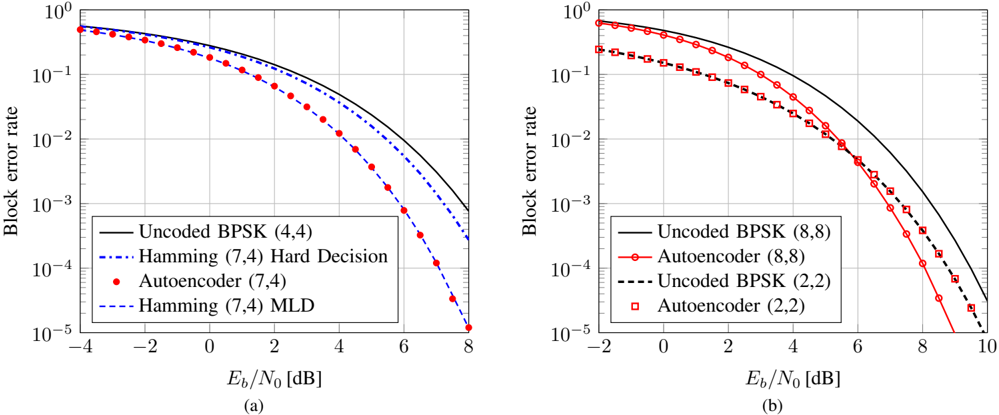
- A learned autoencoder for a (7,4) system at rate R = 4/7 achieves the same block error rate (BLER) as a Hamming (7,4) code with maximum likelihood decoding, while an (8,8) autoencoder outperforms uncoded BPSK over the full E_b/N_0 range, indicating learned joint coding and modulation.
- For the two-user AWGN interference channel, the autoencoder matches time-sharing for (1,1) and (2,2), but achieves gains of about 0.7 dB for (4,4) and 1 dB for (4,8) at a BLER of 10^-3.
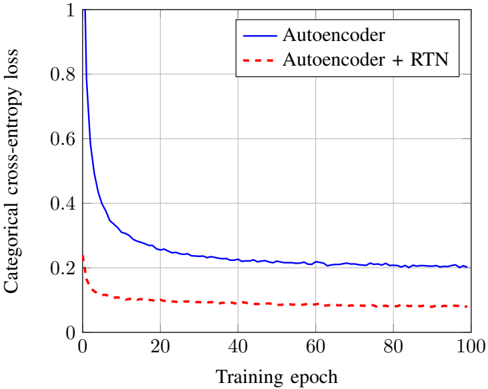
- An autoencoder (8,4) with an RTN over a multipath fading channel with L = 3 Rayleigh taps outperforms differential BPSK with maximum likelihood sequence estimation and a Hamming (7,4) code, whereas the plain autoencoder struggles to match it; RTNs also show faster training convergence.
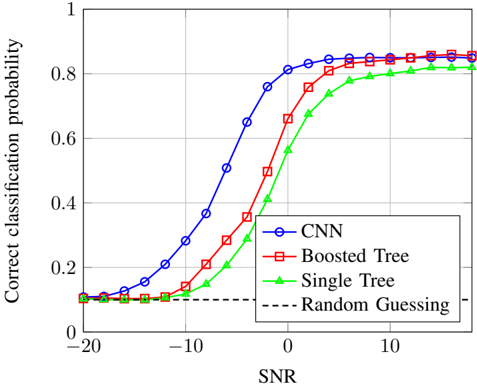
- For modulation classification on 1.2M sequences of 128 complex-valued IQ samples across ten modulation schemes and SNRs from -20 dB to 18 dB, the CNN outperforms a boosted expert-feature classifier by around 4 dB in the low-to-medium SNR range, with almost identical high-SNR performance; a single tree is about 6 dB worse at medium SNR and 3.5% worse at high SNR.
Methods
- The transmitter, channel, and receiver are represented as one deep neural network trained as an autoencoder: one-hot message input, dense layers, normalization layer for transmit constraints, additive noise channel layer, and softmax receiver output, trained with categorical cross-entropy using SGD/Adam at learning rate 0.001 and fixed E_b/N_0 = 7 dB.
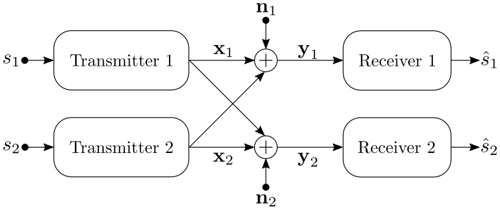
- The autoencoder concept is extended to multiple transmitter-receiver pairs in a two-user interference channel, with dynamic loss weights α_t per mini-batch to balance the two cross-entropy losses; performance is compared against 2^{2k/n}-QAM with time-sharing.
- RTNs combine a learned parameter estimator, a differentiable parametric transform, and a discriminative network; the paper demonstrates phase-offset compensation and multipath inverse filtering. For modulation classification, a VGG-like CNN with 324,330 trainable parameters is trained on the RML2016.10b dataset.
Limitations
- The paper states that scalability to large message sets M is a major challenge: for k = 100 bits, training complexity is prohibitive because the autoencoder must see at least every message once.
- The paper states that optimal data representations, loss functions, training SNR, and hyperparameters are not well understood; training at one SNR does not necessarily generalize to others, and no common communications benchmarks or datasets comparable to MNIST or ImageNet exist.
- The paper states that end-to-end learning over real channels requires system identification because backpropagation assumes a known channel transfer function; complex-valued neural networks are not supported by current DL libraries. Evident from the text: the reported results are simulation-based, use small (n,k) settings, assume known channel models during training, and the paper explicitly leaves detailed performance comparisons for various channel types and parameters to future work.
Model-written summary. Check it against the paper before relying on it.
Integrity signals
Registry
Cites
Statistics
Figures






Verification
Claims the paper makes
6 Valid · 4 Not valid · 18 Not checked · 65 Own results and interpretations
Every source the paper cites for this claim was checked and supports it.
In the paper
“For instance in [22], it was shown that training with a single codeword is sufficient since the structure of the code is embedded in the NN through the Tanner graph.”
What the sources say
- Supportedcites [22] [22] E. Nachmani, Y. Be'ery, and D. Burshtein, 'Learning to decode linear codes using deep learning,' in Proc. IEEE Annu. Allerton Conf. Commun., Control, and Computing (Allerton) , 2016, pp. 341-346. - source
The Introduction says the decoder uses a Tanner graph representing the code and that one codeword suffices for training. Section III explains the precise condition: over a binary memoryless symmetric channel, the decoder’s error rate is independent of the transmitted codeword, so training can use noisy versions of a single codeword. (LLM, conf=0.91)
boostedstates a cause- Asserted: passes — The authors put it forward as true.
- Checkable: passes — It can be checked against evidence.
- Load-bearing: unclear — It is unclear whether the paper’s conclusions depend on it.
- Based: passes — The paper gives a reason why it holds.
- Supported
A result the paper reports from its own data — it cites no other source for it, so there is none to check. The quote shows it is in the paper.
In the paper
“We study the use of NNs on complex-valued IQ samples for the problem of modulation classification and show that convolutional neural networks (CNNs), which are the cornerstone of most DL systems for computer vision, can outperform traditional classification techniques based on expert features.”
plainstates a cause- Asserted: passes — The authors put it forward as true.
- Checkable: passes — It can be checked against evidence.
- Load-bearing: passes — The paper’s conclusions depend on it.
- Based: passes — The paper gives a reason why it holds.
The paper states this without a source or data behind it here, so there is nothing to check it against. The quote shows it is in the paper.
In the paper
“Training at low SNR for instance does not allow for the discovery of structure important in higher SNR scenarios.”
plainstates a cause- Asserted: passes — The authors put it forward as true.
- Checkable: passes — It can be checked against evidence.
- Load-bearing: unclear — It is unclear whether the paper’s conclusions depend on it.
- Based: unclear — It is unclear why the paper says it holds.
A result the paper reports from its own data — it cites no other source for it, so there is none to check. The quote shows it is in the paper.
In the paper
“Another advantage of RTNs is faster training convergence which can be seen from Fig. 10 that compares the validation loss of the autoencoder with and without RTN as a function of the training epochs.”
plainstates a cause- Asserted: passes — The authors put it forward as true.
- Checkable: passes — It can be checked against evidence.
- Load-bearing: unclear — It is unclear whether the paper’s conclusions depend on it.
- Based: passes — The paper gives a reason why it holds.
A result the paper reports from its own data — it cites no other source for it, so there is none to check. The quote shows it is in the paper.
In the paper
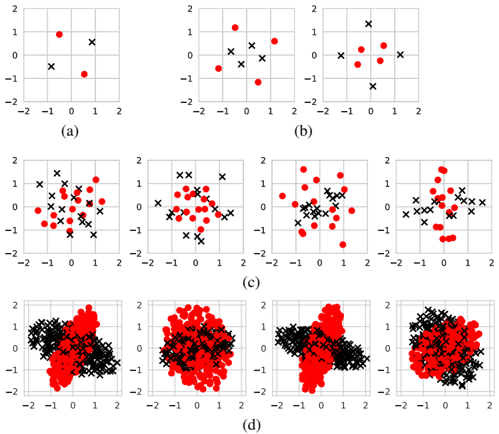
“Similarly, Fig. 4b shows a (4 , 2) system which leads to a rotated 16-PSK constellation.”
plainstates a cause- Asserted: passes — The authors put it forward as true.
- Checkable: passes — It can be checked against evidence.
- Load-bearing: unclear — It is unclear whether the paper’s conclusions depend on it.
- Based: passes — The paper gives a reason why it holds.
39 more claims
Create a free account to see all 93 claims and to verify the 4 references still open.
- Probably not a substantial claim. 29
- It may state two separate claims as one. 24
Self-check
Percentages, sums and reported differences re-computed from the paper’s own numbers.
Each contradiction between two passages listed here was confirmed by an independent check.
Rated minor: it would not touch a result — a value no result rests on, a p-value that stays on the same side of the significance level, or a conflict that is clerical, resolved elsewhere in the paper, or outside its own findings.
In the paper
§ A. Autoencoders for end-to-end communications systems · p. 5
“Similarly, Fig. 4b shows a (4 , 2) system which leads to a rotated 16-PSK constellation.”
§ A. Autoencoders for end-to-end communications systems · p. 6
“Figure 4: Constellations produced by autoencoders using parameters ( n, k ) : (a) (2 , 2) (b) (2 , 4) , (c) (2 , 4) with average power constraint, (d) (7 , 4) 2-dimensional t-SNE embedding of received symbols.”
Citations
Cites
Very Deep Convolutional Networks for Large-Scale Image Recognition
Simonyan, K., & Zisserman, A. (2014) · arXiv · doi:10.48550/arxiv.1409.1556 · Cited by 114,148 · cited 1×
“dense/fully-connected layers and terminated with a dense softmax layer for our classifier (similar to a VGG architecture [55]).”
BackgroundAdam: A Method for Stochastic Optimization
Kingma, D. P., & Ba, J. (2014) · arXiv · doi:10.48550/arxiv.1412.6980 · Cited by 98,946 · cited 4×
“Training was done at a fixed value of Eb/N0 = 7 dB (see Section IV-B) using Adam [46] with learning rate 0.”
BackgroundMethodInfluentialA Mathematical Theory of Communication
Shannon, C. E. (1948) · Bell System Technical Journal · doi:10.1002/j.1538-7305.1948.tb01338.x · Cited by 88,486
Scikit-learn: Machine Learning in Python
Pedregosa, F., Varoquaux, G., Gramfort, A., Michel, V., Thirion, B., Grisel, O., Blondel, M., Müller, A., Nothman, J., Louppe, G., et al. (2012) · arXiv · doi:10.48550/arxiv.1201.0490 · Cited by 71,016 · cited 1×
“11, we compare the classification accuracy of the CNN against that of extreme gradient boosting7 with 1000 estimators, as well as a single scikit-learn decision tree [56], operating on a mix of 16 analog and cumulant expert features as proposed in [53] and [57].”
Method(2014) · Cited by 33,419
(2008) · Journal of Machine Learning Research · Cited by 33,051
Human-level control through deep reinforcement learning
Mnih, V., Kavukcuoglu, K., Silver, D., Rusu, A. A., Veness, J., Bellemare, M. G., Graves, A., Riedmiller, M., Fidjeland, A. K., Ostrovski, G., et al. (2015) · Nature · doi:10.1038/nature14236 · Cited by 30,357
(2007) · Electronics: A First Course · doi:10.4324/9780080477527-64 · Cited by 24,923
Pan, S. J., & Yang, Q. (2010) · IEEE Transactions on Knowledge and Data Engineering · doi:10.1109/tkde.2009.191 · Cited by 23,387 · cited 1×
“learning [64] is one appealing candidate for adapting an endto-end communications system trained on a statistical model to”
BackgroundMultilayer feedforward networks are universal approximators
Hornik, K., Stinchcombe, M., & White, H. (1989) · Neural Networks · doi:10.1016/0893-6080(89)90020-8 · Cited by 21,728 · cited 1×
“Third, it has been shown that NNs are universal function approximators [13] and recent work has shown a remarkable”
BackgroundDelving Deep into Rectifiers: Surpassing Human-Level Performance on ImageNet Classification
He, K., Zhang, X., Ren, S., & Sun, J. (2015) · 2015 IEEE International Conference on Computer Vision (ICCV) · doi:10.1109/iccv.2015.123 · Cited by 19,741 · cited 1×
“For example, while it is an almost impossible task to write a robust algorithm for detection of handwritten digits or objects in images, it is almost trivial today to implement DL algorithms that learn to accomplish this task beyond human levels of accuracy [6], [7].”
BackgroundLabaca-Castro, R. (2023) · Machine Learning under Malware Attack · doi:10.1007/978-3-658-40442-0_9 · Cited by 19,272
GAN(Generative Adversarial Nets)
(2017) · Journal of Japan Society for Fuzzy Theory and Intelligent Informatics · doi:10.3156/jsoft.29.5_177_2 · Cited by 19,270
Wireless Communications: Principles and Practice
Rappaport, T. S. (1996) · Cited by 17,370
Object recognition from local scale-invariant features
Lowe, D. G. (1999) · Proceedings of the Seventh IEEE International Conference on Computer Vision · doi:10.1109/iccv.1999.790410 · Cited by 16,472 · cited 2×
“mately outperform and displace long-used expert features, such as the scale-invariant feature transform (SIFT) [8] and Bag-of-words [9].”
BackgroundA fast learning algorithm for deep belief nets
Hinton, G. E., Osindero, S., & Teh, Y.-W. (2006) · Neural Computation · doi:10.1162/neco.2006.18.7.1527 · Cited by 16,336 · cited 1×
“Layerby-layer pre-training [45] was also a recently popular method for scaling training to larger networks where backpropagation once struggled.”
Method(2010) · International Conference on Machine Learning · Cited by 13,995
Caffe: Convolutional Architecture for Fast Feature Embedding
Jia, Y., Shelhamer, E., Donahue, J., Karayev, S., Long, J., Girshick, R., Guadarrama, S., & Darrell, T. (2014) · Proceedings of the 22nd ACM international conference on Multimedia · doi:10.1145/2647868.2654889 · Cited by 11,077
TensorFlow: Large-Scale Machine Learning on Heterogeneous Distributed Systems
Abadi, M., Agarwal, A., Barham, P., Brevdo, E., Chen, Z., Citro, C., Corrado, G. S., Davis, A., Dean, J., Devin, M., et al. (2016) · arXiv · doi:10.48550/arxiv.1603.04467 · Cited by 9,408
Multilayer feedforward networks are universal approximators
HornikK., StinchcombeM., & WhiteH. (1989) · Neural Networks · doi:10.5555/70405.70408 · Cited by 9,081
Scikit-learn: Machine Learning in Python
(2011) · Journal of Machine Learning Research · doi:10.5555/1953048.2078195 · Cited by 8,539 · cited 1×
“11, we compare the classification accuracy of the CNN against that of extreme gradient boosting7 with 1000 estimators, as well as a single scikit-learn decision tree [56], operating on a mix of 16 analog and cumulant expert features as proposed in [53] and [57].”
Method(2012) · Cited by 8,009
Asynchronous Methods for Deep Reinforcement Learning
Mnih, V., Badia, A. P., Mirza, M., Graves, A., Lillicrap, T. P., Harley, T., Silver, D., & Kavukcuoglu, K. (2016) · arXiv · doi:10.48550/arxiv.1602.01783 · Cited by 7,132
Jaderberg, M., Simonyan, K., Zisserman, A., & Kavukcuoglu, K. (2015) · arXiv · doi:10.48550/arxiv.1506.02025 · Cited by 5,137 · cited 1×
“RTNs are a form of learned feed-forward attention inspired by Spatial Transformer Networks (STNs) [51] which have worked well for computer vision problems.”
BackgroundHarris, Z. S. (1954) · WORD · doi:10.1080/00437956.1954.11659520 · Cited by 4,807
Large Scale Distributed Deep Networks
Dean, J. B., Corrado, G. S., Monga, R., Chen, K., Devin, M., Mao, M., Ranzato, M., Senior, A., Tucker, P. A., Yang, K., et al. (2012) · neural information processing systems · Cited by 4,489
Caffe: Convolutional Architecture for Fast Feature Embedding
Jia, Y., Shelhamer, E., Donahue, J., Karayev, S., Long, J., Girshick, R., Guadarrama, S., & Darrell, T. J. (2014) · arXiv (Cornell University) · doi:10.48550/arxiv.1408.5093 · Cited by 3,752
Eyeriss: An Energy-Efficient Reconfigurable Accelerator for Deep Convolutional Neural Networks
Chen, Y.-H., Krishna, T., Emer, J. S., & Sze, V. (2017) · IEEE Journal of Solid-State Circuits · doi:10.1109/jssc.2016.2616357 · Cited by 3,247 · cited 1×
“, [17]), have shown to be very energy efficient and capable of impressive computational throughput when fully utilized by concurrent algorithms [18].”
BackgroundMXNet: A Flexible and Efficient Machine Learning Library for Heterogeneous Distributed Systems
Chen, T., Li, M., Li, Y., Lin, M., Wang, N., Wang, M., Xiao, T., Xu, B., Zhang, C., & Zhang, Z. (2015) · arXiv · doi:10.48550/arxiv.1512.01274 · Cited by 1,819 · cited 2×
“Among these are Caffe [38], MXNet [39], TensorFlow [40], Theano [41], and Torch [42] (just to name a few), which allow for high level algorithm definition in various programming languages or configuration files, automatic differentiation of training loss functions through arbitrarily large networks, and compilation of…”
BackgroundStatic Analysis of Shape in TensorFlow Programs
The Theano Development Team, Al‐Rfou, R., Alain, G., Almahairi, A., Angermueller, C., Bahdanau, D., Ballas, N., Bastien, F., Bayer, J., Belikov, A., et al. (2016) · arXiv (Cornell University) · doi:10.4230/lipics.ecoop.2020.15 · Cited by 1,589 · cited 3×
“Among these are Caffe [38], MXNet [39], TensorFlow [40], Theano [41], and Torch [42] (just to name a few), which allow for high level algorithm definition in various programming languages or configuration files, automatic differentiation of training loss functions through arbitrarily large networks, and compilation of…”
BackgroundConvolutional Radio Modulation Recognition Networks
O’Shea, T. J., Corgan, J., & Clancy, T. C. (2016) · Communications in Computer and Information Science · doi:10.1007/978-3-319-44188-7_16 · Cited by 1,584
Self-citationHybrid computing using a neural network with dynamic external memory
Graves, A., Wayne, G., Reynolds, M., Harley, T., Danihelka, I., Grabska-Barwińska, A., Colmenarejo, S. G., Grefenstette, E., Ramalho, T., Agapiou, J., et al. (2016) · Nature · doi:10.1038/nature20101 · Cited by 1,412
Dynamic System Identification - Experiment Design and Data Analysis
(1977) · Mathematics in Science and Engineering · doi:10.1016/s0076-5392(08)x6188-0 · Cited by 1,398
Torch7: A Matlab-like Environment for Machine Learning
Collobert, R., Kavukcuoglu, K., & Farabet, C. (2011) · Infoscience (Ecole Polytechnique Fédérale de Lausanne) · Cited by 1,186
Eyeriss: a spatial architecture for energy-efficient dataflow for convolutional neural networks
Chen, Y.-H., Emer, J., & Sze, V. (2016) · ACM SIGARCH Computer Architecture News · doi:10.1145/3007787.3001177 · Cited by 1,182
Digital communication receivers: Synchronization, channel estimation, and signal processing
Meyr, H., Moeneclaey, M., & Fechtel, S. A. (2001) · doi:10.1002/0471200573 · Cited by 1,158 · cited 2×
“COMMUNICATIONS is a field of rich expert knowledge about how to model channels of different types [1], [2], compensate for various hardware imperfections [3], [4], and design optimal signaling and detection schemes that ensure a reliable transfer of data [5].”
Background8-PSK trellis codes for a Rayleigh channel
Zehavi, E. (1992) · IEEE Transactions on Communications · doi:10.1109/26.141453 · Cited by 1,018 · cited 1×
“example, the separation of source and channel coding for many practical channels and short block lengths (see [10] and references therein) as well as separate coding and modulation [11]”
BackgroundGeneralization and network design strategies
LeCun, Y. (1989) · Cited by 885
Learning to Optimize: Training Deep Neural Networks for Interference Management
Sun, H., Chen, X., Shi, Q., Hong, M., Fu, X., & Sidiropoulos, N. D. (2018) · IEEE Transactions on Signal Processing · doi:10.1109/tsp.2018.2866382 · Cited by 874
Identifying and attacking the saddle point problem in high-dimensional non-convex optimization
Dauphin, Y., Pascanu, R., Gulcehre, C., Cho, K., Ganguli, S., & Bengio, Y. (2014) · arXiv · doi:10.48550/arxiv.1406.2572 · Cited by 827 · cited 1×
“making such solutions more likely to emerge as saddle points during optimization [47].”
BackgroundLarge-scale deep unsupervised learning using graphics processors
Raina, R., Madhavan, A., & Ng, A. Y. (2009) · Proceedings of the 26th Annual International Conference on Machine Learning · doi:10.1145/1553374.1553486 · Cited by 742 · cited 1×
“, [17]), have shown to be very energy efficient and capable of impressive computational throughput when fully utilized by concurrent algorithms [18].”
Background(2011) · Cited by 713
Algorithms for automatic modulation recognition of communication signals
Nandi, A. K., & Azzouz, E. E. (1998) · IEEE Transactions on Communications · doi:10.1109/26.664294 · Cited by 703 · cited 19×
“In recent times, numerous tools and algorithms have emerged that make it easy to build and train large NNs. Tools to deploy such training routines from high level language to massively parallel GPU architectures have been key enablers.”
BackgroundMethodInfluentialRF Imperfections in High-rate Wireless Systems
Schenk, T. (2008) · doi:10.1007/978-1-4020-6903-1 · Cited by 616
A Survey on Machine-Learning Techniques in Cognitive Radios
Bkassiny, M., Li, Y., & Jayaweera, S. K. (2013) · IEEE Communications Surveys & Tutorials · doi:10.1109/surv.2012.100412.00017 · Cited by 580 · cited 1×
“These comprise channel modeling and prediction, localization, equalization, decoding, quantization, compression, demodulation, modulation recognition, and spectrum sensing, to name a few [19], [20] (and references therein).”
BackgroundLearning to decode linear codes using deep learning
Nachmani, E., Be'ery, Y., & Burshtein, D. (2016) · 2016 54th Annual Allerton Conference on Communication, Control, and Computing (Allerton) · doi:10.1109/allerton.2016.7852251 · Cited by 561 · cited 3×
“Among the papers trying to improve existing algorithms are [22]–[24] that consider belief propagation channel decoding and multiple-input multiple-output (MIMO) detection, respectively.”
BackgroundMethodOn deep learning-based channel decoding
Gruber, T., Cammerer, S., Hoydis, J., & Brink, S. T. (2017) · 2017 51st Annual Conference on Information Sciences and Systems (CISS) · doi:10.1109/ciss.2017.7926071 · Cited by 545 · cited 2×
“Some of us have also demonstrated initial results in the area of learned end-to-end communications systems [30] as well as considered the problems of modulation recognition [31], signal compression [32], and channel decoding [33], [34] with state-of-the art DL tools.”
BackgroundSelf-citationComplex-Valued Neural Networks
Hirose, A. (2012) · Studies in Computational Intelligence · doi:10.1007/978-3-642-27632-3 · Cited by 531 · cited 1×
“For this reason, it would be desirable to have NNs operate on complex rather than real numbers [61].”
BackgroundGradient-based Hyperparameter Optimization through Reversible Learning
Maclaurin, D., Duvenaud, D., & Adams, R. P. (2015) · arXiv · doi:10.48550/arxiv.1502.03492 · Cited by 509 · cited 1×
“Examples include architecture search guided by hyper-gradients and differential hyper-parameters [59] as well as genetic algorithm or particle swarm style optimization [60].”
MethodEmotion recognition using wireless signals
Zhao, M., Adib, F., & Katabi, D. (2016) · Proceedings of the 22nd Annual International Conference on Mobile Computing and Networking · doi:10.1145/2973750.2973762 · Cited by 461 · cited 1×
“radio environment needs. New applications beyond the traditional scope of communications, such as tracking and identification of humans (through walls) [47] as well as gesture and emotion recognition [48], could be achieved using ML on radio signals. IV. CONCLUSION We have discussed a number of promising new applicatio…”
BackgroundA new approach to signal classification using spectral correlation and neural networks
Fehske, A., Gaeddert, J., & Reed, J. H. (2005) · First IEEE International Symposium on New Frontiers in Dynamic Spectrum Access Networks, 2005. DySPAN 2005. · doi:10.1109/dyspan.2005.1542629 · Cited by 447 · cited 1×
“Some recent methods take a step beyond this using pattern recognition on expert feature maps, such as the spectral coherence function or α -profile, combined with NN-based classification [54].”
MethodCapturing the human figure through a wall
Adib, F., Hsu, C.-Y., Mao, H., Katabi, D., & Durand, F. (2015) · ACM Transactions on Graphics · doi:10.1145/2816795.2818072 · Cited by 443 · cited 1×
“New applications outside the traditional scope of communications, such as tracking and identification of humans (through walls) [65] as well as gesture and emotion recognition [66], could be achieved using ML on radio signals.”
BackgroundSamuel, N., Diskin, T., & Wiesel, A. (2017) · 2017 IEEE 18th International Workshop on Signal Processing Advances in Wireless Communications (SPAWC) · doi:10.1109/spawc.2017.8227772 · Cited by 429 · cited 2×
“Among the papers trying to improve existing algorithms are [22]–[24] that consider belief propagation channel decoding and multiple-input multiple-output (MIMO) detection, respectively.”
BackgroundMethodDeep Unfolding: Model-Based Inspiration of Novel Deep Architectures
Hershey, J. R., Roux, J. L., & Weninger, F. (2014) · arXiv · doi:10.48550/arxiv.1409.2574 · Cited by 412
Neural Programmer-Interpreters
Reed, S., & de Freitas, N. (2015) · arXiv · doi:10.48550/arxiv.1511.06279 · Cited by 347 · cited 18×
“In recent times, numerous tools and algorithms have emerged that make it easy to build and train large NNs. Tools to deploy such training routines from high level language to massively parallel GPU architectures have been key enablers.”
BackgroundInfluentialSibley, M. J. N. (1995) · doi:10.1007/978-1-349-13524-0 · Cited by 336
Learning to optimize: Training deep neural networks for wireless resource management
Sun, H., Chen, X., Shi, Q., Hong, M., Fu, X., & Sidiropoulos, N. D. (2017) · 2017 IEEE 18th International Workshop on Signal Processing Advances in Wireless Communications (SPAWC) · doi:10.1109/spawc.2017.8227766 · Cited by 308 · cited 1×
“The idea of learning to solve complex optimization tasks for wireless resource allocation is investigated in [29].”
BackgroundDeep neural networks to enable real-time multimessenger astrophysics
George, D., & Huerta, E. A. (2018) · Physical Review D · doi:10.1103/physrevd.97.044039 · Cited by 281 · cited 2×
“George and Huerta [58] report on a successful application of a similar CNN for the detection of black hole mergers in astrophysics from noisy time-series data.”
BackgroundReinforcement Learning with Unsupervised Auxiliary Tasks
Jaderberg, M., Mnih, V., Czarnecki, W. M., Schaul, T., Leibo, J. Z., Silver, D., & Kavukcuoglu, K. (2016) · arXiv (Cornell University) · doi:10.48550/arxiv.1611.05397 · Cited by 247
On the computational power of neural nets
Siegelmann, H. T., & Sontag, E. D. (1992) · Proceedings of the fifth annual workshop on Computational learning theory · doi:10.1145/130385.130432 · Cited by 238 · cited 2×
“capacity for algorithmic learning with recurrent NNs [14] that are known to be Turing-complete [15].”
BackgroundLearning to communicate: Channel auto-encoders, domain specific regularizers, and attention
O'Shea, T. J., Karra, K., & Clancy, T. C. (2016) · 2016 IEEE International Symposium on Signal Processing and Information Technology (ISSPIT) · doi:10.1109/isspit.2016.7886039 · Cited by 235 · cited 1×
“Some of us have also demonstrated initial results in the area of learned end-to-end communications systems [30] as well as considered the problems of modulation recognition [31], signal compression [32], and channel decoding [33], [34] with state-of-the art DL tools.”
BackgroundSelf-citationApplications of neural networks to digital communications – a survey
Ibnkahla, M. (2000) · Signal Processing · doi:10.1016/s0165-1684(00)00030-x · Cited by 233
Complex-Valued Neural Networks
Hirose, A. (2006) · Studies in Computational Intelligence · doi:10.1007/978-3-540-33457-6 · Cited by 226
Scaling Deep Learning-Based Decoding of Polar Codes via Partitioning
Cammerer, S., Gruber, T., Hoydis, J., & ten Brink, S. (2017) · GLOBECOM 2017 - 2017 IEEE Global Communications Conference · doi:10.1109/glocom.2017.8254811 · Cited by 196 · cited 1×
“of modulation recognition [31], signal compression [32], and channel decoding [33], [34] with state-of-the art DL tools.”
Self-citationLearning to Protect Communications with Adversarial Neural Cryptography
Abadi, M., & Andersen, D. G. (2016) · arXiv · doi:10.48550/arxiv.1610.06918 · Cited by 182 · cited 2×
“However, in [50], the concept of learning information encoder and decoder which adapt to a variable key to provide privacy is introduced.”
BackgroundWymeersch, H. (2007) · doi:10.1017/cbo9780511619199 · Cited by 168
Learning Radio Resource Management in RANs: Framework, Opportunities, and Challenges
Calabrese, F. D., Wang, L., Ghadimi, E., Peters, G., Hanzo, L., & Soldati, P. (2018) · IEEE Communications Magazine · doi:10.1109/mcom.2018.1701031 · Cited by 154
Zorzi, M., Zanella, A., Testolin, A., De Filippo De Grazia, M., & Zorzi, M. (2015) · IEEE Access · doi:10.1109/access.2015.2471178 · Cited by 118 · cited 1×
“The advent of open-source DL libraries (see Section II-B) and readily available specialized hardware along with the astonishing progress of DL in computer vision have stimulated renewed interest in the application of DL for communications and networking [21] (and other papers in the special issue).”
BackgroundDetection Algorithms for Communication Systems Using Deep Learning
Farsad, N., & Goldsmith, A. J. (2017) · arXiv (Cornell University) · doi:10.48550/arxiv.1705.08044 · Cited by 115 · cited 1×
“The approach of replacing existing algorithms through DL is adopted in [27], dealing with blind detection for MIMO systems with low-resolution quantization, and [28], in which detection for molecular communications for which no mathematical channel model exists is studied.”
MethodSupervised-Learning-Aided Communication Framework for MIMO Systems With Low-Resolution ADCs
Jeon, Y., Hong, S., & Lee, N. (2018) · IEEE Transactions on Vehicular Technology · doi:10.1109/tvt.2018.2832845 · Cited by 106
Abdelmutalab, A., Assaleh, K. T., & El‐Tarhuni, M. (2016) · Physical Communication · doi:10.1016/j.phycom.2016.08.001 · Cited by 99 · cited 1×
“11, we compare the classification accuracy of the CNN against that of extreme gradient boosting7 with 1000 estimators, as well as a single scikit-learn decision tree [56], operating on a mix of 16 analog and cumulant expert features as proposed in [53] and [57].”
MethodRNN Decoding of Linear Block Codes
Nachmani, E., Marciano, E., Burshtein, D., & Be'ery, Y. (2017) · arXiv · doi:10.48550/arxiv.1702.07560 · Cited by 93 · cited 2×
“Among the papers falling into the first category are [22], [23] and [24] that consider improved belief propagation channel decoding and multiple-input multiple-output (MIMO) detection, respectively.”
BackgroundMethodReinforcement Learning Neural Turing Machines - Revised
Zaremba, W., & Sutskever, I. (2015) · arXiv (Cornell University) · doi:10.48550/arxiv.1505.00521 · Cited by 93
Unsupervised representation learning of structured radio communication signals
O’Shea, T. J., Corgan, J., & Clancy, T. C. (2016) · International Workshop on Sensing, Processing and Learning for Intelligent Machines (SPLINE) · doi:10.1109/splim.2016.7528397 · Cited by 92 · cited 1×
“of modulation recognition [31], signal compression [32], and channel decoding [33], [34] with state-of-the art DL tools.”
Self-citationOnsager-corrected deep learning for sparse linear inverse problems
Borgerding, M., & Schniter, P. (2016) · 2016 IEEE Global Conference on Signal and Information Processing (GlobalSIP) · doi:10.1109/globalsip.2016.7905837 · Cited by 92 · cited 1×
“In a similar manner, [26] aims at improving the solution of sparse linear inverse problems with DL.”
BackgroundOn Deep Learning-Based Channel DecodingPreprint
Gruber, T., Cammerer, S., Hoydis, J., & ten Brink, S. (2017) · arXiv (Cornell University) · doi:10.48550/arxiv.1701.07738 · Cited by 72 · cited 2×
“Some of us have also demonstrated initial results in the area of learned end-to-end communications systems [30] as well as considered the problems of modulation recognition [31], signal compression [32], and channel decoding [33], [34] with state-of-the art DL tools.”
BackgroundSelf-citationBlind detection for MIMO systems with low-resolution ADCs using supervised learning
Jeon, Y., Hong, S., & Lee, N. (2017) · International Conference on Communications · doi:10.1109/icc.2017.7997434 · Cited by 68 · cited 1×
“The approach of replacing existing algorithms through DL is adopted in [27], dealing with blind detection for MIMO systems with low-resolution quantization, and [28], in which detection for molecular communications for which no mathematical channel model exists is studied.”
MethodAmin, M. F., Amin, M. I., Al-Nuaimi, A. Y. H., & Murase, K. (2011) · Lecture Notes in Computer Science · doi:10.1007/978-3-642-24955-6_66 · Cited by 65 · cited 1×
“A solution to this problem is Wirtinger calculus [62].”
BackgroundConvolutional Radio Modulation Recognition NetworksPreprint
O’Shea, T. J., Corgan, J., & Clancy, T. C. (2016) · arXiv (Cornell University) · doi:10.48550/arxiv.1602.04105 · Cited by 60
Self-citationLearning to Invert: Signal Recovery via Deep Convolutional NetworksPreprint
Mousavi, A., & Baraniuk, R. G. (2017) · arXiv (Cornell University) · doi:10.48550/arxiv.1701.03891 · Cited by 45
8-PSK trellis codes on Rayleigh channel
Zehavi, E. (2003) · IEEE Military Communications Conference (MILCOM) · doi:10.1109/milcom.1989.103984 · Cited by 38
Joint source/channel coding for wireless channels
Goldsmith, A. (2002) · 1995 IEEE 45th Vehicular Technology Conference. Countdown to the Wireless Twenty-First Century · doi:10.1109/vetec.1995.504941 · Cited by 37 · cited 1×
“example, the separation of source and channel coding for many practical channels and short block lengths (see [10] and references therein) as well as separate coding and modulation [11]”
BackgroundScaling Deep Learning-based Decoding of Polar Codes via PartitioningPreprint
Cammerer, S., Gruber, T., Hoydis, J., & ten Brink, S. (2017) · arXiv (Cornell University) · doi:10.48550/arxiv.1702.06901 · Cited by 32 · cited 1×
“of modulation recognition [31], signal compression [32], and channel decoding [33], [34] with state-of-the art DL tools.”
Self-citationIEEE Access Special Section Editorial: Artificial Intelligence Enabled Networking
Qadir, J., Yau, K.-L. A., Imran, M. A., Ni, Q., & Vasilakos, A. V. (2015) · IEEE Access · doi:10.1109/access.2015.2507798 · Cited by 18 · cited 1×
“The advent of open-source DL libraries (see Section II-B) and readily available specialized hardware along with the astonishing progress of DL in computer vision have stimulated renewed interest in the application of DL for communications and networking [21].”
BackgroundUnsupervised Representation Learning of Structured Radio Communication SignalsPreprint
O’Shea, T. J., Corgan, J., & Clancy, T. C. (2016) · arXiv (Cornell University) · doi:10.48550/arxiv.1604.07078 · Cited by 8 · cited 1×
“of modulation recognition [31], signal compression [32], and channel decoding [33], [34] with state-of-the art DL tools.”
Self-citationLearning to Optimize: Training Deep Neural Networks for Wireless Resource ManagementPreprint
Sun, H., Chen, X., Shi, Q., et al. (2017) · arXiv (Cornell University) · doi:10.48550/arxiv.1705.09412 · Cited by 1
Samuel, N., Diskin, T., & Wiesel, A. (2017) · arXiv · doi:10.48550/arxiv.1706.01151 · cited 2×
“Among the papers trying to improve existing algorithms are [22]–[24] that consider belief propagation channel decoding and multiple-input multiple-output (MIMO) detection, respectively.”
BackgroundMethodOnsager-corrected deep learning for sparse linear inverse problems
Borgerding, M., & Schniter, P. (2016) · arXiv · doi:10.48550/arxiv.1607.05966 · cited 1×
“In a similar manner, [26] aims at improving the solution of sparse linear inverse problems with DL.”
BackgroundSupervised-Learning-Aided Communication Framework for MIMO Systems with Low-Resolution ADCs
Jeon, Y.-S., Hong, S.-N., & Lee, N. (2016) · arXiv · doi:10.48550/arxiv.1610.07693
Deep Neural Networks to Enable Real-time Multimessenger Astrophysics
George, D., & Huerta, E. A. (2017) · arXiv · doi:10.48550/arxiv.1701.00008 · cited 2×
“George and Huerta [58] report on a successful application of a similar CNN for the detection of black hole mergers in astrophysics from noisy time-series data.”
BackgroundUntitled work
(2012) · doi:10.5555/2503308.2188395 · cited 1×
“Examples include architecture search guided by hypergradients and differential hyper-parameters [59] as well as genetic algorithm or particle swarm style optimization [60].”
MethodUntitled work
Srivastava (2014) · doi:10.5555/2627435.2670313 · cited 1×
“…today are able to train networks which are both wide and deep directly using back-propagation and SGD methods with adaptive learning rates (e.g., Adam [46]), regularization methods to prevent overfitting (e.g., Dropout [36]), and activations functions which reduce gradient issues (e.g., ReLU [37]).”
Method
Research works printed but not linked: 5
- goodfellow, 2016, Deep Learning
- estaran, 2016, Artificial neural networks for linear and non-linear impairment mitigation in high-baudrate IM/DD systems, Proc 42nd Eur Conf Opt Commun (ECOC), 1
- al-rfou, 2016, Theano: A Python framework for fast computation of mathematical expressions, arXiv preprint arXiv 1605 01584
- o’shea, 2017, Source Code
- chollet, 2015, Keras
Cited by
On the Road to 6G: Visions, Requirements, Key Technologies, and Testbeds
Wang, C.-X., You, X., Gao, X., Zhu, X., Li, Z., Zhang, C., Wang, H., Huang, Y., Chen, Y., Haas, H., et al. (2023) · IEEE Communications Surveys & Tutorials · doi:10.1109/comst.2023.3249835 · Cited by 2,336
Towards 6G wireless communication networks: vision, enabling technologies, and new paradigm shifts
You, X., Wang, C.-X., Huang, J., Gao, X., Zhang, Z., Wang, M., Huang, Y., Zhang, C., Jiang, Y., Wang, J., et al. (2021) · Science China Information Sciences · doi:10.1007/s11432-020-2955-6 · Cited by 2,027
Deep Learning in Mobile and Wireless Networking: A Survey
Zhang, C., Patras, P., & Haddadi, H. (2019) · IEEE Communications Surveys & Tutorials · doi:10.1109/comst.2019.2904897 · Cited by 1,768
Over-the-Air Deep Learning Based Radio Signal Classification
O'Shea, T. J., Roy, T., & Clancy, T. C. (2018) · IEEE Journal of Selected Topics in Signal Processing · doi:10.1109/jstsp.2018.2797022 · Cited by 1,607
Self-citationDeep Learning Enabled Semantic Communication Systems
Xie, H., Qin, Z., Li, G. Y., & Juang, B.-H. (2021) · IEEE Transactions on Signal Processing · doi:10.1109/tsp.2021.3071210 · Cited by 1,602
“In the communication area, some pioneering works have been carried on DL based E2E physical layer communication systems, which merge the blocks in traditional communication systems [17]–[23].”
BackgroundInfluential
Metadata
- Authors
- O'Shea, T., & Hoydis, J.
- Affiliations
- Nokia (France) (FR)
- Venue
- IEEE Transactions on Cognitive Communications and Networking
- Published
- 2017-12
- Volume
- 3
- Issue
- 4
- Pages
- 563-575
- ISSN
- 2332-7731 (ISSN-L)
- OpenAlex
- W2734408173
- Semantic Scholar
- 78989616eeeac55b202e3e4205225e7135054185
- Cited by
- 2,980
- References
- 69
- Citations by year
- 2026: 307 · 2025: 327 · 2024: 305 · 2023: 368 · 2022: 432 · 2021: 409 · 2020: 406 · 2019: 322 · 2018: 95 · 2017: 9
- FWCI
- 122.29
- Type
- journal article
- Language
- en
- Open access
- green
- arxiv.org
- Locations
- IEEE Transactions on Cognitive Communications and Networking (publishedVersion)
- arXiv (Cornell University) (submittedVersion)
- arXiv (Cornell University)
- Topics
- Physical Sciences › Computer Science › Artificial Intelligence › Wireless Signal Modulation Classification
- Physical Sciences › Engineering › Electrical and Electronic Engineering › Advanced Wireless Communication Techniques
- Physical Sciences › Engineering › Electrical and Electronic Engineering › Advanced Wireless Communication Technologies
- Keywords
- end-to-end reconstruction, domain knowledge integration, convolutional neural networks, automatic modulation classification, IQ samples
About these checks
Registry, retraction, Cites and statistics results are computed, not judged, with one exception: a printed reference that no index lists is read once by a model before it counts as a citation error. Claims are extracted by a model and kept only when their quote appears verbatim in the text; each cited source is then checked, with a model’s help, for whether it says what the claim relies on. Those verdicts can be wrong — read the claim’s quote and the cited source before relying on one.
The claim verdicts this report counts are experimental: their accuracy is not yet measured.
A language model drew the claims from the paper on 2026-11-07, under version 3 of the claim definition (model deepseek-v4.1-flash, prompt extract-v3).
A second model labelled each claim on 2026-11-07 (model jev-1.13-20260917, definition revision gold-guideline-v0.2).
Cited sources are checked with a language model’s help (gpt-6-sol).
Statistics and arithmetic are recomputed, not judged.
Confidence bands are shown only for fields calibrated on our annotated test set. None is calibrated yet, so no band is shown.
What counts as a claim ›How we measure confidence ›How we check this ›
Are you an author, or do you see a problem with this page? Request a review
Data sources
Bibliographic data: Semantic Scholar, OpenAlex, Crossref.
Contains information from the Semantic Scholar Academic Graph Datasets, made available under the ODC Attribution License (ODC-BY 1.0).
Semantic Scholar’s data is described in: Kinney, R., et al. (2023). The Semantic Scholar Open Data Platform. arXiv:2301.10140.
