

Self-Supervised Learning for Time Series Analysis: Taxonomy, Progress, and Prospects
Open accessThe DOI matches its Crossref record; 222 of the 232 references it cites were found in a registry or an index, and 2 are not checked yet; 86 of the 189 sources its claims cite were checked for support.
Abstract
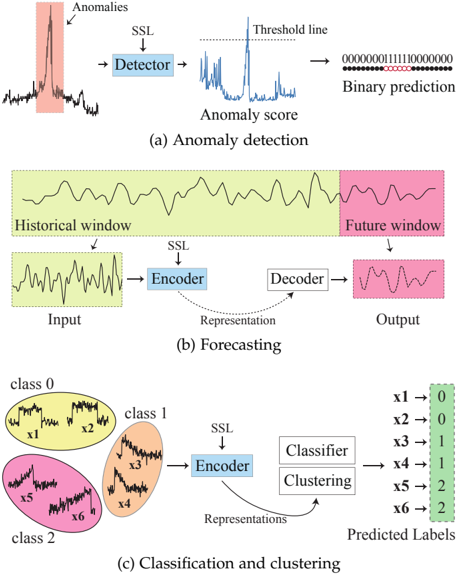
A comprehensive survey of current state-of-the-art SSL methods for time series data, proposing a taxonomy categorizing methods into generative-based, contrastive-based, and adversarial-based across ten subcategories, along with benchmark datasets for forecasting, classification, anomaly detection, and clustering.
Verified 2026-11-19 · 2 references not checked yet
Overview
CoChat Summary
TL;DR
This survey reviews self-supervised learning (SSL) for time series, proposing a taxonomy of generative-based, contrastive-based, and adversarial-based methods divided into ten subcategories. It summarizes applications/datasets and future directions, and compiles quantitative comparisons showing no single SSL method dominates across tasks.
Key findings
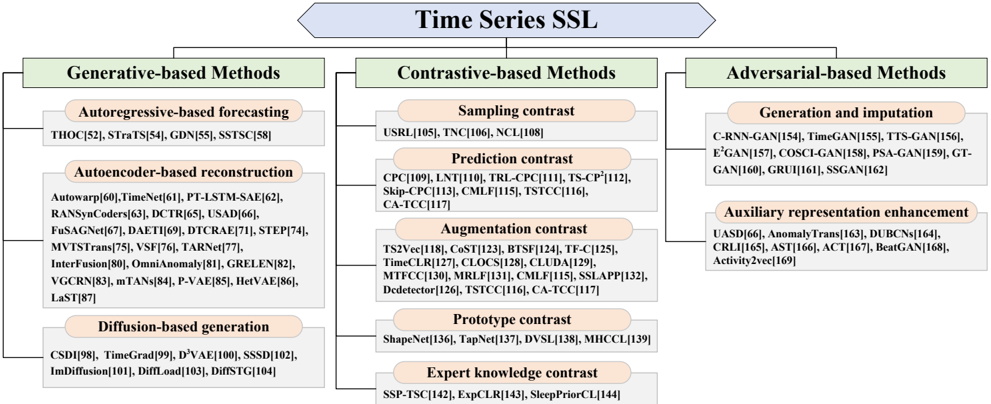
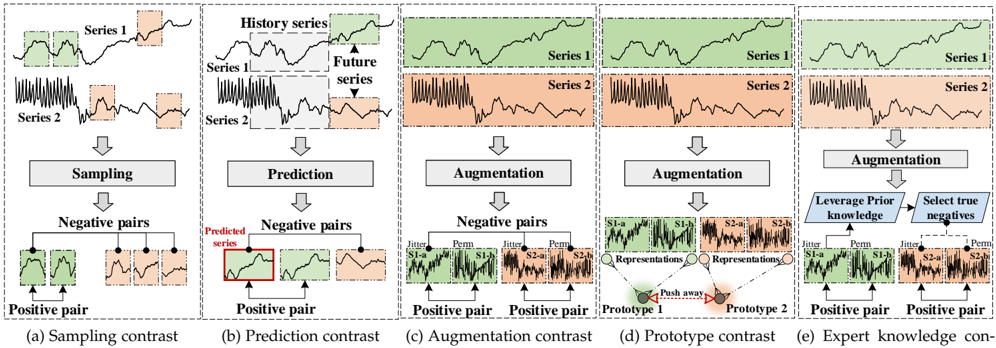
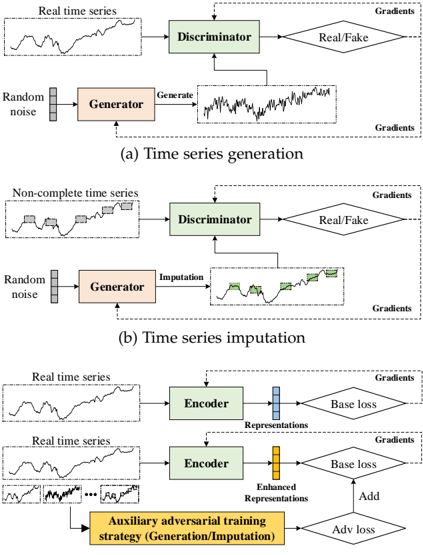
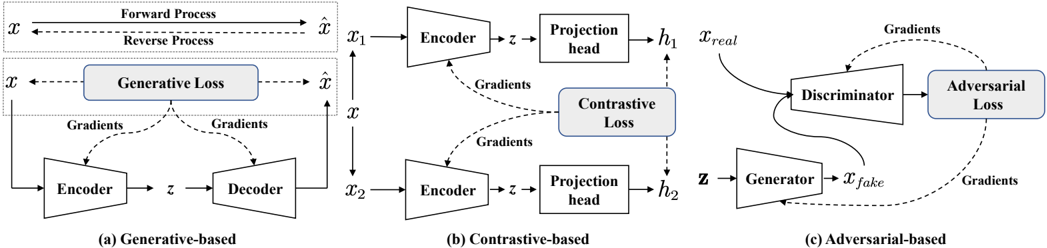
- The paper proposes a taxonomy with three broad SSL paradigms and ten subcategories: autoregressive-based forecasting, autoencoder-based reconstruction, diffusion-based generation; sampling contrast, prediction contrast, augmentation contrast, prototype contrast, expert knowledge contrast; generation/imputation and auxiliary representation enhancement.
- For anomaly detection, contrastive methods such as Skip-CPC and Dcdetector are reported as achieving the best performance on four datasets; Dcdetector reaches F1 scores of 97.94 on PSM, 96.60 on MSL, 97.02 on SMAP, and 96.33 on SWaT, while Skip-CPC reaches F1 98.55 on PSM, 94.46 on SMD, and 92.75 on MSL.
- For forecasting, LaST and CoST show significant advantages; LaST reports ETTh H=24 MSE/MAE of 0.324/0.368, ETTm 0.218/0.289, Electricity 0.125/0.222, and Weather 0.105/0.134.
- For classification and clustering, results on 30 datasets from HAR, UCR, and UEA show that no single method achieves the best performance on all datasets, and most methods are based on self-supervised contrastive learning.
Methods
- Design: a comprehensive literature survey that reviews existing SSL and time series surveys, then organizes time series SSL methods by learning paradigm and by how positive/negative samples or pretext tasks are constructed.
- Data/resources: summarizes commonly used datasets for anomaly detection, forecasting, classification, and clustering, including PSM, SMD, MSL, SMAP, SWaT, WADI, ETTh, ETTm, Electricity, Weather, HAR, UCR 128, and UEA 30.
- Analysis: qualitative review of frameworks, mathematical formulations, advantages/disadvantages, plus compiled quantitative comparisons from prior work on anomaly detection (five datasets), forecasting (four datasets), and classification/clustering (30 datasets); no new experiments are reported.
Limitations
- The paper states that prior time series SSL surveys only discuss a small part of self-supervised contrastive learning, lack benchmark dataset summaries, and have scarce future directions; it positions itself as filling that gap.
- It also summarizes method-family limitations: generative-based methods are sensitive to rare instances and lack high-level semantic information; contrastive-based methods face sampling bias and augmentation uncertainty; adversarial-based methods suffer unstable training and are rarely used for feature extraction.
- Evident from the text: as a survey, it does not run a unified benchmark; the quantitative tables are collected from prior papers and contain missing entries (“-”), so comparisons are incomplete, and the paper itself calls for reliable benchmark evaluation as a future direction.
Model-written summary. Check it against the paper before relying on it.
Integrity signals
Registry
Cites
Statistics
Figures

Verification
Claims the paper makes
66 Valid · 26 Not valid · 63 Not checked · 80 Own results and interpretations
The cited sources support only part of this claim — read each source’s verdict below.
In the paper
“Methods for constructing multiple contrastive views based on multi-granularity or multi-scale augmentations also include MRLF [131], CMLF [115], and SSLAPP [132].”
What the sources say
- Not checked — no full text of the sourcecites [131] [131] M. Hou, C. Xu, Z. Li, Y. Liu, W. Liu, E. Chen, and J. Bian, 'Multigranularity residual learning with confidence estimation for time series prediction,' in Proceedings of the ACM Web Conference 2022 , ser. WWW '22, 2022, p. 112-121. - source
- Not checked — no full text of the sourcecites [115] [115] M. Hou, C. Xu, Y. Liu, W. Liu, J. Bian, L. Wu, Z. Li, E. Chen, and T.-Y. Liu, 'Stock trend prediction with multi-granularity data: A contrastive learning approach with adaptive fusion,' Proceedings of the 30th ACM International Conference on Information & Knowledge Management , p. 700-709, 2021. - source
- Partly supportedcites [132] [132] H. Lee, E. Seong, and D.-K. Chae, 'Self-supervised learning with attention-based latent signal augmentation for sleep staging with limited labeled data,' in Proceedings of the Thirty-First International Joint Conference on Artificial Intelligence, IJCAI-22 , 7 2022, pp. 38683876, main Track. - sourceExperimental — accuracy not yet measured
Sections 3.2 and 3.3 describe SSLAPP constructing two augmented views as a positive pair and learning from global and local features. But Section 3.2 explicitly says SSLAPP uses pairwise representation learning instead of contrastive learning; the global and local distinction applies to its loss terms, not to multi-scale augmentations. The citation identifies SSLAPP correctly but mischaracterizes its method. (LLM, conf=0.88)
plain- Asserted: passes — The authors put it forward as true.
- Checkable: passes — It can be checked against evidence.
- Load-bearing: unclear — It is unclear whether the paper’s conclusions depend on it.
- Based: passes — The paper gives a reason why it holds.
Every source the paper cites for this claim was checked and supports it.
In the paper
“However, introducing reasonable inductive bias or prior is helpful for many deep neural networks-based modeling tasks [140], [196], [197].”
What the sources say
- Supportedcites [140] [140] X. Wu, L. Xiao, Y. Sun, J. Zhang, T. Ma, and L. He, 'A survey of human-in-the-loop for machine learning,' Future Generation Computer Systems , vol. 135, pp. 364-381, 2022. - source
The Introduction (§1.1; page not provided) says integrating prior knowledge into a learning framework is effective for sparse data and describes its use across several applications. This supports the broad claim that suitable priors can help deep-learning modeling tasks. (LLM, conf=0.85)
- Supportedcites [196] [196] C. Deng, X. Ji, C. Rainey, J. Zhang, and W. Lu, 'Integrating machine learning with human knowledge,' iScience , vol. 23, no. 11, p. 101656, 2020. - source
The Network Architecture section says that adding domain-specific components to neural networks can boost performance and that task-targeted architectures can generalize better. It gives examples for different data and tasks, supporting the broad claim that appropriate inductive biases are helpful in neural-network modeling. (LLM, conf=0.91)
- Supportedcites [197] [197] Y. Chen and D. Zhang, 'Integration of knowledge and data in machine learning,' 2022. - source
The Introduction (page not available in our copy) says that embedding domain knowledge can improve model accuracy and robustness, and that it can improve machine-learning performance. Section 3.1 describes several ways to incorporate prior knowledge into neural networks across different applications, supporting the citing sentence’s broad, qualified claim. (LLM, conf=0.91)
plainstates a cause- Asserted: passes — The authors put it forward as true.
- Checkable: passes — It can be checked against evidence.
- Load-bearing: passes — The paper’s conclusions depend on it.
- Based: passes — The paper gives a reason why it holds.
- Rests on 2 assumptions not shown here.
- Supported
Every source the paper cites for this claim was checked and supports it.
In the paper
“Unlike previous frameworks, SSGAN's classification network makes full use of label information, which helps the model achieve more accurate imputations.”
What the sources say
- Supportedcites [162] [162] X. Miao, Y. Wu, J. Wang, Y. Gao, X. Mao, and J. Yin, 'Generative semi-supervised learning for multivariate time series imputation,' Proceedings of the AAAI Conference on Artificial Intelligence , vol. 35, no. 10, pp. 8983-8991, May 2021. - source
The Classifier Network passage says SSGAN’s classifier uses self-training to make full use of label information in partially labeled time series and guides the generator during imputation. The Ablation Study reports that removing the classifier reduces imputation accuracy by an average of 1.36%, supporting its contribution to more accurate imputations. (LLM, conf=0.94)
plainstates a cause- Asserted: passes — The authors put it forward as true.
- Checkable: passes — It can be checked against evidence.
- Load-bearing: unclear — It is unclear whether the paper’s conclusions depend on it.
- Based: passes — The paper gives a reason why it holds.
- Supported
The cited sources support only part of this claim — read each source’s verdict below.
In the paper
“It is beneficial to introduce an adversarial-based SSL, which can further amplify the difference between normal and anomalous data, such as USAD [66] and DAEMON [184].”
What the sources say
- Partly supportedcites [66] [66] J. Audibert, P. Michiardi, F. Guyard, S. Marti, and M. A. Zuluaga, 'USAD: Unsupervised anomaly detection on multivariate time series,' in Proceedings of the 26th ACM SIGKDD International Conference on Knowledge Discovery & Data Mining , ser. KDD '20, 2020, p. 3395-3404. - sourceExperimental — accuracy not yet measured
Section 5.4 (Ablation Study; page unavailable) reports that adversarial training improves USAD’s F1 score and helps detect anomalies close to normal data. Section 3.2 describes USAD as an unsupervised autoencoder method with adversarial training, but the copy does not identify it as self-supervised learning (SSL). (LLM, conf=0.82)
- Partly supportedcites [184] [184] X. Chen, L. Deng, Y. Zhao, and K. Zheng, 'Adversarial autoencoder for unsupervised time series anomaly detection and interpretation,' in Proceedings of the Sixteenth ACM International Conference on Web Search and Data Mining , ser. WSDM '23, New York, NY, USA, 2023, p. 267-275. - sourceExperimental — accuracy not yet measured
The Abstract and §2.2 identify DAEMON as an unsupervised anomaly detector that uses adversarial training to learn normal time-series patterns; the model-variant results in §4.5.2 report a benefit from adversarial regularization. The paper does not describe DAEMON as self-supervised learning (SSL) or establish that adversarial training amplifies the difference between normal and anomalous data. The cited paper is DAEMON, so this verdict does not assess USAD. (LLM, conf=0.84)
plainstates a cause- Asserted: passes — The authors put it forward as true.
- Checkable: passes — It can be checked against evidence.
- Load-bearing: unclear — It is unclear whether the paper’s conclusions depend on it.
- Based: passes — The paper gives a reason why it holds.
- Partly supported
The cited sources support only part of this claim — read each source’s verdict below.
In the paper
“In recent years, many scholars have also explored the potential of generative representation learning in time series generation and imputation, such as C-RNN-GAN [154], TimeGAN [155], TTS-GAN [156], and E 2 GAN[157].”
What the sources say
- Partly supportedcites [154] [154] O. Mogren, 'C-RNN-GAN: continuous recurrent neural networks with adversarial training,' CoRR , vol. abs/1611.09904, 2016. - sourceExperimental — accuracy not yet measured
The Introduction (p. 1) identifies C-RNN-GAN as an adversarial model that generates continuous sequences, demonstrated with classical music. This supports citing it as an example of sequence generation, but the paper does not describe time-series imputation or establish it as an imputation method. (LLM, conf=0.84)
- Not matchedcites [155] [155] J. Yoon, D. Jarrett, and M. van der Schaar, Time-Series Generative Adversarial Networks , Red Hook, NY, USA, 2019. -
Its entry has no title and year that we can search by.
- Supportedcites [156] [156] X. Li, V. Metsis, H. Wang, and A. H. H. Ngu, 'TTS-GAN: A transformer-based time-series generative adversarial network,' in Artificial Intelligence in Medicine: 20th International Conference on Artificial Intelligence in Medicine, AIME 2022, Halifax, NS, Canada, June 14-17, 2022, Proceedings , Berlin, Heidelberg, 2022, p. 133-143. - sourceExperimental — accuracy not yet measured
The TTS-GAN paper identifies itself as a transformer-based GAN for generating synthetic time-series data (title and abstract, p. 1). Citation [156] is attached to TTS-GAN as an example in the list; the paper supports its role as a time-series generation method. (LLM, conf=0.93)
plain- Asserted: passes — The authors put it forward as true.
- Checkable: passes — It can be checked against evidence.
- Load-bearing: unclear — It is unclear whether the paper’s conclusions depend on it.
- Based: passes — The paper gives a reason why it holds.
- Partly supported
44 more claims · 15 with their cited sources checked
Create a free account to see all 235 claims and to verify the 10 references still open.
- Probably not a substantial claim. 158
- It may state two separate claims as one. 79
Self-check
Percentages, sums and reported differences re-computed from the paper’s own numbers.
Each contradiction between two passages listed here was confirmed by an independent check.
Rated minor: it would not touch a result — a value no result rests on, a p-value that stays on the same side of the significance level, or a conflict that is clerical, resolved elsewhere in the paper, or outside its own findings.
In the paper
§ I.2 Correlation analysis between methods and tasks · p. 26
“| Method | 15 UCR Datasets | 15 UCR Datasets | 15 UCR Datasets | 15 UCR Datasets |”
§ I.2 Correlation analysis between methods and tasks · p. 26
“| | Beef | ChCo | Coffee | CricketX | DiPOA | DiPOC | ECG200 | ECGF | Car | Ham | Herring | Wine | Meat | MiPOA | Wafer | Yoga |”
Rated minor: it would not touch a result — a value no result rests on, a p-value that stays on the same side of the significance level, or a conflict that is clerical, resolved elsewhere in the paper, or outside its own findings.
In the paper
§ I.1 Quantitative performance comparisons · p. 25
“| RANSynCoder [63] | 99 | 96 | 93 | 90 | 85 | 83 |”
§ H.1 Anomaly detection · p. 23
“F1-score is the harmonic mean of precision and recall, i.e.,”
Rated minor: it would not touch a result — a value no result rests on, a p-value that stays on the same side of the significance level, or a conflict that is clerical, resolved elsewhere in the paper, or outside its own findings.
In the paper
§ I.1 Quantitative performance comparisons · p. 25
“| ImDiffusion [101] | 98.11 | 97.53 | 97.81 | 95.2 | 95.09 | 94.88 |”
§ H.1 Anomaly detection · p. 23
“F1-score is the harmonic mean of precision and recall, i.e.,”
Citations
Cites
Items 201–224 of 224
Valve Stiction Detection Using Multitimescale Feature Consistent Constraint for Time-Series Data
Zhang, K., Liu, Y., Gu, Y., Wang, J., & Ruan, X. (2023) · IEEE/ASME Transactions on Mechatronics · doi:10.1109/tmech.2022.3227960 · Cited by 16 · cited 1×
“MTFCC [130] is another view generation method based on multi-scale characteristics, which samples time series samples at multiple scales and considers that the views from the same sample have similar representations, even if their scales are different.”
MethodSelf-citationNeighborhood Contrastive Learning Applied to Online Patient Monitoring
Yèche, H., Dresdner, G., Locatello, F., Hüser, M., & Rätsch, G. (2021) · arXiv (Cornell University) · doi:10.48550/arxiv.2106.05142 · Cited by 16 · cited 2×
“In this section, we point out some critical problems in current studies and outline several research directions worthy of further investigation.”
BackgroundLearning Discriminative Virtual Sequences for Time Series Classification
Dorle, A., Li, F., Song, W., & Li, S. (2020) · Proceedings of the 29th ACM International Conference on Information & Knowledge Management · doi:10.1145/3340531.3412099 · Cited by 11 · cited 1×
“TapNet [137] and DVSL [138] are explicit prototypes contrast because explicit prototypes are introduced.”
BackgroundDetecting Anomalies within Time Series using Local Neural Transformations
Schneider, T., Qiu, C., Kloft, M., Latif, D. A., Staab, S., Mandt, S., & Rudolph, M. (2022) · arXiv · doi:10.48550/arxiv.2202.03944 · Cited by 8 · cited 1×
“Following the architectureofCPC,LNT[110],TRL-CPC[111],TS-CP 2 [112], and Skip-Step CPC [113] were proposed.”
Method(2020) · arXiv (Cornell University) · Cited by 7
Making Stochastic Neural Networks from Deterministic Ones
Lee, K., Kim, J., Chong, S., et al. (2017) · Cited by 7
Heteroscedastic Temporal Variational Autoencoder For Irregular Time Series
Shukla, S. N., & Marlin, B. M. (2021) · PubMed · doi:10.48550/arxiv.2107.11350 · Cited by 7
DiffLoad: Uncertainty Quantification in Electrical Load Forecasting with the Diffusion ModelPreprint
Wang, Z., Wen, Q., Zhang, C., et al. (2023) · arXiv (Cornell University) · doi:10.48550/arxiv.2306.01001 · Cited by 5
Self-citationAdversarial Security Verification of Data-Driven FDC Systems
Zhuo, Y., & Ge, Z. (2022) · IEEE Transactions on Reliability · doi:10.1109/tr.2022.3225245 · Cited by 5
Unsupervised Feature Learning with Data Augmentation for Control Valve Stiction Detection
Zhang, K., & Liu, Y. (2021) · 2021 IEEE 10th Data Driven Control and Learning Systems Conference (DDCLS) · doi:10.1109/ddcls52934.2021.9455535 · Cited by 4 · cited 1×
“[61] build a CNN-based autoencoder model and keep the encoder as a feature extractor after minimizing (5).”
BackgroundSelf-citationContrastive predictive coding for Anomaly Detection in Multi-variate Time Series Data
Pranavan, T., Sim, T., Ambikapathi, A., & Ramasamy, S. (2022) · arXiv · doi:10.48550/arxiv.2202.03639 · Cited by 4 · cited 4×
“LNT and TRL-CPC use the same structure as the original CPC [109] to build a representation learning model, and the purpose is to capture the local semantics across the time to detect the anomaly points.”
MethodInfluentialZhang, H., Wang, J., Xiao, Q., Deng, J., & Lin, Y. (2021) · arXiv · doi:10.48550/arxiv.2110.09966 · Cited by 4 · cited 4×
“In addition to the above two works, SleepPriorCL [139] was proposed to alleviate the sampling bias problem faced by (25).”
BackgroundInfluentialDiffSTG: Probabilistic Spatio-Temporal Graph Forecasting with Denoising Diffusion ModelsPreprint
Wen, H., Lin, Y., Xia, Y., et al. (2023) · arXiv (Cornell University) · doi:10.48550/arxiv.2301.13629 · Cited by 4
Heteroscedastic Temporal Variational Autoencoder For Irregularly Sampled Time Series.Preprint
Shukla, S. N., & Marlin, B. M. (2021) · arXiv (Cornell University) · Cited by 4
MHCCL: Masked Hierarchical Cluster-Wise Contrastive Learning for Multivariate Time SeriesPreprint
Meng, Q., Qian, H., Liu, Y., et al. (2022) · arXiv (Cornell University) · doi:10.48550/arxiv.2212.01141 · Cited by 3
Self-citationIndustrial Fault Detection using Contrastive Representation Learning on Time-series Data
Zhang, K., Cai, R., & Liu, Y. (2023) · IFAC-PapersOnLine · doi:10.1016/j.ifacol.2023.10.1456 · Cited by 2 · cited 1×
“An interesting trend is to fuse semi-supervised learning and contrastive-based SSL to guide the training of the encoder through a small amount of labeled data [146], [147].”
BackgroundSelf-citationTowards robust and label-efficient time series representation learning
Emadeldeen, A. I. A. E. (2023) · doi:10.32657/10356/170673 · Cited by 1
Adversarial Unsupervised Representation Learning for Activity Time-Series
Aggarwal, K., Joty, S., Fernandez-Luque, L., & Srivastava, J. (2019) · Proceedings of the AAAI Conference on Artificial Intelligence · doi:10.1609/aaai.v33i01.3301834 · cited 1×
“Combining time series self-supervised learning and federated learning is a valuable research direction that can provide additional modeling tools for modern distributed systems.”
BackgroundAn Introduction to Variational Autoencoders
Kingma, D. P., & Welling, M. (2019) · arXiv · doi:10.48550/arxiv.1906.02691
Pre-trained Models for Natural Language Processing: A Survey
Qiu, X., Sun, T., Xu, Y., et al. (2020) · arXiv · doi:10.48550/arxiv.2003.08271
Self-Supervised Learning of Pretext-Invariant Representations
Misra, I., & van der Maaten, L. (2019) · arXiv · doi:10.48550/arxiv.1912.01991
An Empirical Survey of Data Augmentation for Time Series Classification with Neural Networks
Iwana, B. K., & Uchida, S. (2020) · arXiv · doi:10.48550/arxiv.2007.15951
Learning Latent Seasonal-Trend Representations for Time Series Forecasting
Wang, Z., Xu, X., Zhang, W., et al. (2022) · Advances in Neural Information Processing Systems 35 · doi:10.52202/068431-2810
Research works printed but not linked: 9
- [13] R. B. Cleveland, W. S. Cleveland, J. E. McRae, and I. Terpenning, 'STL: A seasonal-trend decomposition,' J. Off. Stat , vol. 6, no. 1, pp. 3-73, 1990. -
- [83] W. Chen, L. Tian, B. Chen, L. Dai, Z. Duan, and M. Zhou, 'Deep variational graph convolutional recurrent network for multivariate time series anomaly detection,' in Proceedings of the 19. 39th International Conference on Machine Learning , ser. Proceedings of Machine Learning Research, vol. 162, 17-23 Jul 2022, pp. 36213633. -
- [95] Y. Song and S. Ermon, 'Improved techniques for training scorebased generative models,' Advances in neural information processing systems , vol. 33, pp. 12 438-12 448, 2020. -
- [113] K. Zhang, Q. Wen, C. Zhang, L. Sun, and Y. Liu, 'Time series anomaly detection using skip-step contrastive predictive coding,' in NeurIPS 2022 Workshop: Self-Supervised Learning - Theory and Practice , 2022. -
- [148] I. Goodfellow, J. Pouget-Abadie, M. Mirza, B. Xu, D. WardeFarley, S. Ozair, A. Courville, and Y. Bengio, 'Generative adversarial nets,' in Advances in Neural Information Processing Systems , vol. 27, 2014. - · doi:10.5555/2969033.2969125
- [165] Q. Ma, C. Chen, S. Li, and G. W. Cottrell, 'Learning representations for incomplete time series clustering,' Proceedings of the AAAI Conference on Artificial Intelligence , vol. 35, no. 10, pp. 88378846, May 2021. - · DOI · Paper page
- [189] Y. Zhang and J. Yan, 'Crossformer: Transformer utilizing crossdimension dependency for multivariate time series forecasting,' in The Eleventh International Conference on Learning Representations , 2023. -
- [191] H. Wang, J. Peng, F. Huang, J. Wang, J. Chen, and Y. Xiao, 'MICN: Multi-scale local and global context modeling for long-term series forecasting,' in The Eleventh International Conference on Learning Representations , 2023. -
- [215] J. Li, L. Lyu, D. Iso, C. Chakrabarti, and M. Spranger, 'MocoSFL: enabling cross-client collaborative self-supervised learning,' in The Eleventh International Conference on Learning Representations , 2023. -
Cited by
Jin, M., Koh, H. Y., Wen, Q., Zambon, D., Alippi, C., Webb, G. I., King, I., & Pan, S. (2024) · IEEE Transactions on Pattern Analysis and Machine Intelligence · doi:10.1109/tpami.2024.3443141 · Cited by 567
Self-citationKim, J., Kim, H., Kim, H., Lee, D., & Yoon, S. (2025) · Artificial Intelligence Review · doi:10.1007/s10462-025-11223-9 · Cited by 263
Data-driven stock forecasting models based on neural networks: A review
Bao, W., Cao, Y., Yang, Y., Che, H., Huang, J., & Wen, S. (2024) · Information Fusion · doi:10.1016/j.inffus.2024.102616 · Cited by 214
Correlation-Aware Spatial–Temporal Graph Learning for Multivariate Time-Series Anomaly Detection
Zheng, Y., Koh, H. Y., Jin, M., Chi, L., Phan, K. T., Pan, S., Chen, Y. P., & Xiang, W. (2023) · IEEE Transactions on Neural Networks and Learning Systems · doi:10.1109/tnnls.2023.3325667 · Cited by 158
“Due to the capacity of modeling interrelationship of different entities in various domains, GNNs have been widely used in domains and applications including traffic [35], [42], recommender systems [43], drug discovery [44], [45], and anomaly detection [46], [47].”
BackgroundMethodSelf-citationA Survey on Time-Series Pre-Trained Models
Ma, Q., Liu, Z., Zheng, Z., Huang, Z., Zhu, S., Yu, Z., & Kwok, J. T.-Y. (2024) · IEEE Transactions on Knowledge and Data Engineering · doi:10.1109/tkde.2024.3475809 · Cited by 182
Metadata
- Authors
- Zhang, K., Wen, Q., Zhang, C., Cai, R., Jin, M., Liu, Y., Zhang, J. Y., Liang, Y., Pang, G., Song, D., & Pan, S.
- Affiliations
- Zhejiang University (CN)
- Alibaba Group (China) (CN)
- Zhejiang Normal University (CN)
- Monash University (AU)
- Ant Group (China) (CN)
- Hong Kong University of Science and Technology (HK)
- Singapore Management University (SG)
- University of Connecticut (US)
- Griffith University (AU)
- ORCID
- Venue
- IEEE Transactions on Pattern Analysis and Machine Intelligence
- Published
- 2024-10
- Volume
- 46
- Issue
- 10
- Pages
- 6775-6794
- ISSN
- 0162-8828 (ISSN-L)
- 2160-9292
- 1939-3539
- OpenAlex
- W4394699135
- Cited by
- 295
- References
- 232
- Citations by year
- 2026: 124 · 2025: 115 · 2024: 51
- FWCI
- 51.74
- Type
- journal article
- Language
- en
- Open access
- green
- arxiv.org
- Licence
- Locations
- IEEE Transactions on Pattern Analysis and Machine Intelligence (publishedVersion)
- PubMed (publishedVersion)
- arXiv (Cornell University) (submittedVersion, public-domain)
- Singapore Management University Institutional Knowledge (InK) (Singapore Management University) (submittedVersion, cc-by-nc-nd)
- Rare & Special e-Zone (The Hong Kong University of Science and Technology) (submittedVersion)
- Griffith Research Online (submittedVersion)
- arXiv (Cornell University)
- Funders
- Key R&D Project of Zhejiang Province (2024C01172)
- National Key R&D Program of China (2021YFB2012300)
- Topics
- Physical Sciences › Computer Science › Signal Processing › Time Series Analysis and Forecasting
- Physical Sciences › Computer Science › Artificial Intelligence › Domain Adaptation and Few-Shot Learning
- Social Sciences › Decision Sciences › Management Science and Operations Research › Stock Market Forecasting Methods
- Keywords
- self-supervised learning, time series analysis, contrastive learning, adversarial learning, pre-training and fine-tuning, time series forecasting, time series classification, time series anomaly detection, time series clustering, benchmark dataset
About these checks
Registry, retraction, Cites and statistics results are computed, not judged, with one exception: a printed reference that no index lists is read once by a model before it counts as a citation error. Claims are extracted by a model and kept only when their quote appears verbatim in the text; each cited source is then checked, with a model’s help, for whether it says what the claim relies on. Those verdicts can be wrong — read the claim’s quote and the cited source before relying on one.
The claim verdicts this report counts are experimental: their accuracy is not yet measured.
A language model drew the claims from the paper on 2026-10-10, under version 3 of the claim definition (model deepseek-v4.1-flash, prompt extract-v3).
A second model labelled each claim on 2026-10-10 (model jev-1.13-20260917, definition revision gold-guideline-v0.2).
Cited sources are checked with a language model’s help (gpt-6-sol).
Statistics and arithmetic are recomputed, not judged.
Confidence bands are shown only for fields calibrated on our annotated test set. None is calibrated yet, so no band is shown.
What counts as a claim ›How we measure confidence ›How we check this ›
Are you an author, or do you see a problem with this page? Request a review
Data sources
Bibliographic data: Semantic Scholar, OpenAlex, Crossref.
Contains information from the Semantic Scholar Academic Graph Datasets, made available under the ODC Attribution License (ODC-BY 1.0).
Semantic Scholar’s data is described in: Kinney, R., et al. (2023). The Semantic Scholar Open Data Platform. arXiv:2301.10140.
