

Transfer Learning and Meta Learning-Based Fast Downlink Beamforming Adaptation
Open accessThe DOI matches its Crossref record; 47 of the 47 references it cites were found in a registry or an index.
Abstract
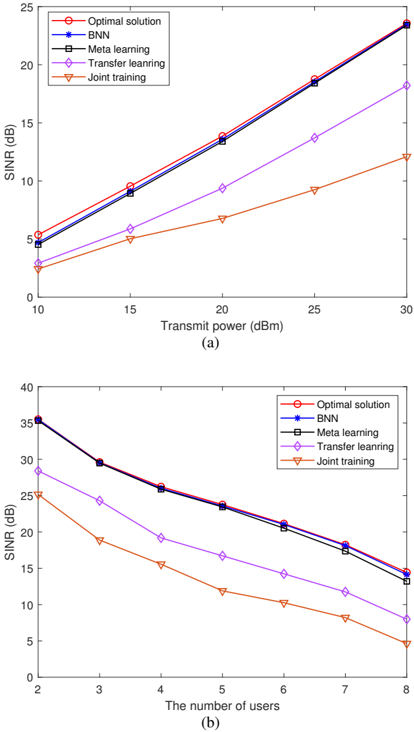
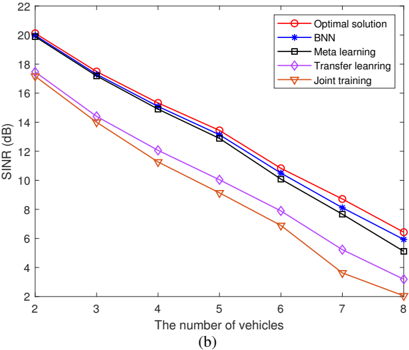
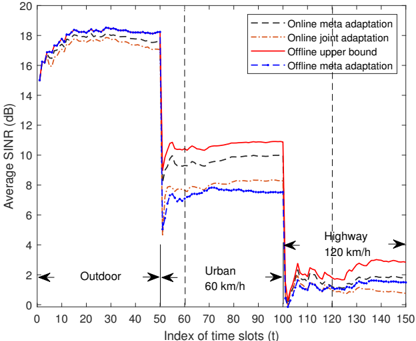
This article studies fast adaptive beamforming optimization for the signal-to-interference-plus-noise ratio balancing problem in a multiuser multiple-input single-output downlink system. Existing deep learning based approaches to predict beamforming rely on the assumption that the training and testing channels follow the same distribution which may not hold in practice. As a result, a trained model may lead to performance deterioration when the testing network environment changes. To deal with this task mismatch issue, we propose two offline adaptive algorithms based on deep transfer learning and meta-learning, which are able to achieve fast adaptation with the limited new labelled data when the testing wireless environment changes. Furthermore, we propose an online algorithm to enhance the adaptation capability of the offline meta algorithm in realistic non-stationary environments. Simulation results demonstrate that the proposed adaptive algorithms achieve much better performance than the direct deep learning algorithm without adaptation in new environments. The meta-learning algorithm outperforms the deep transfer learning algorithm and achieves near optimal performance. In addition, compared to the offline meta-learning algorithm, the proposed online meta-learning algorithm shows superior adaption performance in changing environments.
Overview
The claims and statistics of this paper haven’t been checked yet.
Free: it reads the open-access text and checks the first 5 claims that cite a source we can check. Create a free account to check every claim.
Integrity signals
Registry
Cites
Statistics
Figures








Verification
Claims the paper makes
The claims and statistics of this paper haven’t been checked yet.
Free: it reads the open-access text and checks the first 5 claims that cite a source we can check. Create a free account to check every claim.
Claims other papers make about this one
Each is checked against this paper’s own text: does it say what the citing paper says it does?
In the citing paper
“Transfer learning [103] and continual learning [277] have recently been adopted to address such task mismatch issue in the”
From Edge artificial intelligence for 6g: vision, enabling technologies, and applications (2022) · cites this paper as [103]
Self-check
Percentages, sums and reported differences re-computed from the paper’s own numbers.
The self-check needs the paper’s full text.
Citations
Cites
Adam: A Method for Stochastic Optimization
Kingma, D. P., & Ba, J. (2014) · arXiv · doi:10.48550/arxiv.1412.6980 · Cited by 98,946 · cited 2×
“learning rate, ∇θLossD Tr (θ) is the gradient of the loss function over θ. Alternatively, the network parameter θ also can be updated by using the existing adaptive moment estimation (ADAM) algorithm [39]. Next, we move to the fine-tuning stage when the pre-training stage is finished. Fine-tuning aims to refine all or pa…”
MethodInfluentialPan, S. J., & Yang, Q. (2010) · IEEE Transactions on Knowledge and Data Engineering · doi:10.1109/tkde.2009.191 · Cited by 23,387 · cited 2×
“and corresponding applications have been introduced in [27].”
BackgroundFundamentals of Wireless Communication
Tse, D., & Viswanath, P. (2005) · doi:10.1017/cbo9780511807213 · Cited by 13,162 · cited 1×
“arge-scale case. Besides, the antenna gains of the BS and each vehicle user are set to be 8 dBi and 3 dBi, respectively. The decorrelation distance is set to 50 m. We use Clarke’s model introduced in [42] to generate the small-scale fading of the moving vehicles. The effects of the transmit power and the number of veh…”
MethodModel-Agnostic Meta-Learning for Fast Adaptation of Deep Networks
Finn, C., Abbeel, P., & Levine, S. (2017) · arXiv · doi:10.48550/arxiv.1703.03400 · Cited by 8,512 · cited 4×
“In order to eliminate the model architecture restriction on the applications of meta-learning, the authors in [31] proposed the model-agnostic meta-learning (MAML) algorithm.”
BackgroundMethodInfluentialHow transferable are features in deep neural networks?
Yosinski, J., Clune, J., Bengio, Y., & Lipson, H. (2014) · arXiv · doi:10.48550/arxiv.1411.1792 · Cited by 6,061
Five disruptive technology directions for 5G
Boccardi, F., Heath, R. W., Lozano, A., Marzetta, T. L., & Popovski, P. (2014) · IEEE Communications Magazine · doi:10.1109/mcom.2014.6736746 · Cited by 3,709
Shi, Q., Razaviyayn, M., Luo, Z.-Q., & He, C. (2011) · IEEE Transactions on Signal Processing · doi:10.1109/tsp.2011.2147784 · Cited by 2,129 · cited 1×
“In the last two decades, beamforming optimization has been well studied for some specifical problems, such as signal-to-interferenceplus-noise ratio (SINR) balancing problem [3], [4], power minimization problem [5], [6] and sum rate maximization problem [4], [7]–[9].”
BackgroundSelf-citationPower of Deep Learning for Channel Estimation and Signal Detection in OFDM Systems
Ye, H., Li, G. Y., & Juang, B.-H. (2018) · IEEE Wireless Communications Letters · doi:10.1109/lwc.2017.2757490 · Cited by 2,000
Deep Learning in Mobile and Wireless Networking: A Survey
Zhang, C., Patras, P., & Haddadi, H. (2019) · IEEE Communications Surveys & Tutorials · doi:10.1109/comst.2019.2904897 · Cited by 1,768
Online Learning and Online Convex Optimization
Shalev-Shwartz, S. (2012) · Foundations and Trends® in Machine Learning · doi:10.1561/2200000018 · Cited by 1,246
Solution of the Multiuser Downlink Beamforming Problem With Individual SINR Constraints
Schubert, M., & Boche, H. (2004) · IEEE Transactions on Vehicular Technology · doi:10.1109/tvt.2003.819629 · Cited by 1,178
Online Learning and Online Convex Optimization
Shalev-Shwartz, S. (2011) · now publishers, Inc. eBooks · doi:10.1561/9781601985477 · Cited by 1,095
Linear precoding via conic optimization for fixed MIMO receivers
Wiesel, A., Eldar, Y. C., & Shamai, S. (2006) · IEEE Transactions on Signal Processing · doi:10.1109/tsp.2005.861073 · Cited by 974 · cited 1×
“In the last two decades, beamforming optimization has been well studied for some specifical problems, such as signal-to-interferenceplus-noise ratio (SINR) balancing problem [3], [4], power minimization problem [5], [6] and sum rate maximization problem [4], [7]–[9].”
BackgroundShi, Q., Razaviyayn, M., Luo, Z.-Q., & He, C. (2011) · 2011 IEEE International Conference on Acoustics, Speech and Signal Processing (ICASSP) · doi:10.1109/icassp.2011.5946304 · Cited by 873
Self-citationTransmit beamforming and power control for cellular wireless systems
Rashid-Farrokhi, F., Liu, K. J. R., & Tassiulas, L. (1998) · IEEE Journal on Selected Areas in Communications · doi:10.1109/49.730452 · Cited by 867 · cited 1×
“In the last two decades, beamforming optimization has been well studied for some specifical problems, such as signal-to-interferenceplus-noise ratio (SINR) balancing problem [3], [4], power minimization problem [5], [6] and sum rate maximization problem [4], [7]–[9].”
BackgroundDeep Learning-Based Channel Estimation for Beamspace mmWave Massive MIMO Systems
He, H., Wen, C.-K., Jin, S., & Li, G. Y. (2018) · IEEE Wireless Communications Letters · doi:10.1109/lwc.2018.2832128 · Cited by 823
Deep Learning-based Channel Estimation for Beamspace mmWave Massive MIMO Systems
He, H., Wen, C.-K., Jin, S., & Li, G. Y. (2018) · arXiv · doi:10.48550/arxiv.1802.01290 · Cited by 823 · cited 1×
“address specific physical layer issues, such as channel estimation and decoding [13]–[15], hybrid precoding [16]–[18]”
BackgroundWireless Networks Design in the Era of Deep Learning: Model-Based, AI-Based, or Both?
Zappone, A., Di Renzo, M., & Debbah, M. (2019) · arXiv · doi:10.48550/arxiv.1902.02647 · Cited by 685 · cited 1×
“been recognized as an efficient technique to solve difficult design problems in wireless communications due to its ability of modeling highly non-linear functions at considerably lower complexity [10]–[12]. Accordingly, DL techniques have been widely used in many applications of wireless networks to address specific phys…”
MethodWireless Networks Design in the Era of Deep Learning: Model-Based, AI-Based, or Both?
Zappone, A., Di Renzo, M., & Debbah, M. (2019) · IEEE Transactions on Communications · doi:10.1109/tcomm.2019.2924010 · Cited by 684 · cited 1×
“been recognized as an efficient technique to solve difficult design problems in wireless communications due to its ability of modeling highly non-linear functions at considerably lower complexity [10]–[12]. Accordingly, DL techniques have been widely used in many applications of wireless networks to address specific phys…”
MethodDeep learning for wireless physical layer: Opportunities and challenges
Wang, T., Wen, C.-K., Wang, H., Gao, F., Jiang, T., & Jin, S. (2017) · China Communications · doi:10.1109/cc.2017.8233654 · Cited by 606
Deep Learning Coordinated Beamforming for Highly-Mobile Millimeter Wave Systems
Alkhateeb, A., Alex, S., Varkey, P., Li, Y., Qu, Q., & Tujkovic, D. (2018) · IEEE Access · doi:10.1109/access.2018.2850226 · Cited by 521
Learning to Learn: Introduction and Overview
Thrun, S., & Pratt, L. (1998) · Learning to Learn · doi:10.1007/978-1-4615-5529-2_1 · Cited by 521 · cited 1×
“learning, which aims to improve the learning ability by leveraging the different but related training and testing data [30].”
BackgroundDeep-Learning-Based Millimeter-Wave Massive MIMO for Hybrid Precoding
Huang, H., Song, Y., Yang, J., Gui, G., & Adachi, F. (2019) · IEEE Transactions on Vehicular Technology · doi:10.1109/tvt.2019.2893928 · Cited by 450 · cited 1×
“Accordingly, DL techniques have been widely used in many applications of wireless networks to address specific physical layer issues, such as channel estimation and decoding [13]–[15], hybrid precoding [16]–[18] and resource allocation [19]–[21].”
MethodThrun, S. (1998) · Learning to Learn · doi:10.1007/978-1-4615-5529-2_8 · Cited by 413 · cited 1×
“In the future, we plan to use the lifelong learning technique [43] to solve more complex problems in self-organizing networks, in which tasks may come from different distributions, so bidirectional learning, knowledge retention and accumulation are necessary.”
MethodOnline Meta-LearningPreprint
Finn, C., Rajeswaran, A., Kakade, S. M., & Levine, S. (2019) · arXiv (Cornell University) · doi:10.48550/arxiv.1902.08438 · Cited by 385
A Deep Learning Framework for Optimization of MISO Downlink Beamforming
Xia, W., Zheng, G., Zhu, Y., Zhang, J., Wang, J., & Petropulu, A. P. (2020) · IEEE Transactions on Communications · doi:10.1109/tcomm.2019.2960361 · Cited by 345 · cited 5×
“According to the uplink-downlink duality in [3] and [25], using the uplink power allocation vector to replace beamforming as the output of the neural network is possible because the same SINR region of the uplink and downlink problems can be achieved.”
BackgroundMethodInfluentialSelf-citationLearning to optimize: Training deep neural networks for wireless resource management
Sun, H., Chen, X., Shi, Q., Hong, M., Fu, X., & Sidiropoulos, N. D. (2017) · 2017 IEEE 18th International Workshop on Signal Processing Advances in Wireless Communications (SPAWC) · doi:10.1109/spawc.2017.8227766 · Cited by 308 · cited 1×
“The successful application of the DL techniques on the problems of resource allocation [19]–[21] is based on the learning to optimize framework, which aims to learn a simple mapping through the deep”
MethodDeep Power Control: Transmit Power Control Scheme Based on Convolutional Neural Network
Lee, W., Kim, M., & Cho, D.-H. (2018) · IEEE Communications Letters · doi:10.1109/lcomm.2018.2825444 · Cited by 305
An Iterative BP-CNN Architecture for Channel Decoding
Liang, F., Shen, C., & Wu, F. (2018) · IEEE Journal of Selected Topics in Signal Processing · doi:10.1109/jstsp.2018.2794062 · Cited by 276 · cited 1×
“address specific physical layer issues, such as channel estimation and decoding [13]–[15], hybrid precoding [16]–[18]”
BackgroundOptimal Downlink Beamforming Using Semidefinite Optimization
Bengtsson, M., & Ottersten, B. (1999) · Cited by 276
Self-citationTowards Optimal Power Control via Ensembling Deep Neural Networks
Liang, F., Shen, C., Yu, W., & Wu, F. (2020) · IEEE Transactions on Communications · doi:10.1109/tcomm.2019.2957482 · Cited by 268 · cited 1×
“The successful application of the DL techniques on the problems of resource allocation [19]–[21] is based on the learning to optimize framework, which aims to learn a simple mapping through the deep”
MethodUnsupervised Learning-Based Fast Beamforming Design for Downlink MIMO
Huang, H., Xia, W., Xiong, J., Yang, J., Zheng, G., & Zhu, X. (2019) · IEEE Access · doi:10.1109/access.2018.2887308 · Cited by 222 · cited 1×
“In order to improve the performance, the works in [23], [24] directly predicted the beamforming matrix using the trained network.”
Self-citationDeep Transfer Learning-Based Downlink Channel Prediction for FDD Massive MIMO Systems
Yang, Y., Gao, F., Zhong, Z., Ai, B., & Alkhateeb, A. (2020) · IEEE Transactions on Communications · doi:10.1109/tcomm.2020.3019077 · Cited by 198 · cited 3×
“have been used to solve the channel estimation and decoding problems [32]–[34], they are still in the early stage for wireless communications applications.”
BackgroundMethodResultZappone, A., Di Renzo, M., Debbah, M., Lam, T. T., & Qian, X. (2019) · IEEE Vehicular Technology Magazine · doi:10.1109/mvt.2019.2921627 · Cited by 190
Recent trend of multiuser MIMO in LTE-advanced
Lim, C., Yoo, T., Clerckx, B., Lee, B., & Shim, B. (2013) · IEEE Communications Magazine · doi:10.1109/mcom.2013.6476877 · Cited by 173 · cited 1×
“characteristics of the propagation channel [1], [2].”
Joint Beamforming Optimization and Power Control for Full-Duplex MIMO Two-Way Relay Channel
Zheng, G. (2015) · IEEE Transactions on Signal Processing · doi:10.1109/tsp.2014.2376885 · Cited by 165
Self-citationHybrid Precoding for Multiuser Millimeter Wave Massive MIMO Systems: A Deep Learning Approach
Elbir, A. M., & Papazafeiropoulos, A. K. (2020) · IEEE Transactions on Vehicular Technology · doi:10.1109/tvt.2019.2951501 · Cited by 161
Learning to Demodulate From Few Pilots via Offline and Online Meta-Learning
Park, S., Jang, H., Simeone, O., & Kang, J. (2020) · IEEE Transactions on Signal Processing · doi:10.1109/tsp.2020.3043879 · Cited by 129 · cited 3×
“have been used to solve the channel estimation and decoding problems [32]–[34], they are still in the early stage for wireless communications applications.”
MethodResultElbir, A. M., Mishra, K. V., R., B. S. M., & Ottersten, B. (2021) · IEEE Transactions on Cognitive Communications and Networking · doi:10.1109/tccn.2021.3132609 · Cited by 99
Self-citationMeta-Learning to Communicate: Fast End-to-End Training for Fading Channels
Park, S., Simeone, O., & Kang, J. (2020) · IEEE International Conference on Acoustics Speech and Signal Processing · doi:10.1109/icassp40776.2020.9053252 · Cited by 56 · cited 1×
“insufficient pilots [33], and to predict channel state information (CSI) of frequency division duplexing systems [34].”
BackgroundYuan, Y. X., Xu, P., Yang, Z., Ding, Z., & Chen, Q. (2019) · IEEE Transactions on Vehicular Technology · doi:10.1109/tvt.2019.2892104 · Cited by 37 · cited 1×
“In the last two decades, beamforming optimization has been well studied for some specifical problems, such as signal-to-interference-plus-noise ratio (SINR) balancing problem [3], [4], power minimization problem [5], [6] and sum rate maximization problem [4], [7]–[9].”
BackgroundSelf-citationTransfer Learning for Mixed-Integer Resource Allocation Problems in Wireless Networks
Shen, Y., Shi, Y., Zhang, J., & Letaief, K. B. (2019) · ICC 2019 - 2019 IEEE International Conference on Communications (ICC) · doi:10.1109/icc.2019.8761327 · Cited by 35
Zhang, J., Xia, W., You, M., Zheng, G., Lambotharan, S., & Wong, K. (2020) · IEEE Transactions on Wireless Communications · doi:10.1109/twc.2020.2977340 · Cited by 34 · cited 2×
“The proposed DL algorithms in [22]–[26] are based on a common assumption that the training and testing channel data are drawn from the same distribution in a fixed stationary environment.”
MethodSelf-citationLearning to Beamform for Minimum Outage
Shi, Y., Konar, A., Sidiropoulos, N. D., Mao, X., & Liu, Y. (2018) · IEEE Transactions on Signal Processing · doi:10.1109/tsp.2018.2865408 · Cited by 34 · cited 1×
“In order to improve the performance, the works in [23], [24]”
BackgroundZhang, J., Xia, W., You, M., Zheng, G., Lambotharan, S., & Wong, K. (2020) · Figshare · Cited by 22
Self-citationElbir, A. M., Mishra, K. V., Shankar, M., & Ottersten, B. (2019) · arXiv (Cornell University) · Cited by 14
Self-citationDeep Transfer Learning Based Downlink Channel Prediction for FDD Massive MIMO SystemsPreprint
Yang, Y., Gao, F., Zhong, Z., et al. (2019) · arXiv (Cornell University) · doi:10.48550/arxiv.1912.12265 · Cited by 11 · cited 3×
“have been used to solve the channel estimation and decoding problems [32]–[34], they are still in the early stage for wireless communications applications.”
BackgroundMethodResult
Research works printed but not linked: 4
- hannan, 1957, Approximation to Bayes risk in repeated play, Contributions to the Theory of Games, 3, 97
- kyösti, 2008, IST-4-027756 WINNER II D1.1.2 v.1.2: WINNER II channel models, Inf Technol Soc, 11, 1
- bengtsson, 1999, Optimal downlink beamformingusing semidefinite optimization, Proc 37th Annu Allerton Conf Commun Control Comput, 987
- 2016, Technical Specification Group Radio Access Network Study on LTE-based V2X Services (Release 14)
Cited by
Edge artificial intelligence for 6g: vision, enabling technologies, and applications
Letaief, K. B., Shi, Y., Lu, J., & Lu, J. (2022) · IEEE Journal on Selected Areas in Communications · doi:10.1109/jsac.2021.3126076 · Cited by 829
“Transfer learning [103] and continual learning [277] have recently been adopted to address such task mismatch issue in the “learning to optimize” framework considering the system distribution dynamics.”
Enabling Intelligent Connectivity: A Survey of Secure ISAC in 6G Networks
Zhu, X., Liu, J., Lu, L., Zhang, T., Qiu, T., Wang, C., & Liu, Y. (2025) · IEEE Communications Surveys & Tutorials · doi:10.1109/comst.2024.3432871 · Cited by 211
Meta-learning approaches for learning-to-learn in deep learning: A survey
Tian, Y., Zhao, X., & Huang, W. (2022) · Neurocomputing · doi:10.1016/j.neucom.2022.04.078 · Cited by 161
Transfer Learning for Wireless Networks: A Comprehensive Survey
Nguyen, C. T., Huynh, N. V., Chu, N. H., Saputra, Y. M., Hoang, D. T., Nguyen, D. N., Pham, Q., Niyato, D. T., Dutkiewicz, E., & Hwang, W. (2022) · Proceedings of the IEEE · doi:10.1109/jproc.2022.3175942 · Cited by 180
Multiple Access Techniques for Intelligent and Multifunctional 6G: Tutorial, Survey, and Outlook
Clerckx, B., Mao, Y., Yang, Z., Chen, M., Alkhateeb, A., Liu, L., Qiu, M., Yuan, J., Wong, V. W. S., & Montojo, J. I. (2024) · Proceedings of the IEEE · doi:10.1109/jproc.2024.3409428 · Cited by 177
“These encompass a range of techniques, such as the transformer [186], autoencoder [187], transfer learning [188], and meta-learning [180].”
Background
Metadata
- Authors
- Yuan, Y., Zheng, G., Wong, K.-K., Ottersten, B., & Luo, Z.-Q.
- Affiliations
- Loughborough University (GB)
- University College London (GB)
- Shenzhen Research Institute of Big Data (CN)
- Venue
- IEEE Transactions on Wireless Communications
- Published
- 2021-03
- Volume
- 20
- Issue
- 3
- Pages
- 1742-1755
- ISSN
- 1536-1276 (ISSN-L)
- 1558-2248
- OpenAlex
- W3100120649
- Cited by
- 133
- References
- 45
- Citations by year
- 2026: 18 · 2025: 26 · 2024: 32 · 2023: 24 · 2022: 16 · 2021: 17
- FWCI
- 5.60
- Type
- journal article
- Language
- en
- Open access
- green
- arxiv.org
- Locations
- IEEE Transactions on Wireless Communications (publishedVersion)
- arXiv (Cornell University) (submittedVersion)
- Open Repository and Bibliography (University of Luxembourg) (submittedVersion, cc-by-nc-sa)
- UCL Discovery (University College London) (submittedVersion)
- Figshare (submittedVersion, cc-by)
- arXiv (Cornell University)
- Funders
- U.K. Engineering and Physical Sciences Research Council (EP/N007840/1)
- Leverhulme Trust Research Project (RPG-2017-129)
- EPSRC (EP/N008219/1)
- H2020-ERC-AdG-AGNOSTIC (742648)
- Leading Talents of Guangdong Province Program (00201501)
- National Natural Science Foundation of China (61731018)
- Development and Reform Commission of Shenzhen Municipality
- Shenzhen Fundamental Research and Discipline Layout project (KQTD201503311441545)
- Topics
- Physical Sciences › Computer Science › Artificial Intelligence › Domain Adaptation and Few-Shot Learning
- Physical Sciences › Engineering › Electrical and Electronic Engineering › Advanced MIMO Systems Optimization
- Physical Sciences › Engineering › Electrical and Electronic Engineering › Millimeter-Wave Propagation and Modeling
- Keywords
- downlink beamforming, transfer learning, meta-learning, online meta-learning, SINR balancing, multi-user MIMO, distribution mismatch, rapid adaptation, non-stationary environments, limited labeled data
About these checks
Registry, retraction, Cites and statistics results are computed, not judged, with one exception: a printed reference that no index lists is read once by a model before it counts as a citation error. Claims are extracted by a model and kept only when their quote appears verbatim in the text; each cited source is then checked, with a model’s help, for whether it says what the claim relies on. Those verdicts can be wrong — read the claim’s quote and the cited source before relying on one.
Statistics and arithmetic are recomputed, not judged.
Confidence bands are shown only for fields calibrated on our annotated test set. None is calibrated yet, so no band is shown.
What counts as a claim ›How we measure confidence ›How we check this ›
Are you an author, or do you see a problem with this page? Request a review
Data sources
Bibliographic data: Semantic Scholar, OpenAlex, Crossref.
Contains information from the Semantic Scholar Academic Graph Datasets, made available under the ODC Attribution License (ODC-BY 1.0).
Semantic Scholar’s data is described in: Kinney, R., et al. (2023). The Semantic Scholar Open Data Platform. arXiv:2301.10140.
