

The DOI matches its Crossref record; 35 of the 35 references it cites were found in a registry or an index.
Mapping the incidence of drug‐induced liver injury: A systematic review and meta‐analysis
Abstract
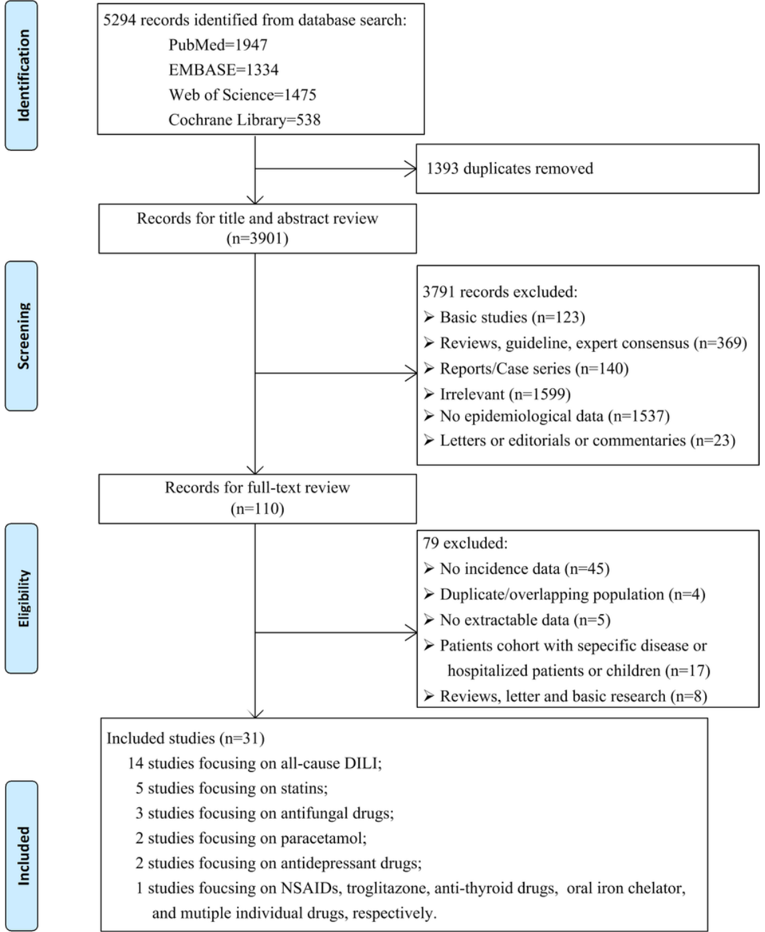
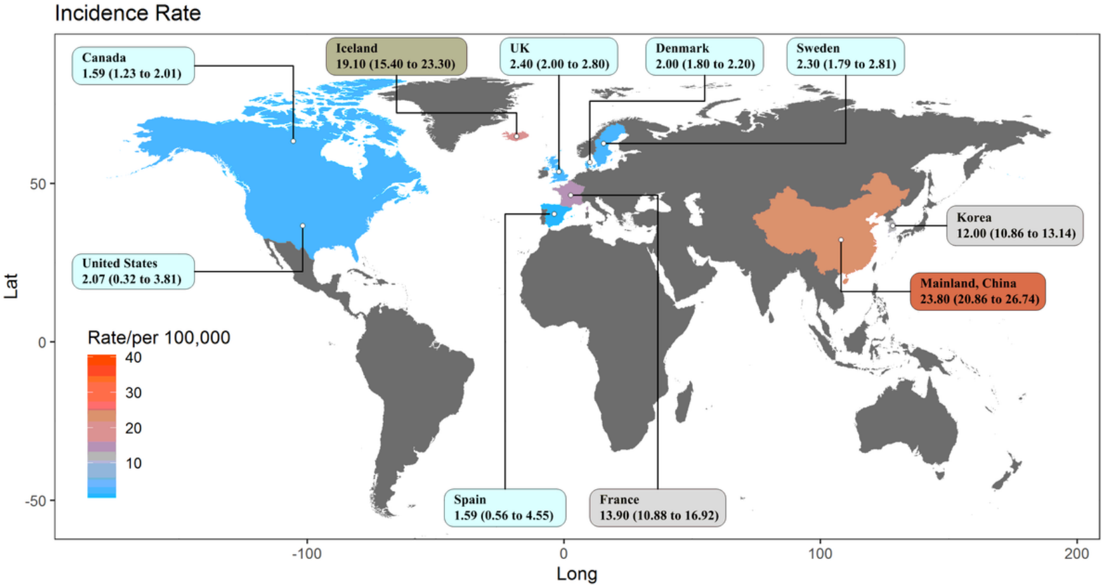
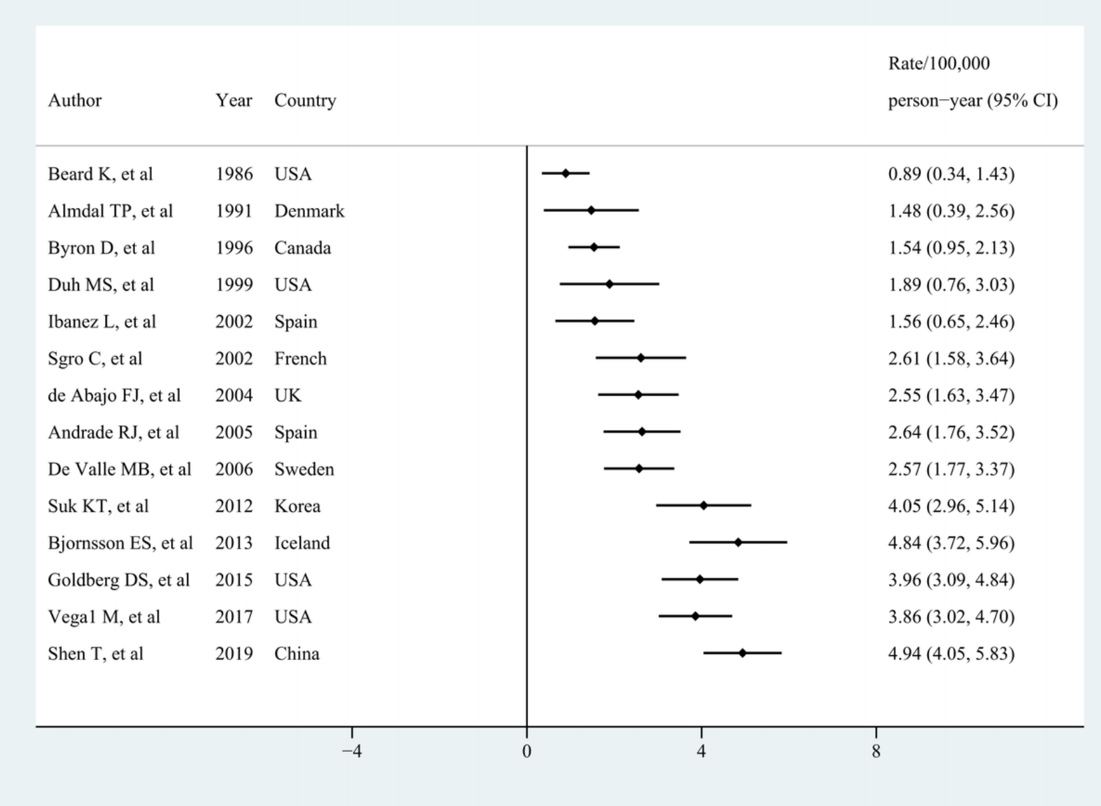
Objectives: Drug‐induced liver injury (DILI) is an increasing etiology of liver dysfunction, with various incidence worldwide. To better understand the disease burden and establish appropriate preventive and treatment strategies, a systematic review and meta‐analysis was conducted. Methods: PubMed, EMBASE, Web of Science, and Cochrane Library were searched for studies on the incidence of DILI published up to June 1, 2022. According to the predefined criteria, only population‐based studies were included. Incidence was presented as cases per 100 000 person‐years with 95% confidence interval (CI) using a random‐effects model. Results: A total of 14 studies were included. The overall incidence of DILI was 4.94 per 100 000 person‐years (95% CI 4.05–5.83). Time‐based cumulative meta‐analysis suggested that the incidence of DILI increased over time since 2010. The incidence varied by regions, with Asia having the highest incidence of 17.82 per 100 000 person‐years (95% CI 6.26–29.38), while North America having the lowest incidence of 1.72 per 100 000 person‐years (95% CI 0.48–2.95). All studies reported a higher incidence of DILI in the elderly but comparable incidences between male and female (3.42 per 100 000 person‐years vs 4.64 per 100 000 person‐years). Conclusions: The global incidence of DILI has been increasing since 2010, with the highest incidence in Asia. Understanding the epidemiological characteristics of DILI helps establish specific strategies to deal with this emerging health problems.
Overview
The claims and statistics of this paper haven’t been checked yet.
Run the check — free, no account needed. It reads the open-access text and checks the sources it cites.
Integrity signals
Registry
Cites
Statistics
Figures
Verification
Claims the paper makes
The claims and statistics of this paper haven’t been checked yet.
Run the check — free, no account needed. It reads the open-access text and checks the sources it cites.
Claims other papers make about this one
Each is checked against this paper’s own text: does it say what the citing paper says it does?
In the citing paper
“A recent meta-analysis of 14 studies reported the pooled incidence of DILI to be 4.9 per 100,000 person-years, though significant variability was noted among countries. 2”
From The contemporary epidemiology, causes, and management of drug-induced liver injury (2026) · cites this paper as [2]
Self-check
Percentages, sums and reported differences re-computed from the paper’s own numbers.
The self-check needs the paper’s full text.
Citations
Cites
Meta-analysis of Observational Studies in Epidemiology<SUBTITLE>A Proposal for Reporting</SUBTITLE>
Stroup, D. F. (2000) · JAMA · doi:10.1001/jama.283.15.2008 · Cited by 20,623
Burden of liver diseases in the world
Asrani, S. K., Devarbhavi, H., Eaton, J., & Kamath, P. S. (2019) · Journal of Hepatology · doi:10.1016/j.jhep.2018.09.014 · Cited by 3,783
Ostapowicz, G., Fontana, R. J., Schiødt, F. V., Larson, A., Davern, T. J., Han, S. H. B., McCashland, T. M., Shakil, A. O., Hay, J. E., Hynan, L., et al. (2002) · Annals of Internal Medicine · doi:10.7326/0003-4819-137-12-200212170-00007 · Cited by 2,227
Lee, W. M. (2003) · New England Journal of Medicine · doi:10.1056/nejmra021844 · Cited by 1,594
Danan, G., & Benichou, C. (1993) · Journal of Clinical Epidemiology · doi:10.1016/0895-4356(93)90101-6 · Cited by 1,481
Andrade, R. J., Chalasani, N., Björnsson, E. S., Suzuki, A., Kullak-Ublick, G. A., Watkins, P. B., Devarbhavi, H., Merz, M., Lucena, M. I., Kaplowitz, N., et al. (2019) · Nature Reviews Disease Primers · doi:10.1038/s41572-019-0105-0 · Cited by 924
Björnsson, E. S., Bergmann, O. M., Björnsson, H. K., Kvaran, R. B., & Olafsson, S. (2013) · Gastroenterology · doi:10.1053/j.gastro.2013.02.006 · Cited by 865
ACG Clinical Guideline: the diagnosis and management of idiosyncratic drug-induced liver injury
Chalasani, N. P., Hayashi, P. H., Bonkovsky, H. L., Navarro, V. J., Lee, W. M., & Fontana, R. J. (2014) · American Journal of Gastroenterology · doi:10.1038/ajg.2014.131 · Cited by 860
ANDRADE, R., LUCENA, M., FERNANDEZ, M., PELAEZ, G., PACHKORIA, K., GARCIARUIZ, E., GARCIAMUNOZ, B., GONZALEZGRANDE, R., PIZARRO, A., & DURAN, J. (2005) · Gastroenterology · doi:10.1016/j.gastro.2005.05.006 · Cited by 856
Drug-Induced Acute Liver Failure: Results of a U.S. Multicenter, Prospective Study
Reuben, A., Koch, D. G., & Lee, W. M. (2010) · Hepatology · doi:10.1002/hep.23937 · Cited by 772
Incidence of drug-induced hepatic injuries: A French population-based study
Sgro, C., Clinard, F., Ouazir, K., Chanay, H., Allard, C., Guilleminet, C., Lenoir, C., Lemoine, A., & Hillon, P. (2002) · Hepatology · doi:10.1053/jhep.2002.34857 · Cited by 716
Frieden, T. R., Sterling, T. R., Munsiff, S. S., Watt, C. J., & Dye, C. (2003) · The Lancet · doi:10.1016/s0140-6736(03)14333-4 · Cited by 689
Incidence and Etiology of Drug-Induced Liver Injury in Mainland China
Shen, T., Liu, Y., Shang, J., Xie, Q., Li, J., Yan, M., Xu, J., Niu, J., Liu, J., Watkins, P. B., et al. (2019) · Gastroenterology · doi:10.1053/j.gastro.2019.02.002 · Cited by 615
Self-citationKirkbride, J. B., Errazuriz, A., Croudace, T. J., Morgan, C., Jackson, D., Boydell, J., Murray, R. M., & Jones, P. B. (2012) · PLoS ONE · doi:10.1371/journal.pone.0031660 · Cited by 537
ACG Clinical Guideline: Diagnosis and Management of Idiosyncratic Drug-Induced Liver Injury
Chalasani, N. P., Maddur, H., Russo, M. W., Wong, R. J., Reddy, K. R., & on behalf of the Practice Parameters Committee of the American College of Gastroenterology (2021) · American Journal of Gastroenterology · doi:10.14309/ajg.0000000000001259 · Cited by 430
Acute and clinically relevant drug‐induced liver injury: a population based case‐control study
De Abajo, F. J., Montero, D., Madurga, M., & Rodríguez, L. A. G. (2004) · British Journal of Clinical Pharmacology · doi:10.1111/j.1365-2125.2004.02133.x · Cited by 408
Liver transplantation for acute liver failure from drug induced liver injury in the United States
Russo, M. W., Galanko, J. A., Shrestha, R., Fried, M. W., & Watkins, P. (2004) · Liver Transplantation · doi:10.1002/lt.20204 · Cited by 393
AASLD practice guidance on drug, herbal, and dietary supplement–induced liver injury
Fontana, R. J., Liou, I., Reuben, A., Suzuki, A., Fiel, M. I., Lee, W., & Navarro, V. (2023) · Hepatology · doi:10.1002/hep.32689 · Cited by 340
Fontana, R. J., Seeff, L. B., Andrade, R. J., Björnsson, E., Day, C. P., Serrano, J., & Hoofnagle, J. H. (2010) · Hepatology · doi:10.1002/hep.23696 · Cited by 324
A prospective nationwide study of drug-induced liver injury in Korea
Suk, K. T., Kim, D. J., Kim, C. H., Park, S. H., Yoon, J. H., Kim, Y. S., Baik, G. H., Kim, J. B., Kweon, Y. O., Kim, B. I., et al. (2012) · American Journal of Gastroenterology · doi:10.1038/ajg.2012.138 · Cited by 221
Drug‐induced liver injury in a Swedish University hospital out‐patient hepatology clinic
DE VALLE, M. B., AV KLINTEBERG, V., ALEM, N., OLSSON, R., & BJÖRNSSON, E. (2006) · Alimentary Pharmacology & Therapeutics · doi:10.1111/j.1365-2036.2006.03117.x · Cited by 179
Clinical Hepatology: Profile of An Urban, Hospital–Based Practic
Byron, D., & Minuk, G. Y. (1996) · Hepatology · doi:10.1002/hep.510240410 · Cited by 156
Almdal, T., & Sørensen, T. I. A. (1991) · Hepatology · doi:10.1002/hep.1840130407 · Cited by 145
A missense variant in PTPN22 is a risk factor for drug-induced liver injury
Cirulli, E. T., Nicoletti, P., Abramson, K., Andrade, R. J., Bjornsson, E. S., Chalasani, N., Fontana, R. J., Hallberg, P., Li, Y. J., Lucena, M. I., et al. (2019) · Gastroenterology · doi:10.1053/j.gastro.2019.01.034 · Cited by 137
Ibáñez, L., Pérez, E., Vidal, X., & Laporte, J. (2002) · Journal of Hepatology · doi:10.1016/s0168-8278(02)00231-3 · Cited by 133
For the Drug Induced Liver Injury Network (DILIN), Vega, M., Verma, M., Beswick, D., Bey, S., Hossack, J., Merriman, N., Shah, A., & Navarro, V. (2017) · Drug Safety · doi:10.1007/s40264-017-0547-9 · Cited by 120
Goldberg, D. S., Forde, K. A., Carbonari, D. M., Lewis, J. D., Leidl, K. B. F., Reddy, K. R., Haynes, K., Roy, J. A., Sha, D., Marks, A. R., et al. (2015) · Gastroenterology · doi:10.1053/j.gastro.2015.02.050 · Cited by 118
Clinical Characteristics and Adverse Impact of Hepatotoxicity due to Immune Checkpoint Inhibitors
Miller, E., Abu‐Sbeih, H., Styskel, B. A., Nogueras‐González, G. M., Blechacz, B. R. A., Naing, A., & Chalasani, N. (2019) · The American Journal of Gastroenterology · doi:10.14309/ajg.0000000000000398 · Cited by 96
HCV testing in low-risk population
Weiner, A. J., Truett, M., Han, J. H., Polito, A. J., Choo, Q.-L., Rosenblatt, J., Quan, S., Kuo, G. C., Houghton, M., Page, E., et al. (1990) · The Lancet · doi:10.1016/0140-6736(90)92194-m · Cited by 86
Epidemiology and Risk Factors for Idiosyncratic Drug-Induced Liver Injury
Bjornsson, E. S. (2014) · Seminars in Liver Disease · doi:10.1055/s-0034-1375953 · Cited by 79
Value of liver biopsy in the diagnosis of drug-induced liver injury
Ahmad, J., Barnhart, H. X., Bonacini, M., Ghabril, M., Hayashi, P. H., Odin, J. A., Rockey, D. C., Rossi, S., Serrano, J., Tillmann, H. L., et al. (2022) · Journal of Hepatology · doi:10.1016/j.jhep.2021.12.043 · Cited by 71
Risk of acute liver injury associated with the use of drugs: a multicentre population survey
Sabaté, M., Ibáñez, L., Pérez, E., Vidal, X., Buti, M., Xiol, X., Mas, A., Guarner, C., Forné, M., Sola, R. L., et al. (2007) · Alimentary Pharmacology & Therapeutics · doi:10.1111/j.1365-2036.2007.03338.x · Cited by 66
Models of Idiosyncratic Drug-Induced Liver Injury
Yokoi, T., & Oda, S. (2020) · The Annual Review of Pharmacology and Toxicology · doi:10.1146/annurev-pharmtox-030220-015007 · Cited by 41
Outpatient Drug‐Induced Parenchymal Liver Disease Requiring Hospitalization
Beard, K., Belic, L., Aselton, P., et al. (1986) · The Journal of Clinical Pharmacology · doi:10.1002/j.1552-4604.1986.tb02963.x · Cited by 32
Nefazodone in community use: the results of prescription-event monitoring
Mackay, F. J., Pearce, G. L., Freemantle, S. N., & Mann, R. D. (1999) · Pharmacoepidemiology and Drug Safety · doi:10.1002/(sici)1099-1557(199907)8:4<275::aid-pds427>3.0.co;2-d · Cited by 5
Cited by
The contemporary epidemiology, causes, and management of drug-induced liver injury
Swanson, L., & Fontana, R. J. (2026) · Hepatology Communications · doi:10.1097/hc9.0000000000001011
Metadata
- Authors
- Li, M., Wang, Y., Lv, T. T., Liu, J. M., Kong, Y. Y., Jia, J. D., & Zhao, X. Y.
- Affiliations
- Clinical Epidemiology and Evidence Based Medicine Unit, Beijing Friendship Hospital Capital Medical University, Beijing Clinical Research Institute Beijing China
- Liver Research Center, Beijing Friendship Hospital Capital Medical University Beijing China
- Department of Pathology and Molecular Medicine, Faculty of Health Sciences McMaster University Hamilton Ontario Canada
- ORCID
- Zhao, Xin Yan
- Venue
- Journal of Digestive Diseases
- Publisher
- Wiley
- Published
- 2023-05
- Volume
- 24
- Issue
- 5
- Pages
- 332-339
- ISSN
- 1751-2972
- 1751-2980
- Cited by
- 39
- References
- 35
- Language
- en
- Funders
- National Natural Science Foundation of China (82103902)
About these checks
Registry, retraction, Cites and statistics results are computed, not judged, with one exception: a printed reference that no index lists is read once by a model before it counts as a citation error. Claims are extracted by a model and kept only when their quote appears verbatim in the text; each cited source is then checked, with a model’s help, for whether it says what the claim relies on. Those verdicts can be wrong — read the claim’s quote and the cited source before relying on one.
Statistics and arithmetic are recomputed, not judged.
Confidence bands are shown only for fields calibrated on our annotated test set. None is calibrated yet, so no band is shown.
What counts as a claim ›How we measure confidence ›How we check this ›
Are you an author, or do you see a problem with this page? Request a review
Data sources
Bibliographic data: Semantic Scholar, OpenAlex, Crossref.
Contains information from the Semantic Scholar Academic Graph Datasets, made available under the ODC Attribution License (ODC-BY 1.0).
Semantic Scholar’s data is described in: Kinney, R., et al. (2023). The Semantic Scholar Open Data Platform. arXiv:2301.10140.
