

The DOI matches its Crossref record; 8 of the 8 references it cites were found in a registry or an index.
Depletion of Rictor, an essential protein component of m TORC 2, decreases male lifespan
Abstract
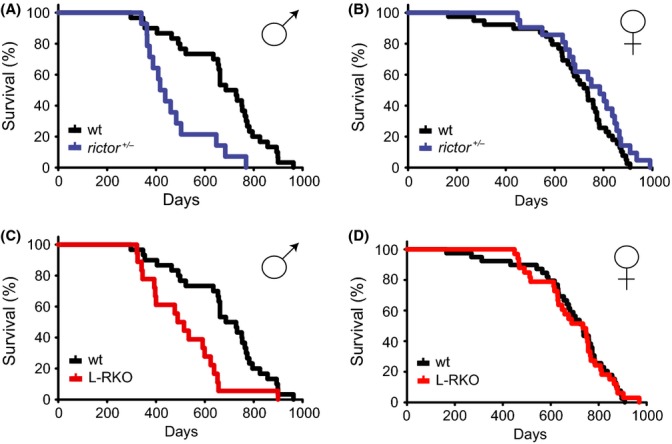
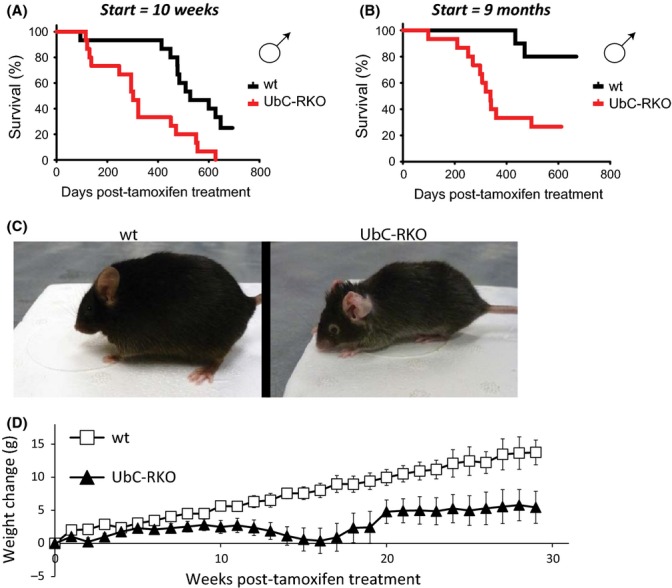
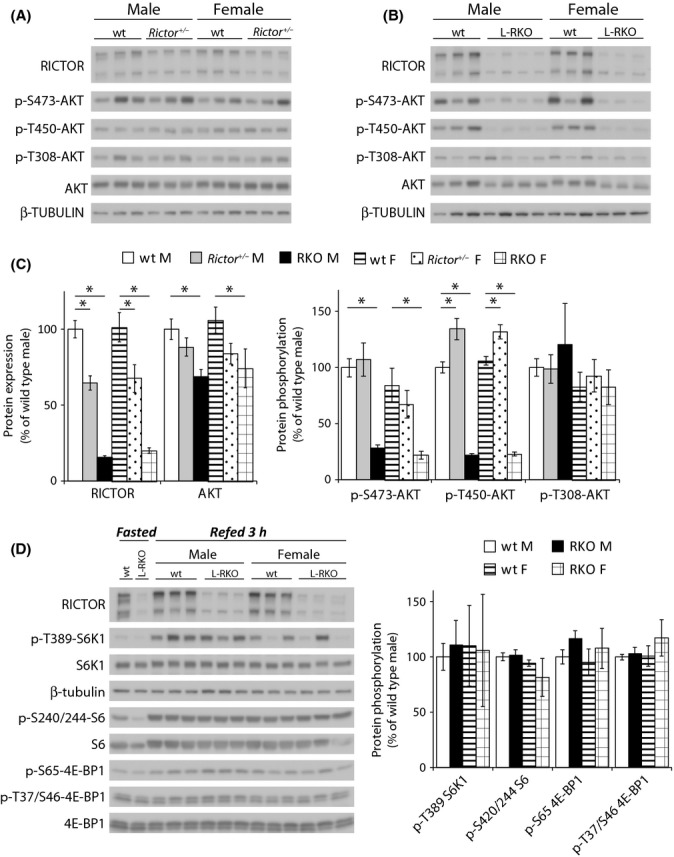
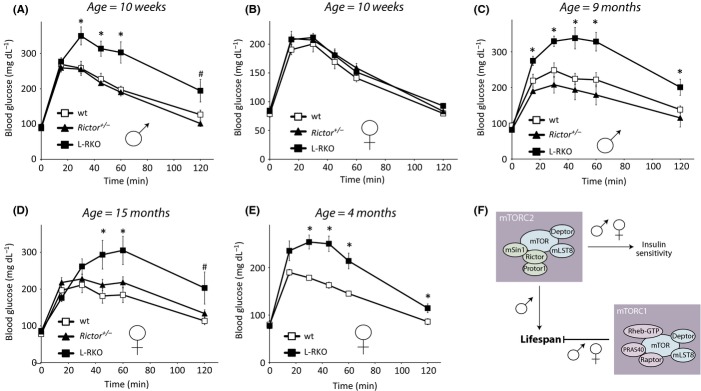
Summary: Rapamycin, an inhibitor of the mechanistic target of rapamycin (m TOR), robustly extends the lifespan of model organisms including mice. We recently found that chronic treatment with rapamycin not only inhibits m TOR complex 1 (m TORC 1), the canonical target of rapamycin, but also inhibits m TOR complex 2 (m TORC 2) in vivo. While genetic evidence strongly suggests that inhibition of m TORC 1 is sufficient to promote longevity, the impact of m TORC 2 inhibition on mammalian longevity has not been assessed. RICTOR is a protein component of m TORC 2 that is essential for its activity. We examined three different mouse models of Rictor loss: mice heterozygous for Rictor, mice lacking hepatic Rictor, and mice in which Rictor was inducibly deleted throughout the body in adult animals. Surprisingly, we find that depletion of RICTOR significantly decreases male, but not female, lifespan. While the mechanism by which RICTOR loss impairs male survival remains obscure, we find that the effect of RICTOR depletion on lifespan is independent of the role of hepatic m TORC 2 in promoting glucose tolerance. Our results suggest that inhibition of m TORC 2 signaling is detrimental to males, which may explain in part why interventions that decrease m TOR signaling show greater efficacy in females.
Overview
The claims and statistics of this paper haven’t been checked yet.
Run the check — free, no account needed. It reads the open-access text and checks the sources it cites.
Integrity signals
Registry
Cites
Statistics
Figures
Verification
Claims the paper makes
The claims and statistics of this paper haven’t been checked yet.
Run the check — free, no account needed. It reads the open-access text and checks the sources it cites.
Claims other papers make about this one
Each is checked against this paper’s own text: does it say what the citing paper says it does?
The source backs part of the claim, not all of it — or backs it for a different population, condition or comparison.
In the citing paper
“Whole body deficiency of mTORC2 signaling, or tissue-specific inhibition of mTORC2 signaling in the brain, liver, or adipose tissue, reduces lifespan in C57BL/6J mice 114–117.”
From Targeting the biology of aging with mTOR inhibitors (2023) · cites this paper as [117]
Experimental — accuracy not yet measuredThe source backs part of the claim, not all of it — or backs it for a different population, condition or comparison.
In the citing paper
“Genetic inhibition of mTORC2 in one or more tissues of a mouse can result in frailty, hyperphagia, insulin resistance, hyperlipidemia, hypercholesterolemia, hyperglycemia, kyphosis, and/or obesity depending upon the specific tissues in which mTORC2 is inhibited 114–117, 68.”
From Targeting the biology of aging with mTOR inhibitors (2023) · cites this paper as [117]
Experimental — accuracy not yet measured
Self-check
Percentages, sums and reported differences re-computed from the paper’s own numbers.
The self-check needs the paper’s full text.
Citations
Cites
Ribosomal Protein S6 Kinase 1 Signaling Regulates Mammalian Life Span
Selman, C., Tullet, J. M. A., Wieser, D., Irvine, E., Lingard, S. J., Choudhury, A. I., Claret, M., Al-Qassab, H., Carmignac, D., Ramadani, F., et al. (2009) · Science · doi:10.1126/science.1177221 · Cited by 1,120 · cited 7×
“We also tested insulin sensitivity in aged male and female mice by means of an insulin wt Rictor+/– FemaleMale wt RICTOR p-S473-AKT AKT p-T308-AKT p-T450-AKT β-TUBULIN p-S473-AKT AKT p-T308-AKT p-T450-AKT β-TUBULIN RICTOR Male Female wt L-RKO wt L-RKO RICTOR AKT p-S473-AKT Pr ot ei n ex pr es si on (% of w ild ty pe m…”
BackgroundInfluentialEfficacy and safety of sirolimus in lymphangioleiomyomatosis
McCormack, F. X., Inoue, Y., Moss, J., Singer, L. G., Strange, C., Nakata, K., Barker, A. F., Chapman, J. T., Brantly, M. L., Stocks, J. M., et al. (2011) · New England Journal of Medicine · doi:10.1056/nejmoa1100391 · Cited by 1,099
TOR Signaling and Rapamycin Influence Longevity by Regulating SKN-1/Nrf and DAF-16/FoxO
Robida-Stubbs, S., Glover-Cutter, K., Lamming, D. W., Mizunuma, M., Narasimhan, S. D., Neumann-Haefelin, E., Sabatini, D. M., & Blackwell, T. K. (2012) · Cell Metabolism · doi:10.1016/j.cmet.2012.04.007 · Cited by 648
Self-citationmTORC1 controls fasting-induced ketogenesis and its modulation by ageing
Sengupta, S., Peterson, T. R., Laplante, M., Oh, S., & Sabatini, D. M. (2010) · Nature · doi:10.1038/nature09584 · Cited by 646
Self-citationSelman, C., Lingard, S., Choudhury, A. I., Batterham, R. L., Claret, M., Clements, M., Ramadani, F., Okkenhaug, K., Schuster, E., Blanc, E., et al. (2008) · The FASEB Journal · doi:10.1096/fj.07-9261com · Cited by 532
Brain IRS2 Signaling Coordinates Life Span and Nutrient Homeostasis
Taguchi, A., Wartschow, L. M., & White, M. F. (2007) · Science · doi:10.1126/science.1142179 · Cited by 523
Houde, V. P., Brûlé, S., Festuccia, W. T., Blanchard, P.-G., Bellmann, K., Deshaies, Y., & Marette, A. (2010) · Diabetes · doi:10.2337/db09-1324 · Cited by 456
Estrogens protect against high-fat diet-induced insulin resistance and glucose intolerance in mice
Riant, E., Waget, A., Cogo, H., Arnal, J.-F., Burcelin, R., & Gourdy, P. (2009) · Endocrinology · doi:10.1210/en.2008-0971 · Cited by 421
Research works printed but not linked: 24
- 10.1371/journal.pone.0031900 · DOI
- 10.1016/j.cmet.2009.11.010 · DOI · Paper page
- 10.1016/j.devcel.2006.10.007 · DOI
- 10.1016/j.ccr.2008.12.017 · DOI · Paper page
- 10.1016/j.transproceed.2011.05.001 · DOI
- 10.1016/j.cmet.2012.03.015 · DOI
- 10.1038/emboj.2008.119 · DOI
- 10.1126/science.1236566 · DOI
- 10.1016/S0092-8674(01)00306-3 · DOI
- 10.1126/science.1215135 · DOI · Paper page
- 10.1111/acel.12097 · DOI
- 10.1096/fj.13-237743 · DOI
- 10.1016/j.cell.2012.03.017 · DOI · Paper page
- 10.1371/journal.pbio.0050261 · DOI · Paper page
- 10.1126/scisignal.2002739 · DOI
- 10.1093/gerona/glq178 · DOI · Paper page
- 10.1111/acel.12194 · DOI
- 10.1371/journal.pone.0069178 · DOI
- 10.1126/science.1106148 · DOI · Paper page
- 10.1016/j.molcel.2006.03.029 · DOI · Paper page
- 10.1371/journal.pone.0016144 · DOI
- 10.1101/gad.1775409 · DOI · Paper page
- 10.1074/jbc.M112.386854 · DOI
- Zhang Y, 2013, Rapamycin Extends Life and Health in C57BL/6 Mice, J. Gerontol. A Biol. Sci. Med. Sci., 69, 119
Cited by
Sorted by citations
Sarcopenia: Aging-Related Loss of Muscle Mass and Function
Larsson, L., Degens, H., Li, M., Salviati, L., Lee, Y. I., Thompson, W., Kirkland, J. L., & Sandri, M. (2019) · Physiological Reviews · doi:10.1152/physrev.00061.2017 · Cited by 1,797
Molecular mechanisms of dietary restriction promoting health and longevity
Green, C. L., Lamming, D. W., & Fontana, L. (2022) · Nature Reviews Molecular Cell Biology · doi:10.1038/s41580-021-00411-4 · Cited by 714
Self-citationmTOR as Regulator of Lifespan, Aging, and Cellular Senescence: A Mini-Review
Weichhart, T. (2018) · Gerontology · doi:10.1159/000484629 · Cited by 596
The mechanistic target of rapamycin: the grand conducTOR of metabolism and aging
Kennedy, B. K., & Lamming, D. W. (2016) · Cell Metabolism · doi:10.1016/j.cmet.2016.05.009 · Cited by 544
Self-citationTORC1 inhibition enhances immune function and reduces infections in the elderly
Mannick, J. B., Morris, M., Hockey, H.-U. P., Roma, G., Beibel, M., Kulmatycki, K., Watkins, M., Shavlakadze, T., Zhou, W., Quinn, D., et al. (2018) · Science Translational Medicine · doi:10.1126/scitranslmed.aaq1564 · Cited by 496
Targeting the biology of aging with mTOR inhibitors
Mannick, J. B., & Lamming, D. W. (2023) · Nature Aging · doi:10.1038/s43587-023-00416-y · Cited by 372
Self-citationmTOR signaling in cellular and organismal energetics
Albert, V., & Hall, M. N. (2015) · Current Opinion in Cell Biology · doi:10.1016/j.ceb.2014.12.001 · Cited by 304
Arriola Apelo, S. I., Neuman, J. C., Baar, E. L., Syed, F. A., Cummings, N. E., Brar, H. K., Pumper, C. P., Kimple, M. E., & Lamming, D. W. (2016) · Aging Cell · doi:10.1111/acel.12405 · Cited by 182
“…is sufficient to cause hepatic insulin resistance, this is also a feature of mice lacking Rictor in adipose tissue, and mice lacking Rictor in skeletal muscle or pancreatic beta cells also have impaired glucose tolerance (Kumar et al., 2008, 2010; Gu et al., 2011; Lamming et al., 2012, 2014a).”
BackgroundSelf-citationTOR‐mediated regulation of metabolism in aging
Antikainen, H., Driscoll, M., Haspel, G., & Dobrowolski, R. (2017) · Aging Cell · doi:10.1111/acel.12689 · Cited by 122
“…questions about tissue-specific mTOR activity in global homeostasis in metabolic disorders and aging, beyond the similarly organism-wide effects mTOR signaling has in liver (Cornu et al., 2014; Lamming et al., 2014) and fat tissues (Polak et al., 2008; Cybulski et al., 2009; Kumar et al., 2010).”
BackgroundInfluentialmTOR signaling and Alzheimer's disease: What we know and where we are?
Davoody, S., Asgari Taei, A., Khodabakhsh, P., & Dargahi, L. (2024) · CNS Neuroscience & Therapeutics · doi:10.1111/cns.14463 · Cited by 96
Lamming, D. W., Cummings, N. E., Rastelli, A. L., Gao, F., Cava, E., Bertozzi, B., Spelta, F., Pili, R., & Fontana, L. (2015) · Oncotarget · doi:10.18632/oncotarget.5180 · Cited by 69
Self-citation
Metadata
- Authors
- Lamming, D. W., Mihaylova, M. M., Katajisto, P., Baar, E. L., Yilmaz, O. H., Hutchins, A., Gultekin, Y., Gaither, R., & Sabatini, D. M.
- Affiliations
- Department of Medicine University of Wisconsin Madison WI 53705 USA
- Whitehead Institute for Biomedical Research Cambridge MA 02142 USA
- Venue
- Aging Cell
- Publisher
- Wiley
- Published
- 2014-07-25
- Volume
- 13
- Issue
- 5
- Pages
- 911-917
- ISSN
- 1474-9718
- 1474-9726
- PMC
- PMC4172536
- Cited by
- 111
- References
- 8
- Language
- en
- Funders
- National Institute on Aging (AG041765)
- American Federation for Aging Research
- Ellison Medical Foundation
- Howard Hughes Medical Institute
- Damon Runyon Cancer Research Foundation (DRG-2146-13)
- American Diabetes Association
About these checks
Registry, retraction, Cites and statistics results are computed, not judged, with one exception: a printed reference that no index lists is read once by a model before it counts as a citation error. Claims are extracted by a model and kept only when their quote appears verbatim in the text; each cited source is then checked, with a model’s help, for whether it says what the claim relies on. Those verdicts can be wrong — read the claim’s quote and the cited source before relying on one.
Statistics and arithmetic are recomputed, not judged.
Confidence bands are shown only for fields calibrated on our annotated test set. None is calibrated yet, so no band is shown.
What counts as a claim ›How we measure confidence ›How we check this ›
Are you an author, or do you see a problem with this page? Request a review
