

The DOI matches its Crossref record; 11 of the 11 references it cites were found in a registry or an index.
Frequency of health‐care utilization by adults who use illicit drugs: a systematic review and meta‐analysis
Abstract
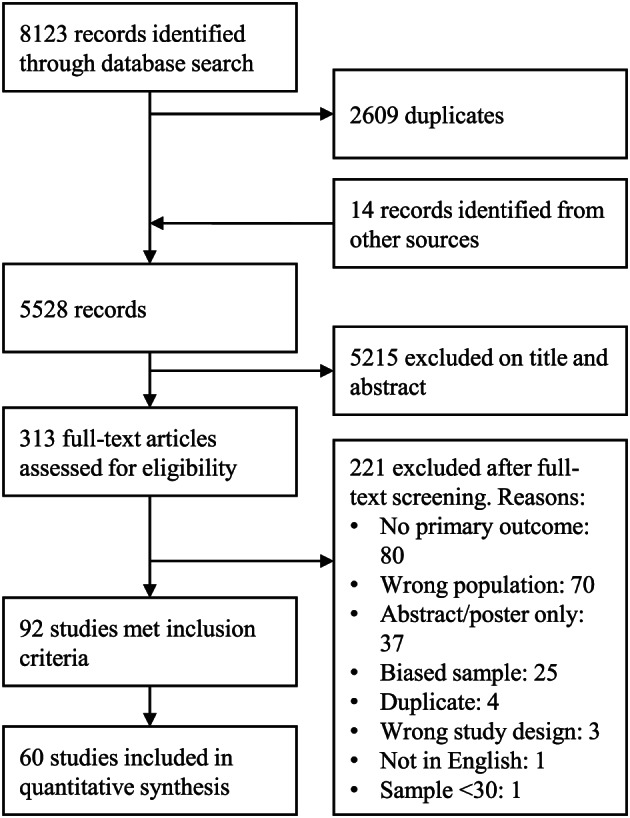
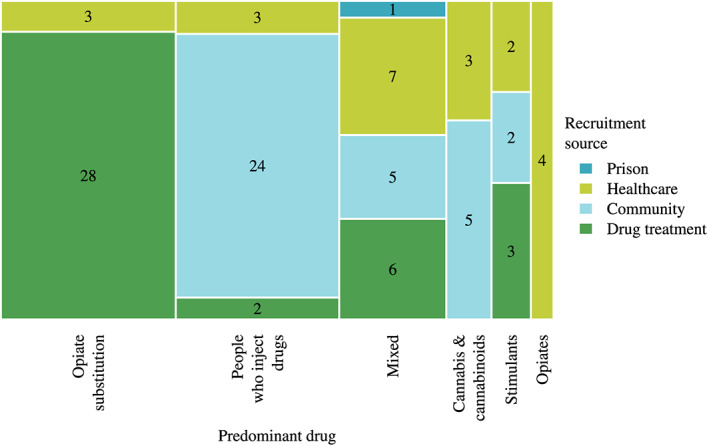
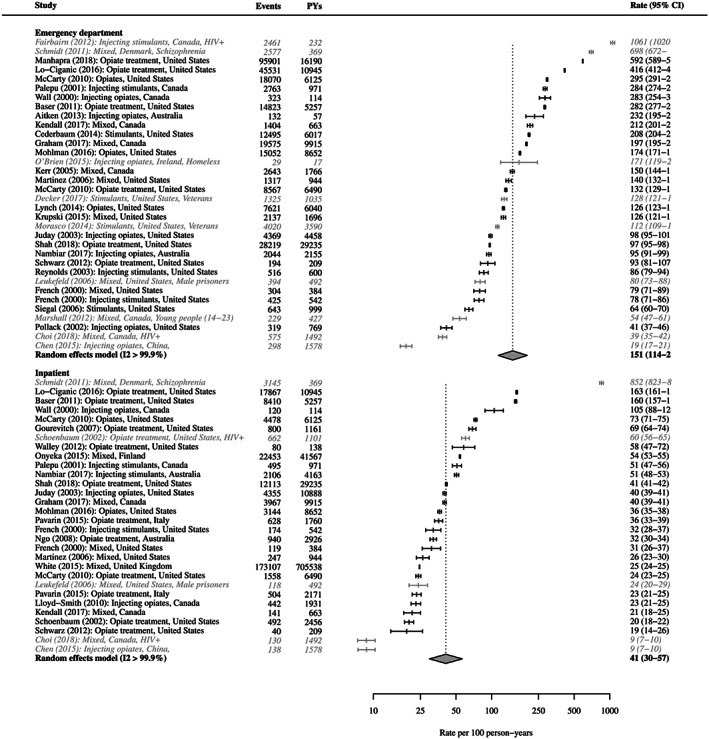
Aims: To summarize evidence on the frequency and predictors of health‐care utilization among people who use illicit drugs. Design: Systematic search of MEDLINE, EMBASE and PsychINFO for observational studies reporting health‐care utilization published between 1 January 2000 and 3 December 2018. We conducted narrative synthesis and meta‐analysis following a registered protocol (identifier: CRD42017076525). Setting and participants: People who use heroin, powder cocaine, crack cocaine, methamphetamine, amphetamine, ecstasy/3,4‐methylenedioxymethamphetamine (MDMA), cannabis, hallucinogens or novel psychoactive substances; have a diagnosis of ‘substance use disorder’; or use drug treatment services. Measurements: Primary outcomes were the cumulative incidence (risk) and rate of care episodes in three settings: primary care, hospital admissions (in‐patient) and emergency department (ED). Findings: Ninety‐two studies were included, 84% from North America and Australia. Most studies focused on people using heroin, methamphetamine or crack cocaine, or who had a diagnosis of drug dependence. We were able to conduct a meta‐analysis of rates across 25 studies reporting ED episodes and 25 reporting hospital admissions, finding pooled rates of 151 [95% confidence interval (CI) = 114–201] and 41 (95% CI = 30–57) per 100 person‐years, respectively; on average 4.8 and 7.1 times more often than the general population. Heterogeneity was very high and was not explained by drugs used, country of study, recruitment setting or demographic characteristics. Predictors of health‐care utilization were consistent across studies and included unstable housing, drug injection and mental health problems. Opioid substitution therapy was consistently associated with reduced ED presentation and hospital admission. There was minimal research on health‐care utilization by people using ecstasy/MDMA, powder cocaine, hallucinogens or novel psychoactive substances. Conclusions: People who use illicit drugs are admitted to emergency department or hospital several times more often than the general population.
Overview
The claims and statistics of this paper haven’t been checked yet.
Run the check — free, no account needed. It reads the open-access text and checks the sources it cites.
Integrity signals
Registry
Cites
Statistics
Figures
Verification
Claims the paper makes
The claims and statistics of this paper haven’t been checked yet.
Run the check — free, no account needed. It reads the open-access text and checks the sources it cites.
Claims other papers make about this one
Each is checked against this paper’s own text: does it say what the citing paper says it does?
In the citing paper
“Injection drug use–associated bacterial and fungal infections (e.g., skin and soft-tissue infections, endocarditis, osteomyelitis, septic arthritis, and epidural abscess) are associated with significant morbidity and mortality among people who inject drugs (PWID) and are costly for healthcare systems [1–6].”
Self-check
Percentages, sums and reported differences re-computed from the paper’s own numbers.
The self-check needs the paper’s full text.
Citations
Cites
Rayyan-a web and mobile app for systematic reviews.
Ouzzani, M., Hammady, H., Fedorowicz, Z., & Elmagarmid, A. (2016) · Systematic Reviews · doi:10.1186/s13643-016-0384-4 · Cited by 26,092
Dixon-Woods, M., Cavers, D., Agarwal, S., Annandale, E., Arthur, A., Harvey, J., Hsu, R., Katbamna, S., Olsen, R., Smith, L., et al. (2006) · BMC Medical Research Methodology · doi:10.1186/1471-2288-6-35 · Cited by 2,289
Sordo, L., Barrio, G., Bravo, M. J., Indave, B. I., Degenhardt, L., Wiessing, L., Ferri, M., & Pastor-Barriuso, R. (2017) · BMJ · doi:10.1136/bmj.j1550 · Cited by 1,816 · cited 1×
“Despite a body of research into the effectiveness of opiate substitutes to reduce use of street heroin [95], community-distributed naloxone to prevent overdose deaths [96], strategies to reduce transmission of hepatitis C and improve access to hepatitis C treatment [97] and some strategies to improve treatment of soft…”
van Boekel, L. C., Brouwers, E. P. M., van Weeghel, J., & Garretsen, H. F. L. (2013) · Drug and Alcohol Dependence · doi:10.1016/j.drugalcdep.2013.02.018 · Cited by 1,810
Aldridge, R. W., Story, A., Hwang, S. W., Nordentoft, M., Luchenski, S. A., Hartwell, G., Tweed, E. J., Lewer, D., Vittal Katikireddi, S., & Hayward, A. C. (2018) · The Lancet · doi:10.1016/s0140-6736(17)31869-x · Cited by 905 · cited 1×
“People who are dependent on illicit drugs generally have poor health outcomes, with cohort studies finding mortality rates of up to 15 times the general population, although this varies widely by population and setting [1,2].”
Self-citationMortality among people who inject drugs: a systematic review and meta-analysis
Mathers, B. M., Degenhardt, L., Bucello, C., Lemon, J., Wiessing, L., & Hickman, M. (2013) · Bulletin of the World Health Organization · doi:10.2471/blt.12.108282 · Cited by 476
Self-citationHagan, H., Pouget, E. R., & Des Jarlais, D. C. (2011) · Journal of Infectious Diseases · doi:10.1093/infdis/jir196 · Cited by 313
High rates of primary care and emergency department use among injection drug users in Vancouver
Kerr, T., Wood, E., Grafstein, E., Ishida, T., Shannon, K., Lai, C., Montaner, J., & Tyndall, M. W. (2005) · Journal of Public Health · doi:10.1093/pubmed/fdh189 · Cited by 201 · cited 9×
“To provide informal comparisons with the general population, we used published frequencies of health-care utilization in the United States, Canada, Australia and the United Kingdom [21 – 23] for the general population group with the most similar age and sex pro fi le as the study population.”
InfluentialThe impact of substance use disorders on the course of schizophrenia—A 15-year follow-up study
Schmidt, L. M., Hesse, M., & Lykke, J. (2011) · Schizophrenia Research · doi:10.1016/j.schres.2011.04.011 · Cited by 171
Lloyd-Smith, E., Wood, E., Zhang, R., Tyndall, M. W., Montaner, J. S., & Kerr, T. (2008) · BMC Public Health · doi:10.1186/1471-2458-8-405 · Cited by 123 · cited 9×
“To provide informal comparisons with the general population, we used published frequencies of health-care utilization in the United States, Canada, Australia and the United Kingdom [21 – 23] for the general population group with the most similar age and sex pro fi le as the study population.”
InfluentialLubman, D. I., Garfield, J. B. B., Manning, V., Berends, L., Best, D., Mugavin, J. M., Lam, T., Buykx, P., Larner, A., Lloyd, B., et al. (2016) · BMC Psychiatry · doi:10.1186/s12888-016-0956-9 · Cited by 57
Research works printed but not linked: 87
- 10.1016/j.drugalcdep.2019.06.027 · DOI
- 10.1111/add.12337 · DOI · Paper page
- 10.1111/j.1360-0443.2010.03140.x · DOI · Paper page
- 10.1017/S147474641100025X · DOI
- 10.3310/hta13060 · DOI
- 10.1056/NEJMra1402309 · DOI · Paper page
- 10.1111/j.1365-2524.2007.00739.x · DOI
- 10.1016/j.drugalcdep.2018.06.010 · DOI
- 10.1016/j.drugalcdep.2014.01.025 · DOI
- 10.1016/j.annemergmed.2014.05.012 · DOI
- 10.1136/emj.2004.022665 · DOI
- 10.1136/emermed-2015-205554 · DOI
- 10.1067/mem.2003.68 · DOI
- 10.1097/MEJ.0b013e328335623d · DOI
- 10.1136/bmj.g7647 · DOI · Paper page
- 10.18637/jss.v036.i03. · DOI · Paper page
- 10.1016/j.addbeh.2013.06.023 · DOI
- 10.1016/j.jemermed.2011.05.020 · DOI
- 10.3111/13696998.2014.925463 · DOI
- 10.1176/appi.ps.201300474 · DOI
- 10.1016/j.drugalcdep.2017.04.017 · DOI
- 10.1186/s12954-017-0143-4 · DOI · Paper page
- 10.1080/08897077.2017.1356789 · DOI
- 10.1016/j.addbeh.2015.01.042 · DOI
- 10.1080/00952990.2017.1318891 · DOI
- 10.1016/j.drugpo.2016.01.017 · DOI
- 10.1086/377558 · DOI
- 10.1177/0706743716664884 · DOI
- 10.1016/j.jsat.2014.12.009 · DOI
- Pavarin R. M., 2015, Health status of users of the Bologna local health authority drug addiction treatment services: a study of hospital admissions in the period 2004–2013, Infez Med, 23, 5
- 10.1016/j.schres.2014.01.014 · DOI
- 10.1016/j.ejim.2016.07.023 · DOI
- 10.1186/1471-2458-8-43 · DOI
- 10.1080/00952990.2017.1339056 · DOI
- 10.1186/1471-2296-10-25 · DOI
- 10.1081/ADA-120006738 · DOI
- 10.1111/jvh.12393 · DOI
- 10.1046/j.1360-0443.2003.00430.x · DOI
- 10.1097/ADT.0000000000000069 · DOI
- 10.1186/1477-7517-10-11 · DOI
- 10.1111/dar.12266 · DOI
- 10.1016/j.drugalcdep.2010.04.018 · DOI
- 10.1016/j.puhe.2011.09.011 · DOI
- 10.1080/08897070309511531 · DOI
- Palepu A., 2001, Hospital utilization and costs in a cohort of injection drug users, Can Med Assoc J, 165, 415
- 10.1016/S0376-8716(02)00344-7 · DOI
- 10.1001/archpsyc.65.3.337 · DOI
- 10.1300/J069v22n02_01 · DOI
- 10.1186/1747-597X-9-16 · DOI
- 10.1016/j.drugpo.2017.03.010 · DOI
- 10.1016/S0376-8716(00)00228-3 · DOI
- 10.1080/00952990500328737 · DOI
- 10.1111/dar.12257 · DOI
- 10.1016/j.drugalcdep.2012.08.013 · DOI
- 10.1186/1471-2296-10-42 · DOI
- 10.1186/s12955-017-0633-9 · DOI
- Shoenbaum E. E., 2002, Predictors of hospitalization for HIV‐positive women and men drug users, 1996–2000, Public Health Rep, 117, S60
- 10.1300/J069v27n02_05 · DOI
- 10.3109/16066359.2012.690052 · DOI
- 10.1001/jama.285.18.2355 · DOI
- 10.1097/00126334-200311010-00012 · DOI
- 10.1186/1472-6963-14-308 · DOI
- Baser O., 2011, Cost and utilization outcomes of opioid‐dependence treatments, Am J Manag Care, 17, S235
- 10.1111/add.13270 · DOI
- 10.1016/j.jsat.2012.03.008 · DOI
- 10.1186/1940-0640-9-16 · DOI
- 10.1016/j.jsat.2016.05.002 · DOI
- 10.1016/j.jsat.2017.12.003 · DOI
- 10.1177/1060028017751913 · DOI
- 10.1097/ADM.0b013e3182584772 · DOI
- 10.1136/bmjopen-2016-014854 · DOI
- 10.1136/emermed-2012-201170 · DOI
- 10.1192/bjp.bp.107.045732 · DOI
- 10.1176/appi.ajp.159.9.1584 · DOI
- 10.1111/j.1475-6773.2004.00244.x · DOI
- 10.1017/S0950268810000324 · DOI · Paper page
- 10.1080/13696998.2018.1427101 · DOI
- 10.1016/j.jsat.2006.07.008 · DOI
- 10.1176/appi.ps.201700363 · DOI
- 10.1186/1477-7517-10-7 · DOI
- 10.1097/ADM.0000000000000034 · DOI
- 10.1001/archsurg.137.11.1217 · DOI · Paper page
- 10.1080/02673037.2015.1080816 · DOI · Paper page
- Hesse M., 2007, Case management for persons with substance use disorders, Cochrane Database Syst Rev, 4
- 10.1136/emj.2009.088344 · DOI
- 10.1186/s12913-018-3756-8 · DOI
- 10.1016/j.drugpo.2017.05.051 · DOI
Cited by
Sorted by citations
Brothers, T. D., Lewer, D., Jones, N., Colledge-Frisby, S., Farrell, M., Hickman, M., Webster, D., Hayward, A., & Degenhardt, L. (2022) · PLOS Medicine · doi:10.1371/journal.pmed.1004049 · Cited by 25
Self-citation
Metadata
- Authors
- Lewer, D., Freer, J., King, E., Larney, S., Degenhardt, L., Tweed, E. J., Hope, V. D., Harris, M., Millar, T., Hayward, A., Ciccarone, D., & Morley, K. I.
- Affiliations
- UCL Collaborative Centre for Inclusion Health Institute of Epidemiology and Health Care UCL London UK
- Centre for Primary Care and Public Health Queen Mary University of London London UK
- National Drug and Alcohol Research Centre (NDARC) University of New South Wales Randwick, NSW Australia
- MRC/CSO Social and Public Health Sciences Unit University of Glasgow Glasgow UK
- Public Health Institute Liverpool John Moores University Liverpool UK
- Department of Public Health, Environments and Society London School of Hygiene and Tropical Medicine , London UK
- Centre for Mental Health and Safety The University of Manchester Manchester UK
- Department of Family and Community Medicine University of California San Francisco CA USA
- National Addictions Centre, Institute of Psychiatry, Psychology and Neuroscience, King's College London London UK
- ORCID
- Venue
- Addiction
- Publisher
- Wiley
- Published
- 2020-02-10
- Volume
- 115
- Issue
- 6
- Pages
- 1011-1023
- ISSN
- 0965-2140
- 1360-0443
- PMC
- PMC7210080
- Cited by
- 161
- References
- 11
- Language
- en
- Funders
- Chief Scientist Office (CAF/17/11, SPHSU13, SPHSU15)
- Department of Health, Australian Government
- Medical Research Council (MC_UU_12017/13, MC_UU_12017/15)
- National Health and Medical Research Council (GNT1041742, GNT1091878, GNT1135991, GNT1140938)
- National Institute for Health Research (CDF‐2016‐09‐014, DRF‐2018‐11‐ST2‐016)
- National Institute on Drug Abuse (DA037820, R01DA1104470)
- Wellcome Trust (109823/Z/15/Z)
About these checks
Registry, retraction, Cites and statistics results are computed, not judged, with one exception: a printed reference that no index lists is read once by a model before it counts as a citation error. Claims are extracted by a model and kept only when their quote appears verbatim in the text; each cited source is then checked, with a model’s help, for whether it says what the claim relies on. Those verdicts can be wrong — read the claim’s quote and the cited source before relying on one.
Statistics and arithmetic are recomputed, not judged.
Confidence bands are shown only for fields calibrated on our annotated test set. None is calibrated yet, so no band is shown.
What counts as a claim ›How we measure confidence ›How we check this ›
Are you an author, or do you see a problem with this page? Request a review
